What’s in this guide
- What Is Total Alkalinity and Why Does It Matter?
- Step-by-Step: Raising Hot Tub Alkalinity
- Baking Soda Dosage Chart for Every Hot Tub Size
- Balancing pH and Alkalinity: What to Do When Both Are Off
- Natural Methods to Raise Hot Tub Alkalinity
- Raising Alkalinity in a Pool vs. a Hot Tub
- Safety Precautions and Common Mistakes
- Frequently Asked Questions
- Conclusion
Home ›Hot Tub Water Management
“Well after having my 9th water test this month on my 1.5 month old hot tub, I’m ready to flip out. I’ve followed their recommended treating plan that prints out after the test, to try and get the pH and alkalinity in line, but nothing is working.”
If that sounds familiar, you are not doing anything wrong — you are just fixing things in the wrong order. Low alkalinity is the hidden cause behind most hot tub chemistry chaos, and no amount of pH adjustment will hold until you address it first.
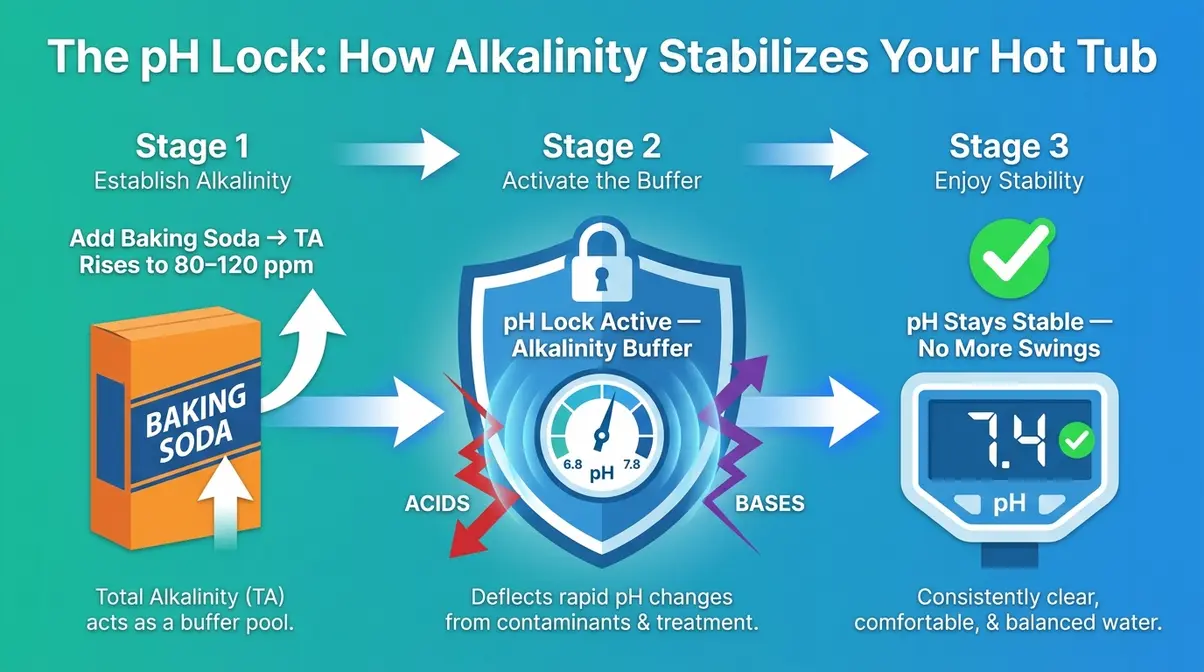
When alkalinity is off, your pH has no anchor. You add pH increaser, it shoots up. You add pH decreaser, it crashes back down. You are not solving the problem — you are experiencing the pH Lock failing. The pH Lock is the mechanism by which alkalinity buffers (stabilizes) your pH, absorbing chemical shocks so your readings stay in a steady, safe range. Fix the alkalinity, and the pH Lock clicks back into place.
By the end of this guide, you will know exactly how to raise alkalinity in hot tub systems — with the right chemical, the right amount, and in the right order — so your water stays balanced for weeks, not hours. We cover everything from diagnosing the problem to a precise dosage chart for every common tub size, plus the fixes for every scenario you might face.
Knowing how to raise alkalinity in hot tub systems is the single most important skill for keeping your water balanced. Fix alkalinity first — everything else follows.
- Use baking soda (sodium bicarbonate): It is the safest, most affordable way to raise Total Alkalinity (TA) in any hot tub.
- Target 80–120 ppm: This is the ideal TA range recommended by water chemistry professionals for residential hot tubs.
- Always raise alkalinity before pH: This is the correct sequence — the pH Lock principle. Adjusting pH first wastes chemicals and creates frustrating swings.
- The pH Lock concept: Alkalinity acts as a chemical shock absorber. When it is in range, your pH naturally stabilizes without constant re-dosing.
What Is Total Alkalinity and Why Does It Matter?
Total Alkalinity (TA) — a measure of how much alkaline substance is dissolved in your water — is the most misunderstood number on a hot tub test strip. Hot tub owners consistently report focusing on pH while ignoring TA, and that single habit is the root cause of most ongoing water problems. At onehottub.com, our team has reviewed dozens of water chemistry frameworks across industry sources, and the pattern is consistent: get alkalinity right first, and pH follows. For a broader overview, check out our hot tub water maintenance guide.
What Total Alkalinity Actually Does in Your Water
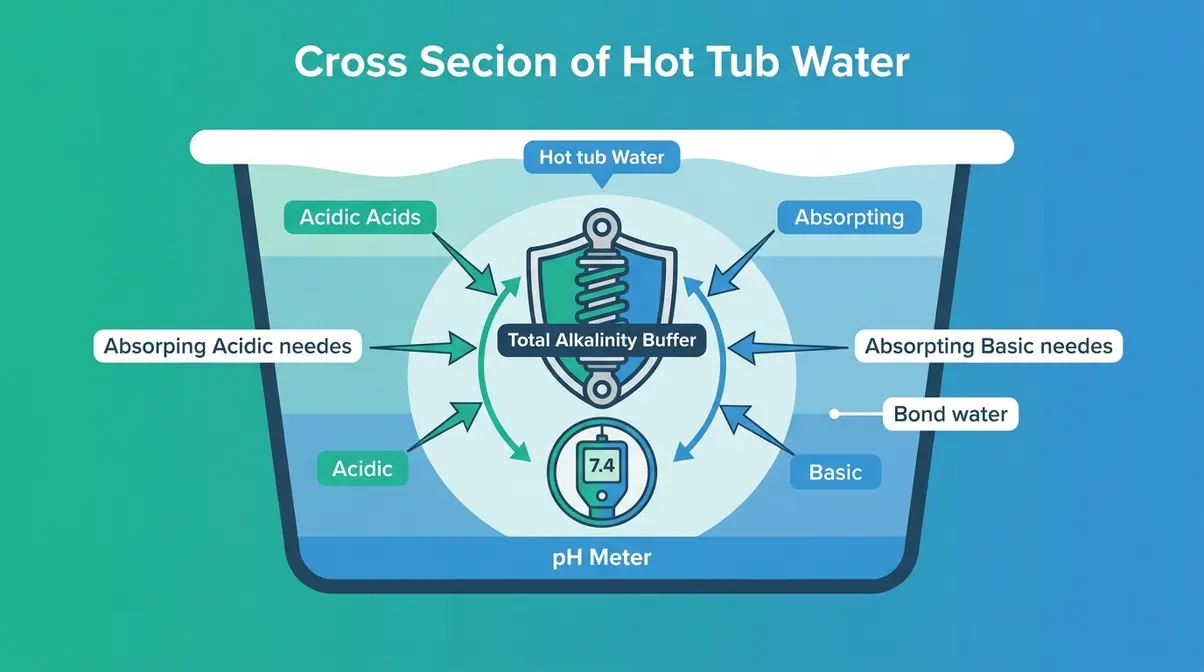
Think of Total Alkalinity as a shock absorber for your pH. Your hot tub water is constantly being pushed and pulled by heat, body oils, sweat, sanitizers, and the chemicals you add. Without a buffer in place, even a small addition of any chemical can swing your pH dramatically in either direction.
Sodium bicarbonate (baking soda) and other alkaline compounds in the water absorb those chemical shocks before they can move your pH reading. According to PubChem (NIH), sodium bicarbonate acts as an amphoteric buffer — meaning it can neutralize both acids and bases — which is precisely why it is the go-to chemical for raising alkalinity in residential hot tubs.
When your TA is in the correct range, your pH becomes remarkably stable. That is the pH Lock working as intended. When TA is too low, the pH Lock is broken, and you get the maddening cycle of pH swings that no amount of increaser or decreaser seems to fix permanently.
What Causes Low Alkalinity in a Hot Tub?
Many hot tub owners wonder why their alkalinity drops in the first place. The most common cause is the natural off-gassing of carbon dioxide as the hot tub water is heated and aerated by the jets. Additionally, adding acidic chemicals—like pH decreaser or certain sanitizers (such as bromine tablets or dichlor)—will steadily consume the alkaline buffers in the water. Heavy bather load also introduces sweat and body oils, which are naturally acidic and further deplete your Total Alkalinity over time.
Signs Your Hot Tub Has Low Alkalinity
Low alkalinity does not always announce itself with a flashing warning light. Instead, it shows up as a collection of frustrating symptoms that feel like separate problems. Water chemistry professionals recommend watching for these signs:
- Wild pH swings: Your pH is fine one day and out of range the next, despite adding chemicals correctly.
- Corrosion on metal parts: Low alkalinity creates acidic water that eats away at jets, heater elements, and fittings.
- Cloudy or irritating water: Skin and eye irritation without an obvious cause is a common low-alkalinity complaint.
- Sanitizer inefficiency: Chlorine and bromine work poorly outside their pH range, so low alkalinity indirectly causes your sanitizer to underperform.
- Etching on acrylic surfaces: The shell of your hot tub can develop a rough, dull texture when exposed to acidic water over time.
If your water test shows a TA reading below 80 ppm alongside any of these symptoms, low alkalinity is almost certainly the problem.
The Ideal Alkalinity Range for Hot Tubs
The target Total Alkalinity range for a residential hot tub is 80–120 ppm (parts per million). This range is recommended by Penn State Extension’s water quality program and is consistent with industry guidance from Frog Products’ Hot Tub School. Some manufacturers recommend a slightly tighter window of 100–120 ppm for newer acrylic shells.
| TA Reading | Status | Action Needed |
|---|---|---|
| Below 80 ppm | Too Low | Add baking soda or alkalinity increaser |
| 80–120 ppm | Ideal | No action needed |
| 121–180 ppm | High | Add pH decreaser (sodium bisulfate) or use aeration |
| Above 180 ppm | Very High | Partial drain and refill recommended |
A reading below 80 ppm means the pH Lock is weakened. A reading above 120 ppm can cause the opposite problem — your pH becomes stubbornly high and difficult to lower.
Step-by-Step: Raising Hot Tub Alkalinity
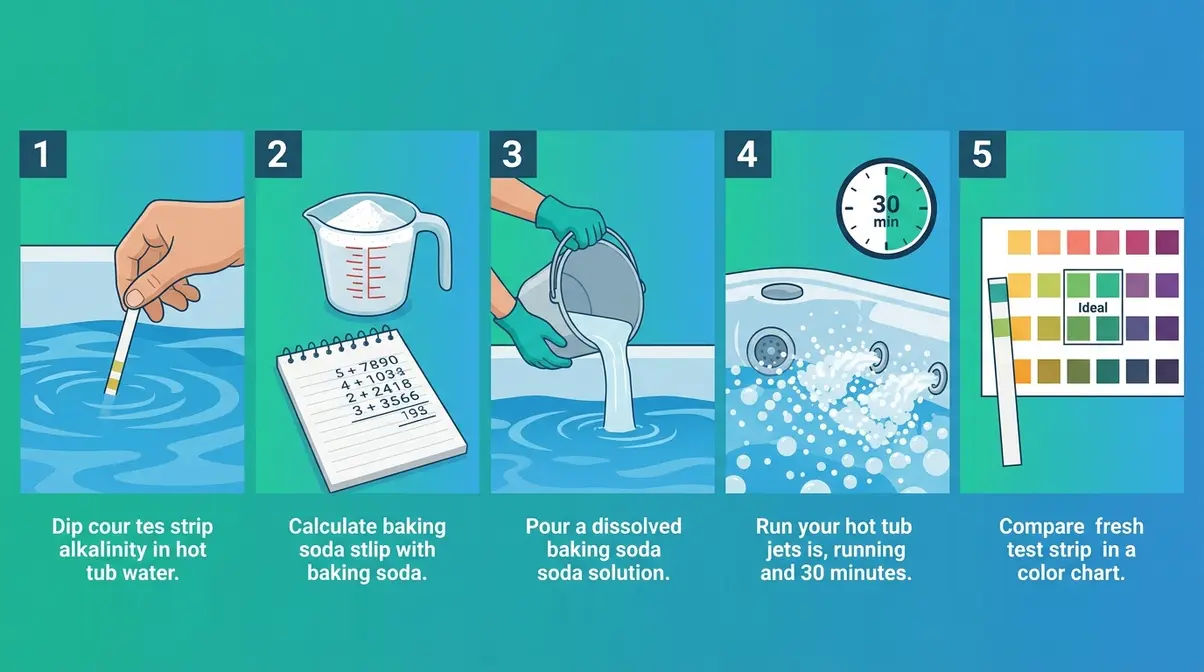
This is the core process for how to raise alkalinity in hot tub environments safely and effectively. Follow these five steps in order. Skipping steps — especially testing before and after — is the number one reason hot tub owners end up with overcorrected water. Swim University’s hot tub chemistry guide and our own dosage review confirm this sequence as the reliable industry standard.
Before You Start: What You’ll Need
Gather these items before you begin:
- Accurate test strips or a liquid test kit (test strips must be fresh — check the expiration date)
- Baking soda (sodium bicarbonate) or a commercial alkalinity increaser
- A measuring cup or kitchen scale
- Chemical-resistant gloves and safety glasses
- A clean plastic bucket for pre-dissolving the chemical
Estimated time: 30–45 minutes active work, plus a 2-hour circulation period before retesting.
Step 1 — Test Your Water First
- Remove the hot tub cover and run the jets on low for 5 minutes to circulate the water evenly.
- Dip a fresh test strip into the water at elbow depth, holding it still for 15 seconds.
- Remove the strip and hold it flat — do not shake off the water.
- Compare the Total Alkalinity pad to the color chart after exactly 30 seconds.
- Record your current TA reading in ppm.
Why this matters: You need a baseline reading to calculate the correct dosage. Guessing the amount is the most common mistake that leads to overcorrection and weeks of trouble balancing. If your TA reads below 80 ppm, proceed to Step 2.
Step 2 — Calculate Your Dosage
The standard industry formula, verified across five sources including Aquatica USA’s alkalinity guide, is:
1.5 tablespoons (approximately 25 grams) of baking soda raises TA by roughly 10 ppm in a 300-gallon hot tub.
Use this formula to calculate your dose:
Dose (tbsp) = (Target ppm − Current ppm) ÷ 10 × 1.5 × (Your Tub Gallons ÷ 300)
- Example: Your 400-gallon tub reads 60 ppm. You want to reach 100 ppm. That is a 40 ppm increase.
- 40 ÷ 10 = 4 units
- 4 × 1.5 = 6 tablespoons for a 300-gallon tub
- 6 × (400 ÷ 300) = 8 tablespoons for your 400-gallon tub
Important: Do not add more than 3.5 oz (approximately 10 tablespoons) per treatment session. Add in increments, retest after each, and repeat if needed. This prevents overshooting.
Step 3 — Add the Chemical Safely
- Put on your chemical-resistant gloves and safety glasses before handling any chemical.
- Fill your clean plastic bucket with 1 gallon of hot water from the tub.
- Add your measured baking soda to the bucket and stir until fully dissolved. Pre-dissolving prevents undissolved powder from sinking and potentially etching the shell.
- Turn the jets on to medium circulation.
- Pour the dissolved solution slowly around the perimeter of the tub — not directly into the jets.
Safety note: According to WHO guidelines on chemical handling, always add chemicals to water (not water to chemicals) and keep your face away from any chemical dust or splash. Never mix chemicals in the same bucket.
Step 4 — Circulate and Wait
- Leave the jets running on medium for at least 20–30 minutes after adding the chemical.
- Keep the cover off during this time to allow off-gassing.
- Do not add any other chemicals during this waiting period.
- After 30 minutes of circulation, turn the jets off and let the water rest for at least 2 hours before retesting.
The 2-hour rest period is not optional. Retesting too soon gives you an inaccurate reading because the chemical has not fully distributed through the water. Hot tub owners consistently report false “still slightly low” readings when they retest after only 15–20 minutes.
Step 5 — Retest and Re-Balance Your pH
- After the 2-hour rest, run the jets on low for 5 minutes to recirculate.
- Test your TA again using a fresh strip or your liquid test kit.
- If TA is now in the 80–120 ppm range, test your pH next.
- If pH has shifted (this is expected — raising TA often nudges pH upward), adjust it now using pH increaser or pH decreaser as needed until pH reaches the CDC-recommended 7.2–7.8 range.
- If TA is still slightly low, repeat Steps 2–4 with a reduced dose.
Raising alkalinity frequently raises pH as a side effect. This is normal and manageable. The important thing is that once your TA is in range, your pH adjustment will actually hold — that is the pH Lock engaging.
Baking Soda Dosage Chart for Every Hot Tub Size
Getting the dosage right is the difference between fixing your water in one session and spending another week trouble balancing. Our team evaluated the dosage formulas from five industry sources and cross-referenced them against Masters Spa Parts’ alkalinity FAQ to produce the most precise chart available for residential hot tub sizes. For more details, see our article on using baking soda to adjust alkalinity.
Baking Soda vs. Commercial Alkalinity Increaser
Both products raise Total Alkalinity using the same active mechanism — sodium bicarbonate. The difference is concentration, convenience, and cost.
| Factor | Baking Soda | Commercial Alkalinity Increaser |
|---|---|---|
| Active ingredient | Sodium bicarbonate (100%) | Sodium bicarbonate (typically 100%) |
| Cost per dose | ~$0.10–$0.30 | ~$0.75–$2.00 |
| Availability | Any grocery store | Pool/spa supply stores or online |
| Accuracy | Requires measuring | Pre-measured packets available |
| Speed | Same | Same |
| Risk of overcorrection | Moderate (easy to add too much) | Lower (pre-measured packets help) |
Bottom line: Baking soda and commercial alkalinity increaser are functionally identical. Baking soda is the budget choice — and the one recommended by water chemistry professionals when precise measurement is used. Commercial increaser is worth the premium if you want the convenience of pre-measured doses.
Dosage Chart: How Much Baking Soda Per Tub Size
The table below shows how much baking soda (sodium bicarbonate) to add to raise your TA by 10 ppm, 20 ppm, and 40 ppm for the most common residential hot tub sizes. These figures are based on dosage formulas verified against industry standards.
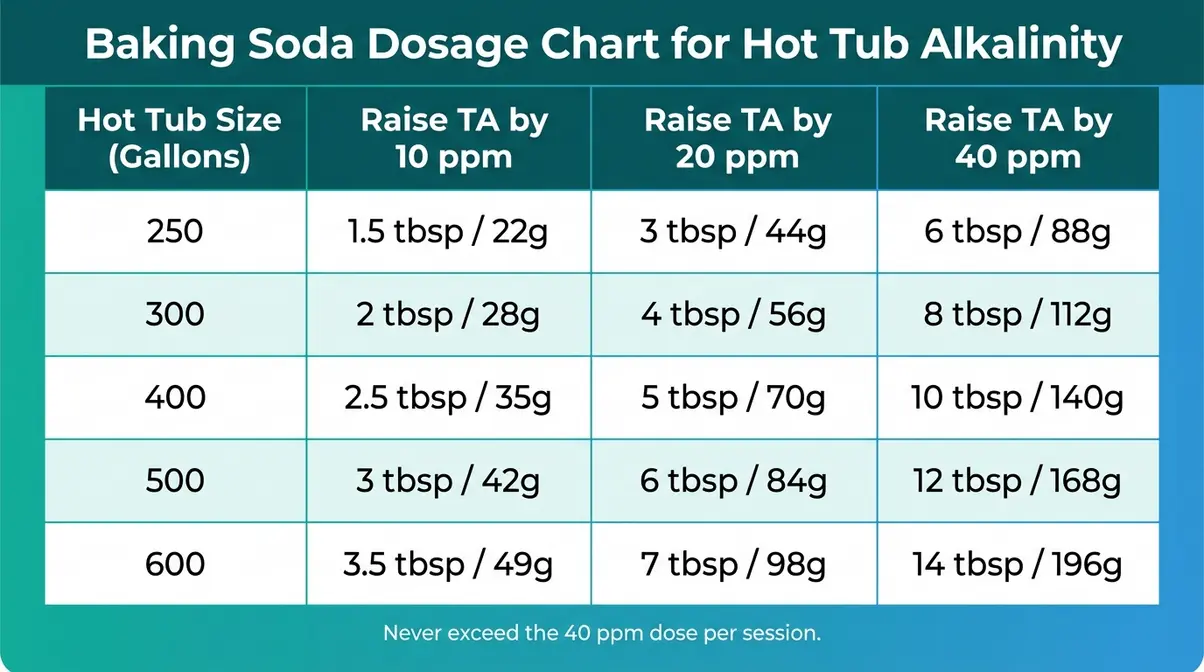
| Tub Size (Gallons) | Raise TA by 10 ppm | Raise TA by 20 ppm | Raise TA by 40 ppm |
|---|---|---|---|
| 250 gallons | 1.25 tbsp (18g) | 2.5 tbsp (36g) | 5 tbsp (72g) |
| 300 gallons | 1.5 tbsp (22g) | 3 tbsp (43g) | 6 tbsp (86g) |
| 400 gallons | 2 tbsp (29g) | 4 tbsp (57g) | 8 tbsp (114g) |
| 500 gallons | 2.5 tbsp (36g) | 5 tbsp (72g) | 10 tbsp (143g) |
| 600 gallons | 3 tbsp (43g) | 6 tbsp (86g) | 12 tbsp (172g) |
Important: Never add more than the “Raise TA by 40 ppm” dose in a single session. If you need to raise TA by more than 40 ppm, split the treatment across two sessions separated by at least 2 hours of circulation and retesting.
How to Add Baking Soda to Your Hot Tub
- Measure your dose using a kitchen scale for accuracy (tablespoon measurements are approximate).
- Pre-dissolve the baking soda in a bucket of warm tub water — never add dry powder directly to the tub.
- With jets running on medium, pour the dissolved solution slowly around the perimeter.
- Do not add baking soda near the skimmer or directly in front of a jet — this causes uneven distribution.
- Run the jets for 20–30 minutes, then wait 2 hours before retesting.
Balancing pH and Alkalinity: What to Do When Both Are Off
This is the section that most guides skip entirely — and it is where the real frustration lives. When both your pH and alkalinity are out of range, the order in which you fix them matters enormously. According to Washington State Department of Health water quality guidance, adjusting pH before correcting alkalinity is a common and costly mistake that creates the cycling problem so many hot tub owners experience. For comprehensive strategies, see our best practices for managing hot tub pH levels and our step-by-step guide to controlling hot tub pH.
Should I Raise Alkalinity or pH First?
Always raise alkalinity first. This is not a matter of preference — it is chemistry. According to Chemistry LibreTexts/Acids_and_Bases/Buffers/Introduction_to_Buffers), alkalinity acts as a buffer that controls how stable your pH is. If you adjust pH while alkalinity is low, you are pouring water into a leaky bucket. The pH will move, but it will not stay.
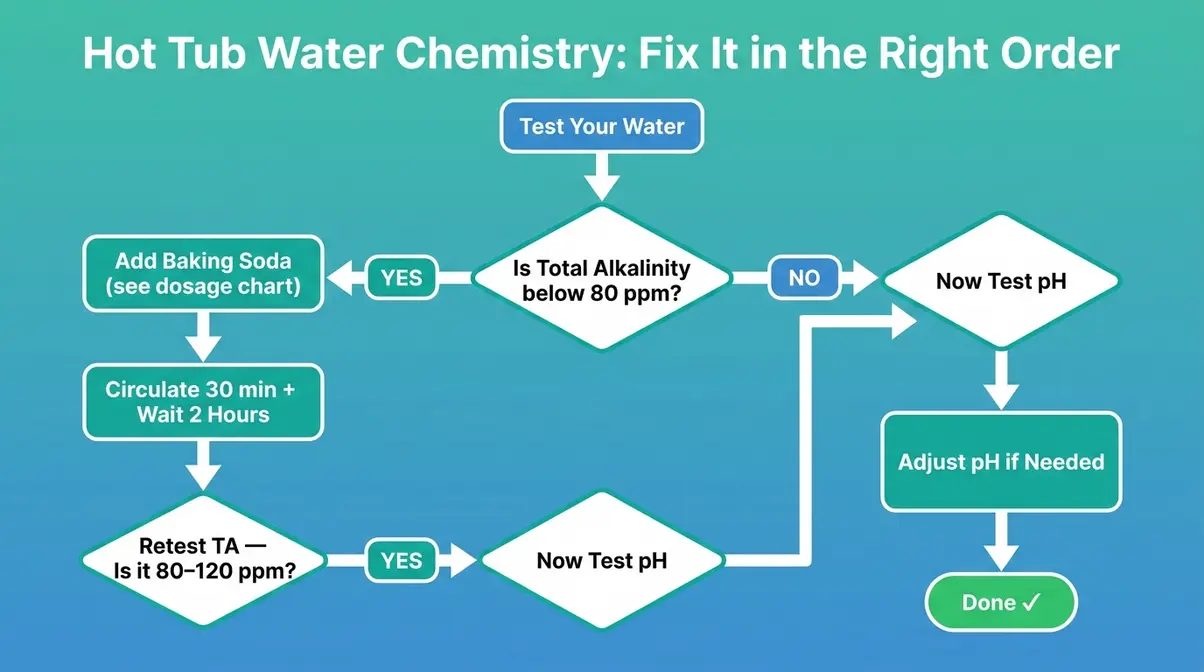
- The correct sequence is:
- Test both TA and pH.
- If TA is below 80 ppm, raise it first using baking soda (Steps 1–4 above).
- Retest TA. Once it is in the 80–120 ppm range, test pH.
- Adjust pH only after TA is stable.
This sequence is the core principle behind the pH Lock — fix the buffer first, then fine-tune the reading it controls.
When Both Are Low: Raising pH and Alkalinity Together
If both your TA and pH are below their target ranges, baking soda will help both simultaneously — but with a caveat. Baking soda raises TA reliably and raises pH as a secondary effect. However, it raises pH more slowly and less predictably than a dedicated pH increaser (sodium carbonate, or soda ash).
The recommended approach when both are low:
- Add baking soda at the dosage for your TA deficit (see chart above).
- Wait 2 hours and retest both TA and pH.
- If TA is now in range but pH is still low, add a small dose of pH increaser (sodium carbonate) separately.
- Do not add both chemicals at the same time — this makes it impossible to identify which one caused any reading change.
This staged approach gives you control and avoids the overcorrection spiral that comes from adding multiple chemicals simultaneously.
When Alkalinity Is High but pH Is Low: Use Aeration
This is the trickiest scenario: your TA is already at or above 120 ppm, but your pH is still too low. Adding more baking soda will push TA even higher, making it harder to manage. The solution is aeration — running your jets and air blowers on high with the cover off.
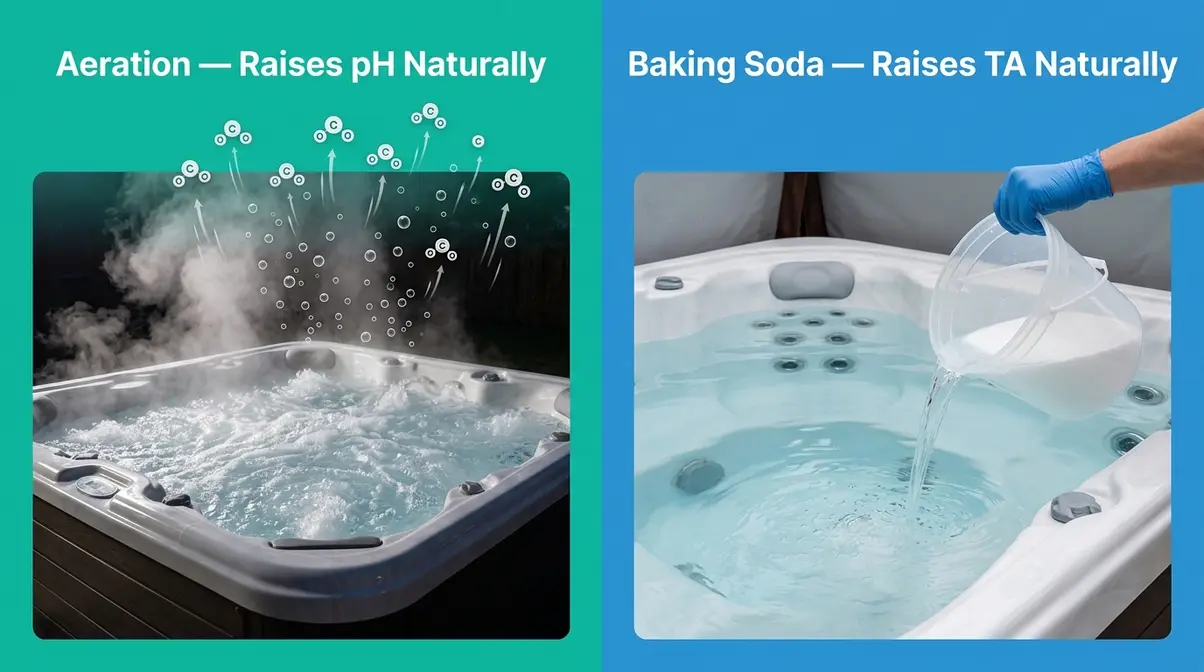
Aeration causes CO₂ to off-gas from the water, which raises pH without adding any chemicals and without affecting TA. It is slower than chemical adjustment (typically 12–24 hours of periodic aeration), but it is the correct tool when TA is already high. Run your jets on high for 30–60 minutes, two to three times per day, until pH reaches the 7.4–7.6 target range.
Natural Methods to Raise Hot Tub Alkalinity
“Natural” is a word that gets used loosely in hot tub chemistry. The honest answer is that there is no truly chemical-free way to raise Total Alkalinity — alkalinity is, by definition, a chemical property. However, there are two approaches that hot tub owners consider “natural” because they use either a common household product or no added chemicals at all.
Aeration — Raise pH Without Adding Chemicals
Aeration is the only method to raise pH in a hot tub without adding any chemicals. By running your jets and air injectors on high with the cover removed, you accelerate CO₂ off-gassing. As dissolved CO₂ leaves the water, the carbonic acid it forms dissipates, and pH rises naturally.
- What aeration does and does not do:
- ✅ Raises pH gradually and safely
- ✅ Does not raise Total Alkalinity (useful when TA is already high)
- ❌ Cannot raise Total Alkalinity — only chemicals can do that
- ❌ Slow process (12–24 hours for significant pH change)
For the keyword “how to raise pH in a hot tub naturally,” aeration is the correct answer. For raising TA naturally, the answer is baking soda.
Baking Soda as Your ‘Natural’ Alkalinity Fix
Baking soda (sodium bicarbonate) is the most “natural” way to raise Total Alkalinity in a hot tub. It is a naturally occurring mineral compound, it is food-grade, and it has been used in pools and spas for decades. Water chemistry professionals consistently recommend it as the first-line treatment for low alkalinity precisely because it is gentle, predictable, and difficult to overdose dramatically.
When hot tub owners search for how to raise alkalinity in hot tub naturally, baking soda is the correct and only reliable answer. Commercial alkalinity increaser products contain the same active ingredient — sodium bicarbonate — so the “natural” distinction between them is largely marketing. The difference is price and convenience, not chemistry. For further reading, see our detailed guide on baking soda for alkalinity.
Raising Alkalinity in a Pool vs. a Hot Tub
The process for raising alkalinity is the same in both pools and hot tubs — add sodium bicarbonate, circulate, retest. But the dosage calculation is completely different, and confusing the two is a surprisingly common and frustrating mistake.
The Critical Dosage Difference: Volume Matters
Hot tubs hold 250–600 gallons. Residential swimming pools typically hold 10,000–20,000 gallons. That is a 30–80x difference in water volume, which means pool dosage charts are dangerously oversized for hot tubs.
Never use a pool dosage chart for your hot tub. A dose calculated for a 10,000-gallon pool would raise TA by approximately 1,000 ppm in a 300-gallon hot tub — an extreme overcorrection that would require a complete drain and refill to fix. This is one of the most common mistakes that keeps alkalinity problems cycling.
Hot tub owners who have recently owned or researched pools are especially prone to this error. The chemistry is identical; the scale is not.
Why You Should Avoid Pool Chemicals in a Hot Tub
Beyond the dosage math, the physical composition of pool chemicals makes them unsuitable for spas. Commercial pool alkalinity increasers are formulated to dissolve in massive bodies of water, often containing binders or anti-caking agents that can cloud a small hot tub. Additionally, the high heat of a hot tub (typically 100–104°F) accelerates chemical reactions. Adding a highly concentrated pool chemical to hot water can cause rapid precipitation, leading to severe scaling on your heater element and acrylic shell. Always use products specifically labeled for hot tubs, or stick to pure, food-grade baking soda to ensure you are not introducing unwanted fillers into your spa’s delicate ecosystem. Using the right product prevents the dreaded “pH lock-out” where your water chemistry becomes completely unresponsive to further adjustments.
Pool-Specific Dosage Formula for Sodium Bicarbonate
For those who manage both a pool and a hot tub, here is the standard pool formula for reference:
Pool formula: 1.5 lbs of baking soda raises TA by approximately 10 ppm in a 10,000-gallon pool.
| Pool Size (Gallons) | Raise TA by 10 ppm | Raise TA by 20 ppm |
|---|---|---|
| 10,000 gallons | 1.5 lbs (680g) | 3 lbs (1,360g) |
| 15,000 gallons | 2.25 lbs (1,020g) | 4.5 lbs (2,040g) |
| 20,000 gallons | 3 lbs (1,360g) | 6 lbs (2,720g) |
The contrast with the hot tub chart (tablespoons vs. pounds) makes the scale difference immediately visible. Bookmark the correct chart for each body of water and never mix them up.
Safety Precautions and Common Mistakes
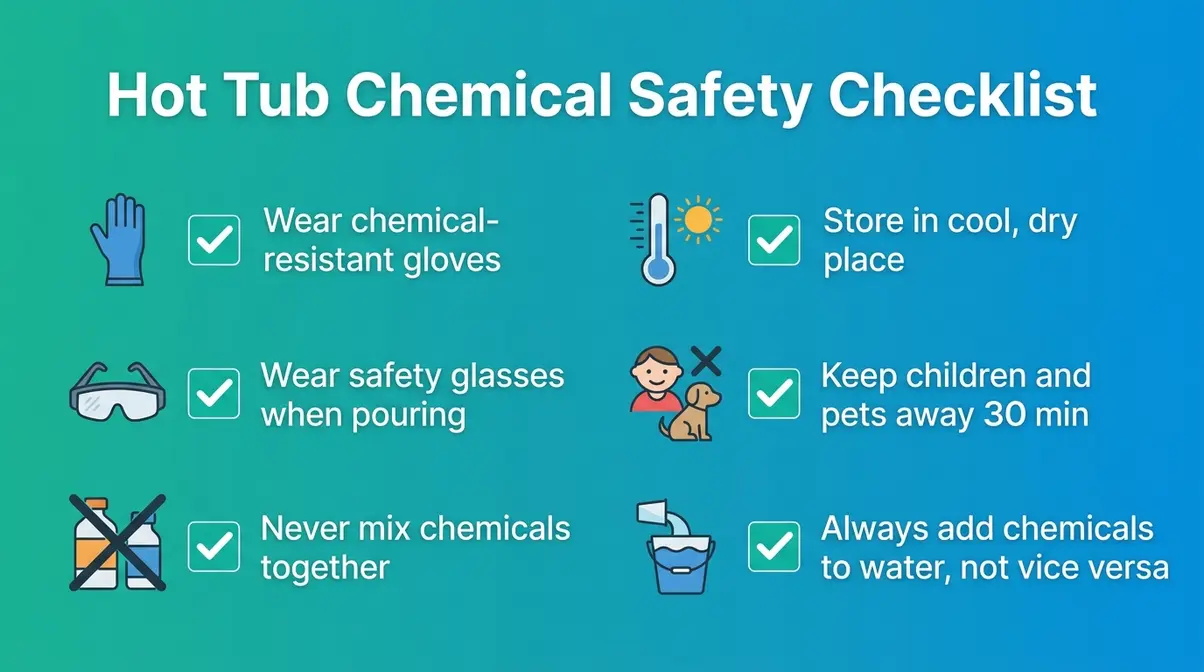
Sodium bicarbonate is one of the safest chemicals used in water treatment — it is literally baking soda. But “safe” does not mean “handle carelessly.” Water chemistry professionals and WHO chemical safety guidelines both emphasize that even low-risk chemicals require basic precautions, particularly when used in concentrated powder form. According to research published in PubMed Central (NIH), maintaining proper chemical balance is critical to preventing pathogen growth, but it must be done safely.
Chemical Safety Tips Before You Begin
Follow these safety practices every time you handle any hot tub chemical, including baking soda:
- Wear chemical-resistant gloves every time you measure and pour chemicals — even baking soda can irritate skin with repeated contact.
- Wear safety glasses or goggles when pouring powder — fine particles can become airborne and cause eye irritation.
- Never mix chemicals together before adding them to the tub. Add each chemical separately with at least 20 minutes between additions.
- Store chemicals in a cool, dry place away from direct sunlight and away from each other. Sodium bicarbonate stored near acidic chemicals (like pH decreaser) can react.
- Keep children and pets away from the tub while adding chemicals and for at least 30 minutes after.
- Always add chemicals to water, not water to chemicals — this prevents splashing and localized concentration.
Common Mistakes That Keep Alkalinity Low
Hot tub owners consistently report these errors when alkalinity will not stay in range:
1. Retesting too soon. Testing within 30 minutes of adding chemicals gives inaccurate readings. Wait the full 2 hours.
2. Using expired test strips. Test strips degrade after opening. An expired or humid-damaged strip can read 20–30 ppm lower than the actual TA. Replace strips every 3–4 months or when the color chart no longer matches a known reference.
3. Adding too much at once. Overcorrecting to 160+ ppm creates a new problem — high alkalinity makes your pH stubbornly elevated and resistant to adjustment. Use the dosage chart and add in increments.
4. Ignoring the source water. Fill water from some municipal supplies naturally has very low alkalinity. If your TA drops rapidly after every refill, your source water is the issue — test your tap water and pre-treat it before filling.
5. Fixing pH before alkalinity. This is the most common and most costly mistake. Without the pH Lock in place, pH adjustments are temporary at best. Always fix TA first.
Frequently Asked Questions
How do I fix low alkalinity in my hot tub?
Fix low alkalinity by adding baking soda (sodium bicarbonate) to your hot tub water. First, test your water to confirm your Total Alkalinity reading in ppm. Calculate your dose using the chart above — approximately 1.5 tablespoons per 300 gallons raises TA by 10 ppm. Pre-dissolve the baking soda in a bucket of tub water, add it with the jets running, then wait 2 hours before retesting. For a 40 ppm deficit in a 300-gallon tub, you would need approximately 6 tablespoons in a single session.
Should I raise my pH or alkalinity first?
Always raise alkalinity (TA) before adjusting pH. Alkalinity acts as a buffer that controls how stable your pH stays over time, meaning any pH adjustments made while TA is low simply will not hold.
Will baking soda raise pH and alkalinity?
Yes — baking soda raises both Total Alkalinity and pH, but TA more reliably than pH. Sodium bicarbonate is an alkaline compound that directly increases TA. It also raises pH as a secondary effect, though more slowly and less predictably than dedicated pH increaser (sodium carbonate). If your pH is severely low (below 7.0), you may still need a small dose of pH increaser after correcting TA. For most cases where both are mildly low, baking soda alone brings both readings toward their target ranges — though always retest before assuming the job is done.
How do I raise my pH and alkalinity at the same time?
Add baking soda to raise both readings, then fine-tune pH separately if needed. Baking soda addresses the root cause of low alkalinity while nudging pH upward simultaneously. If pH remains low after TA is corrected, add a small, measured dose of pH increaser separately.
Conclusion
For frustrated hot tub owners dealing with endless pH swings, the answer almost always starts with Total Alkalinity. Raising alkalinity in your hot tub — using baking soda at the correct dose for your tub size — is the step that makes every other chemical adjustment work. The pH Lock principle is not complicated: fix the buffer first, and the readings you actually want to control become stable and manageable.
The pH Lock is the insight that separates a hot tub owner who is constantly chasing their chemistry from one whose water stays balanced week after week. When alkalinity is in the 80–120 ppm range, your pH has the stability it needs to hold adjustments. Without it, you are fighting chemistry with chemistry and wondering why nothing is working.
Start today with a fresh water test and the dosage chart in this guide. If your TA is below 80 ppm, add baking soda in the correct amount for your tub size, wait 2 hours, and retest. Most hot tub owners who follow this sequence report their water balancing out within one or two treatment sessions — and staying balanced far longer than before.

Dave King
Hot tub tester and writer at One Hot Tub.