

Table of Contents - How to Clean a Hot Tub Without Draining It (5 Steps)
- What You’ll Need Before You Start
- The 5-Step No-Drain Cleaning Process
- How to Test and Balance Your Hot Tub Water
- DIY Cleaning Solutions — What Works (and What to Avoid)
- Hot Tub Hacks, Safety Rules, and Health Tips
- When You Still Need to Drain Your Hot Tub
- Frequently Asked Questions
- Can I clean a hot tub without draining it?
- Can I run vinegar through my hot tub?
- Why is there a 15-minute hot tub rule?
- Is a hot tub bad for folliculitis?
- Can I use Dawn soap to clean my hot tub?
- Why put tennis balls in a hot tub?
- What is the best homemade cleaner for hot tubs?
- How often should I clean my hot tub without draining it?
- Keeping Your Hot Tub Clean Starts With the Loop
This blog post may contain affiliate links. As an Amazon Associate I earn from qualifying purchases.
“I had just emptied my hot tub and refilled it thinking it would help the sliminess. It is still slimy though, probably should have sprayed it down lol. Any suggestions on how to clean without re emptying by any chance?”
— Hot tub owner on Reddit
If this sounds familiar, you’re not alone — and you definitely don’t need to drain it again. Knowing how to clean a hot tub without draining it is one of the most valuable skills any hot tub owner can develop, and most guides bury the answer under pages of chemistry jargon.
A grimy hot tub isn’t just unpleasant. If that sliminess is caused by biofilm (a sticky layer of bacteria) or hard scale, soaking in it can trigger skin irritation or hot tub rash. Worse, draining and refilling uses 300–500 gallons of water and still won’t fix the problem if you haven’t scrubbed the surfaces first. For a complete overview of hot tub cleanliness and maintenance, our full guide covers the bigger picture.
In this guide, you’ll learn exactly how to clean a hot tub without draining it — a simple 5-step process that removes grit, hard scale, and sliminess from the shell, filter, and water in under an hour. We’ll cover what you need, the step-by-step process, water chemistry basics, DIY solutions, and the safety tips most guides skip entirely.
Key Takeaways: How to Clean a Hot Tub Without Draining It
Yes — you can fully clean your hot tub without draining it using the 5-step No-Drain Maintenance Loop, which takes under an hour and saves up to 500 gallons of water per session.
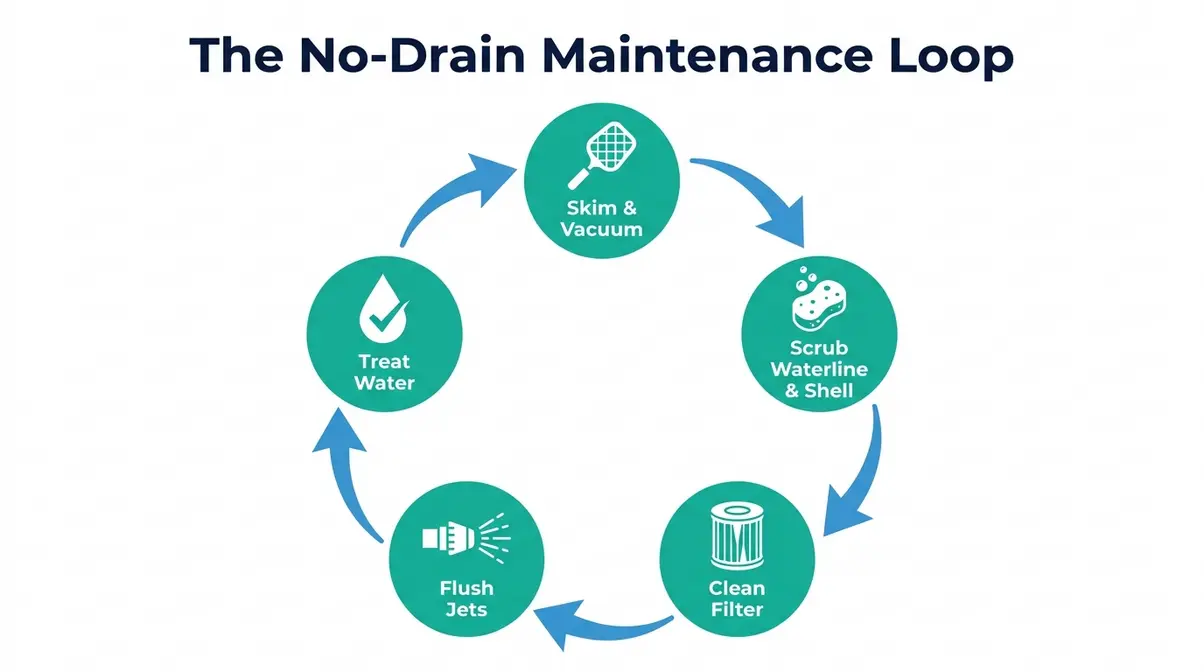
- Steps 1–5: Skim debris → scrub waterline → clean the filter → flush jets → treat the water
- Vinegar works for surface scale — but keep it out of the main water (it lowers pH)
- Never use Dawn soap — it causes persistent foam that requires a full drain to fix
- Tennis balls absorb surface oils and reduce scum buildup between cleanings
- Full drain still needed every 3–4 months to reset total dissolved solids (TDS)
What You’ll Need Before You Start
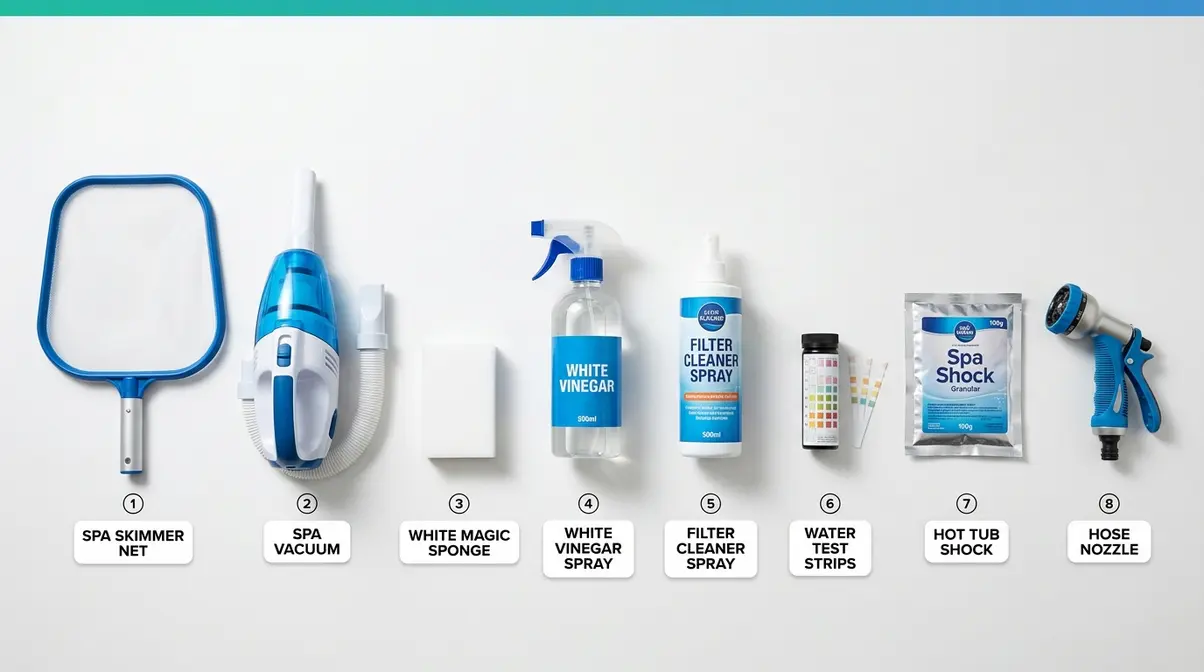
Before you begin the no-drain cleaning process, gather your supplies and take one critical safety step. Having everything within reach means you won’t need to leave the tub unattended mid-clean — and turning off the power first prevents electrical hazards. These are all the tools you need to run the full No-Drain Maintenance Loop, and cleaning a hot tub without draining it requires only these 7 basic tools and takes under 60 minutes — compared to 4–6 hours for a full drain-and-refill cycle.
Supplies and Tools You’ll Need
Here’s what to gather before you touch the water:
- Spa skimmer net — a long-handled net that scoops floating debris (leaves, hair, insects) off the surface without disturbing the water
- Spa vacuum — a handheld device designed to remove grit and sediment from the bottom without turbulence; a turkey baster works as a budget alternative for small debris pockets
- Soft non-abrasive sponge or “magic sponge” — a melamine foam eraser (sometimes called a lazy spa cleaner) that’s particularly effective at removing the dusty residue and hard scale that builds up at the waterline without scratching acrylic surfaces
- White vinegar in a spray bottle — a mild acid that dissolves mineral deposits and hard scale on the shell above the waterline
- Hot tub filter cleaner spray — a chemical soak formulated to break down oils and debris trapped in filter pleats; dish soap is NOT a substitute
- Water test strips or a liquid test kit — measures pH, alkalinity, and sanitizer levels so you know exactly what to add
- Hot tub shock — either non-chlorine (MPS, or monopersulfate) or chlorine-based; non-chlorine shock oxidizes organic waste without raising chlorine levels, while chlorine shock simultaneously sanitizes and oxidizes
- Garden hose — for rinsing the filter cartridge after soaking
For inflatable or lazy spa hot tubs, a standard sponge and skimmer net are sufficient — you don’t need the vacuum. The magic sponge is especially useful for portable spas where hard scale tends to build up faster due to smaller water volume.
Safety First: Turn Off the Power
⚠️ Safety Warning: Turn off the power to your hot tub at the circuit breaker — not just the control panel — before touching the water, handling the filter, or reaching into the shell. Water and electricity are a lethal combination. This step is non-negotiable.
No competitor guide includes this step explicitly, yet it’s the single most important thing you can do before cleaning. The control panel “off” button does not fully de-energize the heating and circulation systems in most tubs. Go to your breaker box, locate the hot tub circuit (usually labeled “spa” or “GFCI”), and flip it off. Confirm it’s off by checking that the control panel display has gone dark.
The 5-Step No-Drain Cleaning Process
This is the heart of the No-Drain Maintenance Loop — a repeating cycle you can run every 1–2 weeks to prevent grit, sliminess, and hard scale from building up in the first place. Hot tub owners who follow this loop consistently report that they never need an emergency drain. These steps are based on standard spa industry practice and align with published guidelines from Leslie’s Pool and Swim University.
Step 1 — Skim and Vacuum the Debris
Why this matters: Floating debris (hair, leaves, insects) and settled grit at the bottom are the first layer of contamination. If you skip this step and go straight to chemistry, you’re just stirring the grime back into the water.
With the power off, use your spa skimmer net to remove all floating debris from the surface. Work from the edges toward the center in slow, steady sweeps. Then use your spa vacuum (or turkey baster) to gently pull up any grit or dirt settled on the bottom. For a lazy spa or inflatable tub, tilt the vacuum slightly at an angle — it creates less turbulence and pulls up sediment more cleanly.
This step takes roughly 5–10 minutes. Don’t rush it. A clean water surface makes every subsequent step more effective.
Step 2 — Scrub the Waterline and Shell
Why this matters: That dark, greasy ring at the waterline is a combination of body oils, sunscreen, cosmetics, and mineral deposits. Left alone, it becomes a biofilm habitat — the source of that sliminess you feel on the shell. Scrubbing it away physically removes the bacteria’s home base.
Spray white vinegar directly onto the waterline ring and let it sit for 2–3 minutes. Then scrub with your magic sponge using firm, circular strokes. The melamine foam lifts the dusty residue and hard scale without scratching the acrylic. Rinse the sponge frequently so you’re not spreading the grime back onto the surface.
For the submerged shell below the waterline, use your soft non-abrasive sponge. Work in sections around the perimeter. Wring the sponge into a bucket rather than back into the tub — this removes the contaminated water from the system rather than recirculating it.
Step 3 — Clean the Filter
Why this matters: Your filter is the lungs of your hot tub. When it’s clogged with oils, dead skin cells, and debris, it can’t circulate water properly — which leads directly to cloudy water, sliminess, and bacterial growth. A dirty filter is the most common cause of persistent water quality problems that no amount of chemicals can fix.
Remove the filter cartridge (consult your tub’s manual for location — most are accessed from inside the tub via a twist-and-lift cap). Rinse it with a garden hose using a firm spray, working from the top down between each pleat. Then spray it generously with hot tub filter cleaner and let it soak for the time specified on the label (typically 15 minutes to overnight for heavily soiled filters).
Rinse thoroughly until the water runs clear. Never use a pressure washer — the high pressure damages the filter media and shortens its lifespan. If your filter is more than 12 months old or visibly torn, replace it rather than cleaning it.
Step 4 — Flush and Clean the Jets
Why this matters: Your jets and the plumbing lines behind them are a prime hiding spot for biofilm (a sticky bacterial colony that clings to pipe walls). Biofilm is resistant to standard sanitizer levels — it’s why your water can test “clean” but still smell musty or feel slimy. Flushing the lines physically dislodges this buildup before it re-contaminates your freshly cleaned water.
Add a jet line flush product (also called a spa purge or pipe purge) to the water according to package directions. Turn the power back on briefly and run the jets on high for 15–20 minutes. You’ll likely see brown or grey foam appear on the surface — that’s the biofilm being expelled from the pipes. This is normal and expected.
Skim off that foam with your net. Then turn the power off again. This is the one step most guides skip entirely, and it’s often the difference between a tub that stays clean for weeks and one that turns slimy again within days.
According to Swim University’s hot tub maintenance guide, line flushing before any major water treatment is one of the highest-impact maintenance steps available to hot tub owners.
Step 5 — Treat and Balance the Water
Why this matters: Clean surfaces and a clean filter mean nothing if the water chemistry is off. Imbalanced water — wrong pH, low sanitizer, or high total dissolved solids (TDS) — allows bacteria to multiply even in a visually clear tub. This step locks in all the work you’ve done in Steps 1–4.
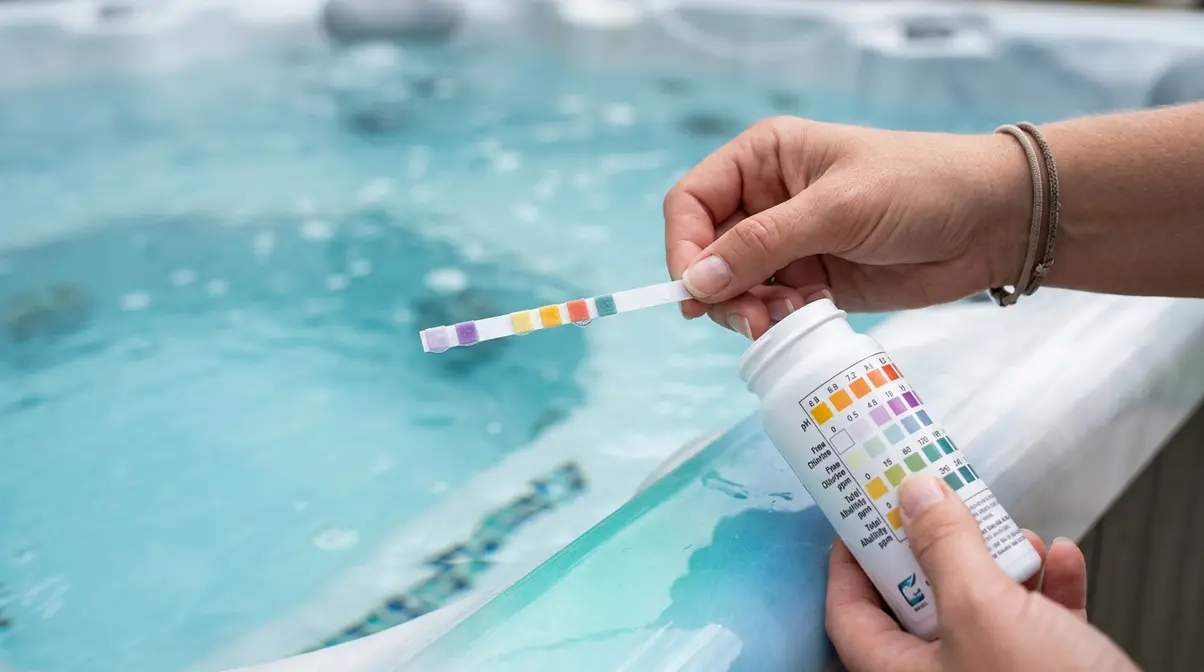
With the filter back in place and the power on, test your water using test strips or a liquid kit. Adjust pH first (target: 7.2–7.8), then alkalinity (target: 80–120 ppm), then sanitizer (chlorine: 1–3 ppm; bromine: 3–5 ppm). Add one chemical at a time, run the jets for 15 minutes between additions, and retest before adding the next.
Finish with a dose of non-chlorine shock (MPS) to oxidize any remaining organic waste. Run the jets for 20 minutes with the cover off to allow off-gassing. Your tub is now clean, balanced, and ready to use.
Common Mistakes to Avoid
Even experienced owners make these errors. Avoiding them saves you from having to start over:
- Over-shocking: Adding too much shock doesn’t clean faster — it creates chloramines (combined chlorine compounds) that irritate skin and eyes and cause that harsh chemical smell. Follow the label dose.
- Using dish soap: Dawn and other dish soaps create a cascade of persistent foam that chemicals cannot break down. Removing it requires a full drain. There is no shortcut.
- Skipping the filter rinse: Replacing a dirty filter without rinsing it is like mopping a floor with a dirty mop. The contamination goes straight back into the water.
- Adding chemicals with the cover on: Always leave the cover off for 15–20 minutes after adding chemicals to allow gases to dissipate safely.
- Cleaning the shell with abrasive pads: Steel wool or rough scrubbing pads scratch acrylic surfaces, creating microscopic grooves where bacteria and hard scale accumulate faster.
How to Test and Balance Your Hot Tub Water
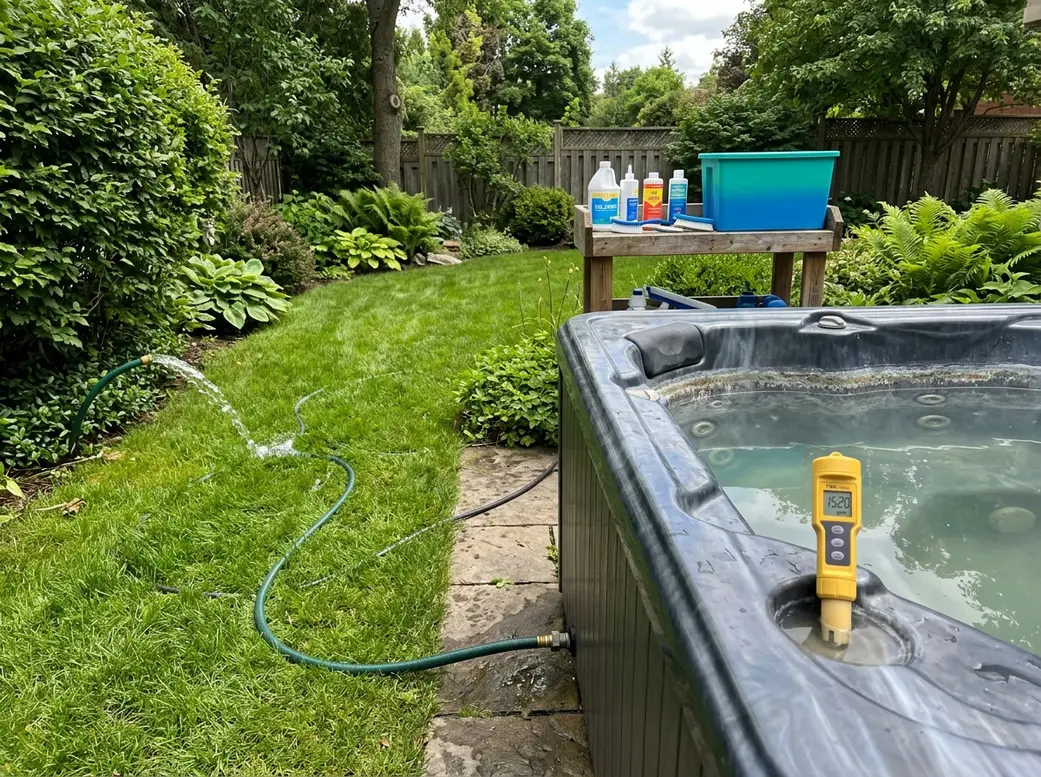
Water chemistry is the invisible foundation of a clean hot tub. You can scrub every surface perfectly, but if the pH is wrong or the sanitizer is depleted, bacteria will recolonize within 24–48 hours. The good news: testing and balancing takes about 15 minutes once you know the targets.
According to Mile High Hot Tub’s maintenance guide, water chemistry imbalances account for the majority of hot tub service calls — most of which are entirely preventable with weekly testing.
How to Test Your Hot Tub Water
Dip a test strip into the water (elbow depth, away from the jets) for the time specified on the package — usually 2 seconds. Remove it without shaking, hold it horizontally, and compare the color pads to the chart on the bottle after 15–30 seconds. Don’t blow on the strip or wave it dry — this skews the readings.
Test for these four parameters every week:
| Parameter | Safe Range | What Happens If Off |
|---|---|---|
| pH | 7.2–7.8 | Too low: corrosion, eye irritation. Too high: scale, cloudy water |
| Total Alkalinity | 80–120 ppm | Too low: pH swings wildly. Too high: pH is hard to lower |
| Sanitizer (Chlorine) | 1–3 ppm | Too low: bacteria multiply. Too high: skin/eye irritation |
| Sanitizer (Bromine) | 3–5 ppm | Same as chlorine — bromine is more stable at high temps |
Liquid test kits (drop-based) are more accurate than strips, particularly for alkalinity readings. If you’re troubleshooting a persistent problem, use a liquid kit to confirm strip results.
How to Balance pH and Alkalinity
Always adjust alkalinity before pH — alkalinity acts as a buffer that stabilizes pH. If you try to fix pH first, it will keep bouncing back.
To raise alkalinity: Add sodium bicarbonate (baking soda is the same compound — the spa version is just marketed for pools). Add in small increments: 1 tablespoon per 100 gallons, run jets for 15 minutes, retest.
To lower alkalinity: Add muriatic acid or a pH decreaser product. Add very slowly — acid is potent and can crash your pH below safe levels if overdosed.
To raise pH: Add sodium carbonate (pH Up / soda ash). To lower pH: Add sodium bisulfate (pH Down / dry acid) or muriatic acid.
That dusty residue and hard scale you see at the waterline is almost always caused by high pH combined with high calcium hardness (target: 150–250 ppm). Keeping pH in range is the single most effective way to prevent scale buildup — more effective than any cleaning product.
When and How to Shock Your Hot Tub
Shocking means adding a large dose of oxidizer to break down organic waste — body oils, sweat, cosmetics, and the byproducts of sanitizer reactions. Hot tub owners consistently report that regular shocking (not just when problems appear) dramatically reduces the frequency of cloudy water and sliminess.
Shock your tub in these situations:
- Weekly: As part of routine maintenance, regardless of usage
- After heavy use: Any time 4+ people have used the tub in one session
- After a water event: Rain contamination, algae appearance, or foam that won’t clear
- After adding fresh water: New water lacks any sanitizer baseline
Add shock at night with the cover off, jets running. Non-chlorine shock (MPS) works within 15 minutes and allows you to use the tub sooner. Chlorine shock requires a 4–8 hour wait until levels drop back to the 1–3 ppm safe range. Never add shock directly on top of other chemicals — pre-dissolve it in a bucket of water first.
DIY Cleaning Solutions — What Works (and What to Avoid)
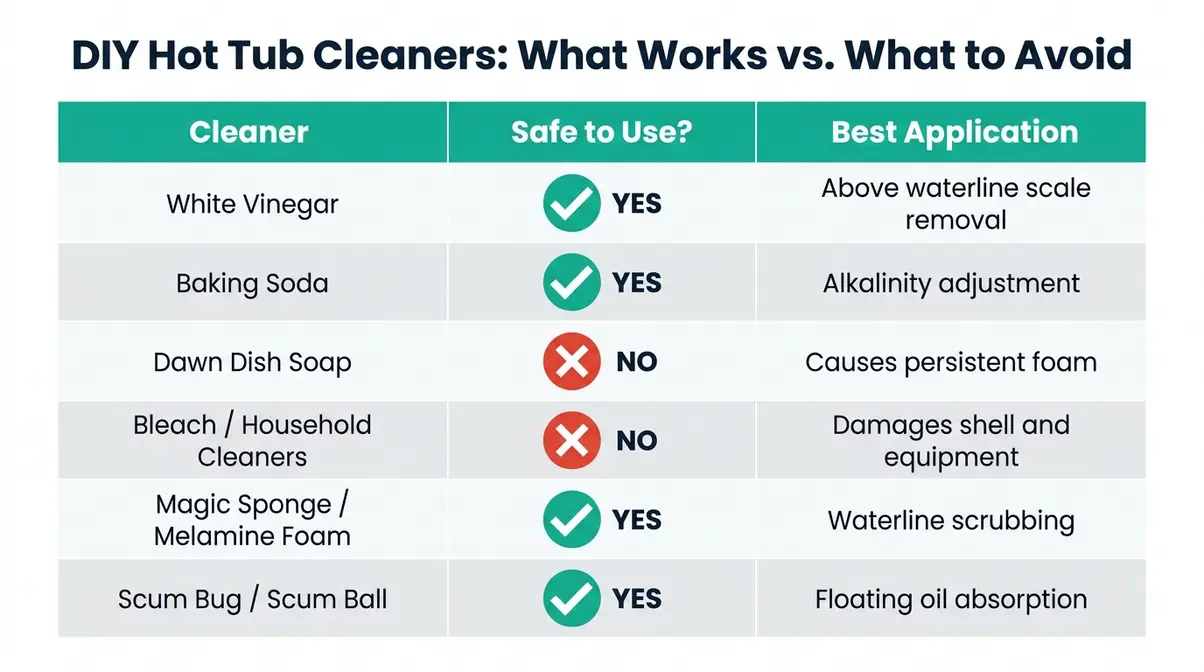
The internet is full of hot tub cleaning hacks. Some are genuinely useful. Others — looking at you, Dawn soap — will create problems that take far longer to fix than the original sliminess. Here’s what the evidence actually supports.
Using Vinegar to Clean Your Hot Tub
White vinegar is a genuinely effective, low-cost cleaner for specific hot tub surfaces — but it must be used correctly. Vinegar is a mild acetic acid (typically 5% concentration) that dissolves calcium carbonate deposits, which is the primary component of hard scale and that chalky white dusty residue that forms at the waterline.
Research from Michigan State University Extension confirms that acetic acid effectively breaks down mineral deposits on hard surfaces without requiring harsh chemicals. This makes white vinegar a practical choice for scrubbing the shell above the waterline, cleaning the underside of the cover, and wiping down the cabinet exterior.
- What vinegar is good for:
- Spraying directly on the waterline ring and scrubbing with a magic sponge
- Soaking a cloth and wiping the inside of the cover to remove mildew
- Cleaning the filter housing (the plastic housing, not the filter media itself)
- What vinegar should NOT do:
- Never pour vinegar directly into the main body of water. Vinegar lowers pH significantly — even a cup of white vinegar can drop pH below the safe range in a 300-gallon tub, requiring pH Up to correct and potentially causing skin irritation.
- Never use vinegar as a sanitizer replacement. It does not kill bacteria at typical spa temperatures.
For the best homemade waterline cleaner, combine white vinegar in a spray bottle with a small amount of water (50/50 ratio). Spray, wait 3 minutes, scrub with a magic sponge, and wipe clean. This is the most effective DIY method available for surface scale.
Why You Should Never Use Dawn Soap
This is the question that sends hot tub owners down a very expensive rabbit hole. Dawn dish soap — and any other surfactant-based soap — seems like a logical cleaning agent. It cuts grease, it’s gentle, it smells clean. The problem is what it does to the water system.
Surfactants (the active cleaning agents in dish soap) create a dense, stable foam when agitated by jets. Unlike normal hot tub foam (which dissipates), surfactant foam is self-sustaining — the jets keep re-aerating it, and it never breaks down. Standard hot tub chemicals, including defoamers, provide only temporary relief. The surfactant residue clings to the plumbing, the filter media, and the shell surface, and continues producing foam with every jet cycle.
Hot tub owners who have used Dawn — even a small amount — consistently report that the only reliable fix is a complete drain, thorough shell scrub, filter replacement, and full refill. That’s 300–500 gallons of water, 4–6 hours of labor, and often a new filter cartridge. The “quick clean” becomes a very expensive mistake.
Use only products specifically formulated for hot tubs and spas. If you want a gentle surface cleaner, stick to white vinegar or a dedicated spa surface cleaner.
The Scum Bug and Magic Sponge Method
Two low-tech tools that hot tub owners swear by — and both are backed by basic chemistry.
The Scum Bug / Scum Ball: These floating foam devices are made from oleophilic (oil-attracting) materials that passively absorb body oils, sunscreen, and cosmetic residue from the water surface. Drop one in the tub and leave it floating between uses. Rinse and squeeze it out weekly. Over time, it measurably reduces the oily film that forms on the waterline and in the filter — which means your filter runs cleaner and your water stays clearer longer.
The Magic Sponge (Melamine Foam): The magic sponge works through micro-abrasion — its extremely fine, open-cell foam structure physically lifts contamination from smooth surfaces without chemical cleaners. It’s particularly effective on acrylic shells where grit or dirt has bonded to the surface. Wet the sponge, wring it out to about 70% dryness, and scrub in small circular motions. Rinse frequently.
According to Outdoor Living Hot Tubs’ cleaning guide, combining a floating scum absorber with weekly waterline scrubbing can reduce the frequency of full filter cleanings by up to 30% — because less oil reaches the filter in the first place.
Hot Tub Hacks, Safety Rules, and Health Tips
Beyond the 5-step loop, a few targeted hacks and safety rules make a meaningful difference — especially for beginners who haven’t yet developed a feel for their tub’s rhythms. This section covers the questions most guides don’t answer: the tennis ball trick, hot tub rash, and why the 15-minute rule actually exists.
The Tennis Ball Trick: How It Really Works
The tennis ball trick is real — but the reason it works surprises most people. It’s not the felt that absorbs oils. It’s the specific fiber structure.
Tennis ball felt is made from a blend of nylon and wool fibers that happen to be oleophilic — meaning they attract and bind to oil molecules rather than water molecules. When you drop a tennis ball into your hot tub, it passively absorbs surface oils (body oils, sunscreen, hair products) that would otherwise coat the waterline and clog the filter.
NPR reported on the oleophilic fiber phenomenon in the context of oil spill cleanup — the same principle that makes certain fibers effective at binding petroleum also makes them effective at pulling cosmetic oils from spa water. A standard tennis ball can absorb several times its weight in oil before becoming saturated.
How to use them correctly: Drop 2–3 tennis balls into the tub after each soaking session. Leave them floating overnight. Remove and rinse them in clean water weekly. Replace them monthly, as the fibers become saturated and less effective over time.
Limitations: Tennis balls are a supplement to — not a replacement for — regular filter cleaning and water treatment. They reduce the oil load on your filter, but they don’t sanitize the water.
Preventing Hot Tub Folliculitis (Hot Tub Rash)
Hot tub rash (folliculitis) is a genuine health concern that most cleaning guides gloss over. According to the Centers for Disease Control and Prevention (CDC), hot tub rash is caused by the bacterium Pseudomonas aeruginosa, which thrives in warm water when sanitizer levels are inadequate. It produces a bumpy, itchy red rash — often on areas covered by a swimsuit — that typically appears within 72 hours of exposure.
The CDC notes that Pseudomonas aeruginosa is particularly problematic in hot tubs because the high water temperature causes chlorine to dissipate much faster than in a swimming pool. A hot tub that tested at safe chlorine levels in the morning may be dangerously under-sanitized by evening, especially after heavy use.
- Prevention protocol:
- Test sanitizer levels before every soak, not just weekly
- Maintain chlorine at 1–3 ppm or bromine at 3–5 ppm at all times
- Shock the tub after every heavy-use session (4+ people)
- Shower before entering — cosmetics and body oils accelerate sanitizer depletion
- Rinse your swimsuit in clean water after each use (detergent residue lowers sanitizer effectiveness)
If you develop a rash after hot tub use, the Cleveland Clinic recommends keeping the rash dry, avoiding further hot tub use until the water is properly balanced, and consulting a physician if symptoms worsen or spread.
Is hot tub bad for folliculitis? For people who already have folliculitis, soaking in a poorly maintained hot tub can worsen the infection. A properly sanitized tub (chlorine 1–3 ppm) does not cause folliculitis — the bacteria cannot survive at those levels.
The 15-Minute Rule: Why It Exists
The 15-minute hot tub rule is not arbitrary. It’s rooted in human physiology and documented by the U.S. Consumer Product Safety Commission (CPSC).
Hot water raises your core body temperature. At typical spa temperatures (100–104°F / 38–40°C), the body’s ability to regulate heat through sweating is significantly impaired — you can’t cool down efficiently when you’re submerged in water hotter than your skin. The CPSC warns that prolonged immersion at high temperatures can lead to hyperthermia (dangerously elevated body temperature), which progresses to dizziness, nausea, and in severe cases, loss of consciousness or cardiac events.
The 15-minute guideline represents a conservative safe exposure limit for healthy adults at standard spa temperatures. Higher temperatures (above 104°F) shorten this window significantly. Children, pregnant women, and people with cardiovascular conditions face higher risk and should limit soaks to 5 minutes or consult a physician before hot tub use.
- Practical rules:
- Keep water temperature at or below 104°F (40°C) — the CPSC maximum
- Exit the tub every 15 minutes to cool down before re-entering
- Never use a hot tub alone — impaired judgment from heat can prevent you from recognizing distress
- Stay hydrated — drink water before and after soaking, not alcohol
When You Still Need to Drain Your Hot Tub
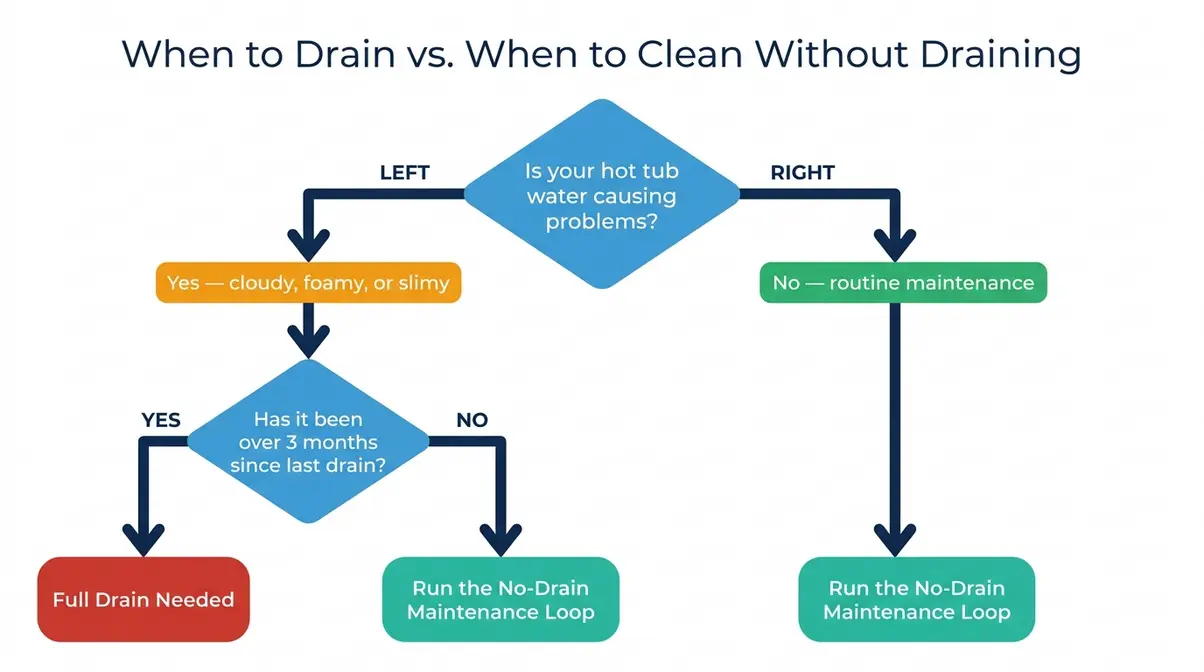
The No-Drain Maintenance Loop is powerful, but it has a hard limit. No amount of cleaning, shocking, or balancing can overcome one fundamental chemistry problem: total dissolved solids (TDS).
TDS — total dissolved solids — refers to the invisible accumulation of minerals, chemical byproducts, body oils, and sanitizer residue that builds up in the water over time. Every chemical you add leaves behind a trace. Every person who soaks adds organic compounds. Over weeks and months, TDS rises to a point where the water is chemically exhausted — it can no longer hold an effective sanitizer level, pH becomes erratic, and the water may appear cloudy or develop a persistent odor even when tested “in range.”
Signs It’s Time for a Full Drain
Watch for these signals that the no-drain approach has reached its limit:
- Persistent cloudiness that doesn’t clear within 24 hours of shocking and filtering
- Foam that returns within hours of using a defoamer product
- Chemical smell that persists even at correct sanitizer levels (indicates chloramine buildup)
- Sliminess returns within days of a full cleaning cycle (indicates biofilm too established to treat chemically)
- TDS above 1,500 ppm (measurable with a TDS meter — the water is chemically saturated)
- More than 3–4 months since the last full drain and refill
The general industry guideline — supported by Leslie’s Pool and Swim University — is to perform a full drain and refill every 3–4 months for average use (2–4 people, 3–4 times per week). Heavy use (daily, 6+ people) may require draining every 6–8 weeks.
When to Call a Professional
Some hot tub problems go beyond what chemistry and elbow grease can fix. Consider calling a licensed spa technician if you encounter:
- Persistent equipment malfunction — jets not working, heater cycling off, pump noise
- Structural damage — cracks in the shell, leaking fittings, damaged jet housings
- Biofilm that won’t clear after two full No-Drain Maintenance Loop cycles plus a pipe flush
- Electrical issues — tripping GFCI breakers, control panel errors, or any sign of water near electrical components
For ongoing professional support, our guide to finding a qualified hot tub repair technician covers what to look for and what to expect to pay. Routine hot tub water care guidance is also available if you want to go deeper on chemistry.
Frequently Asked Questions
Can I clean a hot tub without draining it?
Yes — you can fully clean a hot tub without draining it using a structured 5-step process: skim debris, scrub the waterline, clean the filter, flush the jets, and balance the water chemistry. This approach removes biofilm, hard scale, grit, and chemical imbalances without emptying the tub. Hot tub owners who follow this routine every 1–2 weeks consistently report that they avoid emergency drains entirely. The one exception: after 3–4 months of use, a full drain is still necessary to reset total dissolved solids (TDS).
Can I run vinegar through my hot tub?
No — do not pour vinegar into the main body of your hot tub water. White vinegar is effective for scrubbing the waterline and shell above the water surface, but adding it to the water drops pH significantly, which can cause skin and eye irritation and damage equipment seals over time. Use vinegar in a spray bottle directly on mineral deposits and hard scale at the waterline, scrub with a magic sponge, and wipe clean. Keep it out of the water itself.
Why is there a 15-minute hot tub rule?
The 15-minute rule exists because hot water raises your core body temperature faster than your body can cool itself down. The U.S. Consumer Product Safety Commission (CPSC) warns that prolonged immersion at standard spa temperatures (100–104°F) can cause hyperthermia — a dangerously elevated body temperature that leads to dizziness, nausea, or loss of consciousness. Fifteen minutes represents a safe exposure limit for healthy adults. Exit the tub, cool down for several minutes, and then re-enter if you want to continue soaking.
Is a hot tub bad for folliculitis?
A poorly maintained hot tub can cause folliculitis — but a properly sanitized tub does not. According to the CDC, hot tub rash is caused by Pseudomonas aeruginosa bacteria, which thrive when chlorine or bromine levels fall below safe thresholds. At the correct sanitizer level (chlorine 1–3 ppm; bromine 3–5 ppm), the bacteria cannot survive. If you already have folliculitis, avoid hot tub use until the infection clears and the water chemistry is verified. A rash appearing within 72 hours of soaking is a strong indicator that sanitizer levels were inadequate.
Can I use Dawn soap to clean my hot tub?
No — Dawn soap and any dish soap should never be used in a hot tub. Dish soaps contain surfactants that create dense, self-sustaining foam when agitated by jets. Unlike normal foam, surfactant foam does not break down with defoamer products — the residue clings to the plumbing and filter and continues producing foam with every jet cycle. Hot tub owners who have made this mistake consistently report that a full drain, filter replacement, and complete refill is the only reliable fix. Use only spa-specific surface cleaners or white vinegar on surfaces.
Why put tennis balls in a hot tub?
Tennis balls absorb body oils, sunscreen, and cosmetic residue from the water surface because their felt fibers are oleophilic — meaning they chemically attract and bind to oil molecules. Drop 2–3 tennis balls into the tub after each session and leave them floating overnight. They passively pull oily residue from the water surface before it can coat the waterline or clog the filter. Rinse them weekly and replace monthly once the fibers become saturated. They’re a simple, low-cost way to extend the time between filter cleanings.
What is the best homemade cleaner for hot tubs?
White vinegar (5% acetic acid) is the most effective and safest homemade cleaner for hot tub surfaces. Mix it 50/50 with water in a spray bottle and apply directly to the waterline ring and hard scale deposits. Let it sit for 2–3 minutes, then scrub with a melamine foam magic sponge. For mildew on the underside of the cover, apply undiluted vinegar, let sit for 5 minutes, and wipe clean. Baking soda (sodium bicarbonate) is also useful for raising alkalinity in the water. Everything else — dish soap, bleach, household cleaners — risks damaging the shell or the water chemistry.
How often should I clean my hot tub without draining it?
Run the 5-step No-Drain Maintenance Loop every 1–2 weeks for average use (2–4 people, a few times per week). Test water chemistry weekly and shock after every heavy-use session. Clean the filter monthly with a spray soak, and rinse it with a hose every 2 weeks. Every 3–4 months, perform a full drain and refill to reset total dissolved solids (TDS) — this is the one task the no-drain method cannot replace. Consistent weekly maintenance means your full drain sessions will be easier and faster each time.
Keeping Your Hot Tub Clean Starts With the Loop
A clean, safe hot tub doesn’t require draining it every time something looks off. The No-Drain Maintenance Loop — skim, scrub, filter, flush, treat — gives you a repeatable system that addresses every layer of contamination in under an hour. Hot tub owners who run this cycle every 1–2 weeks consistently avoid the sliminess, grit, and persistent cloudiness that send other owners scrambling for a drain hose. As the CDC confirms, the real safety risk isn’t the cleaning process — it’s neglecting sanitizer levels long enough for bacteria like Pseudomonas aeruginosa to establish themselves.
The No-Drain Maintenance Loop works because it treats cleaning as a cycle, not an event. Each step reinforces the next: a clean filter makes chemical treatment more effective; balanced water makes the shell easier to scrub; flushed jets mean no biofilm reservoir waiting to re-contaminate everything you just cleaned.
Start with Step 1 today. Gather your supplies, flip the breaker, and run through the loop once. Most first-timers finish in 45–60 minutes and are genuinely surprised at the difference. For deeper guidance on hot tub water care, chemical balancing, and filter maintenance, explore our full library of spa maintenance guides. Your tub — and your skin — will thank you.