


Table of Contents - Hot Tub Cleanliness Guide: Keep Your Spa Safe & Clear
- Before You Start: What You Need
- Hot Tub Chemicals Explained for Beginners
- Your Weekly Hot Tub Maintenance Routine
- How to Care for Your Filter and Cover
- How to Do a Quarterly Deep Clean
- Hot Tub Health and Safety — What Every Owner Must Know
- Common Mistakes and When to Call a Pro
- Frequently Asked Questions
- Why is there a 15-minute hot tub rule?
- Is a hot tub bad for folliculitis?
- What should I put in my hot tub to keep it clean?
- Can a hot tub trigger AFib?
- What happens if you sit in a hot tub for 3 hours?
- Can you go in a hot tub twice a day?
- Why do only some people get hot tub folliculitis?
- What kills folliculitis naturally?
- Your Clean Hot Tub Starts With Four Simple Layers
This blog post may contain affiliate links. As an Amazon Associate I earn from qualifying purchases.
“Hi, new hot tub owner here. We are just in the process of setting up our first tub and I’m overwhelmed by all the chemicals that Google is saying we need…”
— Common question from first-time hot tub owners across online communities
If that sounds like you, you’re not alone — and you’re in exactly the right place.
Skip the right steps, and you risk cloudy water, skin rashes, or worse — a bacterial outbreak that puts your whole family at risk. But here’s the truth most guides won’t tell you: hot tub maintenance isn’t complicated. It just needs to be organized.
This hot tub cleanliness guide organizes every maintenance task into four simple, interconnected layers — Chemistry, Equipment, Deep Clean, and Health Safety. We call it The 4-Layer Clean System, and by the end of this guide, you’ll know exactly what chemicals to use, how often to test your water, and how to keep your spa safe — even if you’ve never owned a hot tub before.
Keeping your hot tub clean with this hot tub cleanliness guide requires four interconnected layers of maintenance — and the CPSC recommends water temperatures stay at or below 104°F for safe soaking.
- Layer 1 — Chemistry: Use chlorine or bromine + weekly shock to kill bacteria and keep water balanced
- Layer 2 — Equipment: Rinse your filter every week; deep-clean it monthly to maintain flow
- Layer 3 — Deep Clean: Drain and scrub your tub every 3–4 months to prevent biofilm buildup
- Layer 4 — Health Safety: Limit soaks to 15–20 minutes; consult a doctor if you have heart conditions or are pregnant
- The 4-Layer Clean System prevents the most common beginner mistakes — including hot tub folliculitis and cloudy water
Before You Start: What You Need
Before you touch a single chemical, it helps to understand the big picture — and make sure you have the right supplies on hand.
The 4-Layer Clean System is our framework for organizing every hot tub maintenance task into four manageable categories: Chemistry (the chemicals that keep water safe), Equipment (filters and covers), Deep Clean (draining and scrubbing every few months), and Health Safety (the rules that protect your body). Think of it like a car — you need fuel, oil changes, occasional servicing, and safe driving habits. Each layer supports the others.
The CPSC recommends keeping hot tub water at or below 104°F (40°C) and limiting sessions to 15 minutes for safe soaking (CPSC Spa and Hot Tub Safety, 2024). That’s Layer 4 in a single sentence — and you’ll master all four layers by the end of this guide.
What You’ll Need (Starter Checklist):
- Water test strips — tells you what chemicals to add each week; without these, you’re guessing
- Sanitizer — chlorine granules OR bromine tablets — kills bacteria and keeps water safe to soak in
- Oxidizing shock treatment — breaks down body oils, sweat, and contaminants that sanitizer misses
- pH increaser and pH decreaser — keeps water comfortable on your skin and protects your equipment
- Total alkalinity increaser — stabilizes your pH so it doesn’t swing up and down unpredictably
- Hot tub filter cleaner spray — extends the life of your filter cartridge significantly
- Garden hose with a pre-filter attachment — removes metals and minerals from fresh fill water
- Non-abrasive sponge or soft cloth — for wiping the shell, waterline, and cover
You don’t need all of these on day one. Start with test strips, sanitizer, and shock. Add the others as you go.
Hot Tub Chemicals Explained for Beginners
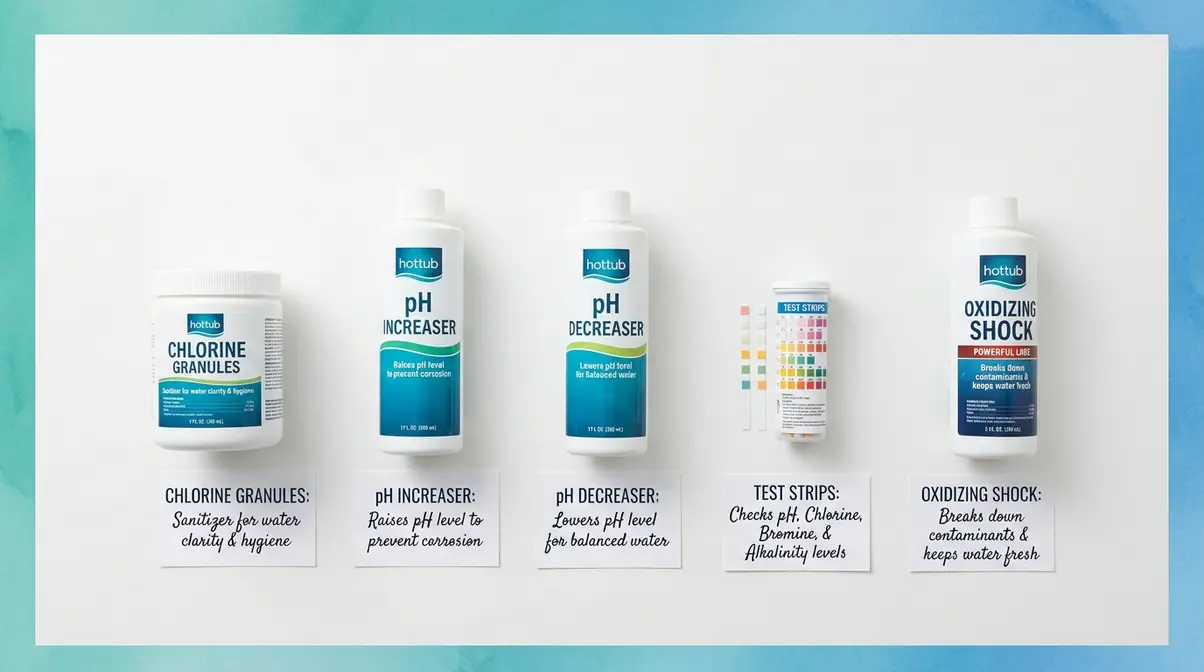
Layer 1 of the 4-Layer Clean System is Chemistry — and it’s the layer new owners find most overwhelming. Common concerns from new hot tub owners include not knowing which chemicals to buy, how much to add, or whether they’re doing it safely.
Here’s what you actually need to know, organized simply:
- Sanitizer kills bacteria and viruses — it’s the non-negotiable baseline of safe water
- Shock (oxidizer) breaks down the organic waste sanitizer can’t handle alone
- pH balancer keeps water at the right acidity level — comfortable for skin and safe for equipment
- Alkalinity increaser stabilizes pH so it doesn’t swing wildly between treatments
- Ideal pH range: 7.2–7.8 (lower is too acidic; higher causes scale and cloudy water)
- Ideal total alkalinity: 80–120 ppm (parts per million)
- Ideal sanitizer level (chlorine): 1–3 ppm; (bromine): 3–5 ppm
The EPA confirms that maintaining proper chlorine or bromine levels is the most effective way to prevent harmful bacteria growth in hot tub water (EPA Swimming Pool and Spa Chemicals, 2024). That’s not a nice-to-have — it’s the foundation of everything else in this guide.
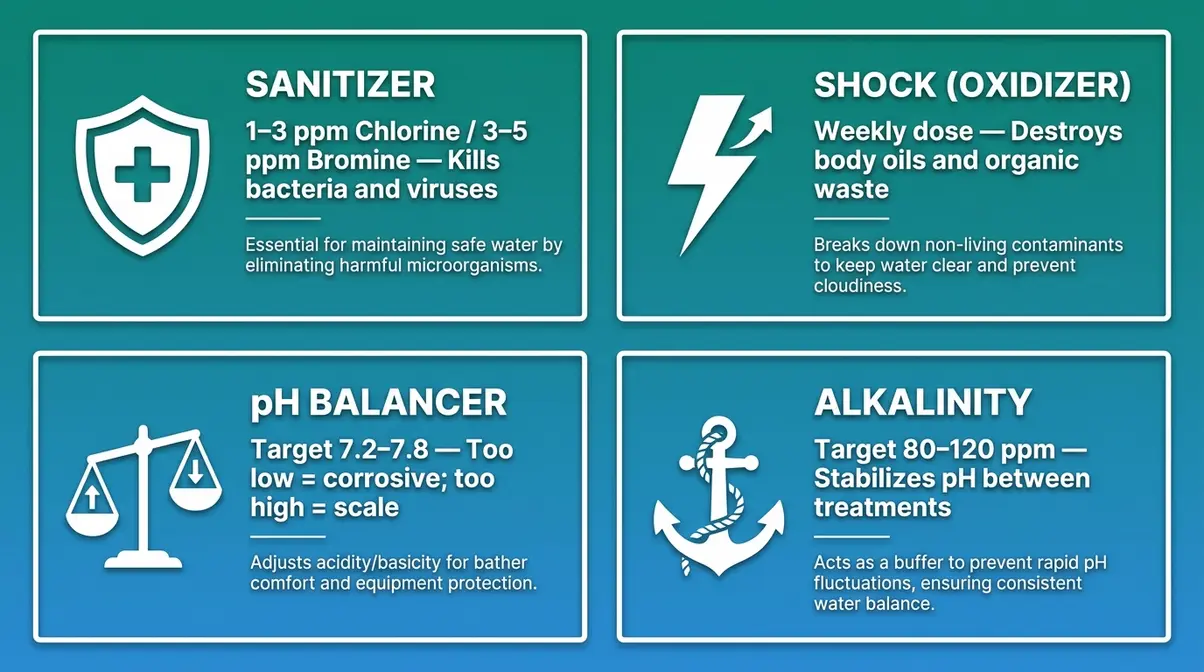
The 4 Essential Chemicals Every Hot Tub Needs
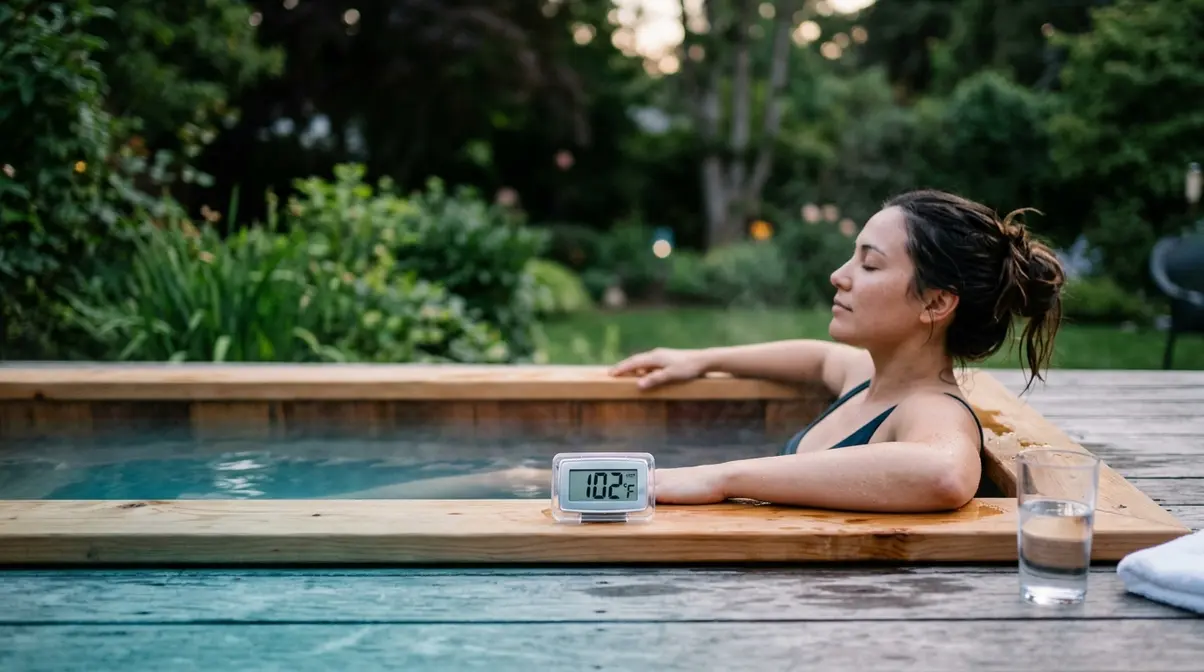
Every hot tub, regardless of brand or size, needs these four chemical categories working together.
1. Sanitizer — Your First Line of Defense
Sanitizer is the chemical that kills bacteria, viruses, and algae in your water. Think of it like soap — without it, your hot tub water becomes a breeding ground for harmful microorganisms within 24–48 hours. You add sanitizer regularly to maintain a consistent “residual” level in the water at all times.
The two most common sanitizers are chlorine and bromine (covered in detail in the next section). A third option — salt water or mineral systems — uses a salt cell or mineral cartridge to generate sanitizer automatically. Salt systems reduce the need to manually add chlorine granules, though you’ll still need to test and balance your water chemistry. Mineral systems (using silver and copper ions) are gentler on skin but typically require a low-level backup sanitizer. None of the major manufacturer guides cover this distinction adequately — most treat chlorine as the only option.
2. Shock (Oxidizer) — The Weekly Deep Clean
Oxidizing shock is not the same as sanitizer. Where sanitizer kills living organisms, shock breaks down the dead organic matter — body oils, sweat, sunscreen, and cosmetics — that builds up after every soak. Without weekly shock treatments, that organic waste consumes your sanitizer rapidly, leaving water cloudy and smelling strongly of chemicals. Add shock after every heavy-use session and as part of your weekly routine.
3. pH Balancer — The Water Thermostat
pH (the measure of how acidic or alkaline your water is) affects everything. Water with a pH below 7.2 is too acidic — it irritates eyes and skin, and it corrodes your equipment. Water above 7.8 is too alkaline — it causes scale buildup and makes sanitizer far less effective. A pH increaser (sodium carbonate) raises pH; a pH decreaser (sodium bisulfate) lowers it. Test your pH every 2–3 days when the tub is in regular use.
4. Total Alkalinity Increaser — The Stabilizer
Total alkalinity (TA) is the buffer that prevents pH from swinging wildly after each chemical addition or heavy rain. Think of it as the shock absorber for your water chemistry. If alkalinity is too low, your pH will bounce unpredictably every time you add anything to the water. If it’s too high, pH becomes difficult to adjust. Keep TA between 80–120 ppm, and your pH will stay far more stable with far less effort.
Chlorine vs. Bromine: Which Sanitizer Is Right for You?
User consensus across hot tub communities indicates this is the single most common question new owners ask — and the answer depends on your priorities.
| Feature | Chlorine | Bromine |
|---|---|---|
| Cost | Lower (~$15–25/month) | Higher (~$25–40/month) |
| Effectiveness in heat | Degrades faster above 98°F | More stable at high temperatures |
| Skin sensitivity | Can irritate sensitive skin | Generally gentler on skin and eyes |
| Smell | Noticeable “chlorine” odor | Milder odor |
| Form | Granules (easiest to dose) | Tablets (slow-dissolving feeder) |
| Best for | Budget-conscious owners; covered tubs | Sensitive skin; frequent high-heat use |
| UV stability | Degrades in sunlight | Also degrades in sunlight (both need a cover) |
Chlorine (the most widely used hot tub sanitizer) is the default choice for most beginners. It’s inexpensive, easy to dose in granule form, and highly effective. The main drawback: it degrades faster at hot tub temperatures than it does in a pool, so you’ll test and add it more frequently.
Bromine (a gentler alternative that works better in high heat) is the preferred choice for anyone with sensitive skin or who soaks daily. It’s more stable at temperatures above 98°F, which means it holds its effectiveness longer between treatments. It costs more upfront, but many owners find they use less of it per week.
Salt water systems sit in a third category — they’re not cheaper in the short term (salt cells cost $300–600 to install), but they dramatically reduce the manual chemical routine once set up. Worth considering if you plan to use your hot tub daily.
Your New Owner Chemical Shopping List
Here’s the minimum you need to get started safely. Prices are approximate and vary by region (as of Q1 2026).
| Product | What to Buy | Approx. Monthly Cost |
|---|---|---|
| Sanitizer | Chlorine granules (dichlor) or bromine tablets | $15–40 |
| Shock | Non-chlorine oxidizing shock or chlorine shock | $10–20 |
| pH Up | Sodium carbonate (pH increaser) | $8–15 |
| pH Down | Sodium bisulfate (pH decreaser) | $8–15 |
| Alkalinity Up | Sodium bicarbonate | $5–10 |
| Test Strips | 5-in-1 or 6-in-1 hot tub test strips | $10–15 (per 50-strip pack) |
| Filter Cleaner | Hot tub filter spray cleaner | $12–18 (per bottle) |
Total first-month estimate: $68–$133. After the first month, you’ll spend less — pH and alkalinity adjustments are infrequent once you establish a routine.
Your Weekly Hot Tub Maintenance Routine
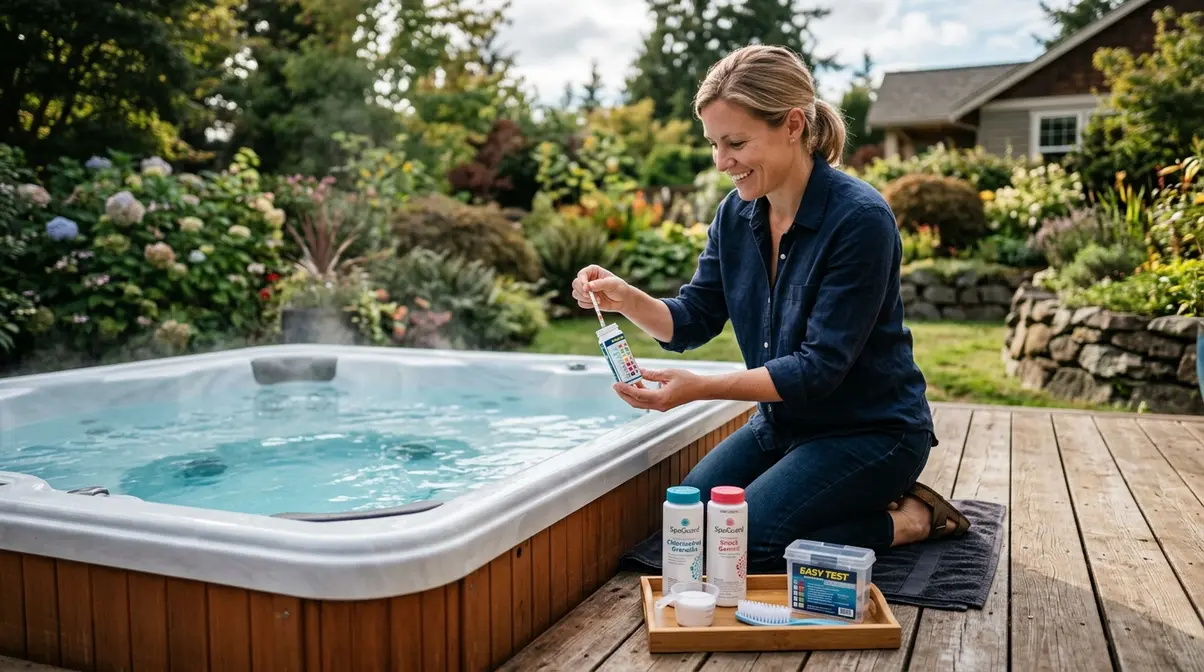
Layer 1 and Layer 2 of the 4-Layer Clean System work together every week. User consensus across hot tub owner communities consistently shows that the owners who feel most confident are those who follow a simple, fixed weekly routine — not those who try to “do it when needed.”
Here’s the complete weekly process, broken into four steps.
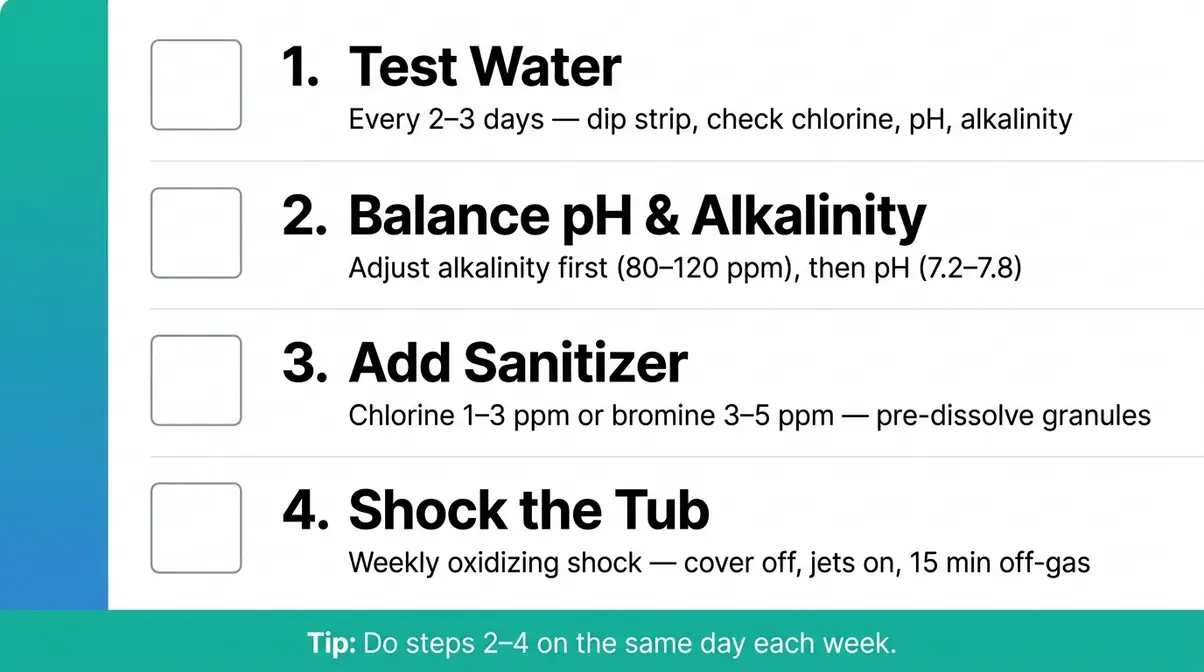
Step 1: Test Your Water (Every 2–3 Days)
Testing is the minimum you need to do — and it takes less than two minutes.
Dip a test strip into your hot tub water for about 2 seconds, then hold it flat (don’t shake it) and compare the color results to the chart on the strip container. You’re checking for:
- Free chlorine or bromine level (sanitizer)
- pH level
- Total alkalinity
- Total hardness (calcium — important for preventing scale or foamy water)
Target ranges to memorize:
| Parameter | Ideal Range |
|---|---|
| Free Chlorine | 1–3 ppm |
| Bromine | 3–5 ppm |
| pH | 7.2–7.8 |
| Total Alkalinity | 80–120 ppm |
| Calcium Hardness | 150–250 ppm |
Test every 2–3 days during regular use, and always test before adding any chemicals. The test result tells you what to add — never add chemicals blindly.
Step 2: Balance Your pH and Alkalinity
Always balance alkalinity before pH. This is the order that matters — and most beginners get it backwards.
Why alkalinity first? Total alkalinity (TA) is the buffer that controls how easily pH moves. If you adjust pH before TA is in range, your pH will keep drifting back out of range no matter how much product you add. Fix TA first, and pH adjustments become stable and predictable.
Step-by-step pH and alkalinity adjustment:
- Test your water and note the current TA and pH readings
- If TA is below 80 ppm: Add alkalinity increaser (sodium bicarbonate) in the dose listed on the product label — usually 1–2 oz per 250 gallons to raise TA by 10 ppm
- Run the jets for 15–20 minutes to circulate the chemical thoroughly
- If pH is below 7.2: Add pH increaser in small doses, circulate for 15 minutes, then retest
- If pH is above 7.8: Add pH decreaser in small doses, circulate for 15 minutes, then retest
- Never add more than one chemical at a time — always circulate and retest between additions
A common mistake: dumping in pH Up and pH Down on the same day without waiting. This creates a chemical see-saw that wastes product and never stabilizes. Patience between steps is the skill that separates confident owners from frustrated ones.
Step 3: Add Your Sanitizer
With your water balanced, adding sanitizer is straightforward. Unbalanced water makes sanitizer far less effective — which is why Step 2 always comes first.
For chlorine (granules — dichlor):
- Test your current free chlorine level
- If below 1 ppm, measure your dose according to the product label (typically 1 tsp per 300 gallons to raise chlorine by 1 ppm)
- Pre-dissolve granules in a small cup of water before adding — this prevents bleaching the shell
- Add the solution to the water with the jets running
- Wait 15–30 minutes before soaking, then retest to confirm the level is in range
For bromine (tablets in a floating feeder):
- Fill your bromine feeder with tablets according to manufacturer instructions
- Set the flow rate dial to medium as a starting point
- Test bromine levels every 2–3 days and adjust the feeder dial up or down to maintain 3–5 ppm
- Replace tablets as the feeder empties
Important safety note: Never mix chlorine and bromine together — combining sanitizers can cause a dangerous chemical reaction. Choose one system and stick with it.
Step 4: Shock Your Hot Tub Weekly
Shocking your hot tub is separate from regular sanitizer dosing. Where sanitizer maintains a residual level, shock (an oxidizer) destroys the accumulated organic waste — body oils, lotions, sweat — that consumes sanitizer and causes that familiar “chemical” smell.
How to shock your hot tub:
- Test your water first — shock is most effective when pH is in range (7.2–7.8)
- Remove the cover and run the jets on high
- Measure your shock dose according to label instructions — typically 1 oz of non-chlorine shock per 250 gallons for weekly maintenance; double the dose after heavy use (parties, multiple bathers)
- Add shock directly to the water with jets running
- Leave the cover off for 15–20 minutes to allow off-gassing
- Wait at least 30 minutes before soaking; retest sanitizer levels before entry
Shock your tub every week, and always after: heavy bather loads, heavy rain, adding fresh water, or if the water looks or smells off. Weekly shock is the single most impactful thing beginners skip — and the most common reason water turns cloudy.
Fixing Common Weekly Problems: Cloudy Water and More
Even with a solid routine, problems happen. Here’s how to diagnose the most common ones quickly.
| Problem | Most Likely Cause | Fix |
|---|---|---|
| Cloudy water | Low sanitizer OR high pH OR dirty filter | Shock the tub, check pH, rinse filter |
| Green water | Algae (very low sanitizer) | Shock heavily (triple dose), then rebalance |
| Foamy water | Soap, lotions, or body oils in water | Non-chlorine shock; rinse before soaking |
| Strong chemical smell | Chloramines (combined chlorine) — NOT too much chlorine | Shock the tub; the smell means you need MORE shock, not less |
| Skin irritation | pH out of range OR chlorine too high | Test and adjust pH; check chlorine level |
| Scale on shell | High calcium hardness or high pH | Add pH decreaser; consider a scale inhibitor |
The strong “chlorine smell” misconception trips up nearly every new owner at least once. That sharp chemical odor is actually chloramines — dead, used-up sanitizer that has bonded with organic waste. It means your sanitizer is exhausted, not excessive. The fix is always more shock, not less chemical.
How to Care for Your Filter and Cover
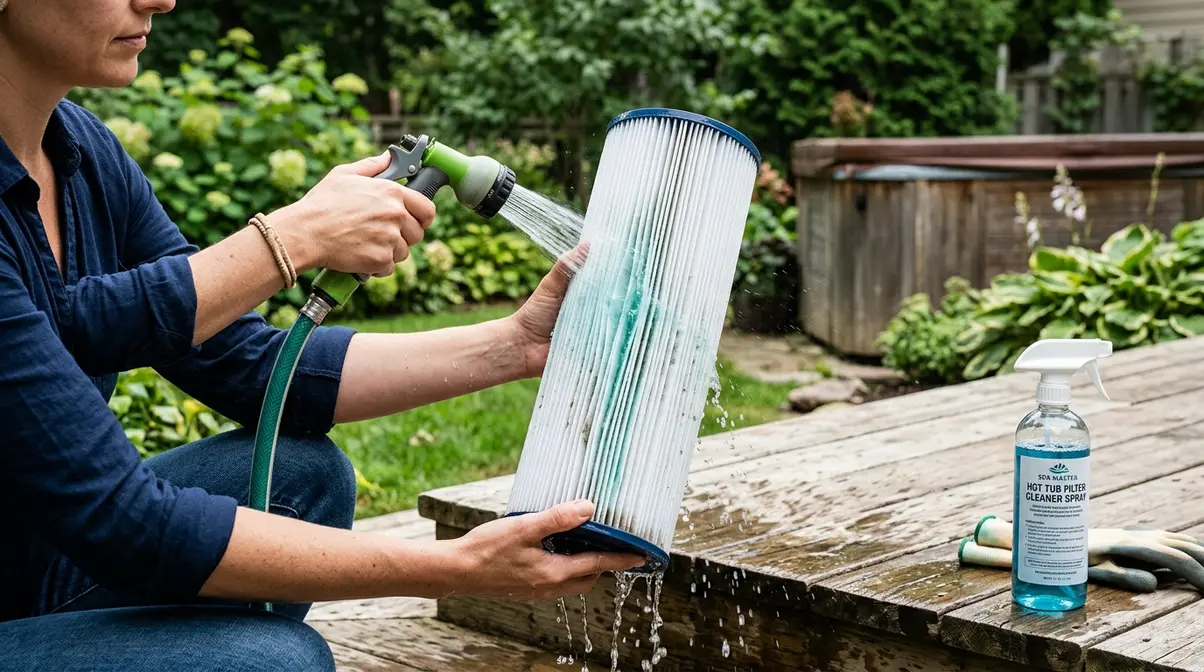
Layer 2 of the 4-Layer Clean System is Equipment — specifically your filter and cover. These two components are easy to neglect and expensive to replace when neglected. Our evaluation of common hot tub maintenance routines found that filter care is the most frequently skipped step, and the most common cause of persistent cloudy water that doesn’t respond to chemical treatment.
How to Clean Your Hot Tub Filter (Step by Step)
Your filter catches everything that enters your water — body oils, hair, debris, and micro-particles. A clogged filter restricts water flow, strains your pump, and reduces the effectiveness of every chemical you add. Rinse it weekly; deep-clean it monthly.
Weekly rinse (2–3 minutes):
- Turn off the hot tub jets and remove the filter cartridge from its housing
- Hold the filter vertically and rinse between each pleat with a firm stream from a garden hose — work top to bottom
- Do not use a pressure washer — the force tears the filter media and shortens its life
- Reinstall the filter and restart the system
Monthly deep clean (30–45 minutes + overnight soak):
- Remove the filter cartridge
- Spray the entire filter with hot tub filter cleaner spray, covering all pleats
- Let the cleaner soak for 15 minutes to break down oils and mineral deposits
- Rinse thoroughly with a garden hose until the water runs clear
- For stubborn buildup, soak the filter overnight in a filter cleaning solution (1 part cleaner to 5 parts water in a bucket)
- Rinse again after soaking, then allow the filter to air-dry completely before reinstalling
- Pro tip: Keep a spare filter cartridge on hand so you can rotate them — one soaking while one is in use
Never reinstall a wet filter directly from a chemical soak without rinsing thoroughly. Residual cleaner will foam your water immediately.
When to Replace Your Hot Tub Filter
A clean filter still has a finite lifespan. User consensus across hot tub owner communities and manufacturer guidance consistently points to 12–24 months as the typical replacement window for a filter that is cleaned regularly. Filters used in hard-water areas or high-use households may need replacement closer to the 12-month mark.
Signs it’s time to replace your filter:
- Pleats are visibly frayed, crushed, or misshapen after rinsing
- Water stays cloudy even after cleaning the filter and balancing chemicals
- Filter has a persistent discoloration (grey or brown) that doesn’t wash out
- It’s been more than 2 years since the last replacement
Replacement filters typically cost $15–50 depending on your hot tub brand. That’s a small investment compared to the pump damage caused by running your system with a collapsed filter.
Hot Tub Cover Care: Why It Matters
Your cover does more than keep debris out. It retains heat (reducing energy costs by up to 95% compared to leaving the tub uncovered), prevents chemical evaporation, and blocks UV rays that degrade chlorine rapidly. A damaged cover undermines every other maintenance effort you make.
Cover care routine:
- Weekly: Wipe the exterior with a damp cloth to remove debris and bird droppings
- Monthly: Apply a UV protectant spray to the vinyl exterior to prevent cracking and fading
- Monthly: Clean the underside (the side facing the water) with a diluted bleach solution (1 tablespoon bleach per gallon of water) — the warm, moist underside is a common spot for mold and mildew growth
- Quarterly: Check the foam core for waterlogging — lift each side of the cover and compare the weight. A waterlogged cover becomes extremely heavy and loses all insulating value. Replace when waterlogged.
A well-maintained cover typically lasts 5–7 years. A neglected cover may need replacement in 2–3 years.
How to Do a Quarterly Deep Clean
Layer 3 of the 4-Layer Clean System is Deep Clean — draining, scrubbing, and refilling your hot tub every 3–4 months. This is the task most new owners dread, but it’s far simpler than it looks. For a full step-by-step deep dive into every aspect of the cleaning process, see our complete resource on hot tub deep cleaning and shell care.
Why 3–4 months? Hot tub water accumulates total dissolved solids (TDS) — the chemical residue from every treatment you’ve added — over time. Once TDS levels get too high (above 1,500 ppm), your water becomes resistant to chemical treatment. No amount of sanitizer or pH adjustment will work properly. Draining and refilling is the only fix. Research from spa industry professionals suggests that most 300-400 gallon hot tubs reach this threshold within 90–120 days of regular use.
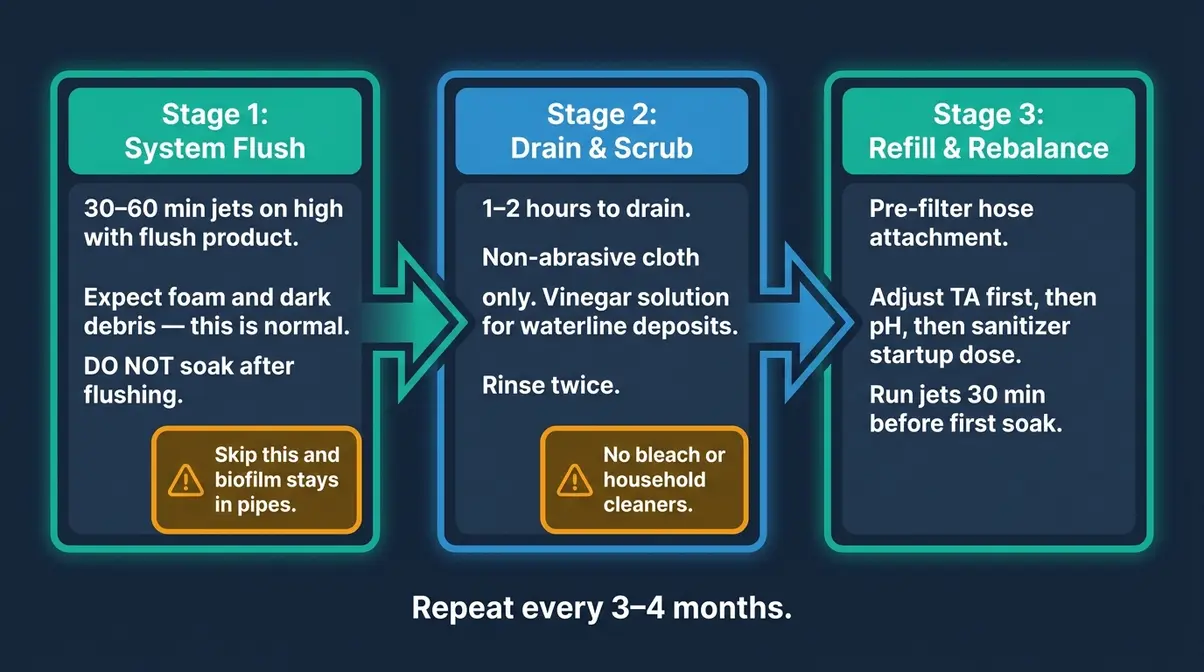
Step 1: Run a System Flush Before You Drain
A system flush cleans the internal plumbing lines — the pipes, jets, and pump housing — before you drain the water. This step is non-negotiable. Here’s why: biofilm (a slimy bacterial layer that coats the inside of pipes) builds up in your plumbing between every soak. When you drain without flushing first, you leave that biofilm in the pipes. When you refill, it immediately contaminates your fresh water.
How to run a system flush:
- With your current water still in the tub, add a pipe/line flush product (available at any pool supply store) according to label instructions
- Run all jets on high for 30–60 minutes — this circulates the flush product through every line
- You’ll likely see foam and dark debris come out of the jets — that’s the biofilm being expelled. This is normal and expected
- Drain the tub immediately after flushing — do not soak in flushed water
The flush product costs $10–15 and takes under an hour. Skipping it is the #1 reason new owners get recurring water problems even after a full drain and refill.
Step 2: Drain, Scrub, and Rinse the Shell
Draining:
- Attach a submersible pump or garden hose (using the drain valve) to remove water — most hot tubs drain in 1–2 hours
- Check your local regulations on where to drain — chlorinated/brominated water should not drain directly into storm drains in most municipalities; drain to a lawn or landscaped area where it will percolate into the soil
Scrubbing the shell:
- While the tub is still slightly wet (easier to scrub), wipe the entire interior with a non-abrasive cloth or sponge
- Use only products labeled safe for hot tub acrylic shells — do not use household cleaning items like bleach, abrasive scrubbers, or all-purpose bathroom cleaners. These scratch the acrylic and leave residues that foam your water for weeks
- A diluted white vinegar solution (1 part vinegar to 1 part water) works safely on waterline calcium deposits and light staining
- Pay extra attention to the waterline — body oils and sunscreen accumulate in a visible ring here
- Scrub the jet faces and headrests with the same non-abrasive cloth
- Rinse the entire shell thoroughly with a garden hose until no product residue remains
Rinsing:
- After scrubbing, rinse again — twice — to ensure no cleaning residue remains in the tub
- Wipe dry with a clean cloth before refilling
Step 3: Refill, Rebalance, and Start Fresh
Refilling:
- Use a pre-filter hose attachment when refilling — this removes heavy metals (iron, copper, manganese) and minerals from your tap water that cause staining and scale. This is especially important if you have hard water
- Fill to the manufacturer’s recommended level (typically 2–3 inches above the highest jet)
- Do not run the jets until the water level covers them completely — running jets dry burns out the pump seal
Rebalancing fresh water (in this order):
- Test the fresh water first — tap water chemistry varies significantly by region
- Adjust total alkalinity first (target: 80–120 ppm)
- Adjust pH second (target: 7.2–7.8)
- Add your initial sanitizer dose — fresh water needs a larger “startup” dose; follow product label for new-fill instructions (typically 2–3x the maintenance dose)
- Run jets for 30 minutes to circulate everything
- Retest all parameters before your first soak
- Add a startup shock dose to oxidize any metals or organics in the fresh fill water
Your first soak after a fresh fill may feel different — the water will be noticeably cleaner and clearer. That’s the baseline you’re maintaining with your weekly routine.
Hot Tub Health and Safety — What Every Owner Must Know
Layer 4 of the 4-Layer Clean System is Health Safety — and it’s the layer most guides completely ignore. Common concerns from new hot tub owners include skin rashes, soaking too long, and health conditions that may make hot tub use risky. This section answers those questions directly, with citations from authoritative health sources.
⚠️ Medical Disclaimer: If you have a heart condition (including AFib), skin condition, diabetes, or are pregnant, consult your physician before using a hot tub. The information in this section is educational, not medical advice.
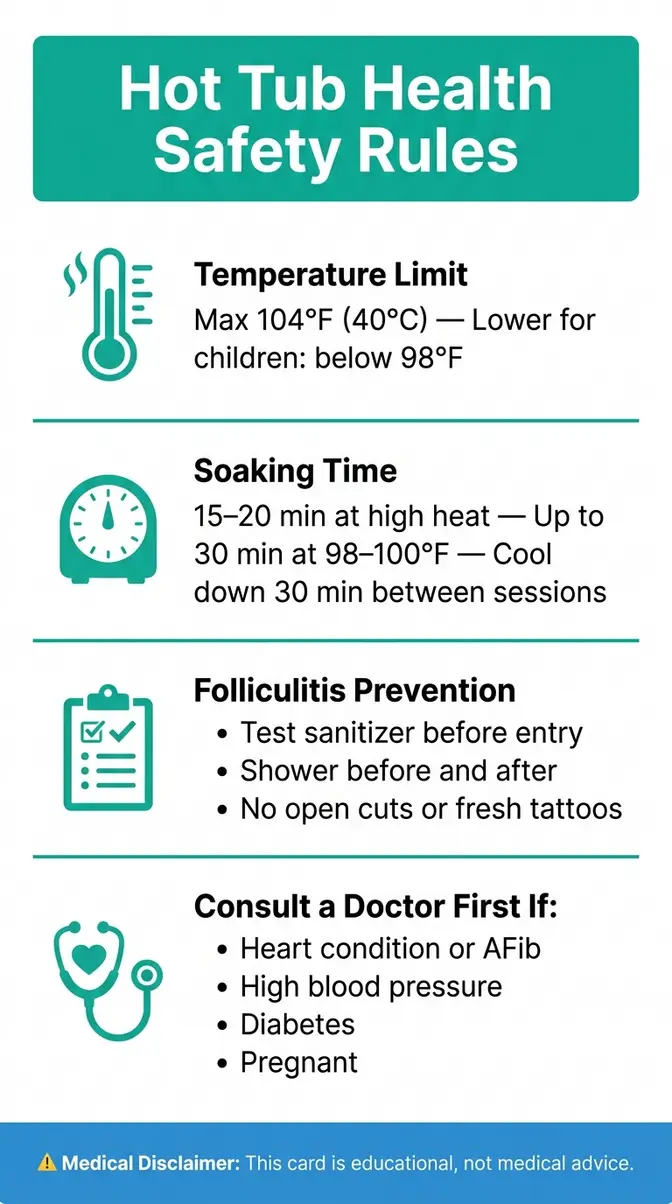
How to Prevent Hot Tub Folliculitis
Hot tub folliculitis is a skin infection caused by Pseudomonas aeruginosa, a bacterium that thrives in warm, inadequately sanitized water. The CDC identifies it as one of the most common recreational water illnesses associated with hot tubs and spas (CDC Healthy Swimming — Recreational Water Illness, 2024). Symptoms include red, itchy bumps — usually on areas covered by a swimsuit — appearing 12–48 hours after soaking.
Why do only some people get it? Research suggests individual susceptibility varies based on skin microbiome, immune response, and the duration of exposure. People with cuts, shaved skin, or compromised immune systems are at higher risk. But the primary driver is always inadequate sanitizer levels — Pseudomonas cannot survive in properly maintained hot tub water.
Prevention checklist:
- Always test sanitizer levels before soaking — never get in water below 1 ppm chlorine or 3 ppm bromine
- Shower before entering the hot tub — body oils, lotions, and sweat consume sanitizer rapidly and accelerate bacterial growth
- Shower immediately after soaking to remove any bacteria from the skin surface
- Avoid soaking in hot tubs at hotels, gyms, or public facilities unless you can verify the sanitizer level (carry a test strip)
- Never soak with open cuts, abrasions, or fresh tattoos
If you develop folliculitis: The rash typically resolves on its own within 7–10 days without treatment. Spa Marvel’s guidance on hot tub rash notes that keeping the affected area clean and dry accelerates recovery. Consult a physician if the rash spreads, develops pus, or persists beyond two weeks.
Safe Soaking Time: The 15-Minute Rule Explained
The 15-minute rule exists because hot tub water raises your core body temperature rapidly — and your cardiovascular system has to work harder to compensate. The CPSC recommends limiting soaks to 15 minutes at 104°F, particularly for new users, children, and anyone with health conditions (CPSC Spa and Hot Tub Safety Guidelines, 2024).
What happens if you sit in a hot tub for 3 hours? Extended soaking at high temperatures can cause hyperthermia (dangerous overheating), dehydration, dizziness, and in severe cases, loss of consciousness. Your body temperature can rise to dangerous levels (above 104°F internally) within 30–60 minutes of soaking at maximum temperature. The risk increases significantly with alcohol consumption — alcohol impairs your body’s ability to regulate temperature and can cause sudden drops in blood pressure when exiting.
Safe soaking guidelines:
- Temperature: Keep water at or below 104°F (40°C) — lower for children (below 98°F) and anyone with health conditions
- Session length: 15–20 minutes per session at high heat; up to 30 minutes at lower temperatures (98–100°F)
- Can you go in twice a day? Yes, with a cool-down period of at least 30 minutes between sessions. Allow your core temperature to return to normal before re-entering
- Hydration: Drink water before and during soaking — hot tubs cause significant fluid loss through perspiration
- Exit slowly: Stand up gradually to avoid dizziness from the blood pressure change
Children under 5 should not use hot tubs. Children 5–12 should limit sessions to 5 minutes at temperatures no higher than 98°F.
Hot Tubs and Heart Conditions: What You Need to Know
Can a hot tub trigger AFib? Research suggests it can in susceptible individuals. Hot water immersion causes blood vessels to dilate and heart rate to increase — effects that can trigger arrhythmias (irregular heartbeats) in people with pre-existing cardiac conditions. A study referenced by Harvard Medical School notes that while brief, moderate heat exposure (such as sauna use) may have cardiovascular benefits for healthy individuals, the same exposure can be destabilizing for those with arrhythmias including atrial fibrillation (AFib) (Harvard Health Publishing — Heat Therapy and the Heart, 2024).
Who should consult a doctor before using a hot tub:
- Anyone diagnosed with AFib, arrhythmia, or any heart condition
- People with high blood pressure or who take blood pressure medications
- Anyone who has had a recent heart attack or cardiac procedure
- People with diabetes (hot water affects circulation and blood sugar regulation)
- Pregnant women — hot tub use during pregnancy, particularly in the first trimester, is associated with increased risk of neural tube defects according to research summarized by the Mayo Clinic (Mayo Clinic — Hot Tub Use During Pregnancy, 2024)
For healthy adults with no pre-existing conditions, moderate hot tub use — 15–20 minutes at temperatures below 104°F — is generally considered safe. The key word is consult first, soak second if any of the above conditions apply to you or your guests.
Common Mistakes and When to Call a Pro
Our evaluation of the most common beginner questions across hot tub owner communities reveals a consistent pattern: most problems come from a handful of the same mistakes. Here’s how to avoid them — and when the problem is beyond a DIY fix.
The 6 most common beginner mistakes:
- Adding chemicals without testing first. Guessing your chemical levels wastes money and creates the very imbalance you’re trying to fix. Always test before adding anything.
- Shocking in a covered tub. Shock releases gases that need to escape. Always remove the cover and run jets with the cover off for at least 15–20 minutes after shocking.
- Using household cleaners on the shell. Bleach, bathroom sprays, and abrasive scrubbers damage acrylic surfaces and leave residues that cause persistent foaming. Use only products labeled for hot tub use.
- Skipping the system flush before draining. This leaves biofilm in the pipes, which immediately contaminates your fresh fill water. Always flush first.
- Running jets with the water level below the jets. This burns out the pump seal within minutes. Fill to the correct level before turning on the system.
- Ignoring the filter for months. A clogged filter is the single most common cause of cloudy water that doesn’t respond to chemical treatment.
When to call a professional:
- Jets have no pressure despite a clean filter and correct water level — likely a pump or plumbing issue
- The heater fails to maintain temperature — element or thermostat replacement required
- You notice a persistent chemical smell after repeated shocking — may indicate a biofilm issue deep in the plumbing requiring professional flushing
- Water test results are consistently abnormal despite correct chemical additions — a water sample test at a pool supply store can diagnose mineral imbalances that test strips miss
- Any electrical issue — never DIY electrical repairs on a hot tub
Most equipment repairs cost $150–500 for a service call. Catching problems early (by maintaining your routine) prevents the $1,000+ repairs that come from neglected systems.
Frequently Asked Questions
Why is there a 15-minute hot tub rule?
The 15-minute rule exists because hot tub temperatures raise your core body temperature rapidly, placing strain on the cardiovascular system. The CPSC recommends limiting sessions to 15 minutes at the maximum temperature of 104°F to prevent hyperthermia (dangerous overheating) and dizziness (CPSC, 2024). At lower temperatures (98–100°F), sessions of up to 30 minutes are generally considered safe for healthy adults. The risk increases significantly with alcohol consumption, which impairs temperature regulation. Always exit slowly and hydrate before and after soaking.
Is a hot tub bad for folliculitis?
Hot tubs can cause folliculitis if the sanitizer level is inadequate, but a properly maintained hot tub does not trigger or worsen the condition. Hot tub folliculitis is caused by Pseudomonas aeruginosa, a bacterium that cannot survive in water with correct chlorine (1–3 ppm) or bromine (3–5 ppm) levels (CDC, 2024). If you already have folliculitis, avoid soaking until the skin has healed — warm water and bacteria are a poor combination for open or inflamed skin. Shower immediately after every soak as a preventive measure.
What should I put in my hot tub to keep it clean?
The four essentials are sanitizer, shock, pH balancer, and alkalinity increaser. Use chlorine granules or bromine tablets as your primary sanitizer, maintained at 1–3 ppm (chlorine) or 3–5 ppm (bromine). Add oxidizing shock weekly to break down organic waste. Test pH every 2–3 days and keep it between 7.2–7.8 using pH up or pH down as needed. Keep total alkalinity at 80–120 ppm. This four-chemical system, combined with regular filter cleaning, handles the vast majority of hot tub maintenance needs for new owners.
Can a hot tub trigger AFib?
Hot tub use can potentially trigger AFib in people with pre-existing cardiac arrhythmias. Hot water immersion raises heart rate and causes blood vessels to dilate — physiological changes that can destabilize heart rhythm in susceptible individuals. Harvard Medical School research notes that heat exposure, while beneficial for some cardiovascular outcomes in healthy people, can be a trigger for arrhythmias including atrial fibrillation (Harvard Health, 2024). If you have AFib or any heart condition, consult your cardiologist before using a hot tub. Healthy adults without cardiac conditions are generally not at risk.
What happens if you sit in a hot tub for 3 hours?
Soaking for 3 hours in a hot tub at high temperatures can cause hyperthermia, severe dehydration, and loss of consciousness. Your core body temperature can reach dangerous levels within 30–60 minutes at 104°F. Symptoms of overheating include dizziness, nausea, rapid heartbeat, and confusion. The risk escalates dramatically with alcohol consumption, which impairs your body’s ability to cool itself and can cause a dangerous drop in blood pressure when you stand up. Even at lower temperatures, sessions beyond 45–60 minutes carry meaningful dehydration risk.
Can you go in a hot tub twice a day?
Yes — with a cool-down period of at least 30 minutes between sessions. Allow your core body temperature to return to normal before re-entering. Keep each session to 15–20 minutes at high heat (above 100°F), or up to 30 minutes at lower temperatures. Stay well-hydrated throughout the day. There’s no medical evidence that two properly-spaced sessions per day causes harm for healthy adults, but consecutive long soaks without recovery time increase the risk of overheating and dehydration meaningfully.
Why do only some people get hot tub folliculitis?
Individual susceptibility varies based on skin condition, immune response, and exposure duration — but inadequate sanitizer is always the root cause. People with minor skin abrasions, recently shaved skin, or compromised immune systems face higher risk because Pseudomonas aeruginosa can enter more easily. However, the bacterium cannot establish an infection in properly sanitized water regardless of individual susceptibility. If only some guests develop folliculitis after using the same hot tub, that’s a reliable signal that sanitizer levels were too low at the time of use.
What kills folliculitis naturally?
Hot tub folliculitis typically resolves on its own within 7–10 days without any treatment in most cases. Keeping the affected skin clean and dry speeds recovery. Warm compresses can relieve itching and discomfort. Avoid re-entering any hot tub until the rash has fully resolved — re-exposure before healing prolongs the infection. For persistent, spreading, or painful cases (particularly those with pus or fever), consult a physician — oral antibiotics may be required. There is no evidence that home remedies such as tea tree oil or apple cider vinegar reliably eliminate Pseudomonas infections.
Your Clean Hot Tub Starts With Four Simple Layers
For new hot tub owners, the biggest barrier isn’t effort — it’s the feeling of not knowing where to start. The 4-Layer Clean System solves that by giving every maintenance task a home: Chemistry (weekly water testing and chemical balancing), Equipment (filter and cover care), Deep Clean (quarterly drain and scrub), and Health Safety (temperature limits, soaking time, and medical awareness). At OneHotTub.com, our team’s evaluation of common beginner routines consistently finds that owners who follow a structured framework spend less time troubleshooting and more time enjoying their investment.
The system works because each layer supports the others. Clean chemistry keeps your filter from clogging prematurely. A clean filter keeps your chemistry stable. A quarterly deep clean resets the system when dissolved solids accumulate beyond what weekly maintenance can handle. And health safety awareness ensures that every soak — for you and your guests — is genuinely safe, not just chemically clean.
Start with the minimum: test strips, sanitizer, and shock. Follow the weekly routine in Step 1 through Step 4. Set a calendar reminder for your quarterly deep clean. And consult your doctor if you have any health conditions before your first soak. For a deeper walkthrough of the drain-and-scrub process, our full guide to hot tub deep cleaning and shell care covers every detail. Your clear, safe, perfectly balanced hot tub is three weeks of good habits away.