

Table of Contents - Hot Tub Installation Cost 2026: Full Price Breakdown
This blog post may contain affiliate links. As an Amazon Associate I earn from qualifying purchases.
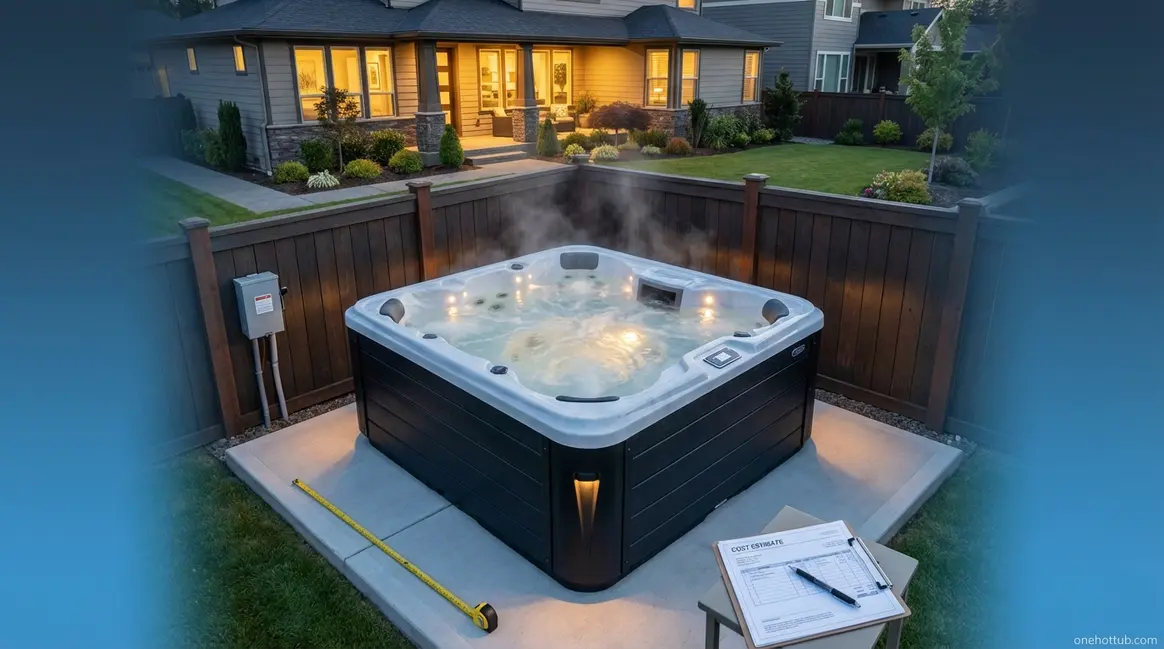
You’ve found the perfect hot tub. The sticker reads $4,500 — and by the time it’s running in your backyard, you’ll have spent closer to $8,500. That gap isn’t a mistake; it’s the predictable result of four separate cost layers that almost no advertised price includes.
Most buyers discover too late that the “hot tub installation cost” shown on a retailer’s website covers only the unit and basic delivery. The dedicated 220V circuit, the concrete pad, the permit fees, and the first year of maintenance arrive as separate invoices — each from a different contractor. According to HomeGuide’s 2026 national contractor data, the average total spend (hot tub plus all installation components) runs $4,000 to $15,000 for above-ground models, compared to the $1,000–$2,000 most buyers initially budget for “installation.”
This guide stacks every cost layer in one place: unit price by tier, installation type (above-ground vs. in-ground), electrical wiring, foundation options, ongoing monthly expenses, and how to hire the right team. Prices listed throughout are 2026 estimates and vary by region, labor market, and site conditions — always request at least three quotes from licensed professionals.
Key Takeaways: Hot Tub Installation Cost 2026
Hot tub installation cost ranges from $650 to $6,100 for above-ground models in 2026 — but The Total Ownership Stack, including electrical ($800–$2,200), a concrete pad ($1,400–$3,500), and first-year maintenance ($1,200–$1,800), can push your realistic first-year spend past $10,000.
- Unit prices range from $300 (inflatable) to $35,000+ (custom in-ground) — your tier determines your entire budget trajectory
- Electrical work requires a licensed electrician for 220V/240V dedicated circuits — budget $800–$2,200 in 2026
- Concrete slabs are highly recommended; expect $1,400–$3,500 to pour a standard hot tub pad
- The Total Ownership Stack adds permits, delivery, and maintenance on top — plan for 3–4x your sticker price in year one
Complete Installation Cost Breakdown
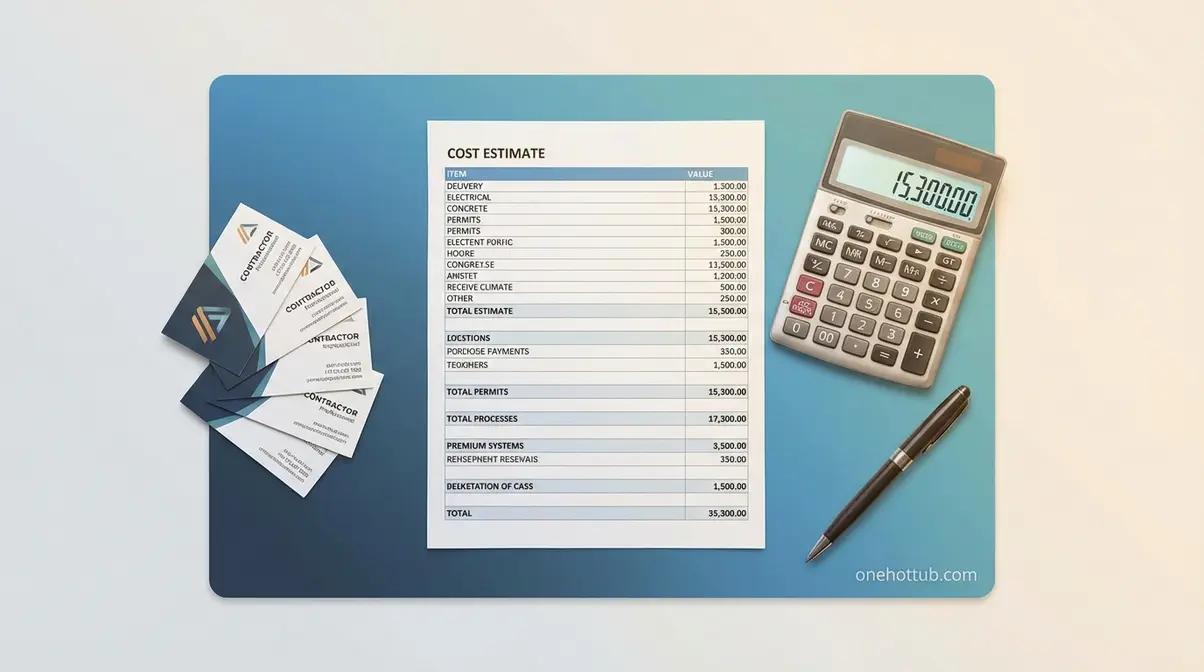
Hot tub installation cost in 2026 ranges from $650 to $6,100 for a standard above-ground model, based on national contractor data from HomeGuide and Angi. That range covers delivery, standard labor, and basic electrical hookup — but it does not include the concrete pad, permit fees, or ongoing maintenance. Understanding the Total Ownership Stack — the layered total of every cost from unit purchase through year-one maintenance — is why this section exists.
Our research at OneHotTub.com across installer quotes and 2026 industry pricing data from HomeGuide, Angi, and HomeAdvisor shows the gap between “sticker price” and “installed price” consistently surprises buyers. The average homeowner who budgets $5,000 for a hot tub ends up spending $8,000–$12,000 once electrical, foundation, and first-year upkeep are added. House Beautiful’s expert cost analysis confirms that hiring a professional electrician to wire a hot tub to a 220V outlet typically adds $1,000–$2,000 to total installation cost (House Beautiful, 2026).
What’s Included in Installation?
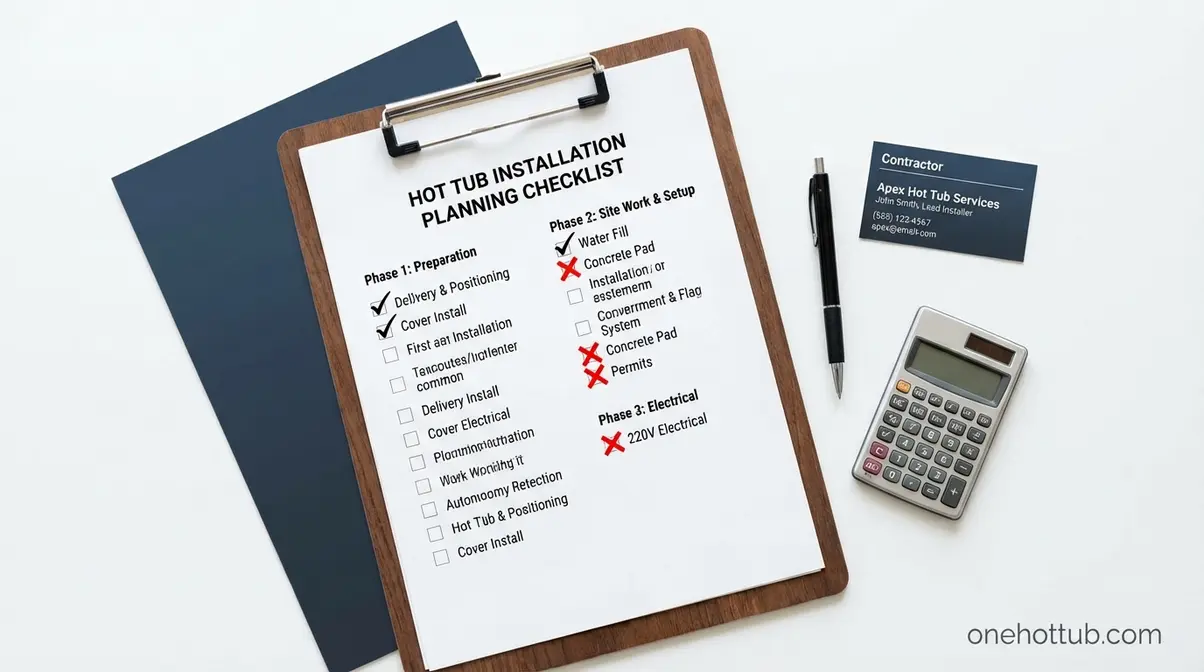
The phrase “hot tub and installation cost” means different things depending on who is quoting you. A retailer’s installation quote and a contractor’s installation quote are not the same document.
Think of it the way you think about buying a car. The sticker price doesn’t include tax, registration, insurance, or the first oil change. A hot tub’s “installed price” similarly breaks into layers:
- What a standard dealer installation quote typically covers:
- Delivery and positioning (moving the tub from the truck to its final location)
- Basic site leveling (minor grading adjustments only)
- Water fill and startup chemical balance
- Control panel orientation and filter setup
- Cover installation
- What is almost always billed separately:
- 220V/240V electrical circuit (requires a licensed electrician)
- Concrete pad or foundation work (requires a concrete contractor)
- Permit and inspection fees ($100–$250 in most municipalities)
- Structural engineering review if placing on a deck ($300–$700)
Permits are required in most municipalities because local building departments need to inspect both the electrical work and any structural modifications for code compliance and safety. Skipping permits can void your homeowner’s insurance and create complications when you sell the property.
When you see “hot tub and installation cost” advertised as $4,500, that typically means the unit plus basic dealer delivery and setup. The electrician and the concrete contractor are separate phone calls you will make yourself. The difference between a buyer who knows this and one who doesn’t: roughly $3,000 in unexpected invoices.
Hot Tub Unit Prices by Tier
Hot tub cost varies enormously — from $300 for a basic inflatable to $35,000+ for a custom in-ground build. The single most important variable for your total budget is the voltage divide: models under $2,000 typically run on a 110V standard outlet (no electrician needed), while virtually every acrylic tub above $2,000 requires a dedicated 220V/240V circuit.
A plug-and-play hot tub is a self-contained unit that runs on a standard 110V household outlet — no electrician required. These are primarily inflatable and small entry-level models. Every other tier requires a licensed electrician and a dedicated circuit.
| Tier | Unit Price Range | Typical Capacity | Voltage | Electrician Needed? |
|---|---|---|---|---|
| Inflatable | $300–$1,200 | 2–4 person, basic jets | 110V | No |
| Entry portable | $2,000–$4,000 | 4–6 person, acrylic shell | 220V | Yes |
| Mid-range portable | $4,000–$8,000 | 6–8 person, therapy jets | 220V | Yes |
| Premium / Luxury | $8,000–$20,000+ | 6–8 person, advanced features | 220V | Yes |
| Custom in-ground | $15,000–$35,000+ | Fully custom | 220V | Yes |
For the most common purchase — a mid-range 6-person portable hot tub — buyers typically spend $5,000–$7,500 on the unit alone. Add a concrete pad ($1,400–$3,500) and 220V electrical ($800–$2,200) and your all-in cost is $7,200–$13,200 before you fill it with water. That’s the Total Ownership Stack in its most common form.
The “8-person hot tub cost” range of $8,000–$16,000 surprises many buyers who start with the unit price but forget that larger tubs require heavier foundations and longer electrical runs — both of which push installation costs toward the upper range.
Labor, Delivery, and Permit Fees
These are the invisible charges that never appear in the headline price — and the competitor gap this section directly addresses.
Standard delivery: $200–$500. This covers transporting the tub to your property and, in most cases, dropping it at the gate or driveway. “Full placement delivery” — moving the tub to its exact final position in the yard — costs an additional $150–$300 and is often included in dealer installation packages but billed separately by big-box retailers.
Permit fees: $100–$250. Most municipalities require a permit for any electrical work (mandatory for 220V installations) and for structural modifications like a new concrete pad. Budget $100–$250 for permit and inspection fees; some higher-cost municipalities charge up to $500. What happens without a permit? Failed inspections, voided homeowner’s insurance coverage, and complications at resale.
Installation labor (dealer setup): $200–$800. This is separate from the electrician and concrete contractor. Dealer installation covers the setup day: positioning, water fill, startup chemical balance, and a walkthrough of your controls. Health Mate Hot Tubs reports national installation labor averages around $300 for basic above-ground setups (Health Mate Hot Tubs, 2026).
For a realistic mid-range portable tub: $350 delivery + $175 permit + $400 installation labor = $925 in fees before any electrical or foundation work. Most buyers don’t see this coming.
Cost of hot tub installation also varies by geography. Labor rates for hot tub installation near you in a high-cost market like Seattle or Boston may run 30–50% above the national average cited here.
Interactive Cost Calculator
To calculate your specific project cost based on zip code, hot tub type, and electrical panel capacity, use the tool below:
Regional variation is real. A $2,200 electrical job in Manhattan may cost $900 in rural Tennessee — the same licensed work, the same materials, vastly different local labor markets. Climate also matters: buyers in Minnesota or Wisconsin need higher-insulation models and should factor in winterizing costs that buyers in Florida rarely face.
The calculator provides an estimate — always confirm with three or more licensed contractor quotes before finalizing your budget.
The Total Ownership Stack below summarizes every line item so you can see the full picture before a single contractor sets foot on your property:
| Cost Category | Low Estimate | High Estimate | Notes |
|---|---|---|---|
| Hot tub unit | $300 | $35,000+ | Tier-dependent |
| Standard delivery | $200 | $500 | Curbside; crane extra |
| Electrical (220V wiring) | $800 | $2,200 | Licensed electrician required |
| Concrete pad/foundation | $1,400 | $3,500 | Highly recommended |
| Deck reinforcement (if applicable) | $800 | $3,100 | Alternative to concrete |
| Permits and inspections | $100 | $250 | Required in most municipalities |
| First-year maintenance | $300 | $600 | Chemicals + filters |
| Total installed (entry-level) | $3,100 | $5,550 | Above-ground, basic setup |
| Total installed (mid-range) | $6,400 | $12,600 | Above-ground, full electrical + pad |
Prices are 2026 estimates. Costs vary by region, labor market, and site conditions (HomeGuide, 2026).
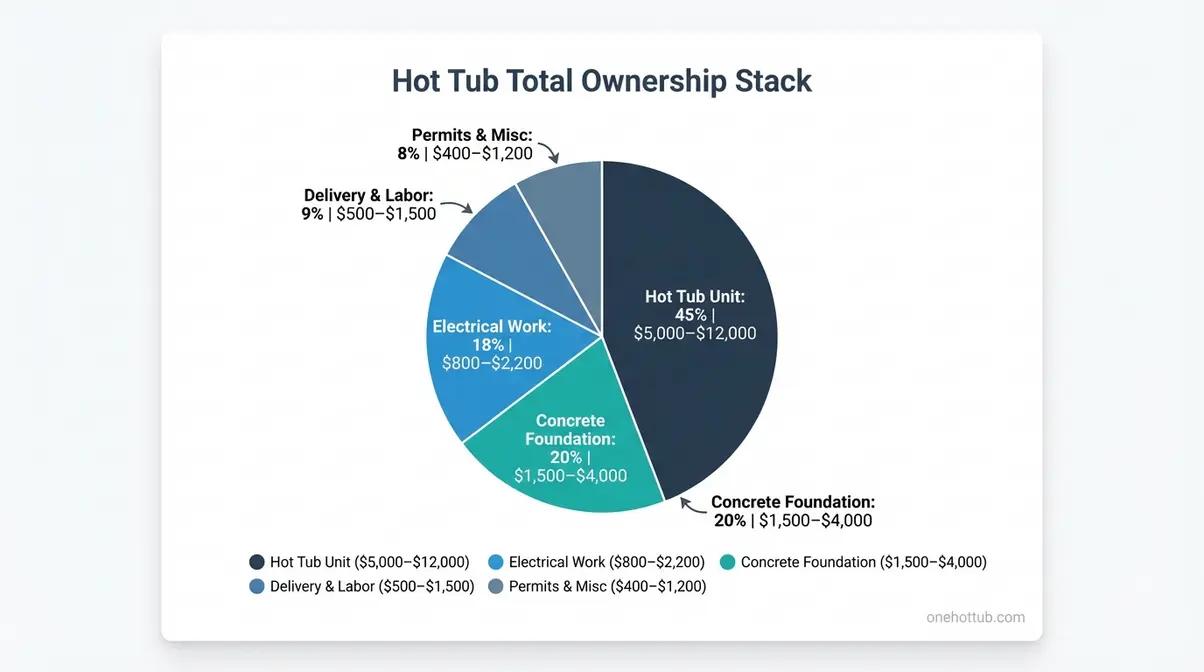
Caption: The Total Ownership Stack — how a $5,000 hot tub budget becomes a $10,000 first-year investment once electrical, foundation, and maintenance are layered in.
For a full breakdown of what to look for before you buy, see our comprehensive hot tub buying guide.
The single biggest surprise for most buyers is the electrical requirement — especially when an older panel needs upgrading. The next section covers exactly what that work costs and why a licensed electrician is non-negotiable.
Above-Ground vs. In-Ground Price Gap
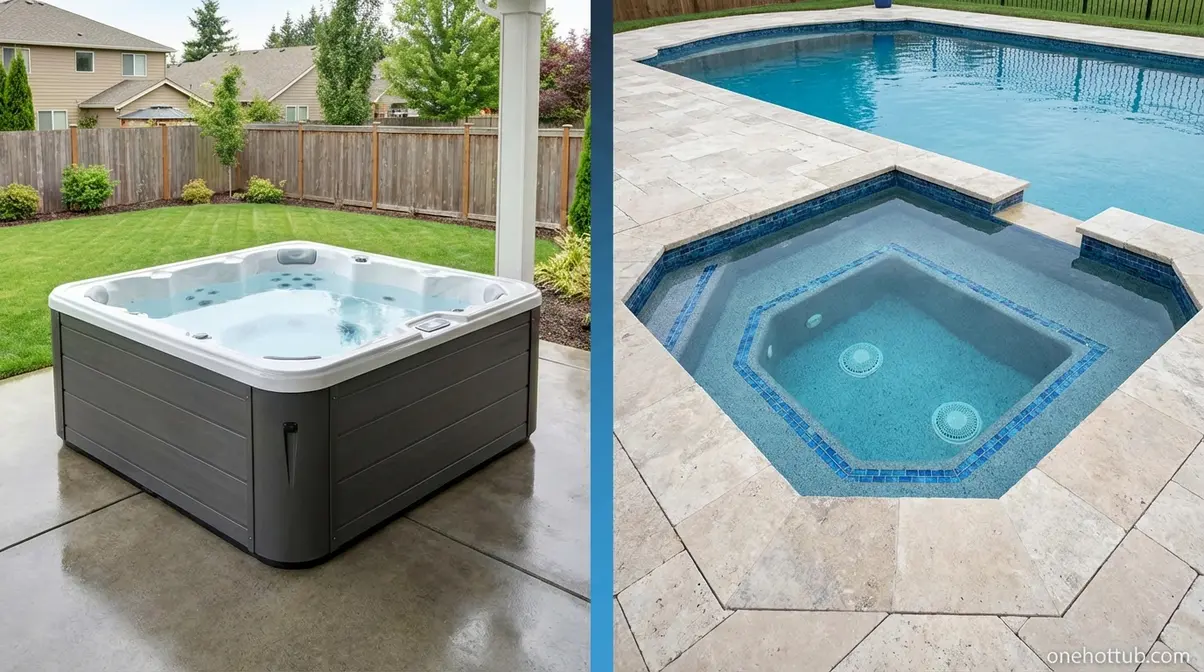
Above-ground hot tub installation costs range from $650 to $6,100; in-ground installation costs start at $15,000 and can top $35,000 for custom builds — a difference that amounts to two entirely separate budget categories (Angi, 2026). The decision between these two types is not a preference question; it is a financial commitment question. Choosing in-ground means committing to a major landscaping project with multiple licensed trades, a timeline of four to eight weeks, and a permanent structural change to your property.
“In-ground hot tub installation costs start at $15,000 and routinely reach $35,000+ for custom builds — roughly 5–10x the cost of a comparable above-ground portable model.”
| Feature | Above-Ground (Portable) | In-Ground (Built-In) | Inflatable |
|---|---|---|---|
| Unit price | $2,000–$20,000 | $15,000–$35,000+ | $300–$1,200 |
| Installation cost | $650–$6,100 | $5,000–$15,000+ | $0–$200 |
| Excavation required | No | Yes ($3,000–$8,000) | No |
| Custom plumbing (PVC pipes) | Minimal | Extensive | No |
| Permit requirement | Likely (electrical) | Certain (multiple) | Rarely |
| Relocation possible | Yes | No | Yes |
| Typical installation time | 1–3 days | 4–8 weeks | Hours |
**
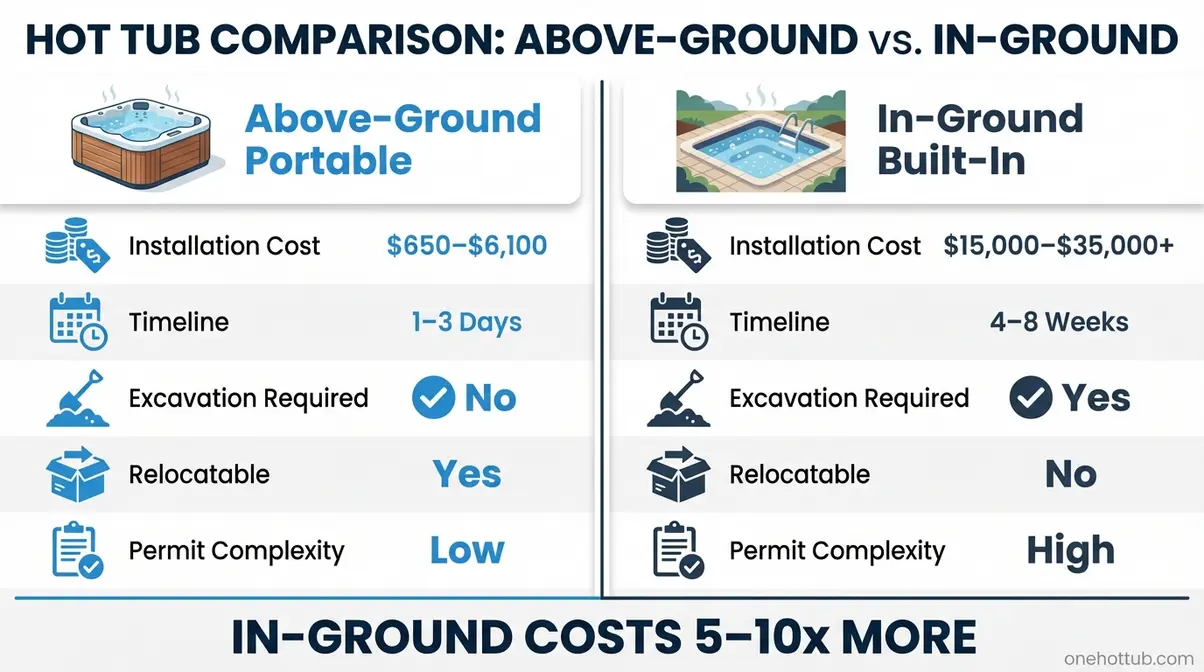
Caption: Above-ground vs. in-ground hot tub cost comparison — installation timelines and total price differences for 2026 buyers.
Explore our complete guide to above-ground hot tub characteristics and cost benefits before making your type decision.
Above-Ground Hot Tub Installation Cost
The $650–$6,100 range for above-ground hot tub installation cost is wide — and understanding why it’s wide is more useful than knowing the endpoints.
The low end ($650–$1,500) assumes a plug-and-play 110V tub on a pre-existing flat concrete surface with no electrical upgrade needed. The high end ($4,000–$6,100) assumes a 220V acrylic tub requiring a new dedicated circuit, a freshly poured concrete pad, and a crane for difficult yard access. Same “above-ground installation” category; completely different projects.
- Variables that push cost toward the high end:
- 220V electrical upgrade required (adds $800–$2,200)
- No existing concrete surface (adds $1,400–$3,500 for a new pad)
- Uneven terrain requiring site grading (adds $300–$800)
- Narrow gate access requiring crane delivery (adds $800–$2,500)
A practical example: a 6-person portable acrylic tub delivered to a home with a pre-poured concrete patio and a 200-amp panel nearby might total $3,200 installed. The exact same tub delivered to a sloped yard with an older 100-amp panel could cost $7,500+ once you factor in the 220V upgrade, a new concrete pad, and site grading. Both are “above-ground” installations.
The above-ground category covers the overwhelming majority of hot tub purchases, which is why the $650–$6,100 range deserves careful decomposition rather than a single headline figure.
In-Ground Hot Tub Installation Cost
In-ground hot tub installation — also called a built-in hot tub — starts at approximately $15,000 fully installed and routinely exceeds $35,000 for premium custom builds (Angi, 2026). The cost drivers are not one big expense; they are five separate trade costs stacked on each other.
- The five cost drivers for in-ground installations:
- Excavation: $3,000–$8,000 to dig the hole and remove soil
- Custom PVC plumbing — PVC pipes are the plastic supply and return lines that carry water to and from the jets and heater — typically $1,500–$3,500 for a basic in-ground build
- Concrete shell construction: $4,000–$10,000 for a gunite or shotcrete shell
- Tile and finish work: $1,500–$5,000+ depending on material
- Landscape restoration after construction: $1,000–$4,000
Timeline matters for planning as well. In-ground installations require four to eight weeks and involve coordinating an excavator, plumber, electrician, and tile installer — four separate contractor relationships. An above-ground tub is typically running within one to three days of delivery.
A realistic mid-tier example: $8,000 shell + $5,000 excavation + $2,000 plumbing + $1,500 electrical = approximately $16,500 minimum. Custom tile work, water features, or pool integration can push the total above $40,000.
One financial consideration worth knowing: Realtor.com notes that adding a hot tub does not typically increase a home’s resale value — a factor worth weighing carefully before committing to a $15,000+ in-ground installation (Realtor.com). If you plan to sell within five years, the in-ground investment is unlikely to return its cost at closing.
Before leaving this section, there’s a third option that most comparison guides skip: the inflatable hot tub — and it might be the smartest first step for budget-conscious buyers.
Inflatable & Portable Budget Tier
Inflatable hot tub installation cost is effectively $0 beyond the unit price. These models range from $300–$1,200, require only a flat surface and a standard 110V outlet, and self-install in hours. No permits, no concrete, no electrician. For buyers testing the hot tub lifestyle before committing to an acrylic tub, this is a legitimate strategy rather than a compromise.
The trade-offs are real and worth knowing upfront. Inflatable models produce lower jet pressure, use thinner insulation — which means 20–30% higher electricity consumption per session compared to full-foam acrylic tubs — and have shorter lifespans of three to five years versus ten to fifteen or more for quality acrylic shells.
Portable hot tub installation cost for small hard-shell entry-level units (as opposed to inflatables) sits in the $200–$500 range for basic delivery and setup — still far below acrylic mid-range installation. The trade-off in this tier is similar: lower jet count, simpler insulation, and limited warranty coverage.
Electrical Work: The Hidden Cost
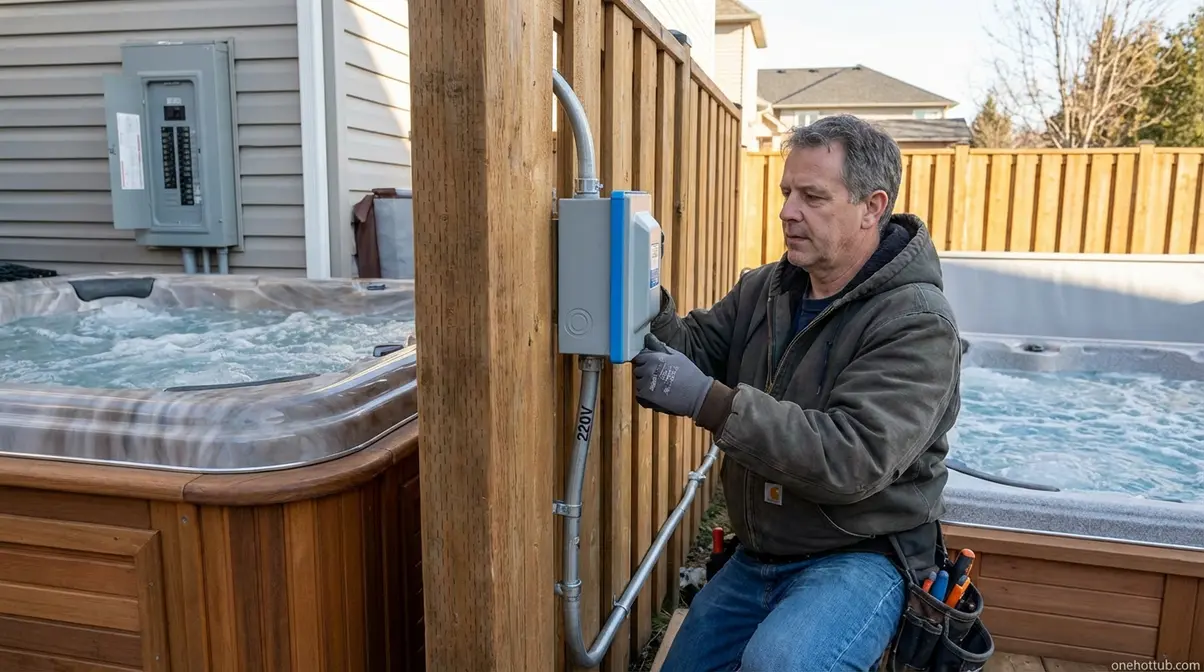
Hot tub electrical installation cost runs $800 to $2,200 for a licensed electrician to wire a dedicated 220V/240V circuit — and this is the line item most buyers discover only after purchasing their tub (HomeGuide, 2026). It is not optional; it is a safety code requirement under NEC Article 680, the National Electrical Code standard specifically governing the installation of pools, spas, and hot tubs.
All hot tub electrical wiring and equipment must strictly adhere to strict electrical requirements for spas — the federal safety standard governing pools, spas, and hot tubs (National Electrical Code).
⚠️ Safety Notice: All 220V/240V hot tub wiring must be installed by a licensed, certified electrician in compliance with NEC Article 680. DIY electrical work on hot tub circuits is illegal in most municipalities and creates serious electrocution and fire risks. This is non-negotiable.
“Hot tub electrical installation runs $800 to $2,200 for a dedicated 220V circuit in 2026 — and that figure can double if your panel needs a subpanel or upgrade.”
For a detailed guide on safe hot tub wiring requirements, see our essential hot tub electrical and 220V wiring requirements guide.
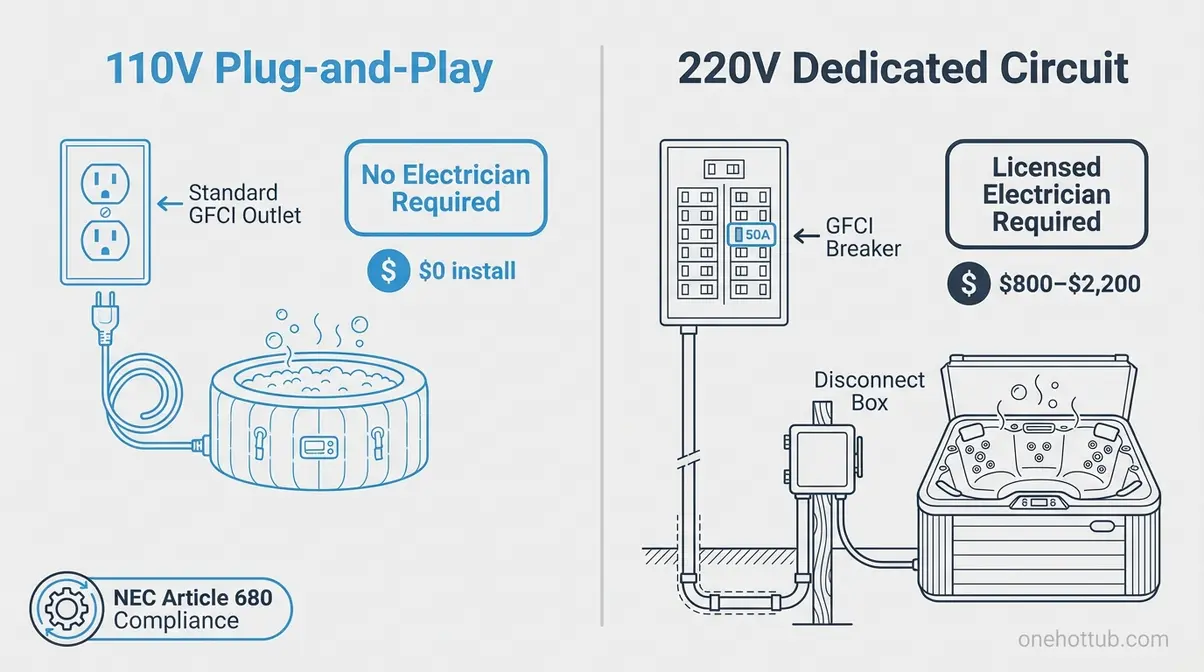
Caption: 110V plug-and-play vs. 220V dedicated circuit — how each setup connects to your home’s electrical system and what each one costs.
110V vs. 220V Dedicated Circuits
Think of a 220V dedicated circuit as a private highway lane just for your hot tub — it carries more power and never shares it with other appliances. A 110V outlet is the shared road: it works, but with limitations.
110V plug-and-play uses a standard US household outlet. No electrician needed — any exterior GFCI outlet (GFCI stands for Ground Fault Circuit Interrupter, a safety device that cuts power instantly when it detects water contact with electricity) will do. The limitation: lower power output means fewer jets, slower heat recovery (sometimes two to four hours longer to reach target temperature), and inferior performance in temperatures below 40°F. Typically available only on inflatable and small entry-level units under $2,000.
220V/240V dedicated circuit is a private electrical circuit running directly from your breaker panel to the tub’s disconnect box — a weatherproof switch mounted within five feet of the hot tub that allows power to be cut for service. This circuit powers the full heater, pump motor, and jet system simultaneously. Required by virtually all acrylic tubs above $2,000.
The “110 or 220 hot tub” debate usually resolves like this: if you’re buying an inflatable for under $1,000, stay with 110V. If you’re spending $2,000+, budget for the 220V install. While 110V units avoid the $800–$2,200 install cost, they cost more in electricity per session because they heat slowly and lose heat faster. The 220V install is a one-time fee; the efficiency gap is a forever cost.
Hot tub wiring installation cost by voltage type:
| Voltage | Upfront Install Cost | Electrician Needed? | Time to Heat | Best For |
|---|---|---|---|---|
| 110V | $0 | No | 8–12 hours | Inflatables, entry units |
| 220V/240V | $800–$2,200 | Yes (required) | 4–6 hours | All acrylic tubs $2,000+ |
What a Licensed Electrician Charges
Hot tub electrical installation cost ranges from $800 to $2,200 for a standard dedicated 220V/240V circuit installation, including new circuit, GFCI breaker, disconnect panel, and wiring up to 100 feet — based on 2026 data from HomeGuide. The expected cost to wire a 220V hot tub outlet typically adds $1,000–$2,000 to total installation cost, per House Beautiful’s expert interviews (House Beautiful, 2026).
Labor accounts for approximately 75% of this cost; materials — wire, conduit, GFCI breaker, and disconnect panel — account for roughly 25%. Electricians typically charge $50–$130 per hour for this work, with the full job running six to eight hours.
- What affects where your quote falls within that range:
- Distance from the electrical panel to the tub location (longer runs mean more wire and labor)
- Whether conduit must be trenched underground (adds $8–$25 per linear foot)
- Your panel’s current capacity (a full panel may require a subpanel — see next section)
- Local labor market rates
How to use this data when evaluating quotes: if a quote comes in under $600, ask exactly what’s included. If it exceeds $2,200 without a subpanel or trenching explanation, request a full itemization in writing.
The base electrical quote assumes your existing panel has available capacity. If it doesn’t — common in homes older than 20 years — the hidden upgrade costs begin.
Hidden Electrical Upgrade Costs
Hot tub electrical installation cost can escalate well beyond the $800–$2,200 baseline when your home’s electrical system isn’t ready for the new load. This is the scenario that turns a $1,100 electrical quote into a $3,500 project — and it’s the most common budget-blowing surprise in hot tub installations.
Subpanel upgrade ($500–$1,500 additional). A subpanel is a secondary electrical panel installed near the tub when your main panel lacks capacity for an additional 50–60 amp circuit. This is common in homes that have added EV chargers, HVAC upgrades, or home additions that already consumed available breaker slots. A subpanel offloads circuits from the main panel rather than replacing it.
Full panel upgrade ($1,500–$4,000). If your main panel is genuinely undersized — 100 amps or older — a full upgrade to 200-amp service may be required before any new high-draw circuit can be added. This involves coordinating with both the electrician and your utility company and can add four to six weeks to your timeline. Rare, but not uncommon in homes built before 1990.
Underground conduit trenching ($8–$25 per linear foot). When the tub is positioned far from the panel, electrical wire must run underground in protective conduit. A typical 50-foot backyard run adds $400–$1,250 in trenching costs. A longer run to a back corner of a large property can approach $2,000 in trenching alone.
These hidden costs — subpanels, trenching, panel upgrades — are exactly why getting your electrical quote before finalizing your hot tub budget is so important. An electrician’s panel assessment is typically free or low-cost, and it eliminates the single largest budget variable before you place an order.
Cost to Install a 220V Hot Tub Line
The cost to install a 220 line for a hot tub — meaning the wire run, dedicated breaker, and disconnect hardware as a standalone task — typically runs $400–$900 when your panel already has available capacity and the tub location is within 50 feet of the panel.
This is lower than the full $800–$2,200 electrical quote because it excludes subpanel work, long-distance trenching, and permit costs. Think of it as the “best case” electrical scenario: an existing 200-amp panel with open breaker slots, a tub location close to the house, and no underground run required.
If your situation matches that description, getting a specific “220V line installation only” quote from an electrician may save you $300–$500 compared to a full-scope electrical proposal.
Foundation and Site Preparation
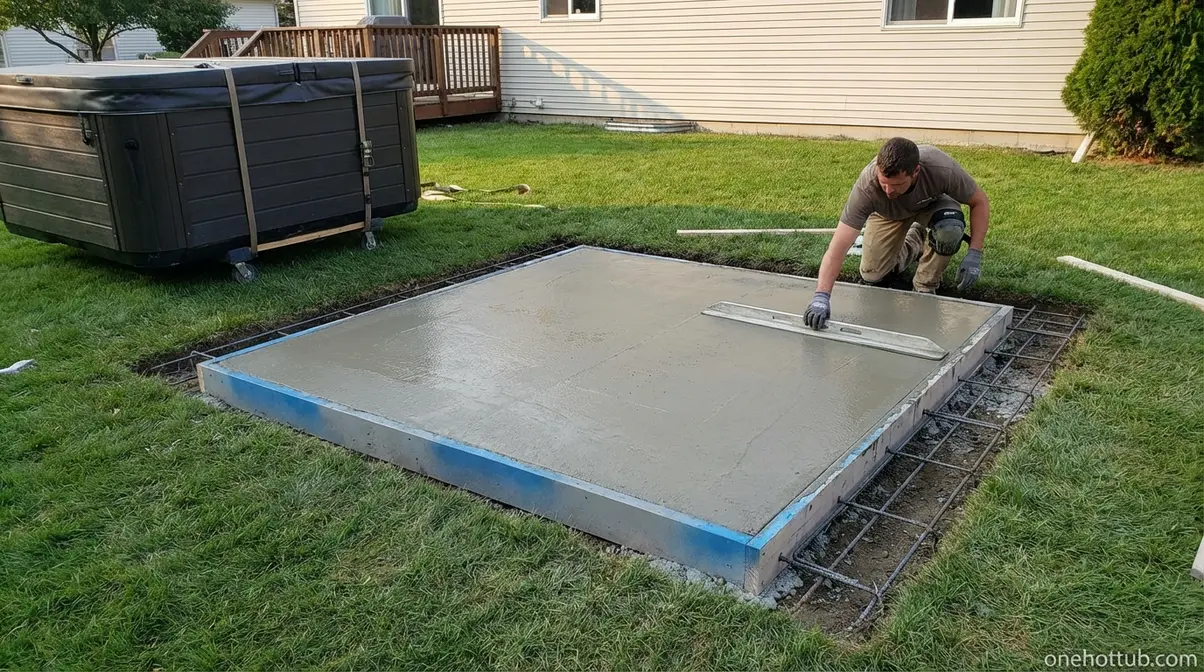
A filled 6-person hot tub weighs approximately 4,000 lbs — roughly the same as a mid-size SUV. Would you park a car on your lawn or on an unreinforced deck? That analogy makes the foundation question easy: grass, loose soil, and standard residential decks will crack, sink, or fail under this load without proper preparation.
The good news: you have three viable foundation options, each with a different cost profile.
“A concrete slab for a hot tub costs $1,400 to $3,500 for a standard-sized pad — though reinforced decks ($800–$3,100) and compacted paver bases are legitimate alternatives depending on your site.”
See our step-by-step guide on hot tub foundation options like concrete pads and pavers for a full installation walkthrough.
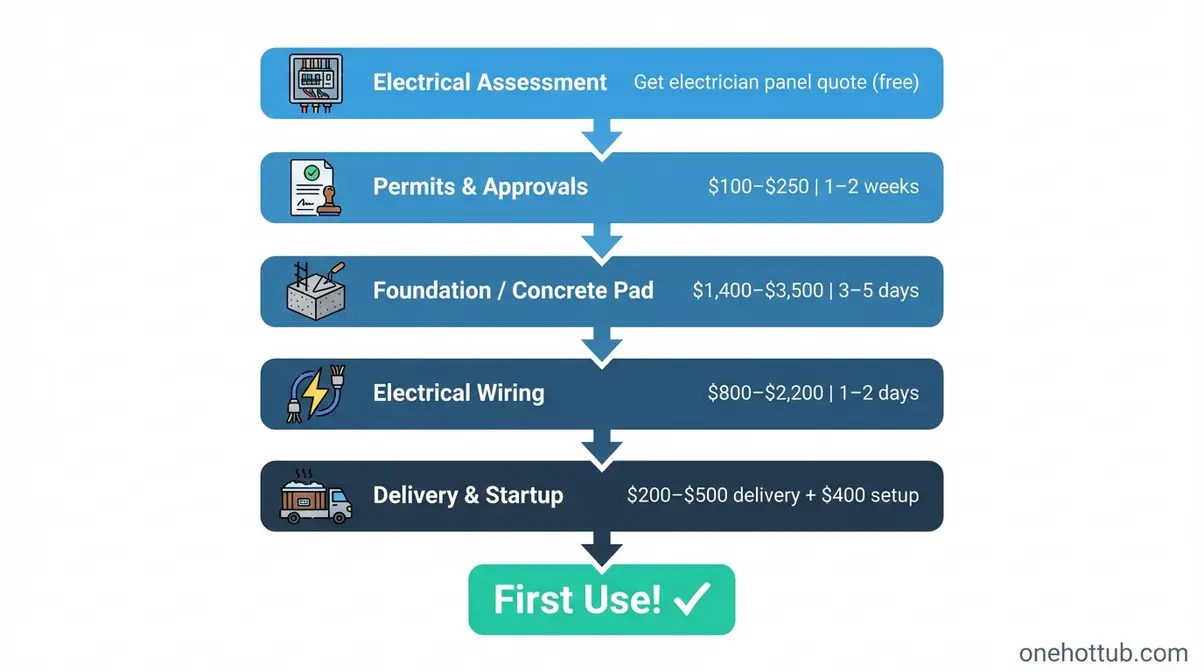
Caption: Hot tub site prep sequence — the four steps between purchase and first use, with typical cost and timeline for each.
Do You Need a Concrete Slab?
A concrete slab — a poured concrete pad at least 4 inches thick that provides a solid, level surface capable of supporting a fully loaded hot tub — is not strictly mandatory, but it is the most durable and code-safe foundation for a permanent above-ground installation.
Concrete pads for hot tubs run 4–6 inches thick, are reinforced with rebar or wire mesh, and are sized to the tub’s footprint plus 12 inches on each side. Based on 2026 data from Angi and HomeGuide, costs run $5–$10 per square foot for materials and labor, with a typical 8’×8′ hot tub pad (64 sq ft) totaling $1,400–$3,500 installed. Higher-spec pads with rebar reinforcement in premium-labor markets can reach $5,000 for larger tubs.
Alternatives include reinforced decks and compacted paver bases (covered in the next section). What you cannot use safely: grass, loose gravel alone, or unreinforced standard residential decking. Foundation failure under a hot tub creates both a structural safety risk and an insurance liability — and most manufacturers will void the warranty if the tub is not installed on an approved surface.
A 7’×7′ hot tub pad at minimum thickness runs approximately $700–$1,100 in materials. Including contractor labor, expect $1,400–$3,500 total — more in areas with high concrete and labor costs.
Deck Reinforcement Alternative
Deck reinforcement is cheaper than concrete in some scenarios — and more expensive in others. The answer depends entirely on what your current deck structure can support.
Most standard residential decks are engineered for 50 lbs per square foot (psf). A filled hot tub can impose 100–150 psf. That gap is why a structural engineer review — typically $300–$700 — is strongly recommended before placing any hot tub on any deck. This is a hidden cost almost every buyer skips.
Hot tub pad installation cost via deck reinforcement runs $800–$3,100 depending on the existing structure and the scope of work required. Common reinforcement measures include sistering additional joists alongside existing ones, adding support posts below the deck frame, and installing a dedicated beam under the hot tub footprint. For a modest reinforcement on a relatively new deck, $800–$1,500 is realistic. For an older deck requiring significant structural additions, $2,500–$3,100 is more likely.
New deck construction with hot tub support engineered in from the start runs higher — $3,000–$8,000+ — but produces a cleaner result and eliminates the guesswork of retrofitting an existing structure.
When deck reinforcement beats concrete: if the hot tub is going on a raised deck, pouring a concrete pad below it is not practical. Deck reinforcement becomes the only viable option. It’s also worth considering aesthetically — a deck-integrated hot tub looks built-in without the excavation cost of a true in-ground installation.
Adding four sister joists and two support posts under a 10’×12′ deck section typically runs $1,000–$1,500 in lumber and contractor labor — potentially less than a concrete pad when the reinforcement scope is modest.
Crane Delivery and Difficult Access
When a hot tub cannot pass through a standard gate or side yard access path, a crane is needed — and that crane adds $800–$2,500 to your installation bill, a cost that virtually no initial budget includes.
Properties that typically require crane delivery: row homes with no side yard access, walled or fenced lots with gates narrower than 36 inches, second-floor deck placements, and properties with steep grade changes between the street and the installation site.
Crane rental plus operator for a hot tub placement runs $800–$2,500 depending on local market rates, lift height, and the duration of the operation. In dense urban markets, crane availability is limited — if a crane is needed, budget an extra $800–$2,500 and schedule at least two to three weeks in advance. Crane operators in hot tub season (spring and summer) book up quickly.
Before ordering a hot tub, walk your delivery path with a tape measure. The minimum clearance for a standard portable tub on a delivery dolly is approximately 36–40 inches. If that clearance doesn’t exist anywhere on the path from the street to the install site, plan for crane costs from day one.
With unit, electrical, and foundation costs clear, we turn to the ongoing expenses that follow you for the life of the tub.
Monthly and Yearly Ownership Costs
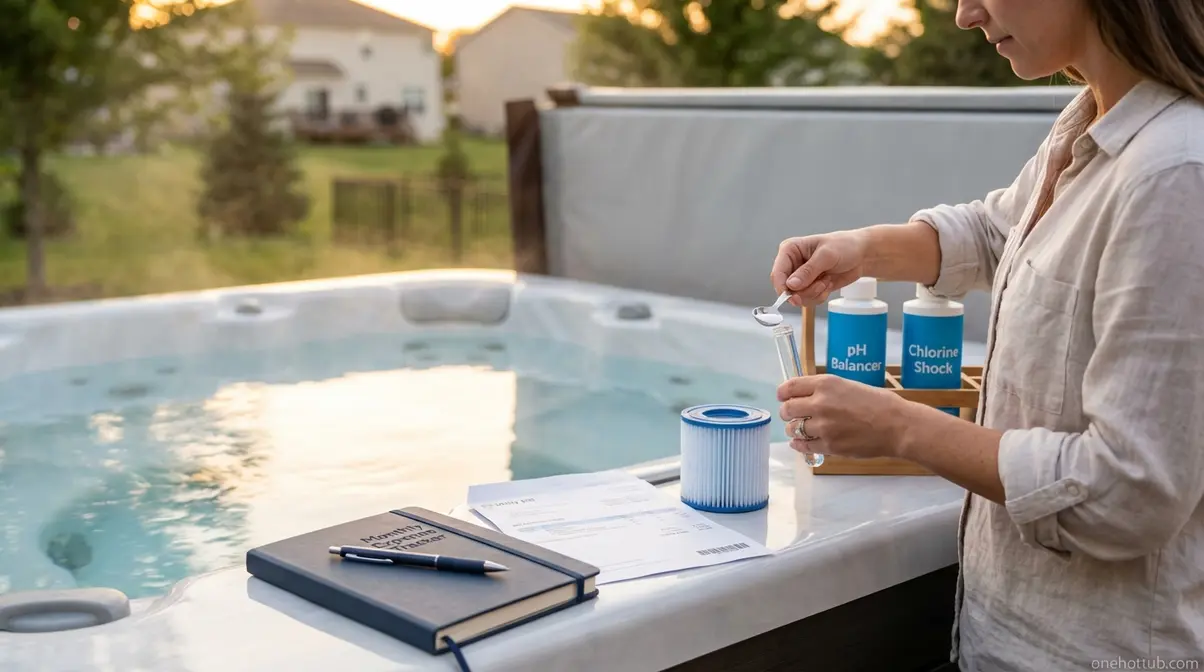
The upfront installation bill is the first layer of the Total Ownership Stack. The second layer — ongoing maintenance and operating costs — is where many buyers get their second surprise, typically four to six weeks after the tub is running.
Licensed contractors and hot tub retailers consistently report that annual ownership costs run $1,200–$1,800 per year beyond the initial installation. That figure covers three categories: electricity, chemicals and filters, and occasional service.
Electricity: $20–$60 per month. The U.S. Department of Energy’s 2022 historical report estimates that average hot tub energy consumption per year runs 1,567–1,699 kWh for a portable electric spa (U.S. Department of Energy, 2022). At average U.S. electricity rates, that translates to $20–$60 per month depending on your model’s insulation quality, local climate, and usage frequency. Modern hot tubs are legally required to meet standby power performance standards designed to reduce monthly operating costs (California Energy Commission).
Chemicals and filters: $300–$600 per year. Routine chemical treatment (sanitizer, pH balancers, shock) and filter replacement are unavoidable maintenance items. Homeowners who stay on a consistent schedule typically land at the low end of this range; those who let chemistry lapse and need a full drain, clean, and refill spend more.
Service visits: $300–$500 per call. When something goes wrong — a pump seal, a jet issue, a heater element — a local hot tub repairman will typically charge $300–$500 for a diagnostic and repair visit. Most buyers get their first referral from the retailer who sold them the tub. As one homeowner in a major hot tub ownership community put it:
“Snatch it up, pay your local hot tub repairman $300–$500 to fix it (probably get a referral from a hot tub retailer), and you’re good to go for…”
That’s an accurate reflection of how most service relationships work — and why building that referral relationship early is smart.
For a complete monthly and yearly cost breakdown — including chemicals, filters, winterizing, and service schedules — see our detailed breakdown of monthly maintenance and operating costs.
Finding and Hiring Your Hot Tub Installation Team
Standard hot tub delivery costs $200 to $500; full-service installation including site placement and hookup runs $500 to $1,500 — and neither includes electrical work or concrete. Most first-time buyers discover this only after they’ve placed their order. Understanding who does what, and what each retailer actually provides, eliminates that surprise.
The critical thing to understand as a beginner: most hot tub installations require coordinating two to three separate contractors — a licensed electrician, a concrete contractor (or deck specialist), and the dealer installer. The retailer coordinates only the third. The first two are entirely your responsibility to source and schedule.
What’s Included in Delivery?
Standard delivery ($200–$500): Transports the hot tub to your property. Most dealers deliver to the gate or driveway — curbside drop. “Placement delivery” (moving the tub to its exact final position in the yard) costs an additional $150–$300 and must be requested explicitly.
- What standard delivery does NOT include:
- Electrical hookup of any kind
- Concrete pad or foundation work
- Water fill
- Chemical startup treatment
- Control panel walkthrough
Full dealer installation package ($500–$1,500 on top of delivery): This is the upsell that makes installation day smooth. It covers site positioning, water fill, startup chemical balance, cover installation, and a control panel orientation. It still does not cover electrical work or concrete — those remain your separate contractor scopes.
In-ground plumbing note: Standard above-ground tubs require no external plumbing. In-ground tubs require a licensed plumber to install PVC supply and return lines — budget $1,000–$3,500 for plumbing on in-ground builds.
When comparing hot tub installation near me quotes from different dealers, ask specifically: “Does your installation package include electrical hookup?” The answer will almost always be no — and it should trigger your separate electrician call.
Costco, Jacuzzi, and Retailers
Costco hot tubs — Costco, the big-box warehouse retailer, sells portable hot tubs at competitive prices ($2,000–$5,000 for popular models). They deliver curbside only. The buyer is entirely responsible for hiring a separate electrician, arranging concrete work, and moving the tub from the curb to the final location. Many first-time Costco hot tub buyers underestimate this by $1,500–$3,000. The unit price is a genuine deal — the installation gap is real.
Jacuzzi hot tubs — Jacuzzi, a premium spa manufacturer, sells through authorized dealers who typically offer full installation coordination as part of the purchase package. Jacuzzi hot tub installation cost runs higher per unit (expect 20–40% above comparable off-brand models), but the process is more turnkey: dealer delivery, placement, startup services, and in many cases a referral to a vetted electrician. For buyers who want a managed experience rather than a three-contractor coordination project, the premium can be worth it.
Specialist hot tub retailers (local dealers) typically offer the best balance: competitive pricing, installation services, local service relationships, and ongoing warranty support. Always ask: “Does your installation quote include electrical and concrete coordination, or do I arrange those separately?” That single question clarifies the scope immediately.
How to Get Accurate Local Quotes

Getting reliable hot tub installation cost near me quotes requires treating electrical, concrete, and dealer installation as three separate RFQ processes — because they are.
Request at least three quotes for each contractor type. For a mid-range portable tub installation, that means three electrician quotes, three concrete quotes, and at minimum two dealer installation comparisons.
- What to tell each contractor:
- Tub model name, dimensions, and weight
- Proposed placement location and distance from your electrical panel
- Whether a concrete pad is planned or an existing surface is available
- Any access constraints — gate width, stairs, grade changes
This information determines approximately 80% of quote accuracy. Contractors who quote without asking these questions are giving you a number, not an estimate.
- Red flags in quotes:
- Electricians who don’t mention GFCI breakers or NEC Article 680 compliance
- Concrete quotes that don’t specify rebar reinforcement
- “Full installation” quotes that don’t itemize what’s included
- Any electrical quote that suggests the work can be DIY or “semi-DIY”
Always request itemized written quotes. Any contractor reluctant to provide itemization is a contractor worth passing on.
Ready to take action? Understand the costs of professional hot tub moving services in your area before your delivery day — it helps you know exactly what to expect from the driver.
Common Hot Tub Budget Mistakes to Avoid
The federal guidelines on locked safety covers from the U.S. Consumer Product Safety Commission require hot tubs to be equipped with locked safety covers when not in use to prevent drowning accidents (CPSC). Budget $200–$400 for a quality locking cover — it is both a safety requirement and an insulation investment that reduces monthly heating costs.
According to historical 2023 data on water loss due to evaporation, the EPA indicates that 56% of spa and pool water loss is due to evaporation — which increases water refill frequency and chemical treatment costs over time (U.S. EPA, 2023 historical data). A tight-fitting locking cover reduces this loss significantly, cutting ongoing water and chemical costs.
3 Costly Hot Tub Installation Mistakes
Pitfall 1: Skipping the electrical assessment before buying. A buyer orders a 220V acrylic tub without first having an electrician assess panel capacity. The panel is at capacity — a subpanel adds $1,200 to the budget post-purchase with no ability to cancel the tub order. The fix: schedule a free panel assessment quote from a licensed electrician before you finalize any hot tub purchase. It takes 30 minutes and costs nothing in most markets.
Pitfall 2: Assuming the retailer handles everything. A buyer orders a hot tub from Costco online and expects “delivered” to mean “installed and running.” The tub arrives curbside. There is no contractor lined up for electrical, no concrete pad ready, and no plan to move it from the driveway to the backyard. Three weeks later, a rental-rate electrician and an emergency concrete crew add $4,500 to the project cost. The fix: map out all three contractor scopes and get quotes before placing the order.
Pitfall 3: Under-insulating for a cold climate. A buyer in Minnesota selects an entry-level acrylic tub with thin-shell insulation because it’s $1,200 cheaper than the full-foam alternative. First winter: electricity bills run $90–$120 per month instead of the expected $30–$40. Over five years, the $1,200 savings costs $3,000 in extra electricity. The fix: ask every dealer specifically about the insulation type (full-foam vs. partial-foam) and the expected kWh per year for your climate zone.
When to Reconsider a Hot Tub
Transparency is part of honest cost guidance — and sometimes the numbers genuinely don’t add up.
Scenario 1 — The stacked-cost trap: If your panel requires a full upgrade ($1,500–$4,000) and you need a new concrete pad ($2,500+) and the tub itself costs $5,000+, your all-in first-year spend may exceed $14,000–$16,000. If the property is a rental or you plan to sell within five years, the return on that investment is likely negative. Realtor.com data confirms that hot tubs rarely increase home resale value in most markets.
Scenario 2 — The access problem: If your installation site has no viable concrete access path and crane costs add $2,500, a smaller inflatable model on an existing patio may serve your relaxation needs at 10–15% of the total cost. Sometimes the right answer is the $800 inflatable, not the $12,000 installed acrylic — and a good retailer will tell you that.
Frequently Asked Questions
Average cost to install a hot tub?
The average hot tub installation cost for a standard above-ground model ranges from $650 to $6,100 in 2026. This includes delivery, basic site preparation, and electrical hookup—but not a concrete pad or permit fees, which add $1,500–$3,750 more, while in-ground installations start at $15,000 and can exceed $35,000 for custom builds. The national average for a mid-range portable tub fully installed sits around $4,000–$8,000 based on 2026 contractor data from HomeGuide. Costs vary significantly by region, panel capacity, and site conditions — always request three itemized quotes before committing.
Cost to install hot tub electric?
Installing the electrical for a hot tub — including a dedicated 220V/240V circuit, GFCI breaker (Ground Fault Circuit Interrupter, a safety device that cuts power when water contacts electricity), and disconnect panel — typically costs $800 to $2,200 for a licensed electrician in 2026 (HomeGuide, 2026). Labor accounts for roughly 75% of that cost; wire, conduit, and hardware make up the rest. If your panel needs a subpanel, add $500–$1,500; a full panel upgrade adds $1,500–$4,000 more. All 220V hot tub wiring must comply with NEC Article 680 — this work is never a DIY project.
Need a concrete slab for a hot tub?
A concrete slab for a hot tub is not strictly mandatory, but it is the most recommended foundation for permanent above-ground installations. A poured concrete pad costs $1,400 to $3,500 and provides a stable, weight-bearing surface for the 3,000–6,000 lb load of a filled tub (Angi, 2026). Reinforced decks ($800–$3,100) and compacted paver bases are legitimate alternatives in the right situations. Placing a hot tub on grass, loose gravel, or an unreinforced deck risks structural failure, voided warranties, and insurance complications. Consult a licensed contractor to assess your specific site before selecting a foundation type.
Is owning a hot tub expensive?
Owning a hot tub adds $20 to $60 per month to your electricity bill and $300 to $600 per year in routine chemical and filter costs (U.S. DOE, 2022 historical report). Service visits from a local hot tub repairman run $300–$500 per call, bringing total annual ownership costs to typically $1,200 to $1,800 beyond the initial installation. Energy-efficient models with full-foam insulation and tight-fitting locking covers significantly reduce these ongoing expenses.
Plumber cost to install a tub?
Standard above-ground hot tub plumbing costs are minimal — most portable tubs are self-contained and require no external plumbing work from a licensed plumber. In-ground hot tubs and walk-in tubs require licensed plumbers to install PVC supply and return lines, typically costing $1,000 to $3,500 based on Home Depot data, depending on site conditions, trench length, and local labor rates. Complex built-in installations with custom water features can push plumbing costs above $5,000. For in-ground hot tub builds, plumbing labor typically represents 15–20% of the total project cost. Always hire a licensed, insured plumber — in-ground spa plumbing must meet local code for pressure testing and backflow prevention.
Conclusion
For homeowners budgeting a hot tub installation in 2026, the true cost goes well beyond the sticker price. Standard above-ground hot tub installation costs range from $650 to $6,100 — but the Total Ownership Stack, including electrical ($800–$2,200), a concrete pad ($1,400–$3,500), permits ($100–$250), and first-year maintenance ($1,200–$1,800), brings the realistic first-year total to $4,000–$15,000+ depending on tub tier and site conditions. Every layer in that stack is predictable — if you know to look for it.
The Total Ownership Stack framework reveals why the hidden-cost trap catches so many buyers: it’s not one surprise — it’s four separate contractor invoices that no single advertised price includes. Using the layered model in this guide, you now have a complete number to defend before any contractor picks up a shovel or pours a single bag of concrete.
Your next step: get a licensed electrician’s assessment of your panel capacity before finalizing any purchase. It costs nothing, takes 30 minutes, and eliminates the single largest budget variable in the entire project. Then explore our comprehensive hot tub buying guide to compare unit tiers and dealer options — so your purchase decision and your budget are built on the same foundation.