

Table of Contents - Hot Tub Chlorine Levels: The Complete Beginner’s Guide
- What You’ll Need Before You Start
- Understanding Hot Tub Chlorine: Free vs. Total Explained
- How to Test Your Hot Tub Chlorine Levels (Step-by-Step)
- Step-by-Step: How to Add and Maintain Chlorine
- Troubleshooting: 6 Chlorine Problems Solved
- Problem 1 — Chlorine Is Too High (Above 5 ppm)
- Problem 2 — Free Chlorine Low, Total Chlorine High (Chloramines)
- Problem 3 — Chlorine Won’t Stay Up (Keeps Dropping to Zero)
- Problem 4 — Cloudy or Green Water Despite Adding Chlorine
- Problem 5 — Strong Chemical Smell (Chloramine Buildup)
- Problem 6 — Inflatable Hot Tub Chlorine Issues
- Chlorine Alternatives: Salt Water, Bromine & Mineral Systems
- Hot Springs Brand Hot Tubs: Chlorine Care Tips
- Safety Risks, Limitations & When to Get Help
- Frequently Asked Questions
- What should my chlorine level be in my hot tub?
- Why is there a 15-minute hot tub rule?
- Does a hot tub lower cortisol?
- Is a hot tub bad for folliculitis?
- Will shock raise free chlorine?
- What happens if you sit in a hot tub for 3 hours?
- Why can’t you be in a hot tub for long?
- What do you crave when cortisol is high?
- Why do so many people get rid of hot tubs?
- Keeping It Simple: The 3-Number Rule in Practice
This blog post may contain affiliate links. As an Amazon Associate I earn from qualifying purchases.
“I’ve had my hot tub for two years. I follow all the guidelines — filters, balanced water, shock, refill schedule, etc. etc. etc. — yet I find my water is still cloudy and the readings make no sense.”
— Common frustration shared across hot tub owner communities
Sound familiar? You’re not doing anything wrong. You’re just trying to manage too many numbers at once. This hot tub chlorine levels guide fixes that. The chemistry comes down to three numbers — and once you know them, everything else clicks into place. You’ll learn the ideal chlorine range, how to test it correctly, and exactly what to do when readings go sideways.
This guide covers the science behind free vs. total chlorine, a step-by-step testing and dosing routine, fixes for the six most common chlorine problems, and answers to the questions hot tub owners search for most. Whether your water is cloudy, smells like chemicals, or just won’t stay balanced, you’ll find the answer here.
As detailed in this hot tub chlorine levels guide, your water should stay between 1–5 ppm (parts per million) to keep your water safe and clear. Master The 3-Number Rule — free chlorine (1–5 ppm), pH (7.2–7.8), test frequency (2× per week) — and you’ll avoid 90% of common water problems.
- Free chlorine (1–5 ppm): The only active sanitizer in your water — this is the number that matters most.
- pH (7.2–7.8): Keeps chlorine effective and protects your skin and equipment from damage.
- Test 2× per week: Catch problems early, before cloudy water or chemical smells develop.
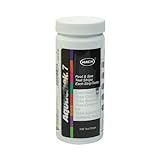
- 7-IN-1 TEST STRIPS: Tests the most critical parameters: pH, Total Chlorine, Free Chlorine, Bromine, Alkalinity, Total Hardness, & Cyanuric Acid
- AQUACHEK ACCURACY: Using medical industry technology, our test strips offer comparable accuracy to liquid tests; No measuring & counting drops of reagent, leaving less room for error
- EASY TO USE: No more messy drops; Just dip the silver strip, remove it, wait 15 seconds, & compare with the color chart on the bottle; Test water at least twice a week for safe & balanced water
- SAFE & CLEAN WATER: Each color pad is designed with unique paper to optimize color vibrancy & mitigate color-bleeding to help maintain healthy water chemistry
- TRUSTED QUALITY: With over 35 years in the business, our products will help professionals maintain healthy pool and spa water chemistry

- Reliable Results In Seconds – Everything you need to test your saltwater pool or spa is conveniently packaged in the handy storage case, including a comparator to mix samples, and 15 easy-to-use reagents for 9 common water test parameters for FAS-DPD High Range testing: Free & Combined Chlorine, pH, Acid & Base Demand, Total Alkalinity, Calcium Hardness, Cyanuric Acid (CYA), and Chloride (Sodium Chloride).
- Quick & Easy to Use – Simply collect your water sample using the comparator and add the appropriate testing reagents to determine the results. Product instructions are written in non-technical language with easy-to-understand pictograms.
- Pool & Spa Test Kits Built to Last – With testing kits built to last, you’ll find yourself needing to replace your Taylor reagents before the entire kit. Replacement reagents are available separately so you can easily replace your pool and spa testing chemicals every season.
- For Homeowners and Professionals – Taylor products are built to professional standards but with processes easy enough for any pool or spa owner to use. With unparalleled customer service and support, Taylor is the go-to for every distributor, retailer, commercial operation, and homeowner… wherever water is tested.
- The K-2006-SALT standard Complete kit contains .75oz bottles for low-frequency water testers. If you are a high-frequency water tester, our K-2006C-SALT Service Complete kit contains 2oz bottles that provide more than 2.5x the total number of water tests compared to the K-2006-SALT kit.

- BENEFIT: Rely on this convenient and easy-to-use sanitizer to control algae, kill bacteria, and destroy contaminants so you can get the most out of your spa
- IDEAL USE: For sanitizing and shock treating spas and hot tubs; Destroys algae and bacteria; Fast acting and easy to use
- CREATES MORE COMFORTABLE WATER: Protects water against chlorine loss for more comfortable water with no sediment
- COMPATIBLE WITH CHLORINE-BASED SPAS: HTH Spa Clear Chlorinating Sanitizer is great for chlorine systems
- YOU'RE ALL CLEAR WITH HTH: For best results, use HTH Spa Clear Chlorinating Sanitizer as part of your regular HTH Spa care routine
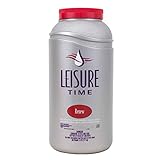
- BENEFITS: Non-chlorine shock oxidizer clears cloudy water and eliminates odors and contaminants
- USE: Buffered to prevent pH fluctuations; use weekly for spa water maintenance
- COMPATIBILITY: Works with chlorine, bromine, ozone and mineral purification systems
- FEATURES: Can use spa 15 minutes after use; Destroys microorganisms, soaps, deodorants and oils
- INCLUDES: Economical bulk-sized 5-pound container of Leisure Time Renew Shock Treatment

- Drops directly into spa filter
- Works with existing filtration system
- For spas up to 500 gallons
- Works with all spa flow rates
- Last an average of four months
⚠️ Safety Disclaimer: Pool and spa chemicals are powerful oxidizers. Always add chemicals to water — never water to chemicals. Store chlorine in a cool, dry place away from other chemicals. Wear gloves when handling granules. Keep children and pets away from the tub for at least 30 minutes after adding chemicals. If you experience eye, skin, or respiratory irritation, exit the water immediately and seek fresh air. When in doubt, consult a licensed pool and spa professional.
What You’ll Need Before You Start
Before diving into the steps, gather these supplies:
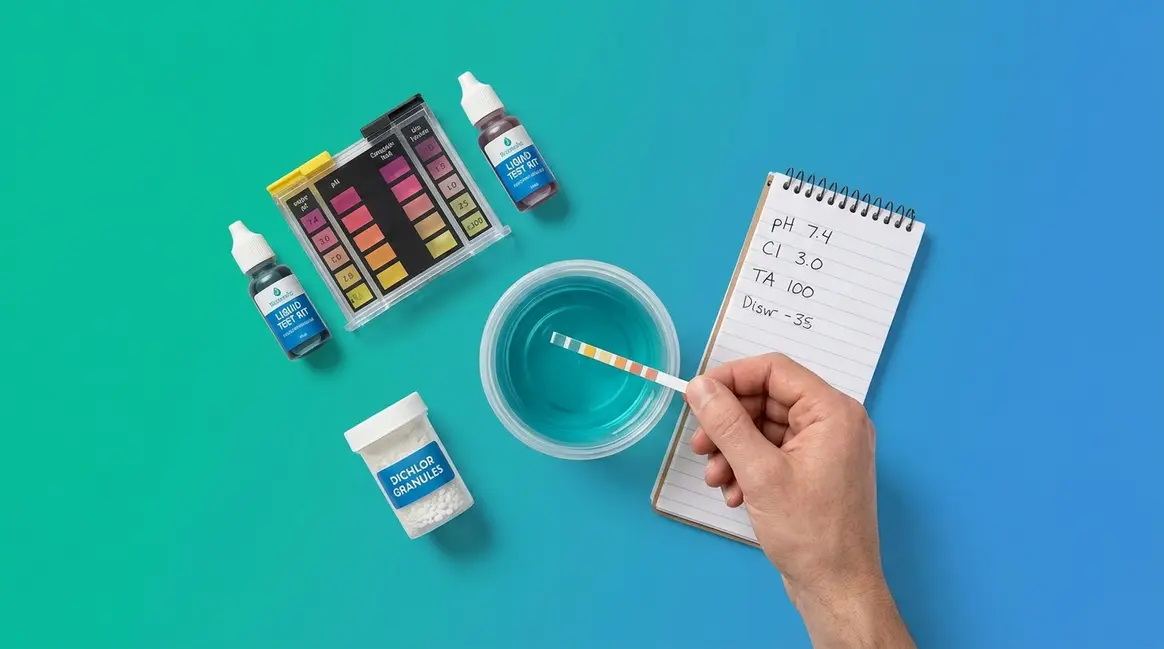
- Test strips (7-way strips cover chlorine, pH, and alkalinity) or a liquid test kit
- Chlorine granules (dichlor — sodium dichloro-s-triazinetriene — is the standard for hot tubs)
- Chlorine shock (non-chlorine or chlorine-based)
- A small measuring cup or scale (for accurate dosing)
- Gloves and eye protection
- A notepad or phone to log your readings
Having everything ready means you won’t be scrambling mid-treatment. A 5-minute prep routine saves a 2-hour headache later.
Understanding Hot Tub Chlorine: Free vs. Total Explained
Hot tub chemistry feels complicated because most guides throw five or six numbers at you without explaining which ones actually matter. Here’s the truth: hot tub chlorine levels are really about one number — free chlorine. Everything else supports it.
What Is Free Chlorine (and Why It’s the Only Number That Matters)
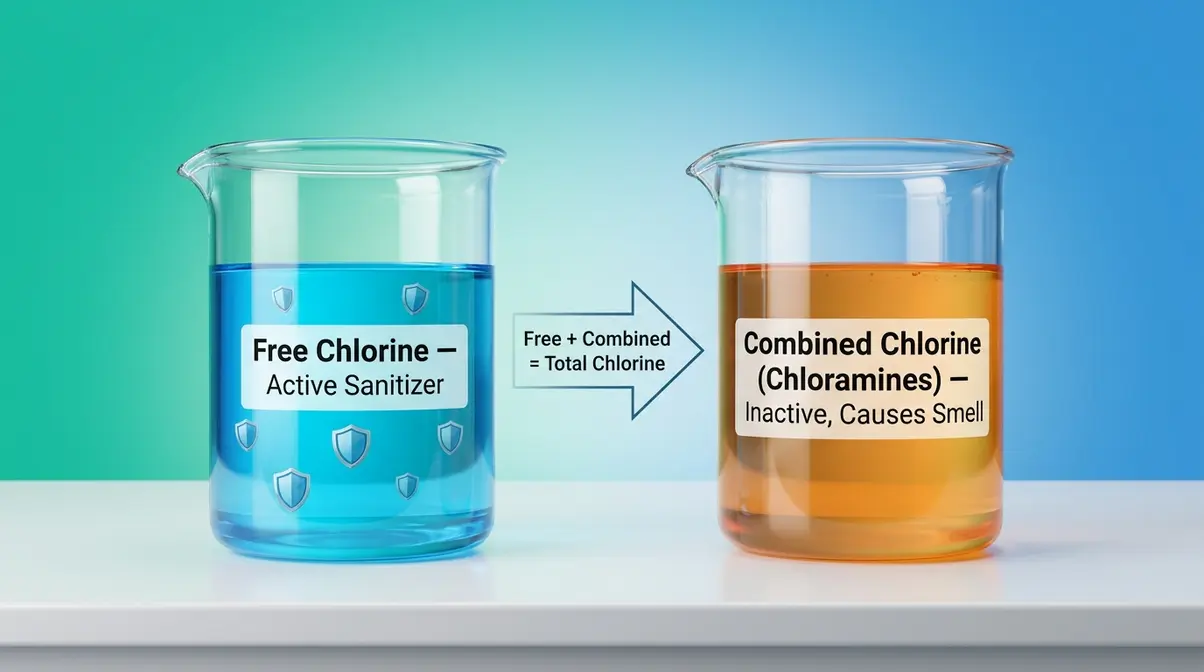
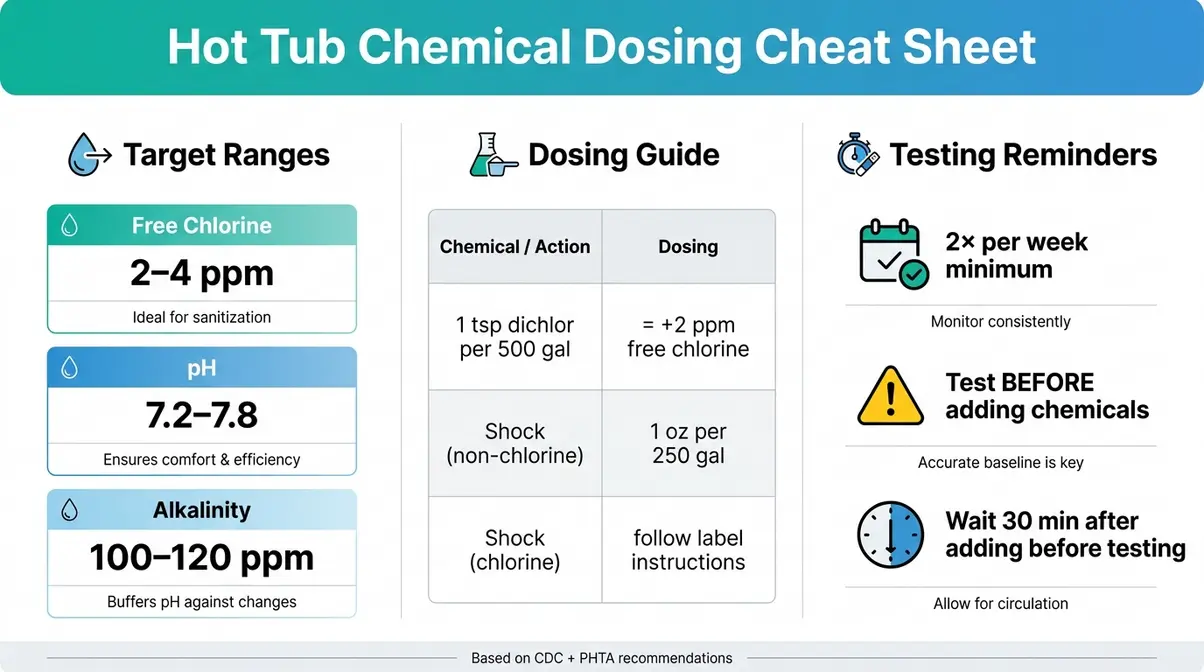
Free chlorine is the active, unreacted chlorine dissolved in your water — the chlorine that is actively killing bacteria, viruses, and algae right now. Think of it as the “available workforce” in your tub. The CDC recommends a minimum free chlorine level of 1 ppm in hot tubs and spas to effectively inactivate harmful pathogens, including Pseudomonas aeruginosa (the bacteria behind hot tub rash) and Legionella (the bacteria behind Legionnaires’ disease).
The ideal range for free chlorine in a hot tub is 1–5 ppm (parts per million) — parts per million being a measure of how much chlorine is dissolved per million parts of water. Below 1 ppm, bacteria can multiply faster than your chlorine can destroy them. Above 5 ppm, you risk skin and eye irritation and potential damage to your cover and shell.
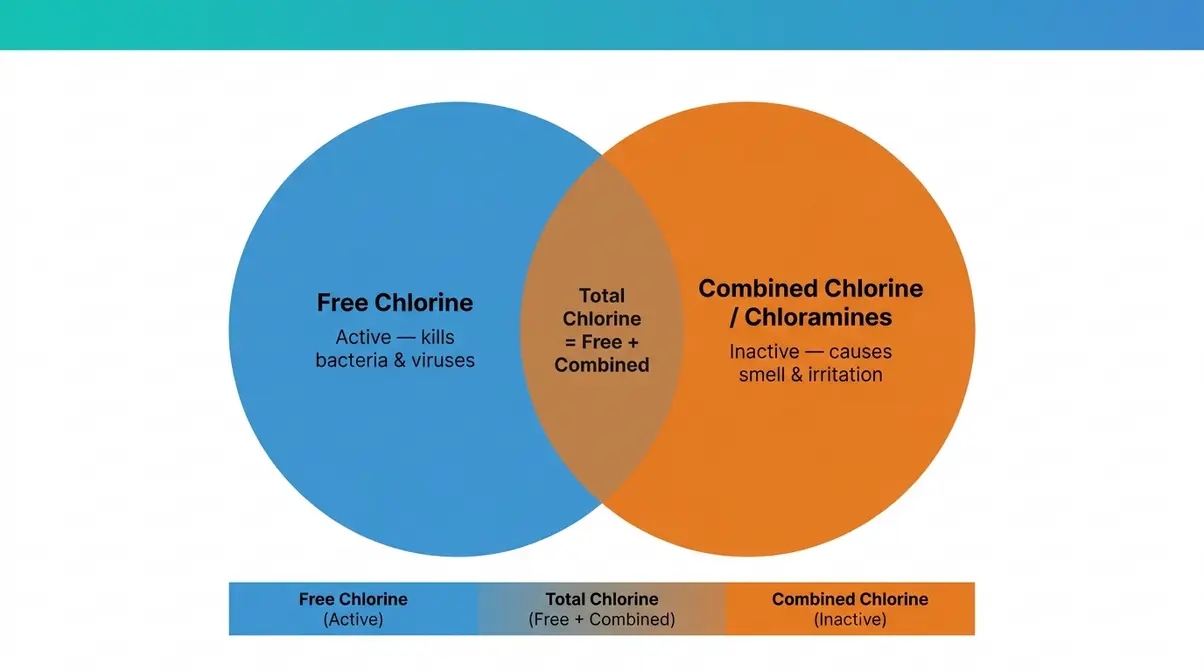
Total chlorine is simply free chlorine plus combined chlorine (chloramines). If your test strip shows a total chlorine reading of 4 ppm but your free chlorine reads only 1 ppm, that gap — 3 ppm — is chloramines. That’s a problem, and the next section explains why.
According to PHTA guidance, the recommended free chlorine range for residential spas is 2–4 ppm under normal use conditions, with the broader safe window running from 1–5 ppm.
What Are Chloramines and Why They Ruin Your Water
Chloramines (also called combined chlorine) form when free chlorine reacts with nitrogen-containing compounds in your water — sweat, body oils, sunscreen, and urine. Once chlorine “combines” with these contaminants, it becomes chemically locked up and can no longer sanitize. Chloramines are like a used-up sponge — they take up space in your water but don’t clean anything.
Here’s what makes chloramines so frustrating: they cause the very symptoms people associate with too much chlorine. That sharp chemical smell? That’s not excess chlorine — it’s chloramines. Itchy eyes and skin after soaking? Chloramines again. Cloudy water despite a high total chlorine reading? Chloramines.
Common frustrations reported by hot tub owners include exactly this scenario: adding more chlorine to fix a smell, only to make it worse. The fix isn’t more chlorine — it’s shocking the water to break apart the chloramine bonds and restore free chlorine. More on that in the step-by-step section.
The Safe Chlorine Range: What the CDC and PHTA Recommend
The CDC’s Model Aquatic Health Code recommends a minimum free chlorine level of 1 ppm in spas and hot tubs at all times. The PHTA (Pool & Hot Tub Alliance — the primary industry standards body in North America) recommends a working range of 2–4 ppm for residential spas under regular use.
| Parameter | Minimum | Ideal Range | Maximum |
|---|---|---|---|
| Free Chlorine | 1 ppm | 2–4 ppm | 5 ppm |
| Total Chlorine | — | Free + <0.5 ppm combined | — |
| pH | 7.2 | 7.2–7.8 | 7.8 |
| Alkalinity | 80 ppm | 100–120 ppm | 150 ppm |
Why does pH matter alongside chlorine? Because chlorine efficiency drops dramatically as pH rises. At pH 7.0, roughly 75% of your chlorine is active. At pH 8.0, only about 20% is active. That’s why the 3-Number Rule pairs free chlorine with pH — they work together.
- The 3-Number Rule distills everything above into three numbers you can actually remember:
- Free chlorine: 1–5 ppm (target 2–4 ppm)
- pH: 7.2–7.8
- Test frequency: 2× per week
Get these three numbers right consistently, and you’ll sidestep most of the problems that frustrate beginner hot tub owners.
How to Test Your Hot Tub Chlorine Levels (Step-by-Step)
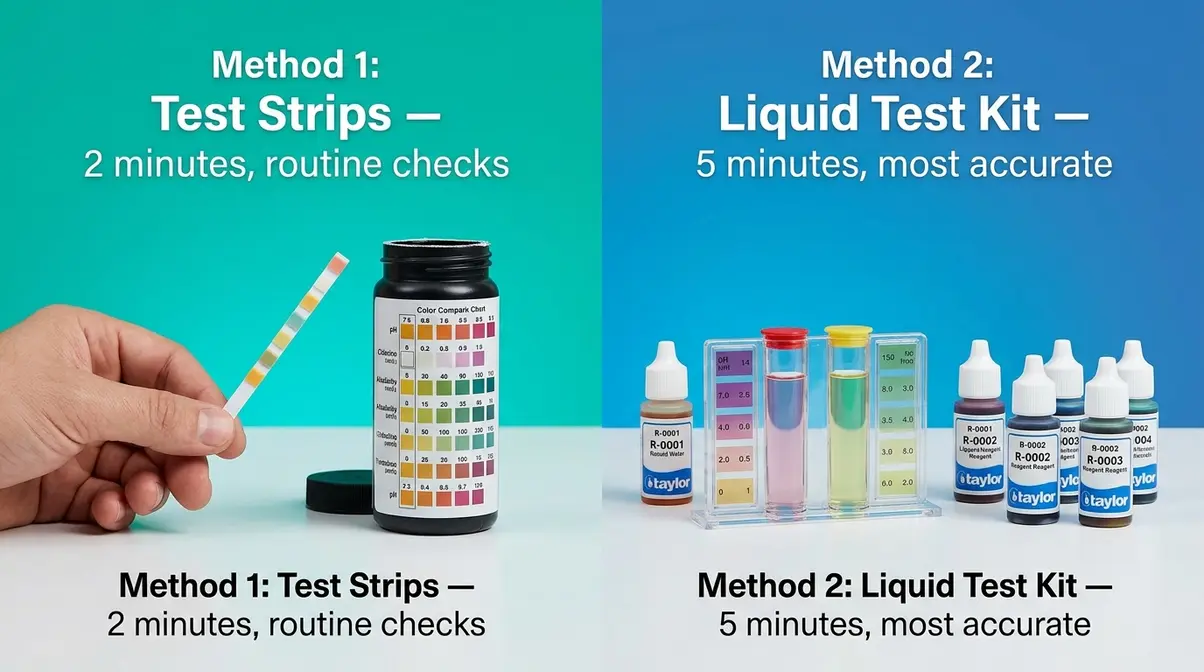
Testing is the foundation of every maintenance routine. You can’t fix what you can’t measure — and testing only takes about 60 seconds once you know the method. Our guidance draws from CDC recommendations, PHTA industry standards, and consensus across hot tub owner communities on when and how to test accurately.
Method 1: Test Strips (Fastest)
Estimated time: 2 minutes
Test strips are the go-to for routine checks. A quality 7-way strip tests free chlorine, total chlorine, pH, alkalinity, and more in under 30 seconds.
Step 1: Wait After Adding Chemicals
Wait 15–30 minutes after your last chemical addition before testing — fresh chemicals need time to distribute evenly.
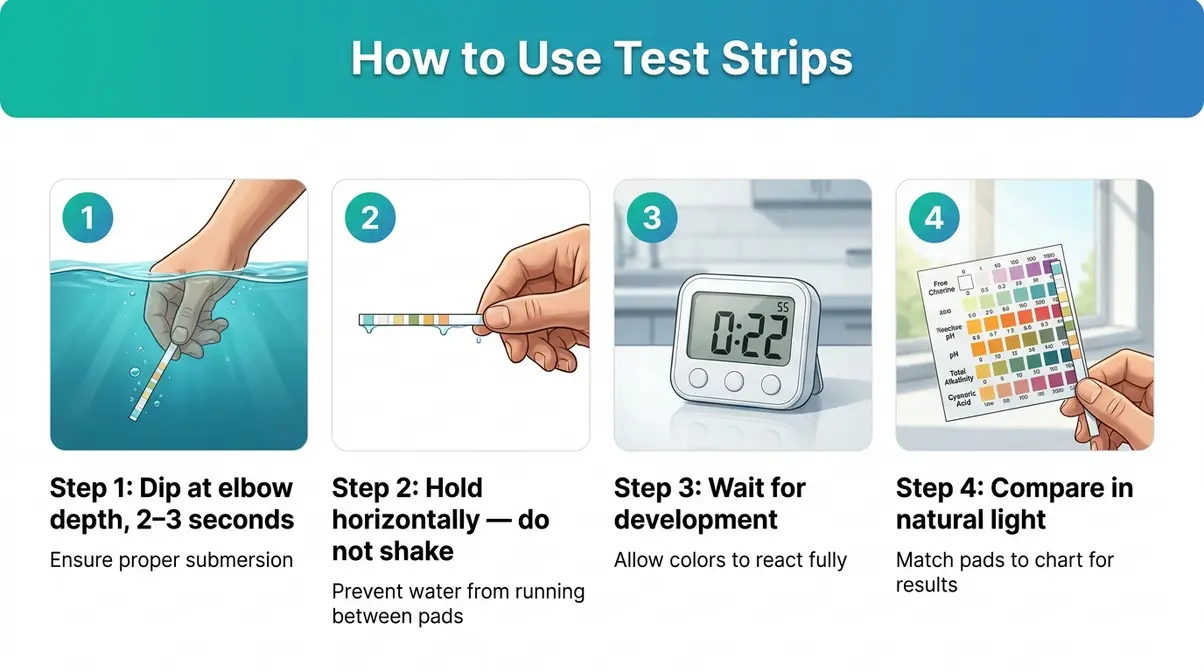
Step 2: Dip the Strip
Dip the strip into the water at elbow depth (about 18 inches below the surface) for 2–3 seconds. Don’t shake it.
Step 3: Hold Horizontally
Remove and hold horizontally — don’t let the pad touch anything.
Step 4: Wait for Development
Wait the time shown on the bottle (usually 15–30 seconds) before reading. Reading too early gives false results.
Step 5: Compare Colors
Compare the color against the chart on the bottle in natural light, not direct sunlight.
Step 6: Log Your Results
Log the reading — free chlorine, pH, and alkalinity. Date it.
Pro tip: Store test strips in a cool, dry place with the lid tightly closed. Humidity ruins them fast. Expired strips give false low readings — check the expiry date on the bottle.
Method 2: Liquid Test Kit (Most Accurate)
Estimated time: 5 minutes
For troubleshooting or when your strip readings seem off, a liquid test kit (like the Taylor K-2006) gives you precise results. These kits use chemical reagents that produce a color change you measure against a comparator.
Step 1: Collect Water Sample
Collect a water sample at elbow depth using the kit’s test tube.
Step 2: Add Free Chlorine Reagent
Add the DPD #1 reagent (the free chlorine reagent) — typically 5 drops. Swirl gently.
Step 3: Read Free Chlorine
Read the color against the comparator. This is your free chlorine reading.
Step 4: Add Total Chlorine Reagent
Add the DPD #3 reagent to the same tube. Swirl. Read again. This gives you total chlorine.
Step 5: Calculate Combined Chlorine
Subtract free from total to calculate combined chlorine (chloramines). If the difference exceeds 0.5 ppm, it’s time to shock.
Step 6: Rinse Tube
Rinse the test tube thoroughly with tap water before testing pH.
Liquid kits are more accurate than strips and are the better choice when you’re troubleshooting a persistent problem. They cost more upfront ($20–$40) but the reagents last for hundreds of tests.
How Often Should You Test Your Hot Tub?
Test at minimum twice per week — this is the second number in The 3-Number Rule. Testing less often means problems compound before you catch them. Cloudy water that could have been fixed with 1 tablespoon of chlorine on Tuesday turns into a full drain-and-refill by Saturday.
| Situation | Testing Frequency |
|---|---|
| Normal use (2–4 people, 3–4x/week) | 2× per week |
| Heavy use (parties, daily soaking) | Daily or after each use |
| After heavy rain or temperature swing | Same day |
| After shocking | 8–12 hours later to confirm chlorine has dropped to safe levels |
| Vacation / low use | At least once per week |
Test before adding chemicals, not after. This gives you an accurate baseline to work from.
Step-by-Step: How to Add and Maintain Chlorine
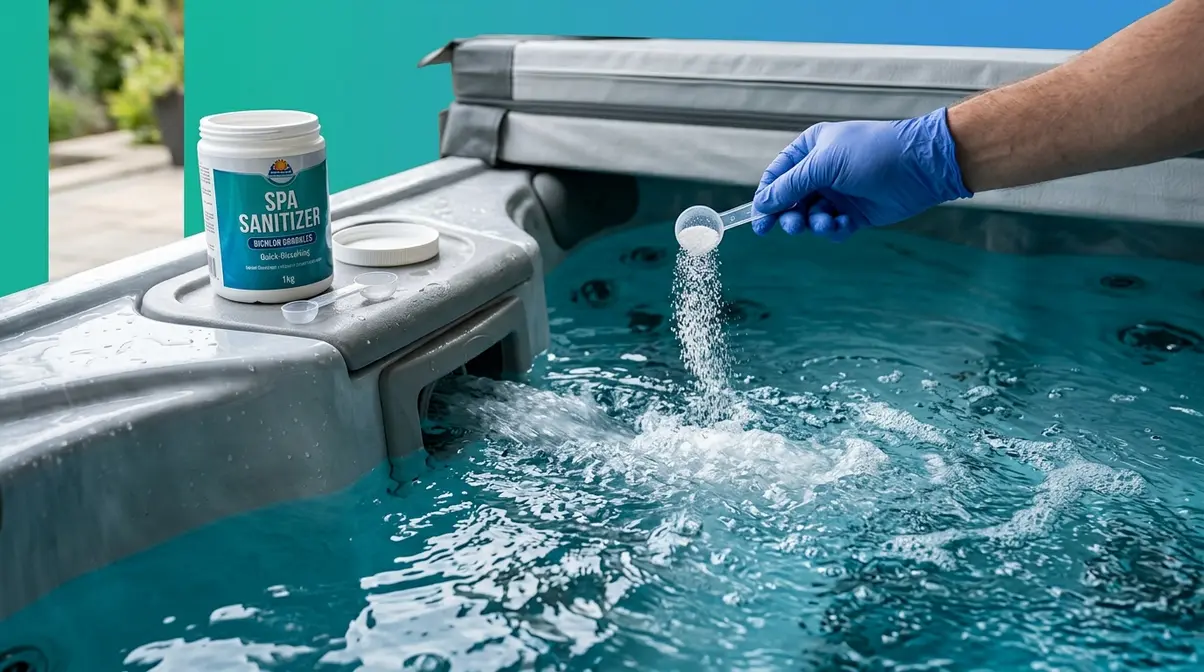
Knowing your numbers is only half the job. Here’s exactly how to act on them. Adding chemicals correctly — the right amount, the right way, at the right time — is what separates a clear, comfortable hot tub from a frustrating chemistry experiment.
How to Add Chlorine Granules to Your Hot Tub
Estimated time: 35 minutes
Most beginner hot tub owners use dichlor granules — sodium dichloro-s-triazinetriene, a stabilized chlorine compound that dissolves quickly and is pH-balanced for spas. Don’t use trichlor tablets designed for swimming pools; they’re too acidic for hot tub volumes.
Step 1: Test Your Water First
Confirm your free chlorine reading before adding anything.
Step 2: Turn On Your Jets
Turn on your jets to circulate water. This helps distribute the chlorine evenly.
Step 3: Measure the Correct Dose
A general starting point: approximately 1 teaspoon (about 6 grams) of dichlor granules per 500 gallons raises free chlorine by roughly 2 ppm. Check your product label — dosing varies by brand.
Step 4: Add Granules to the Water
Add granules to the water — not the other way around. Sprinkle them directly into the water near a jet return, not into the skimmer basket.
Step 5: Keep the Cover Open
Keep the cover open for 15–20 minutes while the jets run. This lets off-gassing occur safely.
Step 6: Wait and Retest
Wait 30 minutes, then retest. Adjust if needed.
Step 7: Verify Safe Levels
Don’t soak until free chlorine reads between 1–5 ppm.
How much chlorine does your hot tub hold? Most residential hot tubs hold 300–500 gallons. Check your owner’s manual. Knowing your exact volume makes accurate dosing much easier.
How and When to Shock Your Hot Tub
Estimated time: 20 minutes (plus wait time)
Shocking means adding a large dose of oxidizer to destroy chloramines and restore free chlorine. Think of it as hitting the reset button on your water chemistry. You should shock your hot tub:
- Weekly as part of routine maintenance
- After heavy use (a party, multiple bathers)
- When you notice a chemical smell (chloramine buildup)
- When total chlorine is significantly higher than free chlorine
- After anyone with an illness has used the tub
- Two types of shock:
- Chlorine shock (dichlor or cal-hypo): Raises free chlorine dramatically to “break point” — typically 10× the combined chlorine level. Effective, but requires a longer wait time before soaking (8–12 hours).
- Non-chlorine shock (MPS — monopersulfate): Oxidizes chloramines without adding chlorine. You can soak 15–20 minutes after adding it. Good for routine weekly oxidation.
Step 1: Test Your Water
Test your water to confirm the problem (high combined chlorine, strong smell, or cloudy water).
Step 2: Choose Your Shock Type
Choose your shock type based on urgency. Non-chlorine shock for routine use; chlorine shock for serious contamination.
Step 3: Run Jets at Full Speed
Run jets at full speed with the cover open.
Step 4: Add Shock to Water
Add shock to water (never the reverse) — follow the package dosing for your tub’s volume.
Step 5: Leave the Cover Open
Leave the cover open for 15–20 minutes.
Step 6: Wait the Required Time
Wait the required time — 15–20 minutes for non-chlorine, 8–12 hours for chlorine shock.
Step 7: Retest Before Entering
Retest before entering. Free chlorine must be between 1–5 ppm.
According to Swim University’s hot tub chlorine guide, regular shocking is one of the most overlooked steps in hot tub maintenance — and one of the most effective at preventing chronic water problems.
Your Weekly Hot Tub Maintenance Routine
Consistency beats intensity. A 10-minute weekly routine prevents 90% of the problems that lead to frustrated forum posts.
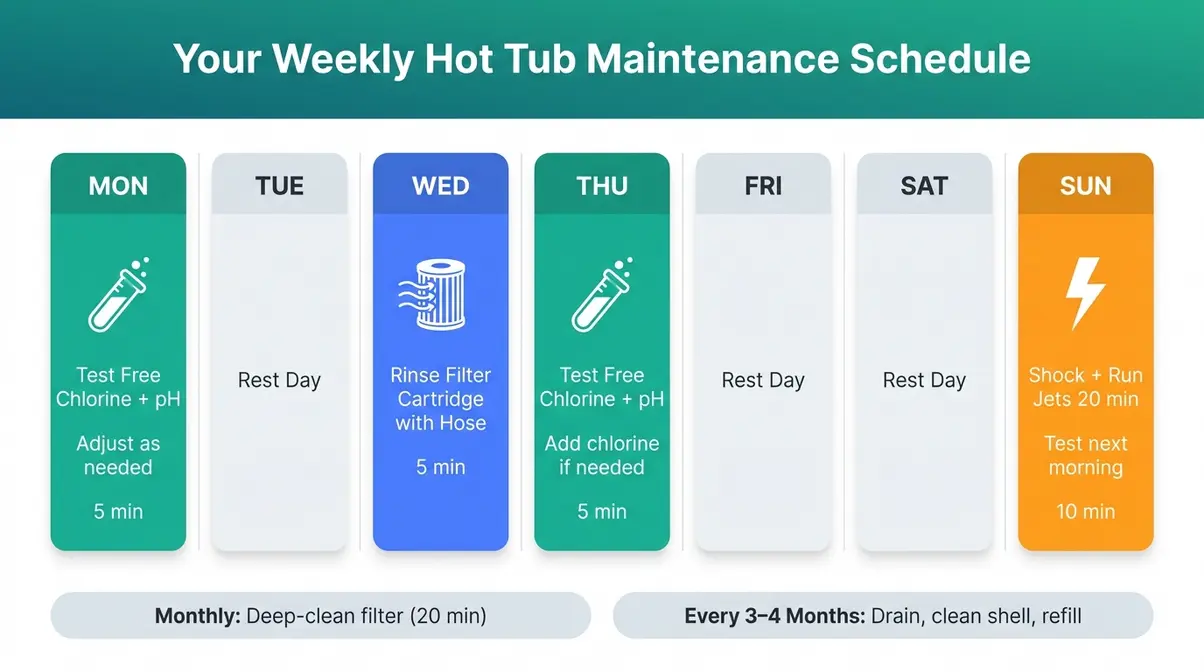
| Day | Task | Time |
|---|---|---|
| Monday | Test free chlorine + pH, adjust as needed | 5 min |
| Thursday | Test free chlorine + pH, add chlorine if needed | 5 min |
| Sunday | Shock + run jets 20 min, test next morning | 10 min |
| Weekly | Rinse filter cartridge with hose | 5 min |
| Monthly | Deep-clean filter with filter cleaner solution | 20 min |
| Every 3–4 months | Drain, clean shell, refill | 2–3 hours |
Troubleshooting: 6 Chlorine Problems Solved
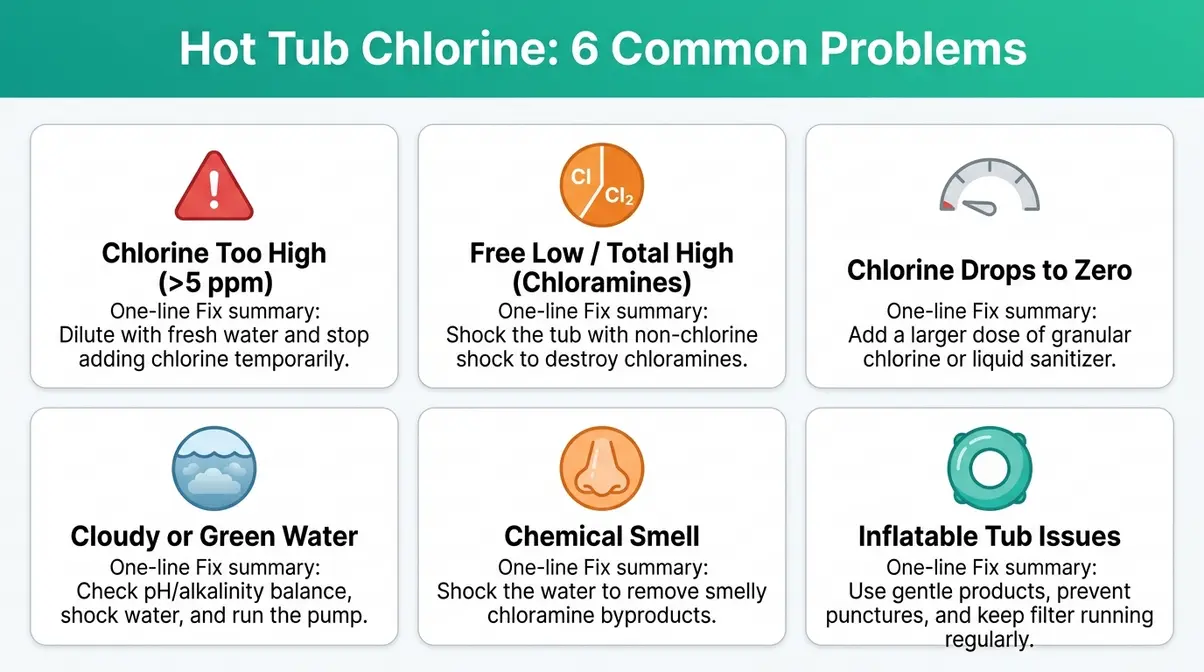
This is where most guides fall short. Generic advice like “add more chlorine” doesn’t help when your specific reading is confusing. Here are the six most common hot tub chlorine level problems — and the exact steps to fix each one.
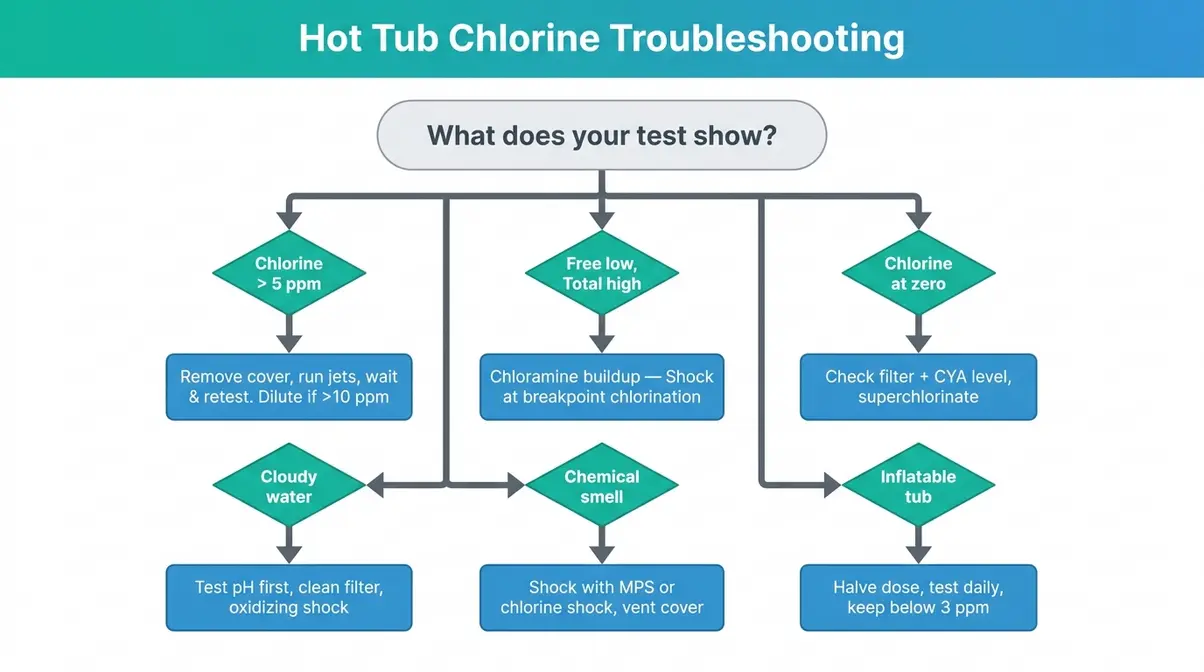
Problem 1 — Chlorine Is Too High (Above 5 ppm)
What you see: Test strip shows free chlorine above 5 ppm. Water may smell strongly of chlorine. Skin and eyes feel irritated after soaking.
Why it happens: Over-dosing, adding shock right before testing, or adding chlorine without testing first.
- Fix:
- Don’t add any more chlorine. Stop all chemical additions.
- Remove the cover and run the jets. Sunlight and aeration naturally break down chlorine (called “off-gassing”). Even 2–3 hours of sun exposure can drop chlorine by 1–2 ppm.
- Wait and retest every 2–3 hours.
- If very high (above 10 ppm): Partially drain and refill with fresh water to dilute.
- Don’t soak until the reading drops below 5 ppm.
High chlorine rarely damages your tub permanently — it just needs time to dissipate.
Problem 2 — Free Chlorine Low, Total Chlorine High (Chloramines)
What you see: Total chlorine reads 3–4 ppm, but free chlorine reads 0.5–1 ppm. Water smells chemical. May be cloudy.
Why it happens: This is the chloramine problem described earlier — your chlorine has “combined” with contaminants and is no longer active. This is the most commonly misdiagnosed hot tub problem. Many owners add more chlorine, which temporarily raises both numbers but doesn’t break apart the chloramines.
- Fix:
- Calculate combined chlorine: Total chlorine minus free chlorine. If the gap is more than 0.5 ppm, chloramines are the issue.
- Shock the water with chlorine shock at breakpoint chlorination — add enough to reach 10× the combined chlorine level. For example: 2 ppm combined chlorine → target 20 ppm free chlorine dose (temporary, will drop quickly).
- Run jets with cover open for 20 minutes.
- Wait 8–12 hours, then retest.
- Confirm free chlorine is back in the 2–4 ppm range before soaking.
According to Master Spas’ free vs. total chlorine guide, this free-low/total-high pattern is one of the most frequently misunderstood readings among new hot tub owners.
Problem 3 — Chlorine Won’t Stay Up (Keeps Dropping to Zero)
What you see: You add chlorine, it reads fine, but 24 hours later it’s back to zero.
Why it happens: Three main culprits: (1) heavy bather load consuming chlorine faster than you’re adding it; (2) high UV exposure — direct sunlight destroys unstabilized chlorine rapidly; (3) organic contamination — algae, biofilm in pipes, or a dirty filter that keeps reintroducing contaminants.
- Fix:
- Check and clean your filter first. A clogged filter recirculates contaminants that eat through chlorine.
- Check your CYA (cyanuric acid) level. CYA stabilizes chlorine against UV breakdown. Ideal range: 30–50 ppm for outdoor hot tubs. If zero, add stabilizer per your tub’s volume.
- Superchlorinate: Add a large dose of chlorine (10–20 ppm) and let it work overnight.
- Inspect for biofilm — a slimy residue in jets or pipes. If present, use a pipe purge product before your next drain-and-refill.
- If problem persists after all above steps: Drain, clean the shell and jets thoroughly, and refill.
Problem 4 — Cloudy or Green Water Despite Adding Chlorine
What you see: Water is hazy, milky, or greenish. You’ve added chlorine but it’s not clearing.
Why it happens: Cloudy water has multiple causes — low chlorine, high pH (which makes chlorine ineffective), phosphates feeding algae, or a dirty filter restricting circulation.
- Fix:
- Test pH first. If pH is above 7.8, chlorine efficiency drops dramatically. Lower pH with pH reducer (sodium bisulfate) before adding more chlorine.
- Check alkalinity. If alkalinity is outside 80–150 ppm, pH will be unstable and hard to hold.
- Clean or replace your filter. Poor circulation is a hidden cause of cloudy water.
- Shock with chlorine shock — not just a maintenance dose, but a full oxidizing shock treatment.
- Run jets for 4–6 hours with the cover off to circulate and aerate.
- Retest after 12 hours. If still cloudy, consider a water clarifier or a partial drain-and-refill.
Green water specifically signals algae growth — a sign chlorine has been at zero for an extended period. A full drain-and-refill is often the fastest resolution.
Problem 5 — Strong Chemical Smell (Chloramine Buildup)
What you see: Strong “pool smell” when you open the cover. Eyes water. Skin feels irritated after soaking.
Why it happens: As explained earlier, that sharp smell isn’t excess chlorine — it’s chloramines. This is a critical distinction. Adding more chlorine to fix a chloramine smell makes it temporarily worse before it gets better.
- Fix:
- Test free vs. total chlorine. Confirm chloramines are the issue (gap > 0.5 ppm).
- Shock immediately with either non-chlorine shock (MPS) for a quick fix, or chlorine shock for a full reset.
- Run jets with cover open for 20–30 minutes to vent chloramine gas.
- Consider the source: Ask recent bathers to shower before entering. Rinse swimsuits — detergent residue is a major chloramine precursor.
- Add shock routinely after heavy use to prevent buildup from recurring.
Regular shocking after every 2–3 soaking sessions prevents chloramine buildup from ever reaching this point.
Problem 6 — Inflatable Hot Tub Chlorine Issues
Inflatable hot tubs present unique challenges: smaller water volumes (typically 150–250 gallons), less powerful filtration, and materials that can react differently to high chlorine levels.
- Key differences for inflatable tubs:
- Dose smaller: A 200-gallon inflatable requires roughly half the chemicals of a 400-gallon hard-shell tub. Over-dosing is the most common mistake.
- Test more often: Less filtration capacity means chemistry shifts faster — test daily or after every use.
- Chlorine ceiling: Keep free chlorine below 3 ppm for inflatables. Some vinyl materials degrade at sustained levels above 3–5 ppm.
- Shock carefully: Use non-chlorine shock (MPS) for routine oxidation in inflatables to avoid over-chlorination.
- Cover and shade: UV breakdown is faster in shallower, smaller volumes. A cover plus shade extends your chlorine’s life significantly.
Leslie’s Pool Supply offers detailed guidance on inflatable spa chemical management, including dosing charts adjusted for smaller volumes.
Chlorine Alternatives: Salt Water, Bromine & Mineral Systems
Not every hot tub owner wants to manage chlorine granules week after week. Several alternatives exist—including saltwater vs chlorine hot tubs—each with genuine trade-offs worth understanding before you switch.
Salt Water vs. Chlorine Hot Tub: What’s Actually Different?
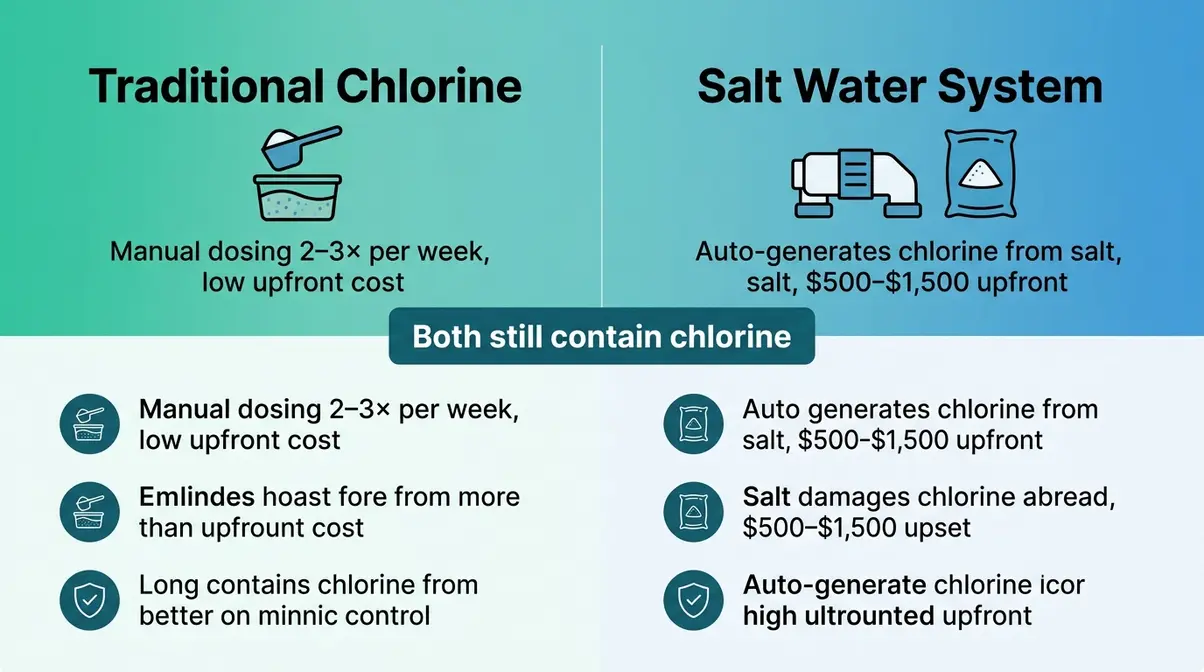
Salt water hot tubs don’t eliminate chlorine — they generate it. A salt water system uses electrolysis to convert dissolved salt (sodium chloride) into free chlorine automatically. The water still contains chlorine; the difference is that the system produces it continuously at low levels rather than you adding it manually in larger doses.
| Feature | Traditional Chlorine | Salt Water System |
|---|---|---|
| Chlorine source | Manual granule addition | Auto-generated from salt |
| Maintenance effort | 2–3× weekly dosing | Weekly salt level check |
| Skin feel | Can feel drying at higher levels | Often described as “softer” |
| Upfront cost | Low ($0 system cost) | $500–$1,500+ for system |
| Operating cost | Low (granules ~$20–$40/month) | Lower ongoing chemical cost |
| Still contains chlorine? | Yes | Yes |
| pH management needed? | Yes | Yes — often rises faster |
Salt water systems reduce the hands-on chemical routine — but they don’t eliminate water chemistry management. pH still drifts. Alkalinity still needs adjustment. And the salt cell needs periodic cleaning and eventual replacement (typically every 3–5 years).
Going Chlorine-Free: Bromine, Minerals, and UV Systems
Bromine is the most popular chlorine alternative for hot tubs. It’s more stable at high temperatures (hot tubs run at 100–104°F, where chlorine degrades faster), less pH-sensitive, and gentler on sensitive skin. The trade-off: bromine is harder to shock out of the water, costs more than chlorine, and can’t be stabilized against UV — making it better suited for indoor tubs.
Mineral systems (like Nature2 or Frog @ease) use silver and copper ions to kill bacteria, reducing the chlorine demand by up to 50%. You still need a small amount of chlorine (typically 0.5–1 ppm), but the mineral cartridge does much of the sanitizing work. These systems work well for owners who are sensitive to chlorine or want to reduce chemical handling.
UV and ozone systems are supplemental sanitizers — they treat water as it passes through the system but don’t maintain a residual sanitizer in the tub. Both must be combined with a low level of chlorine or bromine to protect water between cycles. They’re excellent at reducing chloramine formation and lowering overall chemical demand.
According to FROG Products’ hot tub chlorine overview, mineral-assisted systems can reduce chlorine use by up to 50% while maintaining equivalent sanitation — a meaningful benefit for chlorine-sensitive owners.
Hot Springs Brand Hot Tubs: Chlorine Care Tips
Hot Springs spas — including the Grandee, Envoy, Pulse, and Sovereign models — use the FreshWater Salt System as an optional upgrade, which generates chlorine from salt and significantly reduces manual dosing. For owners using traditional chlorine, the same 3-Number Rule applies: free chlorine 1–5 ppm, pH 7.2–7.8, test 2× per week.
A few Hot Springs-specific notes:
- The FreshWater Salt System generates chlorine automatically but still requires monthly salt level checks and annual cell replacement to maintain performance.
- Hot Springs’ ACE Salt Water System (available on higher-end models) uses an integrated cell in the filter area — keep the filter clean to maintain chlorine generation efficiency.
- All Hot Springs hot tub models use standard dichlor granules for supplemental chlorination when the salt system is off or during startup after a refill.
- The Freshwater IQ System (on newer Highlife Collection models) monitors water chemistry automatically and alerts you when adjustments are needed — but you still need to test manually to verify sensor accuracy.
For model-specific water care instructions, refer to your owner’s manual or the Hot Springs dealer network for guidance tailored to your tub’s filtration system.
Safety Risks, Limitations & When to Get Help
Even with the best routine, things go wrong. Knowing the warning signs — and when to stop DIY-ing — protects both your health and your investment.
Common Mistakes That Wreck Your Water Chemistry
Across hot tub owner forums and retailer guidance, these are the most consistently reported chemistry mistakes:
1. Adding chemicals without testing first. You can’t dose accurately without a baseline reading. This is the single most common cause of over-chlorination.
2. Adding chemicals with the cover closed. Chlorine and shock release gases during dissolution. A closed cover traps those gases, degrades the cover’s underside, and creates a concentrated chemical environment. Always add chemicals with the cover open and jets running.
3. Using pool chlorine in a hot tub. Trichlor tablets and some pool-grade products have very different pH profiles and stabilizer levels. Stick to dichlor granules or products specifically labeled for spas and hot tubs.
4. Not testing after heavy use. A party with four people in a 400-gallon tub can consume all your free chlorine in a single session. Test and adjust the same evening, not three days later.
5. Ignoring pH while chasing chlorine. As mentioned earlier, chlorine at pH 8.0 is only about 20% effective. You can have 4 ppm free chlorine and still have unsanitary water if pH is too high. Always test and adjust pH alongside chlorine.
6. Skipping the drain-and-refill schedule. Total dissolved solids (TDS) — the accumulated mineral and chemical residue in your water — rise over time and make water chemistry increasingly difficult to manage. Most manufacturers recommend draining and refilling every 3–4 months. Many owners who “can’t get their water right” simply need a fresh start.
When to Call a Professional or Drain and Refill
Some problems are beyond routine adjustment. Call a licensed pool and spa professional — or commit to a full drain-and-refill — when:
- Free chlorine won’t hold above 1 ppm despite repeated shocking and dosing
- Water has a persistent foul odor (sulfur smell, musty smell) that doesn’t clear after shocking
- Visible biofilm or slime in jets, pipes, or on the shell surface
- Unexplained skin rashes or irritation in bathers — potentially hot tub folliculitis caused by Pseudomonas aeruginosa, which thrives when chlorine drops below safe levels
- TDS above 1,500 ppm — water is saturated and chemicals become increasingly ineffective
- Chemical readings that make no logical sense despite multiple test methods
Draining and refilling is not a failure — it’s maintenance. Most hot tub problems that persist for weeks or months resolve completely with a fresh fill and a clean filter. The CDC notes that improperly maintained spa water is associated with a range of waterborne illnesses, including Legionella pneumonia — making a drain-and-refill a health decision, not just a cosmetic one.
Frequently Asked Questions
What should my chlorine level be in my hot tub?
Free chlorine should be between 1–5 ppm in a hot tub, with a working target of 2–4 ppm for regular use. The CDC recommends a minimum of 1 ppm to effectively kill bacteria and viruses. Below 1 ppm, pathogens can multiply faster than your chlorine can neutralize them. Above 5 ppm, you risk skin and eye irritation. Test twice per week to stay in range. The PHTA sets the industry standard at 2–4 ppm for residential spas.
Why is there a 15-minute hot tub rule?
The 15-minute guideline exists for safety and hygiene, not arbitrary caution. Hot tubs run at 100–104°F — temperatures that cause your core body temperature to rise quickly. Prolonged soaking can cause dizziness, nausea, overheating, and in rare cases, fainting. Additionally, 15 minutes is the recommended wait time after adding non-chlorine shock (MPS) before entering the water safely. For chlorine shock, the wait is longer — 8–12 hours until free chlorine drops below 5 ppm.
Does a hot tub lower cortisol?
Research suggests regular hot tub use may reduce cortisol levels, the body’s primary stress hormone. The combination of heat, buoyancy, and hydrotherapy jet massage activates the parasympathetic nervous system, promoting relaxation.
Is a hot tub bad for folliculitis?
Hot tubs can cause folliculitis if chlorine levels are too low. Hot tub folliculitis is a skin infection caused by Pseudomonas aeruginosa — a bacteria that thrives in warm water when free chlorine drops below safe levels. Symptoms include an itchy red rash with small pustules, typically appearing 12–48 hours after soaking, according to the CDC’s guidance on hot tub rash. The CDC identifies hot tub folliculitis as one of the most common recreational water illnesses. Maintaining free chlorine above 1 ppm at all times is the primary prevention. If symptoms appear, see a doctor — most cases resolve with topical treatment, but severe infections require antibiotics.
Will shock raise free chlorine?
Yes — chlorine shock directly raises free chlorine levels. Chlorine-based shock (dichlor or cal-hypo) adds a large dose of free chlorine to the water, temporarily raising levels to 10–20 ppm to break apart chloramines and kill resistant bacteria. Non-chlorine shock (MPS) works differently — it oxidizes chloramines without adding chlorine, which frees up existing chlorine to become active again. Both types effectively raise usable free chlorine, but through different mechanisms. Always wait for free chlorine to drop below 5 ppm before soaking after chlorine shock.
What happens if you sit in a hot tub for 3 hours?
Sitting in a hot tub for 3 hours significantly increases health risks. Extended soaking at 100–104°F raises core body temperature, which can cause heat exhaustion, dehydration, low blood pressure, and dizziness. Pregnant women, elderly individuals, and people with cardiovascular conditions face heightened risk. Beyond heat, 3-hour sessions expose your skin to sustained chemical contact — even at proper chlorine levels, prolonged exposure can cause skin dryness and irritation. Most health guidelines recommend limiting sessions to 15–30 minutes, exiting to cool down, and rehydrating before re-entering.
Why can’t you be in a hot tub for long?
Hot tub soak time is limited by your body’s ability to manage heat. Unlike a warm bath that gradually cools, a hot tub maintains temperature continuously. Your body can’t cool itself efficiently through sweating when surrounded by hot water. This causes core temperature to rise steadily. At 104°F, most adults reach an unsafe core temperature within 15–30 minutes of continuous soaking. Children, elderly individuals, and anyone with heart conditions, diabetes, or blood pressure issues reach that threshold faster. Exit the water, cool down for 10–15 minutes, and hydrate before returning.
What do you crave when cortisol is high?
High cortisol levels typically trigger cravings for high-fat, high-sugar, and salty foods. Cortisol activates the brain’s reward pathways and promotes fat storage. This physiological stress response prepares the body for perceived threats by seeking quick energy sources.
Why do so many people get rid of hot tubs?
The most common reason people get rid of hot tubs is the ongoing maintenance burden, particularly water chemistry management. Common frustrations reported by hot tub owners include: the cost of chemicals ($50–$150/month), the time required for testing and adjusting, persistent water problems that feel impossible to solve, and the 3–4 month drain-and-refill cycle. Most of these frustrations stem from not having a simple, repeatable system — which is exactly what The 3-Number Rule addresses. Owners who establish a consistent routine rarely give up their tubs; those who try to “wing it” often do.
Keeping It Simple: The 3-Number Rule in Practice
Using this hot tub chlorine levels guide, hot tub chemistry doesn’t have to feel like a science exam. The frustration most beginners experience comes from trying to manage too many variables at once, without a framework to prioritize them.
The 3-Number Rule cuts through that complexity. Free chlorine between 1–5 ppm keeps your water sanitary. pH between 7.2–7.8 keeps your chlorine effective and your skin comfortable. Testing twice per week catches problems before they compound. Those three numbers — maintained consistently — prevent the vast majority of cloudy water, chemical smell, and equipment problems that drive hot tub owners to online forums at midnight.
Our guidance draws from CDC recommendations, PHTA industry standards, and consensus across hot tub owner communities — because the basics, done consistently, genuinely work.
Start with one week of disciplined testing. Log your readings. Adjust when needed. Within two or three weeks, you’ll develop an intuitive sense for your tub’s patterns — how quickly chlorine drops after a heavy-use weekend, how pH drifts in your local water, how long your filter lasts between rinses. That knowledge turns chemistry anxiety into confidence.
Test today. Log the numbers. Adjust if needed. Your water will thank you by staying clear, comfortable, and safe — exactly what you paid for.