
What’s in this guide
If you are wondering exactly how many calories do you burn in a hot tub, the answer might surprise you. Soaking in a hot tub burns a real, measurable number of calories — roughly 130–140 per hour for a 150 lb person at 104°F, according to research from Loughborough University. That’s the same energy expenditure as a 30-minute walk, achieved without lifting a finger. Most people dismiss hot tub time as “just relaxing,” but your cardiovascular system is quietly working the whole time.
“An hour-long hot bath can burn 130 calories — the same amount you would burn by walking for 30 minutes.”
There’s a critical catch most articles skip, though: that headline number assumes a full 60 minutes at maximum temperature. Realistic 20-minute soaks at home burn closer to 35–50 calories. And some of the weight you notice missing after a soak is water weight from sweating — not body fat. Understanding that distinction matters if you’re serious about using passive heating as a fitness supplement.
In this guide, you’ll get exact calorie numbers by body weight and duration, understand the science behind The Thermal Calorie Effect, compare hot tubs to saunas and hot baths, and learn how to maximize every soak safely. Body weight, water temperature, and session duration all drive the numbers — these variables are explained fully in Section 1.
If you want to know how many calories do you burn in a hot tub, soaking burns approximately 130–140 calories per hour for a 150 lb person — the same as a 30-minute walk — through a process called passive heating (Loughborough University, 2017).
- The Thermal Calorie Effect: Your heart rate rises in hot water, burning real calories without physical movement
- Body weight matters: A 120 lb person burns ~105 cal/hour; a 200 lb person burns ~175 cal/hour
- It’s not fat loss: Most immediate weight lost after soaking is water weight from sweating, not body fat
- Safe soak limit: CDC guidelines recommend no more than 15–20 minutes at 104°F (40°C)
- Best as a supplement: Hot tub calorie burn is real but modest — use it alongside, not instead of, exercise
How Many Calories Do You Burn in a Hot Tub?
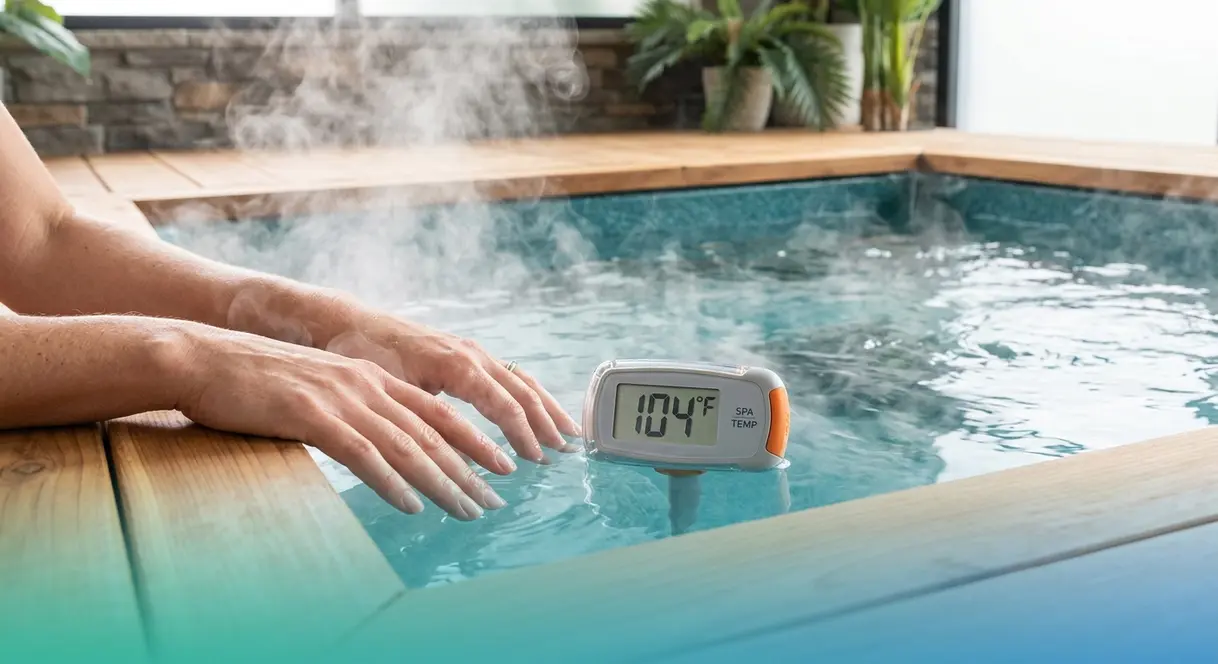
A 150 lb person burns approximately 130–140 calories per hour soaking in a hot tub at 104°F — equivalent to a 30-minute walk, according to the landmark Loughborough University passive heating study led by Dr. Steve Faulkner in 2017. That exact figure, however, depends on your body weight, the water temperature, and how long you stay in. Shorter soaks and lower temperatures produce meaningfully smaller numbers, which is why the full picture matters more than the headline figure.
Calorie Burn by Weight & Duration
Our team reviewed the available clinical research on passive heating to derive these estimates from the Loughborough University baseline of ~140 calories per hour for a 150 lb person at 104°F, scaled proportionally by body weight. These figures represent a useful planning framework, not laboratory-precise measurements — individual metabolic rates vary.
| Body Weight | 20 Minutes (104°F) | 30 Minutes (104°F) | 60 Minutes (104°F) |
|---|---|---|---|
| 120 lbs | ~35 calories | ~52 calories | ~105 calories |
| 150 lbs | ~44 calories | ~65 calories | ~130 calories |
| 180 lbs | ~52 calories | ~78 calories | ~155 calories |
| 200 lbs | ~58 calories | ~87 calories | ~175 calories |
Estimates derived from Loughborough University, 2017. Individual results vary based on metabolic rate, fitness level, and acclimatization.
A few things stand out in this data. First, the 20-minute column is a reality check: if you’re soaking for the CDC-recommended safe duration, you’re burning 35–58 calories depending on your weight — meaningful, but modest. Second, heavier individuals burn more calories because their cardiovascular system works harder to distribute heat across a larger body mass. Third, even at the 60-minute mark, hot tub calorie burn sits well below what most gym sessions deliver — which is exactly why framing it as a supplement rather than a replacement is so important.
A 150 lb person burns approximately 130–140 calories per hour soaking in a hot tub at 104°F — equivalent to a 30-minute walk (Loughborough University, 2017). That’s the quotable number, and it’s genuinely useful — but it’s the 20-minute and 30-minute figures that reflect most people’s real-world soaking habits.
The “Hot Tub Calorie Calculator” concept builds directly on this table: enter your weight and intended soak duration, and the calculator returns a personalized estimate. The data driving that tool lives in the table above. (Note for developers: this element supports WebApplication schema markup for enhanced SERP visibility.)
Want to explore how a hot tub fits into your wellness routine? See our hot tub health benefits guide for the full picture.
Water Temperature Effects
When people ask how many calories do you burn in a hot tub, they often forget that temperature plays a huge role. Temperature is the single most controllable variable in passive heating. The 104°F (40°C) figure in the table above represents the maximum recommended hot tub temperature per CDC guidelines. Drop to 100°F — common in home hot tubs set for comfort — and calorie burn decreases by roughly 15–20%, because your body’s thermoregulatory demand (the effort required to keep your core temperature stable) is proportionally lower.
Research published via USA Today’s health and wellness coverage of recent passive heating studies confirms that the cardiovascular response scales with the temperature differential between your skin and the water. Warmer water = greater thermal stress = more cardiovascular work = more calories burned. This is why competitive athletes who use hot water immersion protocols typically use water at or near 104°F for maximum effect.
The practical implication: if your home hot tub defaults to 100–102°F, your actual calorie burn will sit at the lower end of the table’s estimates. Setting it to 104°F (the safe maximum) optimizes the calorie-burning response without crossing into dangerous territory.
Hot Tub vs. Walking Comparison

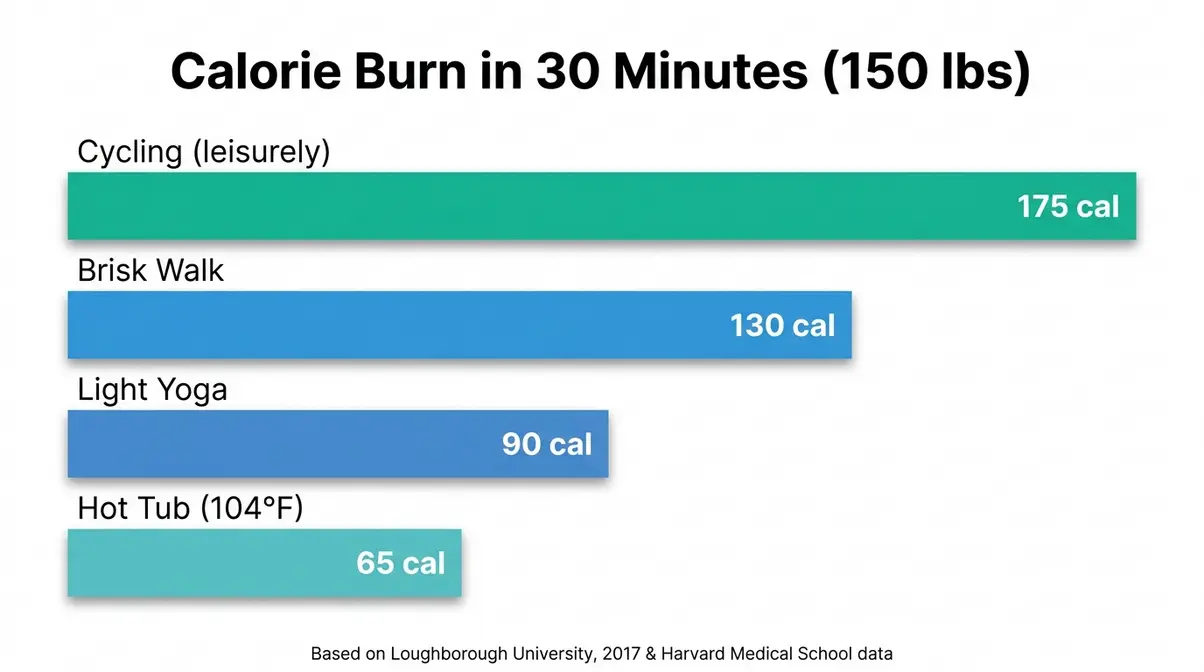
The 30-minute walk comparison is the most intuitive benchmark for understanding how many calories a hot tub burns — but a side-by-side view adds useful context.
| Activity | 30 Minutes | 60 Minutes | Heart Rate Elevation | Muscle Engagement |
|---|---|---|---|---|
| Hot tub (150 lbs, 104°F) | ~65 calories | ~130 calories | Moderate (similar to light exercise) | Minimal |
| Brisk walk (150 lbs) | ~130 calories | ~260 calories | Moderate | Full lower body |
| Light yoga (150 lbs) | ~90 calories | ~180 calories | Low–Moderate | Core + flexibility |
| Cycling, leisurely (150 lbs) | ~175 calories | ~350 calories | Moderate–High | Full lower body |
Walking burns roughly twice as many calories as a hot tub soak over the same period. However, the hot tub delivers cardiovascular benefits — elevated heart rate, improved circulation — with zero joint load. For people recovering from injury, managing arthritis, or simply adding low-effort calorie burn to a rest day, that trade-off has genuine value, as AARP’s health reporting on passive heating benefits highlights.
The Science of Passive Heating

The Thermal Calorie Effect is what happens when hot water forces your heart to work harder to regulate core body temperature — the same cardiovascular demand that burns calories during light exercise, achieved without moving a muscle. Understanding this mechanism explains why passive heating is scientifically real, not wishful thinking, and why it has limits that no amount of soaking can overcome.
Heart Rate Response to Hot Water
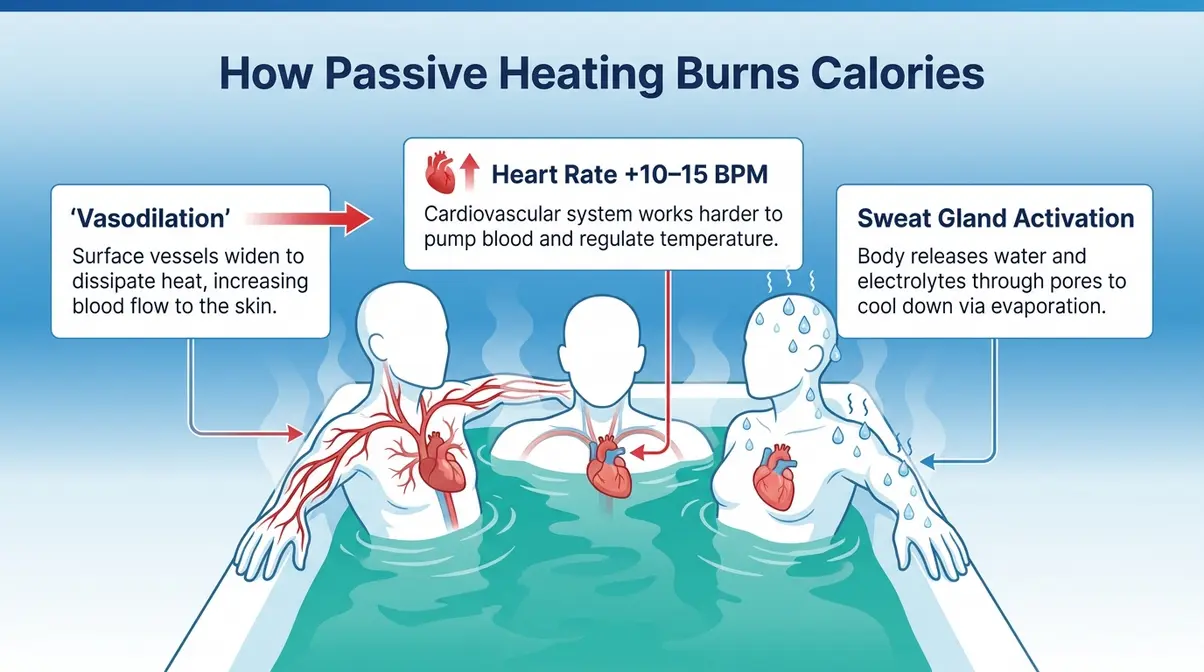
When you submerge your body in water at 104°F, your core temperature begins to rise. Your cardiovascular system responds immediately: blood vessels near the skin dilate (vasodilation) to push heat toward the surface, your heart pumps faster to move that warmed blood, and your sweat glands activate to cool you down through evaporation. Research suggests heart rate can increase by 10–15 beats per minute during a hot water immersion session — comparable to the cardiac demand of a gentle walk.
This cardiovascular response is the engine behind The Thermal Calorie Effect. Your body is performing real physiological work: maintaining a safe core temperature under thermal stress. The energy cost of that work shows up as calories burned. It’s not magic, and it’s not a shortcut to six-pack abs — but it is a genuine, research-supported metabolic response.
The key distinction from exercise: hot tub calorie burn comes almost entirely from cardiovascular and thermoregulatory work, with virtually no contribution from skeletal muscle contraction. That means you don’t build strength, improve VO2 max, or develop endurance from soaking. The cardiovascular benefit is real; the muscular benefit is negligible.
Do you burn calories while sitting in a hot tub?
Yes — you burn calories while sitting in a hot tub, even with zero physical movement. The calorie expenditure comes from your cardiovascular system working to regulate core body temperature under thermal stress, a process called passive heating. Your heart rate rises by approximately 10–15 beats per minute, your blood vessels dilate, and your sweat glands activate — all of which require energy. For a 150 lb person at 104°F, this translates to roughly 44 calories in 20 minutes and 65 calories in 30 minutes. The effect is real; it’s just more modest than active exercise.
Water Weight vs. Fat Loss
This is the most important misconception to clear up, and most articles in this space handle it poorly. When you step out of a hot tub, you may weigh half a pound to a pound less than when you stepped in. Almost none of that is fat.
That missing weight is water — lost through sweat during the soak. Your body can lose 500–1,000 ml of fluid in a 30-minute hot water session without you noticing, because the surrounding water masks the sensation of sweating. According to Cleveland Clinic guidance on hydration and heat exposure, this fluid loss is quickly reversed the moment you drink water. It has no meaningful impact on body fat.
The actual fat-loss math: burning 130 calories in a 60-minute soak contributes approximately 0.037 lbs (17 grams) of fat loss — assuming those calories come entirely from fat stores, which they don’t. Over time, consistent passive heating sessions can contribute to a modest calorie deficit, but they cannot produce meaningful fat loss on their own. The honest framing, per Anytime Fitness’s analysis of the hot tub diet concept, is that hot tubs are a wellness tool, not a weight-loss strategy.
Rehydrate immediately after every soak. The weight you lose in the tub comes back when you drink fluids — and it should.
Other Passive Heating Benefits
Calorie burn is the flashiest benefit, but passive heating research points to several other clinically relevant effects. A 2018 systematic review published on PubMed examining sauna bathing — which uses the same thermoregulatory mechanisms as hot tub immersion — found associations with reduced blood pressure, improved arterial compliance, and lower all-cause cardiovascular mortality in regular users.
Additional evidence-based benefits worth noting:
- Blood sugar regulation: Dr. Faulkner’s Loughborough research found that passive heating improved blood sugar control comparably to moderate exercise in sedentary participants — a finding with implications for Type 2 diabetes management.
- Inflammation reduction: Elevated core temperature triggers heat shock protein production, which research suggests may reduce systemic inflammation markers over time.
- Muscle recovery: The improved circulation from vasodilation can accelerate recovery after exercise by flushing metabolic waste products from muscle tissue.
- Sleep quality: A drop in core temperature after a hot soak signals the body toward sleep onset — soaking 1–2 hours before bed may improve sleep latency.
These benefits don’t replace exercise, but they do make passive heating a legitimate wellness tool with a broader evidence base than “it burns some calories.”
Hot Tub vs. Sauna Calorie Burn
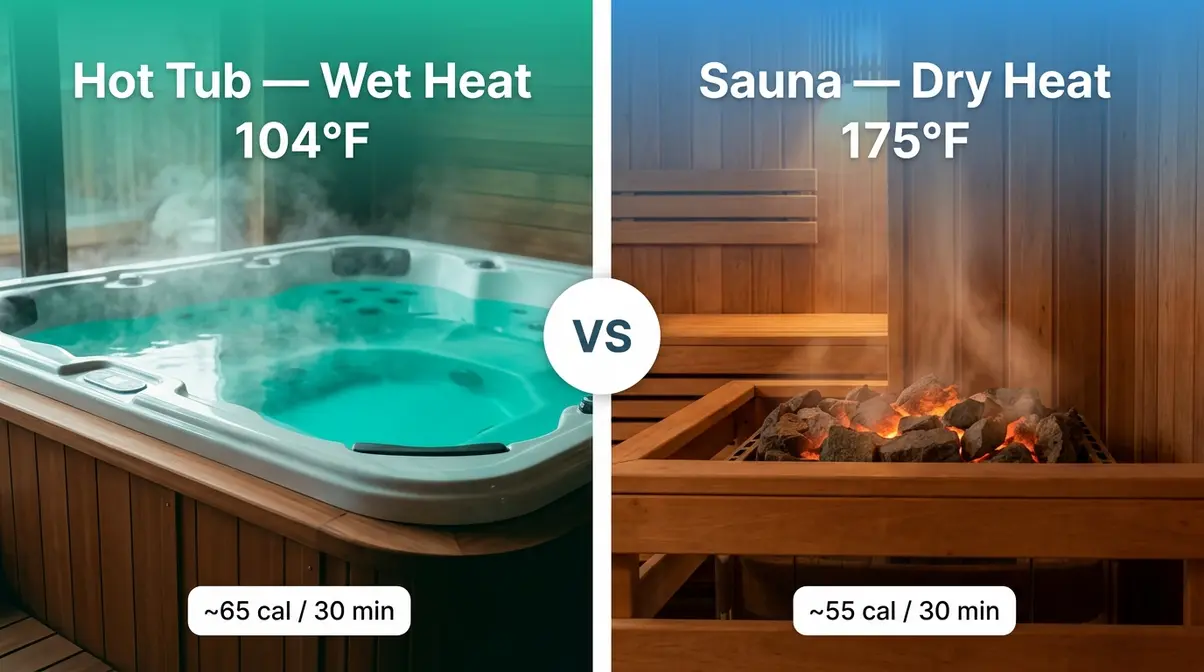
Both hot tubs and saunas exploit The Thermal Calorie Effect — forcing your cardiovascular system to work through heat stress. However, the delivery mechanism differs, and that difference affects calorie burn, safety profile, and practical usability. A 30-minute sauna session typically burns 40–75 calories for a 150 lb person at standard temperatures, placing it in a similar range to a comparably timed hot tub soak.
Dry Heat vs. Wet Heat
A sauna delivers dry heat, typically at 150–195°F (65–90°C) — far hotter than any hot tub. A hot tub delivers wet heat at a maximum of 104°F. The paradox: saunas run much hotter, but hot tubs may produce a comparable or slightly greater cardiovascular response at their respective temperatures.
The reason is water’s thermal conductivity. Water transfers heat to your body approximately 25 times more efficiently than air. So while sauna air reaches 180°F, your body absorbs heat far less efficiently than it does from 104°F water directly contacting your skin. The net cardiovascular stress — and therefore the calorie-burning response — ends up being roughly similar per unit of time, though individual variation is significant.
One meaningful difference: saunas allow higher temperatures and longer sessions before safety risks escalate, because dry air triggers less aggressive core temperature increases per minute. Hot tubs at 104°F can cause dangerous overheating more quickly, which is why the CDC’s 15–20 minute session limit is more conservative for hot water immersion.
Sauna Calorie Burn Estimates
A 2018 systematic review of sauna bathing published on PubMed — the most comprehensive passive heating meta-analysis available — provides the basis for these estimates. For a 150 lb person in a traditional Finnish sauna at approximately 175°F:
| Duration | Estimated Calorie Burn (150 lbs) | Comparison to Hot Tub |
|---|---|---|
| 15 minutes | ~25–35 calories | Slightly less than hot tub |
| 30 minutes | ~45–65 calories | Roughly equivalent |
| 60 minutes | ~90–130 calories | Comparable, slightly less |
The per-minute calorie burn in a sauna is marginally lower than a hot tub at 104°F for most body weights, primarily because water’s thermal conductivity creates a stronger cardiovascular demand. However, sauna sessions often run longer (30–45 minutes is standard), which can bring total session calorie burn into the same range.
Which Is Better for Your Goals?
The honest answer depends on what you’re optimizing for. Neither is a superior fat-loss tool — both burn modest calories through the same underlying mechanism.
- Choose if: You want combined muscle relaxation and cardiovascular benefit, have access to one, or prefer the social/comfort experience. Hot water immersion may also provide marginally better post-exercise muscle recovery.
- Choose if: You want longer sessions with comparable calorie burn, have access to dry heat facilities, or are specifically interested in cardiovascular and blood pressure research (which is more extensive for sauna use).
- For blood sugar and metabolic effects: The Loughborough research on hot water immersion currently has stronger direct evidence than sauna studies for this specific outcome.
If you have access to both, rotating between them provides variety and may prevent thermal acclimatization — the process by which your body becomes more efficient at managing heat stress, which can reduce the calorie-burning response over time.
Hot Bath and Shower Calorie Burn
No hot tub? The same Thermal Calorie Effect operates in your bathtub. The Loughborough University study that generated the 130-calorie headline figure was actually conducted using hot baths, not hot tubs — making the bath the original research subject for passive heating calorie burn. For anyone without hot tub access, a hot bath is the most accessible passive heating tool available.
Hot Bath Calorie Research
Dr. Faulkner’s 2017 Loughborough study placed participants in a bath at 104°F for 60 minutes and measured calorie expenditure and blood sugar response. The result — approximately 130 calories burned for a 150 lb person — is the same figure cited throughout this guide. AARP’s coverage of the research confirmed this finding is transferable to home bathers, making the hot bath a legitimate, no-cost passive heating option.
The calorie estimates from the body weight table in Section 1 apply directly to hot baths at equivalent temperatures. Fill your tub as hot as you can comfortably tolerate (up to 104°F), and the physiological response is essentially identical to a hot tub soak.
20-Minute vs. 30-Minute Bath
Most people don’t soak for a full hour. Here’s what the realistic durations actually deliver:
- 20-minute bath (150 lbs, 104°F): ~44 calories — roughly equivalent to a gentle 10-minute walk
- 30-minute bath (150 lbs, 104°F): ~65 calories — comparable to 15 minutes of light cycling
These numbers are modest but real. For someone adding a nightly bath to a broader wellness routine, 65 calories per session adds up to roughly 400 extra calories burned per week — the equivalent of one moderate gym session, accumulated passively. That’s the efficiency-seeking argument for passive heating in a nutshell.
What About a Hot Shower?
A hot shower produces a mild version of the same effect — your skin temperature rises, your heart rate ticks up slightly, and you burn marginally more calories than at rest. However, the effect is substantially smaller than immersion. Because a shower doesn’t submerge your body, the total skin surface area exposed to sustained heat is lower, the session is shorter (typically 5–10 minutes), and the thermal conductivity advantage of water contact is partially negated by water flowing rather than surrounding you.
A 10-minute hot shower burns approximately 10–20 calories for a 150 lb person — real, but not a meaningful calorie-burning strategy. Showers serve hygiene; baths and hot tubs serve passive heating.
Sauna Suits: Heat Without Water
Sauna suits — garments designed to trap body heat and increase sweat rate during exercise — attempt to replicate passive heating effects through clothing rather than immersion. They’re popular in combat sports for rapid weight cutting, and occasionally marketed as a fitness shortcut for everyday gym-goers. The reality is more complicated, and the risks are higher than most marketing suggests.
What a Sauna Suit Does
A sauna suit works by preventing sweat evaporation, causing your core temperature to rise faster during exercise. The result: your heart works harder, you sweat more, and you lose more fluid weight. During an exercise session, a sauna suit may increase calorie burn by 10–15% compared to exercising without one — because the added thermal stress amplifies the cardiovascular response of the workout itself.
The critical distinction from hot tub or sauna use: a sauna suit’s calorie-burning effect requires you to exercise while wearing it. It amplifies active exercise; it doesn’t create passive calorie burn on its own. Sitting still in a sauna suit produces sweating and fluid loss — not meaningful calorie expenditure beyond what a warm room would generate.
The Safety Risks You Need to Know
In our evaluation of passive heating methods, we found that sauna suits carry significantly higher risk than hot tub or sauna use, particularly for unsupervised users. The dangers are well-documented:
- Severe dehydration: Fluid losses of 2–3 liters per session are possible, causing performance decline, cramping, and in extreme cases, kidney stress.
- Hyperthermia: Without the cooling mechanism of water (which conducts heat away from the body), core temperature can spike dangerously during intense exercise in a sauna suit.
- Cardiovascular strain: The combination of exercise-induced heart rate elevation and thermal stress can push cardiac demand to unsafe levels, particularly in people with underlying conditions.
The FDA and other health organizations have issued warnings about sauna suits in competitive sports contexts. For general fitness use, the risk-to-reward ratio is poor: the modest additional calorie burn doesn’t justify the dehydration and overheating risk. Hot tubs and saunas — used within recommended guidelines — provide passive heating benefits with a far better safety profile. Consult your doctor before using a sauna suit, particularly if you have any cardiovascular or kidney conditions.
Maximize Hot Tub Calorie Burn Safely
Knowing how many calories a hot tub burns is only half the equation. Getting the most from each session — without putting yourself at risk — requires following a short set of evidence-backed guidelines. The good news: safe hot tub use and effective calorie-burning hot tub use are essentially the same thing.
- Estimated Time: 15–20 minutes per session
- Tools & Materials:
- Hot tub (heated to 100–104°F)
- Water bottle (16 oz minimum)
- Thermometer (to verify water temperature)
- Towel
CDC Temperature & Duration Rules
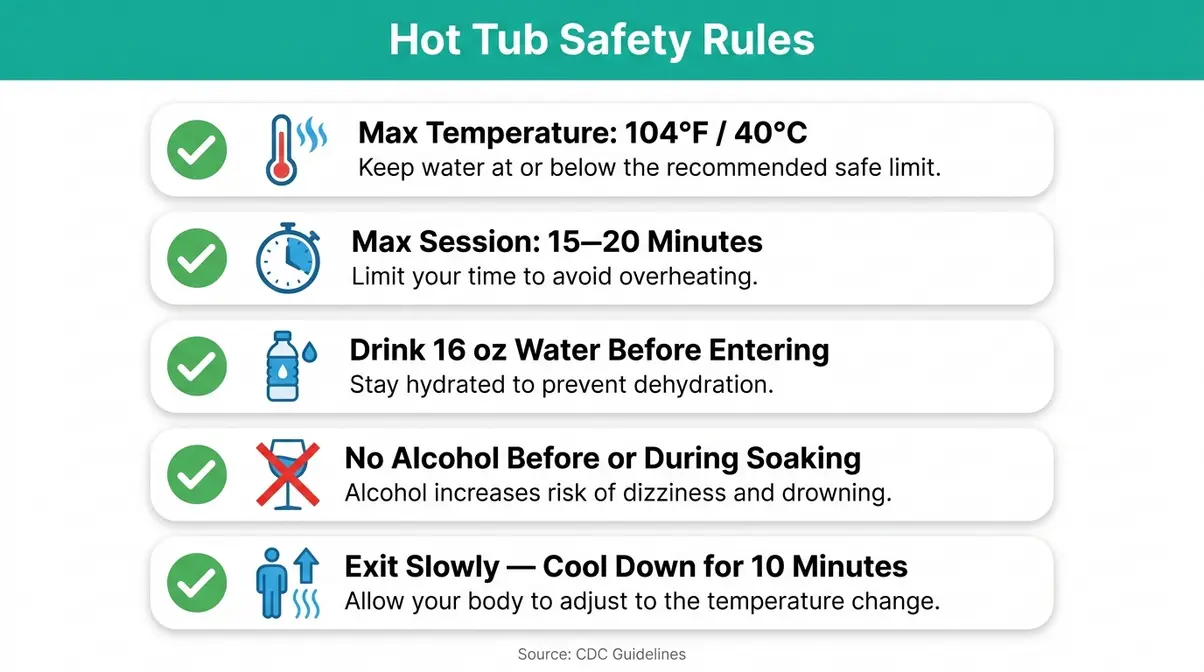
The CDC and most public health authorities recommend a maximum hot tub temperature of 104°F (40°C) and a session duration of no more than 15–20 minutes at that temperature. These limits exist because prolonged heat exposure at high temperatures can cause rapid fluid loss, dangerous drops in blood pressure (as blood pools in dilated surface vessels), and in severe cases, heat stroke.
For calorie-burning purposes, these limits are actually optimal: 104°F at 15–20 minutes hits the sweet spot of meaningful cardiovascular stress without dangerous overheating. You don’t need to push beyond these limits to maximize the calorie-burning benefit — the physiological response is already near its ceiling at 104°F.
Temperature and duration guidelines at a glance:
| Temperature | Maximum Session Duration | Calorie Burn (150 lbs) |
|---|---|---|
| 100°F | 30 minutes | ~50–55 calories |
| 102°F | 20–25 minutes | ~55–60 calories |
| 104°F (max) | 15–20 minutes | ~44–65 calories |
For extended passive heating sessions, exit the tub, cool down for 10–15 minutes, rehydrate, and re-enter if desired. Multiple shorter sessions are safer than one extended soak.
How long should you soak in a hot tub?
Most adults should soak for no more than 15–20 minutes at 104°F (40°C), per CDC guidelines. This duration balances meaningful calorie burn and cardiovascular benefit against the risks of dehydration, overheating, and blood pressure drops from prolonged heat exposure. If you want a longer session, exit after 15–20 minutes, cool down for 10–15 minutes, rehydrate, and re-enter. At lower temperatures (100–102°F), 30-minute sessions are generally safe for healthy adults. People with cardiovascular conditions, diabetes, or who are pregnant should consult a doctor before soaking at any duration.
Hydration and Pre-Soak Prep
Hydration is the single most important preparation step. Because the surrounding water masks the sensation of sweating, many people exit a hot tub significantly dehydrated without realizing it. Follow these steps before and after every session:
- Drink 16 oz (500 ml) of water 30 minutes before entering — this pre-loads your fluid reserves before heat exposure begins.
- Avoid alcohol before soaking — alcohol impairs thermoregulation and increases dehydration risk significantly; it’s also associated with hot tub-related drowning incidents.
- Keep water accessible poolside — sip during the session if you feel thirsty; don’t wait until you exit.
- Rehydrate within 10 minutes of exiting — drink at least 16 oz of water or an electrolyte beverage to replace sweat losses.
- Time your soak strategically — soaking 1–2 hours before bed may improve sleep onset; soaking after exercise can accelerate muscle recovery through improved circulation.
For calorie-burn optimization specifically, soaking after a workout rather than before may provide a small additional benefit: your metabolic rate is already elevated from exercise, and the thermal stress compounds that elevation modestly.
Common Mistakes to Avoid
Most people who use hot tubs for wellness purposes make at least one of these errors:
- Soaking at too-low temperatures (below 100°F): At 98°F, the water is barely warmer than your body temperature — thermoregulatory demand is minimal, and calorie burn drops to near-resting levels. Set your tub to at least 100°F, ideally 102–104°F.
- Staying in too long without breaks: More time doesn’t mean more calories after a point — it means more dehydration and overheating risk. Use the 15–20 minute guideline and cycle with cool-down breaks.
- Drinking alcohol during or before soaking: This combination is responsible for a disproportionate share of hot tub-related medical incidents. Alcohol vasodilates blood vessels independently, compounding the blood pressure drop from heat exposure.
- Expecting fat loss from soaking alone: The water weight lost during a soak is not fat. Replacing it with fluids is necessary and appropriate. Treating post-soak weight loss as meaningful fat reduction leads to poor long-term expectations and inconsistent hydration habits.
- Skipping the cool-down period: Exiting a 104°F tub and immediately sitting in a cold room can cause rapid blood pressure changes. Exit slowly, sit on the tub edge for a minute, and allow your body to transition gradually.
When to Consult a Doctor
Hot tubs are safe for most healthy adults when used within the guidelines above. However, specific populations face elevated risk and should consult a physician before regular passive heating use:
- People with cardiovascular disease or hypertension — the heart rate elevation and blood pressure changes from heat exposure require medical clearance
- People with Type 1 or Type 2 diabetes — passive heating affects blood sugar regulation; monitoring and medication timing may need adjustment
- Pregnant individuals — elevated core temperature poses risk to fetal development, particularly in the first trimester; most OBs advise against hot tub use during pregnancy
- People taking blood pressure medications, diuretics, or anticoagulants — these medications interact with heat-induced fluid loss and circulatory changes
- Anyone who has experienced heat stroke or heat exhaustion — prior heat illness increases sensitivity to thermal stress
When in doubt, a brief conversation with your primary care physician takes five minutes and removes all ambiguity about whether passive heating is appropriate for your specific health situation.
Frequently Asked Questions
What burns 500 calories in 30 minutes?
Burning 500 calories in 30 minutes requires high-intensity activity — not passive heating. Activities in that range include competitive cycling (500–600 cal/30 min), vigorous swimming (400–500 cal), HIIT training (400–600 cal), and rowing at high effort (400–500 cal), all for a 180–200 lb individual (according to Harvard Medical School calorie expenditure data). A hot tub burns approximately 52–65 calories in 30 minutes for the same body weight — roughly 10% of that figure. If 500-calorie sessions are your goal, structured high-intensity exercise is the only realistic path.
How do you burn 1,000 calories in 30 minutes?
Burning 1,000 calories in 30 minutes is physiologically impossible for most humans under safe conditions. Even elite athletes at maximum exertion burn approximately 600–800 calories in 30 minutes. Claims suggesting otherwise typically involve severe dehydration (fluid weight loss, not calorie burn) or are simply inaccurate. For reference, a 150 lb person burns roughly 65 calories in a 30-minute hot tub session — a useful contribution to a daily calorie deficit, but far from 1,000. Focus on sustainable, evidence-based calorie expenditure rather than extreme short-term claims.
What exercise burns the most belly fat in the pool?
High-intensity pool exercises burn the most total calories, which contributes to overall fat loss including belly fat — you can’t spot-reduce fat from specific areas through any exercise. Water-based exercises with the highest calorie burn include water aerobics (400–500 cal/hour), swimming laps at moderate pace (400–600 cal/hour), and pool running with a flotation belt (500–700 cal/hour) for a 150–180 lb person. Passive hot tub soaking burns far fewer calories than any of these activities and doesn’t engage the muscle groups needed for core development. For belly fat specifically, a calorie deficit combined with full-body exercise produces the most evidence-backed results.
Calories Burned in 10,000 Steps
10,000 steps burns approximately 300–400 calories for a 150 lb person, depending on walking pace, terrain, and individual fitness level (based on American Council on Exercise estimates). At an average pace of 3–3.5 mph on flat ground, 10,000 steps covers roughly 4–5 miles and takes 80–100 minutes. By comparison, a 60-minute hot tub soak burns about 130 calories for the same body weight — roughly one-third of the 10,000-step total. Both activities contribute to a daily calorie deficit, but walking delivers roughly 2.5x more calorie burn per hour and engages the cardiovascular and muscular systems far more comprehensively.
What is the laziest way to burn calories?
Soaking in a hot tub or lying in a hot bath is arguably the laziest way to burn meaningful calories — your body does the work through passive heating while you relax completely. A 60-minute hot tub session burns 130–140 calories for a 150 lb person with zero physical effort required (Loughborough University, 2017). Other genuinely passive calorie burners include sleeping (roughly 50–70 calories/hour, depending on body weight), watching TV (60–80 calories/hour), and cold exposure (which activates brown fat thermogenesis, though research is still developing). Hot tub soaking wins the practical laziness category because it actively elevates your heart rate and metabolic rate, not just baseline metabolism.
Limitations and Caveats
Can hot tub use help with weight loss?
Hot tub use can contribute modestly to weight loss when used consistently as part of a broader calorie-deficit strategy. A 60-minute soak burns approximately 130–140 calories for a 150 lb person (Loughborough University, 2017) — meaningful over time, but not sufficient as a standalone weight-loss method. The cardiovascular response from passive heating also shows promise for improving blood sugar regulation, which supports metabolic health. However, any weight lost immediately after soaking is water weight from sweating, not body fat, and is restored when you rehydrate. Think of hot tubs as a supplement to regular exercise, not a replacement.
Common Pitfalls
Overestimating the calorie burn. The 130–140 calorie/hour figure is frequently cited out of context — it assumes a full 60 minutes at 104°F, conditions most people don’t maintain. Realistic 20-minute home soaks deliver 35–50 calories. Building a weight-loss plan around the headline number leads to disappointment and inconsistent effort.
Confusing fluid loss for fat loss. The scale may show a half-pound drop after soaking, but that’s sweat — not fat. Failing to rehydrate after soaking creates real dehydration risk without any meaningful fat-loss benefit. This is the most common misunderstanding in the passive heating space, and it’s worth repeating every time you step out of the tub.
Using hot tubs to justify skipping exercise. Passive heating is a genuine supplement to fitness, not a substitute. A 130-calorie hot tub session replaces roughly 10 minutes of brisk walking — useful, but not a trade-off for skipping a workout.
When to Choose Alternatives
- For meaningful fat loss: Structured exercise (cardio + resistance training) combined with dietary calorie control produces fat loss; hot tubs alone do not. If fat loss is your primary goal, prioritize exercise and use hot tubs as a recovery and wellness tool.
- For cardiovascular fitness: Active exercise — walking, cycling, swimming — builds cardiovascular capacity over time. Hot tubs elevate heart rate but don’t create the progressive overload needed for fitness adaptation. A hot tub cannot replace your cardio routine.
- For blood sugar management: While passive heating shows promise for blood sugar regulation (Loughborough, 2017), it should complement — never replace — medically supervised diabetes management including diet, exercise, and medication.
When to Seek Expert Help
If you have any of the conditions listed in the “When to Consult a Doctor” section above, a brief medical consultation before starting a passive heating routine is the right move. This is especially true for anyone managing hypertension, diabetes, or heart disease — populations for whom passive heating may offer real benefit, but also real risk if used without appropriate monitoring.
Hot tubs burn real calories — approximately 130–140 per hour for a 150 lb person at 104°F — through The Thermal Calorie Effect, the cardiovascular response to passive heat exposure that forces your heart to work without physical movement (Loughborough University, 2017). That’s equivalent to a 30-minute walk, achieved while sitting still. The effect is genuine, the science is solid, and the safety profile is excellent when you follow CDC guidelines.
The Thermal Calorie Effect is most valuable when you understand what it is and what it isn’t: a legitimate wellness supplement that contributes to a calorie deficit, improves circulation, and may support blood sugar regulation — not a replacement for exercise, and not a fast track to fat loss. Ultimately, when considering how many calories do you burn in a hot tub, remember that it is a legitimate wellness supplement, but the water weight you lose in the tub comes back when you drink fluids, as it should.
Your next step: set your hot tub to 104°F, drink 16 oz of water before you enter, soak for 15–20 minutes, and rehydrate when you exit. Use it consistently alongside your regular exercise routine, and The Thermal Calorie Effect becomes a genuine — if modest — contributor to your long-term health goals. For a deeper look at the full wellness picture, explore our guide to how many calories you burn in a hot tub and our guide on sweating in a hot tub.

David King
Hot tub tester and writer at One Hot Tub.