
What’s in this guide
- Why Is My Hot Tub Water Cloudy? (The 4-Root Diagnostic Method)
- How to Clear Cloudy Hot Tub Water: 5 Steps That Work
- When Nothing Works: How to Drain and Refill Your Hot Tub
- How to Keep Hot Tub Water Clear: Your Prevention Checklist
- Is Cloudy Hot Tub Water Safe? Timelines and Health Risks
- Other Hot Tub Water Problems: Foam, Hard Water, and Discoloration
- Frequently Asked Questions
- Keep Your Hot Tub Clear for Good
Home ›Hot Tub Water Management
“Why is this so difficult? I’ve owned hot tubs for 2 decades and still can’t figure this out.”
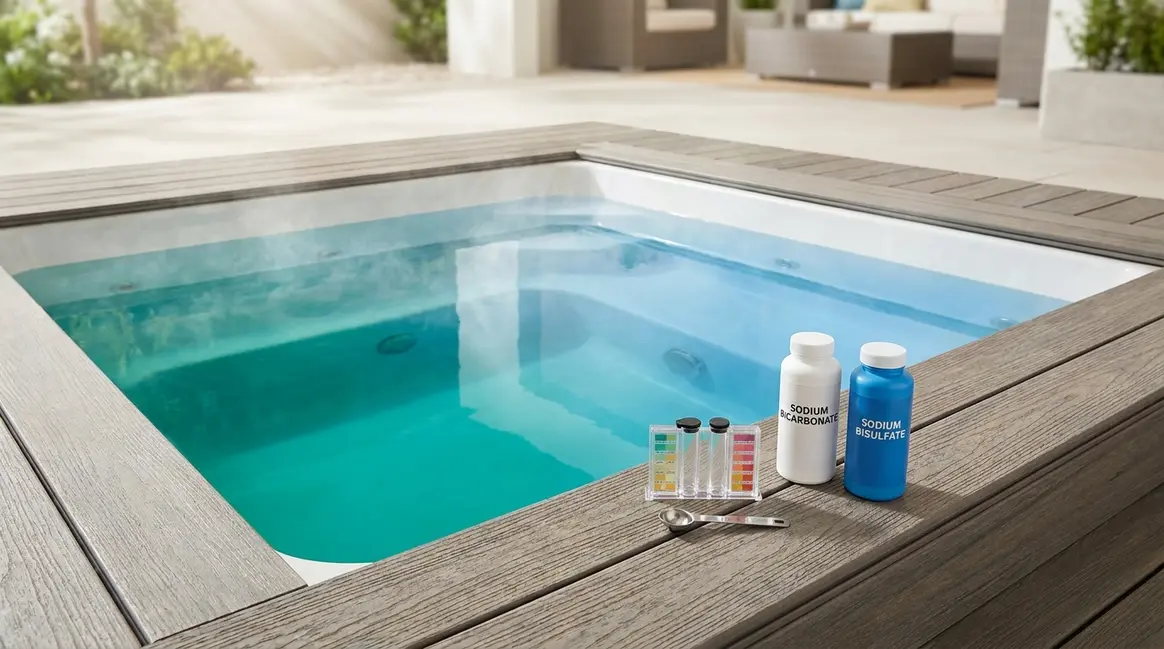
Sound familiar? Cloudy water is the #1 frustration reported by hot tub owners — and the maddening part is that it often happens even when your chemical readings look perfectly fine. The Cloudy Water Crisis isn’t just an eyesore. Murky water can harbor bacteria that cause a painful skin infection called hot tub folliculitis, so the cost of ignoring it is higher than most owners realize.
In this guide, you’ll learn exactly how to clear cloudy hot tub water using a proven 5-step process — and more importantly, you’ll discover which of the four root causes is behind your specific problem using the 4-Root Diagnostic Method. We’ll walk through diagnosing the cause, applying the fix, handling stubborn cases that won’t budge, building a prevention routine, understanding safety timelines, and solving related issues like foam and discoloration.





Cloudy hot tub water is always caused by one of four root causes — and identifying the right one first is the fastest path to crystal-clear water. The 4-Root Diagnostic Method tells you exactly where to start.
- Diagnose first: Use the 4-Root Diagnostic Method before adding any chemicals
- 5-step fix: Clean filter → balance chemistry → shock → circulate → clarify
- Health risk: Never soak in cloudy water — bacteria can cause hot tub folliculitis (CDC)
- Timeline: Most water clears within 12–24 hours after proper treatment
- Prevention: Weekly testing + monthly filter cleaning stops cloudiness before it starts
Why Is My Hot Tub Water Cloudy? (The 4-Root Diagnostic Method)
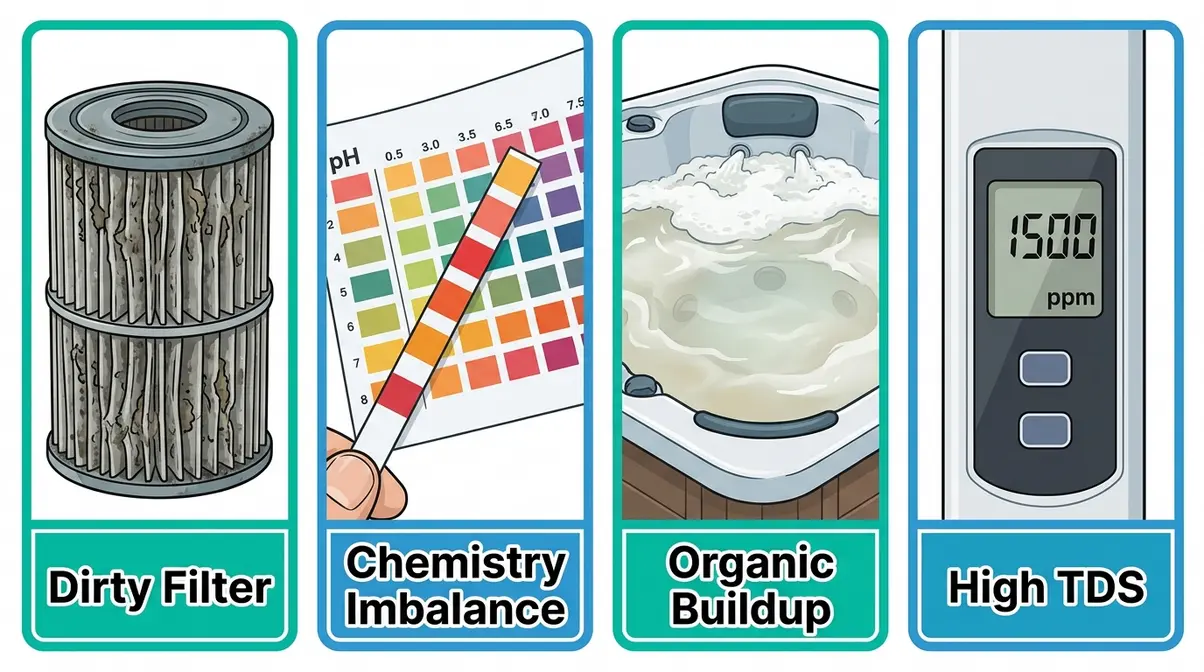
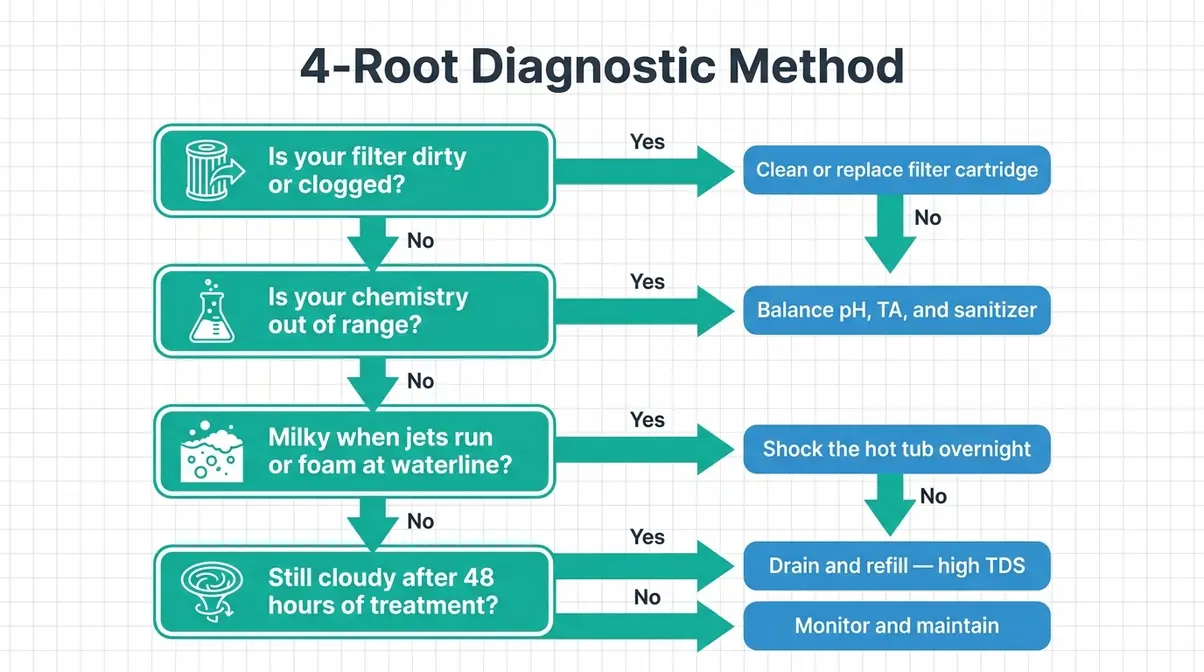
Cloudy hot tub water always traces back to one of four root causes. That’s the core idea behind the 4-Root Diagnostic Method — a framework for diagnosing your specific problem before you spend a dollar on chemicals. Treating the wrong root cause is why so many owners dump shock after shock into their tub and still wake up to milky water. Diagnose first, treat second.
1. Your Filter Is Dirty or Clogged
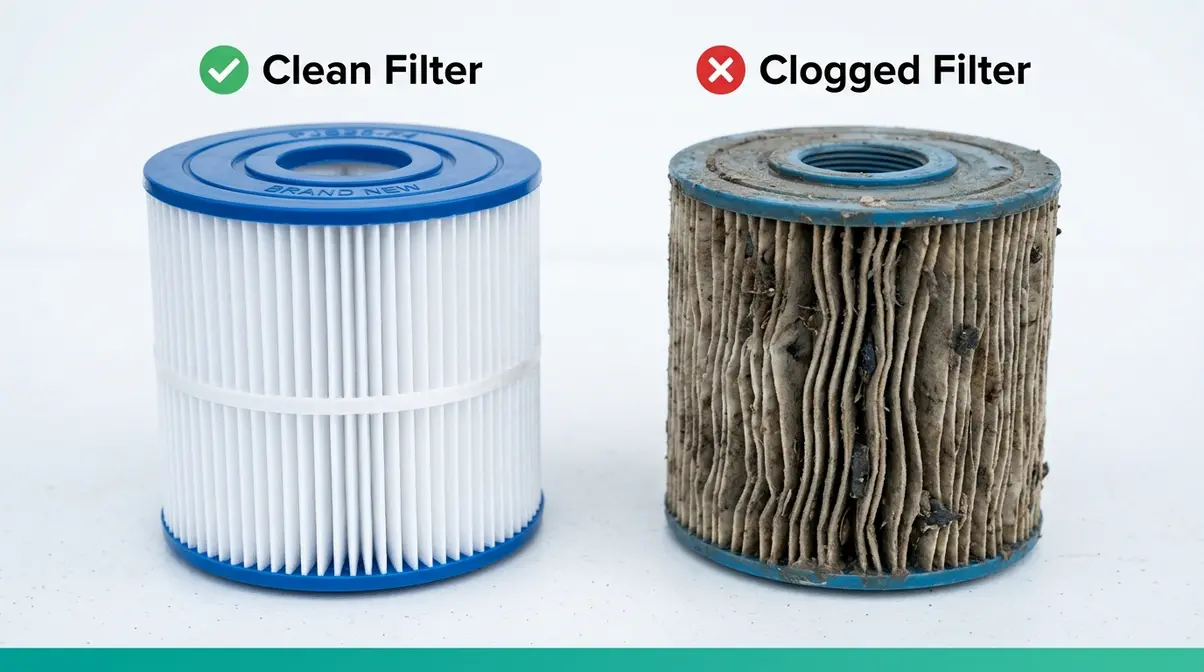
Your filter cartridge is the first line of defense against cloudy water. It physically traps tiny particles — dead skin cells, sunscreen residue, hair products — that would otherwise stay suspended in the water and make it look hazy. When the filter gets clogged, those particles stop getting trapped and the water turns cloudy fast.
How to spot this root cause: Pull out your filter cartridge and hold it up to the light. If the pleats (the accordion-like folds) look grey, brown, or matted flat, a dirty filter is almost certainly your culprit. User consensus from hot tub owner forums consistently points to a neglected filter as the single most common cause of sudden cloudiness.
Most manufacturers recommend rinsing filter cartridges every 1–2 weeks and doing a deep chemical soak every 1–3 months. Filters should be replaced entirely every 1–2 years, depending on usage. If yours is overdue, no amount of chemical balancing will clear that water.
2. Your Water Chemistry Is Off
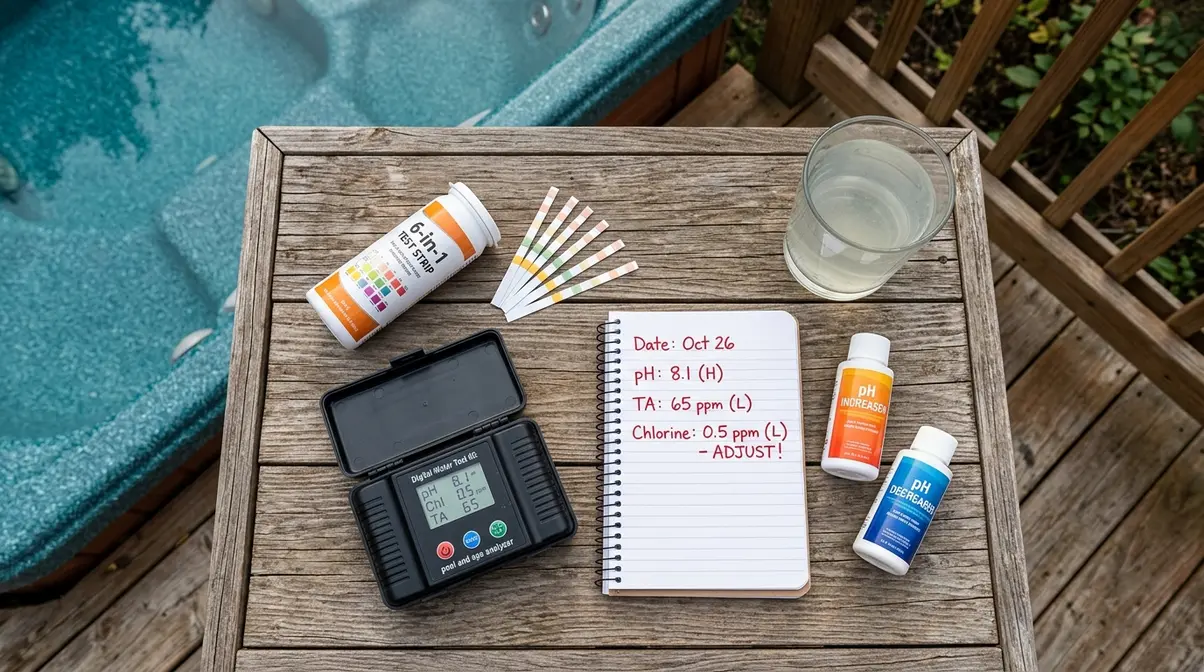
Water chemistry imbalance is the second root cause — and the trickiest, because the cloudiness it creates can look identical to a filter problem. The key players are pH (a measure of how acidic or alkaline your water is, on a scale of 0–14), total alkalinity or TA (a measure of how well the water resists pH changes, measured in parts per million or ppm), and sanitizer levels (chlorine or bromine, which kill bacteria).
Target ranges for clear water:
| Parameter | Ideal Range | Cloudy Zone |
|---|---|---|
| pH | 7.2–7.8 | Below 7.2 or above 7.8 |
| Total Alkalinity (TA) | 80–120 ppm | Below 80 or above 120 ppm |
| Chlorine | 3–5 ppm | Below 1 ppm or above 10 ppm |
| Bromine | 3–6 ppm | Below 2 ppm or above 8 ppm |
| Calcium Hardness | 150–250 ppm | Above 400 ppm |
When pH climbs above 7.8, chlorine loses most of its effectiveness — research from the CDC’s healthy swimming guidelines notes that sanitizer efficacy drops sharply outside the 7.2–7.8 pH window. The result is cloudy, under-sanitized water even when your test strips show “chlorine present.”
How to spot this root cause: Your readings are your evidence. Test the water with a reliable test kit — not just strips — and compare every parameter against the ideal ranges above. If anything is outside those ranges, water chemistry is your root cause.
3. Organic Contaminants Are Building Up
Every person who soaks in your hot tub introduces body oils, sweat, lotions, cosmetics, and hair products into the water. These organic compounds don’t evaporate — they accumulate. Over time, they overwhelm your sanitizer’s ability to break them down, and the result is a milky-when-jets-on cloudiness that often comes with a faint odor or foam around the waterline.
How to spot this root cause: The cloudiness gets noticeably worse when the jets run, and you may see a ring of foam or oily residue at the waterline. Across hot tub owner communities, this pattern — milky when jets are on, clearing slightly when jets are off — is the clearest indicator of organic contamination.
This root cause requires shocking the water (more on that in Step 3) and establishing better pre-soak habits (covered in H2 #4).
4. High Total Dissolved Solids (TDS)
TDS stands for Total Dissolved Solids — the cumulative amount of everything dissolved in your water: minerals, chemicals, body waste, and chemical byproducts. Think of it like a glass of water that you keep adding sugar to. Eventually, no matter how hard you stir, the water becomes saturated and turns cloudy because it simply can’t hold any more dissolved material.
Hot tub water accumulates TDS over time, especially in smaller volumes (most hot tubs hold only 300–500 gallons). Once TDS climbs above approximately 1,500 ppm over your fill-water baseline, no amount of chemical treatment will clear the water — a drain and refill is the only fix.
How to spot this root cause: If you’ve balanced your chemistry, cleaned your filter, shocked the water, and the water still isn’t budging after 24–48 hours, high TDS is the likely culprit. A digital TDS meter (inexpensive, available at most hardware stores) gives you a definitive reading.
Quick Diagnosis Checklist
Run through these questions in order — the first “yes” is almost always your root cause:
- [ ] Is my filter cartridge more than 4 weeks old since the last rinse? → Start with Step 1 (filter cleaning)
- [ ] Are any of my chemical readings outside the ideal ranges in the table above? → Start with Step 2 (balance chemistry)
- [ ] Is the water milky when jets run, or is there foam at the waterline? → Start with Step 3 (shock treatment)
- [ ] Have I balanced chemistry, cleaned the filter, and shocked — and the water still isn’t clearing after 48 hours? → Skip to H2 #3 (drain and refill)
How to Clear Cloudy Hot Tub Water: 5 Steps That Work
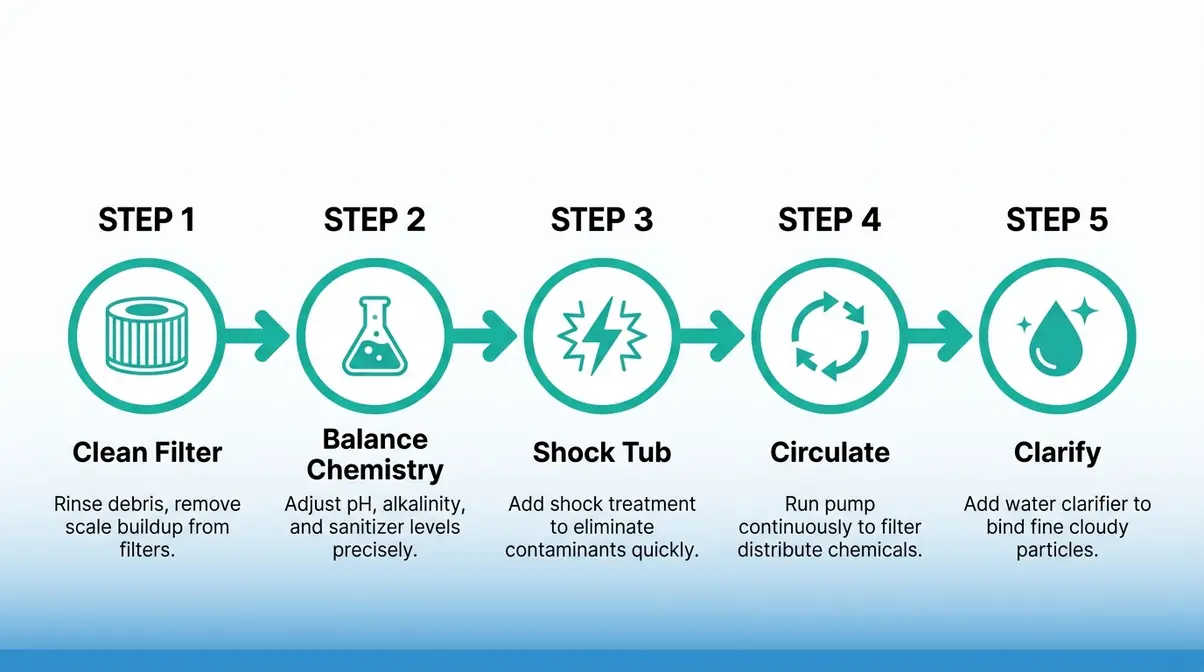
Now that you’ve identified your root cause, here’s the complete 5-step process to clear cloudy hot tub water. Work through the steps in order — each one builds on the last. Do not skip ahead to shocking before your filter is clean, or your results will disappoint.
What You’ll Need
Before you start, gather these supplies:
- Test kit or test strips (a 5-in-1 or 6-in-1 kit is best)
- pH increaser (sodium carbonate) and pH decreaser (sodium bisulfate)
- Total alkalinity increaser (sodium bicarbonate)
- Chlorine shock (dichlor or cal-hypo) or non-chlorine shock (MPS)
- Water clarifier (liquid or granular)
- Filter cleaning spray or chemical soak solution
- Garden hose with spray nozzle
- Rubber gloves and safety glasses
Estimated total time: 1–3 hours of active work, plus 12–24 hours for the water to clear.
Step 1: Clean Your Filter Cartridges
Remove your filter cartridge(s) from the filter housing — consult your owner’s manual if you’re unsure where they’re located. Most hot tubs have 1–4 cartridges.
- Rinse method (quick clean, 10 minutes):
- Hold the cartridge at a 45-degree angle under a garden hose.
- Work the spray nozzle between each pleat from top to bottom, rotating the cartridge as you go.
- Repeat until the water runs clear.
- Reinstall and run the jets for 15 minutes to flush debris.
- Chemical soak method (deep clean, recommended monthly):
- Rinse the cartridge first using the rinse method above.
- Mix a filter cleaning solution in a large bucket following the product instructions.
- Submerge the cartridge completely and soak for a minimum of 8 hours (overnight is ideal).
- Rinse thoroughly with a garden hose until no foam remains.
- Reinstall the cartridge.
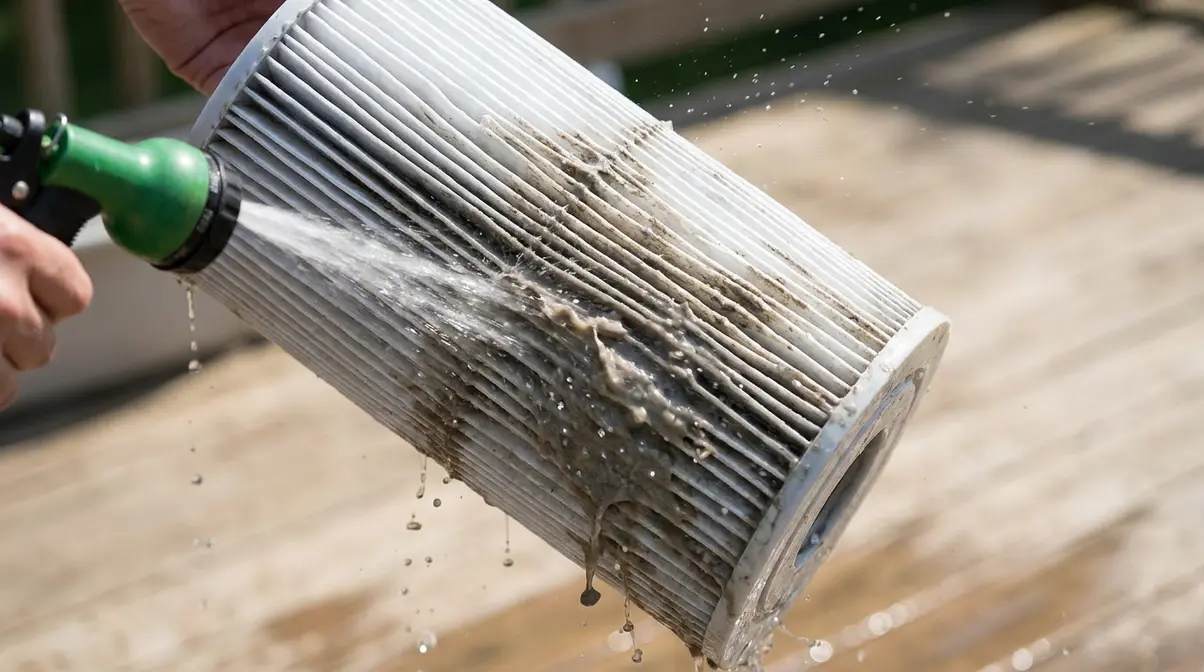
After cleaning, if the pleats are permanently discolored, flattened, or damaged, replace the cartridge entirely. A worn-out filter cannot clear your water no matter how well you clean it. According to Swim University’s hot tub maintenance guide, a clogged or worn filter is responsible for the majority of cloudy water complaints.
Step 2: Test and Balance Your Water Chemistry
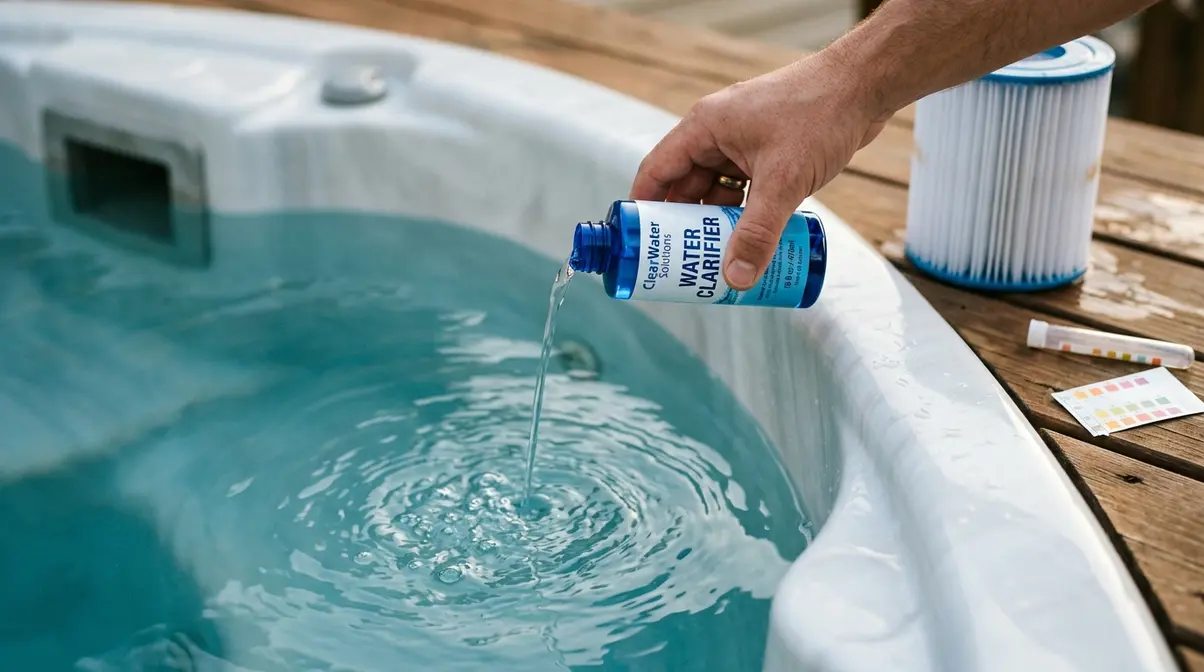
With a clean filter installed, test your water using a reliable test kit. Dip the test strip or draw a water sample per your kit’s instructions, then compare your readings against the ideal ranges.
Balance in this order — sequence matters:
- 1. Total Alkalinity (TA) first:
- TA acts as a buffer that stabilizes pH. If TA is wrong, pH will bounce around no matter what you add.
- Low TA (below 80 ppm): Add sodium bicarbonate (baking soda). A typical dosing example: add 1.4 oz per 100 gallons to raise TA by 10 ppm. For a 400-gallon hot tub with TA at 60 ppm, you’d add roughly 5.6 oz to reach 80 ppm.
- High TA (above 120 ppm): Add pH decreaser (sodium bisulfate) in small increments and retest.
- 2. pH second:
- Low pH (below 7.2): Add pH increaser (sodium carbonate). Start with 1 tablespoon per 300 gallons, retest after 2 hours.
- High pH (above 7.8): Add pH decreaser. Start with 1 tablespoon per 300 gallons, retest after 2 hours.
- 3. Sanitizer (chlorine or bromine) last:
- Low chlorine (below 3 ppm): Add dichlor shock or granular chlorine. A typical dose is 2 teaspoons of dichlor per 300 gallons to raise chlorine by approximately 5 ppm.
- Target range: Chlorine 3–5 ppm; Bromine 3–6 ppm.
- 4. Calcium Hardness:
- Target: 150–250 ppm. High calcium (above 400 ppm) causes white, chalky cloudiness. Add a calcium hardness decreaser, or dilute by partially draining and refilling with fresh water.
Wait 30 minutes between each chemical addition and retest before adding the next. Never add two chemicals at the same time — always add them separately to avoid dangerous reactions.
The Clorox Pool & Spa chemical guidance recommends retesting after each adjustment and not proceeding to shocking until pH and TA are within range, because shock is far less effective outside those windows.
Step 3: Shock the Hot Tub
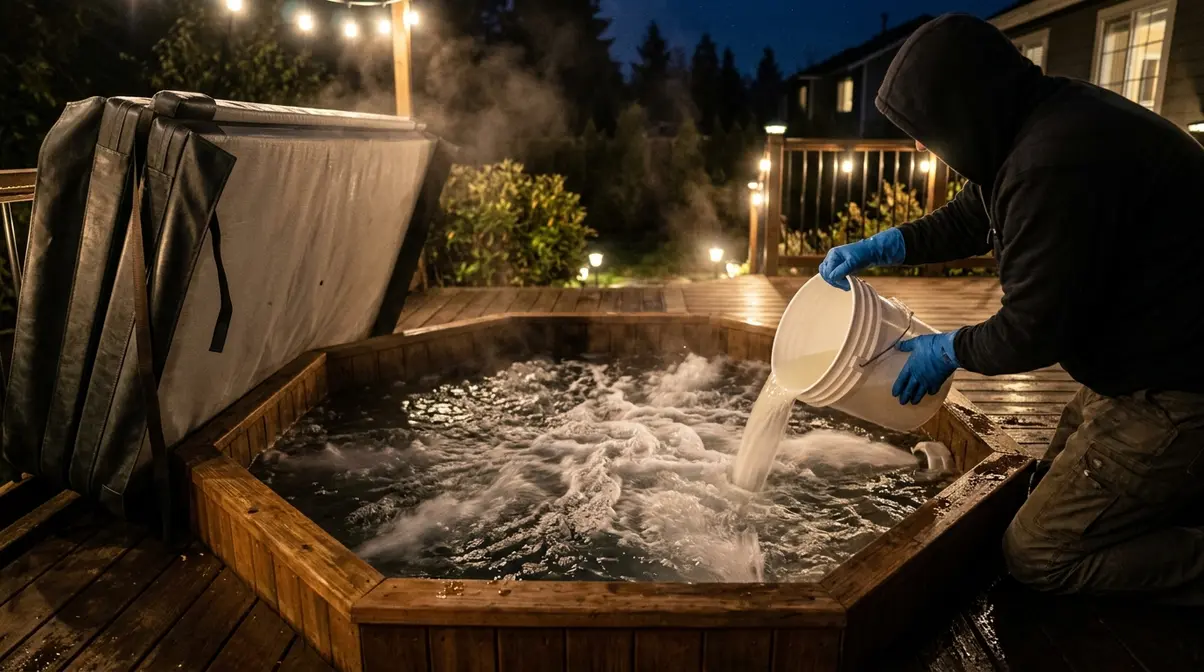
Shocking means adding a large dose of oxidizer to the water to break down organic contaminants — body oils, sweat, cosmetics, and the chloramines (chlorine combined with ammonia from body waste) that cause that strong chemical smell. Shocking restores your sanitizer’s ability to work.
⚠️ Chemical Safety Reminder: Always add chemicals to water — never add water to concentrated chemicals. Wear rubber gloves and safety glasses. Never mix different chemicals together in the same container. Pre-dissolve granular shock in a bucket of warm water before adding to the spa. Keep children and pets away during treatment. Follow all manufacturer instructions on the label.
Two shock options:
| Type | Best For | Dose (300-gallon tub) | Wait Time |
|---|---|---|---|
| Chlorine shock (dichlor) | Organic contamination, bacteria | 2–3 oz | 8–24 hours |
| Non-chlorine shock (MPS) | Routine oxidation, bromine systems | 2 oz | 15–30 minutes |
- The overnight shock method (most effective for stubborn cloudy water):
- Test and balance your water chemistry first (Step 2 above).
- Remove the hot tub cover completely.
- Turn on all jets to maximum.
- Add the appropriate dose of shock, pre-dissolved in a bucket of warm water.
- Run the jets for 20–30 minutes to distribute the shock evenly.
- Leave the cover off and let the water circulate overnight (8–12 hours).
- Retest in the morning. Chlorine should be back in the 3–5 ppm range before anyone enters the tub.
Do not use the hot tub while chlorine is above 10 ppm. This is not just a guideline — elevated chlorine at those levels can irritate eyes, skin, and respiratory passages.
Step 4: Run Your Circulation System
After shocking, run your hot tub’s circulation pump and jets continuously for a minimum of 8–12 hours. This step is critical and often skipped — circulation is what physically moves treated water through your (now-clean) filter, trapping the broken-down particles that are making your water cloudy.
Why this matters: Shock oxidizes organic matter into smaller particles, but those particles are still in the water. Your filter is the only thing that removes them. Without adequate circulation, the treated water just sits there.
- If your hot tub has a dedicated circulation pump (separate from the jet pumps), keep it running continuously.
- If your tub runs on jet pumps only, run them on low speed for at least 8 hours.
- Keep the cover off or slightly ajar during this period to allow gases to escape.
After 8–12 hours, retest your water and check for visible improvement. If the water is clearer but still not crystal clear, proceed to Step 5.
Step 5: Use a Water Clarifier
A water clarifier is a liquid or granular product that works by clumping together the tiny suspended particles in your water — particles so small that your filter can’t trap them individually. The clarifier essentially makes them big enough to catch.
- How to use a water clarifier:
- Confirm your chemistry is balanced (pH 7.2–7.8, sanitizer in range) before adding clarifier.
- Add the clarifier per the product’s label dosing — typically 1–2 oz per 300 gallons.
- Run the jets on low for 30–60 minutes to distribute.
- Let the filter run for 8–12 hours.
- Clean your filter again after 24 hours — it will be loaded with the clumped particles.
Common mistake: Adding clarifier before balancing chemistry. Clarifiers work poorly in unbalanced water, and many owners assume the product “doesn’t work” when the real issue is an out-of-range pH. Always balance first.
Clarifier vs. Flocculant: What’s the Difference?
Both products clear cloudy water, but they work differently and suit different situations:
| Product | How It Works | Best For | Effort Level |
|---|---|---|---|
| Clarifier | Clumps particles so filter can catch them | Mild to moderate cloudiness | Low — just add and wait |
| Flocculant | Causes particles to sink to the bottom | Severe cloudiness, fast results needed | High — must vacuum out settled debris |
Flocculant (also called “floc”) is rarely used in hot tubs because most hot tubs don’t have a vacuum system like pools do. If you use floc, you’ll need to drain a portion of the water to remove the settled debris from the bottom — a messy process. For most hot tub owners, clarifier is the right choice. According to Jacuzzi’s troubleshooting guidance, clarifiers are the recommended first-line product for routine cloudiness before considering more aggressive interventions.
Troubleshooting: Common Mistakes That Keep Water Cloudy
- Adding chemicals without testing first: Always test before treating. Adding more chlorine to already high-chlorine water makes things worse.
- Shocking with the cover on: Always remove the cover when shocking — gases need to escape, and a closed cover traps them, reducing effectiveness.
- Not cleaning the filter after clarifier use: Clarifier pushes debris into your filter. If you don’t clean the filter within 24 hours, the filter re-releases that debris back into the water.
- Giving up too soon: Severely cloudy water can take 24–48 hours to clear fully after correct treatment. Test at 12-hour intervals before concluding treatment has failed.
When Nothing Works: How to Drain and Refill Your Hot Tub
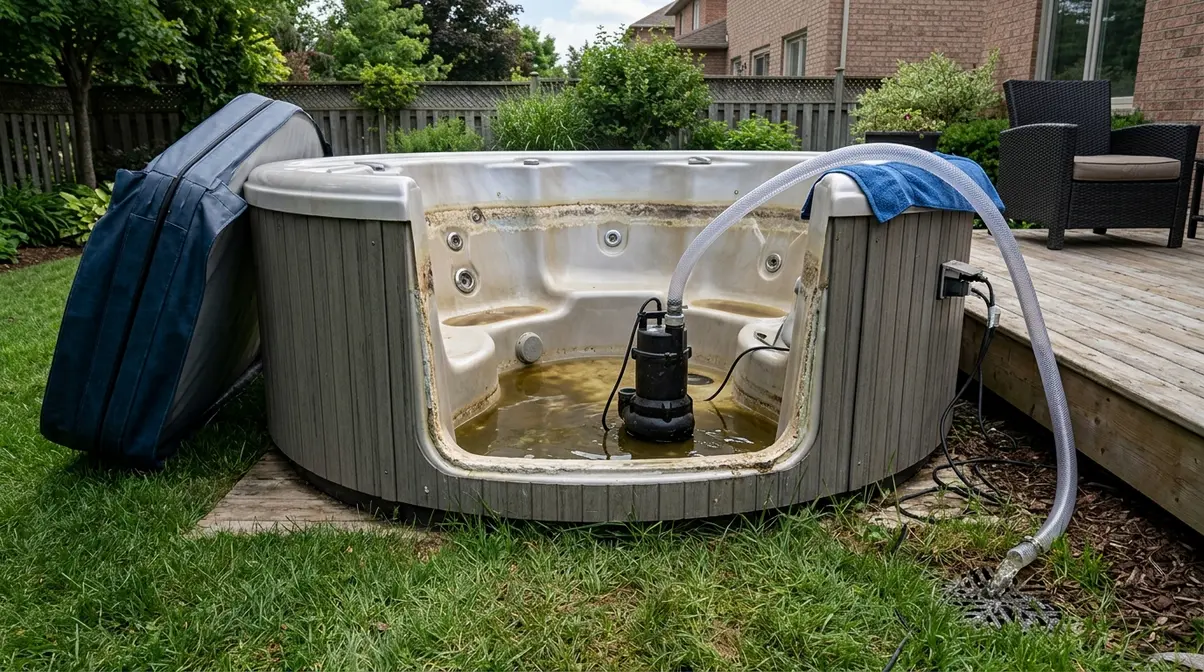
Sometimes, no amount of chemical treatment will clear cloudy water. This is not a failure — it’s a signal that your water has reached the end of its useful life. Knowing when to drain is just as important as knowing how to treat.
What Are Total Dissolved Solids (TDS)?
Total Dissolved Solids (TDS) is the cumulative concentration of everything dissolved in your hot tub water — minerals from your fill water, chemicals you’ve added, body waste, and chemical byproducts. It’s measured in ppm (parts per million).
Every time you add a chemical to your hot tub, TDS goes up. Every time someone soaks, TDS goes up. Water evaporates, but dissolved solids don’t — so TDS concentrates over time. Most hot tub manufacturers recommend draining and refilling when TDS exceeds 1,500 ppm above your fill-water baseline, or every 3–4 months under normal use.
A digital TDS meter costs under $20 at most hardware stores and gives you an instant reading. If your meter shows TDS is significantly elevated and your water isn’t responding to treatment, draining is the correct next step — not more chemicals.
Signs It’s Time to Drain Your Hot Tub
The “Drain vs. Treat” decision is one of the most common points of confusion for hot tub owners. Here’s a clear threshold:
- Drain your hot tub when:
- TDS is more than 1,500 ppm above your fill-water baseline
- Water has been in the tub for more than 3–4 months under regular use
- You’ve completed the full 5-step treatment process and water is still cloudy after 48 hours
- Foam returns immediately after adding defoamer (a sign of exhausted water)
- Water has a persistent strong odor even after shocking
- You’ve had to add unusually large amounts of chemicals to maintain balance
- Continue treating when:
- Water is less than 3 months old
- TDS is within acceptable range
- Cloudiness appeared suddenly (suggesting a specific event like a heavy-use party)
- You haven’t yet completed all 5 treatment steps
How to Drain, Clean, and Refill Your Hot Tub
What you’ll need: A submersible pump or garden hose siphon, spa surface cleaner, fresh filter cartridge (optional but recommended).
- Turn off the power to the hot tub at the breaker before draining. Never work with water and electricity simultaneously.
- Attach a submersible pump or connect a garden hose to the drain spigot (most hot tubs have one on the side panel).
- Drain completely — a 400-gallon tub takes approximately 30–60 minutes with a submersible pump.
- Clean the shell with a non-abrasive spa surface cleaner. Wipe down the waterline ring, jets, and all interior surfaces. Rinse thoroughly.
- Clean or replace your filter cartridge — this is the ideal time for a fresh start.
- Refill with fresh water using a garden hose. Use a hose pre-filter if your source water is high in minerals — this dramatically reduces your starting TDS.
- Balance your fresh water before heating: test pH, TA, and calcium hardness, then adjust to target ranges.
- Add a startup dose of sanitizer (follow your product’s instructions for fresh-fill dosing, which is typically higher than maintenance dosing).
Estimated time: 2–4 hours total. Your fresh water will need 24 hours to reach temperature and stabilize chemically before your first soak.
How to Keep Hot Tub Water Clear: Your Prevention Checklist
The best way to handle a Cloudy Water Crisis is to prevent one entirely. A consistent maintenance routine keeps your water crystal clear and significantly extends the time between drain-and-refills. User consensus from hot tub owner forums indicates that owners who follow a weekly testing routine experience cloudy water problems far less frequently than those who only test when something looks wrong.
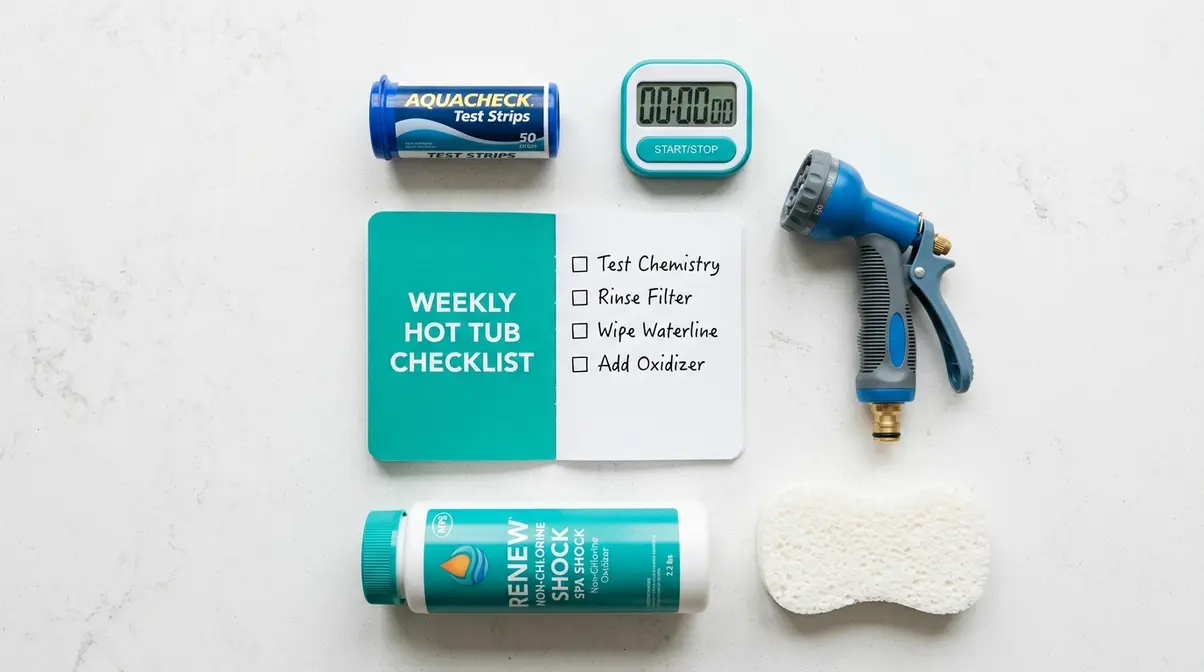
Your Weekly Hot Tub Maintenance Routine
Perform these tasks every week, ideally on the same day:
| Task | Details | Time Required |
|---|---|---|
| Test water chemistry | pH, TA, sanitizer, calcium hardness | 5 minutes |
| Adjust chemistry as needed | Add chemicals in correct sequence | 15–30 minutes |
| Rinse filter cartridge | Hose rinse between pleats | 10 minutes |
| Check water level | Top up if low; low water strains the pump | 2 minutes |
| Wipe waterline | Remove oils and residue with a spa sponge | 5 minutes |
| Add weekly oxidizer | Non-chlorine shock after each heavy-use session | 5 minutes |
- Target chemistry to check weekly:
- pH: 7.2–7.8
- Total Alkalinity: 80–120 ppm
- Chlorine: 3–5 ppm (or Bromine: 3–6 ppm)
- Sanitizer should never drop below 1 ppm
Monthly and Quarterly Tasks
- Monthly:
- Deep-clean filter cartridges using a chemical soak (overnight soak in filter cleaning solution)
- Test calcium hardness and adjust if outside 150–250 ppm range
- Inspect jets, covers, and seals for wear or damage
- Add a maintenance dose of water clarifier if water looks slightly hazy
- Every 3–4 months (or sooner if TDS is elevated):
- Drain, clean, and refill the hot tub completely
- Replace filter cartridge if it is more than 12 months old
- Inspect and clean the filter housing and any skimmer baskets
- Check and lubricate O-rings and gaskets per your manufacturer’s guidance
Smart Habits to Reduce Contaminants
Small behavioral changes dramatically reduce the organic load entering your water — which means less shocking, clearer water, and fewer problems overall.
- Before every soak:
- Shower briefly without soap to rinse off body oils, lotions, and sweat
- Remove makeup, sunscreen, and hair products
- Avoid soaking immediately after applying moisturizers or oils
- After every soak:
- Add a small maintenance dose of non-chlorine shock (MPS) to oxidize body waste
- Wipe the waterline with a spa sponge
- Replace the cover to prevent debris and UV degradation of sanitizer
- General habits:
- Keep the cover on when the tub is not in use — UV light degrades chlorine quickly
- Limit the number of simultaneous soakers relative to your tub’s volume
- Ask guests to shower before entering — even a quick rinse makes a measurable difference
Is Cloudy Hot Tub Water Safe? Timelines and Health Risks
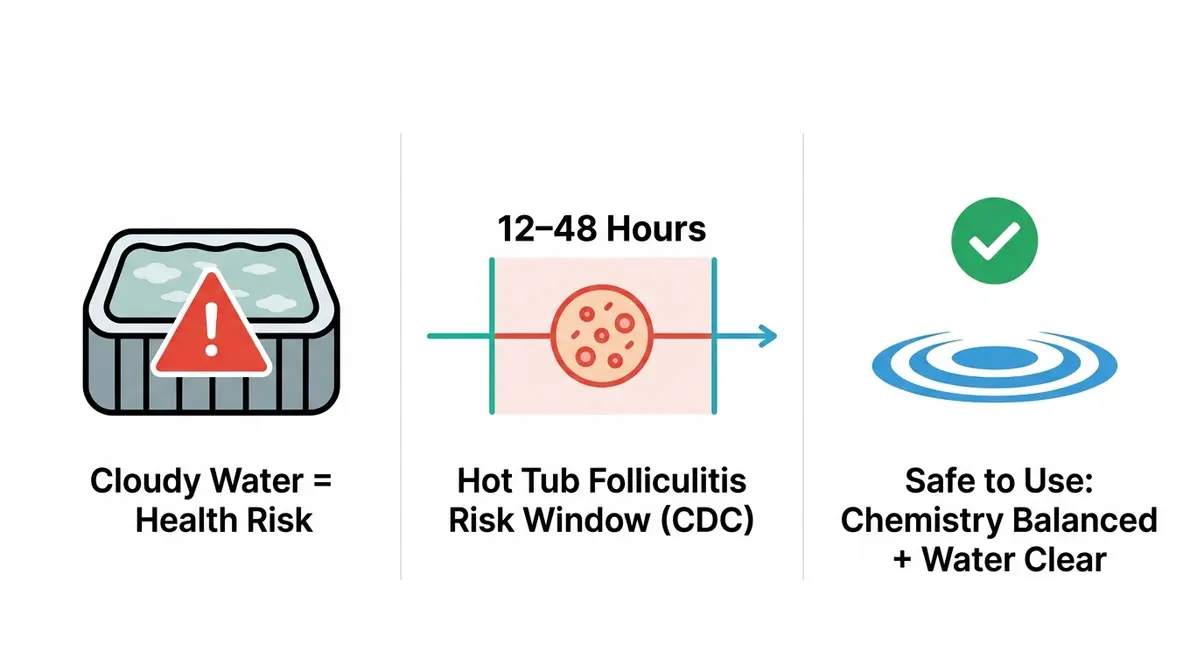
Cloudy water is not just an aesthetic problem. It is a health signal that your water’s sanitizer is overwhelmed — and that means bacteria may be present. Do not use your hot tub when the water is cloudy. This section explains what the research shows about health risks and gives you realistic timelines for recovery.
How Long Does It Take for Cloudy Water to Clear?
The timeline depends on which root cause you’re dealing with and how quickly you act:
| Root Cause | Typical Clearing Time |
|---|---|
| Dirty filter (after cleaning) | 4–8 hours |
| Chemistry imbalance (after correction) | 8–12 hours |
| Organic contamination (after shocking) | 12–24 hours |
| High TDS (after drain and refill) | 24–48 hours (for new water to stabilize) |
Most owners see clear water within 12–24 hours after completing the correct treatment for their root cause. If your water hasn’t shown improvement after 24 hours of correct treatment, revisit the 4-Root Diagnostic Method — you may be treating the wrong root cause, or TDS may be the underlying issue.
Overnight fix: The overnight shock method (Step 3 above) is the fastest approach for organic contamination. Run a full shock dose with jets on, cover off, overnight — and check in the morning. Many owners report significant clearing within 8–12 hours using this method.
Health Risks of Using a Cloudy Hot Tub
Cloudy water signals that your sanitizer is overwhelmed and bacteria may be thriving. The most significant risk is hot tub folliculitis — a skin infection caused by Pseudomonas aeruginosa, a bacteria that survives and multiplies rapidly in warm, under-sanitized water.
According to the CDC’s guidelines on recreational water illnesses, hot tub rash (folliculitis) typically appears 12–48 hours after exposure and presents as a bumpy, itchy rash — often with pus-filled blisters — in areas covered by a swimsuit. The warm water of a hot tub accelerates bacterial growth compared to swimming pools, making sanitizer maintenance critically important.
The Mayo Clinic’s clinical guidance on hot tub folliculitis notes that most mild cases resolve on their own within 7–10 days, but more severe infections — particularly in people with compromised immune systems — may require antibiotic treatment.
⚠️ This is not medical advice. If you or anyone who has used your hot tub develops a rash, skin irritation, or signs of infection after soaking in cloudy water, consult a doctor. Do not attempt to self-treat a skin infection.
- Other health risks associated with cloudy, under-sanitized hot tub water:
- Ear infections (Pseudomonas can infect the outer ear canal)
- Eye irritation from chloramines and unbalanced pH
- Respiratory irritation from off-gassing chloramines (most common when cover is removed)
- Legionella risk in extreme cases of complete sanitizer failure — the CDC classifies Legionella as a serious risk in poorly maintained recreational water
The safest rule: Do not soak in cloudy water. Clear the water first using the 5-step process, confirm your chemistry is in range, and wait for the water to visually clear before re-entering.
Other Hot Tub Water Problems: Foam, Hard Water, and Discoloration
Cloudy water is the most common complaint, but it often comes with related issues. Here’s how to handle the most frequent companion problems.
How to Get Rid of Hot Tub Foam
Foam in a hot tub forms when surfactants (soap-like compounds from body products, detergents, or low-quality chemicals) lower the surface tension of the water. A little foam during jet use is normal; persistent, thick foam that doesn’t dissipate is a problem.
Quick fix: Add a spa defoamer product per the label instructions. This knocks down foam fast — but it’s a temporary fix, not a cure.
Permanent fix: Shock the water to break down the organic compounds causing the foam. If foam returns immediately after defoaming, your water is exhausted and needs a drain and refill. Foam that keeps coming back is one of the clearest signs of high TDS.
Prevention: Shower before soaking, avoid using swimwear washed with detergent (rinse swimsuits in plain water instead), and avoid adding bubble bath or soaps to the tub.
How to Fix Hard Water in a Hot Tub
Hard water refers to water with a high mineral content — specifically calcium and magnesium. When calcium hardness climbs above 400 ppm, the excess calcium precipitates out of solution and creates a white, cloudy haze. You may also notice white scale deposits on the shell, jets, and equipment.
- Treatment:
- Add a sequestering agent (also called a scale inhibitor or metal sequestrant) to bind the calcium and keep it in solution.
- If calcium hardness is severely elevated (above 500 ppm), partial drainage and refilling with softer water is the most effective fix.
- Use a hose pre-filter when refilling if your tap water is naturally hard — this is the most effective long-term prevention.
Target calcium hardness: 150–250 ppm. Test monthly and adjust proactively rather than waiting for cloudiness to appear.
Why Is My Hot Tub Water Discolored?
Water color gives you useful diagnostic clues:
| Water Color | Likely Cause | Fix |
|---|---|---|
| Milky white | Chemistry imbalance or organic contamination | Follow 5-step process |
| Green | Algae (rare in hot tubs) or very high pH | Shock + balance pH |
| Brown/rust | Iron or manganese in fill water | Add metal sequestrant |
| Blue-green | Copper from corroded equipment | Test for metals; adjust pH |
If your water has a green haze, test for algae and metals in addition to standard chemistry. Metal contamination from corroded fittings or copper pipes requires a metal sequestrant product, not shock.
The Tennis Ball Trick for Body Oils
Dropping 2–3 clean tennis balls into your hot tub (either during use or in the filter basket) is a simple, low-tech hack for absorbing body oils. The felt fibers on the ball surface act like a sponge, soaking up the floating oil layer that accumulates at the waterline and in the water column.
Does it work? User consensus from hot tub owner communities indicates that tennis balls noticeably reduce the oily film and waterline ring, particularly in tubs that get heavy use. They don’t replace shocking or filter maintenance — but they’re a useful supplemental tool, especially between deep cleans.
How to use: Drop 2–3 tennis balls directly into the water during a soak, or place them in the filter basket to passively absorb oils during filtration cycles. Replace them every 4–6 weeks, or when they feel slimy to the touch. Rinse them in clean water (no soap) between uses.
Frequently Asked Questions
How long does it take for cloudy hot tub water to clear?
Most cloudy hot tub water clears within 12–24 hours after you correctly identify and treat the root cause. A dirty filter may clear in as little as 4–8 hours after cleaning. Organic contamination treated with overnight shock typically clears by morning. If water hasn’t improved after 24–48 hours of correct treatment, high TDS may be the issue — and a drain and refill is needed. The key word is “correct” treatment: treating the wrong root cause will not clear the water regardless of how long you wait.
Can cloudy hot tub water recover?
Yes — cloudy hot tub water can almost always recover with the right treatment, unless TDS is too high. If your water is less than 3–4 months old, chemistry is the likely culprit, and the 5-step process will clear it. If your water is older, or if you’ve treated it repeatedly without success, TDS may have exceeded 1,500 ppm above baseline — at that point, a drain and refill is the only effective solution. A $20 digital TDS meter tells you definitively which situation you’re in.
Why is the water in my hot tub so cloudy?
Cloudy hot tub water has four possible root causes: a dirty or clogged filter, water chemistry imbalance (pH, TA, or sanitizer out of range), organic contaminant buildup (body oils, sweat, cosmetics), or high TDS from accumulated dissolved solids. The most common cause reported by hot tub owner communities is a combination of a neglected filter and low sanitizer levels. Use the Quick Diagnosis Checklist in this guide to pinpoint your specific cause before adding any chemicals — treating the wrong cause wastes chemicals and time.
Is a hot tub bad for folliculitis?
Using a hot tub with cloudy or under-sanitized water significantly worsens the risk of hot tub folliculitis. This is a skin infection caused by Pseudomonas aeruginosa bacteria that thrive in warm, poorly sanitized water. According to the CDC, symptoms — a bumpy, itchy rash with pus-filled blisters — typically appear 12–48 hours after exposure. If you already have folliculitis, avoid hot tubs entirely until the infection clears. This is not medical advice — if you develop a skin rash after hot tub use, consult a doctor promptly.
How do I clear up a cloudy hot tub fast?
The fastest method is the overnight shock approach: balance your chemistry first (pH 7.2–7.8, TA 80–120 ppm), then add a full dose of chlorine shock (2–3 oz per 300 gallons), remove the cover, run the jets on high for 30 minutes, and let the system circulate overnight with the cover off. Most owners see significant improvement within 8–12 hours. Clean your filter the next morning to remove the debris the shock broke down. For a cleaner filter, add a dose of water clarifier after the shock to help your filter catch the remaining particles.
Why put tennis balls in a hot tub?
Tennis balls absorb body oils, lotions, and cosmetics from hot tub water thanks to their felt fiber surface, which acts like a sponge. These oils accumulate at the waterline and in the water column, overwhelming your sanitizer and causing cloudiness and foam. Drop 2–3 clean tennis balls into the filter basket or directly into the water during use. They won’t replace regular maintenance, but user consensus from hot tub communities suggests they noticeably reduce the oily film — especially in high-use tubs. Replace them every 4–6 weeks.
What clears up cloudy water in a hot tub?
The correct treatment depends on the root cause. A dirty filter requires cleaning or replacement. Chemistry imbalance requires testing and adjusting pH (7.2–7.8), total alkalinity (80–120 ppm), and sanitizer (chlorine 3–5 ppm or bromine 3–6 ppm). Organic contamination requires shocking with chlorine or non-chlorine shock. High TDS requires a drain and refill. For mild, general cloudiness, a water clarifier (1–2 oz per 300 gallons) clumps suspended particles so your filter can catch them. Always balance chemistry before adding clarifier — it works poorly in unbalanced water.
How do I get crystal clear water in a hot tub?
Crystal-clear hot tub water comes from consistent weekly maintenance, not one-time fixes. Test your water every week and adjust chemistry to target ranges. Rinse your filter every 1–2 weeks and do a chemical soak monthly. Shock the water after every heavy-use session. Drain and refill every 3–4 months. Shower before soaking to reduce the organic load entering the water. According to community consensus from hot tub owner forums, owners who test and adjust weekly maintain clear water consistently — while those who only treat when problems appear spend far more time and money fighting recurring cloudiness.
Keep Your Hot Tub Clear for Good
Cloudy hot tub water is frustrating — but it’s always fixable. Our team’s evaluation of the most common hot tub water problems consistently shows that the 4-Root Diagnostic Method resolves the confusion: dirty filter, chemistry imbalance, organic buildup, or high TDS. Identify your root cause first, then apply the matching fix. Most water clears within 12–24 hours after correct treatment (Outdoor Living Hot Tubs, 2024). The 5-step process — clean filter, balance chemistry, shock, circulate, clarify — works for the vast majority of cloudy water situations.
The 4-Root Diagnostic Method isn’t just a troubleshooting tool — it’s a mindset shift. Instead of dumping chemicals and hoping for the best, you identify the specific problem driving your cloudiness and treat it directly. That’s why it works when other approaches fail.
Start with Step 1 today: pull out your filter cartridge and inspect it. That one action alone resolves the majority of cloudy water cases. If your water is already clear, set a reminder for your weekly chemistry test — consistent prevention is always easier than emergency treatment. Your hot tub should be a place to relax, not a source of anxiety.

David King
Hot tub tester and writer at One Hot Tub.