

Table of Contents - Saltwater vs Chlorine Hot Tub: Pros, Cons & True Cost
- Quick Answer: Saltwater vs. Chlorine
- How Each System Works
- Cost Comparison: 5-Year Total Cost
- Maintenance: Minutes Per Month Compared
- Health, Water Feel & Skin Science
- Corrosion Risks and Equipment Longevity
- Which Hot Tub System Is Right for You?
- Limitations and Alternatives Worth Knowing
- Frequently Asked Questions
- The Bottom Line: Run Your Own True Cost Equation
This blog post may contain affiliate links. As an Amazon Associate I earn from qualifying purchases.
Choosing between a saltwater vs chlorine hot tub feels like it should be simple. But after you spend an afternoon reading forums and manufacturer pages, you’re usually left with the same vague advice: “saltwater is gentler, chlorine is cheaper.” That’s not enough to spend thousands of dollars on.
This guide goes further. It breaks down the real numbers — five years of chemical costs, maintenance time (measured in actual minutes), and equipment replacement cycles — so you can see the full financial picture before you buy. Whether you’re a first-time buyer weighing your options or a current owner thinking about switching systems, this saltwater vs chlorine hot tub comparison gives you everything you need to decide with confidence.
Saltwater hot tubs cost more upfront but typically save $100–$250 per year in chemicals — The True Cost Equation only tips in saltwater’s favor after accounting for salt cell replacement costs over five years.
- Cost: Chlorine systems spend $200–$400/year on chemicals; saltwater systems spend $90–$200/year, but add $200–$1,000 in periodic cell replacement.
- Maintenance: Saltwater owners spend roughly 5–10 minutes per week on upkeep; chlorine owners spend 15–30 minutes per week.
- Health: Both systems produce chlorine — saltwater just produces it more consistently, which can reduce irritating chloramines.
- Corrosion: Salt water is harder on metal components; keeping pH between 7.4–7.6 is critical to protecting your investment.
Quick Answer: Saltwater vs. Chlorine
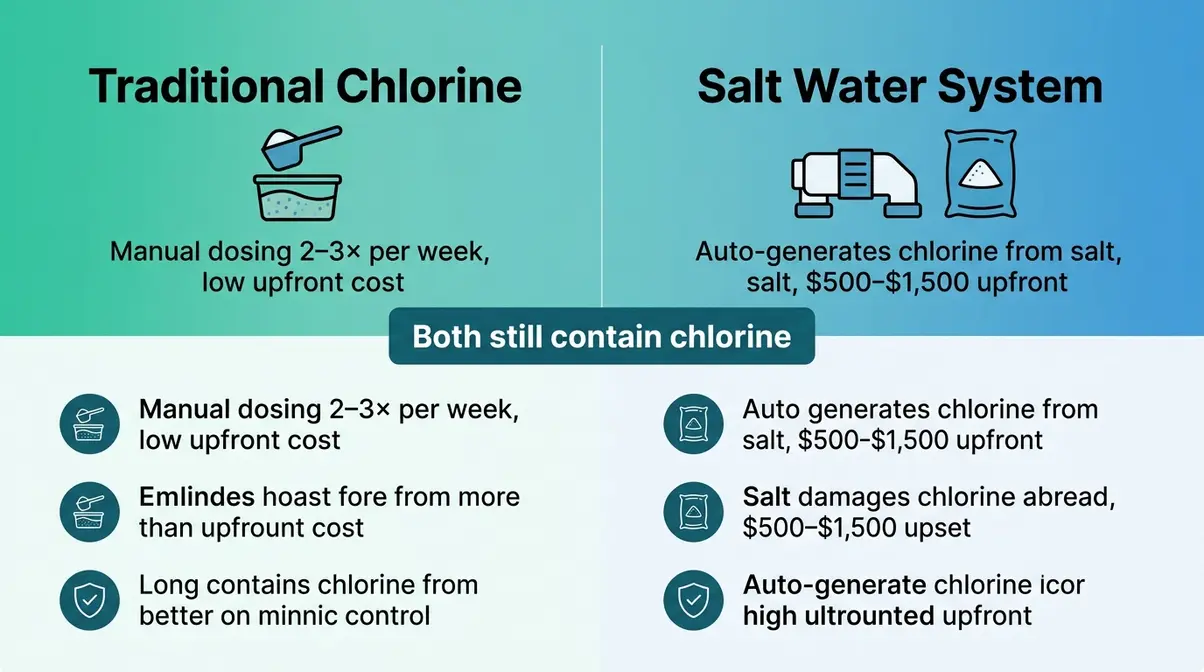
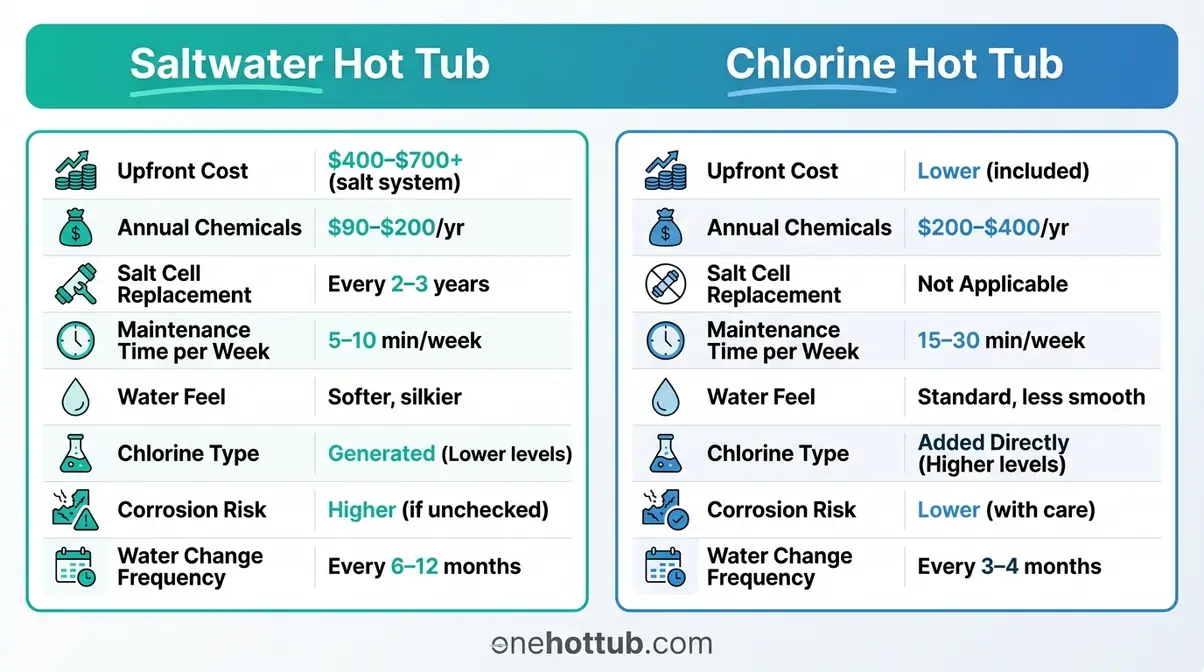
For most buyers, the choice comes down to three things: how much you want to spend upfront, how much time you want to spend on maintenance, and how sensitive your skin is to chemicals. Here’s the side-by-side view before we get into the detail.
| Feature | Saltwater Hot Tub | Chlorine Hot Tub |
|---|---|---|
| Upfront system cost | $500–$5,000 (generator add-on) | Included with most tubs |
| Annual chemical cost | $90–$200/year | $200–$400/year |
| Salt cell replacement | $200–$1,000 every 2–5 years | None |
| Maintenance time | ~5–10 min/week | ~15–30 min/week |
| Water feel | Softer, silkier | Standard |
| Chlorine produced? | Yes (via electrolysis) | Yes (added manually) |
| Corrosion risk | Higher (requires pH management) | Lower |
| Best for | Low-maintenance lifestyle, sensitive skin | Budget-conscious buyers, portability |
| Water change frequency | Every 6–12 months | Every 3–4 months |
| DIY-friendly? | Moderate (generator setup) | Yes |
Bottom line: If you hate measuring chemicals and want softer water, saltwater wins on daily experience. If you want the lowest possible upfront cost and maximum flexibility, a traditional chlorine system is harder to beat.
How Each System Works
Understanding what’s actually happening in your water makes every other decision easier. Both systems use chlorine to keep your hot tub safe. The difference is how that chlorine gets into the water.
How a Salt Chlorine Generator Works
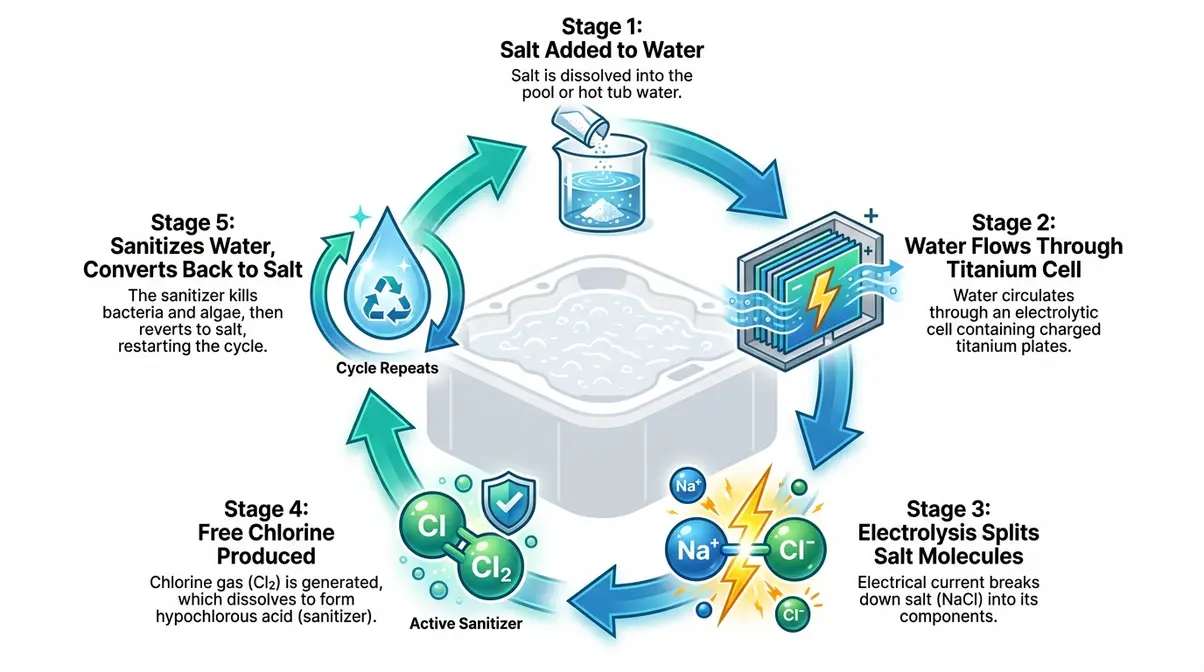
A salt chlorine generator (also called a saltwater system) uses a process called electrolysis — think of it like a tiny factory inside your hot tub. You add pool-grade salt to the water (typically 1,500–2,500 parts per million, which is far less salty than the ocean). The water flows through a salt cell, a small device containing titanium plates that carry a low electrical charge.
That charge splits the salt molecules (sodium chloride) into free chlorine — the active, bacteria-killing form of chlorine — and sodium hydroxide. The free chlorine sanitizes your water continuously. Then it converts back to salt, and the cycle repeats. You’re essentially recycling the same salt over and over.
The result: your hot tub produces its own chlorine automatically, without you adding chlorine pucks or granules every few days. As Hot Spring Spas explains, systems like the FreshWater Salt System are designed to simplify water care significantly for everyday owners.
How Traditional Chlorine Hot Tubs Work
In a traditional setup, managing your hot tub chlorine means adding it directly to the water yourself. Most owners use chlorine pucks (slow-dissolving tablets) in a floating dispenser, or add granules (fast-dissolving powder) directly to the water. You test the water regularly — usually two to three times per week — and adjust as needed.
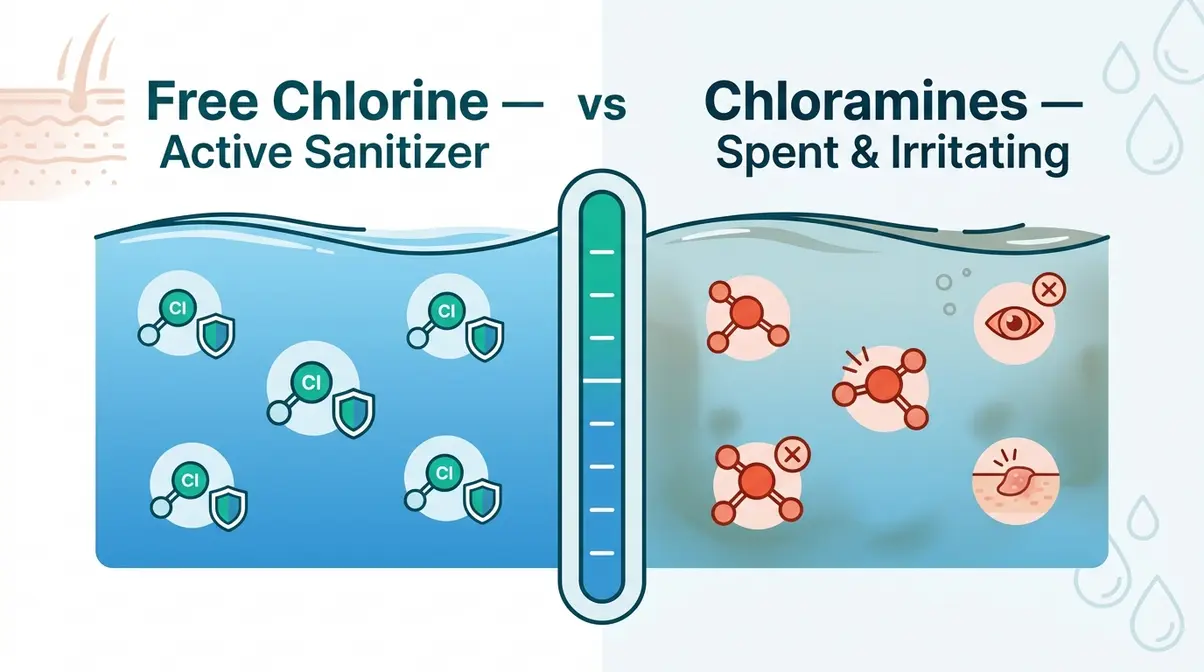
Free chlorine is what actually kills bacteria and viruses. Think of free chlorine like soldiers actively fighting invaders in your water. When those soldiers do their job and neutralize contaminants, they become “used up” and form combined chlorine (also called chloramines). Chloramines are the spent soldiers — they no longer protect your water, and they’re the primary cause of that “classic pool smell” and eye irritation.
To reset the water, you perform a shock treatment (adding a large dose of oxidizer) to break down chloramines. This is a weekly or bi-weekly task for most owners. Traditional systems work reliably and have been the industry standard for decades — they just require more hands-on maintenance.
Do Saltwater Tubs Use Chlorine?
Yes — saltwater hot tubs absolutely still use chlorine. Here’s something that surprises nearly every first-time buyer: saltwater systems are not chlorine-free. The salt chlorine generator converts dissolved salt into free chlorine through electrolysis. The end product in your water is the exact same chlorine that sanitizes a traditional hot tub. The difference is that the chlorine is generated continuously by the salt cell rather than added manually by you.
This matters for two reasons. First, it means saltwater tubs still require you to monitor and balance your water — you just do it less often. Second, the continuous, steady generation of free chlorine tends to produce fewer chloramines than the peaks-and-valleys pattern of manual dosing. That’s the science behind the “softer water” and “gentler on the skin” experience that saltwater owners consistently report.
“Hot tubs stay covered all the time so the sunlight doesn’t break down chlorine like it would in a pool.” This means your hot tub holds chlorine more efficiently than an outdoor pool — and a saltwater system takes full advantage of that enclosed environment.
Cost Comparison: 5-Year Total Cost
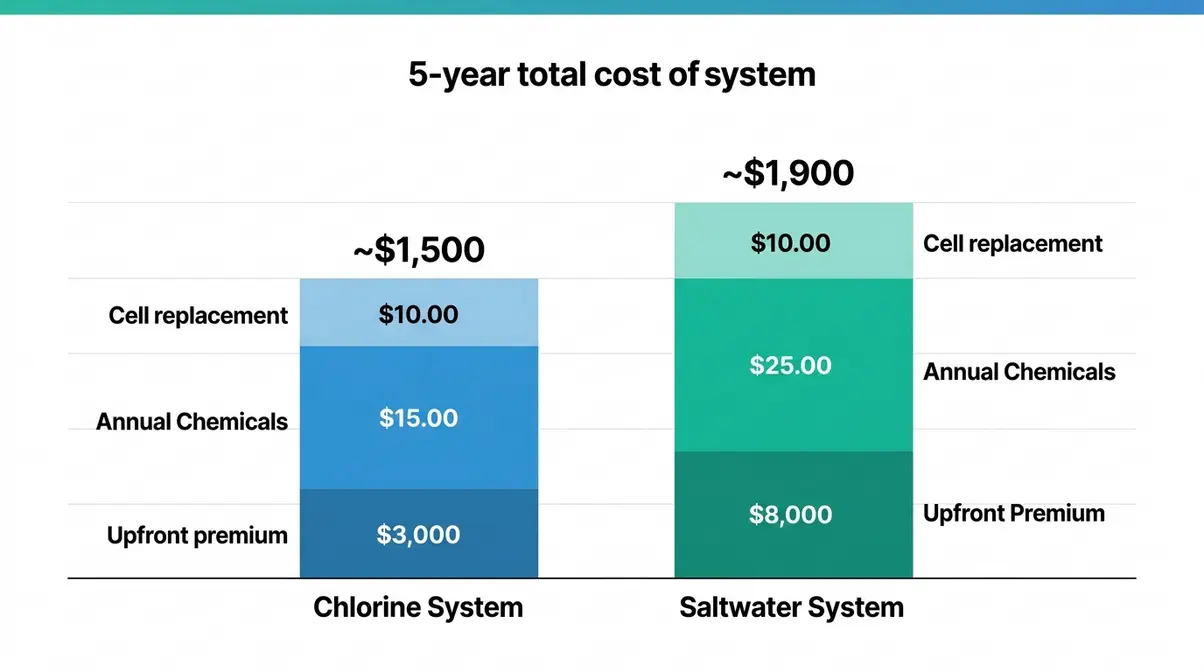
As highlighted in our broader saltwater vs chlorine hot tubs comparison, this is where most guides fall short. They tell you saltwater costs more upfront and saves money on chemicals. What they don’t show you is the full math — The True Cost Equation — which adds up every dollar you’ll spend over five years: initial investment, annual chemicals, and the equipment you’ll eventually need to replace.
Upfront Purchase Costs
A traditional chlorine hot tub comes ready to use. The chemicals are cheap, widely available, and you can buy them at any hardware store. There’s no generator to install.
A saltwater system adds a meaningful upfront cost. If you’re buying a new hot tub with a built-in salt system, you’ll typically pay a premium of $500–$2,000 over an equivalent chlorine model. If you’re retrofitting an existing hot tub with an aftermarket salt chlorine generator, expect to spend $500–$5,000 depending on the brand and complexity of installation (ConsumerAffairs, 2026).
| System | Upfront Equipment Cost | Installation Complexity |
|---|---|---|
| Chlorine | $0 (included with tub) | None |
| Saltwater (built-in) | +$500–$2,000 premium | Professional setup |
| Saltwater (retrofit) | $500–$5,000 | Moderate to complex |
All prices are as of July 2026; costs vary by brand and region. Check with your local dealer for current pricing.
Annual Chemical Costs
This is where saltwater systems earn back their upfront cost over time. According to East Texas Hot Tub, a traditional chlorine hot tub costs approximately $240–$360 per year in chemicals — covering chlorine pucks or granules, shock treatments, and pH adjusters. ConsumerAffairs puts the range slightly higher at $200–$400 per year (ConsumerAffairs, 2026).
Saltwater systems cut that annual spend dramatically. The same East Texas Hot Tub data shows saltwater systems running $90–$120 per year in consumables for cartridge-style systems (like the FreshWater Salt System), which includes the salt and any replacement cartridges. Other saltwater configurations run $100–$200 per year.
That’s an annual saving of roughly $100–$250 — before you factor in cell replacement.
Long-Term Replacement Costs
Here’s the number most saltwater advocates quietly skip: the salt cell doesn’t last forever. Depending on the system, you’ll replace it every 2–5 years at a cost of $200–$1,000 (ConsumerAffairs, 2026). Cartridge-style systems like FreshWater replace individual titanium cartridges every four months at roughly $30 each — about $90/year, already baked into their annual cost figures.
Now let’s run The True Cost Equation over five years:
| Cost Category | Chlorine System (5 years) | Saltwater System (5 years) |
|---|---|---|
| Upfront system premium | $0 | +$1,000 (mid-range estimate) |
| Annual chemicals × 5 | $1,500 (avg. $300/yr) | $500 (avg. $100/yr) |
| Salt cell replacement | $0 | $400 (1 replacement, mid-range) |
| Water changes (3–4×/yr vs. 1×/yr) | Included in chemicals | Lower water/energy cost |
| 5-Year Total | ~$1,500 | ~$1,900 |
The True Cost Equation shows that at mid-range estimates, saltwater systems cost slightly more over five years once you include the upfront premium and cell replacement. However, if you’re buying a new tub where the salt system is built in (lower upfront premium) or using a cartridge system with predictable $90/year costs, the numbers can flip in saltwater’s favor.
The honest answer: For many buyers, the financial difference over five years is modest — often $200–$500 either way. Your decision should rest on maintenance preference and water feel, not cost alone.
Maintenance: Minutes Per Month Compared
Maintenance is where saltwater hot tubs create the biggest real-world difference for most owners. Less time measuring chemicals means more time actually enjoying your hot tub.
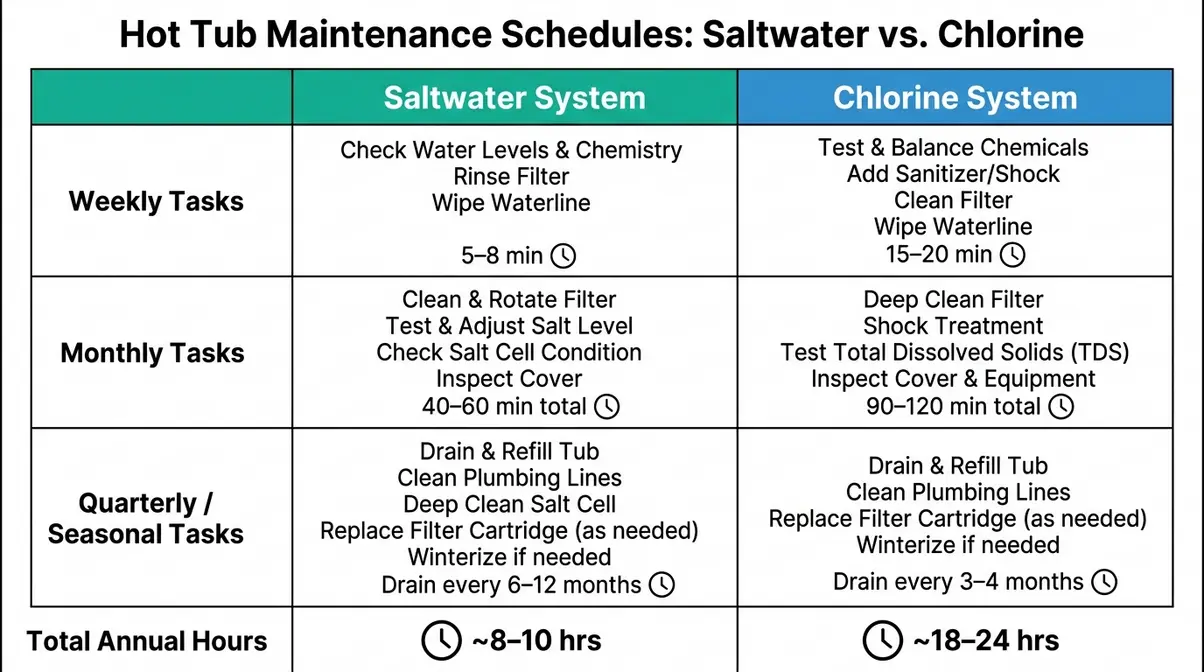
Weekly Maintenance Tasks for Each System
If you follow a standard chlorine and hot tubs guide, your weekly routine looks like this:
- Test the water with test strips or a digital tester (free chlorine, pH, alkalinity) — 5 minutes
- Add chlorine pucks or granules to hit your target of 3–5 ppm — 2–5 minutes
- Adjust pH if needed (target 7.4–7.6) with pH Up or pH Down — 2–5 minutes
- Perform a shock treatment (oxidizer dose) weekly or after heavy use — 5 minutes
- Rinse the filter cartridge every 2 weeks — 10–15 minutes
For a saltwater hot tub, your weekly routine is shorter:
- Check the salt cell output and verify free chlorine level — 2–3 minutes
- Test pH and alkalinity, adjust if drifting — 2–5 minutes
- Visually inspect the salt cell for scale buildup monthly — 5 minutes (monthly)
According to Master Spas, routine water care for a saltwater hot tub takes “usually less than 15 minutes a week” — and some weeks, it’s just a quick check.
Monthly and Seasonal Maintenance Tasks
Beyond weekly tasks, any comprehensive hot tub water maintenance guide will note that both systems require periodic deeper maintenance. Here’s where the time gap widens further.
Traditional chlorine systems require a full drain, scrub, and refill every 3–4 months. That’s roughly 2–3 hours of work, four times a year. You’re also doing more frequent shock treatments and filter cleanings.
Saltwater systems typically need a full drain only once every 6–12 months (The Spa Team, 2026). That’s one or two major maintenance sessions per year instead of four. The salt cell itself needs a light acid rinse every few months to remove calcium scale — a 10–15 minute job.
The Minutes-Per-Month Matrix
Our team evaluated the published maintenance guidance from Hot Spring Spas, Master Spas, and East Texas Hot Tub alongside community consensus from hot tub owner forums to build this time matrix.
| Task | Chlorine System | Saltwater System |
|---|---|---|
| Weekly chemical testing & dosing | 15–20 min/week | 5–8 min/week |
| Monthly shock treatments | 20–30 min/month | 10–15 min/month |
| Filter rinse (bi-weekly) | 10–15 min each | 10–15 min each |
| Salt cell inspection/cleaning | N/A | 10–15 min/month |
| Full drain & refill | Every 3–4 months (2–3 hrs) | Every 6–12 months (2–3 hrs) |
| Total hands-on time per month | ~90–120 minutes | ~40–60 minutes |
Saltwater systems save the average owner roughly 50–60 minutes of hands-on maintenance per month. Over a year, that’s 10–12 hours you’re not measuring chemicals and adjusting water balance.
Health, Water Feel & Skin Science
The health claims around saltwater hot tubs are often the vaguest part of any comparison guide. Words like “gentler” and “softer” get thrown around without explanation. Here’s the actual science behind what you feel — and what to watch out for in either system.
Free Chlorine vs. Chloramines
Both systems use chlorine. The difference is in which form of chlorine your skin is exposed to most.
Free chlorine is the active, sanitizing form. It’s effective against bacteria and generally well-tolerated by skin at recommended levels (3–5 ppm for hot tubs, per CDC guidelines). Chloramines — also called combined chlorine — form when free chlorine reacts with nitrogen-containing compounds like sweat, body oils, and urine in the water. Chloramines are the primary cause of red eyes, skin irritation, and that “classic pool smell.” They’re essentially spent chlorine that no longer sanitizes but still irritates.
In a traditional chlorine system, chloramine buildup is a routine challenge. Manual dosing creates peaks and valleys — high chlorine right after you add it, lower levels as it depletes. During the low periods, chloramines accumulate. Saltwater systems produce free chlorine continuously, which tends to maintain a more stable level and reduce chloramine buildup over time. This is the science behind the “gentler on the skin” and “softer water” experience that saltwater owners consistently report.
According to research published in dermatology literature, chloramine exposure in recreational water settings is associated with eye irritation, nasal irritation, and skin dryness, particularly in people with pre-existing eczema or sensitive skin. If you or your family have sensitive skin, this distinction matters more than it might for a casual user.
What is Hot Tub Syndrome?
“Hot tub syndrome” is the common name for hot tub folliculitis, an infection of hair follicles caused by Pseudomonas aeruginosa, a bacteria that thrives in warm, improperly sanitized water. Symptoms include an itchy, bumpy rash — often with small pustules — that typically appears within 24–48 hours of exposure and is often worse under areas covered by a swimsuit (Cleveland Clinic, 2026).
According to the CDC’s Healthy Swimming guidelines, hot tub folliculitis is almost entirely preventable with proper water chemistry. The CDC recommends maintaining free chlorine at least 3 ppm and pH between 7.0–7.8 in hot tubs. When these levels are correct, Pseudomonas aeruginosa cannot survive.
Both saltwater and chlorine systems can prevent folliculitis equally well — provided the water is properly maintained. The risk is higher when chlorine levels drop and aren’t corrected quickly. Because saltwater systems generate chlorine continuously, there’s less chance of the level falling dangerously low between your weekly checks. However, this is not a guarantee — you still need to test and verify.
If you’re treating a hot tub after a folliculitis event, the Cleveland Clinic recommends draining completely, scrubbing all surfaces, refilling, and re-establishing proper chemical balance before using the tub again. Consult a dermatologist if symptoms persist, worsen, or are accompanied by fever.
Quoted for reference: “Hot tub folliculitis is preventable. Maintaining free chlorine at or above 3 ppm and pH within 7.0–7.8 eliminates the conditions that allow Pseudomonas aeruginosa to grow.” — CDC Healthy Swimming, 2026
Sensitive Skin and Pool Smell
Across hot tub owner communities, the consistent feedback is that saltwater users experience less skin dryness, fewer red eyes, and significantly less of the “classic pool smell” compared to chlorine users. This aligns with the chloramine science above — fewer chloramines means fewer of the byproducts that cause those symptoms.
That said, some people are sensitive to the salt concentration itself, or to the slightly higher pH that salt systems tend to produce (because electrolysis generates sodium hydroxide as a byproduct, which raises pH). If your skin tends to dry out easily, both systems require you to rinse off after soaking and moisturize. Neither hot tub system is inherently “safe” for all skin types without proper maintenance.
A board-certified dermatologist perspective worth noting: chlorine at recommended levels is harsh on skin over time, stripping natural oils and potentially exacerbating eczema or psoriasis (Dr. Gurgen, 2026). If skin sensitivity is a primary concern for your household, saltwater systems offer a meaningful advantage — but they are not a medical solution. Consult a dermatologist if you have a diagnosed skin condition before choosing a system.
Corrosion Risks and Equipment Longevity
Salt is corrosive. That’s the honest trade-off that comes with a saltwater system, and it’s one of the most common concerns among first-time buyers. Understanding how corrosion works — and how to prevent it — is essential to protecting your investment.
How Salt Affects Components
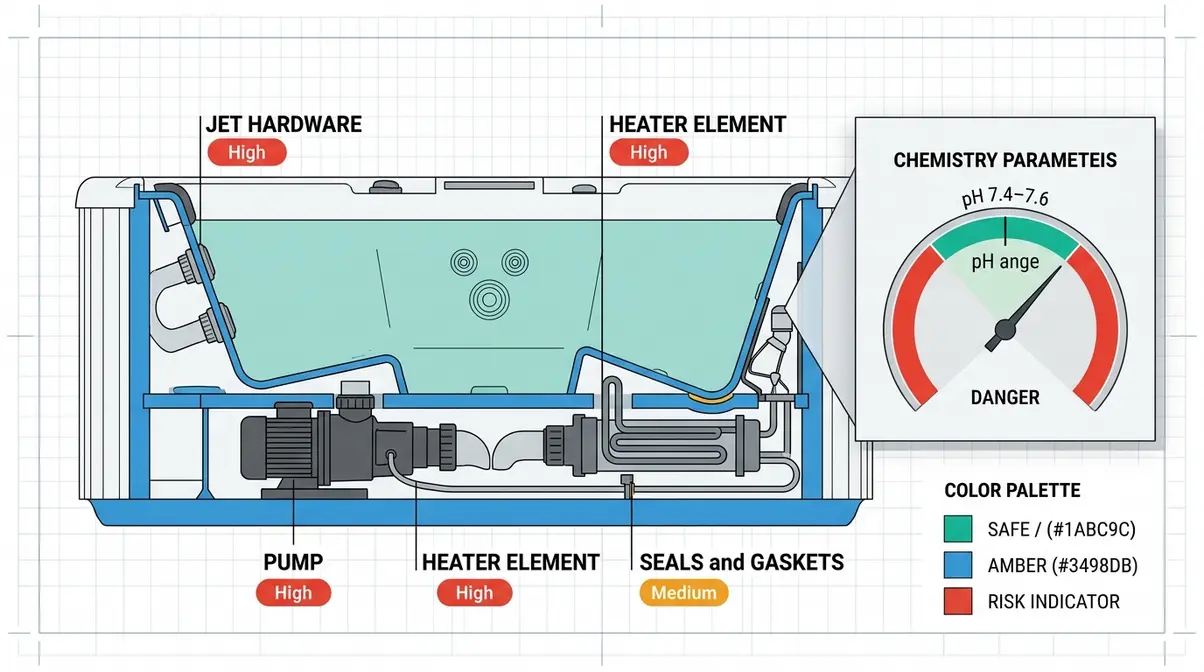
The salt concentration in a hot tub (1,500–2,500 ppm) is far lower than the ocean (roughly 35,000 ppm), but it’s still enough to accelerate corrosion on certain materials over time. Components most at risk include:
- Metal hardware: Jets, pumps, heater elements, and lighting fixtures
- Acrylic and shell: Generally resistant, but seals and gaskets can degrade faster
- Surrounding surfaces: Wooden decking, metal railings, and stone near the tub can be affected by splashed or evaporated salt water
Common pain points reported by saltwater hot tub owners include premature corrosion of jet hardware and occasional calcium scaling on the salt cell itself. The salt cell requires a periodic acid rinse (diluted muriatic acid) every 2–3 months to remove scale buildup — a task that’s easy but non-negotiable for system longevity.
According to Fun Outdoor Living, annual upkeep for a saltwater system can range from $500–$1,000 when you include salt, balancing chemicals, filter cleanings, and the amortized cost of periodic cell or cartridge replacement.
Chemistry Thresholds for Protection
The single most effective way to prevent corrosion in a saltwater hot tub is keeping your water chemistry within tight thresholds. Here are the targets, verified against pool and spa industry guidance (In The Swim, 2026; Sunplay, 2026):
| Parameter | Target Range | Why It Matters |
|---|---|---|
| Free Chlorine | 3–5 ppm | Sanitizes water; prevents bacterial growth |
| pH | 7.4–7.6 | Outside this range, corrosion accelerates and chlorine becomes less effective |
| Total Alkalinity | 80–120 ppm | Buffers pH from swinging; protects equipment |
| Calcium Hardness | 150–250 ppm | Too low = water leaches calcium from equipment; too high = scaling |
| Salt Level | 1,500–2,500 ppm | Maintain per your generator manufacturer’s spec |
| Cyanuric Acid | 30–50 ppm | Stabilizes chlorine; prevents UV degradation |
pH is the most critical variable. Saltwater systems naturally push pH upward because electrolysis produces sodium hydroxide as a byproduct. If you don’t add a pH reducer periodically, the pH drifts above 7.8 — which reduces chlorine effectiveness and accelerates scale formation on the cell and equipment. Check pH at least weekly.
Sacrificial anodes are a practical tool for corrosion protection. A sacrificial anode is a small piece of zinc or magnesium that you attach to your hot tub’s plumbing or frame. It corrodes in place of your more expensive metal components — essentially volunteering itself to be eaten by electrochemical action so your pump and heater don’t have to. Pool and spa supply sources recommend replacing sacrificial anodes annually or when they’re 50% depleted (In The Swim, 2026).
If you’re installing a saltwater system, ask your dealer whether your hot tub model is rated for salt water use. Some manufacturers void warranties if a salt system is added to a tub not designed for it.
Which Hot Tub System Is Right for You?
After everything above, this is the section where The True Cost Equation comes together. Your best choice depends on how you actually use your hot tub, what your budget looks like, and what trade-offs matter most to your household. If you’re ready to explore specific models, check out our guide to the best saltwater hot tubs available this year.
Choose a Saltwater Hot Tub If…
A saltwater system is likely the better fit for you if:
- You hate measuring chemicals. The salt cell handles chlorine production automatically. You still test and balance, but you’re doing it far less often — roughly 5–10 minutes per week instead of 15–30.
- Your skin or eyes are sensitive. The consistent free chlorine generation produces fewer chloramines, which are the main culprit behind red eyes, skin dryness, and that “classic pool smell.”
- You use your hot tub frequently. Heavy use depletes chlorine faster in traditional systems. Saltwater systems adjust their output and maintain levels more consistently under demand.
- You’re buying a new hot tub and can select a built-in salt system. The upfront premium is lower when it’s part of the original purchase, which improves the five-year cost math significantly.
- You don’t mind a learning curve. Salt cells require pH monitoring (they push pH up), periodic acid cleaning, and eventual cell replacement. It’s manageable, but it’s not zero-effort.
As noted by Master Spas, saltwater systems are particularly popular with families and frequent users who want “water care even easier” without sacrificing sanitation quality.
Choose Traditional Chlorine If…
A traditional chlorine system is likely the better fit if:
- You want the lowest possible upfront cost. No generator to buy, no installation premium. Your hot tub is ready to use with a bag of chlorine granules from the hardware store.
- You’re cost-conscious on a tight five-year budget. At mid-range estimates, the chlorine system’s lower upfront and zero cell-replacement costs keep total ownership costs competitive.
- You prefer simplicity and familiarity. Chlorine systems are well understood, widely supported, and any pool supply store can help you troubleshoot. Parts and chemicals are universally available.
- You’re retrofitting an older hot tub. Adding a salt system to a tub not designed for it risks voiding your warranty and accelerating corrosion on incompatible components. Check with your manufacturer first.
- You soak infrequently. If your hot tub sits for weeks at a time, a manual chlorine system gives you more direct control over chemical levels when you bring it back online.
The Decision Matrix
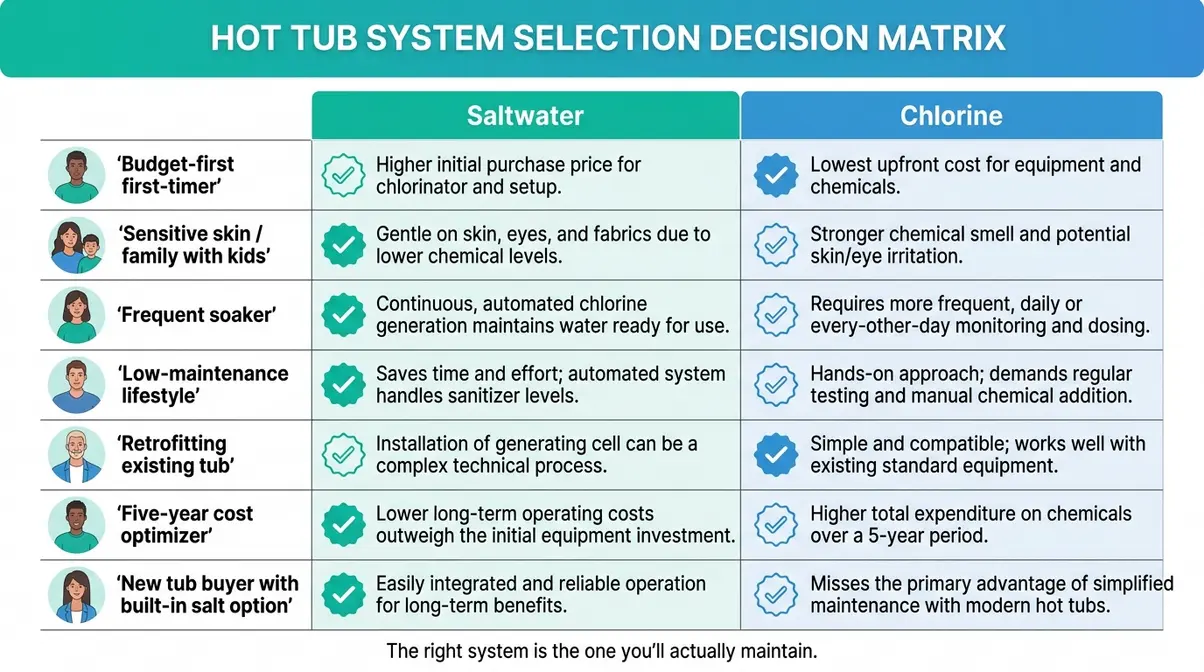
| Buyer Profile | Best System | Key Reason |
|---|---|---|
| Budget-first first-timer | Chlorine | Zero upfront premium; chemicals from any store |
| Sensitive skin / family with kids | Saltwater | Fewer chloramines; softer water feel |
| Frequent soaker (4+ times/week) | Saltwater | Consistent chlorine output under heavy use |
| Low-maintenance lifestyle | Saltwater | ~50–60 fewer minutes of upkeep per month |
| Retrofitting an existing tub | Chlorine (or verify compatibility) | Salt system may void warranty on older tubs |
| Five-year cost optimizer | Chlorine (slight edge) | Lower upfront + no cell replacement |
| New tub buyer with built-in salt option | Saltwater | Lower premium when factory-installed |
Limitations and Alternatives Worth Knowing
No comparison is complete without an honest look at the trade-offs that don’t fit neatly into a pros column. Here’s what both systems get wrong — and what to consider if neither feels quite right.
Common Pitfalls
- Saltwater systems:
- pH drift goes unnoticed. Because electrolysis raises pH naturally, owners who test infrequently often find their pH has crept above 7.8. At that level, chlorine becomes far less effective — your water looks clear but isn’t protected. Test pH at least once a week, every week.
- Salt cell scale buildup. In hard-water areas, calcium deposits on the titanium plates within weeks. Owners who skip the quarterly acid rinse end up with a failed cell years before the expected replacement window.
- Corrosion surprises. Installing a salt system on a hot tub not rated for salt water — or using a nearby garden hose with high mineral content to fill — can accelerate corrosion on jets and seals within the first year.
- Chlorine systems:
- Chloramine creep between shocks. If you skip a weekly shock, combined chlorine accumulates. The water may test as having enough total chlorine, but the active free chlorine is depleted. This is how folliculitis risk rises — not from one missed test, but from a pattern of inconsistent maintenance.
- Chemical storage hazards. Chlorine granules and pucks are oxidizers. Storing them improperly (near heat sources, mixed with other chemicals) is a genuine safety risk. Keep them in a cool, dry location in their original containers.
When to Choose Alternatives
- Bromine systems: If chlorine irritates your skin even in a well-maintained saltwater system, bromine is a gentler alternative sanitizer. It’s more stable at high temperatures and produces fewer irritating byproducts. The trade-off: bromine is more expensive than chlorine and can’t be used with a salt chlorine generator.
- Mineral sanitizers (silver/copper): Products like the Nature2 cartridge system use silver and copper ions to reduce the amount of chlorine needed. They work as a supplement, not a replacement — you still need 0.5–1 ppm of free chlorine. Good for owners who want to minimize chemical use further.
- UV and ozone systems: Ultraviolet (UV) and ozone systems oxidize contaminants and reduce chlorine demand by 50–80%. They’re often paired with either saltwater or chlorine systems for the lowest possible chemical load. Expect to add $300–$800 for a quality UV or ozone unit.
When to Seek Expert Help
If you’re managing a hot tub for a medically vulnerable household member — someone with a compromised immune system, open wounds, or a diagnosed skin condition — consult both a hot tub professional and a physician before choosing a system. The same applies if you’re experiencing recurring rashes, persistent eye irritation, or unexplained water cloudiness despite correct chemical readings. These can indicate biofilm buildup in the plumbing, which requires professional drain-and-purge treatment.
Frequently Asked Questions
What are the negatives of saltwater hot tubs?
Saltwater hot tubs have three primary drawbacks: higher upfront cost, corrosion risk, and the need for pH management. The salt chlorine generator adds $500–$5,000 to your initial investment. Salt water is harder on metal components like jets and heater elements, particularly when pH drifts above 7.8. The electrolysis process naturally raises pH, so saltwater owners must test and adjust pH more vigilantly than the “low-maintenance” marketing suggests. Salt cell replacement every 2–5 years adds $200–$1,000 to long-term costs (ConsumerAffairs, 2026).
What is the healthiest hot tub sanitization system?
No single system is universally “healthiest,” as a properly maintained hot tub is safe regardless of the sanitation method. However, saltwater systems tend to produce fewer irritating chloramines, making them more comfortable for sensitive skin. Always maintain free chlorine at 3 ppm and pH between 7.0–7.8 per CDC guidelines.
Is a saltwater hot tub cheaper to maintain?
Saltwater hot tubs are cheaper on annual chemical costs ($90–$200/year vs. $200–$400/year for chlorine), but the total picture is more nuanced. Salt cell replacement adds $200–$1,000 every 2–5 years, which partially offsets the chemical savings. Over five years, the difference in total maintenance cost is often modest — typically $200–$500 either way depending on your specific system and usage. Where saltwater systems save the most is time: roughly 50–60 fewer minutes of hands-on maintenance per month compared to traditional chlorine systems (East Texas Hot Tub, 2026).
Why is there a 15-minute hot tub rule?
The 15-minute rule exists to prevent overheating and dehydration, as soaking in 104°F water raises your core body temperature rapidly. Extended sessions can lead to dizziness, nausea, or fainting. If you want to soak longer, lower the water temperature to 98°F–100°F.
Do hot tubs reduce cortisol?
Yes, soaking in a hot tub can help lower cortisol levels, which is the body’s primary stress hormone. The warm water promotes muscle relaxation and improves circulation, triggering a parasympathetic nervous system response. This combination of heat and buoyancy effectively reduces physical tension and mental stress.
The Bottom Line: Run Your Own True Cost Equation
Choosing between a saltwater vs chlorine hot tub is not a decision you should make based on vague claims about “softer water” or “lower costs.” The real answer depends on your specific budget, your maintenance tolerance, and how sensitive your household is to chloramine-related irritation.
The True Cost Equation shows that saltwater systems typically cost slightly more over five years at mid-range estimates — but they return roughly 10–12 hours of your time annually and deliver a measurably better water experience for sensitive skin. For buyers purchasing a new hot tub with a built-in salt system, or using a cartridge-style system like FreshWater, the five-year cost gap narrows significantly or disappears. Traditional chlorine systems remain the right call for budget-first buyers, anyone retrofitting an older tub, and owners who prefer the simplicity of a well-understood system with universally available supplies.
Whichever system you choose, the maintenance fundamentals are non-negotiable: test your water at least weekly, keep pH between 7.4–7.6, maintain free chlorine at 3–5 ppm, and drain and clean on schedule. A well-maintained chlorine hot tub will always outperform a neglected saltwater one.
Before you buy, get quotes for both options from a local dealer — ask specifically about the built-in salt system premium versus aftermarket retrofit cost. Then run the five-year numbers for your situation. Browse our saltwater hot tub models at onehottub.com to find the right size and system for your home. At onehottub.com, our team has evaluated dozens of hot tub configurations to help buyers make this exact decision. The right system is the one you’ll actually maintain — and enjoy using for years to come.