

Table of Contents - How to Drain a Hot Tub: Step-by-Step Guide (2026)
- Before You Start: What You’ll Need
- Step-by-Step: How to Drain a Hot Tub
- Pump vs. Hose: Choosing the Fastest Method
- After the Drain: Clean and Refill Your Hot Tub
- Winterizing: How to Drain a Hot Tub for Cold Weather
- Where to Drain Hot Tub Water Safely
- Brand-Specific Quick Reference (Jacuzzi, Bullfrog & More)
- Common Draining Problems and How to Fix Them
- Frequently Asked Questions
- Wrapping Up
This blog post may contain affiliate links. As an Amazon Associate I earn from qualifying purchases.
Most first-time hot tub owners put off learning how to drain a hot tub because they’re not sure what they’re doing — and that hesitation leads to cloudy water, biofilm buildup, and frustrated guesswork at 10 p.m. on a Saturday.
Here’s the problem: skipping or delaying draining allows total dissolved solids (TDS — the accumulated minerals, chemicals, and organic waste in your water) to build up past the point of balance. When TDS gets too high, no amount of chemicals will clear the water. Worse, your plumbing lines become a breeding ground for bacteria, including Legionella, the pathogen responsible for Legionnaires’ disease.
This guide walks you through exactly how to drain a hot tub safely — including which method takes 10 minutes versus 3 hours, how to flush your plumbing lines first, where to legally dispose of the water, and what to do differently if you’re draining for winter. You’ll cover everything from equipment to refill in one place.
“Use a submersible pump for fastest draining (10 minutes) or the built-in drain spigot for slower method (1 hour). Always turn off power and allow water to cool.”
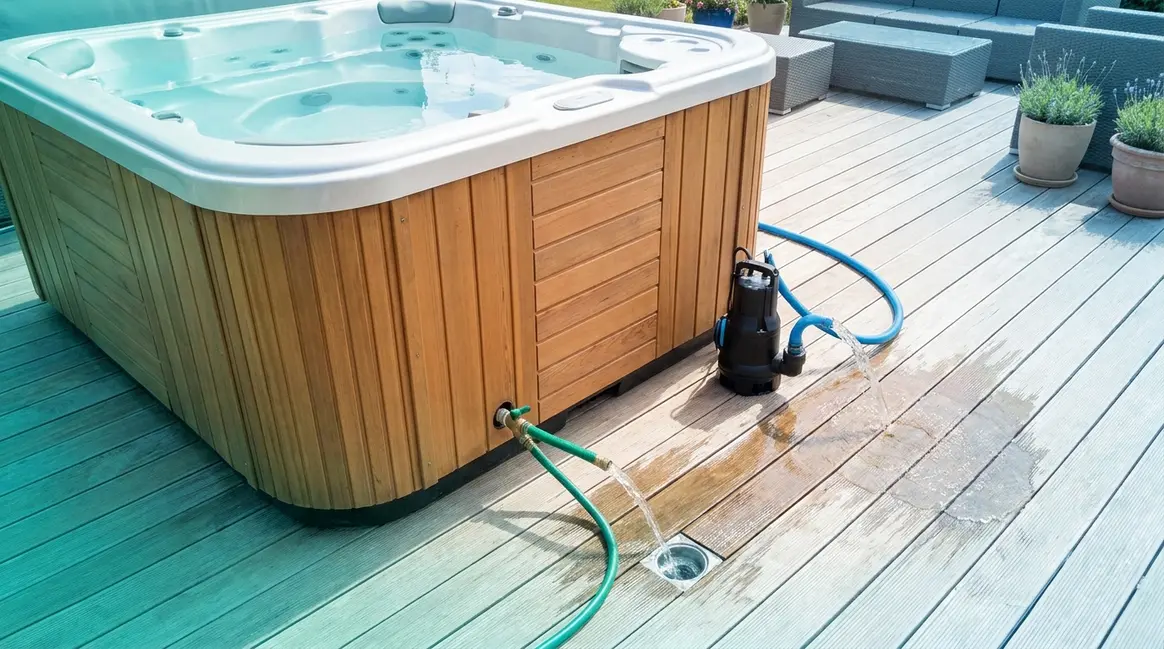
You can drain a hot tub in as little as 10 minutes with a submersible pump, or 1–3 hours using the built-in drain spigot — always disconnect power at the breaker first.
- Fastest method: Submersible utility pump empties most tubs in 10–45 minutes
- Easiest method: Built-in drain spigot + garden hose requires no extra equipment
- Flush first: Run a line flush cleaner 24 hours before draining to clear biofilm from plumbing
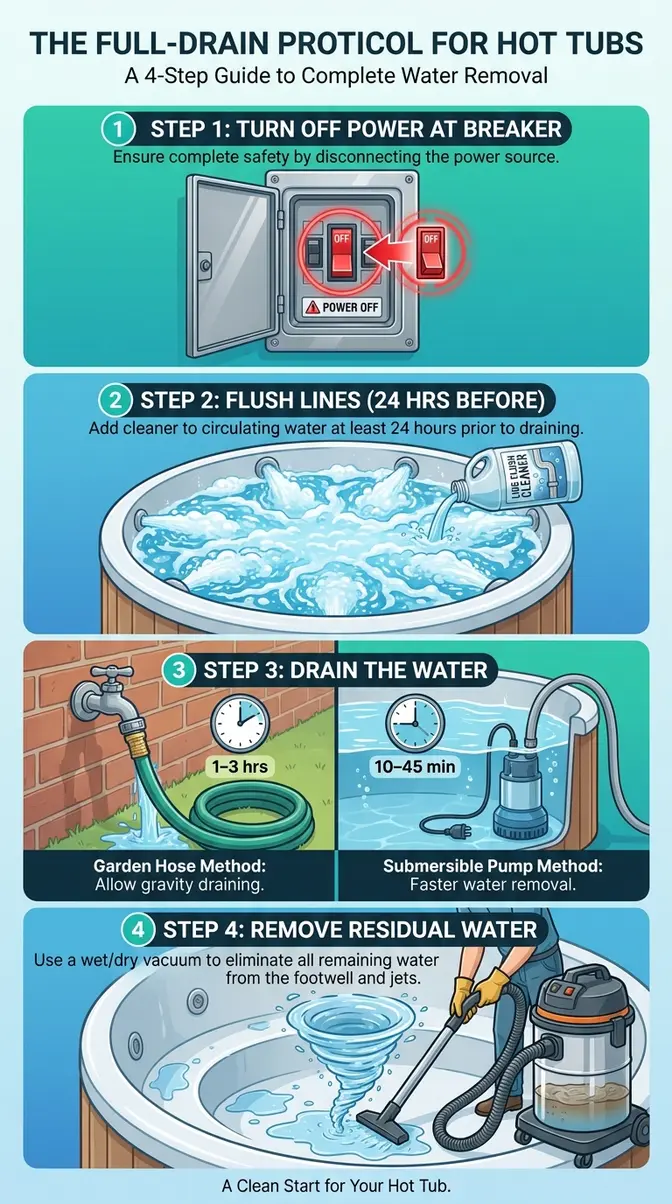
- The Full-Drain Protocol: Safe draining means power off, lines flushed, water disposed of correctly, and shell cleaned before refilling
Before You Start: What You’ll Need
Before you drain your hot tub, you need three things ready: the right tools, the power switched off at the circuit breaker (your electrical panel that controls power to your hot tub), and ideally a line flush cleaner run 24 hours earlier. The CDC recommends draining hot tub water every 3 to 4 months to prevent dangerous TDS buildup and bacterial growth (CDC, 2024). Skipping any of these pre-steps is the most common reason a routine drain turns into a bigger maintenance headache.
This section introduces The Full-Drain Protocol — the complete sequence of power-off → line-flush → drain → clean → dispose → refill that ensures a safe, complete hot tub drain every time. Follow each phase in order and you won’t need to call a technician.
What Equipment Do You Need?
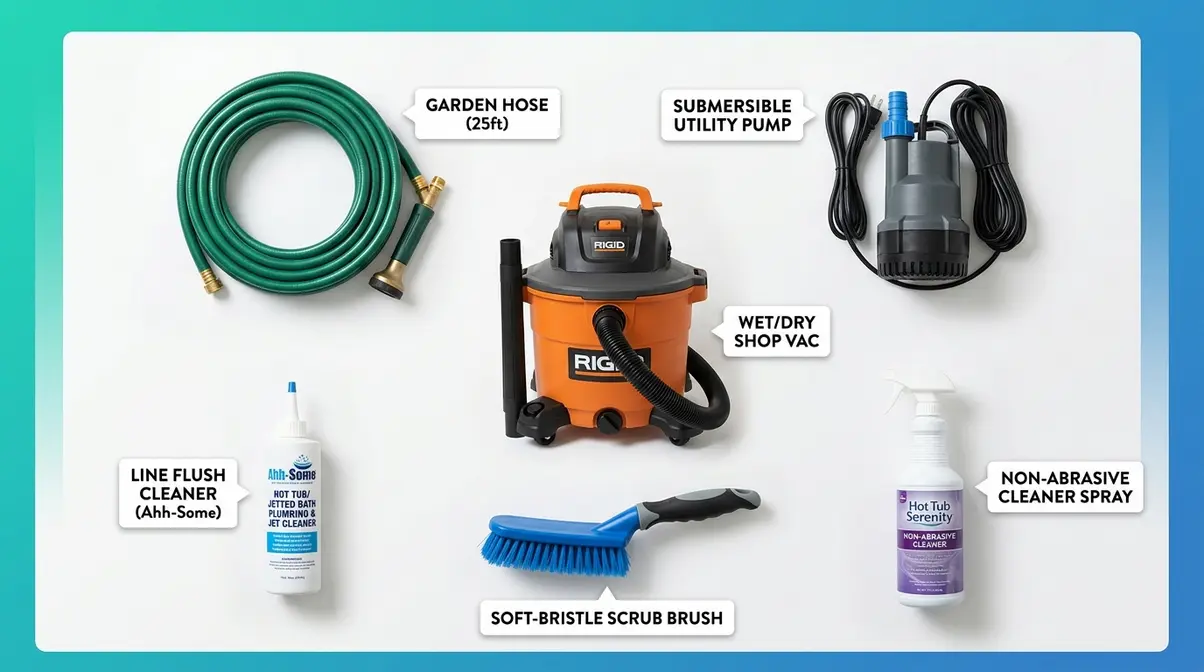
Gather your supplies before you begin — stopping mid-drain to find a hose is frustrating and avoidable. Here’s what you’ll need based on your chosen method:
- For Method A (gravity drain via drain spigot):
- Garden hose long enough to reach a downhill drainage point
- Wrench or pliers (optional — most spigots are hand-tightened)
- For Method B (fast drain):
- Submersible utility pump (also called a sump pump or utility pump) — available at hardware stores for $30–$80. This is the single most useful hot tub accessory you can own if you drain more than once a year. See best submersible pumps for hot tub drainage for current recommendations.
- Pump discharge hose (usually included)
- Universal needs (regardless of method):
- Wet/dry shop vac (for residual water and winterizing)
- Line flush cleaner — such as Ahh-Some or Natural Chemistry Spa Purge
- Soft-bristle scrub brush and non-abrasive cleaner for shell cleaning
If you’re draining for winter, you’ll also need the shop vac to blow out the plumbing lines — more on that in the Winterizing section.
Safety First: Turn Off the Power
⚠️ Before you do anything else: Turn off your hot tub at the circuit breaker — not just the control panel. Hot tubs use 240V electricity. Water and electricity are a lethal combination. Do not skip this step.
Here’s exactly how to do it:
- Go to your home’s electrical panel (the metal box, usually in your garage, utility room, or outside).
- Find the breaker labeled for your hot tub — it’s typically a 2-pole breaker (two switches connected together) rated 40–60 amps.
- Flip it to the OFF position.
Do not rely on the tub’s control panel or GFCI button alone. Those cut power to the controls, not the full circuit. The only safe method is the breaker. Hot tubs run on the same 240V voltage as a clothes dryer — even a small splash near an active component can cause serious injury.
Should You Flush the Lines First?
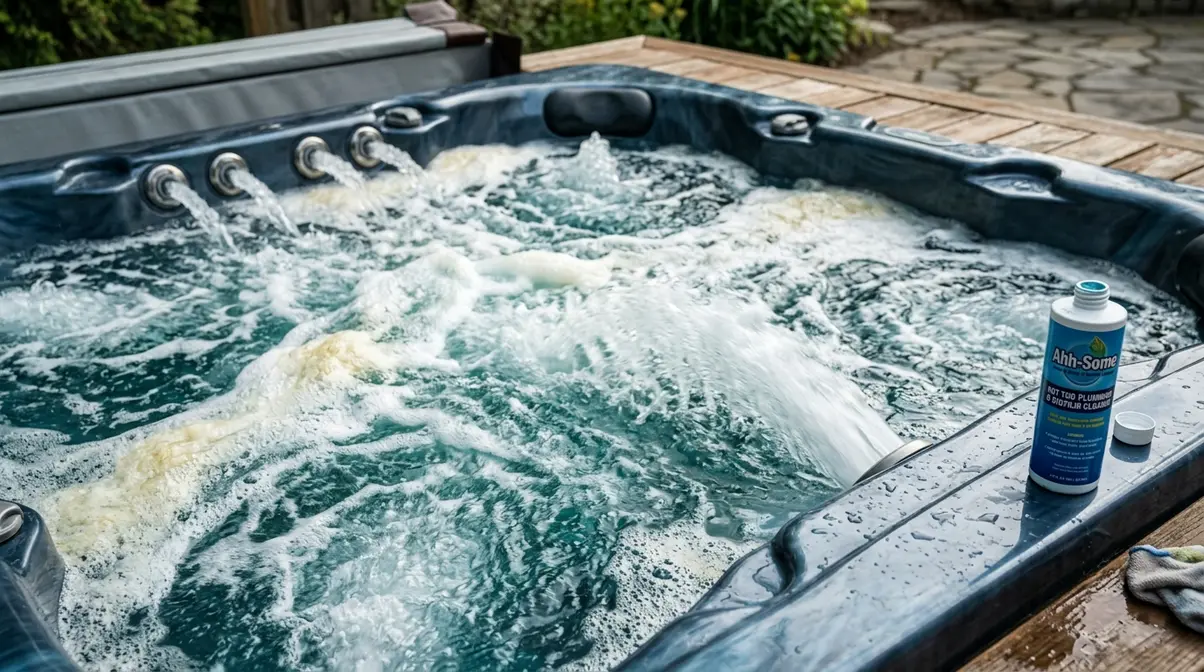
Yes — and most guides skip this entirely. Adding a line flush cleaner (like Ahh-Some or Spa Purge) to the water while the jets are running, 24 hours before you drain, breaks up biofilm — the slimy bacterial layer that builds up inside your hot tub’s plumbing pipes over time.
Here’s why this matters: if you skip the flush and refill with fresh water, you’re pouring clean water into contaminated pipes. The biofilm recontaminates the new water within days, making it cloudy and difficult to balance. Hydropool’s hot tub maintenance guide notes that manufacturers consistently recommend flushing the lines before draining to prevent this exact problem.
How to do it:
- Add the recommended dose of line flush cleaner to the water.
- Run the jets on high for 15–30 minutes.
- Let it sit for 24 hours before draining. You’ll often see foam or debris surface — that’s the biofilm breaking loose.
This step is optional for routine 3-month drains but highly recommended if your water has been cloudy, foamy, or difficult to balance. Now that your power is off and your lines are flushed, you’re ready for the drain itself.
Step-by-Step: How to Drain a Hot Tub
Here is the complete step-by-step process, starting from the moment your power is off and your lines are flushed. The full process takes 10 minutes to 3 hours depending on which method you choose — both are covered in Step 2. You’re now in Phase 3 of The Full-Drain Protocol.
Step 1 — Locate Your Drain Valve

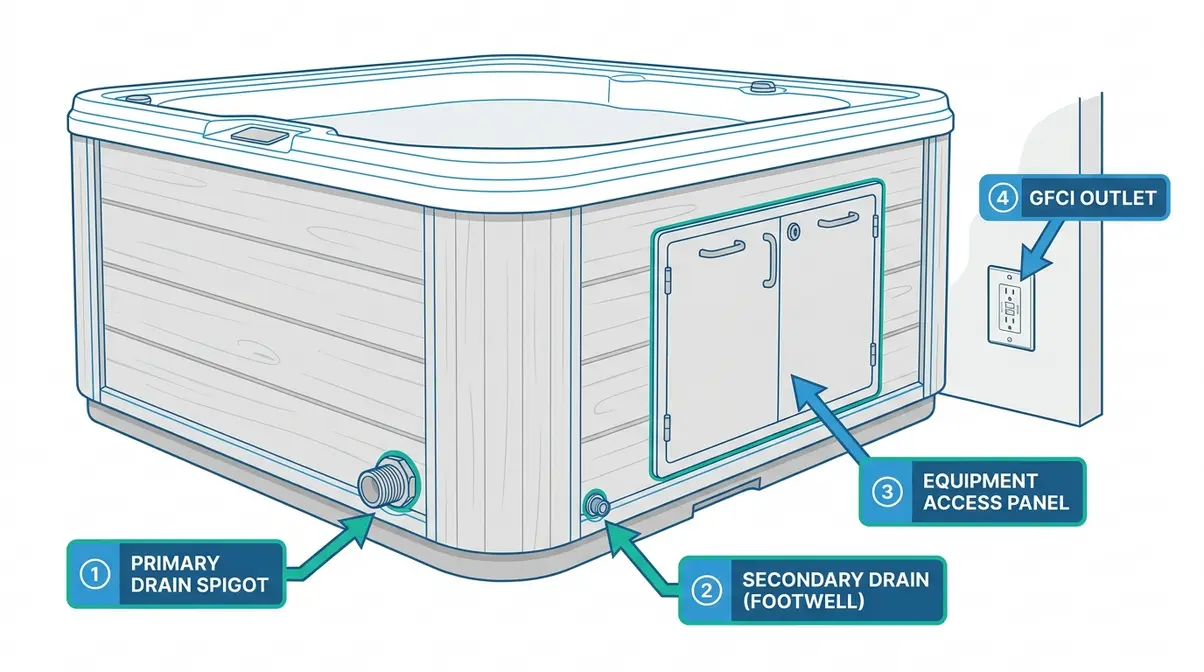
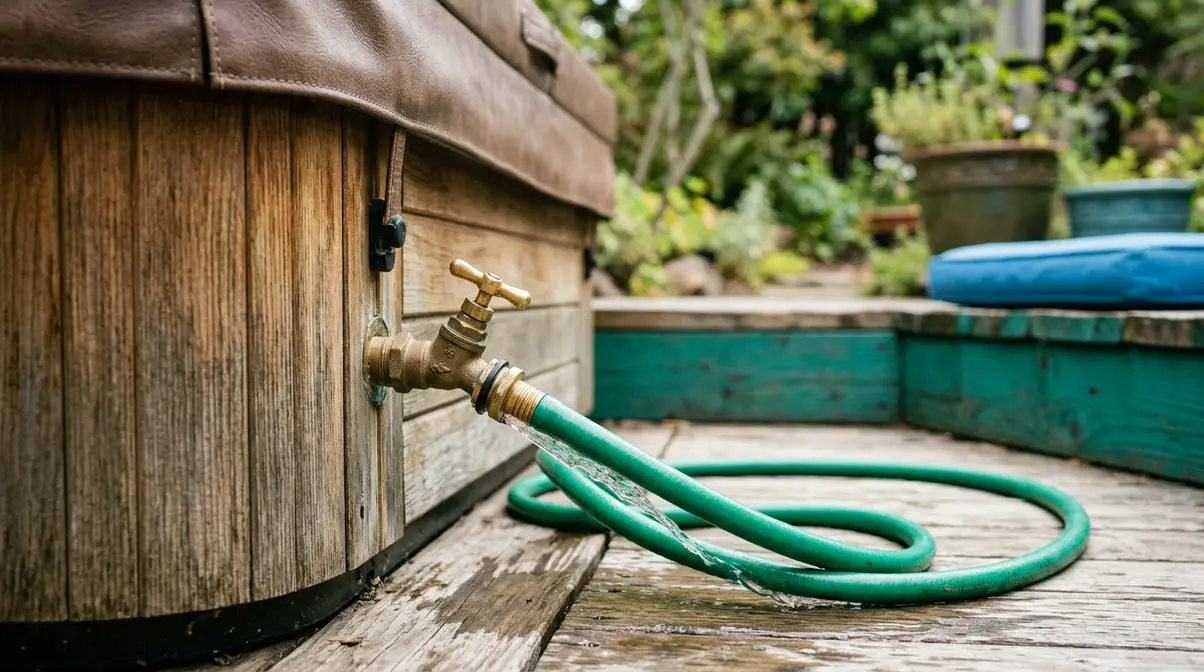
The drain spigot (also called the drain valve or drain plug) is typically located at the base of the exterior cabinet — look near a corner or behind the main equipment access panel. It looks like a threaded hose bib, the same type you’d see on an outdoor faucet.
Two things to know:
- Most hot tubs have two spigots: a primary drain (larger, for the main tank) and a secondary drain (smaller, for the footwell). Open the primary drain first.
- Some models have a small cap or plug that screws off before you can attach a hose. Remove this first and keep it somewhere safe — losing it means water will dribble out during normal operation.
Jacuzzi’s official draining guide confirms the drain valve is located at the base of the cabinet, often near the equipment panel, across most of their model lines. If you can’t find yours, check your owner’s manual or see the Brand-Specific Quick Reference section below.
Once you’ve found the valve, your next decision determines whether you’re done in 10 minutes or 3 hours.
Step 2 — Choose Your Draining Method
Two options are available:
- Method A: Built-in drain spigot + garden hose — no extra equipment required, takes 1–3 hours.
- Method B: Submersible utility pump — costs $30–$80, drains in 10–45 minutes.
For a quick side-by-side breakdown, see the comparison table in the next section (“Pump vs. Hose: Choosing the Fastest Method”). If you want to compare different hot tub draining methods in detail before deciding, that resource walks through the trade-offs clearly.
If this is a routine 3-month drain and you have time, Method A works fine. If you’re winterizing or in a hurry, a submersible pump is worth the investment.
Step 3 — Drain the Water
Method A — Gravity/Spigot:
- Attach the female end of your garden hose to the drain spigot. Thread it clockwise until snug.
- Run the other end downhill to your disposal area (a street gutter, sanitary sewer cleanout, or sloped lawn — see “Where to Drain Hot Tub Water Safely” before choosing).
- Open the valve by turning counterclockwise. Water will begin flowing slowly.
Method B — Submersible Pump:
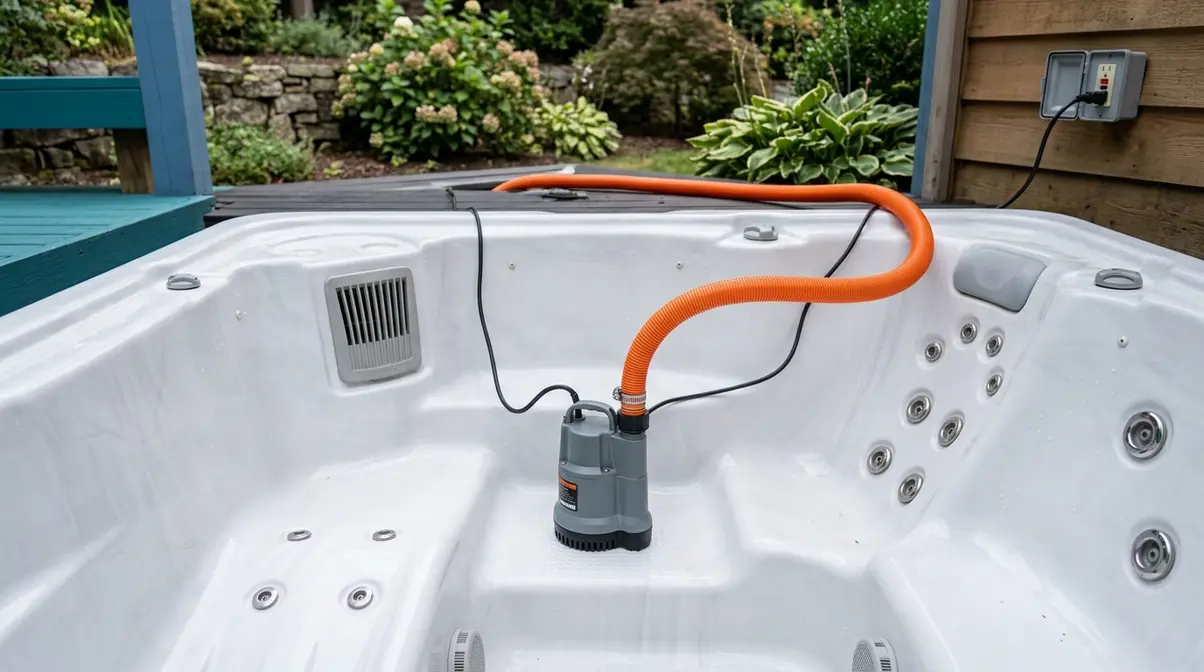
- Place the pump at the lowest point of the tub — the footwell center.
- Connect the pump’s discharge hose and run it to your chosen disposal area.
- Plug the pump into a GFCI outlet (the type with test/reset buttons) — never a standard outlet near water.
- Turn on the pump. Most tubs are nearly empty in 10–45 minutes.
Critical beginner mistake to avoid: The hose or discharge line must run downhill from the tub. If the endpoint is level with or higher than the tub, water will not flow (gravity drain) or will back-pressure the pump. Check the elevation before you start — this one detail is responsible for more failed drains than any other.
Leslie’s Pool draining guide confirms that submersible pumps can drain a standard tub in 10–45 minutes versus 1–3 hours for gravity drain — a meaningful difference when you’re working against the weather or a schedule.
Step 4 — Remove Residual Water
After the gravity drain or pump empties the main volume, 1–3 gallons typically remain in the lowest points of the shell — the footwell, around the jets, and in the filter housing. Remove this water before cleaning, because wet cleaner applied to standing water dilutes its effectiveness.
Use a wet/dry shop vac to remove remaining water:
- Suction the footwell first — this is the lowest collection point.
- Work along the bench seating, pulling water from each low corner.
- Suction around each jet housing individually.
For winterizing, this step becomes even more critical — you’ll switch the shop vac to blow air (not suction) through the plumbing lines to push out trapped water. Full instructions are in the Winterizing section. According to expert advice on winterizing hot tub plumbing lines, removing every drop of residual water before winter storage is non-negotiable for preventing pipe damage.
For a more detailed walkthrough of the emptying process, see this detailed guide on how to empty a hot tub.
Pump vs. Hose: Choosing the Fastest Method
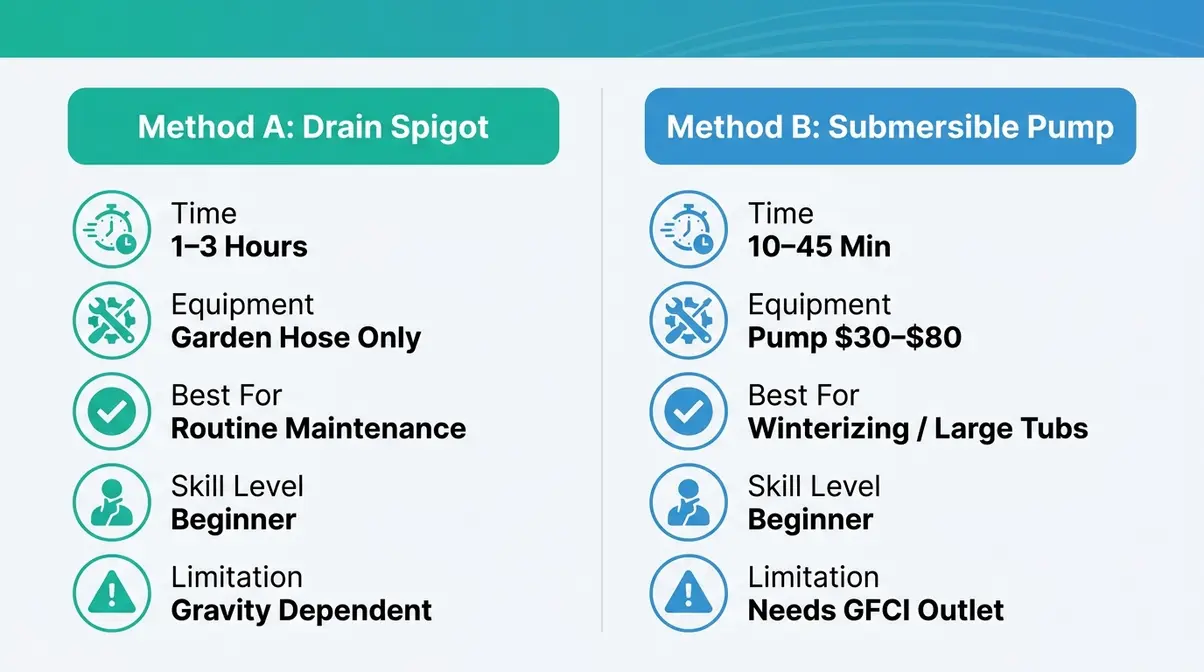
A submersible utility pump is the fastest way to drain a hot tub — emptying a 400-gallon tub in 10 to 45 minutes versus 1 to 3 hours via the built-in gravity spigot. The built-in drain spigot takes longer but requires no extra equipment. Here’s the full comparison to help you choose before your next drain.
Method A — Built-In Drain Spigot (1–3 Hours)
The gravity drain method uses your hot tub’s built-in drain spigot and a standard garden hose — no equipment purchase required. It’s the right choice for routine 3-month maintenance drains when you’re not pressed for time.
Pros:
- No equipment cost
- Simple setup — attach hose, open valve, walk away
- Works for any tub with a functioning drain spigot
Cons:
- Purely gravity-fed — the endpoint must be lower than the tub
- Very slow for large tubs (500+ gallons can take 2–3 hours)
- Leaves residual water in the footwell that still requires a shop vac
A 300-gallon hot tub drains via spigot in roughly 1 hour. If you’re draining without a pump and your tub has no drain spigot, you can use the siphon method — a gravity technique using a garden hose to create suction by submerging the hose fully, capping one end, and directing it downhill before releasing.
Method B — Submersible Utility Pump (10–45 Min)
The submersible pump method is the choice for winterizing, large tubs (400+ gallons), and anyone who drains more than twice a year. A 1/6 HP utility pump moves approximately 30 gallons per minute — a 400-gallon tub empties in about 13 minutes at full flow.
Pros:
- Dramatically faster — 10–45 minutes versus 1–3 hours
- Works even when the drain endpoint isn’t perfectly downhill
- Pays for itself after 2–3 uses versus a service call
Cons:
- Upfront cost: $30–$80 at Home Depot, Lowe’s, or Amazon
- Requires a GFCI outlet nearby — never use a standard extension cord near water
- One more piece of equipment to store
For specific pump recommendations, see best submersible pumps for hot tub drainage.
Side-by-Side Comparison Table
| Factor | Method A: Drain Spigot | Method B: Submersible Pump |
|---|---|---|
| Time to drain | 1–3 hours | 10–45 minutes |
| Equipment needed | Garden hose only | Pump ($30–$80) + hose |
| Best for | Routine maintenance | Winterizing, large tubs |
| Skill level | Beginner | Beginner |
| Limitations | Slow, gravity-dependent | Requires GFCI outlet |
Choose Method B if you’re winterizing or draining a tub larger than 400 gallons. Choose Method A if this is a routine maintenance drain and you have 2+ hours to spare.
After the Drain: Clean and Refill Your Hot Tub
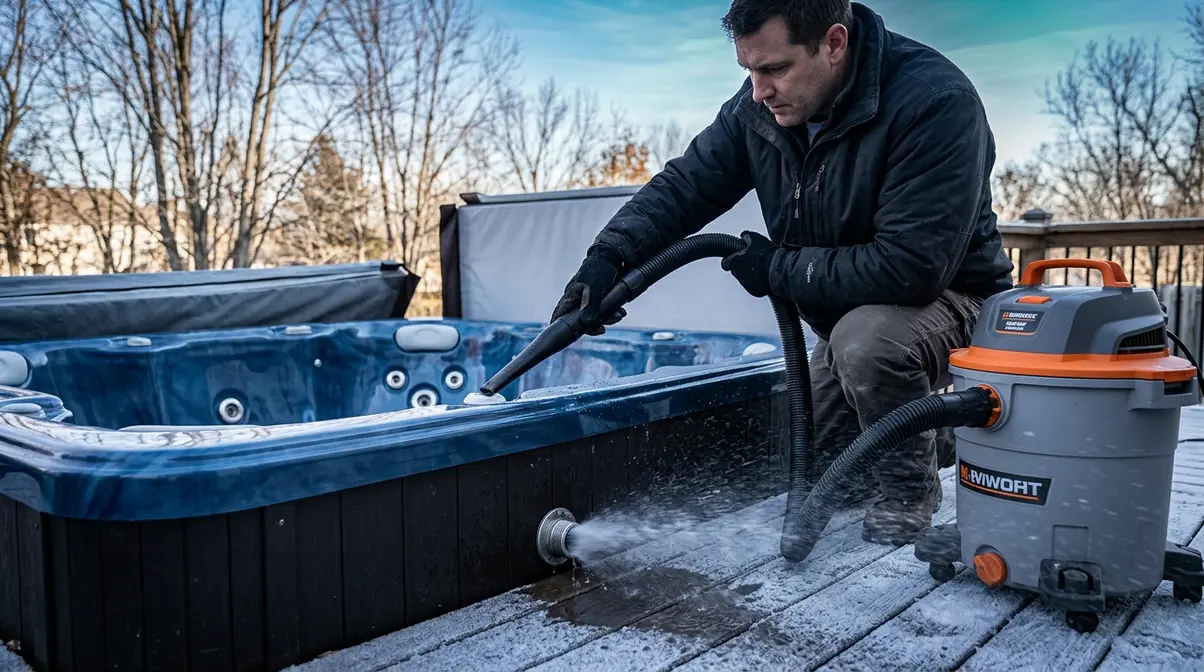
Draining your hot tub is only half the job — cleaning the empty shell and filters before refilling ensures your fresh water stays clean from day one. This step takes 30–60 minutes and requires a soft brush, a non-abrasive cleaner, and your garden hose. Hot tub service professionals consistently recommend cleaning the shell immediately after draining while any residue is still soft and easy to remove.
Clean the Shell and Jets
Use a non-abrasive cleaner: diluted white vinegar, a baking soda paste, or a dedicated hot tub surface cleaner all work well. Never use household bleach, Ajax, or anything with oils — these leave residue that foams up aggressively once the jets are running.
Cleaning steps:
- Scrub the shell, seats, and headrests with a soft-bristle brush.
- Work around each jet housing individually — mineral deposits collect in the grooves.
- Remove the filter cartridge (the replaceable element inside your hot tub’s filter housing that traps debris) and rinse it thoroughly with a garden hose.
- If the filter is 3+ months old, soak it overnight in a chemical filter cleaner before reinstalling.
Consumer Reports’ hot tub maintenance guidelines recommend chemically cleaning filters every 1–3 months — this drain is the ideal time since the tub is already empty. Replace the cartridge entirely if the pleats are damaged, discolored, or won’t clean up after soaking.
Refill Without Air Lock Issues
The way you refill matters more than most guides admit. Insert your garden hose into the filter housing — not over the edge of the tub — to fill from the bottom up.
Why this matters: Filling from the top traps air in the plumbing lines. That air creates an air lock (a pocket of trapped air in the plumbing that prevents water from circulating), causing a gurgling sound and preventing the circulation pump from priming. Bottom filling eliminates this problem entirely.
Steps:
- Insert the hose into the filter housing opening.
- Fill until water is at least 2–3 inches above the highest jet.
- Turn the power back on at the breaker only after the water is at proper level.
For a complete walkthrough of the refill process, see the ultimate guide to hot tub cleaning and refilling.
Balance the Water Chemistry
Test the fresh water immediately using test strips or a digital tester. Target ranges:
| Parameter | Target Range |
|---|---|
| Total Alkalinity | 80–120 ppm |
| pH | 7.4–7.6 |
| Chlorine (sanitizer) | 3–5 ppm |
| Bromine (alternative) | 3–5 ppm |
Adjust alkalinity first, then pH, then sanitizer — always in that order. Adjusting out of sequence wastes chemicals and makes balancing harder. The Pool & Hot Tub Alliance water quality standards provide the industry-standard protocols these ranges are based on. Don’t get in the tub until all three levels are in range — unbalanced water causes skin irritation and can damage equipment seals over time.
Winterizing: How to Drain a Hot Tub for Cold Weather
Draining a hot tub for winter requires one extra step that most guides skip: blowing out the plumbing lines (the PVC pipes that carry water from the pump to the jets) with a shop vac. Without this step, water trapped in the pipes freezes, expands, and cracks the plumbing — repairs typically cost $500 to $2,000 or more depending on which lines are affected. The Full-Drain Protocol adds two additional phases for cold-weather draining: line blow-out and a final seal-up checklist.
Why Winter Draining Is Different
A routine 3-month drain removes the water from the main tank. But winterizing must remove water from every inch of plumbing, including the lines between the pump, heater, and jets. Water expands approximately 9% when it freezes — that’s enough force to split PVC pipe fittings, crack the pump housing, or damage the heater manifold.
Hot tub service professionals report that freeze damage is the single most common and preventable winterization mistake. The difference between a $0 blow-out and a $1,500 plumbing repair is one shop vac session.
Blow Out the Lines with a Shop Vac
Tools needed: Wet/dry shop vac, foam pipe insulation or rags (to seal gaps), a helper (optional but useful).
Steps:
- Complete Steps 1–4 of the standard Full-Drain Protocol first — the main tank must be empty.
- Switch your shop vac to blow mode (reverse the hose to the exhaust port).
- Hold the blower nozzle firmly against each jet opening, one at a time, and run for 10–15 seconds per jet. You’ll see water spray out of the drain spigot or footwell — that’s the trapped water being pushed out.
- Work through every jet systematically — don’t skip any.
- Blow through the filter housing inlet as well to clear the circulation line.
For inflatable models, skip this step — their flexible tubing drains fully when the tub is emptied and tilted.
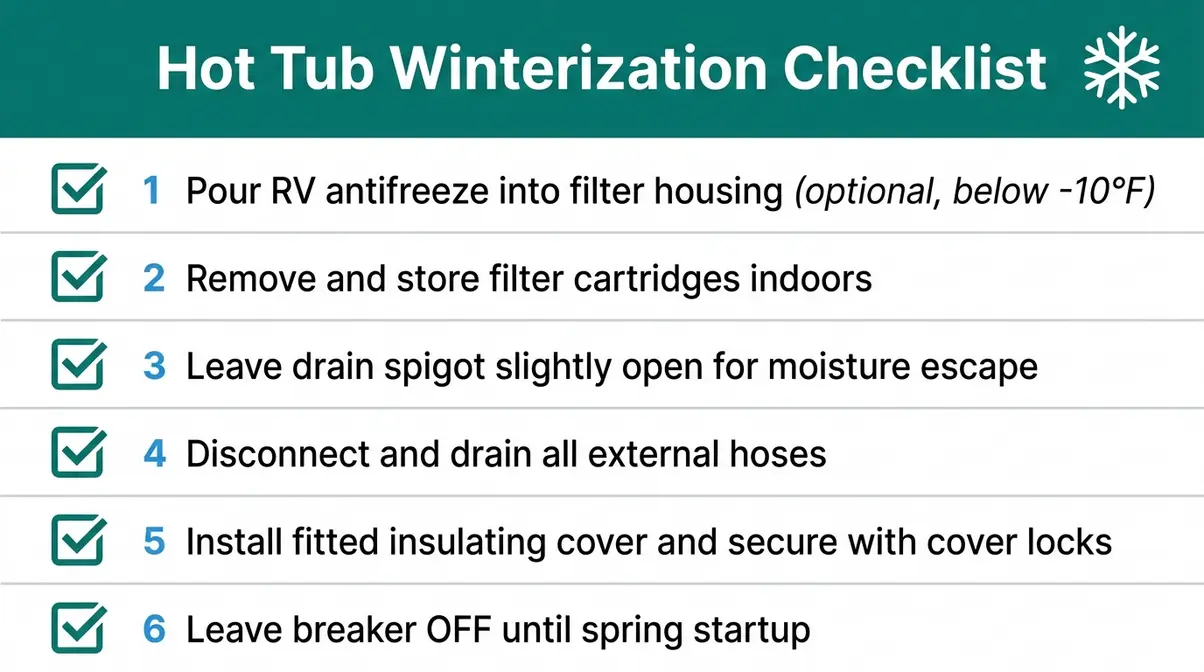
Final Winterization Checklist
Complete these steps after blowing out the lines:
- ☐ Pour a small amount of non-toxic RV antifreeze into the filter housing (optional but adds a safety margin in extreme cold below -10°F)
- ☐ Remove and store all filter cartridges indoors
- ☐ Leave the drain spigot open slightly to allow any remaining moisture to escape
- ☐ Disconnect and drain any external hoses
- ☐ Place a fitted insulating cover on the tub and secure with cover locks
- ☐ Do NOT turn the power back on — leave the breaker off until spring startup
For additional winterization guidance, see this detailed guide on how to empty a hot tub for cold-weather preparation.
Where to Drain Hot Tub Water Safely
Hot tub water contains chlorine, bromine, pH adjusters, and other chemicals. Where you drain it matters — both for your local environment and for legal compliance.
Why You Can’t Just Drain to the Street
Draining chemically treated water directly into a street gutter typically flows into a storm drain. Storm drains in most municipalities discharge directly to local waterways — rivers, lakes, and wetlands — without treatment. Chlorine and bromine are toxic to aquatic life even at low concentrations. The Washington State Department of Ecology explicitly advises against draining pool or spa water into storm drains or natural waterways, recommending instead that water be dechlorinated before disposal or directed to a sanitary sewer system.
The EPA’s Clean Water Act also prohibits discharging pollutants into navigable waters without a permit. While enforcement against individual homeowners is rare, the ecological harm is real — and many municipalities have local ordinances with fines.
Safe Disposal Options
Option 1 — Let it dechlorinate naturally: Stop adding sanitizer 2–3 days before draining. Sunlight and time will break down chlorine and bromine to safe levels (below 0.1 ppm). Test with strips before draining.
Option 2 — Sanitary sewer cleanout: Drain to your home’s sanitary sewer cleanout (the capped pipe near your home’s foundation). This water goes to the wastewater treatment plant, which is designed to handle it.
Option 3 — Lawn irrigation (dechlorinated only): Once sanitizer levels are below 0.1 ppm, hot tub water is safe to use on grass and non-edible plants. Avoid vegetable gardens.
Option 4 — Call your municipality: Some cities provide guidance or even permit connections for large-volume draining. A quick call to your local water authority takes 5 minutes and confirms your specific rules.
Brand-Specific Quick Reference (Jacuzzi, Bullfrog & More)
Jacuzzi and Hot Spring Models
On most Jacuzzi models, the primary drain spigot is located at the base of the cabinet near the equipment compartment — typically on the side facing away from the main entry steps. Jacuzzi’s official guidance recommends attaching a standard garden hose directly to the threaded spigot without any adapter on most J-300 and J-400 series models.
Hot Spring (Watkins Wellness) places the drain valve behind the equipment access panel on the equipment side of the cabinet. Hot Spring models include a secondary drain for the footwell — drain both before cleaning. Manufacturer guidelines from Jacuzzi and Hot Spring confirm that both brands use standard 3/4-inch garden hose fittings on their residential drain spigots.
Inflatable Models (Coleman, SaluSpa, Intex)
Inflatable hot tubs use a different drain system — typically a rubber plug and valve on the exterior wall near the base, not a threaded spigot. To drain a Coleman or SaluSpa model:
- Turn off and unplug the pump unit completely.
- Remove the rubber drain plug from the exterior valve.
- Attach the included drain hose (if provided) or a standard garden hose adapter.
- Tilt the tub slightly toward the drain side to speed gravity flow.
For Intex models, the process is identical. None of these models require a submersible pump — gravity drainage is sufficient given their smaller capacity (typically 150–250 gallons). Draining takes 20–40 minutes via gravity.
Common Draining Problems and How to Fix Them
Stuck or Seized Drain Valve
A drain valve that won’t turn is usually caused by mineral scale buildup or a rubber O-ring that has dried and swollen shut. Hot tub service professionals report this is most common on tubs that haven’t been drained in 6+ months.
Fix: Apply a small amount of penetrating oil (like WD-40) around the valve base and wait 15 minutes before trying again. Use pliers with a cloth wrap — not bare metal — to avoid scratching the fitting. If the valve still won’t turn, a replacement spigot costs $10–$20 at any hardware store and takes about 20 minutes to swap with the water drained.
Tub Is Draining Too Slowly
A slow gravity drain is almost always caused by one of three things: a kinked hose, an endpoint that isn’t downhill enough, or a partially closed valve.
- Fix:
- Check the hose for kinks — straighten any bends within 6 feet of the spigot.
- Verify the discharge end is at least 12–18 inches lower in elevation than the tub base.
- Confirm the valve is fully open (turned counterclockwise until it stops).
If all three are correct and flow is still minimal, switch to a submersible pump. Gravity drains rely entirely on elevation difference — a pump eliminates this dependency entirely.
Frequently Asked Questions
What is the easiest way to drain a hot tub?
The easiest method is the built-in drain spigot combined with a garden hose — no extra equipment required. Attach the hose to the threaded spigot at the base of the cabinet, run it to a downhill location, open the valve, and wait. The process takes 1–3 hours and requires almost no physical effort. For first-time owners, this is the lowest-barrier starting point — the only prerequisite is confirming your hose reaches a downhill drainage area.
Where is the hot tub drain valve?
The hot tub drain valve (also called the drain spigot) is located at the base of the exterior cabinet, typically near a corner or behind the equipment access panel. It looks like a threaded outdoor faucet fitting. Most tubs have two spigots — a larger primary drain for the main tank and a smaller secondary drain for the footwell. If you can’t locate it visually, check your owner’s manual or look behind the largest access panel on the equipment side of the tub.
How often does a hot tub need to be drained?
Hot tubs should be drained and refilled every 3 to 4 months under normal use conditions (2–4 people, 3–4 sessions per week). This frequency prevents dangerous TDS buildup and bacterial growth in the plumbing lines (CDC, 2024). Heavy use — more bathers, more frequent sessions, or a spa used for therapy — may require draining every 6–8 weeks. A simple rule: if your water is cloudy, foamy, or won’t balance despite correct chemical additions, it’s time to drain regardless of schedule.
Can you drain a hot tub with a garden hose?
Yes — a garden hose is the standard tool for the gravity drain method. Attach the female end of the hose to the drain spigot, run the male end downhill to your disposal area, and open the valve. The hose doesn’t pump the water — it simply channels gravity flow. A 400-gallon tub will take approximately 1.5–2 hours to empty this way. The hose must run continuously downhill; any uphill section will stop water flow entirely. For faster draining, a submersible pump replaces the wait time with a 10–45 minute process.
What happens if you don’t drain your hot tub?
Skipping regular draining allows TDS (total dissolved solids) to accumulate until the water becomes chemically unmanageable. High TDS causes cloudy water, skin irritation, and equipment corrosion — and no amount of added chemicals will fix it short of a full drain. More seriously, stagnant water with high organic load creates ideal conditions for Legionella and Pseudomonas bacteria to colonize the plumbing lines. The CDC links inadequately maintained hot tubs to outbreaks of Legionnaires’ disease and hot tub rash (folliculitis). Draining every 3–4 months is the single most effective maintenance action a hot tub owner can take.
Wrapping Up
For first-time hot tub owners, draining safely comes down to following The Full-Drain Protocol in sequence: power off at the breaker, lines flushed 24 hours earlier, water drained via spigot (1–3 hours) or submersible pump (10–45 minutes), residual water removed with a shop vac, shell cleaned, and fresh water balanced before anyone gets back in. The CDC recommends this cycle every 3 to 4 months — and skipping any phase is the most common reason water quality problems return within weeks of a refill.
The Full-Drain Protocol isn’t just a checklist — it’s the difference between a tub that’s genuinely clean and one that looks clean but has biofilm growing in the plumbing. Each phase builds on the last: flushing the lines makes the drain more effective, removing residual water makes cleaning more effective, and bottom-filling prevents air locks that would otherwise require a service call.
Your next step: gather your equipment today — a garden hose if you’re doing a routine drain, or a best submersible pumps for hot tub drainage if you’re winterizing or draining a larger tub. Run your line flush cleaner tonight, and you’ll be draining in 24 hours. If you’re heading into winter, complete the full winterization checklist before the first freeze — the cost difference between prevention and pipe repair is measured in hundreds of dollars.