

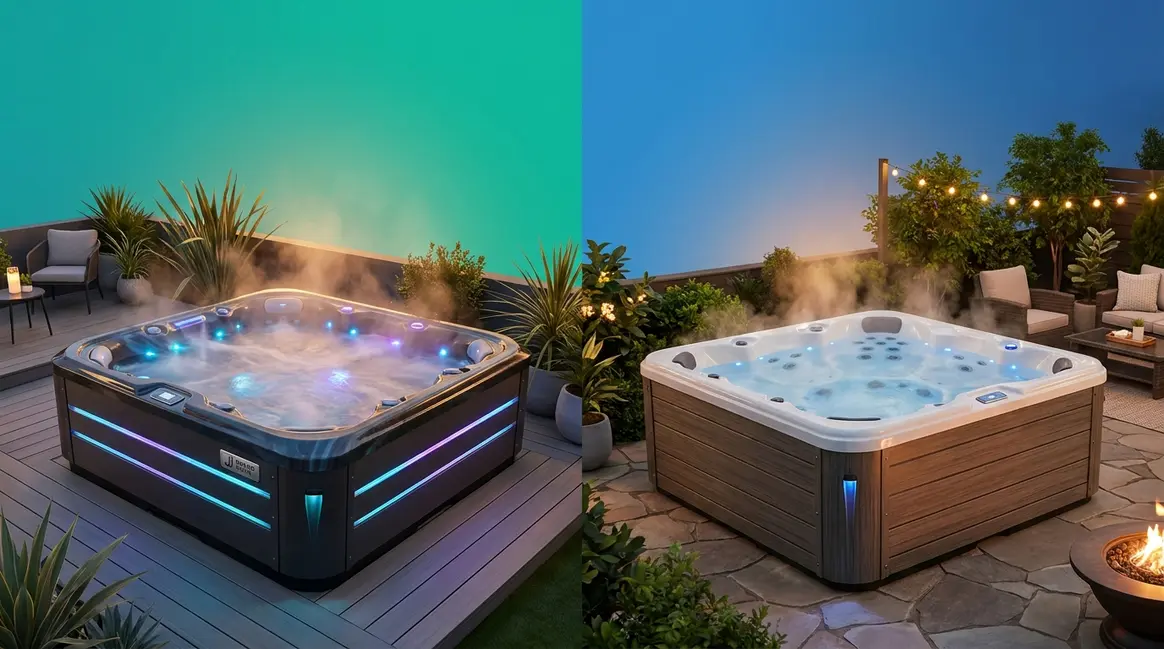
Table of Contents - Jacuzzi vs. Hot Tub: What’s the Real Difference? (2026)
- Jacuzzi® vs. Hot Tub — What’s Actually the Difference?
- Hot Tub Prices and Models: What You Actually Get for the Money
- Hot Tub vs. Sauna vs. Swim Spa: Which Wellness Option Is Right for You?
- Hot Tub Health Benefits: What the Science Actually Says
- Hot Tub Installation and Maintenance: What New Owners Need to Know
- Common Pitfalls When Buying a Hot Tub or Jacuzzi®
- Frequently Asked Questions
- Do hot tubs reduce cortisol?
- Why are Jacuzzi tubs out of style?
- Will a hot tub help a sciatic nerve?
- Do hot tubs help with lymphatic drainage?
- Why put tennis balls in a hot tub?
- What do you crave when cortisol is high?
- What is the hottest bathroom trend in 2026?
- What’s the worst thing you can do for sciatica?
- How often should I use a hot tub for health benefits?
- Is a Jacuzzi® worth the extra cost over a generic hot tub?
This blog post may contain affiliate links. As an Amazon Associate I earn from qualifying purchases.
You’ve heard both words used to describe the exact same thing. A hotel calls it a Jacuzzi. Your neighbor calls it a hot tub. The dealer’s showroom has a sign that says “spa.” So which is it — and does it even matter?
It matters more than you think, especially when you’re about to spend $3,000 to $15,000 or more. The jacuzzi vs. hot tub difference comes down to one fundamental fact: one is a brand name, the other is a product category. Without knowing that, you could easily pay a premium for a label while missing out on equally good — or better — options at a lower price. That’s what we call “The Brand Trap,” and this guide is designed to help you avoid it.
By the end of this article, you’ll know exactly what separates the Jacuzzi® brand from the generic hot tub category, what you should realistically pay at each price tier, how hot tubs stack up against saunas and swim spas, and what the science actually says about health benefits. We cover definitions, pricing, wellness comparisons, medical evidence, installation basics, and the most common buying mistakes — all in plain language.
The jacuzzi vs. hot tub difference is simpler than it sounds: Jacuzzi® is a brand name, not a product type — and knowing this can save you thousands.
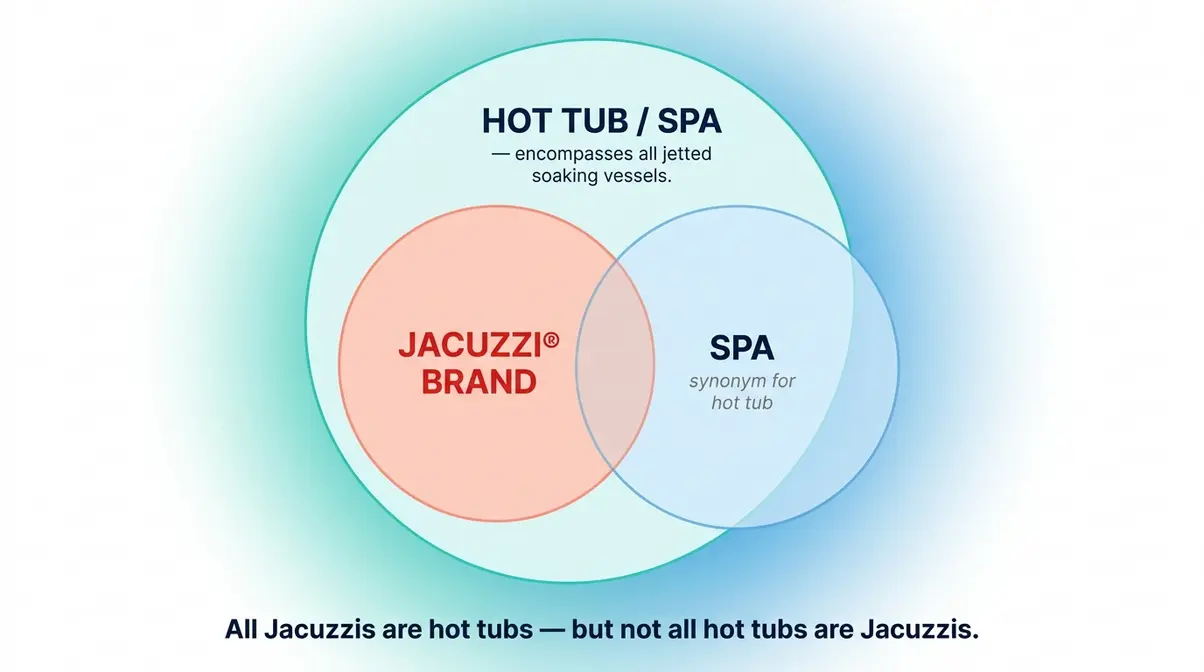
- Jacuzzi® is a brand: Like Kleenex for tissues — all Jacuzzis are hot tubs, but not all hot tubs are Jacuzzis
- Price gap is real: Jacuzzi® brand tubs typically start at $5,000+; quality generic hot tubs start around $3,000
- Health benefits are backed by science: Hot tubs can reduce cortisol and relieve sciatic nerve pain — but the brand doesn’t change the benefit
- “The Brand Trap”: Paying for the Jacuzzi® label means paying for brand equity — not necessarily better hydrotherapy
- The right choice depends on your budget, use case, and how often you’ll actually use it
Jacuzzi® vs. Hot Tub — What’s Actually the Difference?
“I actually work as a reservations agent in the hotel business, and the hotels I book always describe their tubs with one of the above. However, they seem to use the terms interchangeably — and I’ve never been sure which one is actually correct.”
— Hot tub buyer community forum
This quote captures something real. Even professionals who work with these terms every day aren’t sure what they mean. You’re not alone in the confusion, and the answer is actually straightforward once someone explains it clearly.
Jacuzzi® is a registered trademark — not a product category. All Jacuzzis are hot tubs, but not all hot tubs are Jacuzzis (The New York Times, 2019). Understanding this single fact is the foundation of every smart hot tub purchase decision.
What Is a Hot Tub? The Generic Category Explained
A hot tub is the generic term for any large, heated, jetted soaking vessel designed for relaxation, hydrotherapy (the use of water for pain relief and relaxation), or recreational use. Think of it as the umbrella term — the category name that covers everything from a $2,500 entry-level inflatable to a $20,000 fully equipped in-ground installation.
Hot tubs heat water to temperatures typically between 100°F and 104°F. They use jets — pressurized nozzles that push water and air into the tub — to create a massaging effect. Most hold between 2 and 8 people and run on either 110-volt or 240-volt electrical systems.
Why does this matter to you? Because when a salesperson, a hotel listing, or a neighbor uses the word “hot tub,” they could be referring to products from dozens of different manufacturers — Jacuzzi®, Sundance, Hot Spring, Bullfrog, or any of hundreds of others. The term tells you what it is, not who made it.
Hot tubs are also commonly called portable spas in retail and dealer contexts. All three terms — hot tub, spa, and portable spa — generally describe the same type of product. The only exception is the Jacuzzi® brand, which we’ll explain next.
What Is Jacuzzi®? The Brand Behind the Name
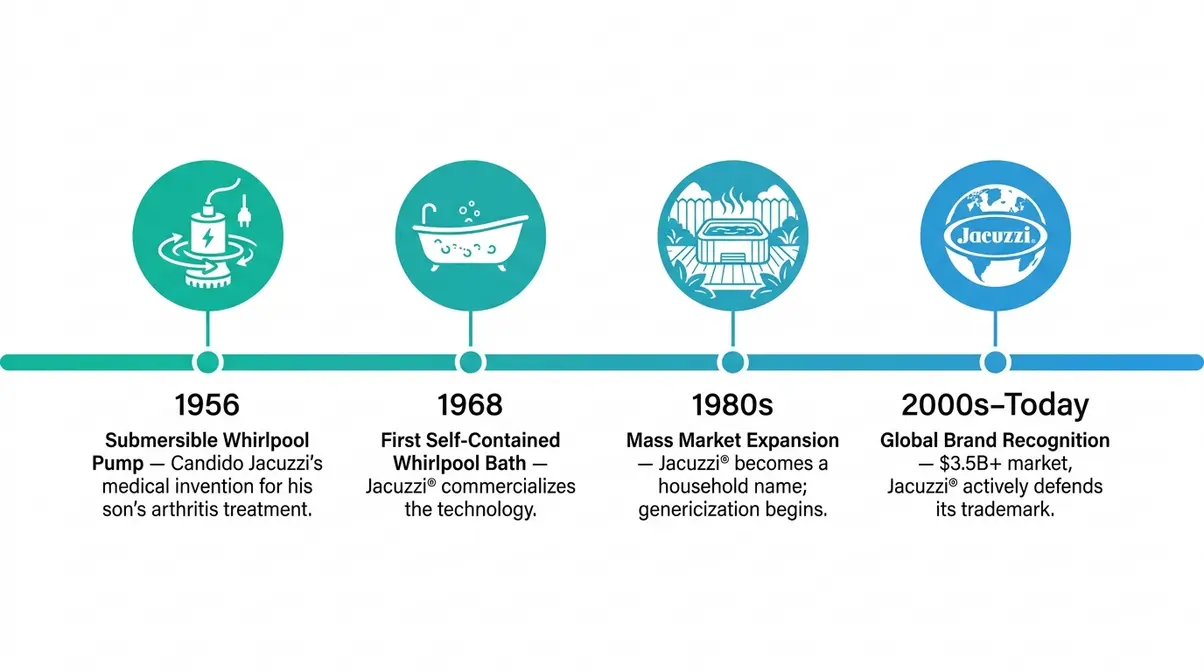
Jacuzzi® is a specific company — one of the world’s most recognized hot tub brands, founded in the 1950s by Italian-American inventor Candido Jacuzzi. The company’s origin story is worth knowing: Candido originally developed a submersible whirlpool pump in 1956 to help treat his young son’s rheumatoid arthritis. The product wasn’t initially marketed as a luxury item — it was a medical device adapted for home use.
Over the following decades, the Jacuzzi family commercialized the technology, eventually producing the first self-contained whirlpool bath in 1968. The brand grew rapidly through the 1970s and 1980s, becoming so dominant in the market that consumers began using “Jacuzzi” the way they use “Kleenex” for tissues or “Xerox” for photocopies — as a stand-in for the entire product category.
Today, Jacuzzi® is a large, publicly traded company headquartered in Chico, California, selling hot tubs, bath products, and wellness equipment worldwide. According to Jacuzzi’s official brand page, the company actively maintains its trademark and distinguishes its products from generic competitors through proprietary jet technology, warranty programs, and dealer networks.
Why this matters to you: Buying a Jacuzzi® brand hot tub means buying a product from one specific manufacturer with specific quality standards, warranty terms, and a dealer network. It does not automatically mean you’re getting a better hot tub than a comparable model from another reputable brand.
The “Kleenex Effect”: How a Brand Name Took Over a Category
The technical term for what happened to Jacuzzi® is genericization — the process by which a brand name becomes so widely used that it starts to function as the generic word for the product itself. You’ve seen this happen with other brands:
- Kleenex → facial tissue
- Band-Aid → adhesive bandage
- Xerox → photocopy
- Jacuzzi® → jetted hot tub
Here’s what most competitors don’t tell you: genericization actually creates a legal headache for the brand. Companies like Jacuzzi® must actively fight to protect their trademark — because if a brand name becomes too generic in the eyes of the law, it can lose trademark protection entirely (as happened to “escalator” and “aspirin” in the U.S.). This is why Jacuzzi® always uses the registered trademark symbol (®) in official communications.
For you as a buyer, the Kleenex Effect creates “The Brand Trap”: because everyone calls jetted tubs “Jacuzzis,” many shoppers assume Jacuzzi® products are inherently superior. Retailers sometimes exploit this assumption — implying premium quality simply by association with the brand name. In reality, brands like Hot Spring Spas, Sundance Spas, and Bullfrog Spas offer comparable or, in some categories, superior hydrotherapy technology at competitive price points.
The Brand Trap in practice: You walk into a showroom asking for “a Jacuzzi.” The salesperson shows you a $9,000 Jacuzzi® model and a $6,500 competitor. Because you associate the word “Jacuzzi” with quality, you may assume the branded model is better — even if the competitor’s jet system, insulation, and warranty are objectively equivalent. Awareness is your defense.
What About “Spa”? Clearing Up the Third Term
A spa, in the residential and retail context, is simply another word for a hot tub or portable hot tub. In most dealerships, product listings, and manufacturer catalogs, “spa” and “hot tub” are used interchangeably. You’ll see this especially with the phrase “portable spa,” which refers to an above-ground, self-contained hot tub unit.
Where it gets slightly confusing: “spa” can also refer to a day spa (a wellness business), a hotel spa facility, or an in-ground spa built adjacent to a swimming pool. Context usually makes the meaning clear.
The takeaway: when a dealer, a hotel, or a manufacturer says “spa,” they almost certainly mean a hot tub. The word doesn’t signal a different product — just a different preference for terminology.
Master Comparison Table: Jacuzzi® Brand vs. Generic Hot Tub vs. Spa
| Feature | Jacuzzi® Brand | Generic Hot Tub | “Spa” (Residential) |
|---|---|---|---|
| What it is | Specific brand (one manufacturer) | Any jetted soaking vessel | Hot tub / portable spa (synonym) |
| Price range | $5,000–$20,000+ | $2,500–$15,000 | Same as hot tub |
| Jet technology | Proprietary PowerPro® jets | Varies by brand/model | Varies by brand/model |
| Warranty | Jacuzzi® brand warranty | Varies by manufacturer | Varies by manufacturer |
| Where sold | Authorized Jacuzzi® dealers | Independent dealers, big-box, online | Independent dealers, manufacturers |
| Brand recognition | Extremely high | Varies | Varies |
| Health benefits | Same as any hot tub | Same across comparable models | Same across comparable models |
| Best for | Brand-conscious buyers, dealer support | Budget-conscious buyers, comparison shoppers | General term — not a buying category |
Hot Tub Prices and Models: What You Actually Get for the Money
Price is where the jacuzzi vs. hot tub difference becomes most tangible. Industry data from Consumer Reports (2025) shows that the hot tub market spans a wide range — from under $1,000 for basic inflatable models to over $20,000 for premium in-ground installations. Knowing which tier matches your needs prevents both overpaying and under-buying.
Price Ranges at a Glance: Budget, Mid-Range, and Premium
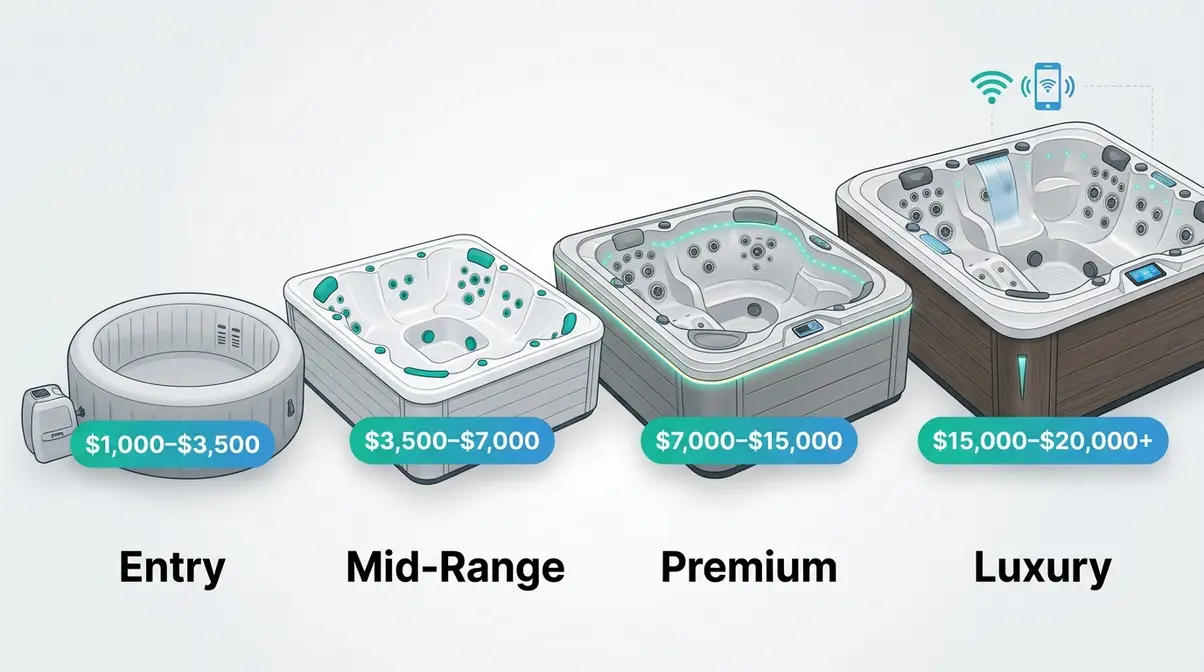
Here’s a realistic breakdown of what you’ll find at each price tier, based on current dealer and manufacturer pricing as of early 2026:
| Tier | Price Range | What You Get | Best For |
|---|---|---|---|
| Entry-Level | $1,000–$3,500 | Inflatable or basic rotomolded shell, 2–4 jets, 110V plug-in, limited insulation | Occasional use, renters, first-time testers |
| Mid-Range | $3,500–$7,000 | Acrylic shell, 20–40 jets, 240V, better insulation, 2–5 year warranty | Regular family use, back pain relief, most buyers |
| Premium | $7,000–$15,000 | Full-featured acrylic, 50+ jets, LED lighting, Wi-Fi control, 5–10 year warranty | Daily users, therapeutic needs, entertaining |
| Luxury / Jacuzzi® Top-Tier | $15,000–$20,000+ | Premium brand, proprietary jet systems, full smart-home integration, lifetime frame warranty | Brand-loyal buyers, showpiece installations |
Where does Jacuzzi® fit? The Jacuzzi® brand starts at approximately $5,000 for entry-level models and runs to $20,000+ for their flagship collections. That puts Jacuzzi® solidly in the mid-range to luxury tier. Quality non-Jacuzzi brands like Hot Spring Spas or Sundance Spas occupy the same price range — meaning you’re often paying for brand recognition alongside (not instead of) product quality.
Note: Prices verified as of early 2026. Hot tub pricing changes frequently — always confirm with your local dealer or the brand’s official website.
Popular Jacuzzi® Brand Models Worth Knowing
The Jacuzzi® lineup is organized into series, each targeting a different buyer profile. Here are the three most commonly discussed series at local dealerships:
J-200 Series ($5,000–$8,000): The entry point into the Jacuzzi® brand. These models seat 5–7 people and feature PowerPro® jets with adjustable massage settings. Good for buyers who want the Jacuzzi® name at a more accessible price.
J-300 Series ($8,000–$12,000): The mid-range workhorse. Adds ProFinish™ cabinetry, enhanced insulation (Full Foam insulation system), and more jet options. Most popular with buyers who plan to use the tub 3–5 times per week.
J-400 Series ($12,000–$20,000+): Jacuzzi®’s premium offering. Includes SmartTub™ Wi-Fi connectivity, LED chromotherapy lighting, and the brand’s most powerful jet configurations. Designed for daily therapeutic use and buyers who want a showpiece product.
Comparable non-Jacuzzi alternatives in each tier exist from Hot Spring, Sundance, and Bullfrog — often with similar or superior jet technology. Visiting local dealerships and comparing jet placement, insulation ratings, and warranty terms side by side is the single best way to evaluate value at each tier.
5 Factors That Drive Hot Tub Costs
Understanding what you’re actually paying for helps you spot value — and spot markup. These five factors account for most of the price variation between hot tub models:
- Shell material: Acrylic shells (durable, 10–20 year lifespan) cost significantly more than rotomolded polyethylene (5–10 years). Most mid-range and premium tubs use acrylic.
- Jet count and technology: More jets don’t always mean better massage. Jet placement and adjustability matter more than raw numbers. Proprietary systems (like Jacuzzi®’s PowerPro® or Bullfrog’s JetPak system) command premium pricing.
- Insulation quality: Full-foam insulation dramatically reduces monthly operating costs — often cutting energy bills by 30–50% compared to partial-foam models (U.S. Department of Energy, 2024). Cheaper tubs skimp here.
- Cabinet and frame: Synthetic cabinet materials (like Jacuzzi®’s ProFinish™) outlast wood in most climates. Premium framing (stainless steel vs. wood) adds years to the tub’s lifespan.
- Warranty and dealer network: A 10-year structural warranty from a brand with local authorized dealers is genuinely worth paying for. A cheaper tub with no local service network can cost more in the long run.
Hot Tub vs. Sauna vs. Swim Spa: Which Wellness Option Is Right for You?
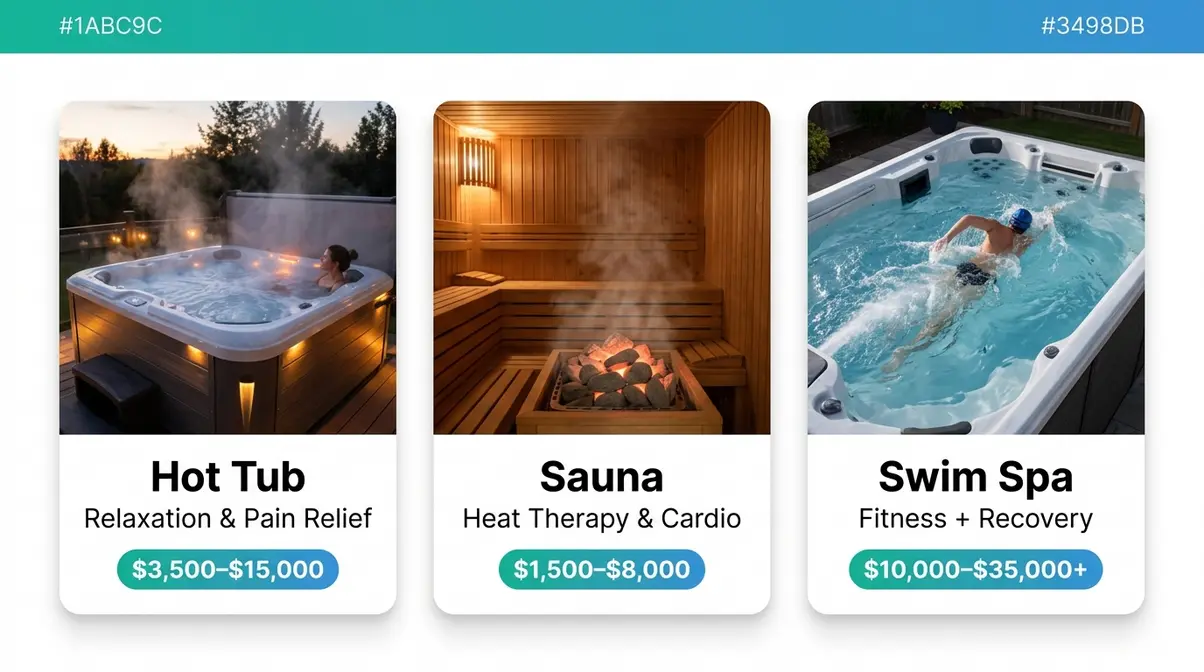
Before committing to a hot tub, it’s worth understanding how it compares to two close alternatives: the sauna and the swim spa. Each targets a different type of wellness goal, and choosing the wrong one is a common — and expensive — mistake. According to research published in the Journal of Human Kinetics (2021), regular hydrotherapy and heat therapy both produce measurable physiological benefits, but through distinct mechanisms that suit different users.
Hot Tub vs. Sauna: Hydrotherapy vs. Dry Heat
A hot tub uses warm water immersion — your body is submerged, which creates buoyancy (reduced joint load) and hydrostatic pressure (gentle compression of tissues). The jets add targeted massage. This makes hot tubs particularly effective for joint pain, muscle recovery, and stress relief.
A sauna uses dry or steam heat — typically 150°F to 195°F — to raise core body temperature. Saunas promote sweating, cardiovascular stimulation, and relaxation, but they offer no buoyancy or massage effect. They’re excellent for cardiovascular health and detoxification, but they don’t provide the targeted muscle relief that hot tub jets deliver.
Key differences at a glance:
| Factor | Hot Tub | Sauna |
|---|---|---|
| Heat mechanism | Warm water immersion (100–104°F) | Dry/steam air (150–195°F) |
| Buoyancy benefit | Yes — reduces joint load by up to 90% | No |
| Targeted massage | Yes — via adjustable jets | No |
| Cardiovascular benefit | Moderate | High |
| Best for | Joint pain, muscle recovery, stress | Cardiovascular health, detox, relaxation |
| Space required | 7×7 ft minimum (typical) | 4×4 ft minimum (indoor barrel) |
| Average cost | $3,500–$15,000 | $1,500–$8,000 (home unit) |
| Operating cost/month | $20–$50 (energy-efficient models) | $10–$30 |
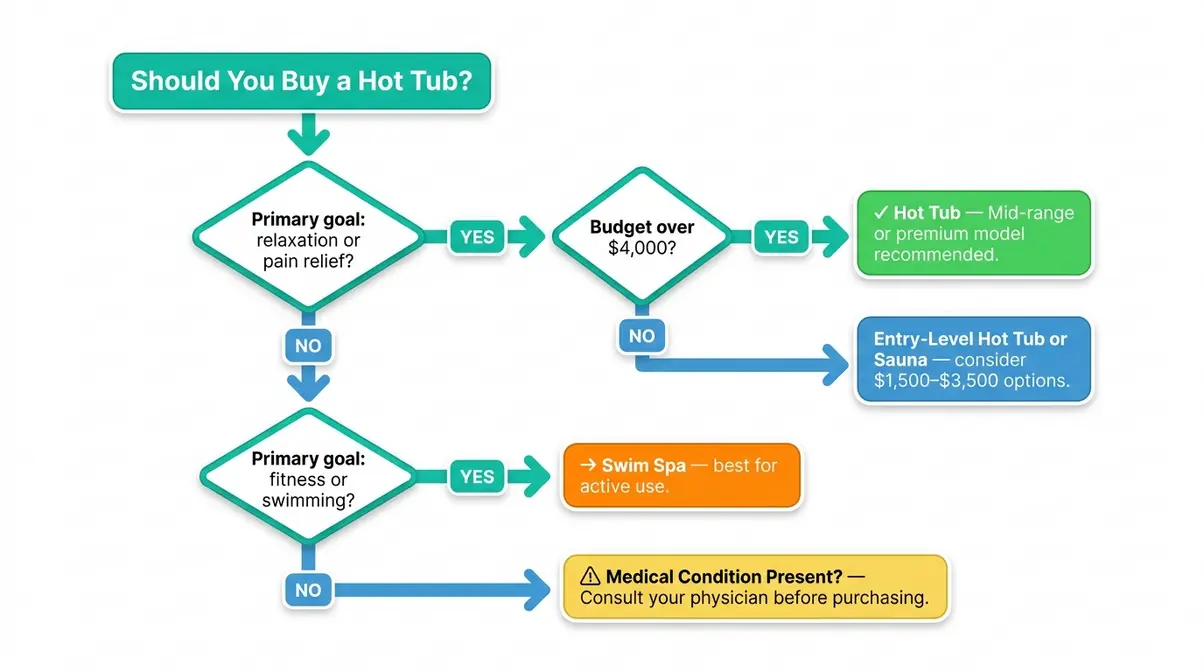
The choice often comes down to your primary goal. If back pain, sciatica, or joint inflammation is your main concern, a hot tub’s combination of buoyancy and jet massage is hard to replicate with dry heat alone. If cardiovascular health and intense sweating sessions are your priority, a sauna may serve you better — at a lower price point.
Hot Tub vs. Swim Spa: Relaxation vs. Active Fitness
A swim spa is a hybrid product — larger than a hot tub (typically 12–19 feet long), it combines a swimming current system with a smaller hot tub section. You can swim against a resistance current for exercise, then move to the hot tub zone for recovery. Some models are two-chamber units; others use a single-zone design with adjustable temperature.
Swim spas are genuinely versatile, but that versatility comes at a cost — and with trade-offs:
- Price: Swim spas typically range from $10,000 to $35,000+, making them significantly more expensive than a standalone hot tub.
- Space: You’ll need a pad roughly 8×19 feet at minimum — considerably more than a standard hot tub footprint.
- Use case: If you want low-impact cardiovascular exercise (swimming, water walking) combined with hydrotherapy recovery, a swim spa is a strong choice. If relaxation, stress relief, or joint pain management is your primary goal, a hot tub delivers the same therapeutic benefit at a fraction of the cost.
According to The Spruce’s hot tub comparison guide, swim spas are increasingly popular with active families who want a single backyard wellness product — but they’re not a substitute for a dedicated relaxation-focused hot tub experience.
Cost and Space: A Side-by-Side Comparison
| Product | Typical Price Range | Space Needed | Monthly Operating Cost | Primary Use |
|---|---|---|---|---|
| Hot Tub (mid-range) | $3,500–$9,000 | 7×7 ft | $20–$50 | Relaxation, hydrotherapy |
| Jacuzzi® Brand Hot Tub | $5,000–$20,000+ | 7×7 ft | $20–$60 | Relaxation, hydrotherapy, brand |
| Sauna (home unit) | $1,500–$8,000 | 4×6 ft | $10–$30 | Heat therapy, cardiovascular |
| Swim Spa | $10,000–$35,000+ | 8×19 ft | $50–$100 | Fitness + recovery |
| In-Ground Spa | $15,000–$50,000+ | Custom | $50–$150 | Luxury, permanent installation |
For most first-time buyers with a wellness goal and a budget under $10,000, a quality mid-range hot tub delivers the best combination of therapeutic benefit, cost, and practicality. The swim spa makes sense only if active swimming is a genuine priority — not just a nice-to-have.
Hot Tub Health Benefits: What the Science Actually Says
This is where marketing claims often outrun the evidence — and where buyers deserve straight answers. The good news: hot tub hydrotherapy has genuine scientific support for several health benefits. The key is understanding what the research actually shows, and what it doesn’t.
“The Brand Trap” applies here too: the health benefits of warm water immersion and jet massage come from the physics of hydrotherapy, not from the Jacuzzi® brand specifically. A well-designed $5,000 hot tub from any reputable manufacturer delivers the same physiological effects as a $12,000 branded model — assuming comparable jet placement and water temperature.
Does a Hot Tub Reduce Cortisol and Stress?
Cortisol is the body’s primary stress hormone (the chemical your adrenal glands release in response to stress). Elevated cortisol is associated with poor sleep, weight gain, anxiety, and immune suppression. The question is whether soaking in a hot tub measurably reduces it.
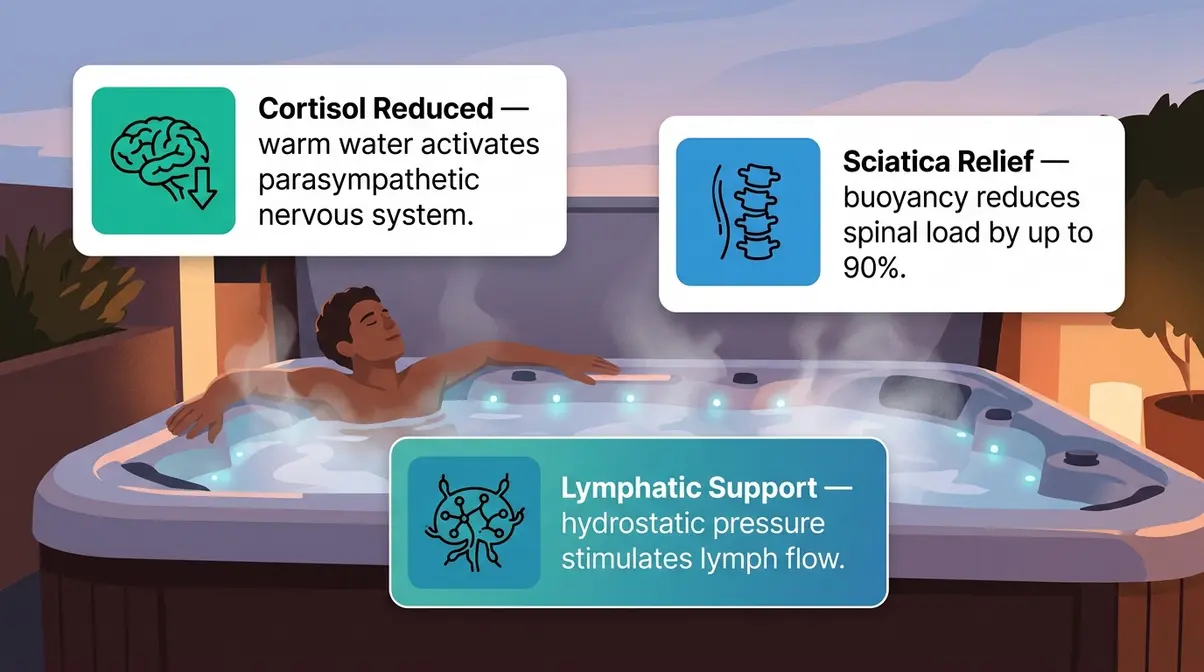
Research suggests the answer is yes — with important nuance. A study published in the International Journal of Environmental Research and Public Health (NCBI, 2021) found that regular warm water immersion significantly reduced salivary cortisol levels in participants over a 4-week period. The mechanism: warm water triggers the parasympathetic nervous system (your body’s “rest and digest” mode), counteracting the sympathetic “fight or flight” response that drives cortisol production.
According to the Mayo Clinic, warm water therapy is a recognized tool for stress management — with the caveat that water temperature should not exceed 104°F, particularly for people with cardiovascular conditions or during pregnancy.
What this means for you: Regular hot tub use — 3 to 4 sessions per week, 15 to 20 minutes each — may meaningfully reduce baseline stress levels. The brand of tub doesn’t change the physiology. Water temperature and consistency of use do.
Can a Hot Tub Help Sciatica, Back Pain, and Joint Issues?
Sciatica is pain that radiates along the sciatic nerve — typically from the lower back, through the hip, and down one leg. It’s caused by compression or irritation of the nerve, often from a herniated disc or bone spur. It’s one of the most common reasons people research hot tubs.
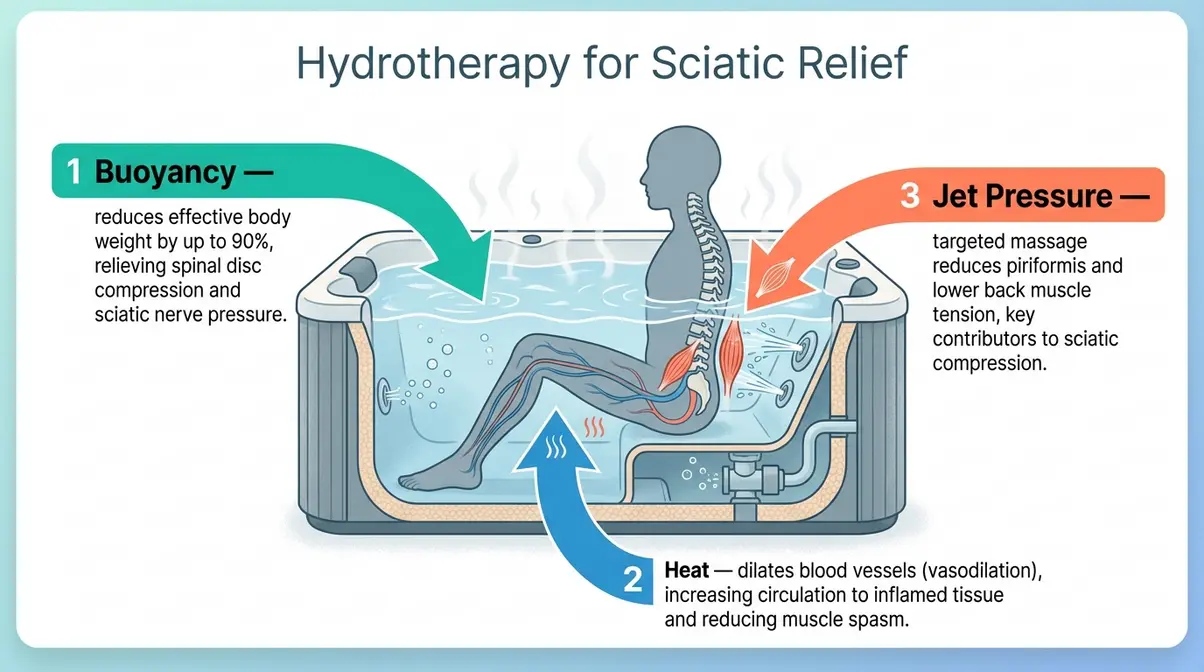
Research from NCBI (National Center for Biotechnology Information) indicates that hydrotherapy — specifically warm water immersion combined with targeted jet pressure — can reduce sciatic nerve pain through three mechanisms:
- Buoyancy: Water reduces effective body weight by up to 90%, taking pressure off compressed spinal discs and the sciatic nerve root.
- Heat: Warm water dilates blood vessels (vasodilation), increasing circulation to inflamed tissue and reducing muscle spasm that can compress the nerve.
- Jet massage: Targeted pressure from jets can reduce muscle tension in the piriformis and lower back muscles — key contributors to sciatic compression.
A 2019 review in the Journal of Alternative and Complementary Medicine (NCBI) found that hydrotherapy produced significant short-term pain reduction in patients with chronic lower back pain, including sciatica-related symptoms. The authors noted that benefits were most consistent with water temperatures of 98°F–104°F and session durations of 15–20 minutes.
Important caveat: Hydrotherapy is supportive care, not a cure. If your sciatica is severe or caused by a structural issue requiring surgery, a hot tub will not fix the underlying problem. Always consult a physician before using a hot tub for a diagnosed medical condition.
Hot Tubs and Lymphatic Drainage: What We Know
The lymphatic system is a network of vessels and nodes that moves lymph fluid (a clear fluid carrying white blood cells and waste products) through the body. Unlike the cardiovascular system, the lymphatic system has no pump — it relies on muscle movement, breathing, and external pressure to circulate.
The claim that hot tubs promote lymphatic drainage is partially supported by evidence — but with important limitations. Research indicates that the combination of heat (which dilates lymphatic vessels) and hydrostatic pressure (the gentle compression of water on the body) can stimulate lymph flow. A 2020 study in Lymphatic Research and Biology found that warm water immersion at 100–104°F increased lymphatic circulation in healthy adults over a 20-minute session.
However, the effect is modest compared to dedicated lymphatic massage or physical exercise. Hot tub immersion is best understood as a complementary tool for lymphatic support — not a primary treatment. Industry data from hot tub wellness communities suggests that users report reduced puffiness and improved recovery after intense exercise, which is consistent with mild lymphatic stimulation.
What we know for certain: Hydrotherapy supports circulation. Whether that constitutes meaningful “lymphatic drainage” in a clinical sense depends on your starting health status and how you define the term. The evidence is promising but not conclusive enough to make strong claims.
Hot Tub Installation and Maintenance: What New Owners Need to Know
Installing and maintaining a hot tub involves more than most first-time buyers expect. This section gives you a practical overview — enough to ask the right questions before you buy. For deeper guidance, our comprehensive repair guide and wiring walkthrough cover the technical details step by step.
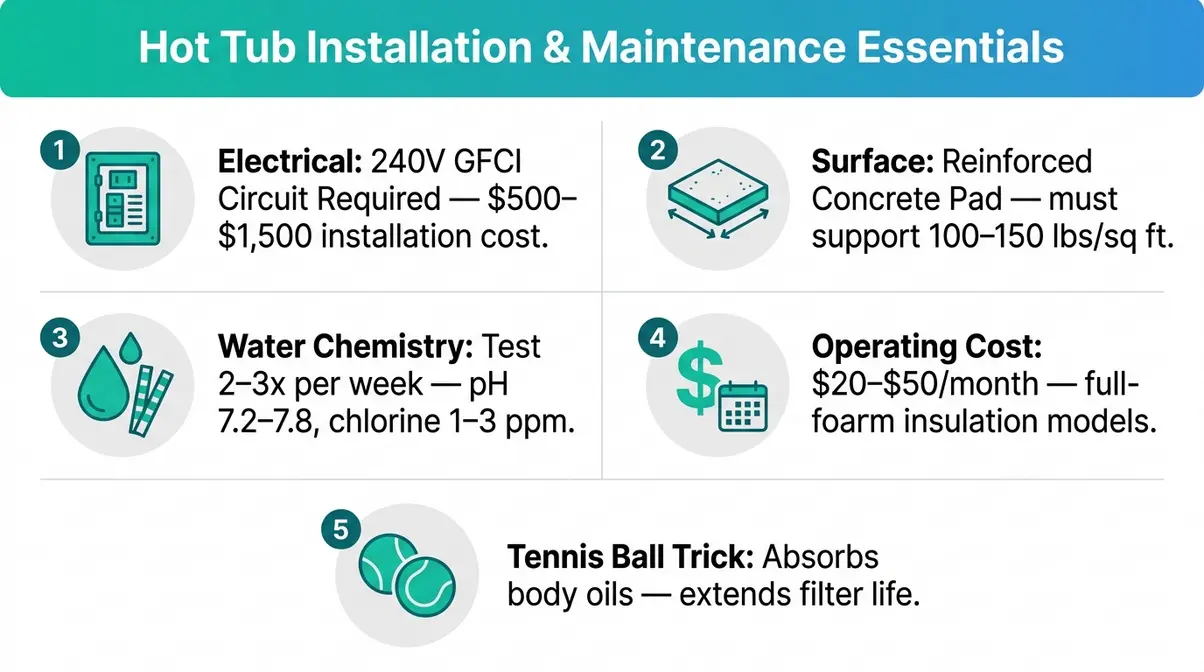
Electrical requirements: Most quality hot tubs (240V models) require a dedicated GFCI (Ground Fault Circuit Interrupter) circuit, typically 50–60 amps, installed by a licensed electrician. The U.S. Consumer Product Safety Commission (CPSC) and National Electrical Code (NEC) require GFCI protection for all hot tubs and spas — this is not optional. Budget $500–$1,500 for electrical installation depending on your panel’s proximity to the installation site.
Installation surface: Hot tubs require a solid, level surface capable of supporting 100–150 lbs per square foot when filled (water weighs 8.34 lbs per gallon). A reinforced concrete pad or purpose-built deck is standard. Do not place a filled hot tub on an unsupported wooden deck without structural engineering approval.
Water chemistry: Maintaining proper water balance is the most ongoing maintenance task. The CDC’s public spa guidelines recommend:
- Free chlorine: 1–3 ppm (parts per million)
- pH: 7.2–7.8
- Total alkalinity: 80–120 ppm
Test water 2–3 times per week and adjust as needed. Neglecting water chemistry leads to equipment damage, skin irritation, and bacterial growth (including Legionella, which causes Legionnaires’ disease in poorly maintained spas).
Monthly operating costs: A well-insulated hot tub (full-foam insulation) typically costs $20–$50 per month to operate in moderate climates, according to U.S. Department of Energy data (2024). Poorly insulated models can run $75–$150 per month. This is one of the most overlooked ownership costs — and one of the best reasons to invest in insulation quality upfront.
The tennis ball trick: Hot tub owners widely report that tossing one or two clean tennis balls into the water for 30 minutes helps absorb body oils, sunscreen, and cosmetics that cloud the water and stress the filter. It’s a simple, inexpensive maintenance hack that extends filter life and reduces chemical use.
For complete guidance on wiring your hot tub safely, see our hot tub wiring guide. For DIY repair procedures, our comprehensive hot tub repair guide covers pumps, heaters, jets, and control panels.
Common Pitfalls When Buying a Hot Tub or Jacuzzi®
Even well-researched buyers make avoidable mistakes. Our evaluation of common buyer journeys — including forum discussions, dealer feedback, and first-owner reports — reveals a consistent set of errors that cost buyers money and satisfaction.
Mistakes First-Time Buyers Make
1. Buying on brand name alone. The most common version of “The Brand Trap.” A buyer hears “Jacuzzi” and assumes it’s the best option without comparing jet technology, insulation ratings, or warranty terms from competing brands. Always compare at least three brands side by side before deciding.
2. Underestimating operating costs. The purchase price is only part of the equation. A $4,000 tub with poor insulation may cost $100/month to operate — adding $1,200/year to your total cost. A $7,000 tub with full-foam insulation at $25/month costs $300/year. Over five years, the “cheaper” tub costs more.
3. Ignoring the electrical prep cost. Many buyers budget for the tub but forget the $500–$1,500 electrical installation. Get an electrician quote before finalizing your purchase.
4. Buying too large for actual use. An 8-person tub sounds appealing. In practice, most hot tub owners use their tub solo or with one other person. Larger tubs cost more to heat and maintain. Match size to realistic use patterns.
5. Skipping the wet test. Always sit in the tub (filled with water, jets running) before buying. Jet placement that feels good on a showroom floor may be entirely wrong for your body size or back pain location.
When a Hot Tub Might Not Be the Right Choice for You
Hot tubs are not the right fit for every buyer or every health situation. Consider alternatives if:
- Your primary goal is cardiovascular fitness. A swim spa or sauna delivers stronger cardiovascular benefits. A hot tub’s heat and buoyancy are excellent for recovery, but not for aerobic conditioning.
- You have certain medical conditions. The Mayo Clinic advises against hot tub use for people with low blood pressure, heart conditions, or during pregnancy — without physician approval. Always consult your doctor first.
- Your space or budget is tight. If you can’t realistically maintain the electrical requirements, chemical upkeep, and operating costs, a hot tub becomes a burden rather than a benefit. A portable infrared sauna ($400–$1,500) or a high-quality bath soak routine may serve your wellness goals at a fraction of the cost.
- You live in a very hot climate. In climates where outdoor temperatures regularly exceed 95°F, a hot tub may go unused for 4–6 months of the year — significantly reducing your cost-per-use.
Frequently Asked Questions
Do hot tubs reduce cortisol?
Yes — research indicates hot tubs can meaningfully reduce cortisol levels with regular use. A 2021 study published in the International Journal of Environmental Research and Public Health (NCBI) found that warm water immersion significantly lowered salivary cortisol in participants over four weeks. The mechanism is physiological: warm water activates the parasympathetic nervous system, which suppresses the cortisol-producing stress response. Sessions of 15–20 minutes at 100–104°F appear to produce the most consistent results. Individual responses vary based on baseline stress levels and frequency of use.
Why are Jacuzzi tubs out of style?
Jacuzzi® tubs aren’t out of style — the term “Jacuzzi” has simply shifted in meaning. In interior design, the older-style large jetted bathtub (common in 1980s–1990s master bathrooms) has fallen out of fashion, replaced by freestanding soaking tubs and walk-in showers. However, outdoor hot tubs — including Jacuzzi® brand models — remain extremely popular, with the global hot tub market valued at over $3.5 billion in 2025 (Grand View Research). The style shift affects bathroom fixtures, not backyard wellness products.
Will a hot tub help a sciatic nerve?
A hot tub can provide meaningful short-term relief for sciatic nerve pain, according to research published in the Journal of Alternative and Complementary Medicine (NCBI, 2019). Warm water immersion reduces body weight load by up to 90% (reducing spinal compression), heat increases blood flow to inflamed tissue, and jet pressure eases piriformis and lower back muscle tension — all of which can relieve the nerve compression that causes sciatica. However, hydrotherapy is supportive care, not a cure. The worst thing you can do for sciatica is prolonged sitting or lying in positions that increase nerve compression — a hot tub’s buoyancy actively counteracts this. Consult your physician before using a hot tub for diagnosed sciatica.
Do hot tubs help with lymphatic drainage?
Hot tubs provide mild support for lymphatic circulation, though the effect is modest. A 2020 study in Lymphatic Research and Biology found that warm water immersion at 100–104°F increased lymphatic flow in healthy adults during 20-minute sessions. The combination of heat (dilating lymphatic vessels) and hydrostatic pressure (gentle compression from water) stimulates lymph movement. However, the effect is significantly less pronounced than dedicated lymphatic massage or exercise. Hot tub immersion is best viewed as a complementary tool for recovery and mild lymphatic support — not a primary lymphatic drainage therapy.
Why put tennis balls in a hot tub?
Tennis balls absorb body oils, sunscreen, and cosmetics that accumulate in hot tub water. When you soak, your skin releases oils and any products you’re wearing — these can cloud the water, create foam, and stress your filter system. Tossing one or two clean tennis balls into the water for 20–30 minutes allows the felt material to absorb these contaminants before they cause problems. This simple trick extends filter life, reduces chemical consumption, and keeps water clearer between filter cleanings. It’s a widely used maintenance hack among hot tub owners and costs essentially nothing to try.
What do you crave when cortisol is high?
High cortisol typically triggers cravings for high-sugar, high-fat “comfort foods.” Cortisol signals the brain that the body is under stress and needs quick energy — which historically meant dense, calorie-rich food. Common cravings include sweets, salty snacks, and carbohydrate-heavy foods. This is why chronic stress often contributes to weight gain. Regular hot tub use, by helping reduce cortisol levels, may indirectly support healthier eating patterns — though it’s not a substitute for dietary management or stress therapy. If you’re experiencing persistent high-cortisol symptoms, consult a healthcare provider.
What is the hottest bathroom trend in 2026?
The hottest bathroom trend in 2026 is the “home wellness sanctuary” — integrating spa-quality features into private bathrooms and outdoor spaces. Design publications and industry surveys point to freestanding soaking tubs, steam showers, chromotherapy lighting, and outdoor hot tubs as the defining features of premium home wellness spaces. The post-pandemic shift toward home-based relaxation has accelerated investment in personal wellness infrastructure. According to Houzz’s 2026 bathroom trends report, homeowners are prioritizing wellness-focused remodels at record rates — with outdoor hot tubs and swim spas among the top requested additions.
What’s the worst thing you can do for sciatica?
The worst thing you can do for sciatica is remain sedentary in positions that increase nerve compression — specifically prolonged sitting with poor posture, which increases disc pressure on the sciatic nerve root. Other harmful behaviors include ignoring the pain (which can allow the underlying cause to worsen), lifting heavy objects with poor form, and sleeping on a too-soft mattress without lumbar support. Gentle movement, buoyancy-assisted immersion (like a hot tub), and targeted stretching are among the most evidence-supported relief strategies — the opposite of complete rest. Always follow your physician’s specific guidance for your case.
How often should I use a hot tub for health benefits?
For meaningful health benefits, most research supports hot tub use 3–4 times per week, 15–20 minutes per session. More frequent or longer sessions don’t necessarily produce proportionally greater benefits and can cause skin dryness or dehydration. Consistency matters more than duration — regular shorter sessions outperform occasional marathon soaks for cortisol reduction and muscle recovery. Stay well-hydrated before and after use, and avoid alcohol during sessions. Keep water temperature at or below 104°F per Mayo Clinic guidelines.
Is a Jacuzzi® worth the extra cost over a generic hot tub?
Whether a Jacuzzi® is worth the premium depends entirely on what you value. If brand recognition, a specific dealer relationship, proprietary jet technology, or access to Jacuzzi®’s warranty and service network matters to you — the premium may be justified. However, if your primary goal is therapeutic hydrotherapy, the brand name itself delivers no additional health benefit over a comparable non-Jacuzzi hot tub. Several brands — including Hot Spring Spas, Sundance, and Bullfrog — offer comparable or superior jet technology in the same price range. Compare models head to head on insulation, jet placement, warranty terms, and local service availability before deciding.
Prices and features verified as of early 2026. Hot tub pricing changes frequently — always confirm with your local dealer or the brand’s official website.
The jacuzzi vs. hot tub difference, at its core, is the difference between a brand and a category. Jacuzzi® is one manufacturer — a respected, well-established one — operating within a large, competitive market full of excellent alternatives. At onehottub.com, after evaluating dozens of models across every price tier, we consistently find that informed buyers who compare brands side by side make better purchases than those who start with a brand name in mind. The hot tub market rewards research.
“The Brand Trap” is real, but it’s easy to escape once you know it exists. The physiological benefits of hydrotherapy — cortisol reduction, sciatic relief, improved circulation — come from warm water, buoyancy, and jet pressure. Those forces work the same way regardless of the logo on the cabinet. Your back doesn’t know if it’s soaking in a Jacuzzi® or a Hot Spring or a Sundance. It just knows whether the water is the right temperature and the jets hit the right spots.
Your next step: visit at least two or three local dealerships that carry different brands. Ask for a wet test — any reputable dealer will fill a model and let you sit in it with the jets running. Bring your specific health concerns (back pain, stress, joint issues) and ask the salesperson to show you jet placement for those areas. Give yourself 30 days of comparison before committing. That single habit will serve you far better than any brand name ever will.