

Table of Contents - Hot Tub Water Maintenance Schedule: Complete 2026 Guide
- Before You Start: What Every Hot Tub Owner Needs
- Hot Tub Maintenance Schedule at a Glance
- Daily and Every-Other-Day Tasks: Daily Defence
- Weekly Hot Tub Maintenance Checklist: Weekly Reset
- Monthly Deep Clean Checklist: Monthly Refresh
- Quarterly Drain and Refill: The Full Reset
- How to Test and Balance Hot Tub Water Chemistry
- Essential Hot Tub Chemicals and Equipment
- Troubleshooting Common Water Problems
- Hot Tub Health and Safety: What You Need to Know
- Salt Water vs. Chlorine: How Maintenance Differs
- Common Mistakes and When to Get Professional Help
- Frequently Asked Questions
- Why put tennis balls in a hot tub?
- Do hot tubs reduce cortisol?
- Why should you not put your head under water in a hot tub?
- Why should you bring two tennis balls and a sock on your next road trip?
- How often should I change my hot tub filter?
- Can I use pool chemicals in my hot tub?
- Will a hot tub maintenance schedule lower my energy bills?
- What is the difference between chlorine and non-chlorine shock?
- Limitations and When to Seek Professional Help
- Conclusion
This blog post may contain affiliate links. As an Amazon Associate I earn from qualifying purchases.
If you’ve ever stood over your hot tub with a test strip, squinting at the colour chart and wondering whether that purple is “ideal” or “call a professional,” you’re not alone. The anxiety is real — and completely understandable.
“Hi, how often should I be changing the water? Had Miami lazy spa a week, testing chemicals daily, used at night for about an hour, daughter had few friends in at weekend. I was going with 8–12 weeks but friends have commented would need to be a lot more.”
That quote captures what most new owners feel: they’re doing the work, but they’re not sure they’re doing it right. A hot tub water maintenance schedule shouldn’t feel like a chemistry exam. It should feel like a checklist you glue to the pump room door and follow without second-guessing.
This guide introduces The 4-Stage Water Guardian Method — a named, time-based framework built around four clear intervals: Daily Defence, Weekly Reset, Monthly Refresh, and Quarterly Renewal. Every task in your spa water care schedule maps to one of these stages, so you always know what to do and when to do it.

- AFFORDABLE 150 STRIPS: This water chemical testing kit contains 150 test strips. Enough balanced for your swimming pool, hot tub, spa and other water testing. At least testing twice a week is recommended to keep your pool sparkling clean and safe.
- ACCURATE AND FAST TESTING: Just soak in water for 1 seconds; Then take it out,no need to shake excess water off and hold the test strip horizontally for 15 seconds; Compare with the color chart on the bottle to obtain clear and accurate water quality results.
- 7 IN 1 POOL TEST KIT: Test all necessary parameters for your swimming pool at 1 time, such as Bromine, Total Alkalinity, pH, Free Chlorine, Total Hardness, Cyanuric Acid, and Total Chlorine. Check water quality at any time you want.
- HIGH ACCURACY POOL TESTING STRIPS: High-quality fiber paper and no-bleeding pads selected after repeated trials by R&D personnel. No need to shake off excess water and follow the instructions easily, you will to get the accurate results.
- TIPS FOR ACCURATE RESULTS: Keep wet fingers away from the strips. Read under natural daylight for best results.Store in a cool dry place.The expiration is 3 years from manufacture. Once opened, use up in 90 days.
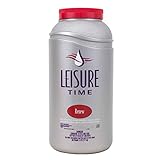
- BENEFITS: Non-chlorine shock oxidizer clears cloudy water and eliminates odors and contaminants
- USE: Buffered to prevent pH fluctuations; use weekly for spa water maintenance
- COMPATIBILITY: Works with chlorine, bromine, ozone and mineral purification systems
- FEATURES: Can use spa 15 minutes after use; Destroys microorganisms, soaps, deodorants and oils
- INCLUDES: Economical bulk-sized 5-pound container of Leisure Time Renew Shock Treatment

- pH Decreaser: SpaGuard Rapid-Dissolve pH Decreaser Tabs will quickly lower the pH level of water in spas. The pH level should be maintained at 7.2-7.6 as measured by an accurate test strip or kit.
- Safe & Easy To Use: This dry tablet is easier to use than liquid acids. Using this product regularly will help make maintaining proper water balance a breeze.
- Easy Application: Simply drop a tab in the filter well, then watch it disperse chemicals without any added effort achieving maximum bather comfort.
- Protect Spa Equipment & Surfaces: Rapid-Dissolve pH Decreaser Tabs help maintain the proper pH balance, preventing fluctuations that can lead to equipment corrosion and discomfort for bathers.
- Tested and Proven Effective: SpaGuard products are known for delivering reliable results and making spa care less complex. SpaGuard carries an extensive line of spa solutions that match your unique needs.
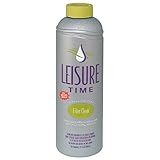
- BENEFITS: Improves the efficiency and life of the filter
- USE: Soak solution overnight for maximum effect; use when draining and refilling spa or hot tub
- COMPATIBILITY: Chlorine, bromine, ozone and mineral purification systems
- FEATURES: Soak-and-rinse formula for cartridge, D.E. and sand filters; item is not for sale in Catalina Island
- INCLUDES: 32 fl oz of spa cleaning chemicals

- 7-IN-1 TEST STRIPS: Tests the most critical parameters: pH, Total Chlorine, Free Chlorine, Bromine, Alkalinity, Total Hardness, & Cyanuric Acid
- AQUACHEK ACCURACY: Using medical industry technology, our test strips offer comparable accuracy to liquid tests; No measuring & counting drops of reagent, leaving less room for error
- FREE MOBILE APP: It uses photo capture technology to interpret results & provides a tailored chemical treatment plan for your pool; No more guesswork with AquaChek Connect app
- EASY TO USE: No more messy drops; Dip the test strip, remove it, wait 15 seconds, & compare with the color chart on the comparator; Test water at least twice a week for safe & balanced water
- SAFE & CLEAN WATER: Each color pad is designed with unique paper to optimize color vibrancy & mitigate color-bleeding to help maintain healthy water chemistry

- Fast-acting & Quick-Dissolving: SpaGuard's Chlorinating Concentrate provides spa owners with the sanitizing power of chlorine in a quick-dissolving granular form, making application quick and easy.
- One-Step Sanitizer & Oxidizer: SpaGuard Chlorinating Concentrate is a simple to use granular chlorine for sanitization and super-chlorination or shock. Chlorinating Concentrate can be used in regular doses as a sanitize and a shock.
- Simplify Spa Care: SpaGuard's Chlorinating Concentrate provides spa owners with the sanitizing power of chlorine in a quick-dissolving granular form, making application quick and easy.
- Easy to Use: Simply add to spa water while the pump is running, and they dissolve completely to start disinfecting your spa. Chlorinating Concentrate is also pH neutral to ensure no affect on your chemically-balanced spa water.
- Tested and Proven Effective: SpaGuard products are known for delivering reliable results and making spa care less complex. SpaGuard carries an extensive line of spa solutions that match your unique needs.
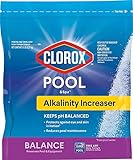
- For Raising Total Alkalinity: The Alkalinity Increaser helps maintain balanced pH levels in your pool water. Proper alkalinity levels reduce the need for frequent maintenance, and our product's granulated formula is easy to apply and dissolves quickly.
- Improves Swimmer Comfort: This product plays a crucial role in enhancing swimmer comfort by preventing eye and skin irritation caused by unbalanced pH. It helps prevent dry, itchy skin and red, burning eyes, ensuring a more pleasant swimming experience.
- Protects Pool Equipment from Corrosion: By keeping your pool's pH level balanced, this product helps prevent equipment corrosion, allowing you to spend less time maintaining and more time enjoying your swimming pool.
- Perfect for All Pools: Clorox Pool&Spa Swimming Pool Chlorine Stabilizer is perfect for new pools, freshly refilled pools and pools that use liquid chlorine.
- Clorox Pool App: Test like an expert anytime, anywhere with the Clorox Pool App. Solve common swimming pool problems and get personalized product and dosage recommendations.
A consistent hot tub water maintenance schedule prevents bacteria, protects your investment, and keeps every soak safe. The 4-Stage Water Guardian Method organises every task into four time intervals you can follow without guesswork.
- Daily Defence: Check temperature, cover, and waterline — takes under 2 minutes.
- Weekly Reset: Test chemistry, shock the water, and rinse your filter every 7 days.
- Monthly Refresh: Deep-clean the shell, soak the filter, and inspect jets.
- Quarterly Renewal: Drain, purge biofilm, refill, and rebalance completely.
Before You Start: What Every Hot Tub Owner Needs
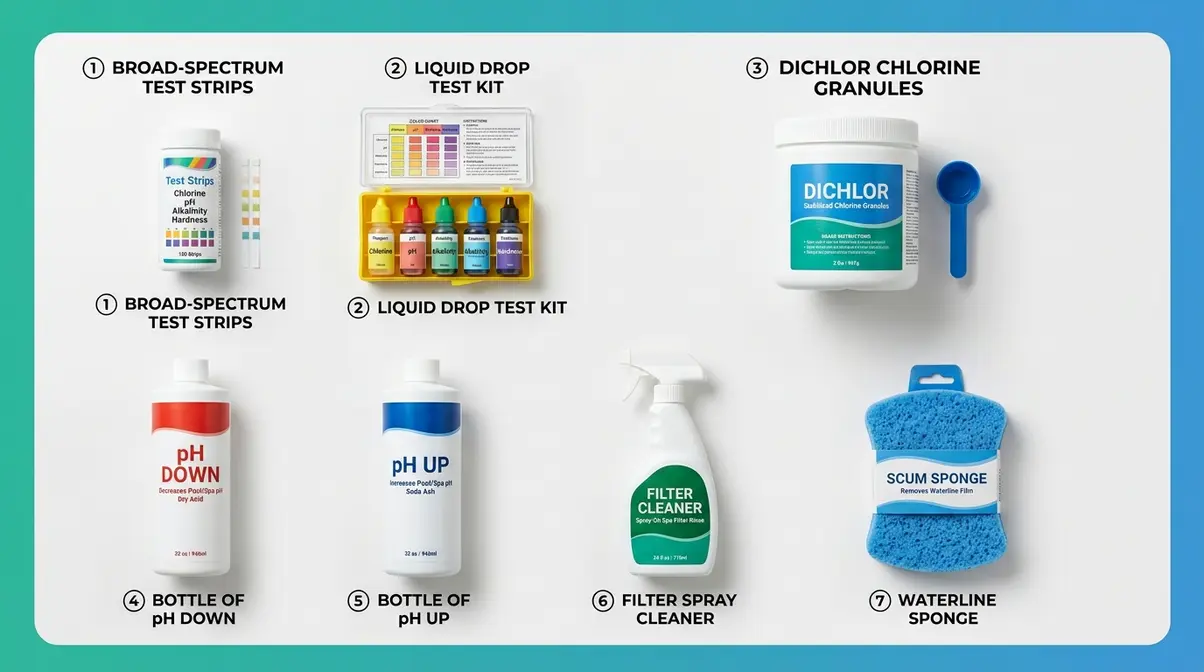
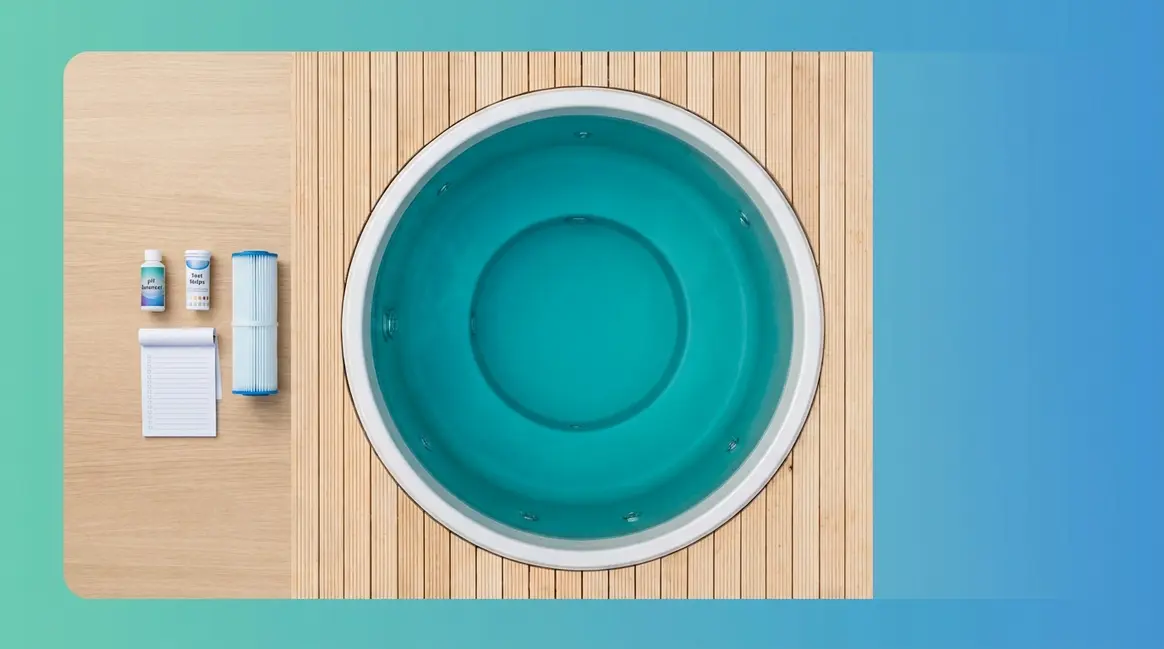
Before diving into the schedule itself, take 10 minutes to make sure you have the right supplies. Our evaluation of common owner errors found that most early maintenance failures come not from ignorance but from missing one or two key tools — specifically a reliable test kit and a proper filter cleaner.
Estimated completion time: 30 minutes for initial setup and supply review.
Here’s what you need on hand before Stage 1 of the 4-Stage Water Guardian Method begins:
- Testing equipment:
- Broad-spectrum test strips (pH, total alkalinity, free chlorine, bromine, hardness) — replace after 6 months
- A liquid drop test kit for periodic accuracy checks (strips drift over time)
- Sanitiser and shock:
- Chlorine granules (dichlor) or bromine tablets — your choice of primary sanitiser
- Non-chlorine oxidising shock (MPS) for weekly use; chlorine shock for monthly deep resets
- Balancing chemicals:
- pH Down (sodium bisulphate)
- pH Up (sodium carbonate)
- Total Alkalinity (TA) Increaser (sodium bicarbonate)
- Calcium Hardness Increaser (if your tap water tests below 150 ppm)
- Cleaning tools:
- Dedicated spa surface cleaner (never household bleach)
- Filter spray cleaner and filter soak solution
- A waterline sponge or non-abrasive cloth
- Optional but highly recommended:
- A floating tennis ball or two (more on this in the Weekly section)
- A pre-filter hose attachment for filling — dramatically reduces initial balancing time
Check out our complete guide on the hot tub chemicals you need to ensure your kit is fully stocked.
Hot Tub Maintenance Schedule at a Glance
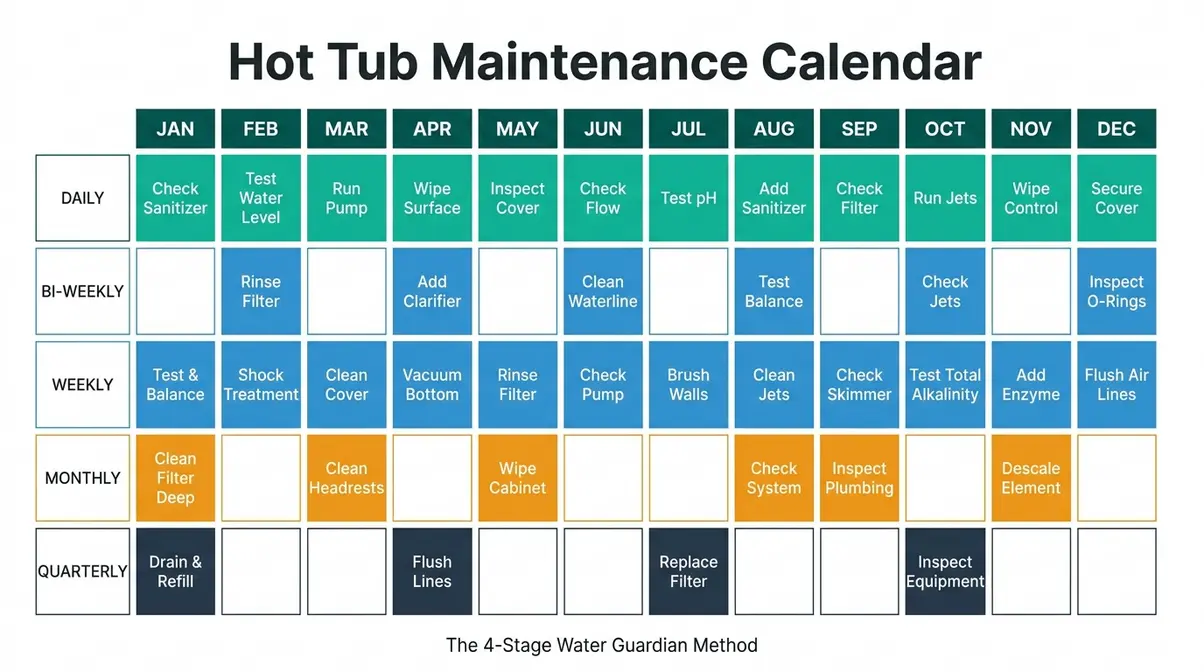
This table is your cheat sheet. Print it, laminate it, and stick it on your pump room door. Every task in the complete hot tub water maintenance schedule appears here, mapped to its interval.
| Interval | Task | Time Required | Priority |
|---|---|---|---|
| Daily | Check temperature and cover condition | 1 min | High |
| Daily | Visual waterline inspection | 1 min | High |
| 2–3× per week | Test free chlorine/bromine, pH, TA | 3–5 min | Critical |
| 2–3× per week | Adjust chemistry if outside target range | 5–10 min | Critical |
| Weekly | Shock the water (oxidise) | 5 min | High |
| Weekly | Rinse filter cartridge with hose | 5 min | High |
| Weekly | Tennis ball treatment for body oils | Passive (overnight) | Medium |
| Monthly | Deep-clean waterline and shell | 15–20 min | High |
| Monthly | Soak filter in chemical solution (overnight) | 5 min active | High |
| Monthly | Inspect jets, seals, and equipment | 10 min | Medium |
| Quarterly | Full drain, purge, and refill | 2–4 hours | Critical |
| Quarterly | Complete rebalance after refill | 30–60 min | Critical |
| Every 12–18 months | Professional equipment service | Varies | Medium |
Daily and Every-Other-Day Tasks: Daily Defence
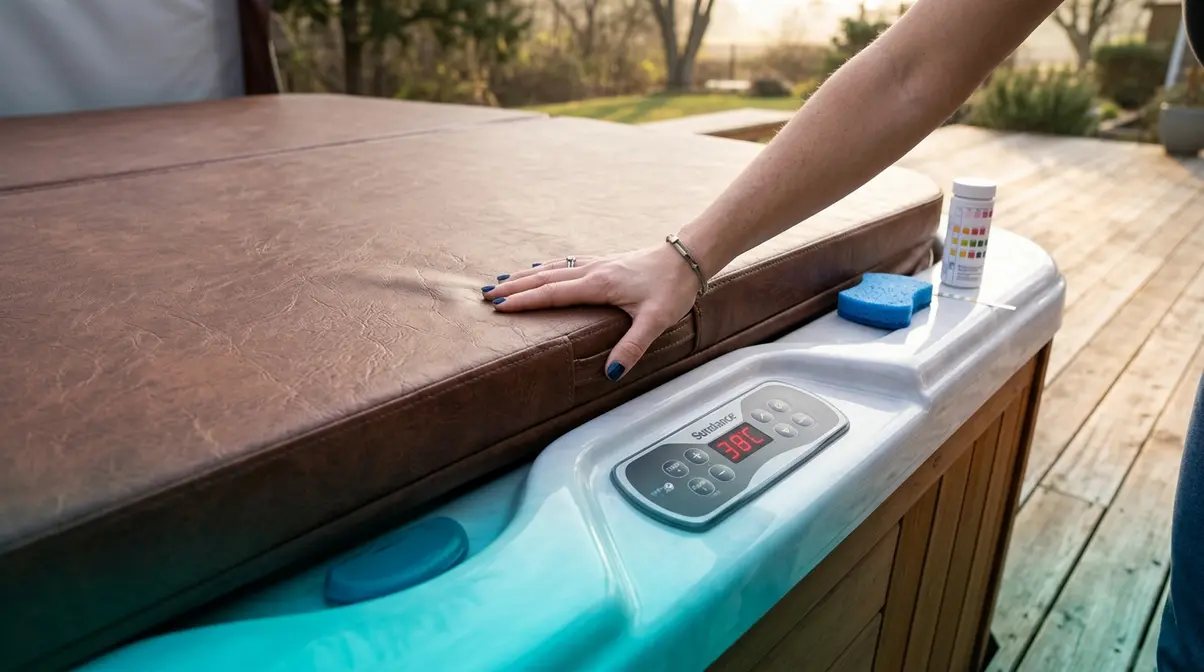
Daily Defence is Stage 1 of the 4-Stage Water Guardian Method, and it takes less than 5 minutes. Think of it as a quick health check — you’re not fixing anything, you’re catching problems before they compound.
Check the Temperature and Cover
Your hot tub should hold between 37°C and 40°C (98°F–104°F) for comfortable, safe use. The CDC advises that water above 40°C (104°F) can cause heat-related illness, particularly for pregnant women, the elderly, and young children (CDC, 2026). A glance at the digital display takes 10 seconds and tells you immediately if the heater is working correctly.
While you’re there, inspect the cover. A waterlogged, cracked, or ill-fitting cover loses heat aggressively — owners commonly report 20–30% higher energy bills when a cover seal degrades. Press down on the cover panels: they should feel firm, not spongy. If one side feels heavier than the other, it’s likely absorbing water and needs replacing.
- What to look for:
- Temperature reading within 1–2°C of your set point
- Cover latches both secured
- No visible cracks, tears, or compression damage on foam inserts
Visual Waterline Inspection
Scum lines — that greasy, discoloured ring at the waterline — are one of the most common complaints from new owners, and they’re a direct sign of body oil and lotion accumulation. A quick daily wipe with a damp sponge prevents a 10-second job from becoming a 20-minute scrub session.
Run your eyes along the waterline. A faint grey or brown ring forming within 24–48 hours of a soak means your sanitiser is being consumed faster than expected — often because bathers aren’t showering beforehand. Biofilm (a thin, slippery bacterial film that can coat pipe interiors and shell surfaces) starts forming in as little as 48 hours in warm, nutrient-rich water. Catching it visually at the waterline is your earliest warning.
- Quick checklist:
- Wipe waterline with sponge if any residue is visible
- Note whether the ring reappears faster than usual (signals heavy bather load or low sanitiser)
- Check water clarity — it should be clear enough to see the floor of the spa
Bi-Weekly Chemical Checks
Testing 2–3 times per week sounds like a lot until you understand what’s happening in that water. A hot tub holds roughly 1,000–1,500 litres and operates at 37–40°C — conditions that accelerate chemical consumption significantly compared to a swimming pool. The CDC recommends maintaining free chlorine at 3–10 ppm in spa water (CDC, 2026), but after a single heavy-use session, levels can drop by 50% or more.
Test these values every time you open the cover after a soak:
| Parameter | Target Range | Action if Out of Range |
|---|---|---|
| Free Chlorine | 3–5 ppm | Add dichlor; wait 20 min before retesting |
| Bromine | 3–5 ppm | Add bromine; wait 20 min |
| pH | 7.2–7.6 | Below: add pH Up; Above: add pH Down |
| Total Alkalinity | 80–120 ppm | Low: add TA Increaser; High: add pH Down in small doses |
| Calcium Hardness | 150–250 ppm | Low: add Calcium Hardness Increaser |
If you notice foam at the waterline, it’s a sign that your sanitiser is struggling to keep up with organic loads.
Weekly Hot Tub Maintenance Checklist: Weekly Reset
Stage 2 of the 4-Stage Water Guardian Method — the Weekly Reset — takes about 20–30 minutes and prevents the slow chemical drift that catches most owners off guard. Think of it as your hot tub’s weekly service appointment.
Test and Adjust Chemistry
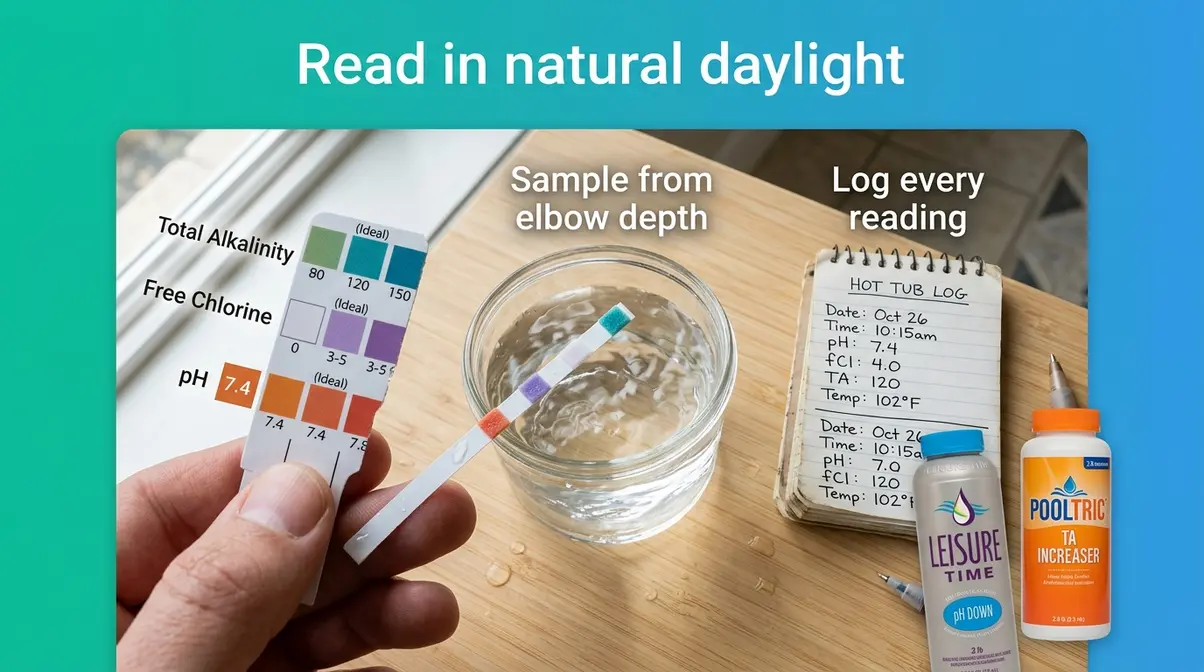
Even if you’ve been testing 2–3 times per week, a dedicated weekly session should be more thorough. This is when you test calcium hardness and total dissolved solids (TDS — the cumulative concentration of everything that’s dissolved in the water, including minerals, chemicals, and bather contaminants) in addition to your routine parameters.
Step-by-step weekly chemistry check:
- Remove the cover and run the jets for 5 minutes to circulate the water evenly
- Collect your water sample from elbow depth (not the surface — surface readings skew high for sanitiser)
- Dip your test strip for exactly the time specified on the packaging (usually 2–3 seconds) — do not wave it around in the water
- Read the strip in natural daylight within 15 seconds; artificial light distorts colour matching
- Record your readings (a simple notebook works; apps like PoolMath are excellent)
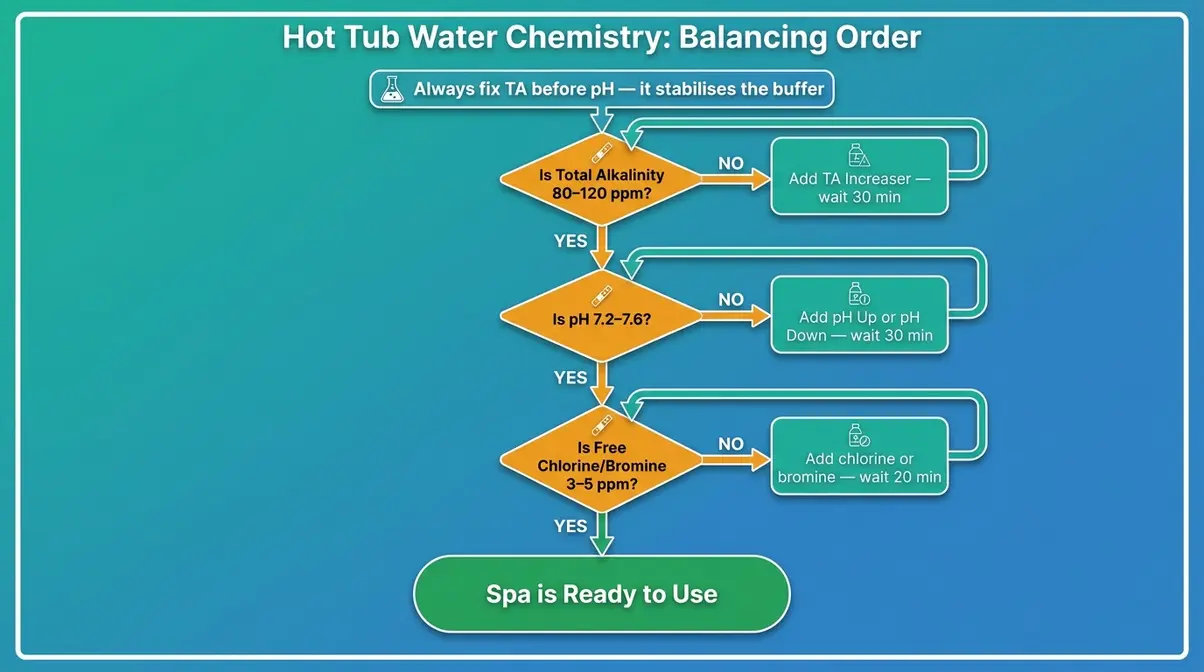
- Address imbalances in this order: Total Alkalinity first → pH second → Sanitiser last
Why the order matters: Total Alkalinity (TA) acts as a buffer for pH. If you adjust pH before TA, you’ll find yourself chasing pH values that keep shifting. Fix the buffer first, and pH stabilises naturally.
Shock the Water
Shocking — adding a large oxidising dose of sanitiser to destroy combined chloramines (chlorine that has already reacted with contaminants and lost its disinfecting power) and organic waste — is the single most important weekly task most owners skip. Chloramines are what cause the “chlorine smell” people often misidentify as too much chlorine; it’s actually too little free chlorine doing the work.
Two types of shock, two different jobs:
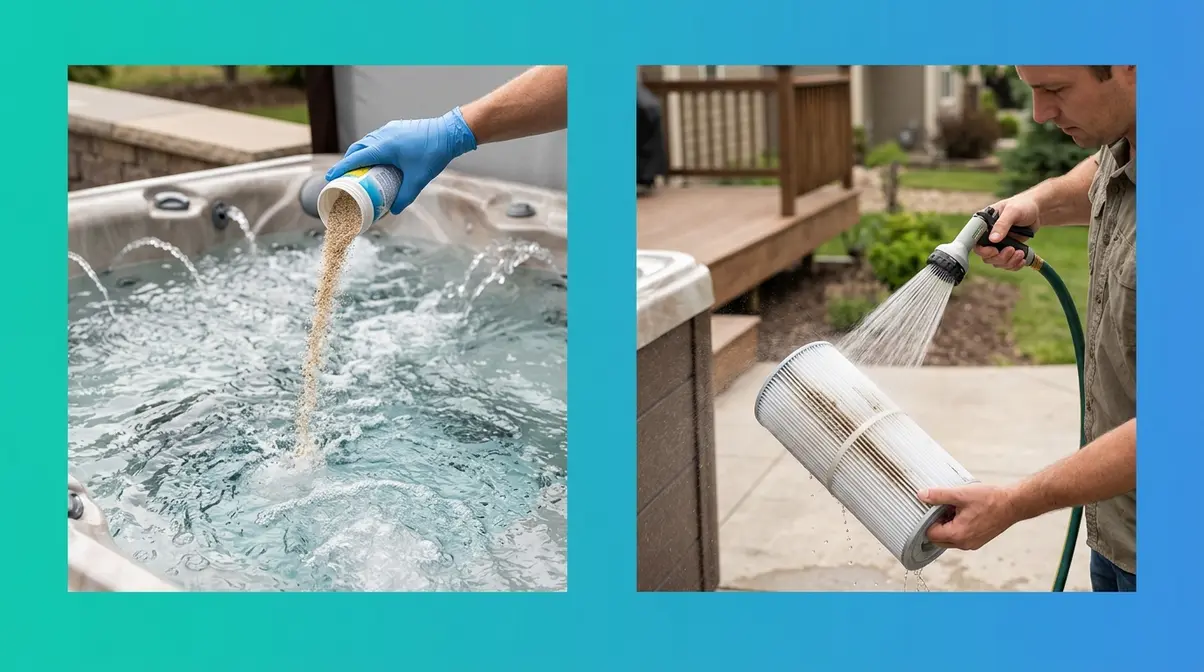
- Non-chlorine shock (MPS/potassium peroxymonosulphate): Use weekly. Oxidises organic waste without raising chlorine. You can re-enter the spa after just 15–20 minutes.
- Chlorine shock (granular dichlor): Use monthly or after heavy use. Raises free chlorine to 10+ ppm to kill bacteria and reset the water. Wait until free chlorine drops below 5 ppm before re-entry — typically 4–8 hours with the cover off.
- Dosing example (non-chlorine shock, 1,000L spa):
- Standard dose: 35–40g per 1,000L
- After heavy bather use (4+ people): 50–60g per 1,000L
- Always add shock to water, never water to shock; add with jets running
If you experience cloudy water after shocking, your filter may need attention.
Rinse or Replace Filter
Your filter is silently doing the hardest work in the spa — trapping body oils, hair, sunscreen, and fine particles. A clogged filter restricts flow, stresses the pump, and creates the warm, nutrient-rich dead zones where bacteria thrive.
- Weekly filter rinse (5 minutes):
- Remove the filter cartridge
- Rinse thoroughly with a garden hose — use a fan-spray nozzle, not a jet (high-pressure jets damage filter fibres)
- Work top to bottom between each pleat, rotating the cartridge as you go
- Visually inspect for tears, deformed ends, or deeply embedded grey-brown deposits (these won’t rinse out — they need a chemical soak)
- Reinstall and restart circulation
If your spa runs continuously (24/7 circulation mode), rinse weekly. If it runs on a timer, rinse every 5–7 days of actual run time. For more details, consult our deep filter cleaning guide.
Tennis Ball Trick for Oils
Here’s a practical hack that professional spa technicians and online spa communities have used for years: drop two standard tennis balls into your hot tub and leave them in overnight (or permanently between uses). The fibrous felt material on tennis balls is highly absorbent — it draws body oils, sunscreen, and cosmetic residues out of the water in a way that your filter simply cannot.
Body oils and lotions are the primary cause of scum lines, foam, and filter clogging. A single hour-long soak for two adults can introduce 50–100ml of oils into the water (community consensus among spa technicians, Swim University forum data). Your filter traps solids, but oils pass through and accumulate in the water column.
- How to use the tennis ball trick:
- Drop 2–3 clean, unused tennis balls directly into the spa water
- Leave them floating between uses (they work passively)
- Squeeze and rinse them under clean water weekly
- Replace them every 4–6 weeks, or when they feel saturated and no longer absorb water when squeezed
Important note: Use standard felt tennis balls only — avoid foam or novelty balls that may leach dyes or plasticisers into the water.
Monthly Deep Clean Checklist: Monthly Refresh
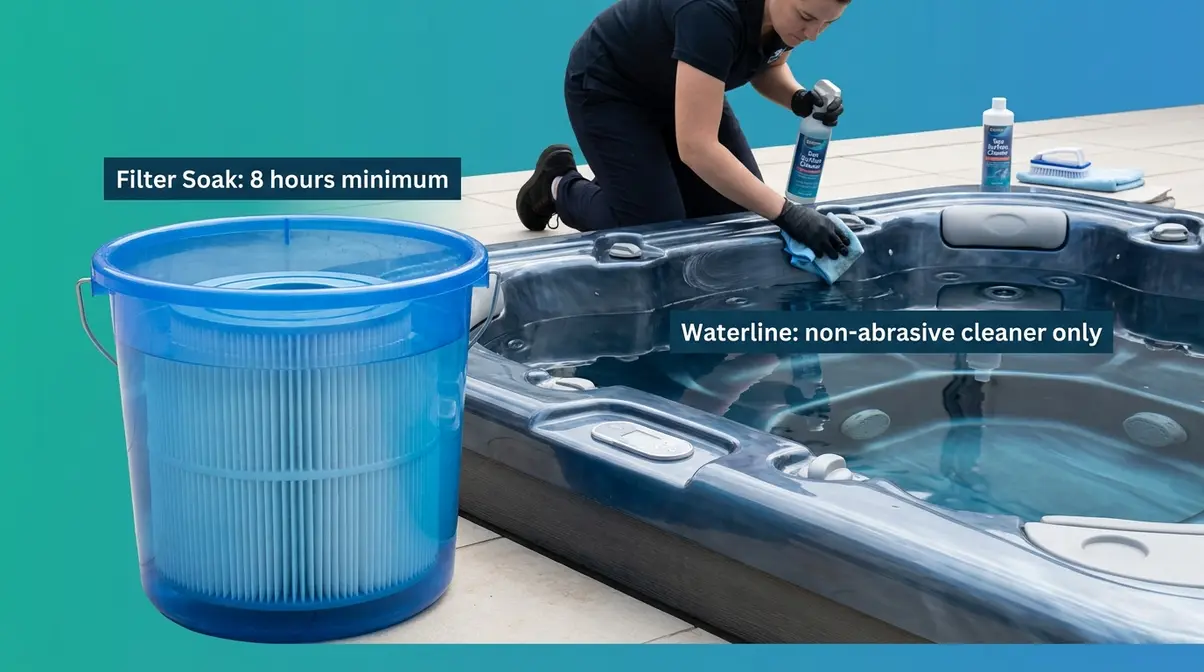
Stage 3 — the Monthly Refresh — is where you address everything that daily and weekly maintenance can’t reach. This is your spa’s deep clean, and it takes 30–45 minutes of active effort plus overnight filter soaking.
Clean the Waterline and Shell
Even with daily wiping, oils and mineral deposits build up over a month. Monthly cleaning with a dedicated spa surface cleaner removes the scum line accumulation that creates a breeding ground for bacteria and makes the spa look neglected.
- Step-by-step shell and waterline clean:
- Reduce the water level slightly (drain 10–15cm) to expose the full waterline
- Apply a non-abrasive spa surface cleaner to a damp cloth or sponge — never use household cleaners like bleach or washing-up liquid, which leave residues that create foam
- Work around the entire waterline in sections, using circular motions
- Rinse the cleaned area with clean water before it dries to avoid residue
- Wipe down the interior shell below the waterline while accessible
- Refill to the correct level and retest chemistry (cleaning agents can affect pH)
For stubborn calcium scaling (white or grey crusty deposits), use a dedicated calcium/scale remover designed for spa surfaces. These are typically citric acid-based and safe for acrylic shells. Be sure to rinse thoroughly to avoid foam from cleaning residue.
Soak and Inspect Filter
The weekly rinse removes loose debris, but oils and fine particles bind to filter fibres over time and require a chemical soak to release. Monthly soaking extends filter life significantly — owners who soak monthly typically replace filters every 12–18 months versus every 6–9 months for those who only rinse.
- Overnight filter soak process:
- Remove the filter and rinse it first with a hose to remove loose debris
- Fill a clean bucket with water — enough to fully submerge the filter
- Add a dedicated filter cleaning solution (follow manufacturer dosing — typically one capful per 4 litres of water)
- Submerge the filter completely, ensuring all pleats are exposed to the solution
- Leave for a minimum of 8 hours (overnight is ideal)
- Remove and rinse very thoroughly — residual filter cleaner in the spa will create foam
- Allow to air-dry before reinstalling if you have a spare cartridge; otherwise reinstall after a thorough rinse
Inspect while soaking: Look for tears in the filter fabric, deformed or cracked end caps, and areas where the pleats have collapsed. A filter showing any of these signs should be replaced, not returned to service.
Check Jets and Equipment
Jets and seals are easy to ignore until they fail. A monthly 10-minute inspection catches early signs of wear before they become expensive repairs.
- What to check:
- Jets: Turn each jet by hand to confirm it rotates freely and adjusts direction. A stiff or seized jet indicates mineral buildup in the jet body — remove and soak in a white vinegar solution overnight.
- Headrests and pillows: Remove and wipe down with a mild spa cleaner. Biofilm accumulates on pillows surprisingly quickly because they sit at the waterline.
- Equipment area (if accessible): Listen for unusual pump sounds — grinding or cavitation (a high-pitched whining) can indicate low water flow or air in the lines. Check for visible moisture or staining around pipe fittings.
- Cover condition: Monthly, not just daily — lift and inspect the underside for mould growth. A small amount of surface mould can be wiped with a diluted spa cleaner; heavy mould penetrating the foam core means the cover needs replacing.
Quarterly Drain and Refill: The Full Reset
Stage 4 of the 4-Stage Water Guardian Method is the most time-intensive, but it’s also the most important for long-term water safety. No amount of chemical balancing can reverse the gradual accumulation of total dissolved solids (TDS), dead sanitiser by-products, and biofilm that builds up over 3–4 months of use.
When to Drain Your Hot Tub
The standard recommendation from manufacturers and spa industry professionals is to drain and refill every 3–4 months for regular use (1–2 adults, several times per week). However, your specific drain schedule depends on bather load and usage frequency.
Use this formula to calculate your drain interval:
Drain interval (days) = Total water volume (litres) ÷ (Number of daily bathers × 12)
For a 1,200L spa used by 2 people daily: 1,200 ÷ (2 × 12) = 50 days — roughly every 7 weeks. For the same spa used by 2 people twice per week: 1,200 ÷ (0.6 × 12) = 167 days — roughly 5–6 months.
- Signs you need to drain sooner than scheduled:
- Water has a persistent odour despite correct chemistry
- Water appears dull or cloudy even after shocking
- TDS readings exceed 1,500 ppm above your source water baseline
- Foam appears immediately after shocking (exhausted sanitiser by-products)
- You can smell chloramines (the sharp “pool smell”) regularly
If you use a salt system, review our salt water vs chlorine drain schedule guide for specific timing adjustments.
How to Drain, Purge, and Clean
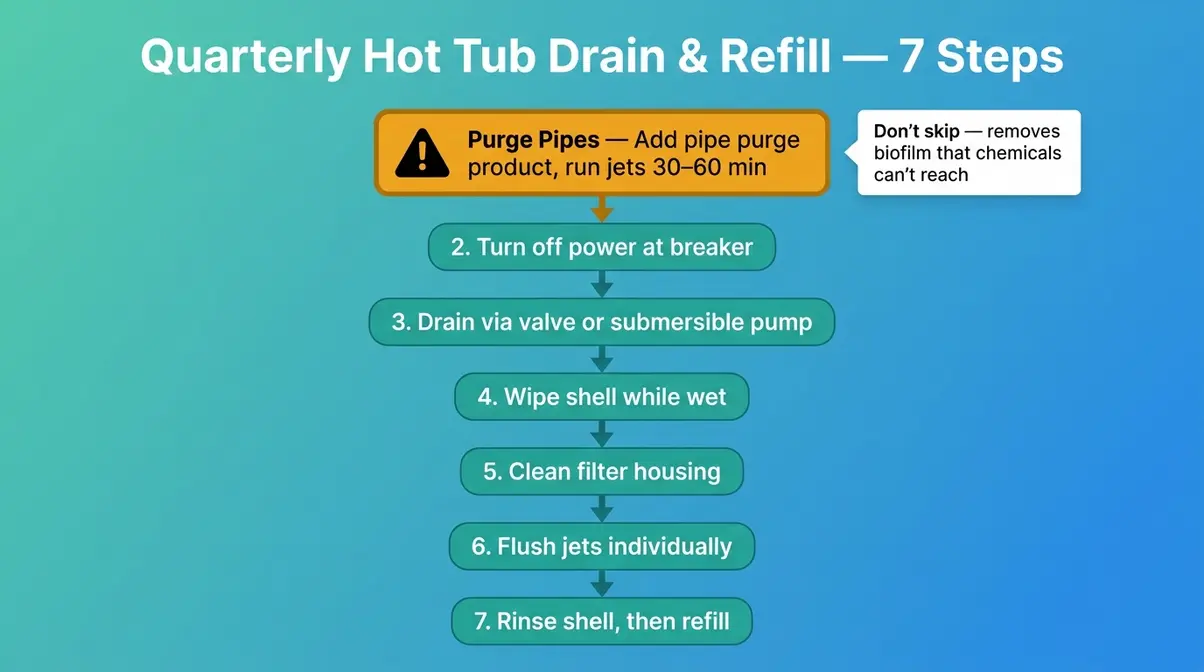
The most important step most owners skip is purging the plumbing before draining. Biofilm — a protective layer of bacteria embedded in a polysaccharide matrix that coats the interior of your spa’s pipes — doesn’t drain away with the water. It requires a dedicated pipe purge product to dislodge it.
Full quarterly drain process:
- Purge the pipes (24–48 hours before draining): Add a dedicated pipe purge product (e.g., Ahh-Some, Spa Flush) to the water with jets running on high.
Run jets for 30–60 minutes. You’ll likely see grey, brown, or foamy debris emerging from the jets — this is the biofilm being dislodged. This step alone is why quarterly drains are essential.
- Turn off power at the breaker before draining — never drain with the heater or pump running.
- Drain via the drain valve or submersible pump. A submersible pump drains a 1,200L spa in 20–30 minutes versus 2–3 hours via gravity.
- Wipe the shell while wet: Use a spa surface cleaner on all interior surfaces before they dry — dried mineral deposits are much harder to remove.
- Clean the filter housing and inspect all visible plumbing connections.
- Flush the jets individually with a hand-held shower or hose to clear any remaining biofilm debris from jet bodies.
- Rinse the entire shell with clean water before refilling.
Refilling and Rebalancing
Refilling is not the end of the process — it’s the start of a rebalancing sequence that takes 24–48 hours to complete properly. Fresh tap water introduces new variables: different mineral content, pH, and hardness levels that need adjusting before the spa is safe to use.
Refill and rebalance sequence:
- Attach a pre-filter to your hose before filling — this removes heavy metals and reduces initial balancing time
- Fill to the recommended level (above jets, below headrests)
- Balance Total Alkalinity first — target 80–120 ppm. Add TA Increaser in 50g increments per 1,000L; wait 30 minutes between doses
- Balance pH second — target 7.4–7.6. Add pH Up or pH Down as needed; wait 30 minutes between adjustments
- Add Calcium Hardness Increaser if below 150 ppm — “soft” water corrodes acrylic and metal fittings
- Add your sanitiser (chlorine or bromine) to establish an initial dose — typically 30–40g dichlor per 1,000L
- Run jets on high for 30 minutes to circulate and off-gas any volatile chemicals
- Retest all parameters after 2 hours before declaring the spa ready for use
How to Test and Balance Hot Tub Water Chemistry
Proper chemistry is the foundation of your entire spa water care schedule. Every other task — shocking, filtering, draining — only works if your water parameters are within range. Getting this right consistently is what separates anxious owners from confident ones.
Key Chemical Levels
Think of your hot tub’s chemistry as three concentric circles of protection. Total Alkalinity (TA) is the outermost circle — it stabilises everything inside it. pH sits in the middle ring, controlling how effectively your sanitiser works. Free sanitiser (chlorine or bromine) is the innermost circle — the actual disinfectant doing the biological work.
The key parameters explained:
- Total Alkalinity (TA): The water’s resistance to pH change. Target: 80–120 ppm. Low TA causes wild pH swings (“pH bounce”); high TA makes pH difficult to lower.
- pH: The acidity/alkalinity of the water on a scale of 0–14. Target: 7.2–7.6. Below 7.2, the water becomes corrosive to equipment and skin. Above 7.8, chlorine efficiency drops by up to 80% (Water Quality Association, 2026).
- Free Chlorine / Bromine: The active sanitiser. Target: 3–5 ppm for both. The CDC recommends a minimum of 3 ppm free chlorine in spa water to effectively reduce bacterial contamination risk (CDC, 2026).
- Calcium Hardness: Dissolved calcium in the water. Target: 150–250 ppm. Low calcium “hungry water” leaches calcium from your shell and equipment.
Using Test Strips Correctly
Test strips are fast and convenient, but they’re notoriously easy to use incorrectly. Across professional spa communities, the consistent advice is that improper strip technique is responsible for more maintenance problems than actual chemistry errors.
Common strip mistakes and how to avoid them:
| Mistake | Correct Technique |
|---|---|
| Dipping for too long | Dip for exactly 2–3 seconds — no more |
| Reading in artificial light | Always read in natural daylight |
| Comparing immediately | Wait the full reaction time (15–20 seconds) |
| Using old strips | Check expiry date; replace after 6 months |
| Taking surface samples | Sample from elbow depth, away from jets |
| Wet fingers on the strip pad | Hold the strip by the white end only |
For monthly accuracy verification, use a liquid drop test kit alongside your strips. Drop kits are more accurate for pH and total alkalinity — they’re worth the 5 extra minutes once a month.
Order for Adding Chemicals
Adding chemicals in the wrong order is one of the most common and costly mistakes in hot tub maintenance. Certain combinations can create dangerous reactions; others simply cancel each other out, wasting money and leaving your water unbalanced.
The correct chemical addition sequence:
- Total Alkalinity Increaser — if TA is low, this is always first
- pH adjustment (Up or Down) — after TA is stable
- Calcium Hardness Increaser — if needed
- Sanitiser (chlorine or bromine) — always last in the balancing sequence
- Shock — add separately; never mix with other chemicals
- Critical safety rules:
- Always add chemicals to water, never water to chemicals
- Add each chemical separately with at least 20–30 minutes of circulation between doses
- Never mix chemicals together in the same container or in the spa simultaneously
- Run jets on high when adding any chemical to aid distribution and off-gassing (the natural release of volatile compounds — chlorine gas, for example — that occurs as chemicals react with water)
Chemical Dosing Examples
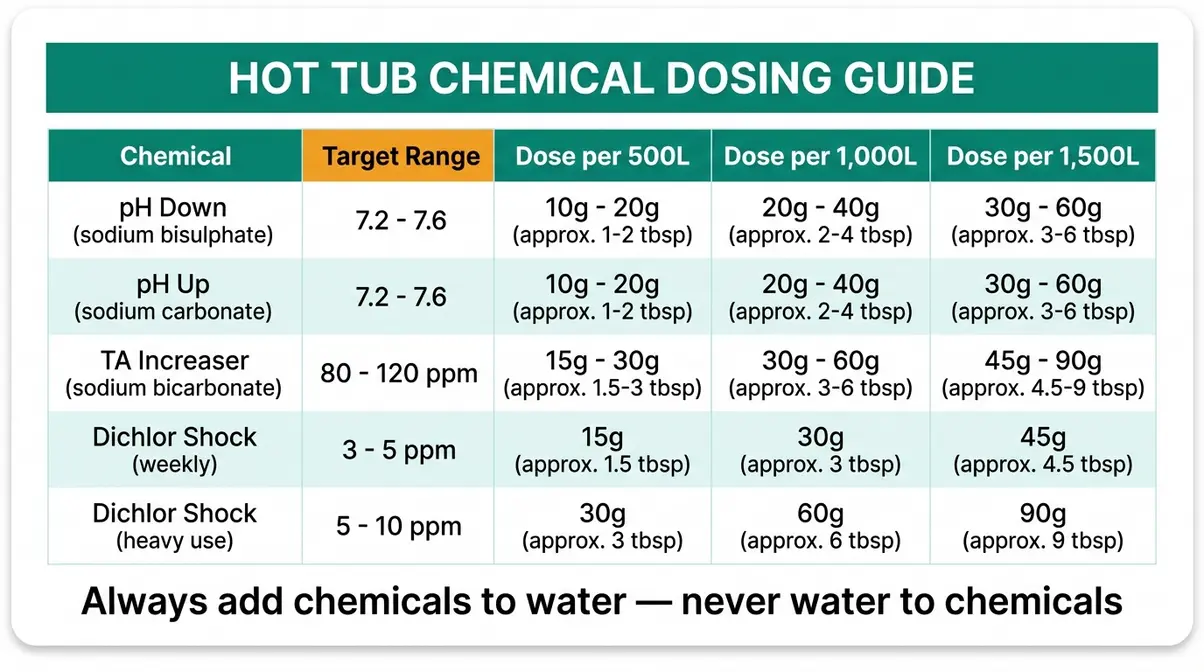
This is where most guides fail you — they tell you what to add but not how much. These dosing examples are based on manufacturer guidelines and are intended as starting points; always retest after each addition.
pH Down (Sodium Bisulphate) — to lower pH by 0.2 units:
| Spa Volume | Dose to Lower pH by 0.2 |
|---|---|
| 500L | 12–15g |
| 1,000L | 25–30g |
| 1,500L | 37–45g |
| 2,000L | 50–60g |
pH Up (Sodium Carbonate) — to raise pH by 0.2 units:
| Spa Volume | Dose to Raise pH by 0.2 |
|---|---|
| 500L | 10–12g |
| 1,000L | 20–25g |
| 1,500L | 30–37g |
| 2,000L | 40–50g |
Total Alkalinity Increaser (Sodium Bicarbonate) — to raise TA by 10 ppm:
| Spa Volume | Dose to Raise TA by 10 ppm |
|---|---|
| 500L | 13–15g |
| 1,000L | 26–30g |
| 1,500L | 39–45g |
Dichlor Chlorine Shock — weekly maintenance dose:
| Spa Volume | Weekly Maintenance | After Heavy Use |
|---|---|---|
| 500L | 15–20g | 25–35g |
| 1,000L | 30–40g | 50–60g |
| 1,500L | 45–60g | 75–90g |
Always retest 30–60 minutes after adding any chemical. These doses are starting points — your source water chemistry, bather load, and ambient temperature all affect how much you’ll actually need. For more details, consult our complete spa chemical guide.
Essential Hot Tub Chemicals and Equipment
A complete hot tub maintenance routine requires the right chemical kit, but you don’t need to buy every product on the shelf. For a thorough breakdown of exactly which chemicals every spa owner needs — including which are genuinely essential versus optional upgrades — see our full hot tub chemical list and our dedicated spa filter maintenance guide.
At the core, every spa owner needs: a sanitiser (chlorine or bromine), a shock oxidiser, pH adjustment chemicals (Up and Down), a Total Alkalinity Increaser, and a filter cleaner.
Beyond the core chemicals, understanding your specific water care system is crucial. Standard chlorine or bromine systems require manual dosing, but many modern spas incorporate alternative sanitizers. Mineral systems, like the FrogEase system, use silver and copper ions to destroy bacteria, allowing you to maintain a much lower free chlorine residual (typically 1–2 ppm instead of 3–5 ppm). Ozonators and UV-C systems provide secondary oxidation, breaking down organic contaminants before they consume your primary sanitizer. While these systems reduce chemical demand, they do not eliminate the need for a baseline sanitizer or weekly shocking.
Additionally, consider investing in a high-quality submersible pump for quarterly drains, a dedicated spa vacuum for grit, and a pre-filter hose attachment. A pre-filter removes heavy metals and excess calcium from your source water before it even enters the tub, drastically reducing the time and chemicals needed for initial balancing.
Troubleshooting Common Water Problems
Foamy water, persistent cloudiness, and chemical odours are the three most common complaints from spa owners following a maintenance routine. In almost every case, the root cause is one of four issues: low sanitiser, high TDS, inadequate shocking, or filter overload.
Understanding why these issues occur helps prevent them. For instance, cloudy water is frequently caused by high Total Dissolved Solids (TDS). As you add chemicals week after week, the TDS level rises. Once TDS exceeds 1,500 ppm above your tap water baseline, the water can no longer dissolve new chemicals effectively, leading to microscopic particles suspending in the water column. Phosphates are another hidden culprit. Introduced via source water, skin care products, and even some spa chemicals, phosphates act as a food source for algae and bacteria, rapidly depleting your sanitizer. If your chlorine levels drop to zero within 24 hours of dosing, high phosphates or an underlying biofilm infection are likely to blame.
Water Without Chemicals
How long can water sit in a hot tub without chemicals? Untreated hot tub water becomes unsafe within 24–72 hours. At 37–40°C, bacteria double approximately every 20 minutes in the absence of sanitiser (CDC, 2026). Biofilm begins forming on pipe surfaces within 48 hours. In practice, if you’ve been away for a few days and your spa has been running without chemical attention, test immediately upon return and shock before use. Water that has sat untreated for more than a week should be drained rather than chemically rescued.
For detailed step-by-step fixes, see our guide to fix foamy hot tub water or learn how to clear up cloudy spa water.
Quick diagnostic table:
| Symptom | Most Likely Cause | First Action |
|---|---|---|
| Foamy water | Body oils, soap residue, or low calcium | Shock, then tennis ball treatment |
| Cloudy water | Low sanitiser or high TDS | Shock, test TA and pH, check filter |
| Persistent odour | Chloramines (combined chlorine) | Heavy chlorine shock; consider drain |
| Green tint | Algae or copper in water | Shock + algaecide; check metal levels |
| Scum lines | Body oil/lotion accumulation | Wipe daily; increase shocking frequency |
| Itchy skin | pH too low or high sanitiser | Test and adjust pH to 7.4–7.6 |
Hot Tub Health and Safety: What You Need to Know
Warm water at 37–40°C creates an ideal environment for relaxation — and, without proper maintenance, for bacterial growth. This section covers the health questions most maintenance guides completely ignore.
⚠️ Health Disclaimer: The information in this section is for educational purposes only and is not a substitute for professional medical advice, diagnosis, or treatment. If you develop a skin rash, infection, or any health concern after hot tub use, consult a qualified healthcare provider promptly.
Hot Tub Folliculitis Risks
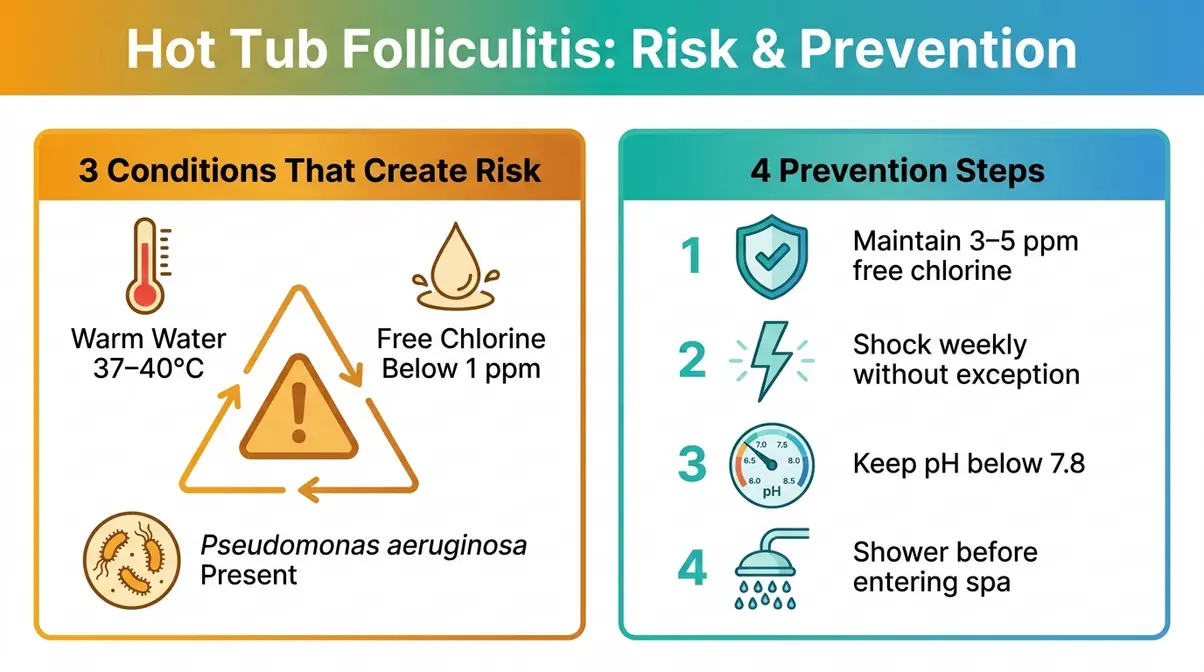
Hot tub folliculitis is a skin infection caused by Pseudomonas aeruginosa — a bacteria that thrives in warm, inadequately sanitised water. It typically presents as a red, itchy, bumpy rash around hair follicles on the torso and limbs, appearing 12–48 hours after exposure (CDC, 2026).
Is a hot tub bad for folliculitis? A poorly maintained hot tub can cause folliculitis, but a properly maintained one poses minimal risk. Maintaining free chlorine at 3–5 ppm consistently, shocking weekly, and keeping pH between 7.2–7.6 prevents the bacterial concentrations that cause infection. If you already have folliculitis, avoid hot tub use until the infection has fully cleared.
Why do only some people get hot tub folliculitis? Individual susceptibility depends on skin condition, immune function, and exposure duration. People with minor skin abrasions, recently shaved skin, or compromised immune systems are significantly more vulnerable to Pseudomonas aeruginosa infection. Tight-fitting synthetic swimwear increases risk by trapping contaminated water against the skin.
What kills folliculitis naturally? Most cases of hot tub folliculitis resolve on their own within 7–10 days. Keeping the affected area clean and dry, avoiding further hot tub use until the rash clears, and wearing loose, breathable clothing can support natural resolution. However, “natural” approaches are not a substitute for medical assessment.
- Prevention through your maintenance schedule:
- Maintain free chlorine at 3–5 ppm consistently — this is your primary defence
- Shock weekly without exception
- Never allow pH to exceed 7.8, as alkaline conditions reduce chlorine effectiveness by up to 80%
- Shower before entering the spa to reduce the organic load that depletes sanitiser
- Drain and refill on schedule — P. aeruginosa can colonise biofilm in pipes even when surface water appears chemically balanced
Head Submersion Risks
Submerging your head in hot tub water carries a risk that goes beyond ear infections. The CDC specifically warns against submerging your head in warm, potentially contaminated water due to the risk of Naegleria fowleri — a rare but nearly always fatal brain-eating amoeba found in warm freshwater environments (CDC, 2026). While the risk in well-maintained spas is extremely low, the CDC’s guidance is clear: avoid getting water up your nose in any warm water setting.
Beyond the amoeba risk, submersion exposes the eyes, ears, and nasal passages to concentrated bacteria and chemical compounds at much higher exposure levels than skin contact. Ear infections (otitis externa, or “swimmer’s ear”) are a common outcome of regular submersion in spa water. Children are at higher risk due to developing immune systems.
- Practical guidance:
- Keep your head and face above the waterline during normal spa use
- If you use the spa with young children, ensure they understand not to submerge
- If you or a family member experiences ear pain, headache, or nasal symptoms after spa use, seek medical advice promptly
Safe Chemical Handling
The chemicals used in spa maintenance are effective precisely because they’re reactive — which also makes them hazardous if handled carelessly. Off-gassing (the release of gases like chlorine vapour when chemicals react with water or air) is a real risk in enclosed pump rooms or poorly ventilated spaces.
- Safe handling rules:
- Always store chemicals in their original containers in a cool, dry, ventilated space away from direct sunlight
- Never mix different chemicals together — even “compatible” chemicals can react dangerously when concentrated
- Wear gloves and eye protection when measuring and adding chemicals
- Add chemicals to water, not water to chemicals — this prevents violent splashing reactions
- Wash hands thoroughly after handling any spa chemical
- Keep chemicals out of reach of children and pets
- Allow the spa to off-gas with the cover off for at least 15–20 minutes after adding chemicals before using or covering
The EPA recommends storing oxidising chemicals (like shock) separately from other spa chemicals, as they can accelerate fires if stored near flammable materials (EPA, 2026). For more details, consult our safe chemical storage guide.
Cortisol & Health Benefits
Hot tub use has genuine, evidence-supported health benefits beyond relaxation. Cortisol — the body’s primary stress hormone, produced by the adrenal glands in response to physical and psychological stressors — is measurably reduced by warm water immersion. Research published in the International Journal of Environmental Research and Public Health found that regular hydrotherapy sessions significantly reduced self-reported stress and cortisol markers in study participants (Janssen et al., 2026).
The Cleveland Clinic notes that warm water immersion can help reduce muscle tension, improve circulation, and support sleep quality — all of which contribute to lower baseline cortisol levels over time (Cleveland Clinic, 2026). The key word is “regular” — occasional use provides temporary relief, but consistent spa use (3–4 times per week) appears to produce more sustained stress reduction effects.
- Other documented benefits of regular hot tub use:
- Improved sleep onset — warm water raises core body temperature; the subsequent cooling effect signals the brain to produce melatonin
- Reduced muscle soreness after exercise — heat increases blood flow and reduces lactic acid accumulation
- Joint pain relief — buoyancy reduces load on joints by up to 90% in water
These benefits only accrue when the water is properly maintained. A poorly maintained spa is a stress source, not a stress reliever. Learn more about the health benefits of salt water spas.
Salt Water vs. Chlorine: How Maintenance Differs
If you’re considering a salt water system or already own one, the core maintenance schedule from this guide still applies — but with meaningful differences in how you manage sanitiser levels.
Salt water systems use a salt chlorine generator (electrolysis cell) to convert dissolved salt into chlorine continuously. This means you’re still using chlorine — just generating it on-site rather than adding it manually. The practical difference for your spa water care schedule is that you test and adjust the chlorine generator’s output level rather than adding granular chlorine weekly.
While salt water systems automate sanitizer generation, they introduce unique maintenance requirements. The electrolysis cell, which converts salt to chlorine, is highly susceptible to calcium scaling. Because the cell generates heat during operation, calcium naturally precipitates out of the water and coats the titanium plates. To maintain efficiency, you must visually inspect the salt cell monthly and clean it every 3–4 months using a mild acid wash (typically a diluted muriatic acid or white vinegar solution).
Furthermore, salt water spas naturally experience a gradual rise in pH due to the aeration and chemical byproducts of the chlorine generation process. You will find yourself adding pH Down more frequently than in a traditional chlorine spa. Finally, remember that salt cells are consumable components; they typically require replacement every 3–5 years depending on usage and maintenance diligence.
For a complete comparison of maintenance requirements, costs, and long-term considerations, see our salt water hot tub maintenance guide.
Common Mistakes and When to Get Professional Help
Even experienced owners make maintenance errors. The 4-Stage Water Guardian Method reduces mistakes by making the routine predictable, but knowing what can still go wrong — and when to stop DIYing — is part of being a confident owner.
Common Maintenance Mistakes
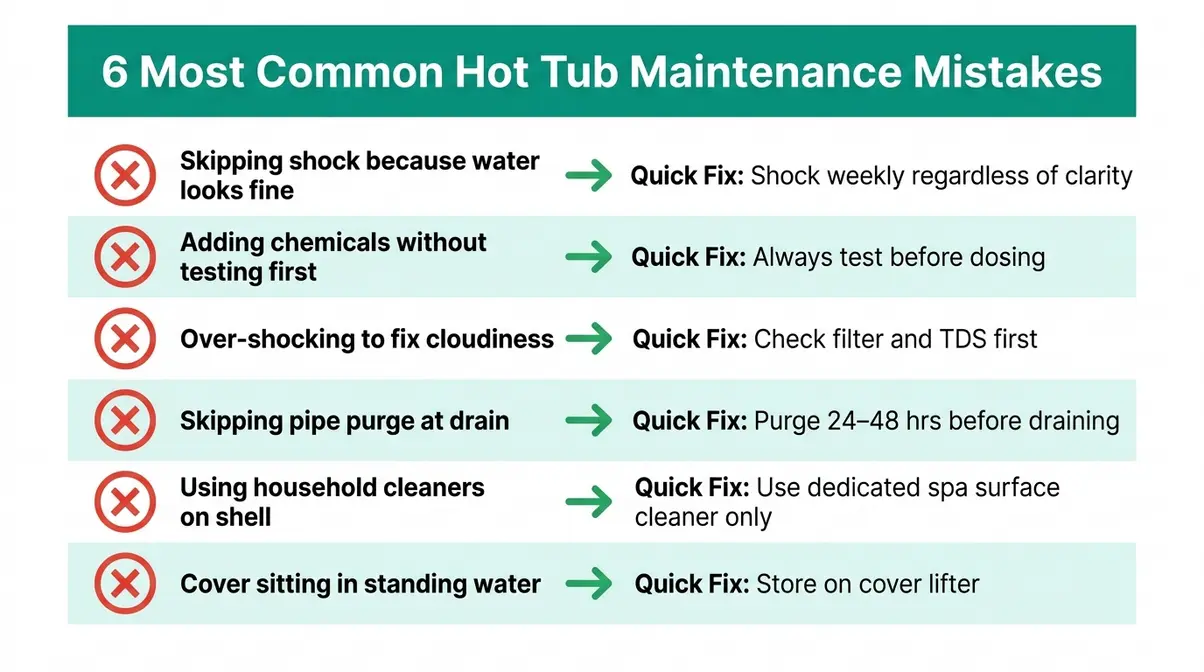
Our review of common pain points reported by spa owners, combined with professional community consensus, reveals these recurring errors:
1. Skipping the shock because the water “looks fine”
Water clarity is not a reliable indicator of chemical balance or bacterial safety. P. aeruginosa can be present in dangerous concentrations in water that looks crystal clear. Never skip weekly shocking based on visual inspection alone.
2. Adding chemicals without testing first
Adding pH Down to water that’s already at 7.2 will push it below the safe threshold. Always test before adding anything — even if you “just balanced it yesterday.” Bather load, temperature, and rainfall (in uncovered spas) all shift chemistry quickly.
3. Over-shocking to fix persistent cloudiness
More shock is not always the answer. Persistent cloudiness after shocking usually indicates a filter problem (clogged or damaged) or high TDS (time to drain). Adding more shock to water with exhausted TDS won’t clear it — it will just raise your sanitiser costs.
4. Neglecting the pipe purge at drain time
Draining without purging first leaves biofilm in the plumbing. That biofilm immediately begins colonising your fresh water after refilling. The pipe purge step is non-negotiable.
5. Using household cleaning products on the shell
Washing-up liquid, bathroom cleaners, and bleach all leave residues that create persistent foam and can damage the acrylic surface. Use only dedicated spa surface cleaners.
6. Letting the cover sit in standing water
A cover sitting in pooled water on the spa deck wicks moisture into the foam core, creating mould and dramatically increasing weight. Always store the cover raised or on a cover lifter.
When to Call a Professional
The 4-Stage Water Guardian Method handles 95% of spa maintenance. However, some situations genuinely require a trained technician:
- Call a professional when:
- Persistent water problems despite correct chemistry: If your water remains cloudy, foamy, or malodorous after a full drain, refill, and rebalance, there may be a plumbing issue (dead legs, air locks, or a failing circulation pump) that a technician needs to diagnose.
- Heater or pump sounds have changed: Grinding, whining, or intermittent operation indicate mechanical wear. Continuing to run faulty equipment can cause secondary damage that multiplies repair costs.
- Electrical issues: Any sign of electrical fault — tripped breakers, GFCI trips, or visible corrosion on the control panel — requires a qualified electrician or spa technician. Do not attempt electrical repairs yourself.
- Leaks: A wet equipment bay or a spa that loses more than 2–3cm of water per week (above evaporation loss) needs professional inspection. Leaks in pressurised lines worsen quickly.
- Annual service: Even without visible problems, an annual inspection by a qualified spa technician is worth the cost. They’ll check heater element condition, pump seals, circulation system efficiency, and any manufacturer-specific components your warranty may require to be serviced professionally.
Frequently Asked Questions
Why put tennis balls in a hot tub?
Tennis balls absorb body oils and cosmetic residues that your filter cannot trap. The fibrous felt material acts like a sponge, drawing oils out of the water column before they accumulate as scum lines or clog filter fibres. Community consensus among spa technicians consistently identifies body oil accumulation as the primary driver of foam, scum lines, and filter overload. Drop 2–3 standard felt tennis balls into your spa and leave them between uses; rinse and squeeze them weekly. Replace them every 4–6 weeks. This simple hack can noticeably extend filter life and reduce waterline cleaning frequency.
Do hot tubs reduce cortisol?
Yes — regular warm water immersion measurably reduces cortisol levels. Research published in peer-reviewed environmental health journals found significant reductions in stress markers following consistent hydrotherapy. The mechanism involves both the thermal effect (heat triggers parasympathetic nervous system activation) and the buoyancy effect (reduced physical load on joints and muscles). Regular warm water use can also improve sleep quality and reduce muscle tension — both of which contribute to lower baseline cortisol over time. These benefits depend on consistent use in properly maintained water.
Why should you not put your head under water in a hot tub?
Submerging your head in hot tub water carries bacterial and amoeba risks that skin contact does not. The CDC warns specifically about Naegleria fowleri, a rare but nearly always fatal brain-eating amoeba that can enter through the nasal passage when warm water is inhaled. While the risk in well-maintained spas is very low, it is not zero. Additionally, submersion significantly increases exposure to concentrated bacteria, chloramines, and chemical compounds through the eyes, ears, and nasal passages. Keep your head above the waterline during normal spa use.
Why should you bring two tennis balls and a sock on your next road trip?
This is a practical travel hack adapted from hot tub maintenance. The same absorbent properties that make tennis balls effective at removing oils from spa water make them useful for absorbing moisture and odours in enclosed spaces (like a car or luggage). In the hot tub context, the “two tennis balls” advice refers to the oil-absorption technique described above. For road trips specifically, a sock filled with tennis balls placed in a car can absorb moisture and reduce odours — the same polysaccharide-absorbing felt material at work in a different environment.
How often should I change my hot tub filter?
You should rinse your hot tub filter weekly, perform a chemical soak monthly, and replace the filter entirely every 12 to 18 months. If the filter fabric appears torn, the pleats are collapsing, or the end caps are cracked, replace it immediately regardless of age. A damaged filter allows debris and body oils to bypass the filtration system, leading to cloudy water and increased sanitizer demand.
Can I use pool chemicals in my hot tub?
No, you should never use pool chemicals in a hot tub. While the active ingredients (like chlorine) may be similar, pool chemicals are formulated for much larger volumes of cooler water. Hot tubs operate at high temperatures (37–40°C), which causes chemicals to react and off-gas differently. Using pool chemicals can cause severe pH imbalances, damage your spa’s acrylic shell, and degrade the internal plumbing seals.
Will a hot tub maintenance schedule lower my energy bills?
Yes, consistent maintenance directly improves energy efficiency. A clean filter allows the circulation pump to operate with less resistance, drawing less power. Similarly, maintaining proper water chemistry prevents scale buildup on the heater element; even a thin layer of calcium scale forces the heater to work significantly harder to warm the water. Regularly inspecting your cover for waterlogging ensures heat isn’t escaping unnecessarily.
What is the difference between chlorine and non-chlorine shock?
Chlorine shock raises your sanitizer levels, while non-chlorine shock only oxidizes organic waste. Non-chlorine shock (MPS) is ideal for weekly maintenance because it destroys contaminants and chloramines without drastically spiking your chlorine levels, allowing you to use the tub shortly after dosing. Chlorine shock (dichlor) is a heavy-duty treatment used monthly or after heavy bather loads to completely reset the water and kill lingering bacteria.
Limitations and When to Seek Professional Help
Common Pitfalls
Pitfall 1: Treating the 4-Stage Method as optional rather than sequential. The method is designed as a nested system — Daily Defence catches problems before they reach the Weekly Reset, and the Weekly Reset prevents the Monthly Refresh from becoming a crisis response. Skipping stages doesn’t save time; it concentrates problems into larger, more expensive fixes.
Pitfall 2: Trusting test strips exclusively for YMYL-adjacent chemistry. Test strips are accurate enough for routine monitoring, but their margin of error (±0.2–0.3 ppm for chlorine, ±5–10 ppm for TA) can mask meaningful imbalances. In any situation involving potential health risk — persistent skin irritation, unexplained illness after spa use — verify with a liquid drop kit or take a water sample to a pool shop for professional analysis.
Pitfall 3: Assuming “chemicals check ok” means the water is safe. Correct chemical readings mean the measured parameters are balanced. They don’t guarantee that biofilm isn’t present in pipes, that TDS isn’t approaching exhaustion, or that a failing filter isn’t recirculating debris. Chemistry readings are one data point, not the complete picture.
When to Choose Alternatives
If you have a very high bather load (5+ people multiple times per week): The standard 3–4 month drain interval is too long. Use the drain interval formula in the Quarterly section and plan for monthly drains. Standard maintenance schedules are designed for average use — heavy commercial-style use requires a compressed timeline.
If you experience recurring health issues despite correct chemistry: Some individuals are genuinely sensitive to chlorine or bromine at standard concentrations. Salt water systems, UV/ozone hybrid systems, or alternative sanitiser approaches (enzyme-based systems like the FrogEase system) may be more appropriate. Consult a spa specialist and, for persistent skin or respiratory issues, a healthcare provider.
When to Seek Expert Help
If you’ve completed a full quarterly drain and refill, rebalanced all parameters to within target ranges, and still experience persistent water problems — cloudy water, foam, or odour — the issue is likely mechanical rather than chemical. A qualified spa technician can pressure-test your plumbing, inspect the heater element, and assess circulation system performance. Most reputable spa dealers offer water testing and technical consultations. Annual professional servicing is particularly important for spas under warranty, as some manufacturers require documented service history for warranty claims.
Conclusion
A reliable hot tub water maintenance schedule removes the anxiety from spa ownership and replaces it with something better: confidence. The 4-Stage Water Guardian Method — Daily Defence, Weekly Reset, Monthly Refresh, and Quarterly Renewal — maps every task to a clear time interval so you always know what to do and when to do it. Maintain free chlorine at 3–5 ppm, keep pH between 7.2–7.6, and drain every 3–4 months, and your spa will stay safe, clear, and genuinely enjoyable year-round.
The method works because it’s systematic, not reactive. Most water problems — from scum lines to folliculitis risk — are prevented entirely by the weekly and quarterly stages that owners most commonly skip. The pipe purge before each drain, the weekly shock regardless of how clear the water looks, and the two tennis balls floating between sessions: these aren’t optional upgrades. They’re the difference between a spa that’s a joy to own and one that’s a source of ongoing stress.
Start with the cheat sheet table in this guide. Print the 12-month calendar. Run your first full chemistry test this week using the correct sequence: Total Alkalinity first, then pH, then sanitiser. If you’re uncertain where your water stands right now, take a sample to your nearest pool and spa shop for a free professional analysis — most will test it within minutes. From there, the 4-Stage Water Guardian Method takes over. Your first confident soak is closer than you think.
This article contains general information about hot tub maintenance. Health-related content is for educational purposes only and is not a substitute for professional medical advice. Always consult a qualified healthcare provider for medical concerns.