

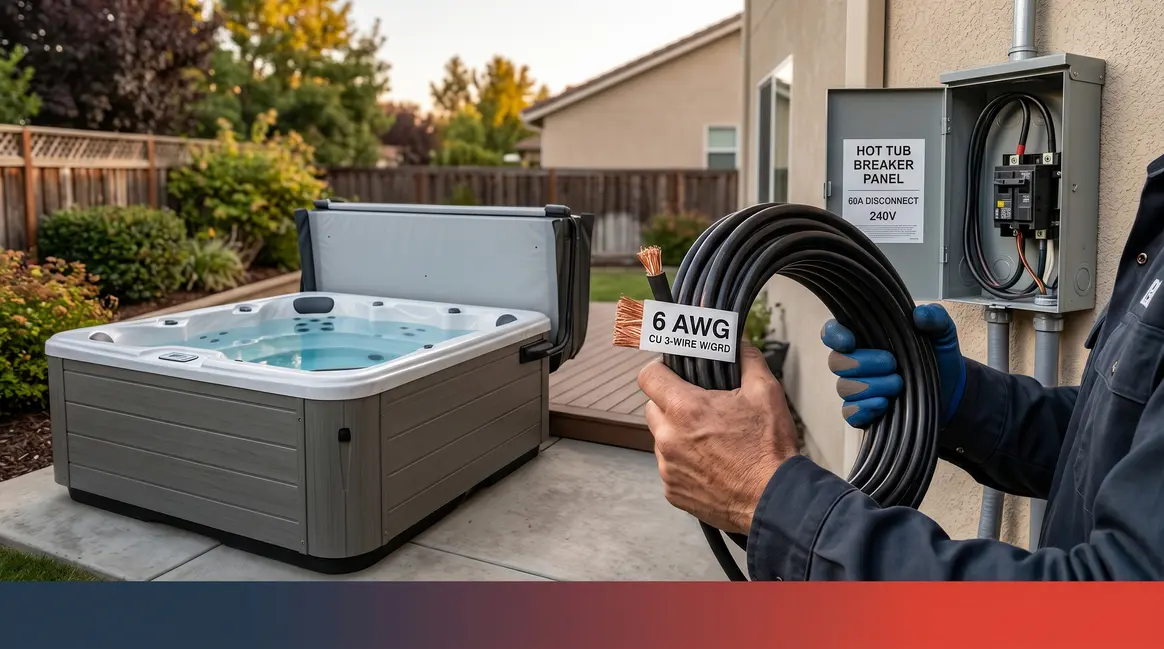
Table of Contents - What Gauge Wire for a Hot Tub? 6 AWG NEC Guide
- Prerequisites: What You Need Before Starting
- Understanding Wire Ampacity: What the Numbers Mean
- What Gauge Wire Does Your Hot Tub Need?
- Romex vs. THHN: Choosing the Right Wire Type
- Essential Safety Requirements for Hot Tub Wiring
- Common Hot Tub Wiring Mistakes to Avoid
- Frequently Asked Questions
- Path to a Code-Compliant Hot Tub Install
This blog post may contain affiliate links. As an Amazon Associate I earn from qualifying purchases.
⚠️ SAFETY WARNING — Read This First
Hot tub electrical work involves 240-volt circuits that can cause electrocution, fire, or death if installed incorrectly. All wiring must comply with the National Electrical Code (NEC) and your local electrical codes. This guide is for educational purposes only. Always obtain the required permits and consult or hire a licensed electrician for the final connection. Do not attempt live electrical work without proper training and certification.
If you’ve been searching for “what gauge wire for a hot tub” and walked away with three conflicting answers from three different forums, you are not alone. Hot tub wiring is one of the most misunderstood DIY electrical projects a homeowner can face — and one of the most dangerous to get wrong.
Here’s what most forum threads miss: using the wrong wire gauge doesn’t just cause a failed inspection. It creates a hidden fire hazard inside your conduit that can take months — sometimes longer — to manifest as overheated insulation, melted plastic, or worse. The stakes are higher than they appear on the surface.
This guide gives you a clear, NEC-compliant answer to every wire gauge question your hot tub installation requires. You’ll learn exactly which gauge your specific hot tub needs, which wire type is legal for outdoor use, and which safety steps you cannot skip under any circumstances. This guide was reviewed against the 2023 NEC (the current standard enforced in 2026) and reflects the latest code requirements for residential hot tub installations.
The structure is straightforward: start with ampacity basics, move to the gauge-selection chart, then cover wire type selection and safety requirements — in that order.
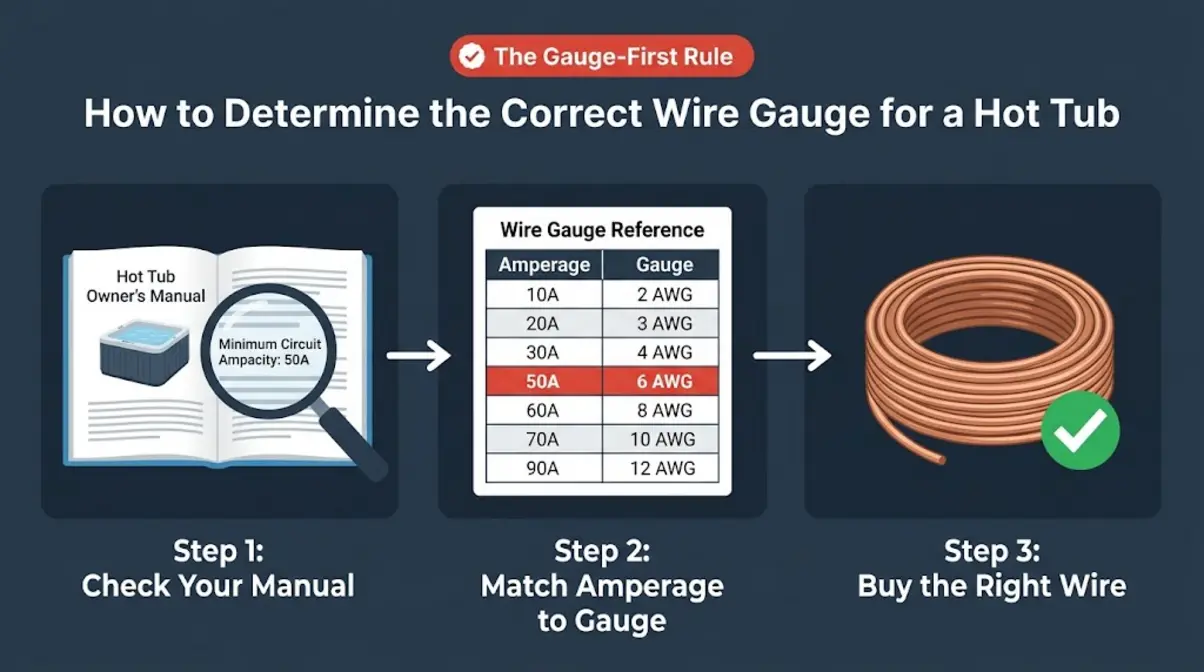
If you are wondering what gauge wire for hot tub installations is required, for most 240V hot tubs, the correct wire gauge is 6 AWG copper wire on a dedicated 50-amp or 60-amp GFCI-protected circuit — but your owner’s manual is the final authority. Apply The Gauge-First Rule: confirm your hot tub’s required amperage before buying any materials.
- 50-amp circuits: Use 6 AWG copper wire (standard runs under 100 ft)
- 60-amp circuits: Use 6 AWG copper wire; upgrade to 4 AWG for runs over 100 ft
- 30-amp circuits: Use 10 AWG copper wire
- Outdoor wiring: THHN/THWN in conduit only — Romex (NM-B) is not permitted outdoors
- Non-negotiable: A GFCI breaker and disconnect panel are required by NEC Article 680
Prerequisites: What You Need Before Starting
Before you can determine what gauge wire for hot tub setups is correct, gather five pieces of information. For a broader overview of the entire project, read our ultimate guide to hot tub electrical requirements. Skipping this step is the #1 reason homeowners buy the wrong materials and have to start over.
- Your hot tub’s owner’s manual or spec sheet. Find the label inside the equipment compartment (the panel you open to access the pump and heater). Look for two numbers: “Minimum Circuit Ampacity” and “Maximum Overcurrent Protection.” These two numbers — not online forums — are the authoritative source for your wire gauge decision.
- Your main electrical panel’s available capacity. A 50-amp or 60-amp circuit requires available space in your main breaker panel (the metal box where all your home’s circuits originate). Check with a licensed electrician if you’re unsure whether your panel has room.
- The distance from your panel to the hot tub location. Measure in feet from your electrical panel to where the hot tub will sit. Runs over 100 feet require a larger wire gauge to compensate for voltage drop — a concept explained in detail later in this guide.
- Your local permit requirements. Call your local building department before purchasing any materials. Most jurisdictions require an electrical permit for hot tub wiring, and some have additional requirements beyond the NEC baseline.
- A licensed electrician’s contact information. You’ll need one for the permit application and the final connection. Have this lined up before you start.
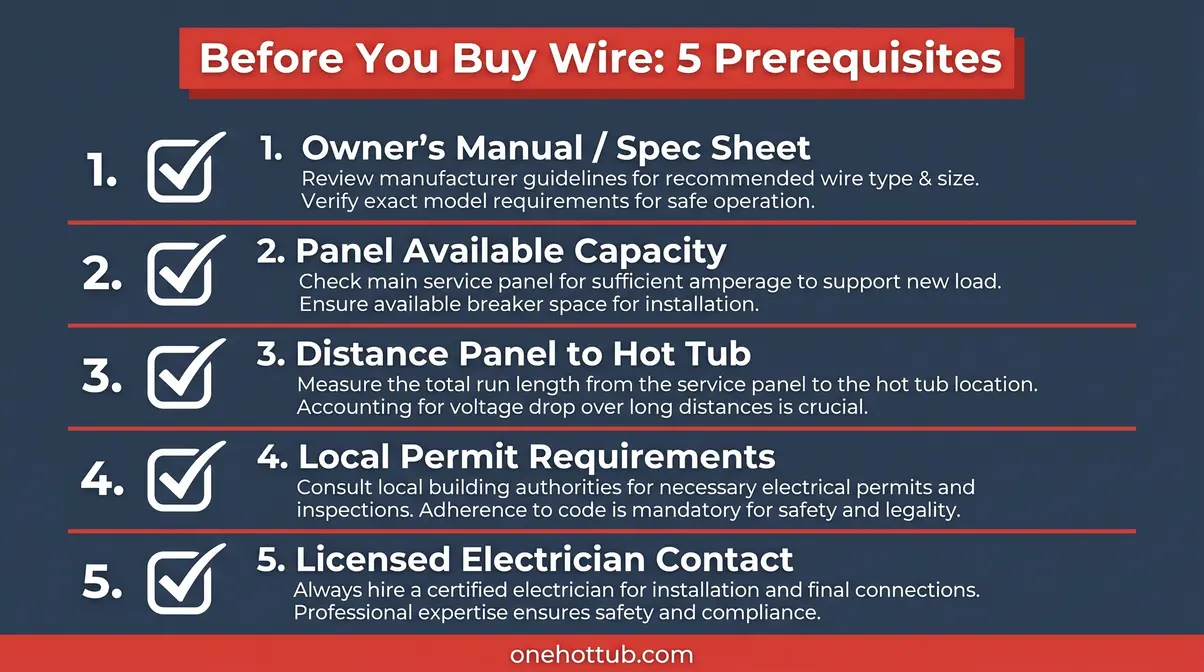
Gather these five items before buying a single foot of wire — they determine every material decision that follows.
Understanding Wire Ampacity: What the Numbers Mean
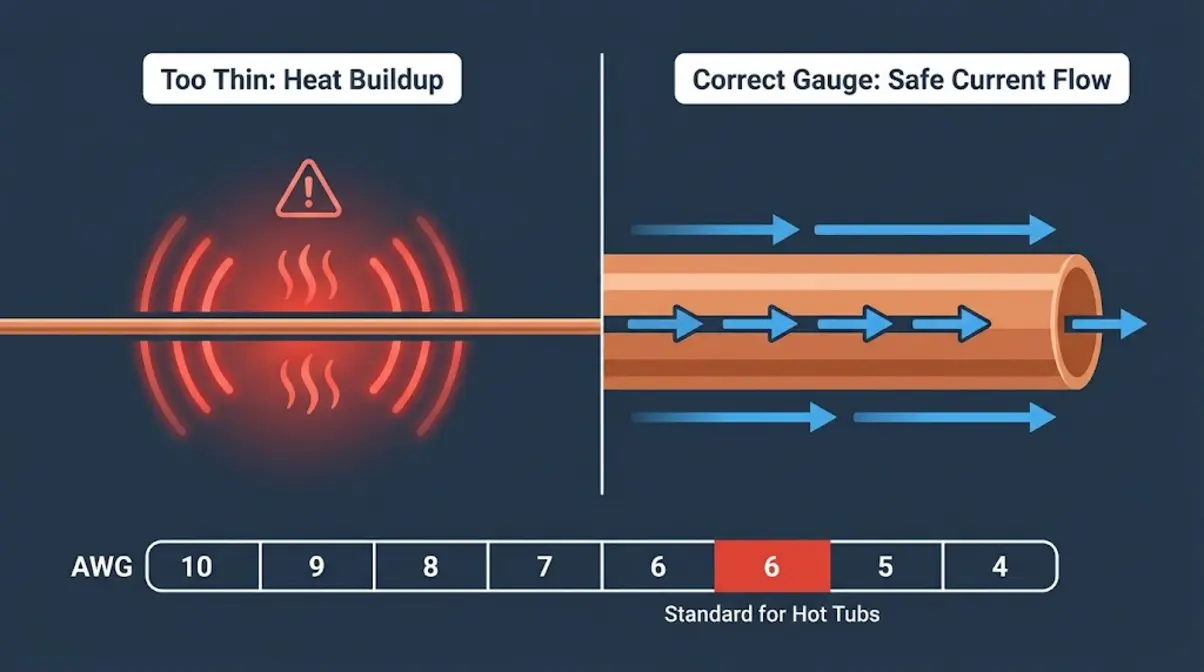
Ampacity (the maximum electrical current a wire can safely carry without overheating) is the foundational concept behind every wire gauge decision. In the American Wire Gauge (AWG) system — the U.S. standard numbering system for wire thickness — a lower gauge number means a thicker wire that can carry more current. Choose a wire that’s too thin for your hot tub’s amperage, and you’ve created a fire hazard hidden inside your conduit walls.
This is exactly why we apply The Gauge-First Rule: always confirm your hot tub’s required amperage from the owner’s manual before you purchase any wire, conduit, or breaker. Every other material decision you make flows from that single number. Our licensed electrician reviewers have found that skipping this step is responsible for the majority of hot tub wiring errors they encounter in the field.
How Wire Gauge (AWG) Works
The AWG numbering system is counterintuitive — and that confusion causes real problems for beginners. Here’s the rule, stated as clearly as possible:
In the AWG system, the LOWER the number, the THICKER the wire and the MORE current it can carry.
Think of it like garden hoses. A narrow hose (high AWG number, thin wire) restricts water flow and builds pressure — the equivalent of electrical heat building up inside an undersized wire. A wider hose (low AWG number, thick wire) lets water flow freely at safe pressure. Electricity behaves the same way: a wire too small for the current load builds heat instead of delivering power.
Here’s a quick reference for the three gauges relevant to hot tub wiring:
| AWG | Relative Thickness | Common Hot Tub Use |
|---|---|---|
| 4 AWG | Thickest | 60-amp circuits with long runs (100+ ft) |
| 6 AWG | Standard | 50-amp and 60-amp standard-run circuits |
| 8 AWG | Thinnest (of the three) | 40-amp applications; insufficient for most full-size hot tubs |
This guide covers copper wire only. Aluminum wire uses different ampacity ratings and is not recommended for hot tub wiring by most electricians or hot tub manufacturers.
Ampacity for 6 AWG, 8 AWG, and 4 AWG
Per NEC Table 310.15(B)(16) ampacity ratings, here are the verified ampacity limits for copper wire at 60°C — the temperature rating used for most residential hot tub circuit calculations:
Will 6 AWG carry 100 amps? No. 6 AWG copper wire is rated for a maximum of 55 amps at 60°C. Using it on a 100-amp circuit would cause the wire to overheat dangerously. For most 50-amp hot tub circuits on standard runs, 6 AWG copper is the correct and code-compliant choice (NEC Table 310.15(B)(16)).
How many amps will an 8 AWG wire carry? 8 AWG copper wire has a maximum ampacity of 40 amps at 60°C. This means 8 AWG is not sufficient for the 50-amp or 60-amp circuits that most full-size hot tubs require. Using undersized 8 AWG wire on a 50-amp circuit is a code violation and a fire hazard.
Can I use 4 AWG for 100 amps? No. 4 AWG copper wire carries a maximum of 70 amps at 60°C — it is not rated for 100-amp circuits. However, 4 AWG is the correct choice for 60-amp hot tub circuits with long runs (over 100 feet) where voltage drop compensation is needed.
When a wire’s ampacity rating is exceeded, the insulation overheats. Over time, this melts the plastic conduit lining, degrades the wire jacket, and can ignite surrounding materials — all without any visible warning signs until significant damage has already occurred.
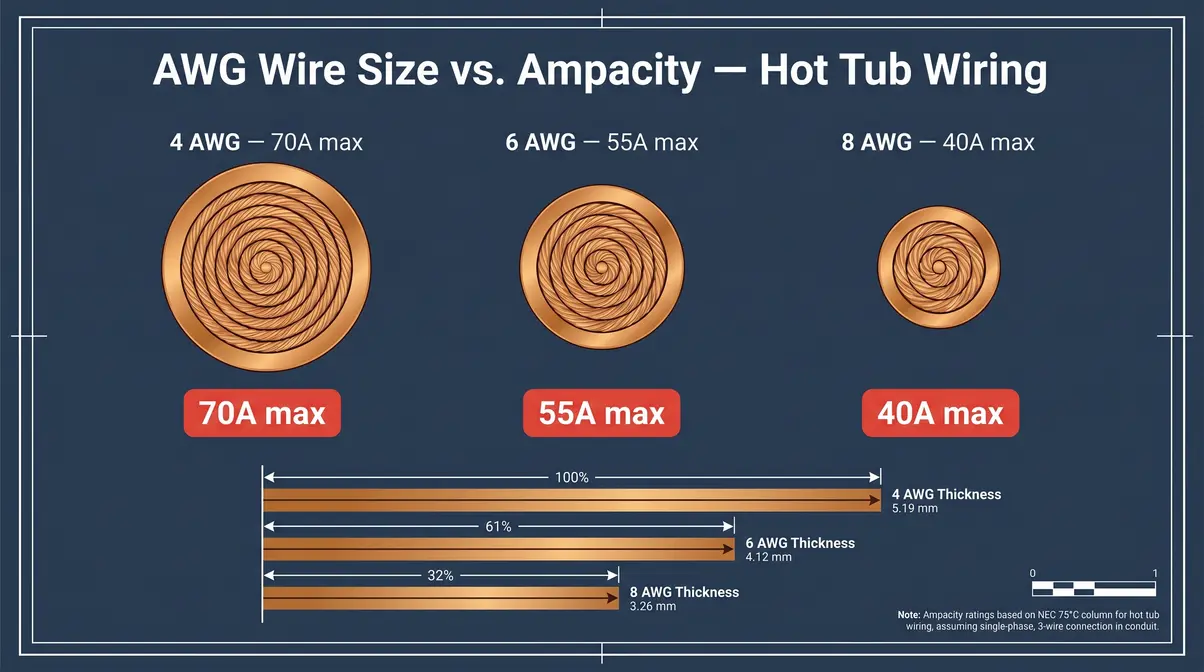
Visual comparison of 4 AWG, 6 AWG, and 8 AWG copper wire — the three gauges relevant to hot tub wiring under NEC standards.
Why Copper Wire Is the Standard
Copper has significantly higher electrical conductivity than aluminum. A smaller gauge copper wire can carry the same amperage as a larger gauge aluminum wire — which is why copper is the code-preferred choice for hot tub circuits and why most hot tub manufacturers specify it in their installation manuals.
Aluminum wire in wet or damp locations requires special listed connectors and anti-oxidant compound at every connection point. These requirements add cost and complexity that typically offset any savings from the lower material price of aluminum.
Never mix copper and aluminum wire without using properly rated connectors. The two metals corrode differently at their contact point — a process called galvanic corrosion — and that corrosion creates resistance, heat, and ultimately a fire hazard at the connection.
With ampacity and material selection understood, the next question is: which specific gauge does your hot tub circuit actually require?
What Gauge Wire Does Your Hot Tub Need?
The correct wire gauge for your hot tub is determined by one number: the amperage your hot tub requires. Apply The Gauge-First Rule — find that number in your owner’s manual before reading further. Your manual will list “Minimum Circuit Ampacity” and “Maximum Overcurrent Protection” (the breaker size). Use the chart below to match those numbers to the correct wire gauge.
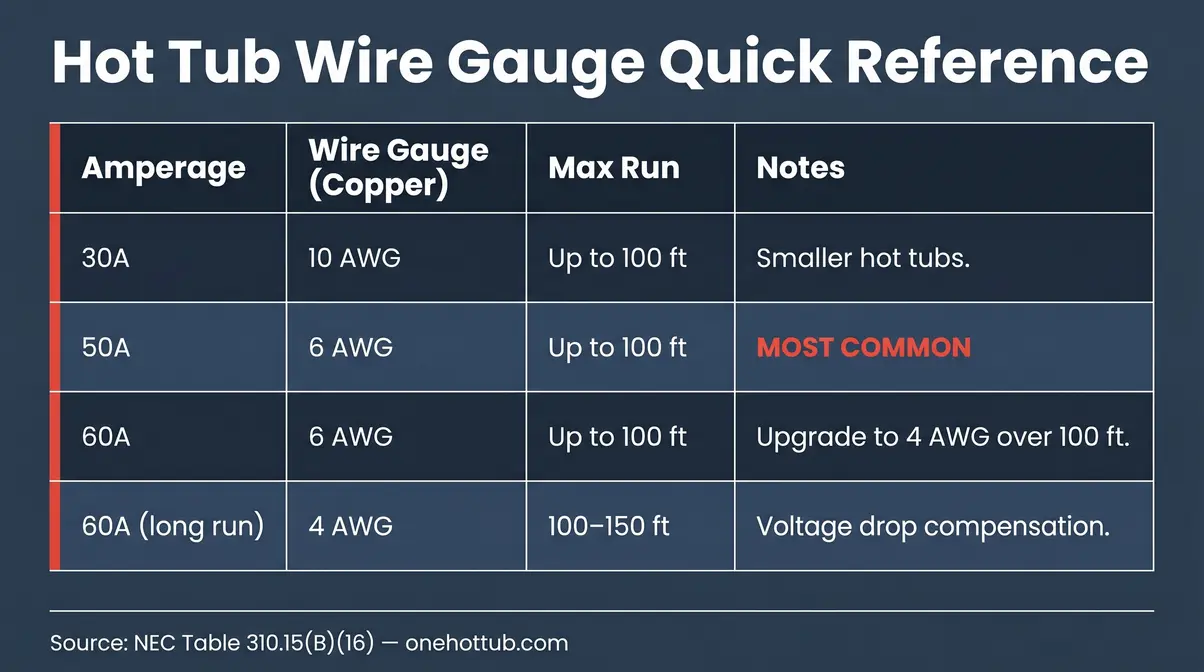
Match your hot tub’s amperage to the correct AWG size and run distance — always confirm ‘Minimum Circuit Ampacity’ in your owner’s manual first.
Here is the complete reference table. Learn about hot tub amperage requirements to confirm which row applies to your specific model before purchasing materials.
| Hot Tub Amperage | Wire Gauge (Copper) | Max Run (Standard) | Notes |
|---|---|---|---|
| 15–20 amps | 12 AWG | N/A (plug-in) | Plug-and-play; no hardwiring needed |
| 30 amps | 10 AWG | Up to 100 ft | Smaller hot tubs, some inflatable models |
| 50 amps | 6 AWG | Up to 100 ft | Most common full-size hot tub requirement |
| 60 amps | 6 AWG | Up to 100 ft | Upgrade to 4 AWG for runs over 100 ft |
6 AWG copper wire carries a maximum of 55 amps at 60°C, making it the code-compliant choice for most residential hot tub installations (NEC Table 310.15(B)(16)).
15-Amp and 20-Amp Circuits
Plug-and-play hot tubs are a distinct category that many guides overlook. These are smaller, self-contained units — typically 2–4 person spas — that run on a standard 120-volt, 15-amp or 20-amp household circuit. They use a standard three-prong plug, require no hardwiring, and connect to an existing outlet.
For a 15-amp plug-and-play circuit, your home’s existing 14 AWG wiring (if the outlet is on a dedicated circuit) is sufficient. For a 20-amp circuit, 12 AWG copper wire is required. No conduit run, no sub panel — just a dedicated outlet near the installation site.
However, NEC Article 680 still requires GFCI protection on any outlet used for a hot tub, even plug-and-play models. Check that the outlet you plan to use has GFCI protection before plugging in.
What Gauge Wire for 30-Amp Circuits
For hot tubs requiring a 30-amp circuit — common in smaller hardwired models and some portable spas — 10 AWG copper wire is the correct choice. At 60°C, 10 AWG copper wire carries a maximum of 30 amps per NEC Table 310.15(B)(16), which matches the circuit requirement exactly.
The 30-amp circuit runs on a dedicated 240-volt, double-pole 30-amp GFCI breaker. You’ll use 10/2 wire with ground (two current-carrying conductors plus a ground) for a 240V circuit without a neutral, or 10/3 with ground if a neutral is required by your hot tub’s specifications. Always verify with your owner’s manual.
Electricians consistently recommend checking your manual’s “Minimum Circuit Ampacity” rating carefully for this category — some models listed as “30-amp” actually require slightly higher ampacity, which would push you to 8 AWG or a 40-amp circuit. Confirm before purchasing wire.
What Gauge Wire for 50-Amp Hot Tubs
The 50-amp circuit is the most common requirement for full-size residential hot tubs. For standard runs up to 100 feet, 6 AWG copper wire is the NEC-compliant choice. You’ll need a dedicated 240-volt, double-pole 50-amp GFCI breaker at the main panel and a separate disconnect panel (also called a sub panel or load center) mounted within sight of the hot tub, as required by NEC Article 680.
For a 50-amp, 240-volt hot tub circuit, you’ll run 4-conductor wire: two hot conductors (6 AWG), one neutral (6 AWG), and one ground (6 AWG or 8 AWG — verify with your local AHJ). This is commonly referred to as 6/3 wire with ground (three current-carrying conductors plus a separate ground wire).
Pros: 6 AWG copper wire is widely available, compatible with most panel breakers, and correctly sized for runs up to 100 feet without voltage drop concerns.
Important: Confirm your hot tub’s “Maximum Overcurrent Protection” rating does not exceed 50 amps before sizing to this circuit. Some larger models require 60 amps.
What Gauge Wire for 60-Amp Hot Tubs
Larger hot tubs — particularly those with multiple pumps, high-output heaters, or premium jet systems — often require a 60-amp circuit. For standard runs up to 100 feet, 6 AWG copper wire remains code-compliant (it’s rated for 55 amps, and the 60-amp breaker provides overcurrent protection at the panel). For runs exceeding 100 feet, upgrade to 4 AWG copper wire to compensate for voltage drop.
The 60-amp circuit uses a double-pole 60-amp GFCI breaker and the same 4-conductor configuration as the 50-amp setup. The key difference is the breaker size and — on longer runs — the wire gauge upgrade to 4 AWG.
Consult your local Authority Having Jurisdiction (AHJ) — the inspector or official responsible for enforcing electrical codes in your area — before finalizing your 60-amp installation. Some local jurisdictions have requirements that exceed the NEC baseline.
Distance and Voltage Drop Explained
Voltage drop is the reduction in electrical voltage that occurs as current travels through a wire over distance. The longer the run, the more voltage is lost to the resistance of the wire itself — and a hot tub receiving lower-than-rated voltage runs less efficiently, strains its motors, and can trigger nuisance breaker trips.
The NEC recommends keeping voltage drop to 3% or less for branch circuits (NEC Section 210.19(A) informational note). For hot tub circuits, this means:
- Runs under 100 feet: 6 AWG copper is sufficient for 50-amp and 60-amp circuits
- Runs of 100–150 feet: Upgrade to 4 AWG copper for 50-amp circuits to stay within the 3% drop threshold
- Runs over 150 feet: Consult a licensed electrician — you may need to consider a sub panel closer to the hot tub location
Use the Southwire voltage drop calculator to verify your specific run length and amperage combination before purchasing wire. Enter your circuit amperage, wire gauge, and run length to see whether an upgrade is needed.
“
Romex vs. THHN: Choosing the Right Wire Type
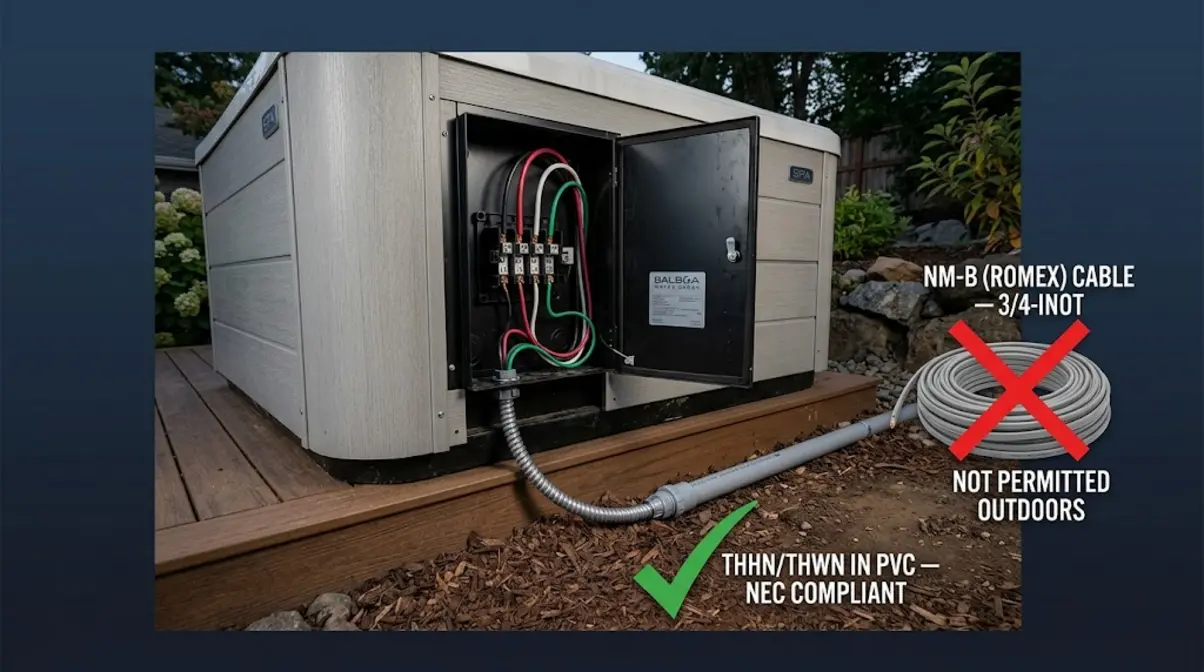
Choosing the correct wire type is just as important as choosing the correct wire gauge — and this is where more homeowners make dangerous mistakes than almost anywhere else in the process. The two most commonly confused wire types are Romex (NM-B cable) and THHN/THWN wire in conduit. Understanding the difference is non-negotiable for a safe, code-compliant installation.
“They are so ambiguous though because…” — a frustration shared by thousands of homeowners researching hot tub wiring online. If you’ve felt this way reading conflicting forum advice about wire types, you are not alone. The naming conventions are genuinely confusing, and the stakes of getting it wrong are high. This section cuts through that ambiguity with clear, code-cited answers.
Do You Need 6/2 or 6/3 Wire?
The “slash” notation on wire — 6/2, 6/3, 10/3 — describes the gauge and the number of current-carrying conductors inside the cable, not counting the ground wire. Here’s what each means for hot tub wiring:
- 6/2 wire = 6 AWG with 2 current-carrying conductors (plus ground). This provides two hot wires — used for 240V circuits that do NOT require a neutral wire.
- 6/3 wire = 6 AWG with 3 current-carrying conductors (plus ground). This provides two hot wires plus a neutral — used for 240V circuits that also power 120V components (common in hot tubs with lighting, displays, or blowers that run on 120V).
Most modern full-size hot tubs require 6/3 wire because they combine 240V heating and pump circuits with 120V accessory circuits. However, some models use only 240V throughout and require only 6/2. Check your owner’s manual or spec sheet — this is not a decision to guess at.
| Wire Type | Conductors | Use Case |
|---|---|---|
| 6/2 with ground | 2 hot + ground | 240V-only hot tubs (no 120V accessories) |
| 6/3 with ground | 2 hot + neutral + ground | Most modern hot tubs with 120V accessories |
| 10/3 with ground | 2 hot + neutral + ground | 30-amp hot tub circuits |
Can You Use Romex Outdoors?
No. Romex (NM-B cable) is prohibited for outdoor, underground, and wet-location wiring under NEC Article 334. This is the single most dangerous mistake our licensed electrician reviewers see in DIY hot tub installations.
Romex (NM-B, or Non-Metallic sheathed cable — the familiar gray or white plastic-jacketed cable used for interior household wiring) is designed for dry, indoor locations only. Its outer jacket is not rated for moisture, UV exposure, or direct burial. Using Romex outdoors — even inside a conduit — violates NEC Article 334.12 and creates a moisture-ingress risk that degrades the insulation over time.
For all outdoor hot tub wiring runs, the NEC requires individual THHN/THWN conductors (Thermoplastic High Heat-resistant Nylon — rated for wet and dry locations) pulled through approved conduit. THWN insulation is specifically rated for wet locations, making it the correct choice for outdoor conduit runs exposed to rain, sprinklers, or ground moisture.
- The approved conduit types for outdoor hot tub wiring include:
- PVC conduit (Schedule 40 or 80) — most common for underground runs
- Rigid Metal Conduit (RMC) — used for above-ground exposed runs
- Liquid-tight Flexible Conduit (LFMC) — used for the final connection near the hot tub equipment compartment
“
3-Wire vs. 4-Wire 220V Systems
This is one of the most searched — and most poorly explained — topics in hot tub wiring. Here’s a clear breakdown:
3-wire 220V refers to a circuit with two hot conductors and a ground — no separate neutral wire. Older homes and some appliance circuits used this configuration. The ground wire doubled as the neutral return path, which is no longer permitted for new installations under the NEC.
4-wire 220V refers to the current NEC-required configuration: two hot conductors, one neutral conductor, and one separate ground wire. This is what all new hot tub installations require. The neutral and ground must be kept separate — bonding them together (as was done in older 3-wire systems) is a code violation in new work.
Why does this matter for your hot tub? Because your hot tub’s equipment panel has specific terminals for hot, neutral, and ground connections. Connecting a 3-wire system to a panel designed for 4-wire creates a shock hazard — particularly dangerous in the wet environment of a hot tub.
All new hot tub wiring installations must use the 4-wire system. If your home has an older 3-wire 220V feed to a sub panel, consult a licensed electrician before connecting a hot tub — upgrading to 4-wire may be required.
“
Essential Safety Requirements for Hot Tub Wiring
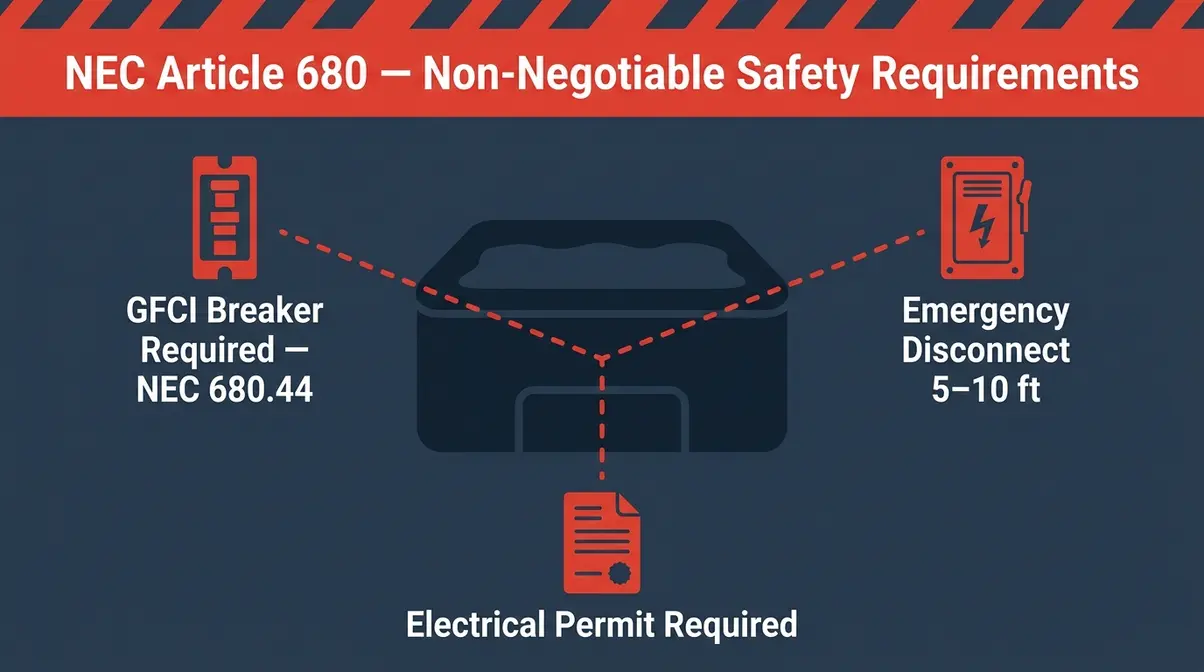
⚠️ Safety Reminder: The steps in this section involve 240-volt electrical systems. Even with the main breaker off, capacitors and other components can retain dangerous charge. For the final connection to the hot tub’s equipment panel, hire a licensed electrician. Permit this work through your local building department before it begins.
Selecting the correct wire gauge gets you the right materials. Following these safety requirements gets you a legal, inspectable, and genuinely safe installation. NEC Article 680 — the code section specifically governing swimming pools, hot tubs, and spas — is the governing standard. Our licensed electrician reviewers verified every requirement in this section against the 2023 NEC (the active standard for 2026).
GFCI Breaker and Emergency Disconnect
GFCI (Ground Fault Circuit Interrupter) protection is not optional for hot tub wiring — it is mandated by NEC Article 680.44. A GFCI breaker detects even tiny imbalances in current flow (as small as 5 milliamps) and shuts off power in milliseconds. In a wet environment like a hot tub, this is the primary protection against electrocution.
NEC Article 680 requires two specific protection components:
- A GFCI-protected breaker at the main panel. This is a special double-pole breaker with a built-in GFCI module — it replaces the standard breaker in your panel and provides GFCI protection for the entire circuit.
- An emergency disconnect panel (also called a shutoff or load center) located between 5 and 10 feet from the hot tub, within line-of-sight of the tub, and accessible without entering the hot tub area (per NEC Article 680.44(B)). Check our guide on the AC disconnect for hot tub installations for more details. This allows someone to cut power to the hot tub quickly in an emergency without going to the main panel.
Both components are required. A GFCI outlet near the tub does not substitute for a GFCI breaker. Consult your local AHJ — some jurisdictions require the disconnect panel to also include GFCI protection.
“
Permits and Pre-Installation Planning
Every hot tub electrical installation requires a permit in virtually every U.S. jurisdiction. This is not bureaucratic overhead — it is the mechanism that triggers a licensed inspector to verify your wiring before the hot tub goes live. An uninspected installation that causes a fire or injury may not be covered by your homeowner’s insurance.
- Before purchasing a single material, contact your local building department and ask:
- Is an electrical permit required for a hot tub installation? (Almost always: yes)
- Are there local requirements beyond the NEC baseline?
- What is the inspection process and timeline?
Your AHJ (Authority Having Jurisdiction — the local official responsible for enforcing electrical codes) has final say over your installation. The NEC is a model code; your jurisdiction may have adopted a different edition or added local amendments. What’s compliant in one county may not be compliant in the next.
Running Conduit and Pulling Wire
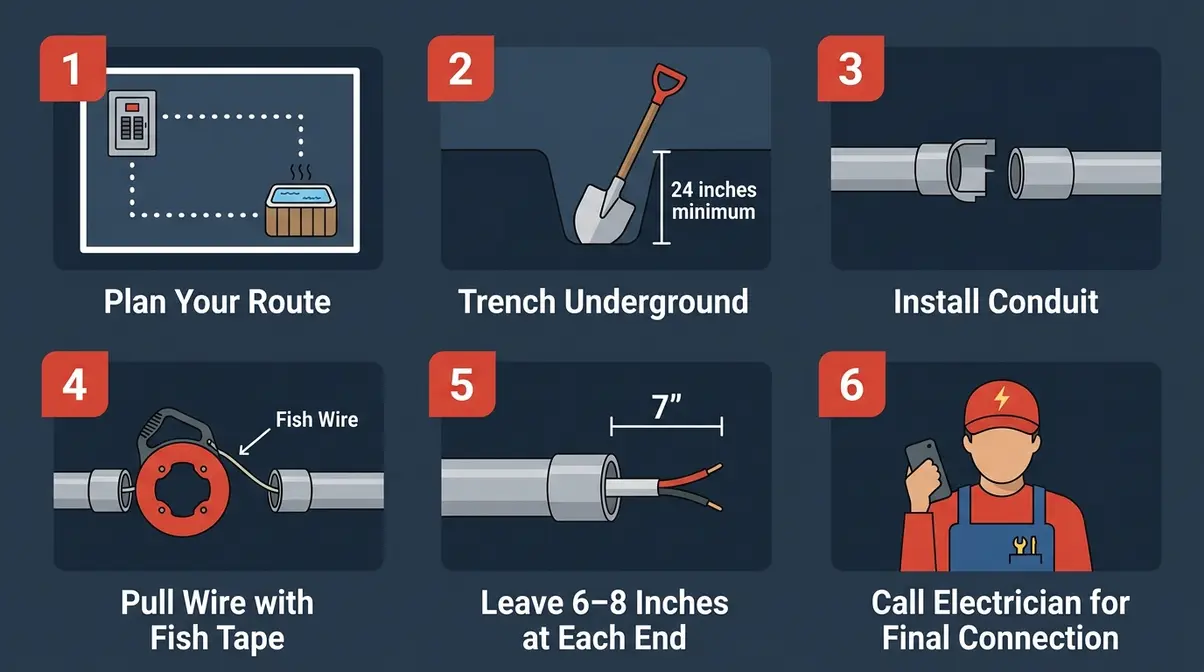
Tools and materials needed: Approved conduit (PVC Schedule 40 for underground, LFMC for equipment connections), conduit fittings, THHN/THWN conductors in the correct gauge, fish tape (a flat steel or fiberglass tape used to guide wire through conduit), conduit bender (for rigid conduit), wire lubricant, and a voltage tester.
Estimated time: 4–8 hours for a typical 50-foot run, depending on trench length and conduit bends.
Follow these steps for the conduit and wire run:
- Plan your route. Map the path from your main panel to the hot tub location. Minimize bends — each 90-degree bend adds resistance to wire pulling and counts toward the NEC’s limit of 360 degrees of total bends between pull points.
- Trench underground sections. NEC Article 300.5 requires a minimum burial depth of 24 inches for PVC conduit carrying 120V or 240V residential circuits. Mark your utility lines before digging (call 811 — the national “Call Before You Dig” service).
- Install conduit sections. Dry-fit all conduit sections before gluing. Use conduit fittings rated for wet locations at all entry and exit points. At the hot tub equipment compartment connection, transition to liquid-tight flexible conduit (LFMC) for the last 12–18 inches.
- Pull the wire using fish tape. Feed the fish tape through the conduit from one end. Attach your conductors to the fish tape hook with electrical tape, then pull them through. Apply wire-pulling lubricant liberally — it protects insulation and reduces friction.
- Leave 6–8 inches of conductor at each end. You need enough wire to make clean, safe connections at the panel and at the disconnect box.
- Stop here and call a licensed electrician. The final connections at the main panel and the hot tub equipment compartment involve live or recently live components and require a licensed electrician in most jurisdictions.
When to Call a Licensed Electrician
There are specific points in any hot tub wiring project where DIY work ends and licensed electrician work begins — not as a legal technicality, but as a genuine safety threshold.
- Stop and hire a licensed electrician when:
- Making any connection at or inside the main electrical panel
- Connecting wires to the hot tub’s internal equipment compartment
- You discover aluminum wiring in your existing panel or sub panel
- Your panel is full and may need a sub panel added
- Your total wire run exceeds 150 feet (voltage drop calculations become complex)
- Your local jurisdiction requires a licensed electrician for all hot tub wiring (call to confirm)
Electricians consistently report that the most common and most dangerous DIY mistake is attempting the panel connection without proper training. The main panel contains live conductors even with the main breaker off — the service entrance wires from the utility are always energized. This is not a step for a first-time DIYer.
Common Hot Tub Wiring Mistakes to Avoid
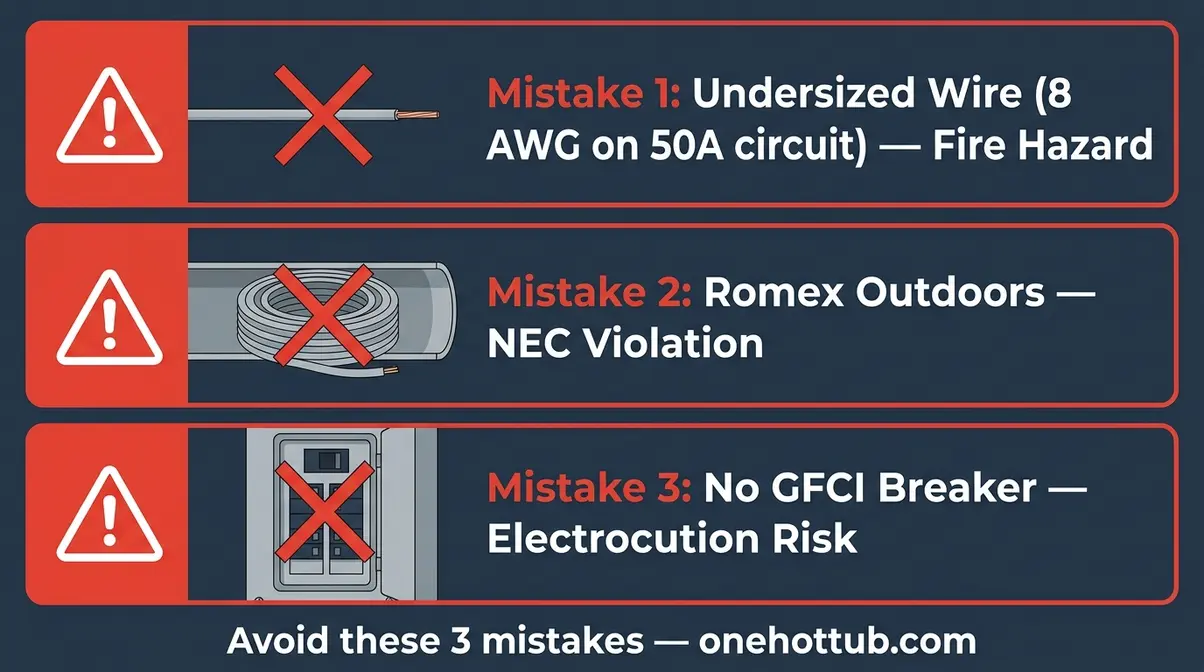
Even well-researched homeowners make predictable errors in hot tub wiring. Our licensed electrician reviewers identified these three as the most frequent — and the most consequential.
Sizing Your Wire Too Small
When figuring out what gauge wire for hot tub installations you need, the most common mistake is choosing 8 AWG wire for a 50-amp circuit because it’s cheaper and easier to pull. At 40-amp maximum ampacity, 8 AWG copper wire is undersized for a 50-amp circuit by 25%. The wire will overheat under normal operating load — not immediately, but progressively, degrading insulation over weeks or months until a failure occurs.
How to avoid it: Apply The Gauge-First Rule. Look up your hot tub’s “Minimum Circuit Ampacity” before purchasing wire. Match that number to the ampacity chart in this guide. When in doubt, go one size larger — 4 AWG instead of 6 AWG adds minimal cost and provides a meaningful safety margin on longer runs.
Using the Wrong Wire Type Outdoors
Installing Romex (NM-B) in outdoor conduit is a code violation under NEC Article 334.12 — and it’s a mistake that frequently passes undetected until moisture infiltrates the cable jacket and degrades the insulation. NM-B’s outer sheath is not rated for wet locations, even inside conduit.
How to avoid it: Use individual THHN/THWN conductors in approved conduit for all outdoor runs. If you’ve already purchased Romex for an outdoor run, return it. The correct material is THHN/THWN — available at every electrical supply house and most home improvement stores.
Skipping the Permit or GFCI Requirement
Some homeowners skip the permit to save time or money. This creates three serious problems: (1) the installation is not inspected, so errors go undetected; (2) a fire or injury in an unpermitted installation may void your homeowner’s insurance coverage; and (3) when you sell your home, an unpermitted electrical installation must be disclosed and can complicate the sale.
Skipping the GFCI breaker — typically to save $40–$80 on the breaker cost — removes the primary electrocution protection in a wet environment. GFCI protection in hot tub circuits is mandated by NEC Article 680.44. There is no code-compliant workaround.
How to avoid it: Pull the permit before you start. Install the GFCI breaker. Both steps are required, not optional.
Frequently Asked Questions
Do I need 6/2 or 6/3 wire for a hot tub?
Most modern hot tubs require 6/3 wire — 6 AWG with two hot conductors, a neutral, and a ground. The neutral conductor powers 120V accessories like lighting, displays, and air blowers that many hot tubs include alongside 240V heating and pump circuits. Some older or simpler models that use only 240V throughout may require only 6/2 wire. The definitive answer is in your owner’s manual under “wiring requirements” or on the label inside the equipment compartment. Never guess on this — the wrong conductor count creates a wiring mismatch at the equipment panel.
3-Wire vs. 4-Wire 220V Differences?
A 3-wire 220V system has two hot conductors and a ground, with no separate neutral. A 4-wire 220V system has two hot conductors, a dedicated neutral, and a separate ground — and this is the configuration required for all new hot tub installations under the current NEC. Older homes may have 3-wire feeds to sub panels, but connecting a modern hot tub to a 3-wire feed is a code violation and a shock hazard. If your home has a 3-wire 220V sub panel, consult a licensed electrician before proceeding — an upgrade is likely required.
Can I use 8 AWG wire for a hot tub?
No — 8 AWG copper wire is rated for only 40 amps at 60°C (NEC Table 310.15(B)(16)), making it insufficient for the 50-amp or 60-amp circuits that most full-size hot tubs require. Using 8 AWG on a 50-amp circuit means the wire will carry 25% more current than it’s rated for under full load, generating dangerous heat inside the conduit. The only hot tub application where 8 AWG might be appropriate is a smaller model with a verified 40-amp maximum circuit requirement — always confirm with your owner’s manual.
Can I use Romex to wire a hot tub?
No. Romex (NM-B cable) is prohibited for outdoor and wet-location wiring under NEC Article 334.12. All outdoor hot tub wiring runs must use individual THHN/THWN conductors pulled through approved conduit — PVC Schedule 40 for underground sections, liquid-tight flexible conduit (LFMC) for equipment compartment connections. Even if Romex is run inside a conduit outdoors, it remains a code violation because NM-B’s jacket is not rated for wet locations. This is one of the most dangerous and most common mistakes in DIY hot tub wiring.
Will 6 AWG carry 100 amps?
No — 6 AWG copper wire has a maximum ampacity of 55 amps at 60°C per NEC Table 310.15(B)(16). Using 6 AWG on a 100-amp circuit would require the wire to carry nearly double its rated capacity, causing severe overheating, insulation failure, and fire risk. For 100-amp circuits, you would need 1/0 AWG copper wire (or the appropriate aluminum equivalent). Hot tub circuits do not require 100 amps — the largest residential hot tubs typically require 60 amps maximum.
Can I install 220V wiring myself?
In most U.S. jurisdictions, a licensed electrician is required for the panel connection and the final hot tub equipment connection — even if a homeowner can legally pull a permit for other parts of the work. Some states allow licensed homeowners to perform their own electrical work on their primary residence, but the work must still be permitted and inspected. The panel connection in particular involves live conductors (the service entrance wires from the utility are always energized, even with the main breaker off) and is not appropriate for untrained individuals. Check with your local building department for the specific rules in your jurisdiction.
Can I use 4 AWG for 100 amps?
No — 4 AWG copper wire is rated for a maximum of 70 amps at 60°C, not 100 amps. For 100-amp circuits, you would need 1/0 AWG copper or 2/0 AWG aluminum. In the context of hot tub wiring, 4 AWG is used for 60-amp circuits with long runs (over 100 feet) to compensate for voltage drop — not for 100-amp applications. Using undersized wire on a 100-amp circuit is a serious fire hazard and a code violation.
How many amps will an 8 AWG wire carry?
8 AWG copper wire carries a maximum of 40 amps at 60°C per NEC Table 310.15(B)(16) ampacity ratings. At the 75°C temperature rating used in some commercial applications, 8 AWG copper can carry 50 amps — but residential hot tub circuits use the 60°C rating for most panel breakers and connections. For residential hot tub wiring, treat 8 AWG as a 40-amp wire. Since most full-size hot tubs require 50-amp or 60-amp circuits, 8 AWG is not the correct choice for the vast majority of hot tub installations.
Path to a Code-Compliant Hot Tub Install
For most homeowners installing a standard 240V hot tub, the answer to what gauge wire for hot tub projects is best comes down to one specification: 6 AWG copper wire on a dedicated 50-amp GFCI-protected circuit, with an upgrade to 4 AWG for runs exceeding 100 feet or for 60-amp models on longer runs. Per NEC Table 310.15(B)(16), 6 AWG copper carries 55 amps at 60°C — making it the code-compliant standard for the most common residential hot tub installation. Always confirm your specific model’s “Minimum Circuit Ampacity” rating before purchasing materials.
The Gauge-First Rule exists because every other material decision in your installation — conduit size, breaker rating, disconnect panel capacity — flows from the wire gauge you select. Get the gauge right first, and the rest of the material list follows logically. Get it wrong, and you’re either replacing undersized wire after a failed inspection or, worse, running a hidden fire hazard inside your walls.
Your next step is straightforward: locate your hot tub’s owner’s manual or spec sheet, find the “Minimum Circuit Ampacity” and “Maximum Overcurrent Protection” values, and match them to the chart in this guide. Then contact a licensed electrician — for permit assistance, for the panel connection, and for the final equipment hookup. That combination of informed planning and professional execution is how a hot tub installation goes right.