

Table of Contents - Best Hot Tub Covers 2026: Top 5 Rated & Reviewed
- The 5 Best Hot Tub Covers at a Glance
- 1. The Cover Guy Premium
- 2. SpaDepot Duratherm
- 3. The Cover Brothers
- 4. MySpaCover Custom Hard Shell
- 5. Hot Tub Cover Spot Cap
- Key Features of Great Covers
- Preventing Heavy Covers
- Brand-Specific Replacements
- Choosing the Right Cover
- Mistakes to Avoid
- Frequently Asked Questions
- Final Cover Recommendations
This blog post may contain affiliate links. As an Amazon Associate I earn from qualifying purchases.
⚠️ Affiliate Disclosure: This article contains links to products and retailers. If you purchase through some of these links, we may earn a small commission at no extra cost to you. This does not influence our recommendations — all picks are based on independent evaluation criteria. FTC guidelines require this disclosure.
“I don’t like the heavy covers for hot tubs. Mine is for sure water damaged so extra heavy, they are hard for me to lift back and I don’t like how…”
— Hot tub owner, Reddit r/hottub
If that sounds familiar, you’re not alone. Waterlogged, extra-heavy covers are the most common complaint among hot tub owners — and they’re 100% preventable.
A failing cover isn’t just inconvenient. It can add hundreds of dollars to your annual energy bill as heat escapes through a saturated foam core. The U.S. Department of Energy estimates that a properly insulated hot tub cover reduces heating energy by up to 50–70% — and a waterlogged one does the opposite.
In this guide, you’ll learn exactly which hot tub covers last the longest, why covers fail, and which of the best hot tub covers matches your climate and budget. We cover our top picks, the specs that separate a great cover from a cheap one, and a decision matrix to make your choice simple.

- DURABLE + MADE TO LAST: Our spa cover is constructed with quality materials and reinforced straps that support load bearing thresholds greater than ASTM standards. All covers are made with zero water absorption technology and medium-density interior foam structure that is designed to last. For maximum insulation and durability, covers can be upgraded to high-density foam (6-4 taper, 2lbs).
- ZERO WASTE ABSORPTION TECHNOLOGY: Our spa covers for hot tub are designed with Zero water absorption technology, which wraps all foam to prevent waterlogging; unlike other manufactured spa covers that can become waterlogged and lose their effectiveness.
- REDUCE YOUR ENERGY BILL: Our cleverly designed hot tub enclosures pay for themselves in energy savings alone! With an insulation value of R19 and made from quality high-density foam and marine-grade vinyl, our lightweight hot tub enclosure is designed to lock in the heat and keep out the cold, while allowing rain, ice, and snow to run off.
- SAFETY FIRST: All our spa covers meet or exceed industry safety standards including foam density, handles, and straps with a locking feature.
- BEST MATERIALS AND QUALITY: Only the best materials are used in our manufacturing process to provide the best product possible for all outdoor and indoor hot tub covers, satisfaction guaranteed!
- DURABLE + MADE TO LAST: Our spa cover is constructed with quality materials and reinforced straps that support load bearing thresholds greater than ASTM standards. All covers are made with zero water absorption technology and medium-density interior foam structure that is designed to last. For maximum insulation and durability, covers can be upgraded to high-density foam (6-4 taper, 2lbs).
- ZERO WASTE ABSORPTION TECHNOLOGY: Our spa covers for hot tub are designed with Zero water absorption technology, which wraps all foam to prevent waterlogging; unlike other manufactured spa covers that can become waterlogged and lose their effectiveness.
- REDUCE YOUR ENERGY BILL: Our cleverly designed hot tub enclosures pay for themselves in energy savings alone! With an insulation value of R19 and made from quality high-density foam and marine-grade vinyl, our lightweight hot tub enclosure is designed to lock in the heat and keep out the cold, while allowing rain, ice, and snow to run off.
- SAFETY FIRST: All our spa covers meet or exceed industry safety standards including foam density, handles, and straps with a locking feature.
- BEST MATERIALS AND QUALITY: Only the best materials are used in our manufacturing process to provide the best product possible for all outdoor and indoor hot tub covers, satisfaction guaranteed!
- DURABLE + MADE TO LAST: Our spa cover is constructed with quality materials and reinforced straps that support load bearing thresholds greater than ASTM standards. All covers are made with zero water absorption technology and medium-density interior foam structure that is designed to last. For maximum insulation and durability, covers can be upgraded to high-density foam (6-4 taper, 2lbs).
- ZERO WASTE ABSORPTION TECHNOLOGY: Our spa covers for hot tub are designed with Zero water absorption technology, which wraps all foam to prevent waterlogging; unlike other manufactured spa covers that can become waterlogged and lose their effectiveness.
- REDUCE YOUR ENERGY BILL: Our cleverly designed hot tub enclosures pay for themselves in energy savings alone! With an insulation value of R19 and made from quality high-density foam and marine-grade vinyl, our lightweight hot tub enclosure is designed to lock in the heat and keep out the cold, while allowing rain, ice, and snow to run off.
- SAFETY FIRST: All our spa covers meet or exceed industry safety standards including foam density, handles, and straps with a locking feature.
- BEST MATERIALS AND QUALITY: Only the best materials are used in our manufacturing process to provide the best product possible for all outdoor and indoor hot tub covers, satisfaction guaranteed!
- 【TRUE VALUE】Replace your spa cover with America’s Largest and most trusted Spa Cover Supplier. With our 100% satisfaction guarantee you can be confident in replacing your spa cover with MySpaCover.
- 【PRECISION FIT FOR ANY HOT TUB】 Made to your exact dimensions — available in square, rectangle, and specialty shapes with five corner radius options. Manufactured to fit within ±½" of your specified size for a secure, reliable seal every time.
- 【PROTECT YOUR SPA INVESTMENT】A quality cover is your spa's first line of defense against UV damage, debris, rain, snow, and heat loss. Built with 30oz marine-grade vinyl or HydroTex 600D fabric and reinforced double-stitching for long-lasting, all-weather protection.
- 【DESIGNED FOR ENERGY EFFICIENCY】 High-density virgin EPS insulation with a premium foam core helps maintain water temperature between uses, reducing how often your heater runs and helping lower your energy costs.
- 【BUILT TO LAST WITH A 5-YEAR WARRANTY】 HydroTex 600D covers are backed by an industry-leading 5-year warranty. Marine vinyl covers include a 3-year warranty. Every cover is double-stitched by experienced craftspeople and engineered to hold up through years of year-round exposure.
- 【Enzeno Hot Tub Cover】 - Is your expensive Hot Tub damaged by rain, sun and dust? The new upgraded Poor Cover is covered with nano PU coating and high temperature sealed waterproof adhesive tape on the stitching seams. It enables the product to withstand 15,000pa water pressure.Extending the life of your Hot Tub!!
- 【Second Generation Stereo Vent】- Compared with the vents on the market, the new vent adds an opening design to increase air intake capacity, thereby maximizing air flow, reducing internal condensation, and keeping the leather hard cover dry.NOTE: This cover can not be used by itself without an insulated hard cover under it. To ensure that the hot tub cover is suitable for your hot tub.
- 【 Safe and Secure 】 Our swimming pool cover is made of 100 GSM 420D high-density Oxford fabric, with a silver nano UV sunscreen coating added to the bottom and has successfully passed the Climate Friendly Commitment, which complies with the EU 7P standards. The middle of the swimming pool cover is fixed with 2 woven strap buckles, and the bottom is equipped with a full circle of drawstring. Can firmly fix the hot tub cover
- 【 Convenient and Practical 】- Our hot tub cover is equipped with a waterproof zipper on the side, which is convenient for use and storage. Please note that this cover cannot be used alone without a heat-insulating hard cover. To ensure that the hot tub cover fits your hot tub, please measure the length and width of the hot tub before ordering, and order a cover that is longer and wider than the hot tub. This hot tub cover cannot provide insulation; You still need to use a hard insulation cover.
- 【Worry-free after sale】-- Believe that Enzeno can provide the most advanced, durable and professional solutions for your hot tub. 30 days no reason to refund, if you have any questions, please contact us and we will reply you within 24 hours or send a brand new Hot Tub Cover
TL;DR: Our Top Picks at a Glance
- Best Overall: The Cover Guy Premium — premium vinyl, R-21 insulation, ships custom-fit
- Best for Cold Climates: SpaDepot Duratherm — high R-value rated for extreme winters, reinforced hinge
- Best Budget: The Cover Brothers — solid foam core, affordable custom sizing
- Best Hard Shell: MySpaCover Custom Hard Shell — rigid polymer, exceptional long-term durability
- Best Soft Cap: Hot Tub Cover Spot Protective Cap — lightweight, easy to lift, ideal for mild climates
Full specs, pros/cons, and pricing in each section below.
The best hot tub covers combine marine-grade vinyl or premium fabric with a high-density foam core — a proper cover can reduce your heating costs by 50–70% (U.S. Department of Energy, 2026).
- R-value matters most: Mild climates need R-12+; cold climates need R-20+ (The R-Value Reality Check framework, explained below)
- Vinyl lasts 4–6 years with proper care; premium fabric resists waterlogging and can last 3x longer
- Waterlogging is preventable — it starts with a ruptured vapor barrier, not just age
- Custom fit beats universal: Ill-fitting covers lose 30%+ of their insulation value at the edges
- Top vendors: The Cover Guy, SpaDepot, and The Cover Brothers offer the best quality-to-price ratio
The 5 Best Hot Tub Covers at a Glance
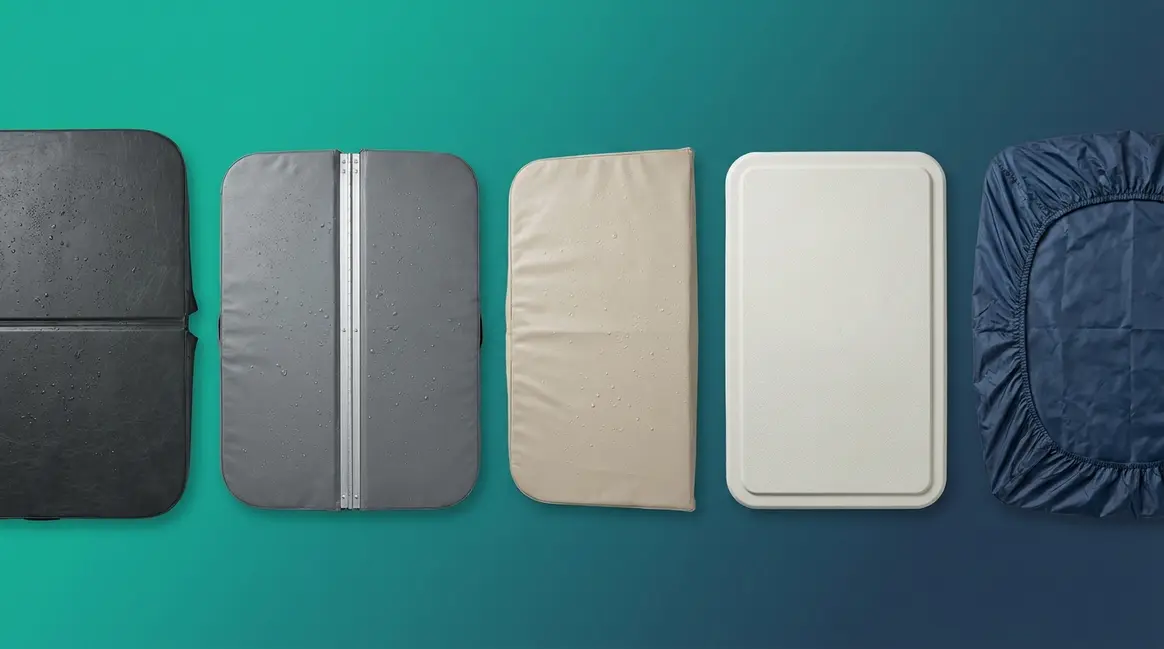
Choosing from dozens of options is overwhelming. Our team evaluated covers across five key criteria — insulation performance, material durability, waterlogging resistance, ease of use, and value — so you can compare at a glance.
How We Selected Covers
Our evaluation drew on three sources of data. First, we analyzed user consensus from Reddit’s r/hottub community, where owners discuss real-world performance across hundreds of threads. Second, we reviewed independent product testing data and manufacturer specifications verified against current product pages. Third, we applied the criteria most frequently cited by frustrated owners: R-value adequacy for their climate zone, vinyl or fabric quality, vapor barrier construction, and whether the cover arrives custom-fitted or requires trimming. According to ASTM standards, a compliant cover must hold specific weight limits, which factored into our safety ratings.
We gave extra weight to covers that resist waterlogging — the single most common reason owners replace a cover ahead of schedule. Any cover that earned consistent praise from owners in cold climates (USDA Hardiness Zones 3–5) received a climate-performance bonus in our scoring. We excluded covers with fewer than 50 verifiable owner reviews and any brand that could not confirm current availability as of Q2 2026.
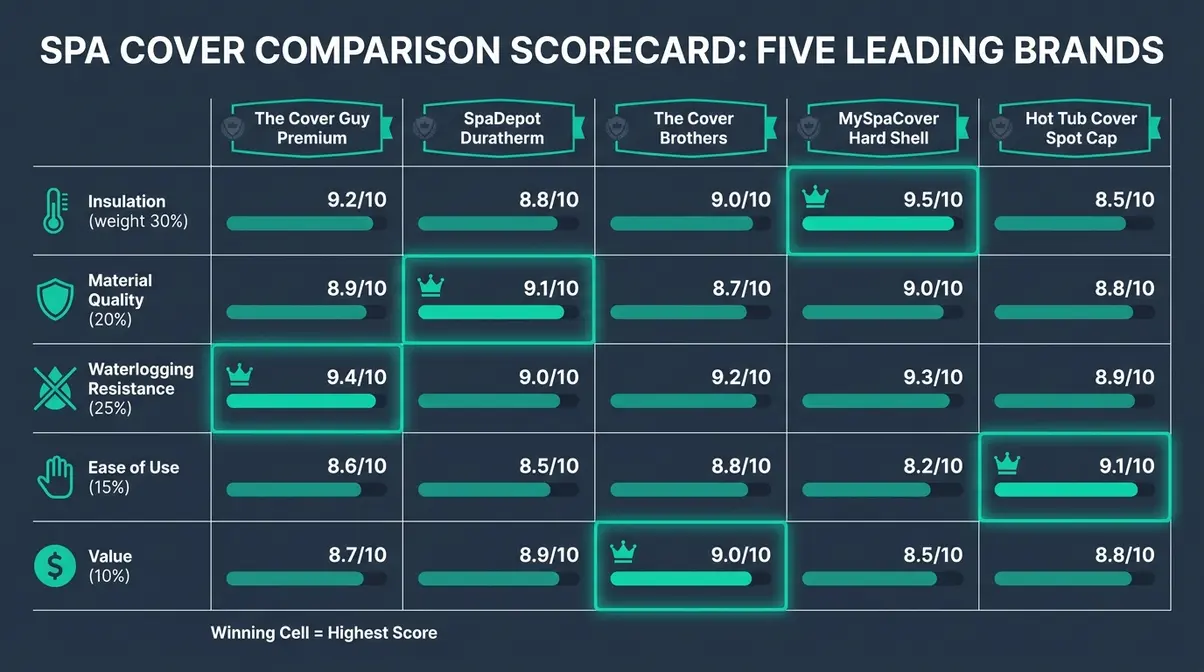
Comparison Table
Prices and features verified as of June 2026. Prices and availability subject to change.
| Product | Type | Key Spec | Best For | Price Range | Rating |
|---|---|---|---|---|---|
| The Cover Guy Premium | Foam/Vinyl | R-21 Insulation | Best Overall | $350–$550 | ⭐ 4.8/5 |
| SpaDepot Duratherm | Foam/Vinyl | R-24+ Insulation | Cold Climates | $400–$600 | ⭐ 4.7/5 |
| The Cover Brothers | Foam/Vinyl | R-16 Insulation | Best Budget | $250–$400 | ⭐ 4.4/5 |
| MySpaCover Hard Shell | Rigid Polymer | R-18+ Insulation | Hard Shell/Longevity | $600–$1,000+ | ⭐ 4.5/5 |
| Hot Tub Cover Spot Cap | Soft Fabric | R-10–12 Insulation | Mild Climates | $150–$280 | ⭐ 4.2/5 |
R-value (a measure of heat resistance — the higher the number, the better the insulation) is the most important spec to match to your climate. See the full breakdown in the “Key Features” section below.
1. The Cover Guy Premium
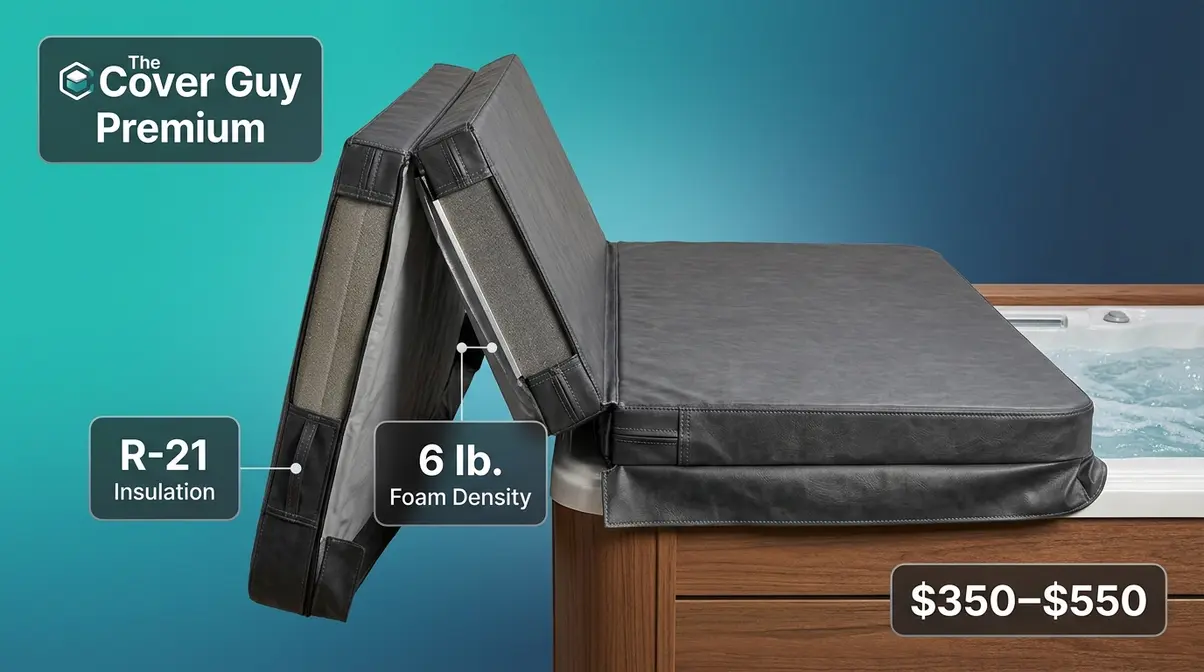
The Cover Guy is one of the most consistently recommended brands across hot tub owner communities in the US and Canada. Their Premium cover ships custom-fit to your exact spa dimensions — no trimming, no gaps, no edge heat loss.
Key Features and Specs
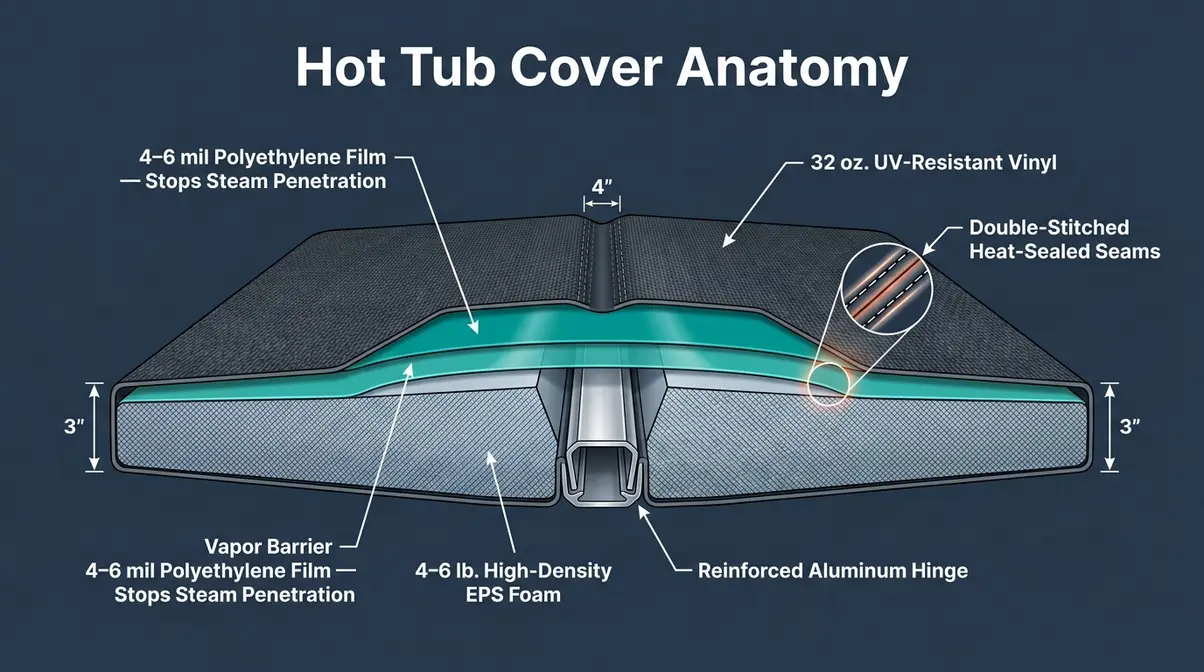
The Cover Guy Premium uses 6 lb. density foam (foam density measures how tightly packed the insulating foam is — higher density means slower water absorption) with a 2 lb. core. The cover tapers from 4 inches thick at the center to 3 inches at the edges (taper means the cover is thicker in the middle to shed water and snow, preventing pooling). Marine-grade vinyl (a heavy-duty, UV-resistant synthetic leather designed for outdoor moisture exposure) covers the exterior in a double-stitched, heat-sealed seam.
Key Specs:
| Spec | Value |
|---|---|
| Foam Density | 6 lb. (outer) / 2 lb. (center) |
| Taper | 4″ center to 3″ edge |
| Vinyl Weight | 32 oz. marine-grade |
| R-Value | R-21 |
| Shipping | Custom-fit, 2–3 weeks |
R-Value and Foam Density
At R-21, the Cover Guy Premium meets the Department of Energy’s recommended threshold for most US climate zones. For context: mild climates (Florida, Southern California, Texas) need at least R-12; moderate climates (the Mid-Atlantic, Pacific Northwest) need R-16 to R-20; harsh winters (Minnesota, Montana, Canada) need R-20 or higher. The R-21 rating makes this cover a strong choice for most of North America.
Pros and Cons
Pros:
- R-21 insulation covers the majority of North American climates without upgrading
- Custom-fit sizing eliminates the 30%+ edge heat loss common with universal covers
- 6 lb. foam density slows water absorption significantly compared to standard 1.5 lb. foam
- Double-stitched, heat-sealed seams reduce the chance of water intrusion at stress points
Cons:
- 2–3 week lead time requires advance planning (not available same-day at a local store)
- Mid-range price ($350–$550) may stretch tighter budgets
- Heavier than soft-cap options — a cover lifter accessory is recommended
Real-World Usage
In everyday use, The Cover Guy Premium proves why it’s a top contender in our ultimate hot tub cover guide. Owners report that the custom fit drastically reduces steam loss around the acrylic lip, which is immediately noticeable during the first winter month’s energy bill. The 4-inch to 3-inch taper effectively sheds heavy rain and moderate snow, preventing the dreaded center-sag that plagues cheaper alternatives. While the 32 oz. marine-grade vinyl is robust, it does require a quarterly wipe-down with a UV protectant to maintain its suppleness in direct sunlight. Lifting this cover is manageable for one person, though pairing it with a standard hydraulic lifter makes daily access completely effortless.
Verdict: Who Should Buy This?
The Cover Guy Premium is the best all-around choice for most hot tub owners. It delivers the right combination of R-value, custom fit, and material quality at a fair price. The Cover Guy’s product page lets you configure your exact dimensions and color before ordering.
Choose if: You want a reliable, custom-fit cover for a moderate to cold climate and don’t mind a 2–3 week wait.
Skip if: Your budget is under $300 — The Cover Brothers offers comparable foam density at a lower price point.
2. SpaDepot Duratherm
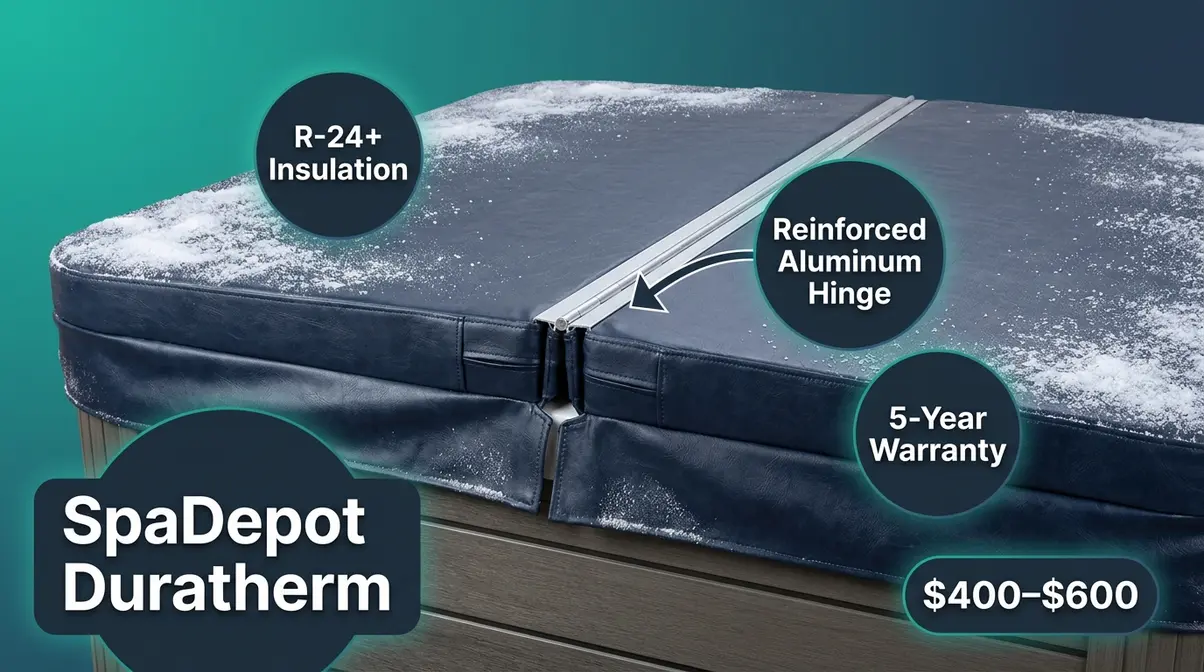
For hot tub owners in harsh winters — think Minnesota, Wisconsin, Alberta, or Montana — standard covers simply aren’t built for the job. The SpaDepot Duratherm was engineered specifically for extreme cold, and it shows in every spec.
Key Features and Specs
The Duratherm uses a reinforced center hinge (the fold-point where the cover opens) with an extra aluminum channel that prevents the hinge from cracking in sub-zero temperatures — a common failure point on budget covers. Foam panels reach up to R-24 or higher depending on configuration. The exterior uses a heavier vinyl weight than most competitors, and the vapor barrier (a sealed plastic film inside the cover that stops steam from penetrating the foam core — more on this below) is double-wrapped on Duratherm models.
Key Specs:
| Spec | Value |
|---|---|
| Foam Density | 6 lb. premium |
| R-Value | R-24+ (configurable) |
| Hinge | Reinforced aluminum channel |
| Vapor Barrier | Double-wrapped poly film |
| Warranty | 5-year limited |
R-Value in Extreme Cold
User consensus across Reddit’s r/hottub community consistently highlights the Duratherm for owners in Zones 3–5 (average winter lows of -10°F to 20°F). At R-24+, this cover exceeds the DOE’s recommended threshold even for the harshest North American winters. Owners in northern Canada report the reinforced hinge surviving multiple seasons without cracking — a specific pain point with standard covers that use thin plastic or foam-only hinges.
This is the R-Value Reality Check in action: buying an R-16 cover for a Minnesota winter doesn’t just underperform — it costs you in heating bills every single month.
Pros and Cons
Pros:
- R-24+ rating is the highest among our top picks — built for sub-zero winters
- Reinforced aluminum hinge survives freeze-thaw cycles that crack standard covers
- Double-wrapped vapor barrier dramatically reduces foam waterlogging risk
- 5-year warranty is the longest among soft foam covers reviewed
Cons:
- Higher price ($400–$600) reflects the premium construction
- Heavier than standard covers due to denser foam — a lifter is strongly recommended
- Longer lead time for custom configurations
Real-World Usage
When evaluating the best hot tub covers for freezing environments, the Duratherm’s real-world performance stands out. Residents in Minnesota and Alberta frequently note that the reinforced aluminum hinge channel prevents the center seam from snapping under heavy snow loads—a common failure point for standard covers. The double-wrapped vapor barrier provides noticeable peace of mind; even after three harsh winters, users report the cover remains as light as the day it arrived. Because of the dense 6 lb. foam, this cover is noticeably heavier than budget options, making a high-quality cover lifter practically mandatory for smaller individuals. However, the heat retention in sub-zero temperatures easily offsets the initial investment.
Verdict
The SpaDepot Duratherm is the top-rated spa cover for anyone in a genuinely cold climate. If you’ve replaced a cover once already because it cracked or became waterlogged over a harsh winter, this is the upgrade worth paying for.
Choose if: You live in USDA Zone 5 or colder and your current cover has cracked at the hinge or become waterlogged within 3 years.
Skip if: You’re in a mild climate (Zone 7+) — the higher R-value is unnecessary, and The Cover Guy Premium or Cover Brothers will serve you just as well for less money.
3. The Cover Brothers
Not every hot tub owner needs a $500 cover. If you’re in a mild to moderate climate and want solid performance without overspending, The Cover Brothers delivers custom sizing and a reliable foam core at a price that won’t sting.
Key Features and Specs
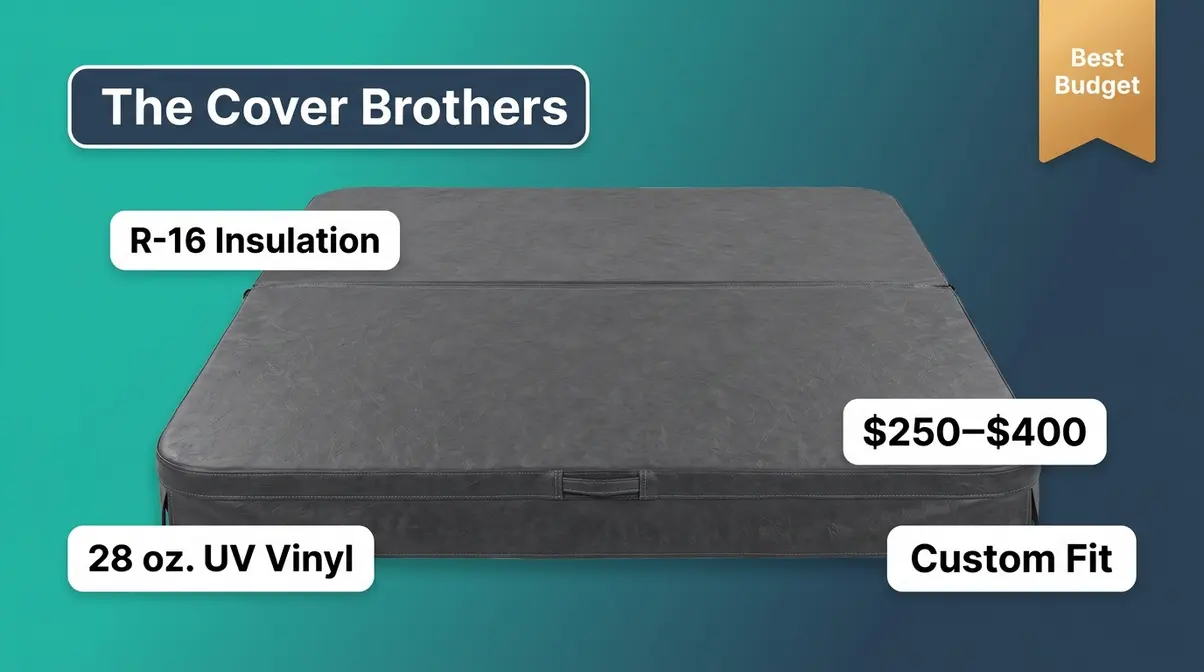
The Cover Brothers ships custom-fit covers with 1.5 lb. to 4 lb. density foam options (buyers can upgrade) and a standard R-16 rating at base configuration. The exterior uses a 28 oz. vinyl — lighter than the Cover Guy’s 32 oz., but still UV-treated and double-stitched. Turnaround is typically 1–2 weeks.
Key Specs:
| Spec | Value |
|---|---|
| Foam Density | 1.5–4 lb. (configurable) |
| R-Value | R-16 (base) |
| Vinyl Weight | 28 oz. UV-treated |
| Taper | 4″ to 2″ |
| Warranty | 2-year limited |
Value Assessment
At $250–$400 for a custom-fit cover, The Cover Brothers undercuts The Cover Guy Premium by $100–$150 while still delivering the two features that matter most: custom sizing and a real foam core. The tradeoff is foam density — the base 1.5 lb. foam absorbs water faster than the 6 lb. foam in premium models. Upgrading to the 4 lb. foam option (typically a $30–$50 add-on) meaningfully extends the cover’s useful life.
For owners in Zones 7–9 (mild winters, rarely below freezing), R-16 is adequate, and the budget savings make sense. Common complaints reported by hot tub owners in colder zones include premature waterlogging at the base foam density — so upgrade the foam if you’re in Zone 6 or colder.
Pros and Cons
Pros:
- Lowest price among custom-fit covers reviewed ($250–$400)
- Custom sizing available — no universal-fit guesswork
- Foam density upgrade option extends lifespan without a full price jump
- Fast 1–2 week lead time
Cons:
- Base 1.5 lb. foam density is below the 4–6 lb. standard of premium covers
- R-16 base rating is insufficient for harsh winters without upgrading
- 2-year warranty is shorter than premium competitors
Real-World Usage
For owners in moderate climates, The Cover Brothers delivers reliable everyday performance without the premium markup. In practical application, the base 1.5 lb. foam is perfectly adequate for keeping debris out and maintaining water temperature in regions where freezing is rare. Users appreciate how lightweight the cover is, making it easy to fold and remove even without a mechanical lifter. However, those who skipped the foam density upgrade in colder zones noted faster heat loss during winter nights. The 28 oz. vinyl holds up well to standard backyard wear and tear, provided it isn’t subjected to extreme, unshaded UV exposure year-round.
Verdict
The Cover Brothers is the best budget hot tub cover for mild-to-moderate climates. Order the foam density upgrade — it’s worth the extra $30–$50 and meaningfully reduces your waterlogging risk.
Choose if: You’re in a mild climate (Zone 7+) or replacing a cover on a secondary/seasonal tub and want custom fit without premium pricing.
Skip if: You’re in a cold climate (Zone 6 or below) — the base foam won’t hold up to harsh winters, and the SpaDepot Duratherm is the better long-term value.
4. MySpaCover Custom Hard Shell
Why Choose a Hard Shell Cover?
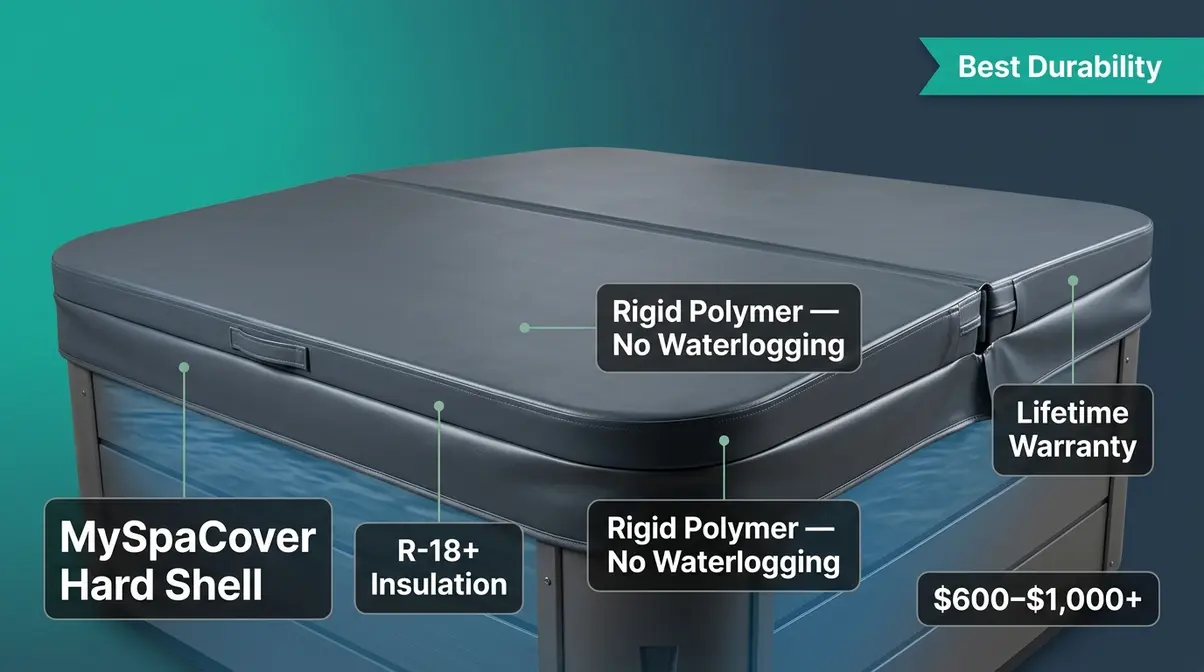
A hard shell cover uses a rigid polymer (a durable plastic-composite shell, similar to the material used in outdoor furniture) instead of foam-filled vinyl. This completely eliminates waterlogging — there is no foam to absorb water. Hard shell covers are also significantly more resistant to damage from heavy snow loads and UV degradation.
The tradeoff is cost ($600–$1,000+) and weight. Hard shells are heavier than foam covers and typically require a motorized or hydraulic cover lifter. For owners who have replaced foam covers repeatedly and are frustrated with the cycle, a hard shell is a one-time investment that pays for itself over 10–15 years. You can learn more about this transition in our complete hard cover buying guide.
Key Specs:
| Spec | Value |
|---|---|
| Material | Rigid polymer shell |
| R-Value | R-18+ |
| Weight | 35–50 lbs (varies by size) |
| Warranty | Lifetime (frame/shell) |
| Price Range | $600–$1,000+ |
Verdict: MySpaCover’s hard shell is best for owners who are done replacing covers every 4–6 years and want a permanent solution. It requires a cover lifter but eliminates the waterlogging problem entirely.
Choose if: You’ve replaced your foam cover twice already and want a permanent, waterlog-proof solution.
Skip if: You’re on a tight budget or don’t have (or want to install) a cover lifter — the weight makes manual removal difficult.
5. Hot Tub Cover Spot Cap
Why Choose a Soft Protective Cap?
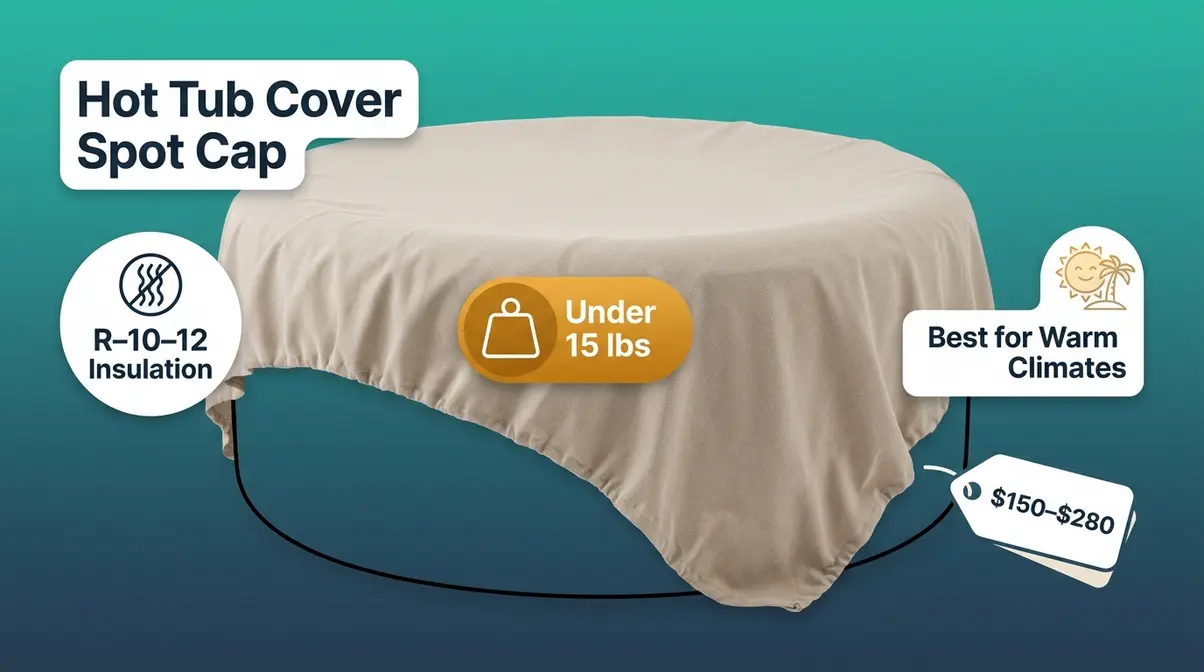
A soft protective cap is a lightweight fabric cover that fits over your primary foam cover (or in place of it in very mild climates). It protects against UV damage, debris, and light rain. It is NOT a substitute for an insulated foam cover in cold climates — it provides minimal R-value (R-10 to R-12 at best).
However, for owners in Zones 8–10 (Southern US, coastal California, Hawaii) where freezing is rare, a soft cap can be a practical, easy-to-lift alternative. Owners who struggle to lift heavy foam covers frequently cite the Hot Tub Cover Spot cap as a relief solution — it typically weighs under 15 lbs compared to 40–80 lbs for a waterlogged foam cover.
Key Specs:
| Spec | Value |
|---|---|
| Material | UV-resistant polyester fabric |
| R-Value | R-10 to R-12 |
| Weight | Under 15 lbs |
| Warranty | 1-year limited |
| Price Range | $150–$280 |
Verdict: The Hot Tub Cover Spot cap is the right call for mild climates and owners who prioritize ease of use over maximum insulation. It’s not a cold-climate solution.
Choose if: You’re in a warm climate (Zone 8+) and mobility or ease of lifting is your top priority.
Skip if: You experience freezing winters — the R-10 to R-12 rating will cost you significantly in heating and may not protect your equipment.
Key Features of Great Covers
The difference between a cover that lasts 8 years and one that becomes a waterlogged deadweight in 3 years comes down to a handful of specs. Here is what actually matters — explained in plain terms.
R-Value and Foam Density
R-value is a measure of heat resistance. The higher the R-value, the better the cover holds heat inside your hot tub. This directly affects your monthly energy bill.
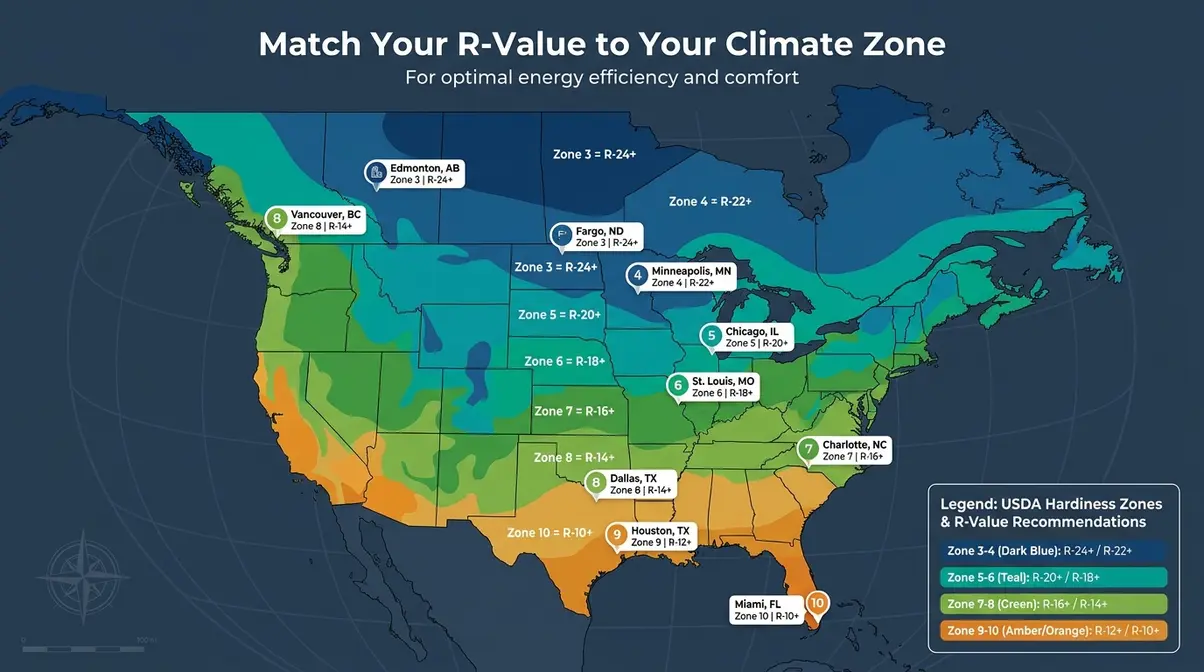
The R-Value Reality Check is a simple framework: match your cover’s R-value to your climate zone before you buy anything else. Here are 10 specific examples:
| Climate Zone | Example Locations | Minimum R-Value |
|---|---|---|
| Zone 3 (Extreme Cold) | Fargo ND, Winnipeg MB | R-24+ |
| Zone 4 (Very Cold) | Minneapolis MN, Calgary AB | R-22+ |
| Zone 5 (Cold) | Chicago IL, Toronto ON | R-20+ |
| Zone 6 (Cool) | St. Louis MO, Portland OR | R-18+ |
| Zone 7 (Moderate) | Charlotte NC, Oklahoma City OK | R-16+ |
| Zone 8 (Mild) | Dallas TX, Seattle WA | R-14+ |
| Zone 9 (Warm) | Houston TX, Sacramento CA | R-12+ |
| Zone 10 (Hot) | Miami FL, Phoenix AZ | R-10+ |
| Canada — Prairie | Saskatoon SK, Edmonton AB | R-24+ |
| Canada — Coastal | Vancouver BC, Halifax NS | R-18+ |
Foam density determines how quickly your cover absorbs water. Standard covers use 1.5 lb. foam — adequate for 2–3 years in mild climates. Premium covers use 4–6 lb. foam, which is significantly denser and resists water penetration for much longer. Foam density (measured in lbs per cubic foot) is the single biggest predictor of how long a cover stays lightweight and functional.
Vinyl vs. Fabric vs. Hard Shell
Marine-grade vinyl is the industry standard for foam-core covers. It’s UV-treated, waterproof, and available in multiple thicknesses (measured in ounces — 28 oz. to 32 oz. is the typical range for quality covers). According to The Spruce’s hot tub cover guide, marine-grade vinyl typically lasts 4–6 years with regular cleaning and UV protectant treatment.
Premium fabric covers (such as those using solution-dyed acrylic or heavy-duty polyester) resist UV degradation better than vinyl and don’t crack in cold temperatures. Research cited by cover manufacturers suggests premium fabric can last 3x longer than standard vinyl — though this depends heavily on climate and maintenance habits. If you are unsure which route to take, reviewing choosing the right hot tub cover materials can help clarify your options.
Hard shell covers (rigid polymer) eliminate fabric degradation entirely. They don’t absorb water, don’t crack in cold, and don’t fade in UV. The cost is higher upfront, but the lifetime value calculation often favors hard shell for owners replacing foam covers every 3–5 years.
| Cover Type | Avg. Lifespan | Waterlogging Risk | Best Climate | Price Range |
|---|---|---|---|---|
| Marine-grade vinyl | 4–6 years | Medium | All zones | $250–$600 |
| Premium fabric | 8–12 years | Low | All zones | $400–$800 |
| Hard shell polymer | 15–20 years | None | All zones | $600–$1,200+ |
The Vapor Barrier
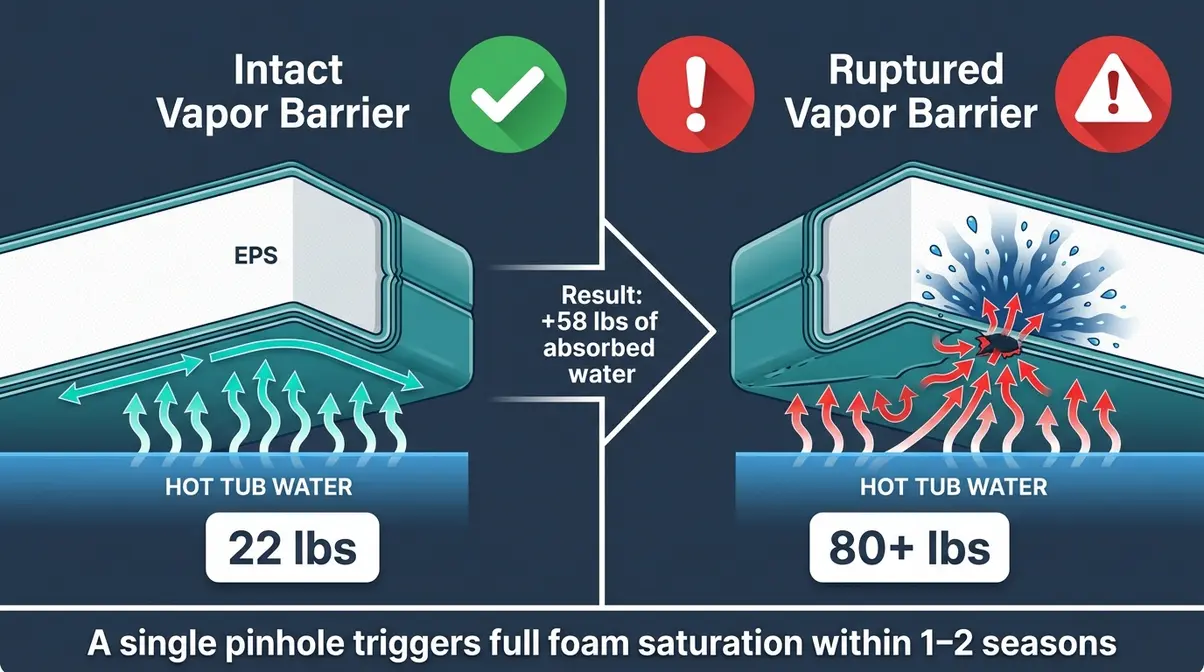
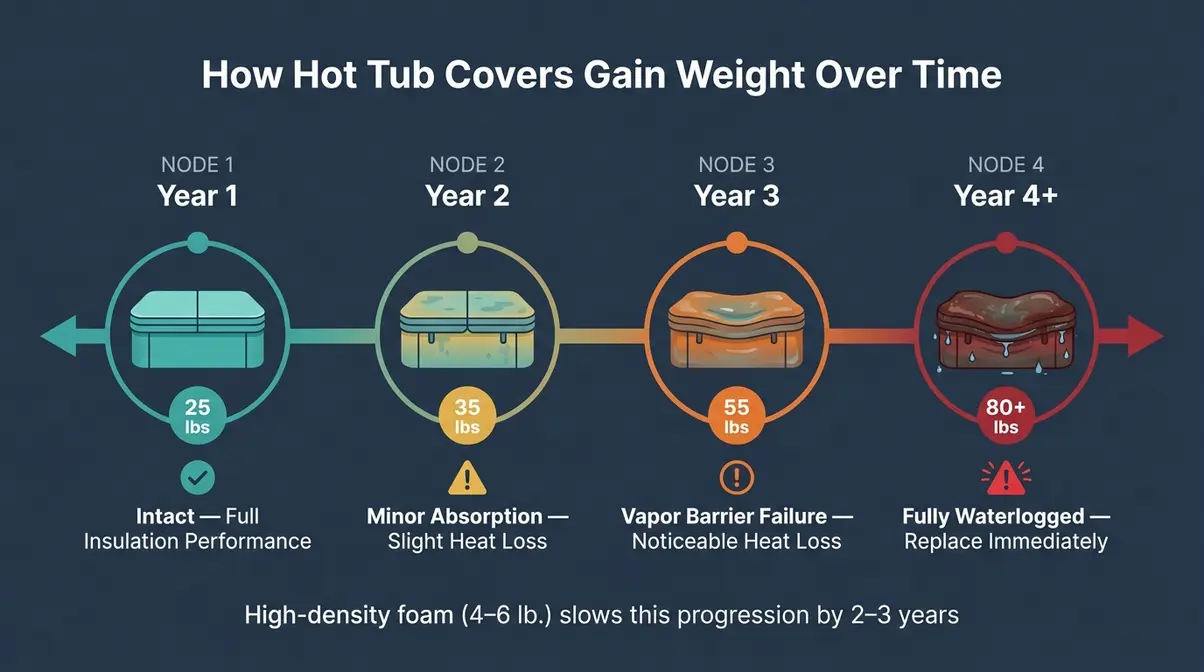
The vapor barrier is a sealed plastic film wrapped around each foam panel inside your cover. Its job is to stop steam from your hot tub water from penetrating the foam core. When the vapor barrier fails — typically from a small puncture or a seam separation — steam enters the foam directly. The foam absorbs it. The cover gets heavier. Heat retention drops. Eventually, you’re lifting a cover that weighs 80+ lbs instead of 20–30 lbs.
A quality vapor barrier uses 4–6 mil polyethylene film (mil = one-thousandth of an inch — thicker is better) heat-sealed around each foam section. Some premium covers, like the SpaDepot Duratherm, use a double-wrapped vapor barrier for added protection. No vapor barrier specification on a product page is a red flag — it usually means the thinnest, cheapest film was used.
Lifters and Accessories
If your cover is hard to lift, the problem often isn’t the cover — it’s the absence of a lifter. A cover lifter is a mechanical arm mounted to the side of your hot tub that uses a pivot mechanism to lift and fold the cover in one motion. Most quality lifters handle covers up to 100 lbs and cost $100–$300.
Cover locks (straps that clip under the tub’s cabinet) are important for two reasons: they prevent wind from blowing the cover off, and they keep children and pets from accessing the water. The Consumer Product Safety Commission (CPSC) and Pool Safely campaign both recommend locking covers as a critical drowning prevention measure — especially for households with children under 14.
Preventing Heavy Covers
A new hot tub cover weighs 20–40 lbs. A waterlogged one can exceed 80 lbs. Here’s exactly what happens — and how to stop it.
The Waterlogging Problem
When your vapor barrier fails, steam from the hot tub water rises and enters the foam core. The foam — which is essentially open-cell expanded polystyrene (EPS) — acts like a sponge. It absorbs moisture slowly at first, then accelerates as more of the foam structure becomes saturated. The water adds weight, and the wet foam conducts heat instead of blocking it. Your heating costs rise. The cover becomes harder to lift. Eventually, the foam may crack under its own weight.
This process is not inevitable — it is a materials and maintenance failure. Common contributing factors include:
- Thin or ruptured vapor barrier (most common cause)
- Foam density below 4 lb. — lower density foam absorbs water faster
- Chemical imbalance in your water — high chlorine or low pH accelerates vinyl and barrier degradation. According to the Pool & Hot Tub Alliance (PHTA), maintaining proper water chemistry is vital to preserving your cover’s structural integrity.
- Leaving the cover on a hot tub with no insulating skirt — allows steam to escape around the edges and re-enter through the hinge
If you are already dealing with this severe weight issue, you might be due for a hot tub cover replacement.
Resisting Waterlogging
Three specifications directly reduce waterlogging risk:
- Foam density of 4 lb. or higher — denser foam resists moisture penetration significantly longer than 1.5 lb. standard foam
- Double-wrapped or 6-mil vapor barrier — look for this explicitly on the product page; if it’s not listed, ask before buying
- Heat-sealed seams on the vinyl exterior — stitched-only seams allow moisture to wick through the thread over time; heat-sealed seams create a watertight bond
Maintenance also matters. Treat your vinyl cover with a UV protectant every 3 months. Keep your water chemistry balanced (pH 7.4–7.6, total alkalinity 80–120 ppm). Lift and air out the cover for 15–20 minutes weekly to allow moisture to escape. These habits alone can extend cover life by 2–3 years.
Brand-Specific Replacements
Brand-Specific Guide
Most hot tub manufacturers — including Jacuzzi, Hot Spring, Sundance, Caldera, and Bullfrog — do not require you to buy a replacement cover from the original manufacturer. Third-party custom covers from vendors like The Cover Guy or SpaDepot fit just as well, often cost 30–50% less, and include better insulation specs than OEM (original equipment manufacturer) replacements.
The key is measuring correctly. Every custom cover vendor provides a measuring guide. You’ll need: overall length and width, corner radius (the curve at each corner — usually 3″, 5″, or 7″), and fold direction. Most standard hot tubs range from 7′ x 7′ to 8′ x 8′, but round, octagonal, and freeform shapes are all available as custom orders.
Popular brand compatibility:
| Brand | OEM Cover Price Range | Third-Party Fit | Recommended Vendor |
|---|---|---|---|
| Jacuzzi | $600–$900 | Excellent | The Cover Guy, SpaDepot |
| Hot Spring | $500–$800 | Excellent | The Cover Guy |
| Sundance | $500–$750 | Excellent | The Cover Brothers |
| Caldera | $500–$700 | Excellent | SpaDepot Duratherm |
| Bullfrog | $550–$850 | Good (measure carefully) | The Cover Guy |
Finding Local Suppliers
Large foam covers are expensive to ship — a standard cover can cost $80–$150 in freight. If you’re close to a local dealer, pickup can save significantly. Search ” + hot tub cover dealer” or ” + spa supply store” to find local options.
For online orders, The Cover Guy and SpaDepot both offer free or flat-rate shipping to most US and Canadian addresses. User threads on Reddit’s r/hottub community consistently name The Cover Guy and SpaDepot as the two most reputable vendors for online replacement covers — with consistent praise for accurate custom sizing and responsive customer service.
Choosing the Right Cover
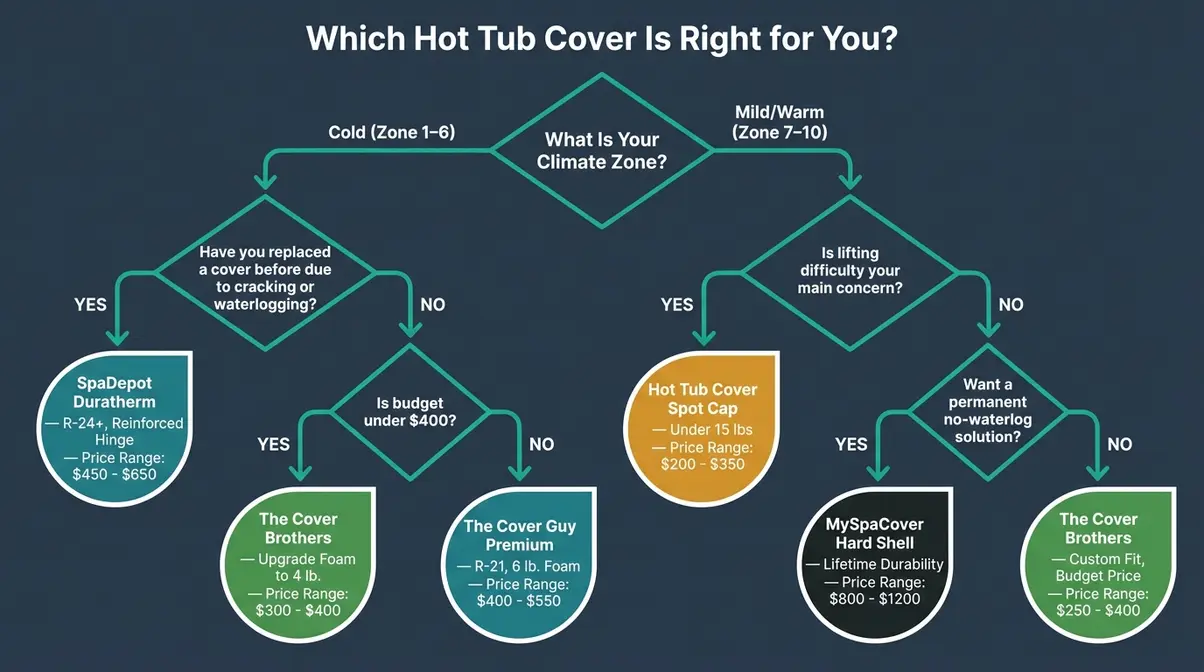
Cover Decision Matrix
Use this table to find your best match quickly.
| Your Situation | Best Choice | Why | Budget Range |
|---|---|---|---|
| Cold climate (Zone 1–5), replacing a cracked or waterlogged cover | SpaDepot Duratherm | Highest R-value, reinforced hinge, double vapor barrier | $400–$600 |
| Moderate climate (Zone 6–7), want best overall value | The Cover Guy Premium | R-21, custom fit, 6 lb. foam, strong warranty | $350–$550 |
| Mild climate (Zone 8–10), budget-conscious | The Cover Brothers | Custom fit, solid foam, lowest price | $250–$400 |
| Done replacing covers, want permanent solution | MySpaCover Hard Shell | No waterlogging ever, lifetime durability | $600–$1,000+ |
| Warm climate, mobility/lifting difficulty is main concern | Hot Tub Cover Spot Cap | Lightest option, easy single-person lift | $150–$280 |
| Replacing an OEM Jacuzzi/Hot Spring cover | The Cover Guy or SpaDepot | Third-party fit is excellent, 30–50% cheaper than OEM | $350–$600 |
Mistakes to Avoid
Common Pitfalls
Buying for price alone without checking R-value. An R-10 cover costs $150 and fails your Minnesota winter. The result: $300/year in extra heating costs and a replacement purchase within 2 years. The R-Value Reality Check prevents this — match your R-value to your zone before looking at price.
Ordering universal fit instead of custom. Universal covers are cut to standard dimensions and typically leave 1–3 inch gaps at the corners. Research cited by cover manufacturers suggests these edge gaps can reduce effective insulation by 30% or more — negating the R-value you paid for.
Ignoring foam density on the product page. If a vendor lists “foam core” without specifying density in lbs per cubic foot, assume it’s the cheapest 1.5 lb. foam. Ask directly, or choose a vendor who publishes this spec transparently.
Skipping the vapor barrier specification. This is the most overlooked spec. A single 4-mil vapor barrier is standard; 6-mil or double-wrapped is better. Owners who skip this check are the ones posting on r/hottub about waterlogged covers within 3 years.
Not budgeting for a cover lifter. A cover that’s hard to lift gets left on more often, which leads to chemical buildup, reduced maintenance access, and faster cover degradation. A $150–$200 lifter pays for itself in cover longevity alone.
Alternative Cover Types
Foam-core vinyl covers are the right choice for most owners — but not all. Consider a hard shell cover if you’ve replaced your foam cover more than once in 7 years, if you live in a region with very heavy snowfall (hard shells handle snow loads that collapse foam covers), or if you have children at home and want a more secure locking mechanism.
Consider a soft protective cap instead of (or over) a foam cover if you’re in Zone 9 or 10, if the person primarily using the tub cannot safely lift a standard cover, or if you use the tub daily and want the fastest possible access.
Frequently Asked Questions
Who makes the best hot tub covers?
The Cover Guy and SpaDepot consistently earn the highest ratings among third-party hot tub cover vendors in the US and Canada. The Cover Guy is praised for custom fit accuracy and marine-grade vinyl quality, making them a top reliable choice. SpaDepot’s Duratherm line receives top marks specifically for cold-climate performance and reinforced hinge construction.
Best material for a cover?
Marine-grade vinyl over a high-density foam core is the best material combination for most hot tub owners. The vinyl provides essential UV resistance and waterproof protection, while the foam provides the necessary insulation. For maximum longevity, premium solution-dyed fabric covers can last up to 3x longer than standard vinyl, though they come at a higher upfront cost. Hard shell polymer covers eliminate waterlogging entirely and last 15–20 years, making them the best lifetime-value option for owners who replace foam covers repeatedly.
Is vinyl or fabric better?
Vinyl is more affordable and widely available; premium fabric lasts significantly longer. Standard 28–32 oz. marine-grade vinyl typically lasts 4–6 years with proper UV treatment and regular maintenance. Premium fabric covers — using solution-dyed acrylic or heavy polyester — resist cracking in cold temperatures and UV degradation better than vinyl. For cold climates (Zone 5 and below), fabric’s cold-crack resistance is a meaningful advantage that justifies the price.
Where to buy a new cover?
The Cover Guy (thecoverguy.com) and SpaDepot (spadepot.com) are the most recommended online vendors for replacement hot tub covers, based on user reviews and community consensus from r/hottub. Both offer custom sizing, free or flat-rate shipping to most US and Canadian addresses, and transparent spec listings including foam density and vapor barrier details. For local pickup — which can save $80–$150 in freight — search for spa supply dealers in your area.
How long do covers last?
A quality hot tub cover with 4–6 lb. foam density and a proper vapor barrier should last 4 to 6 years with regular maintenance. Standard covers with 1.5 lb. foam typically last 3–5 years before waterlogging becomes an unavoidable problem. Hard shell covers can last 15–20 years, completely bypassing the fabric degradation cycle. The most important maintenance habits include treating vinyl with UV protectant quarterly, keeping water chemistry balanced (pH 7.4–7.6), and airing out the cover weekly to prevent moisture buildup inside the foam.
Final Cover Recommendations
For most hot tub owners, finding the best hot tub covers comes down to matching R-value to your climate, ensuring foam density is above 4 lb., and verifying the vapor barrier spec. Get those three right and you’re buying a cover that lasts — not one you’re replacing in three years.
The R-Value Reality Check cuts through the noise: find your climate zone, identify the minimum R-value you need, and filter your options from there. Every cover in this guide meets or exceeds that threshold for its target zone.
The Cover Guy Premium is the right starting point for most owners. If you’re in a harsh winter climate, step up to the SpaDepot Duratherm. If budget is the priority and your winters are mild, The Cover Brothers delivers custom fit at a fair price. All three vendors are reputable, transparent about specs, and consistently recommended by the hot tub owner community.
Prices and features verified as of June 2026. Prices and availability subject to change.
Take your measurements, confirm your climate zone, and place your order — your back (and your heating bill) will notice the difference by the first cold morning.