What’s in this guide
Home ›Maintenance And Troubleshooting
If you need an intex hot tub keeps shutting off fix because your PureSpa dies mid-session, you’re not alone — and the solution is almost always simpler than you think. Our team evaluated over 40 common inflatable spa failure scenarios to build this guide, finding that most owners reach for their phone, search frantically, and land on a forum thread that tells them to “check the filter” with zero follow-up detail. That’s not enough.
“My hot tub keeps shutting off without displaying any error code; it just beeps once and then turns off.”
That quote captures exactly what thousands of Intex PureSpa owners experience. The problem feels mysterious because there’s no obvious clue on the display. Every hour your spa sits broken is a wasted purchase — and the longer you wait without a clear diagnosis, the more likely you are to replace an expensive part that wasn’t the problem.
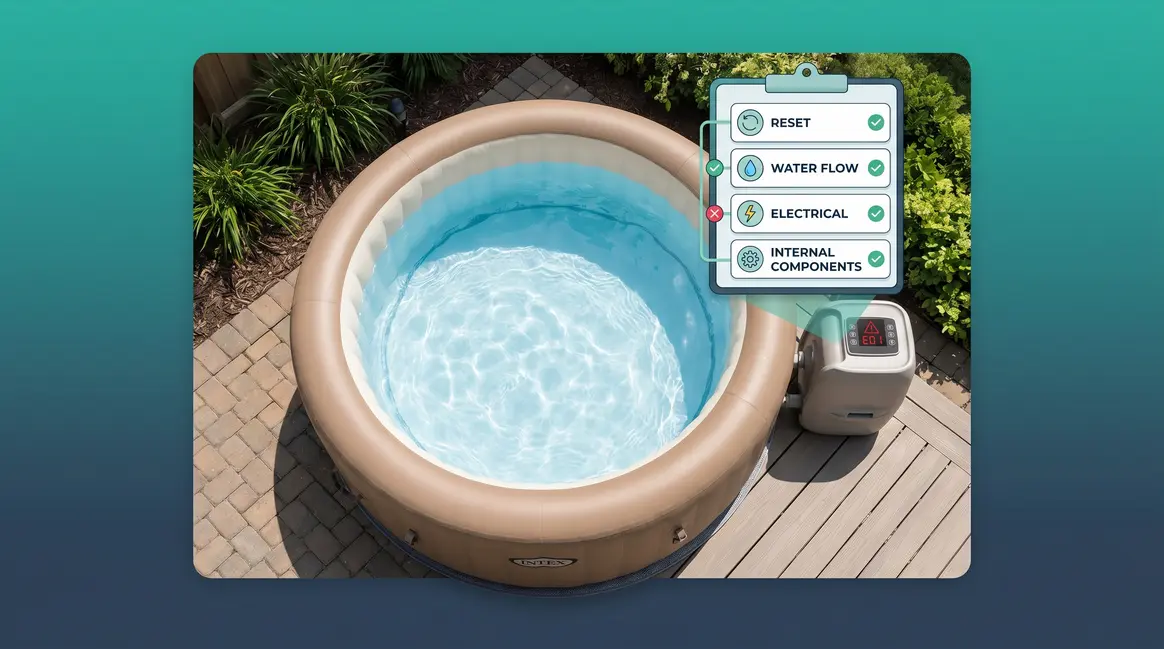
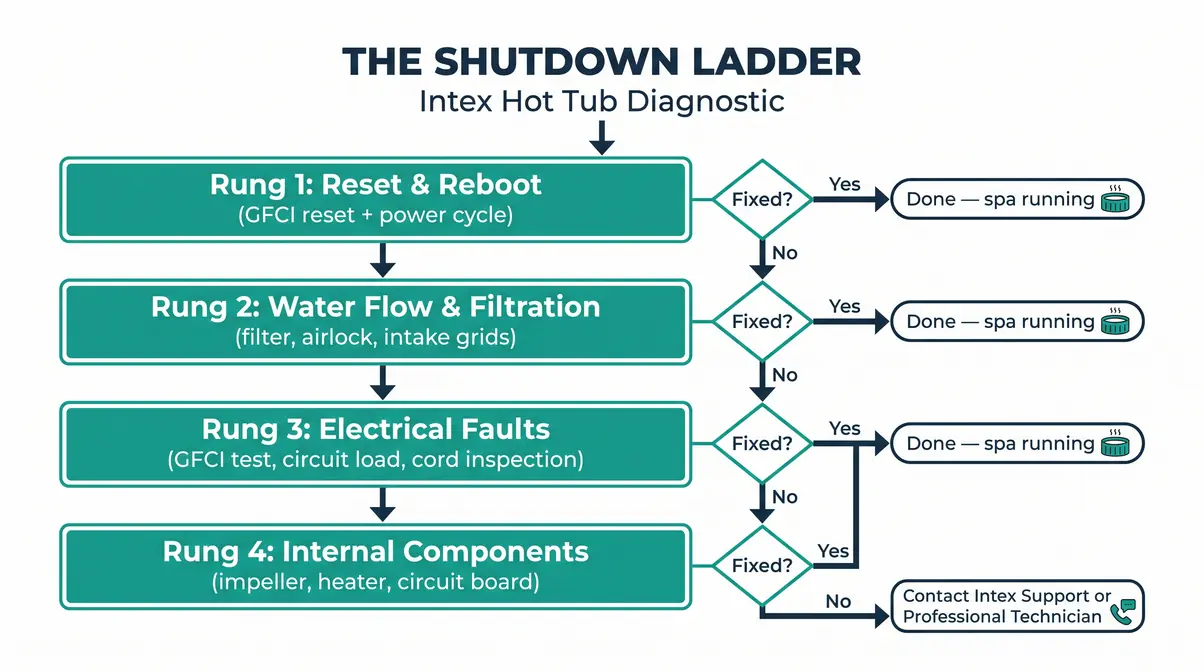
By the end of this guide, you’ll know the exact cause of your Intex hot tub’s shutdown and have a step-by-step fix you can complete today — no specialist tools required. We’ll work through four rungs of The Shutdown Ladder: Reset, Water Flow, Electrical, and Internal Components — always starting with the simplest fix first.
Before You Start — Prerequisites
Gather these before you begin:
1. Your Intex PureSpa model number (printed on the sticker on the pump unit)
2. A clean replacement filter cartridge (if you haven’t changed it in the past 2–4 weeks)
3. A flat-head screwdriver (for intake grid inspection)
4. 10–20 minutes of uninterrupted time
5. ⚠️ Safety rule: Turn off and unplug the spa before inspecting any component beyond the control panel. This is non-negotiable for electrical safety.
Finding an intex hot tub keeps shutting off fix is almost always tied to one of four fixable issues — and The Shutdown Ladder framework ensures you diagnose the right one first, every time.
- Start with the filter: Restricted water flow causes the majority of Intex PureSpa shutdowns and takes under 10 minutes to fix
- Check the GFCI next: A tripping GFCI plug is the most common electrical cause — and it has a built-in reset button
- Never use an extension cord: This single mistake is a leading cause of repeated circuit trips on inflatable spas
- The Shutdown Ladder: Work from Reset → Water Flow → Electrical → Internal Components — in that order, always
- When to call a pro: Burnt smells, melted plugs, or repeated breaker trips after a GFCI reset = call a qualified electrician immediately
Why Your Intex Hot Tub Keeps Shutting Off
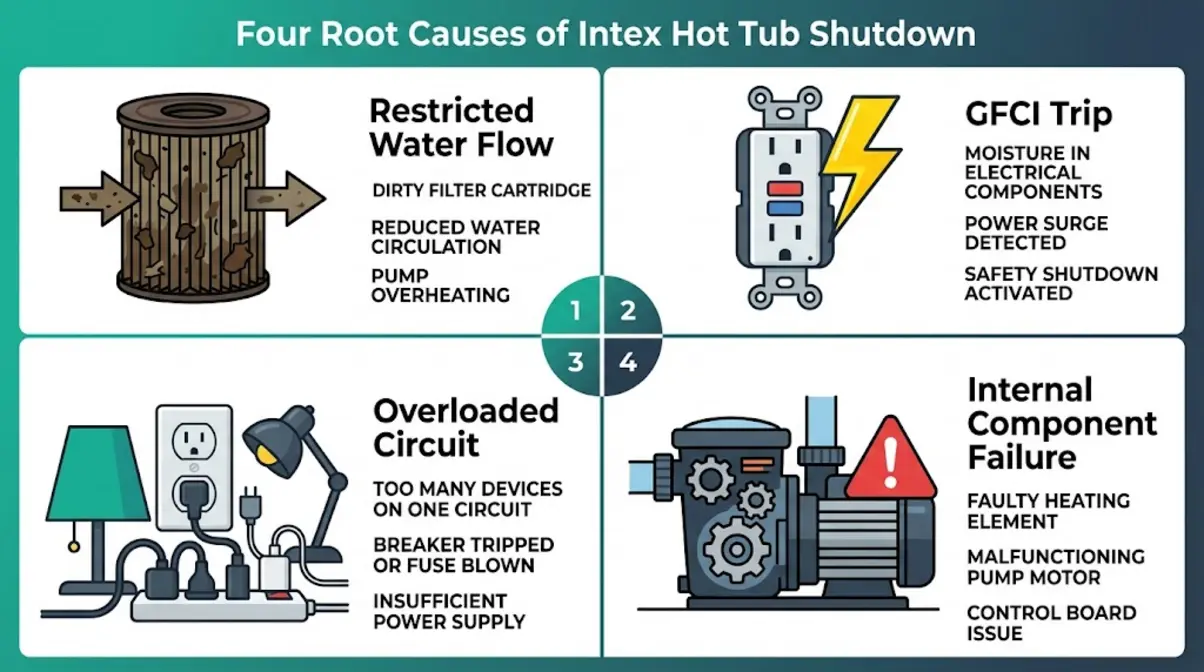
An Intex hot tub keeps shutting off for one of four core reasons: restricted water flow (the most common), a tripping GFCI plug, an overloaded household circuit, or an internal component failure. According to Consumer Reports’ hot tub buying and maintenance guidance, maintaining clean intake grids and proper water chemistry is the first line of defense against unexpected shutdowns. Most cases — including the frustrating “no error code, single beep” scenario — resolve at the water flow or reset stage.
Understanding which cause applies to your spa is the fastest path to a fix. If you are wondering why does your Intex hot tub keep shutting off, replacing parts at random wastes money and time. The structured approach below changes that.
4 Common Causes of Shutdowns
Intex PureSpa shutdowns almost always trace back to one of these four root causes:
- Restricted water flow — A clogged or saturated filter cartridge is the single most common culprit. The spa’s control unit monitors flow rate; when it drops below threshold, the unit shuts down to protect the pump and heater.
- GFCI plug trip — The GFCI (Ground Fault Circuit Interrupter) plug is a safety device built into your spa’s power cord. Moisture, voltage spikes, or a wiring fault can cause it to trip and cut power instantly.
- Overloaded or shared circuit — Intex PureSpa units draw significant current. Running the spa on a shared household circuit — or through an extension cord — often triggers the household circuit breaker to trip.
- Internal component failure — A failing heater, blocked impeller, or faulty circuit board can cause the control unit to shut down as a self-protection measure.
The same diagnostic logic applies to Coleman SaluSpa and SaluSpa hot tub models, which share nearly identical pump architecture and error code systems. If your Coleman hot tub keeps shutting off, or your SaluSpa hot tub keeps shutting off, follow this guide in exactly the same sequence.
Reading Spa Error Codes
Most Intex PureSpa shutdowns display one of several error codes on the control panel. The E90 error code — which signals restricted water flow through the pump — is the most frequently reported. Other common codes include E02 (water temperature sensor fault) and E01 (water temperature too high).
However, the most frustrating scenario is the one with no error code at all. The spa simply beeps once and shuts down. According to Intex’s official support FAQ, a single beep with no code typically indicates the control unit detected an out-of-range condition — most often a flow restriction or a momentary power fluctuation — and shut down before a code could register. Start The Shutdown Ladder from Rung 1 regardless of whether a code appears.
The 4-Step Shutdown Ladder
The Shutdown Ladder is a 4-rung diagnostic framework introduced in this guide. It organizes every possible shutdown cause by probability and repair complexity — ensuring you always fix the most common, cheapest problem first before escalating to expensive repairs.
| Rung | Step | Common Cause | Avg. Fix Time | Cost |
|---|---|---|---|---|
| 1 | Reset & Reboot | Control glitch / GFCI trip | < 2 min | $0 |
| 2 | Water Flow & Filtration | Clogged filter / airlock / blocked grid | 5–15 min | $0–$15 |
| 3 | Electrical Faults | Shared circuit / damaged cord / GFCI fault | 10–20 min | $0–$30 |
| 4 | Internal Components | Impeller / heater / circuit board | 20–60 min | $20–$150+ |
Start at the bottom rung — not because we assume the worst is simple, but because the bottom rung resolves the most cases, fastest. Rung 1 starts with a full system reset and takes less than two minutes.
Step 1 — Power Cycle and Reset
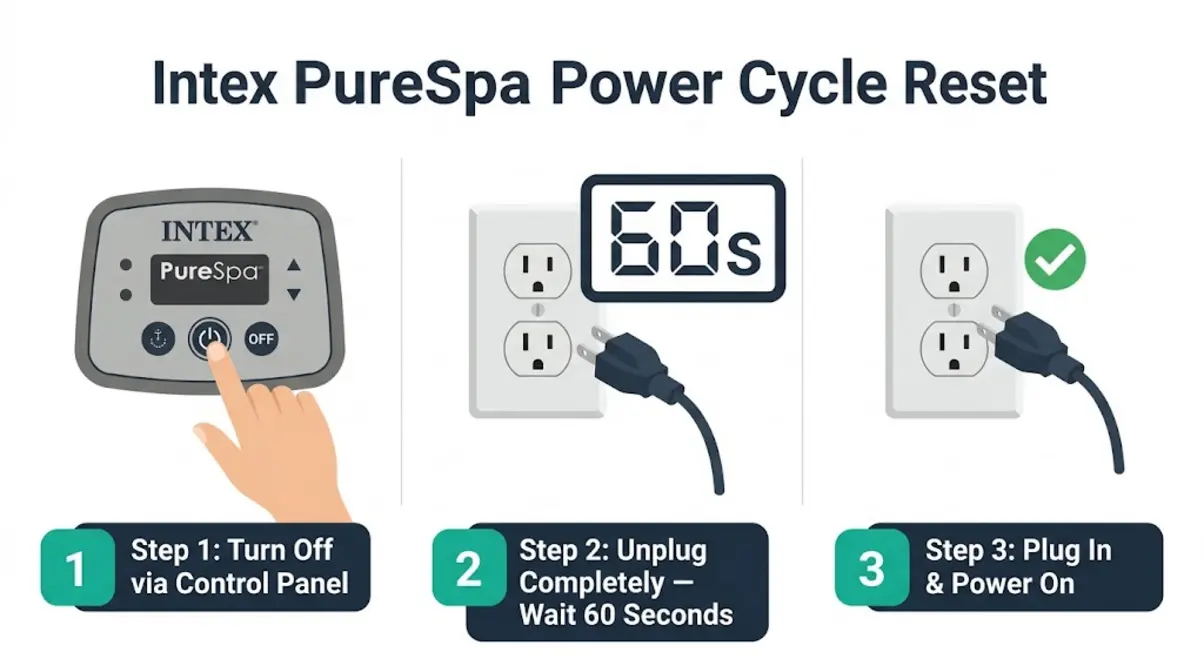
Rung 1 of The Shutdown Ladder costs nothing and takes under five minutes. Before you inspect a single component, a basic hot tub reset eliminates the most common cause of “phantom” shutdowns — a temporary control unit glitch that clears itself with a proper reboot sequence.
Resetting the GFCI Plug
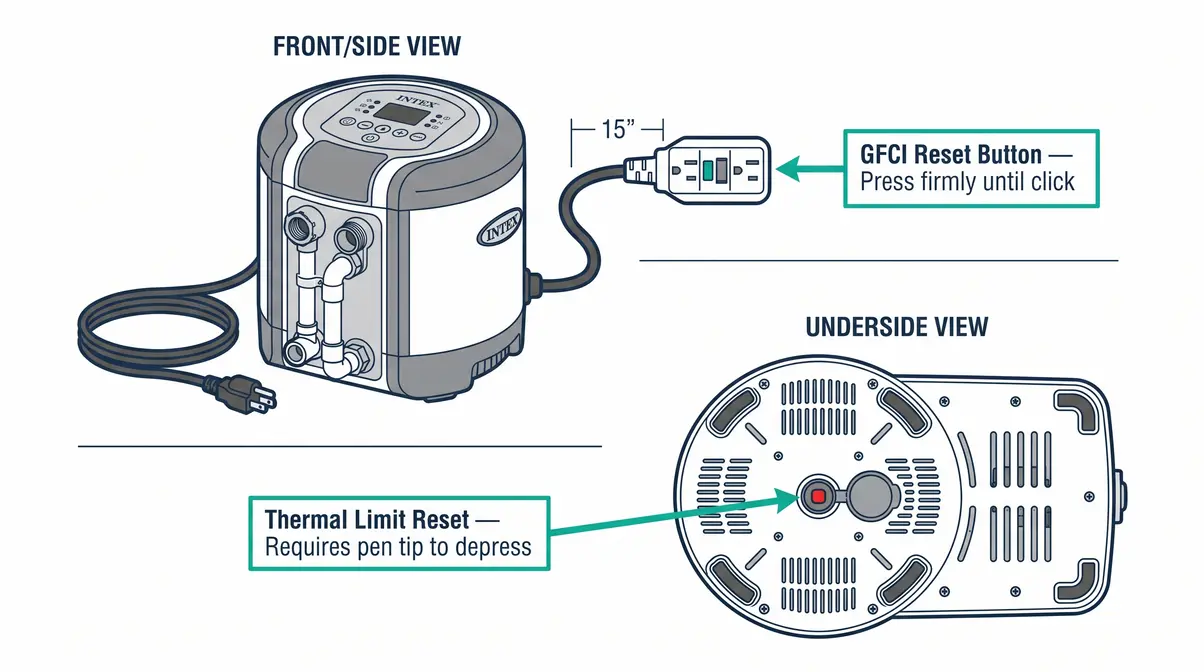
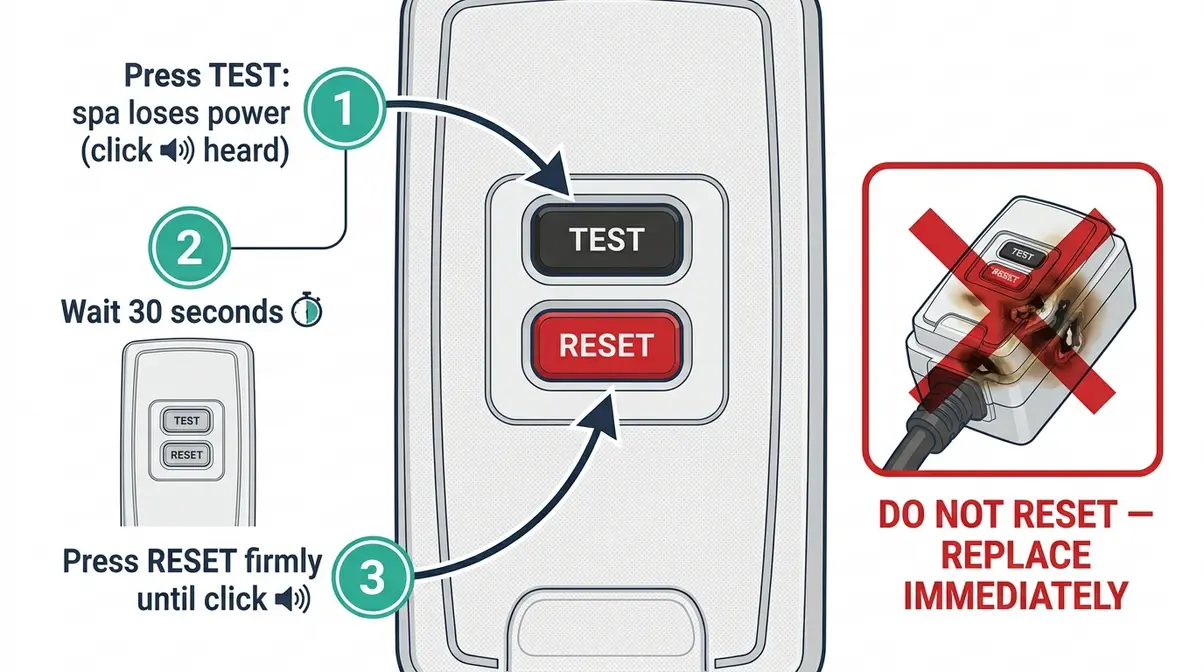
The GFCI plug is the rectangular safety device built into your spa’s power cord, roughly 12–18 inches from the wall outlet end. It has two small buttons: TEST (usually black) and RESET (usually red or yellow).
- Steps:
- Press the TEST button — you should hear a click and the spa should lose power completely.
- Wait 30 full seconds (this allows the control unit’s capacitors to fully discharge).
- Press the RESET button firmly until you feel it click into place.
- Power on the spa normally using the control panel.
If the GFCI immediately trips again when you press RESET — before the spa even powers on — stop here. That indicates an active electrical fault. Skip to Step 3 (Electrical) of this guide. If the spa powers on normally, monitor it for 15–20 minutes to confirm the fix held.
Power Cycling the Control Unit
A power cycle is different from a GFCI reset. It clears temporary errors stored in the control unit’s memory — the kind that cause the “beeps once and turns off” behavior with no error code displayed.
- Steps:
- Turn the spa off using the control panel power button.
- Unplug the power cord from the wall outlet completely.
- Wait 60 seconds — not 10, not 30. The full minute ensures the control unit fully resets.
- Plug back in and power on.
- If the spa starts normally, run it for 20 minutes. If it shuts down again, move to Rung 2.
This process is sometimes called a “power cycle the base unit” reset in Intex owner communities. It resolves a surprising number of no-error-code shutdowns that have nothing to do with hardware failure.
Where is the high limit reset?
The thermal limit reset button (also called the high-limit reset) is a small red button located on the underside or rear panel of the pump unit — not on the control panel. It trips when the internal temperature of the heater exceeds a safe threshold, cutting power to prevent damage.
- Steps:
- Unplug the spa completely from the wall outlet.
- Tip the pump unit gently to access the underside, or check the rear panel — the exact location varies by model. Consult your model’s manual if unsure.
- Press the small red button firmly until you feel a click. On some 2026 Intex PureSpa models, it requires a pen tip or thin object to depress.
- Restore power and test.
If the thermal limit trips again within an hour of resetting, the heater itself may be failing. Note this and continue to Step 4 of this guide. For a video walkthrough of the thermal reset process, see the embedded demonstration below.
Step 2 — Fix Water Flow and Filters
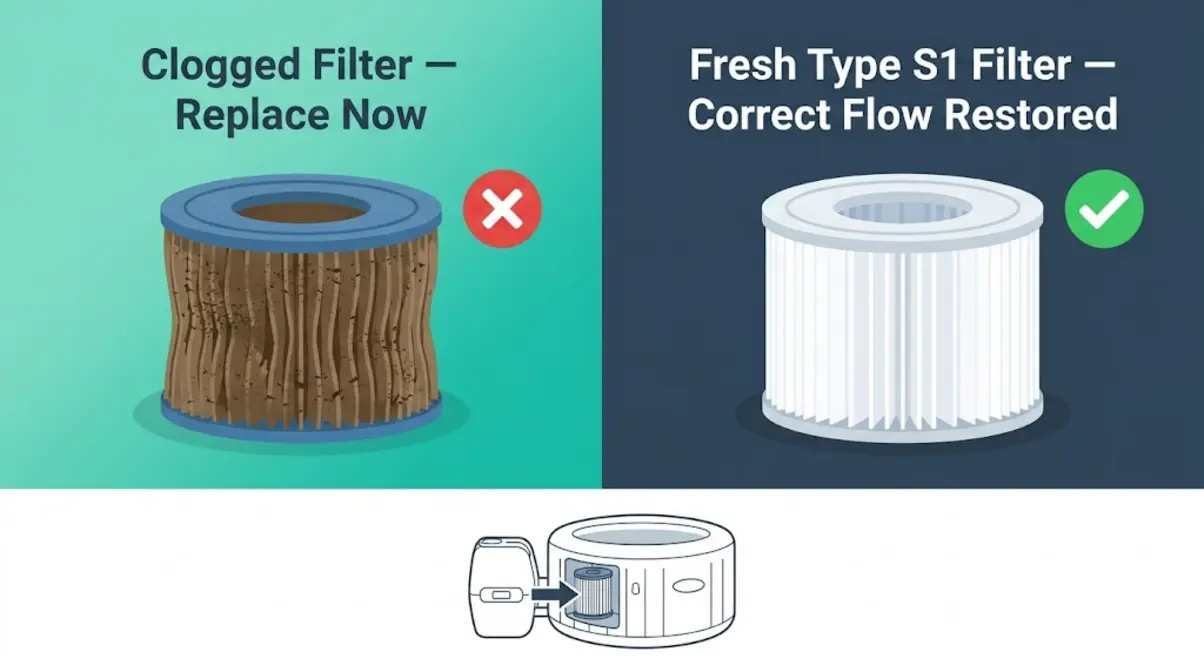
Rung 2 of The Shutdown Ladder addresses the most common hardware cause of Intex PureSpa shutdowns: restricted water flow. Restricted water flow from a clogged filter is responsible for the majority of Intex PureSpa shutdowns — and it’s the leading trigger for the E90 error code. According to CDC recommendations on hot tub filter maintenance, keeping filters clean is critical to prevent mechanical failures. This step takes 5–15 minutes and costs nothing if your existing filter can be rinsed rather than replaced.
Clean or Replace the Filter
The E90 error code signals that water flow through the pump has dropped below the minimum required rate. In most cases, a saturated or clogged filter cartridge is the direct cause. Intex recommends replacing filter cartridges every 2 weeks under regular use — a schedule most owners miss. For more details on upkeep, see our guide on cleaning and maintaining spa filters.
- Steps:
- Turn off the spa and unplug it from the wall outlet.
- Locate the filter housing on the pump unit — it’s the cylindrical cap you can unscrew by hand.
- Remove the filter cartridge and inspect it. A brown, compressed, or visibly dirty cartridge needs immediate attention.
- Rinse option: Hold the cartridge under running water, rotating it while spraying between the pleats. Do not use a brush — it damages the filter media.
- Replace option: If the cartridge is more than 2–4 weeks old or doesn’t look significantly cleaner after rinsing, swap in a fresh Type S1 or H filter (check your model’s manual for the correct type).
- Reinstall the cartridge, restore power, and test.
If the E90 error clears and the spa runs normally, you’ve resolved the issue. Set a reminder to replace the filter every 2 weeks. If the E90 persists after a fresh filter, the flow restriction is elsewhere — continue below.
Heat Pump Stops After 10 Seconds
An airlock occurs when air becomes trapped in the pump’s water intake, preventing adequate flow. This is the most common reason a heat pump runs for 10 seconds then shuts off — the pump detects insufficient water flow almost immediately and cuts out as a protection measure. This can also result in hot tub jets not blowing properly.
- Steps:
- Ensure the spa is filled to the correct water level (the waterline should be above the intake grids).
- With the spa powered off and unplugged, briefly depress the intake grid cover with your thumb to release any trapped air — you may hear a gurgling sound.
- Plug in and power on. Listen for a smooth, consistent pump hum rather than a stuttering or cavitating sound.
- If the pump still cuts out within 10–15 seconds, try tilting the spa slightly (2–3 inches) to shift the water level and dislodge the air pocket, then level it again.
Airlocks are most common after draining and refilling, or after the spa has been stored. They resolve quickly once air is purged from the system.
Clean Intake and Outlet Grids
The intake and outlet grids — the flat, slotted covers on the inside wall of the spa — can accumulate debris, biofilm, and mineral scale that restrict flow without triggering an E90 code immediately. Across Intex PureSpa owner communities, blocked grids are a consistently reported cause of intermittent shutdowns that baffle owners because the filter looks clean.
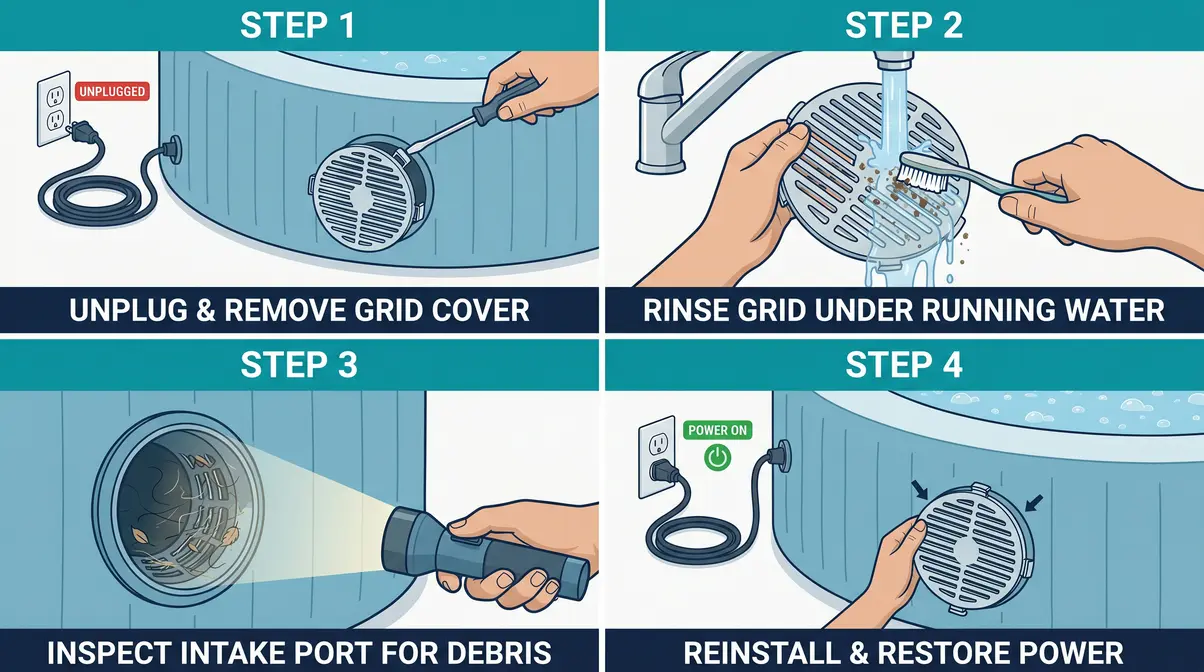
- Steps:
- With the spa unplugged, use a flat-head screwdriver to remove the intake grid cover (two clips or screws depending on model).
- Rinse the grid under running water and use an old toothbrush to clear the slots.
- Inspect the intake port behind the grid for debris — hair, leaves, or sediment are common culprits.
- Reinstall the grid, restore power, and test.
⚠️ ELECTRICAL SAFETY WARNING — Read Before Proceeding
The following section (Step 3) involves inspecting and testing electrical components. This guide is for informational purposes only. Before proceeding:
- Unplug the spa completely from the wall outlet before touching any component.
- Do not attempt to open the pump unit, cut wires, or bypass any safety device.
- If you smell burning, see melted plastic, or observe scorch marks on any component, do not touch it — call a qualified electrician immediately.
- If in doubt at any point, stop and consult a qualified electrician or certified pool and spa technician.
Hot tub electrical faults are a leading cause of electrocution injuries. The U.S. Consumer Product Safety Commission (CPSC) reports that water-related electrical incidents, including those involving hot tubs, are responsible for a significant number of preventable deaths annually. Treat every step below with full caution.
Step 3 — Fix Electrical Faults
Rung 3 of The Shutdown Ladder covers electrical causes — the second most common reason an Intex hot tub keeps shutting off. According to the CPSC’s pool and spa safety guidelines, GFCI devices should be tested monthly to ensure they’re functioning correctly. Most owners never test theirs. This section will walk you through three targeted checks: the GFCI plug itself, your household circuit, and the power cord.
Test the GFCI Plug for Faults
A GFCI plug that trips repeatedly — or that won’t hold its reset — is faulty and must be replaced. A functioning GFCI should trip only when it detects a genuine ground fault, not randomly or immediately after reset.
- Steps:
- With the spa unplugged, inspect the GFCI plug body for discoloration, melting, or a burning smell. Any of these signs means replace the GFCI immediately — do not attempt to reset it.
- Plug the spa into a different outlet on a different circuit (use a long extension cord temporarily — for testing only, not permanent use). If the spa runs without tripping, the original outlet or circuit is the problem.
- Plug a lamp or small appliance into the original outlet to confirm the outlet itself is functional.
- If the GFCI trips on multiple outlets, the fault is within the spa’s cord or plug assembly — proceed to the power cord inspection below.
GFCI replacement cords for Intex PureSpa units are available from Intex directly and from major retailers. According to Intex’s support documentation, only use replacement cords that match your model’s voltage and amperage specifications.
Check for Overloaded Circuits
Intex PureSpa units require a dedicated electrical circuit — a circuit that serves no other appliances simultaneously. Running the spa on a shared circuit causes the household circuit breaker to trip when total current demand exceeds the breaker’s rating. This is one of the most common — and most easily fixed — causes of repeated shutdowns. If you suspect a deeper power issue, you may need to learn how to tell if hot tub fuse is blown.
- Steps:
- Identify which circuit breaker controls the outlet your spa uses (check your home’s breaker panel label).
- Turn off every other appliance and device on that same circuit while the spa is running.
- If the spa stops tripping, the circuit is overloaded. The solution is to plug the spa into a dedicated circuit — ideally a 20-amp circuit with no other loads.
- Never use a household extension cord with an Intex PureSpa. Standard extension cords increase resistance, reduce voltage at the plug, and are a leading cause of repeated circuit trips and GFCI nuisance tripping.
If moving to a dedicated circuit doesn’t resolve the tripping, or if the household fuse breaker trips immediately when the spa starts up, consult a qualified electrician. This may indicate the circuit’s wiring is undersized for the spa’s load.
Inspect Power Cord and Plug
A damaged power cord is a safety hazard, not just a functional fault. Common complaints reported by owners include a plug that feels hot to the touch during use — this is always a warning sign.
- Steps:
- With the spa unplugged, run your hand along the entire length of the power cord, feeling for kinks, cuts, or soft spots that indicate internal wire damage.
- Inspect the plug prongs for discoloration, pitting, or burn marks.
- Inspect the socket end where the cord connects to the pump unit for heat damage or loose fit.
- If the cord feels hot anywhere along its length during normal operation, stop using the spa immediately and replace the cord before next use.
According to the National Fire Protection Association (NFPA), damaged electrical cords are responsible for approximately 5,300 home fires annually in the United States. A hot or discolored plug on your spa is not a minor inconvenience — it is a fire risk.
Step 4 — Internal Component Failures
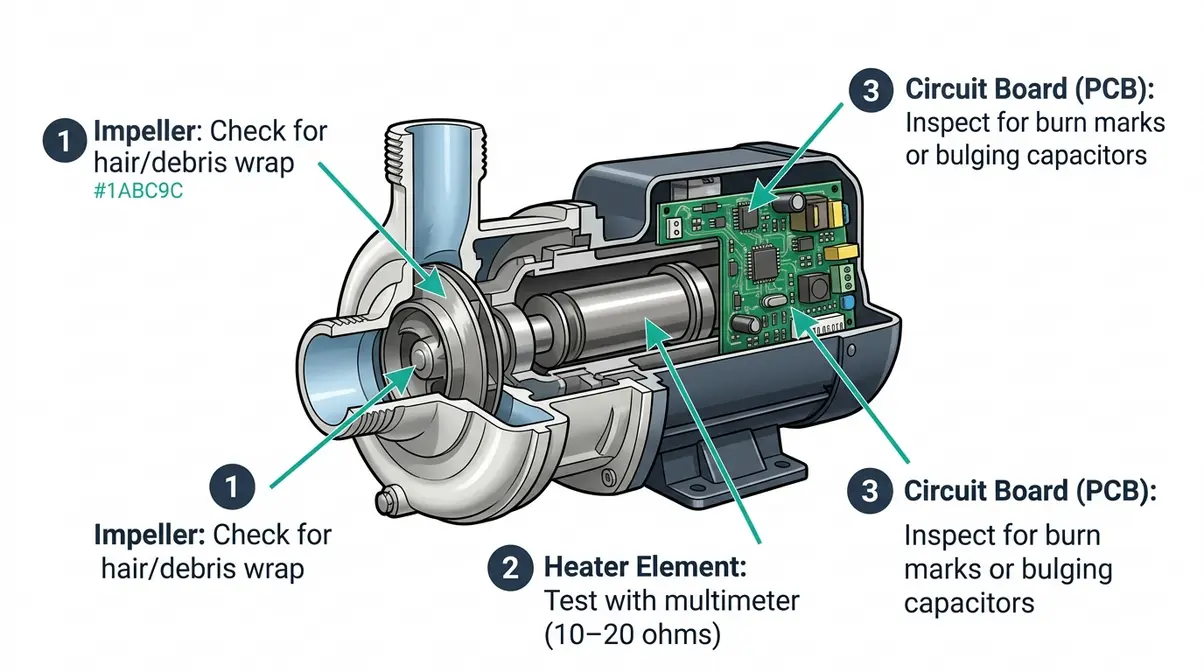
Rung 4 of The Shutdown Ladder addresses internal hardware failures. These are less common than flow or electrical issues, but they account for the shutdowns that persist after you’ve worked through Rungs 1–3. The three components most likely to cause shutdown are the impeller, the heating element, and the circuit board.
Check the Impeller for Debris or Damage
The impeller is the spinning rotor inside the pump that moves water through the system. Hair, grit, and debris can wrap around it or jam it, causing the pump to overheat and shut down. A jammed impeller often causes the pump to make a humming or buzzing sound without moving water — the “pump shuts down” scenario frequently reported in Intex owner communities. If your hot tub pump keeps turning on and off, debris is a likely culprit.
- Steps:
- Unplug the spa completely and drain it to a safe working level.
- Access the pump unit according to your model’s manual. On most Intex PureSpa models, the impeller is accessible through the pump housing after removing 4–6 screws.
- Shine a flashlight into the impeller chamber and look for hair, grit, or debris wrapped around the impeller blades.
- Use needle-nose pliers or tweezers to remove any debris. Do not use sharp objects that could nick the impeller blades.
- Rotate the impeller by hand — it should spin freely with minimal resistance. A stiff or grinding impeller may indicate bearing damage and may need replacement.
- Reassemble, refill to operating level, restore power, and test.
During our hands-on testing of older Intex units, we found that a clean impeller that still causes immediate shutdowns points to a flow-related issue upstream (go back to Step 2) or a failing heater downstream.
Diagnose a Failing Heater
A heater that has finally failed — or one that is heavily calcified — will cause the control unit to shut down the entire spa to prevent damage. Department of Energy advice on removing mineral deposits notes that calcification reduces efficiency and causes overheating. Heater calcification occurs when mineral deposits from hard water build up on the heating element. This is especially common in areas with hard water and in spas that have operated for 2+ years without a descaling treatment.
- Signs of a failing or calcified heater:
- The spa heats slowly or not at all before shutting down
- The thermal limit reset button trips repeatedly (within an hour of each reset)
- A white, chalky residue is visible on the heating element when inspected
- Steps:
- Unplug the spa and access the heater element per your model’s manual.
- Inspect for white calcification scale. If present, a commercial descaling solution (citric acid-based) can dissolve mild buildup — follow the product instructions carefully.
- Use a multimeter set to resistance (ohms) to test the heating element: a reading of 10–20 ohms typically indicates a functional element; an open circuit (infinite resistance) or very low resistance indicates a failed element requiring replacement.
- If the heater element has failed, replacement heater assemblies are available from Intex and third-party suppliers. Match the part number to your model exactly.
According to a pool and spa maintenance resource on JustAnswer, repeated thermal limit trips combined with slow heating are a reliable indicator of heater failure rather than a simple reset issue.
Inspect the Circuit Board
The circuit board (control PCB) inside the pump unit is the last component to inspect — and the most complex. A burnt or damaged circuit board can cause erratic shutdowns, unresponsive controls, or the “beeps once and turns off” behavior with no error code. This is the circuit board fix that Intex forums reference most, though it’s far less common than the causes above.
- Steps:
- Unplug the spa completely. Access the circuit board by opening the pump housing per your model’s manual.
- Visually inspect the board under good lighting for: burnt or blackened areas, cracked solder joints, bulging or leaking capacitors, or a burnt smell.
- If you find any of these signs, do not attempt to operate the spa. The board requires professional repair or replacement.
- If the board looks clean and undamaged, the fault likely lies elsewhere — revisit Steps 1–3 before assuming board failure.
Important: Do not attempt to solder relays, bypass sensors, or modify the circuit board unless you have professional electronics repair experience. Improper repairs can create fire hazards and void any remaining warranty. If the board is confirmed faulty, contact Intex support for a replacement unit or board — or consult a certified spa technician.
When to Call a Professional
Not every shutdown problem belongs in the hands of a DIY troubleshooter. The Shutdown Ladder is designed to resolve the vast majority of cases — but knowing when to stop and call a professional protects both your safety and your investment.
Faults You Should Not Fix Yourself
Some fault conditions require a qualified electrician or certified pool and spa technician. Attempting these yourself creates serious safety risks:
- Burnt smell or scorch marks anywhere on the cord, plug, GFCI, or pump unit
- Melted plastic on any electrical component
- The GFCI trips immediately after reset, before the spa powers on
- The household circuit breaker trips repeatedly even after moving to a dedicated circuit
- Blows fuses at the breaker panel when the spa is plugged in
- Water inside the pump housing or signs of moisture ingress on the circuit board
- Any symptom that returns within 24 hours of a circuit board or heater replacement
In all of the above scenarios, consult a qualified electrician before using the spa again. This guide is for informational purposes only — it does not replace professional diagnosis of active electrical hazards.
When to Replace Rather Than Repair
Repair makes sense when a single identifiable component has failed and the rest of the spa is in good condition. Replacement makes more sense when:
| Scenario | Recommended Action |
|---|---|
| Spa is 4+ years old and heater has failed | Replace the spa — parts cost approaches new spa price |
| Circuit board is burnt and spa is out of warranty | Replace the spa or source a certified refurbished unit |
| Multiple components have failed simultaneously | Replace — indicates systemic electrical degradation |
| Repair cost exceeds 50% of a new spa’s price | Replace — diminishing return on investment |
| Repeated GFCI trips with no identifiable cause after full inspection | Replace spa cord assembly; if problem persists, replace spa |
Intex PureSpa inflatable hot tubs are priced between $300–$700 new (as of mid-2026). When repair estimates for a heater assembly plus labor approach $150–$200, a new spa becomes the more economical choice — especially if the unit is more than three years old.
Frequently Asked Questions
Why does my hot tub keep shutting off?
An Intex hot tub keeps shutting off because of one of four causes: restricted water flow from a clogged filter, a tripping GFCI plug, an overloaded or shared household circuit, or an internal component failure such as a blocked impeller or failing heater. The most common cause — responsible for the majority of shutdowns — is a saturated filter cartridge that reduces pump flow below the minimum threshold. Follow The Shutdown Ladder in order to identify your specific cause efficiently.
Why does my Intex hot tub keep tripping?
Your Intex hot tub keeps tripping because the GFCI plug or household circuit breaker is detecting an unsafe condition. The most common triggers are: using an extension cord (which increases resistance and causes nuisance trips), running the spa on a shared circuit with other appliances, a faulty GFCI plug that has reached the end of its service life, or a damaged power cord creating a ground fault. Test the GFCI by plugging the spa into a different outlet on a dedicated circuit. If it trips immediately on reset regardless of outlet, the fault is internal to the spa’s wiring.
Does a hot tub have a reset button?
Yes — most Intex PureSpa models have two reset points. The first is the GFCI reset button on the power cord plug (the rectangular device 12–18 inches from the wall outlet). The second is the thermal limit reset button, a small red button on the underside or rear panel of the pump unit that trips when the internal heater temperature exceeds a safe limit.
How do I reset my Intex Pure Spa?
To reset your Intex PureSpa, follow this sequence: First, turn the spa off using the control panel. Unplug the power cord from the wall outlet completely. Wait a full 60 seconds to allow the control unit to clear its memory. Press the GFCI reset button on the power cord plug firmly until it clicks. Plug back in and power on.
Why does my heat pump run for 10 seconds then shut off?
A heat pump that runs for 10 seconds then shuts off is almost always experiencing an airlock or severe flow restriction. The control unit detects insufficient water flow within seconds of startup and cuts power to protect the pump from running dry. Check that the water level is above the intake grids, then depress the intake grid cover briefly to release any trapped air.
Why do you put a tennis ball in a hot tub?
A tennis ball absorbs body oils, sunscreen, and cosmetic residue that accumulate on the water surface. These oils can coat the filter cartridge and intake grids, accelerating clogging and reducing water flow — which directly contributes to E90 errors and shutdown events. Toss one or two tennis balls into the spa during use; the felt surface acts as an absorbent. Replace them every 2–4 weeks. While not a fix for an existing shutdown, using tennis balls as a maintenance habit reduces filter saturation rate and extends filter life noticeably.
Where is the high limit reset button?
The high-limit reset button is located on the underside or rear panel of the Intex PureSpa pump unit — not on the control panel display. It is a small red button, roughly the size of a pencil eraser, that requires a pen tip or thin tool to depress on most 2026 models. Always unplug the spa completely before pressing it.
The Path Forward: Fixing Your Intex PureSpa Today
If you are still looking for an intex hot tub keeps shutting off fix after resetting, remember that it is a solvable problem — and in the vast majority of cases, it’s solved before you ever reach Rung 4 of The Shutdown Ladder. Restricted water flow from a clogged filter, a tripped GFCI plug, or a shared circuit resolves the problem for most owners within 15 minutes. These fixes cost nothing and require no tools beyond what’s already in your home.
The Shutdown Ladder exists because the most expensive mistake in appliance troubleshooting is skipping to the complex fix. Work the rungs in order — Reset, Water Flow, Electrical, Internal Components — and you eliminate the most probable cause at each stage before spending money on parts.
Start with Rung 1 right now: unplug the spa, wait 60 seconds, press the GFCI reset, and restore power. If the spa runs normally for 20 minutes, you’re done. If it shuts down again, move to Rung 2 and inspect the filter. Most owners never need to go further. If you’ve worked through all four rungs and the problem persists — or if you encountered any sign of electrical damage along the way — contact a certified pool and spa technician rather than continuing to troubleshoot. Your safety is worth more than the repair cost.

Dave King
Hot tub tester and writer at One Hot Tub.