

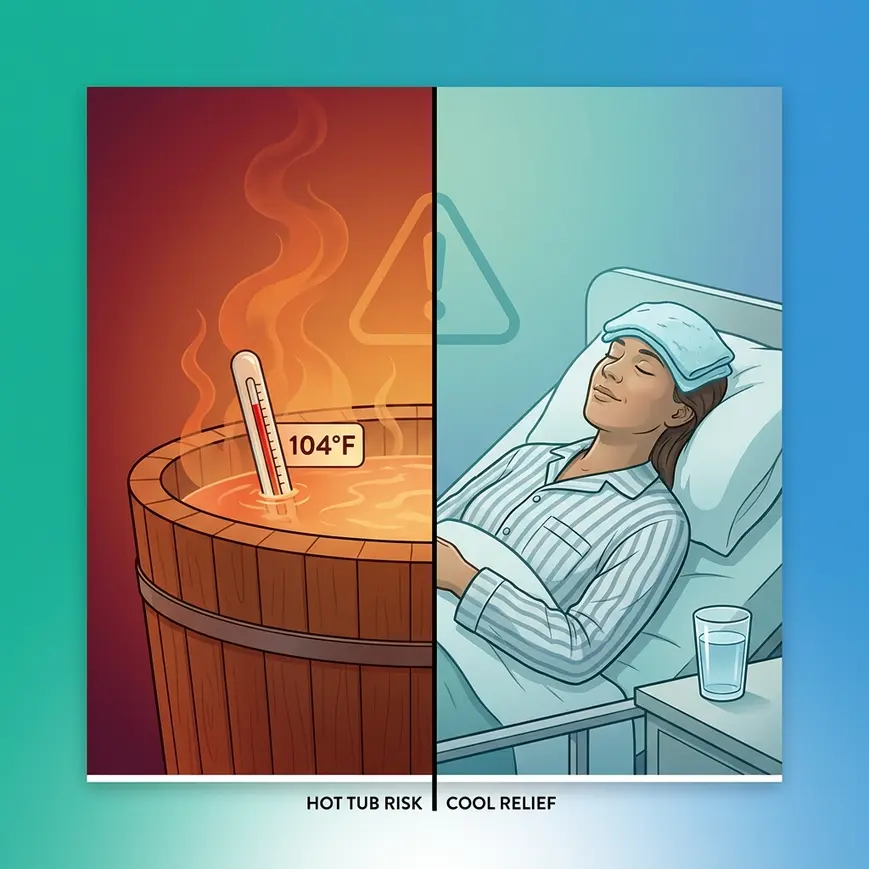
Table of Contents - Can You Go in a Hot Tub with a Fever? Safety Guide
- Hot Tubs and Fevers: The Short Answer
- The Temperature Safety Matrix: 99.5°F vs. 100.4°F
- 3 Safe Alternatives When the Hot Tub Is Off-Limits
- Hot Tub Safety with Specific Illnesses
- Hot Tubs and Infection Risks: UTIs and Bacteria
- When Hot Tubs CAN Help (and When to See a Doctor)
- Frequently Asked Questions
- The Bottom Line: Fever and Hot Tubs Don’t Mix
This blog post may contain affiliate links. As an Amazon Associate I earn from qualifying purchases.
Medical Disclaimer: This article is for informational purposes only and is not a substitute for professional medical advice, diagnosis, or treatment. Always consult a qualified healthcare provider with any questions you may have regarding a medical condition. If your fever is severe, persistent, or accompanied by other serious symptoms, seek emergency medical care immediately.
Medically Reviewed (Include reviewer name + credentials in the byline area — see E-E-A-T Checklist)
“I currently have a fever/cold and all I want is to get in my hottub to warm up.”
That impulse makes complete sense — warmth feels comforting when you’re sick, and your hot tub is right there. But if you’re wondering whether can you go in hot tub with a fever safely, the honest answer is no — and the reason matters more than the answer itself.
Using a hot tub while running a fever doesn’t help your body fight the illness. It actively works against your immune system, and in serious cases, it can push your temperature to a genuinely dangerous level. The good news: there are three safe alternatives that deliver real relief without the risk.
In this guide, you’ll learn exactly why hot tubs are off-limits with a fever, what the temperature thresholds really mean, and which alternatives actually work. We’ll also cover specific illnesses like COVID and pneumonia, answer the most common fever questions, and tell you exactly when to call a doctor.
No — if you are wondering, “can you go in hot tub with a fever,” you should not. A fever is already raising your core body temperature, and hot tub heat can push it to dangerous levels, risking hyperthermia and dehydration (Mayo Clinic).
- The threshold matters: 100.4°F (38°C) or higher = fever; hot tubs are off-limits at any fever level
- The Temperature Safety Matrix shows why 99.5°F and 100.4°F require very different responses
- “Sweating out” a fever is a myth — heat exposure makes your fever worse, not better
- Safer alternatives exist: lukewarm baths, steam inhalation, and hydration work without the risk
- The 24-hour rule: Stay fever-free for 24 hours without medication before resuming normal activities (CDC)
Hot Tubs and Fevers: The Short Answer
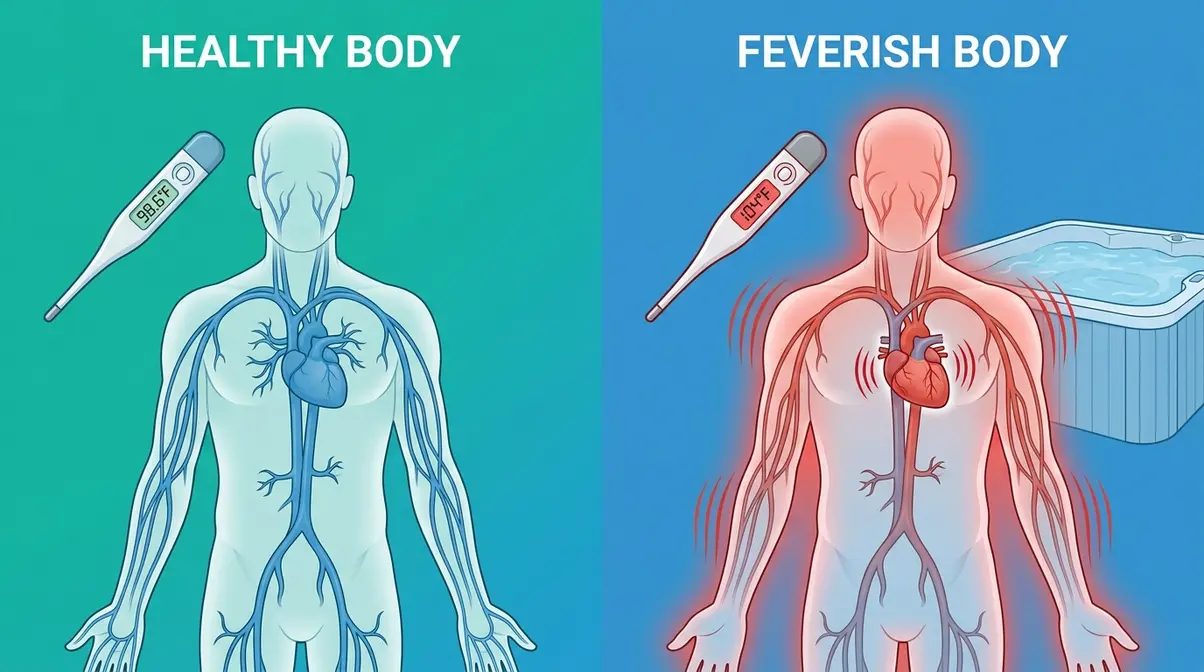
No — you should not go in a hot tub with a fever. A standard hot tub runs at 100–104°F, and a fever is already raising your core temperature to 100.4°F (38°C) or higher, according to Johns Hopkins Medicine on fever thresholds. Adding external heat at that point doesn’t help your body fight the illness — it forces your system to work harder to prevent dangerous overheating, a condition called hyperthermia (dangerously elevated body temperature, above 104°F).
Medical consensus across the CDC, Mayo Clinic, and Johns Hopkins consistently warns against heat exposure during a fever. Your body is already under significant physiological stress before you even consider climbing into a spa.
How a Fever Already Stresses Your Body
A fever isn’t a malfunction. Your immune system turns up the heat on purpose — deliberately raising your core temperature to make your body inhospitable to the virus or bacteria making you sick. It’s a sophisticated defense mechanism, not a sign that something has gone wrong.
But that defense comes at a physiological cost. Even before you consider the hot tub, a fever is already driving up your heart rate, speeding your breathing, triggering sweating (which means fluid loss), and increasing your body’s overall metabolic demand. You’re running a fever the way a car runs with the engine redlined — everything is working harder than normal.
Johns Hopkins Medicine on fever thresholds defines the medical threshold at 100.4°F (38°C) — not the 98.6°F that most people think of as “normal.” That distinction matters enormously for the Temperature Safety Matrix we’ll cover next. Think of it this way: your body is like a phone overheating while running a demanding app. Adding more heat — the hot tub — doesn’t cool the processor. It crashes the system.
What Happens When You Add Hot Tub Heat
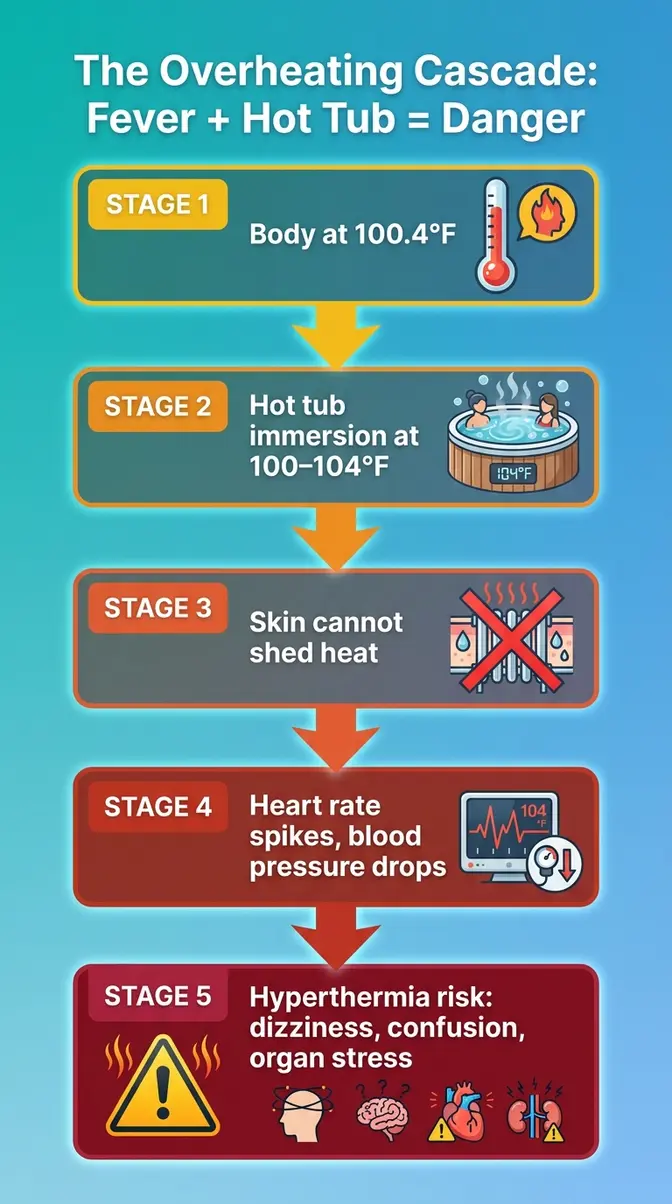
Here’s the overheating cascade that every competitor skips over — and it’s the most important thing to understand.
Hot tubs are heated to 100–104°F. When your body is already at 100.4°F or higher, immersion in water at or above that temperature eliminates your body’s ability to shed heat through the skin. Normally, your skin acts as a radiator, releasing heat into cooler surrounding air or water. In a hot tub during a fever, that mechanism is completely blocked.
Your body responds by pushing more blood to the surface — which raises your heart rate further, drops your blood pressure, and diverts circulation away from your vital organs. According to CDC heat illness guidelines, this cascade can progress quickly: dizziness, confusion, and loss of coordination are early warning signs that core temperature has exceeded safe limits. For someone already weakened by illness, that progression happens faster than it would for a healthy person.
A hot tub heated to 100–104°F combined with a fever of 100.4°F or higher can push your core body temperature toward hyperthermia — a dangerous condition where the body loses its ability to regulate heat (CDC).
Dehydration: The Hidden Risk
Most people running a fever are already dehydrated before they feel thirsty. Fever drives fluid loss through sweating and faster breathing — your body is actively losing water as part of its immune response. Adding a hot tub session dramatically accelerates that loss.
Hot water immersion causes additional sweating and fluid shifts within the body. If you’re already depleted from illness, even 15–20 minutes in a hot tub can push dehydration from mild to moderate — worsening your headache, fatigue, and dizziness, and making your fever harder to manage. According to Mayo Clinic’s fever guidance, staying well-hydrated is one of the most important steps in managing a fever safely. A hot tub works directly against that goal.
The Temperature Safety Matrix: 99.5°F vs. 100.4°F
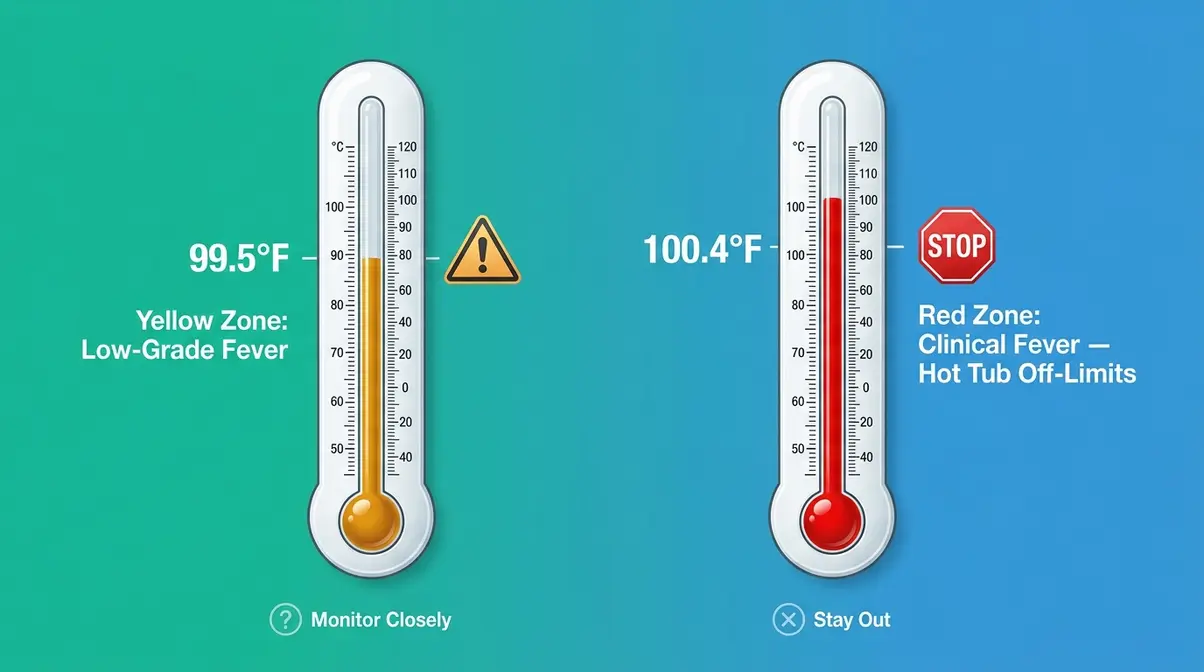
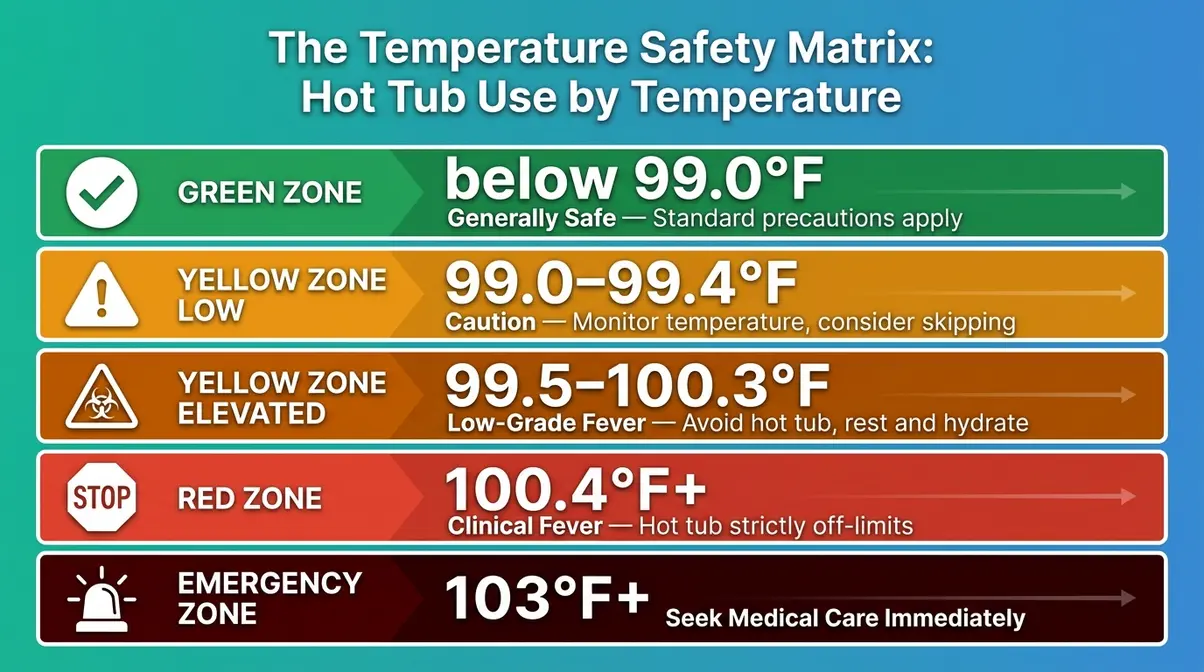
The Temperature Safety Matrix is a practical framework for understanding exactly which body temperature ranges make hot tub use safe versus dangerous. Think of it as a traffic light for your thermometer — green, yellow, and red zones with specific guidance for each. Medical consensus from Johns Hopkins, the CDC, and the Mayo Clinic supports the thresholds described below.
Is 99.5°F a Fever? What This Threshold Means
99.5°F is considered a low-grade fever in adults, according to Johns Hopkins Medicine. It sits in the yellow zone of the Temperature Safety Matrix — not a true clinical fever by the standard 100.4°F definition, but a signal that your body’s immune system is activating.
At 99.5°F, your body is working harder than normal but hasn’t crossed into the danger threshold. Hot tub use at this temperature is still inadvisable for most people — especially those with underlying health conditions, the elderly, or children — but the physiological risk is lower than at full fever levels. The smarter move is to monitor your temperature every 30 minutes. If it rises toward 100.4°F, the hot tub becomes strictly off-limits.
The key takeaway: 99.5°F means “proceed with extreme caution and monitor closely.” 100.4°F means “stay out.”
| Temperature | Zone | Hot Tub Guidance |
|---|---|---|
| Below 99.0°F | 🟢 Green | Generally safe for healthy adults; standard hot tub precautions apply |
| 99.0°F – 99.4°F | 🟡 Yellow (Low) | Caution; monitor temperature; consider skipping if feeling unwell |
| 99.5°F – 100.3°F | 🟡 Yellow (Elevated) | Low-grade fever; avoid hot tub; rest and hydrate |
| 100.4°F and above | 🔴 Red | Clinical fever; hot tub strictly off-limits; apply safe alternatives |
| 103°F and above | 🚨 Emergency | Seek medical care immediately; do not use hot tub under any circumstances |
The Real Danger Zone: 100.4°F and Above
At 100.4°F (38°C) or higher, you have a clinical fever by the definition used by Johns Hopkins Medicine and the CDC. This is the red zone of the Temperature Safety Matrix, and it’s the threshold at which hot tub use moves from inadvisable to genuinely dangerous.
Fevers also progress through recognizable stages. Your temperature typically rises from normal, peaks, and then breaks as your immune system gains the upper hand — followed by sweating as your body sheds the excess heat. During the rising and peak stages, your body’s heat-regulation mechanisms are already under maximum stress. Introducing hot tub heat at either of these stages can overwhelm those mechanisms entirely.
The 24-hour rule, as outlined in CDC respiratory virus precautions, states that you should be fever-free for at least 24 hours without the help of fever-reducing medication (like acetaminophen or ibuprofen) before returning to normal activities — including hot tub use. Medication can mask a fever without resolving the underlying infection, which means your hot tub risk remains even if you feel better after taking a pill.
Debunking the “Sweat It Out” Myth
The idea that you can “sweat out a fever” or “flush out a fever” by raising your body temperature further is one of the most persistent — and dangerous — home remedy myths. The science is clear: it doesn’t work, and it can actively harm you.
Your fever is already doing the work. Your immune system deliberately raised your temperature; forcing it higher doesn’t accelerate recovery. According to Johns Hopkins Medicine, heat exposure during a fever can worsen dehydration, elevate heart rate to dangerous levels, and in vulnerable individuals, trigger febrile seizures or cardiac stress.
Sweating in a hot tub doesn’t “flush out” a fever — it depletes the fluids your immune system needs to fight the infection. The sweat you produce in a hot tub is your body desperately trying to cool itself down, not your illness leaving your body. These are completely different physiological processes.
3 Safe Alternatives When the Hot Tub Is Off-Limits
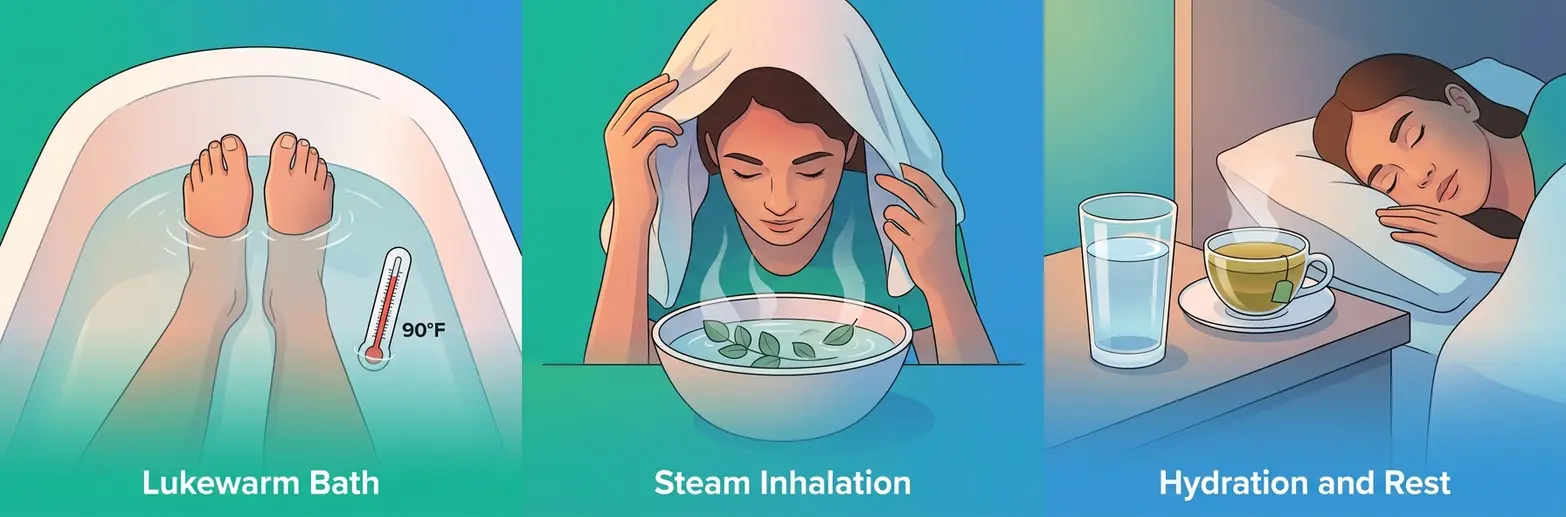
When the hot tub is off-limits, you still have options that provide genuine comfort and support your recovery. These three methods are backed by medical guidance from the Mayo Clinic and CDC — and unlike a hot tub, they work with your body’s immune response rather than against it.
Will a Hot Bath Help a Fever? (The Lukewarm Bath Method)
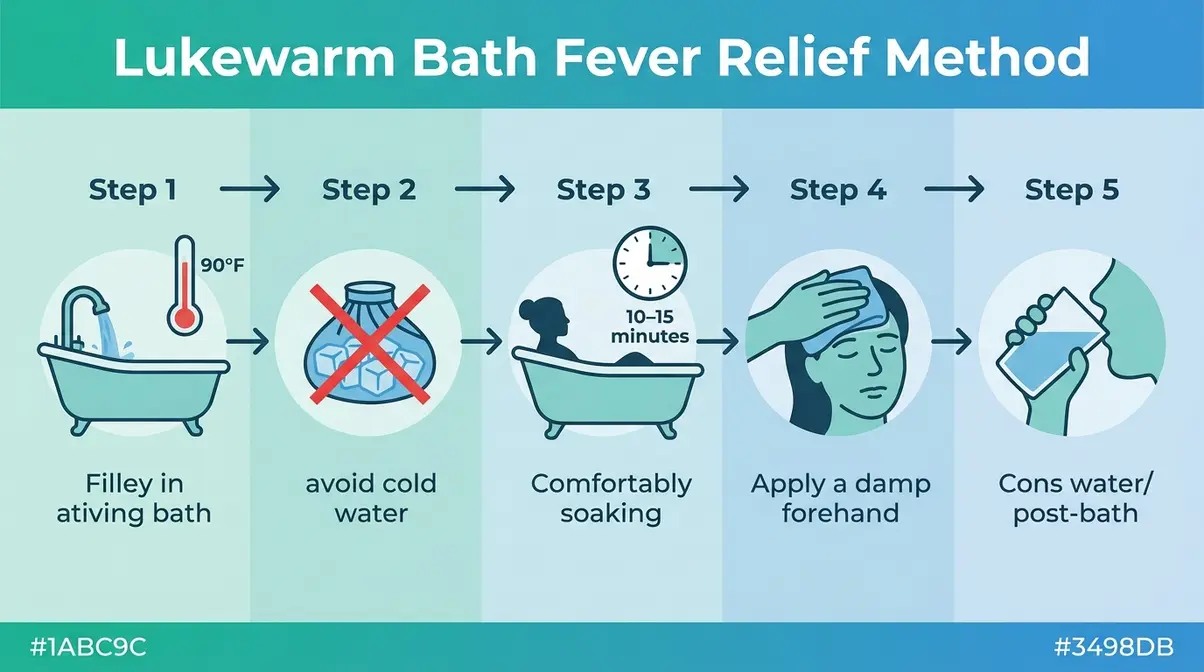
A hot bath will not help a fever, but a lukewarm bath can. The Mayo Clinic recommends this approach specifically for fever management, particularly when fever-reducing medication alone isn’t providing enough relief. Cool water draws heat away from your skin, helping your body shed excess temperature without the dangerous overheating risk of a hot tub.
- Estimated Time: 15–20 minutes
- Tools and Materials Needed:
- Clean bathtub
- Lukewarm water (85–95°F)
- Damp cloth or sponge
- Dry towel
- Glass of drinking water
Step 1: Fill the Tub with Lukewarm Water
Fill the tub with lukewarm water aiming for approximately 85–95°F. Test it with your wrist; it should feel slightly cool, not cold.
Step 2: Avoid Ice or Cold Water
Do not add ice or very cold water. Cold water causes shivering, which actually generates more body heat and can raise your temperature further.
Step 3: Soak Briefly
Soak for 10–15 minutes — no longer. Extended soaking can cause chills once you exit.
Step 4: Cool Your Forehead
Sponge your forehead and neck with a damp cloth while soaking for an additional cooling effect.
Step 5: Dry Gently and Hydrate
Pat dry gently — don’t rub vigorously, as friction generates heat. Drink a glass of water immediately afterward to replace any fluid lost.
Why this matters: A 10-minute lukewarm soak can reduce a fever by 1–2°F within 30 minutes, providing meaningful relief without the cardiovascular strain of hot water immersion.
Steam Inhalation Without Getting In
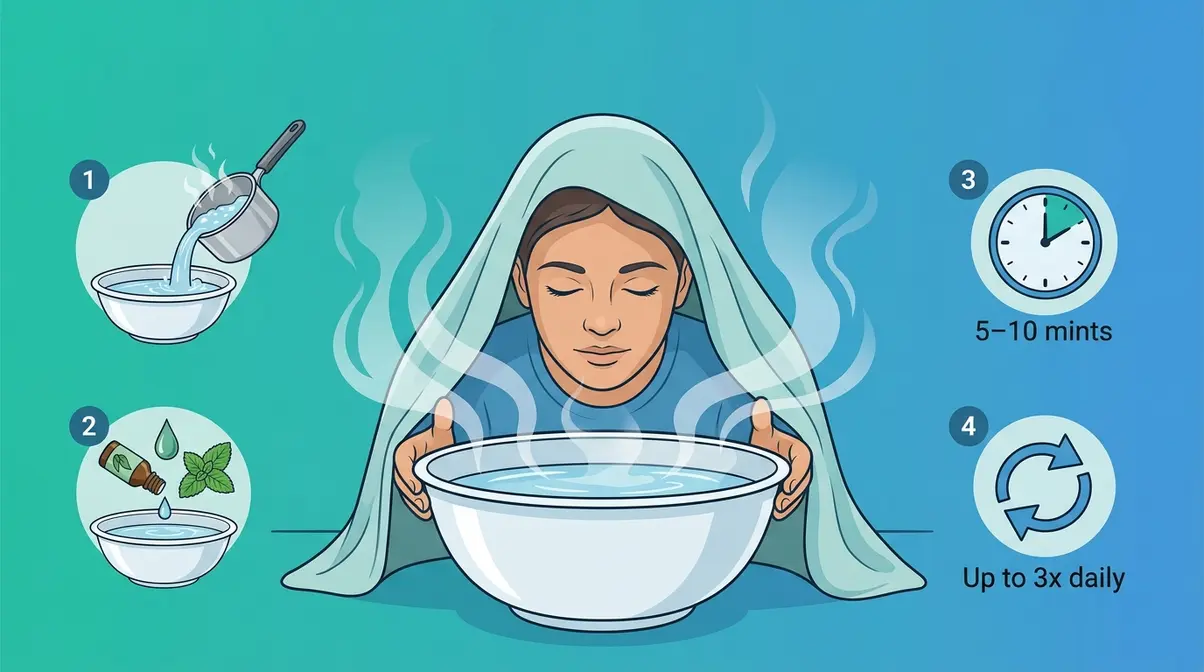
If congestion and sinus pressure are your primary symptoms, steam inhalation delivers most of the respiratory relief of a hot tub — without any of the fever risk. This method is particularly effective for cold and flu symptoms, sinus congestion, and upper respiratory discomfort.
- Estimated Time: 10–15 minutes
- Tools and Materials Needed:
- Heat-safe bowl
- Boiling water
- Large towel
- Eucalyptus oil or mint leaves (optional)
Step 1: Prepare the Hot Water
Boil a pot of water and carefully pour it into a large heat-safe bowl.
Step 2: Add Decongestants
Add optional ingredients if desired: 2–3 drops of eucalyptus oil or a few fresh mint leaves can enhance the decongestant effect.
Step 3: Create a Steam Tent
Drape a towel over your head and lean over the bowl, creating a tent to trap the steam.
Step 4: Breathe Deeply
Breathe slowly and deeply through your nose for 5–10 minutes. Keep your eyes closed to avoid irritation from the steam.
Step 5: Repeat as Needed
Repeat up to 3 times daily while symptoms persist.
Why this matters: Steam inhalation moistens your nasal passages and airways, loosening mucus and reducing congestion — the same mechanism that makes a hot shower feel so good when you’re sick, with zero overheating risk.
Hydration and Rest: What Actually Works
There is no faster way to “flush out a fever” than adequate hydration and rest. This isn’t a consolation prize — it’s the foundation of every clinical fever management protocol recommended by the CDC and Mayo Clinic.
Fever accelerates fluid loss significantly. You need to replace those fluids continuously to support your immune system’s work. Aim for 8–10 glasses of water or clear fluids (broth, herbal tea, diluted juice) per day while feverish — more if you’re sweating heavily.
Rest matters just as much. Your immune system does its most effective work when your body isn’t expending energy on other tasks. Sleep allows your body to redirect resources toward fighting the infection. Combine adequate fluid intake with 8–10 hours of sleep, keep your room at a comfortable 65–68°F, and use a light blanket rather than heavy covers that trap body heat. These simple steps genuinely support recovery in ways that a hot tub cannot.
Hot Tub Safety with Specific Illnesses
Different illnesses carry different risk profiles when it comes to hot tub use. Here’s what medical guidance says about the most common questions.
Can You Go in a Hot Tub with COVID-19?
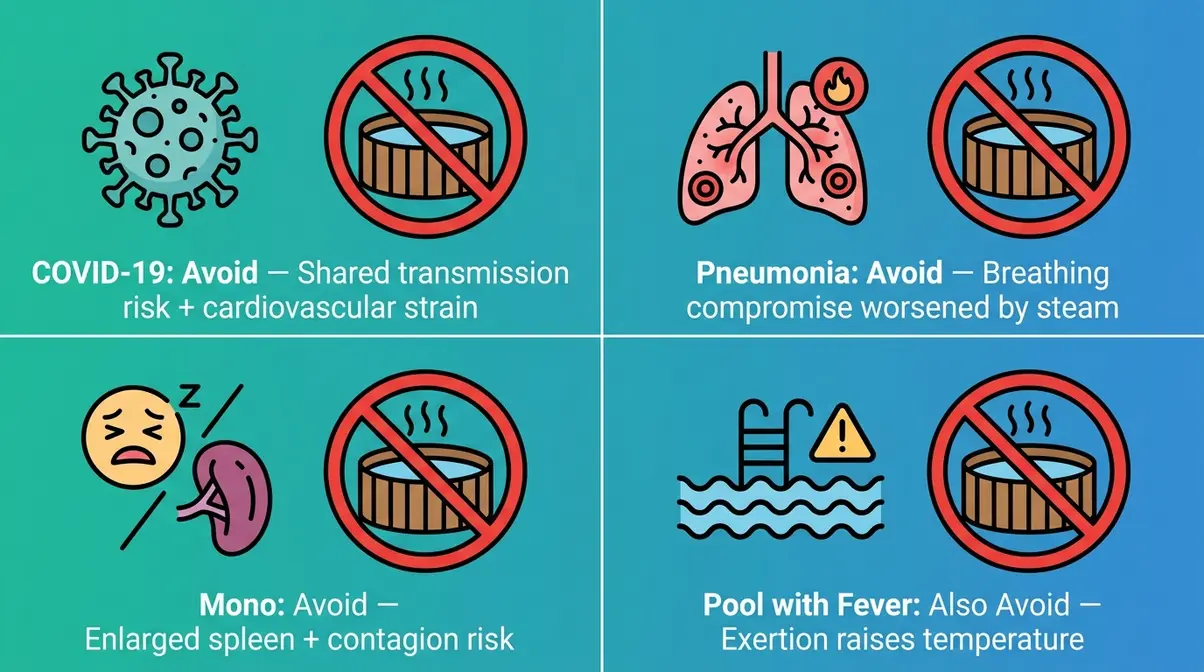
No — avoid hot tubs entirely if you have COVID-19. Beyond the fever risk already described, using a shared hot tub while COVID-positive exposes others to infection through respiratory droplets and potentially through the water itself. The CDC recommends staying home and away from shared spaces — including outdoor hot tubs — until you are fever-free for 24 hours without medication and your symptoms are improving.
Even a private hot tub carries risk for the individual. COVID-19 frequently causes cardiovascular stress, and heat immersion during active infection adds additional strain to an already-taxed heart and circulatory system.
Can You Go in a Hot Tub with Pneumonia?
Pneumonia and hot tubs are a particularly dangerous combination. Pneumonia (an infection of the lungs that causes inflammation and fluid buildup) already compromises your breathing capacity. Hot tub heat and steam cause your airways to vasodilate (expand), which can worsen breathing difficulty in someone with active pneumonia.
According to the NIH National Heart, Lung, and Blood Institute, pneumonia can cause dangerously high fevers, and the cardiovascular stress of hot water immersion on top of respiratory compromise poses serious risk. If you have been diagnosed with pneumonia, avoid hot tubs until your doctor explicitly clears you.
Can You Go in a Hot Tub with Mono?
Mono (infectious mononucleosis) is another case where hot tubs are off-limits during the acute phase. Mono commonly causes fever, extreme fatigue, and — critically — an enlarged spleen. Physical stress, including heat stress from hot water immersion, can aggravate these symptoms and, in rare cases, increase the risk of complications.
Additionally, mono is highly contagious through saliva. Shared hot tubs present obvious transmission risks. Wait until your fever has fully resolved and your doctor has confirmed your spleen is no longer enlarged before returning to hot tub use.
Can I Sit in a Pool with a Fever?
No — the same core risks apply to pools as to hot tubs, with some variation. A swimming pool is typically cooler (78–82°F) than a hot tub, which reduces the overheating risk slightly. However, the physical exertion of swimming raises your heart rate and body temperature significantly — negating any cooling benefit of the water.
More importantly, swimming while feverish exposes other swimmers to your illness. Respiratory viruses can spread through shared water environments, and chlorine does not fully neutralize all pathogens. The responsible choice — and the medically safer one — is to stay out of both pools and hot tubs until you are fever-free for 24 hours.
Hot Tubs and Infection Risks: UTIs and Bacteria
Beyond fever risks, hot tubs carry a separate set of infection concerns that every hot tub owner should understand — particularly around urinary tract infections (UTIs) and bacterial contamination.
Hot tub water that isn’t properly maintained can harbor Pseudomonas aeruginosa (a bacteria commonly found in poorly maintained hot tubs) and other pathogens. The warm, aerated environment of a spa is the perfect breeding ground for these bacteria if sanitizer levels drop even slightly. According to CDC guidelines on recreational water illnesses, poorly maintained hot tubs are a leading cause of recreational water illness outbreaks, including hot tub folliculitis (a skin rash caused by Pseudomonas) and more serious infections.
The connection to UTIs is particularly relevant for women. Hot tub chemicals — including chlorine — can disrupt the natural bacterial balance of the urogenital area. Combined with the warm, moist environment, this creates conditions that may increase UTI risk, especially with prolonged soaking. The risk multiplies when soaking in water shared with others, as bacteria can more easily enter the urethra. According to the Cleveland Clinic, frequent hot tub use is a recognized risk factor for recurrent UTIs in susceptible individuals.
Key prevention steps:
- Test your hot tub’s pH (7.2–7.8) and sanitizer levels weekly (free chlorine 1-3 ppm or bromine 3-5 ppm)
- Shower with soap before and after hot tub use
- Limit soak time to 15–20 minutes
- Urinate immediately after your soak to help flush out potential bacteria
- Change out of a wet swimsuit promptly after exiting
For a complete guide to hot tub hygiene, bacterial risks, and UTI prevention, see our full article on hot tub UTI risks and hygiene.
When Hot Tubs CAN Help (and When to See a Doctor)
The answer isn’t always “never.” Hot tubs have legitimate therapeutic applications — when used at the right time, by the right person, for the right reason.
Will a Hot Tub Help if You’re Sick?
No — a hot tub will not help you recover faster from an active illness, and it may make things worse. The warm water does not “flush out” pathogens or accelerate your immune response. If you have a fever, the overheating risk is serious. Even without a fever, hot tub use while sick can cause dehydration, dizziness, and cardiovascular strain. The one exception is if you have a mild cold without a fever, where a short, moderate-temperature soak may temporarily relieve congestion and muscle aches — but it won’t shorten your illness.
Doctor-Prescribed Hot Tub Therapy
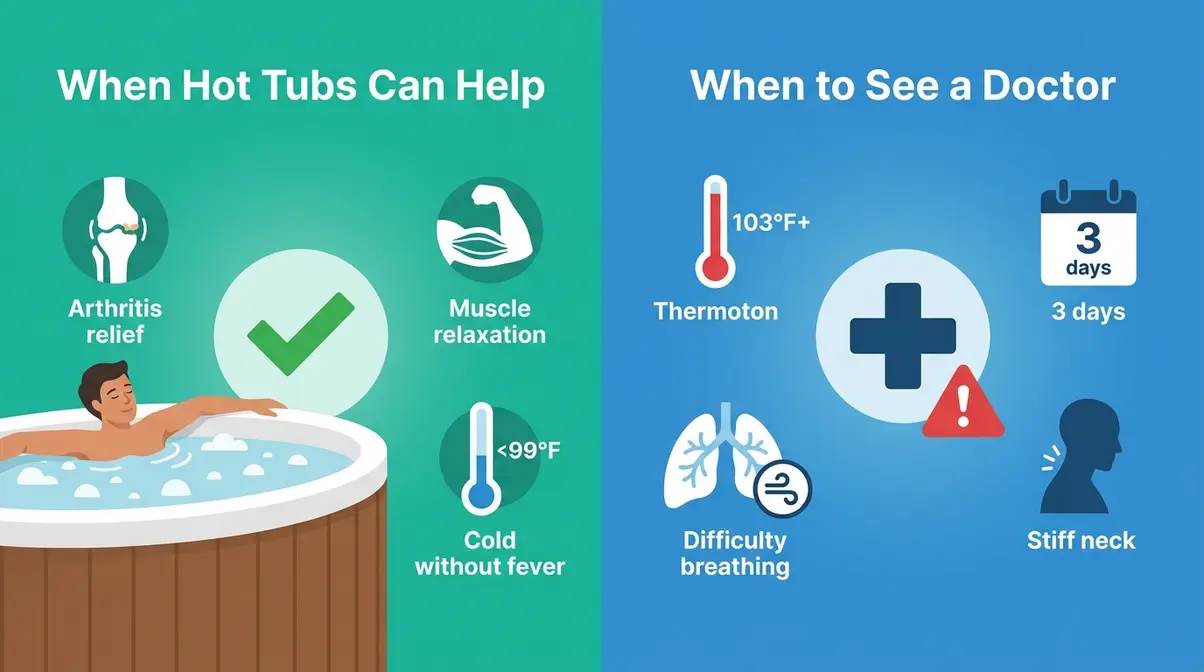
In some cases, a physician can actually prescribe hot tub therapy as part of a treatment plan for chronic conditions including arthritis, fibromyalgia, and certain musculoskeletal disorders. According to IRS Publication 502, a doctor-prescribed hot tub may even qualify as a tax-deductible medical expense.
The key distinction: these prescriptions apply to chronic condition management, not acute illness. A doctor prescribing hot tub therapy for your arthritis is not giving you permission to use it while feverish — those are entirely separate medical situations. If you have a chronic condition that benefits from hydrotherapy, ask your doctor specifically whether hot tub use is safe during illness episodes.
Hot Tubs for Cold Symptoms Without a Fever
Here’s the nuance most articles miss: if you have a cold without a fever, a hot tub session may actually provide some relief. Steam and warm water can temporarily ease nasal congestion, relax muscle aches, and improve sleep quality — all genuine benefits for cold sufferers.
The critical qualifier is “without a fever.” Check your temperature before getting in. If you’re below 99.0°F and feeling well enough to enjoy the soak, a 15–20 minute session at a moderate temperature (100°F rather than 104°F) may be reasonable for healthy adults. Stay well-hydrated before, during, and after. Exit immediately if you feel dizzy, lightheaded, or unusually warm.
This is also when hot tubs can genuinely boost your immune system in a supportive way — warm water immersion promotes relaxation, reduces cortisol (the stress hormone), and can improve sleep quality, all of which support immune function during recovery.
When to Call Your Doctor About a Fever
Some fever situations go beyond home management. Seek medical care promptly if:
- Your fever reaches 103°F (39.4°C) or higher in an adult
- Your fever has lasted more than 3 days without improvement
- You experience difficulty breathing, chest pain, or severe headache
- You develop a stiff neck, skin rash, or confusion alongside a fever
- You are pregnant, immunocompromised, or over 65 — these groups face higher risk from even moderate fevers
- A child under 3 months has any fever at or above 100.4°F — this is a medical emergency
The Mayo Clinic recommends contacting a healthcare provider any time you are uncertain about a fever’s severity or duration. When in doubt, call.
Frequently Asked Questions
What should you not do during a fever?
Avoid hot tubs, saunas, and vigorous exercise during a fever — all of these add heat stress to a body already working hard to regulate temperature. Similarly, avoid alcohol (which causes dehydration and can mask fever symptoms), bundling under heavy blankets (which traps heat), and taking cold showers or ice baths (which cause shivering and raise core temperature). According to the Mayo Clinic, the most effective approach is rest, adequate hydration, and fever-reducing medication like acetaminophen or ibuprofen as directed.
Should you stay home if you have a 99.6°F fever?
Yes — staying home with a 99.6°F fever is the responsible choice, both for your own recovery and to protect others from exposure. At 99.6°F, you are in the low-grade fever range and your body is actively fighting an infection. The CDC recommends staying home until you have been fever-free for at least 24 hours without the use of fever-reducing medication. This applies whether your temperature is 99.6°F or 102°F — the 24-hour rule is the standard regardless of fever severity.
What are the 5 stages of a fever?
The five stages of a fever are: onset, rising, peak (fastigium), falling (defervescence), and resolution. During onset, you may feel chills and fatigue as your body begins raising its temperature. The rising stage involves increasing discomfort, sweating, and elevated heart rate. The peak is when temperature is highest and symptoms are most intense. During the falling stage, your body begins shedding heat — often through sweating. Resolution marks the return to normal temperature. Hot tub use is dangerous during every stage except resolution, and even then the 24-hour rule applies.
How do you flush out a fever fast?
The most effective way to “flush out” a fever is hydration, rest, and fever-reducing medication — not heat exposure. Drink 8–10 glasses of clear fluids per day (water, broth, herbal tea) to replace fluids lost through sweating and faster breathing. Take acetaminophen or ibuprofen as directed to reduce fever and ease discomfort. A lukewarm bath can provide temporary relief. Rest allows your immune system to direct maximum resources toward fighting the infection. According to the Mayo Clinic, these steps — not heat exposure — are the evidence-based approach to fever management.
What is the 24-hour rule for fever?
The 24-hour rule means you should be completely fever-free for 24 hours without fever-reducing medication before returning to normal activities. This standard, recommended by the CDC, exists because fever-reducing medication like acetaminophen can temporarily suppress a fever without resolving the underlying infection. If your temperature is only normal because of medication, you are still contagious and still at risk. The 24-hour rule applies to returning to work, school, shared hot tubs, and other activities where you interact with others.
The Bottom Line: Fever and Hot Tubs Don’t Mix
For anyone running a fever, the answer to the question “can you go in hot tub with a fever” is consistently clear across every major medical authority: no. A hot tub heated to 100–104°F combined with a body temperature of 100.4°F or higher creates the conditions for hyperthermia, dehydration, and cardiovascular strain — risks that compound quickly in someone already weakened by illness. The CDC and Mayo Clinic are unambiguous on this point.
The Temperature Safety Matrix gives you a practical framework to make this decision with confidence: below 99.0°F is generally safe for healthy adults; 99.5°F is a yellow-zone warning to monitor and rest; 100.4°F and above is a firm red zone where hot tub use stops entirely. That traffic-light framework removes the guesswork when you’re feeling awful and tempted by the warmth of your spa.
The better path when you’re sick: try a lukewarm bath for fever relief, steam inhalation for congestion, and prioritize hydration and rest above everything else. These approaches work with your immune system rather than against it. When your fever has been gone for 24 hours without medication — and only then — your hot tub will be waiting.
If your fever reaches 103°F, lasts more than three days, or comes with serious symptoms like difficulty breathing or a stiff neck, skip the home remedies and call your doctor.