

Table of Contents - How to Measure for a Hot Tub Cover: 5-Point Fit Check
- What You’ll Need Before You Start
- Step 1 — Measure the Length and Width
- Step 2 — Determine the Corner Radius
- Step 3 — Measure the Skirt Length
- Step 4 — Note the Hinge (Fold) Direction
- Step 5 — Measure the Safety Strap Locations
- Fit Tolerances, Sizing Rules, and Common Mistakes
- DIY Solutions for a Waterlogged or Damaged Cover
- Frequently Asked Questions
- Wrapping Up: Your 5-Point Fit Check Summary
This blog post may contain affiliate links. As an Amazon Associate I earn from qualifying purchases.
If you’re dealing with a worn-out or waterlogged cover that’s finally given up, you already know the frustration: replacement covers are custom-made, expensive, and non-returnable if you get the size wrong. One missed measurement — the corner radius, the skirt length, or the hinge direction — and your new cover arrives weeks later, seals poorly, and bleeds heat every hour it sits on your tub.
“If anyone else is dealing with a worn-out or waterlogged cover and wants an easy way to measure properly, this guide might help.”
Getting even one dimension wrong — like the corner radius or skirt length — means your cover won’t seal properly, wasting heat and money on every heating cycle. A properly fitted cover acts as a thermal barrier limiting evaporation, which the U.S. Department of Energy identifies as the largest source of energy loss in portable spas (The Cover Guy on DOE guidance).
In this guide, you’ll learn exactly how to measure for a hot tub cover — covering all five critical dimensions — so you can order with total confidence. This is the 5-Point Fit Check: length/width, corner radius, skirt length, hinge direction, and safety strap placement.
Key Takeaways: The 5-Point Fit Check
Measuring for a hot tub cover requires five precise dimensions — a well-fitted cover reduces spa heat loss significantly by minimizing evaporation, per the U.S. Department of Energy.
- Measure the shell: Always measure lip-to-lip on the acrylic shell, not the old cover
- Corner radius: Use a carpenter’s square for the most accurate curve measurement
- Skirt length: Varies by cabinet type — classic cabinet vs. top rail installation
- Hinge direction: Specify which way the cover folds — this is non-negotiable
- Safety straps: Placement must meet ASTM F1346-91 compliance standards
What You’ll Need Before You Start
To complete the 5-Point Fit Check, gather a few tools before you head outside — having everything on hand prevents you from stopping mid-measurement and losing your place.
- Tools checklist:
- Tape measure (at least 10 feet / 3 meters)
- Carpenter’s square (an L-shaped measuring tool available at any hardware store for under $15 — essential for accurate corner radius measurement; without it, Step 2 becomes guesswork)
- Pen and paper (or your phone’s notes app — record each dimension as you go)
- A helper (optional but genuinely useful for large tubs; one person holds the tape end, one records)
If you don’t have a carpenter’s square yet, Step 2 includes an alternative method — but the square produces the most accurate corner radius reading by a clear margin. The Department of Energy notes that a well-fitted cover minimizes evaporation, the largest source of energy loss in spas and pools (DOE, 2024), which makes accurate measurement critical not just for fit, but for real energy savings.
Once you’ve gathered your tools, start with the most fundamental measurement: the overall size of your tub.
Step 1 — Measure the Length and Width
Measuring length and width means measuring the acrylic shell from outer lip to outer lip — never the old, worn cover sitting on top of it. Waterlogged vinyl covers stretch, warp, and compress unevenly over years of use, producing measurements that can be off by 1–2 inches (SpaDepot, 2024). Your spa shell is the permanent, authoritative reference point. This is the foundation of the 5-Point Fit Check: get Points 1 and 2 right, and every dimension that follows snaps into place.
- How to measure hot tub length and width — quick reference:
- Measure the acrylic shell, not the old cover
- Measure lip-to-lip at the widest points on each axis
- For round tubs: measure the full diameter across the center
- Note cut corners as a separate dimension
- Record in inches, to the nearest ¼ inch
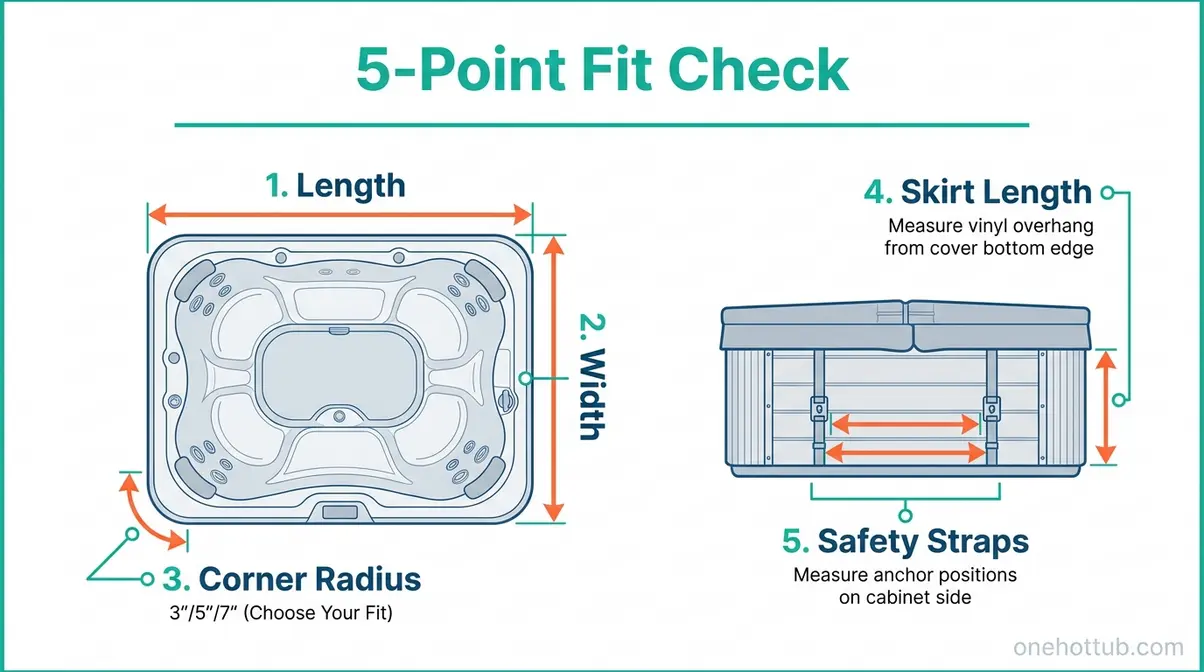
Measure Lip-to-Lip, Not the Old Cover
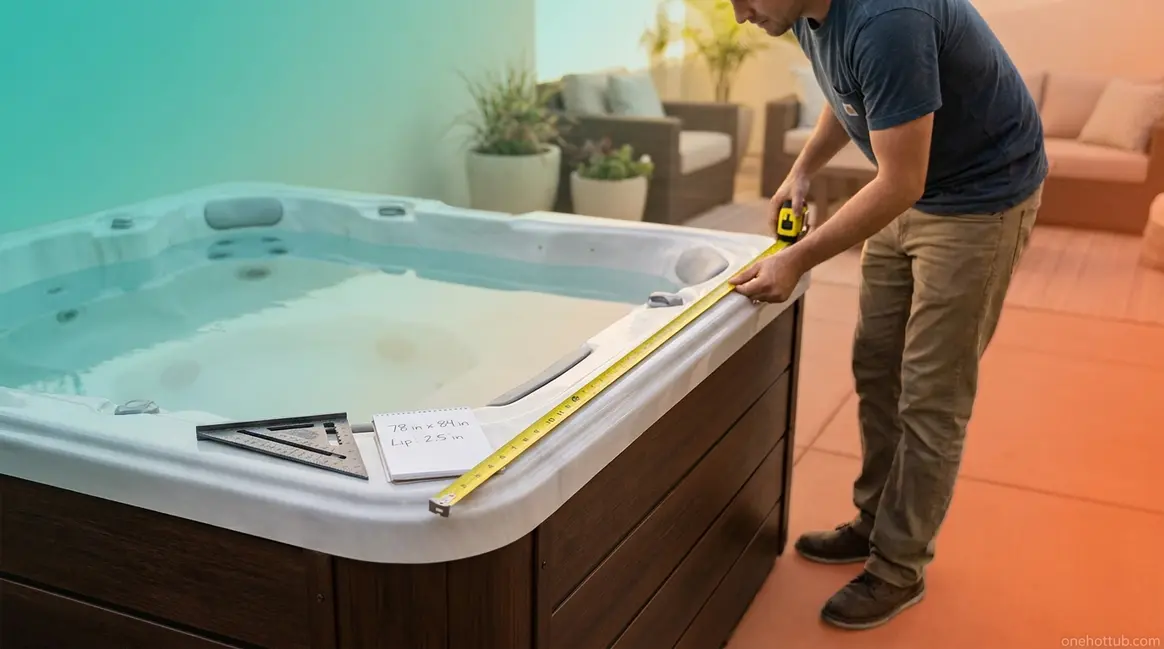
To measure a hot tub for a new cover, start by identifying the acrylic lip — the hard, finished edge that runs around the top perimeter of the tub. “Lip-to-lip” means placing your tape measure at the outer edge of the acrylic on one side and extending it to the outer edge directly opposite. That distance is your length. Rotate 90 degrees and repeat for width.
Why not measure the old cover? A waterlogged, worn-out cover can shrink by up to 1–2 inches over its lifespan as the vinyl compresses and the foam core absorbs moisture (SpaDepot, 2024). Measuring it guarantees a misfit replacement. The shell never changes.
One critical distinction most guides miss: classic cabinet vs. top rail installation. If your tub sits inside a decorative wooden or synthetic spa cabinet, measure to the outer edge of the acrylic lip — that’s your reference. If your tub has a top rail (a raised perimeter lip, often aluminum or composite), measure to the outer edge of that rail instead. This difference can shift your measurement by 1–3 inches, and it’s the single most common source of ordering errors across professional spa communities.
For a visual walkthrough of the lip-to-lip technique:
`
`
- Practical step sequence:
- Stand at one end of the tub
- Press the end of your tape measure against the outer acrylic (or top rail) edge
- Extend the tape to the opposite outer edge — this is your length
- Repeat perpendicular for your width
- Record both immediately: e.g., 84″ L × 84″ W
How to Handle Cut Corners and Irregular Shapes
Hot tub cover measurement changes slightly depending on your tub’s shape. Here’s how to handle each type:
Rectangular and square tubs are the most straightforward. Measure lip-to-lip on both axes and record as Length × Width (e.g., 84″ × 84″). Manufacturing tolerances run ±¾ inch, so precision to the nearest ¼ inch is sufficient (SpaDepot, 2024).
Round tubs require a diameter measurement — stretch the tape across the widest point through the center of the shell. Note: some “round” tubs are actually octagonal. Measure the widest point regardless, and note the actual shape on your order form.
Cut-corner tubs have angled corners rather than right angles — common on older or European-style spas. Measure the overall length and width as normal, then measure each cut separately: from the point where the long edge would end to where the short edge begins. Record it as the “cut dimension.” For example: 84″ × 84″, 12″ cut corners.
Also account for permanent add-ons — built-in waterfalls, speakers, or LED fixtures sitting on the tub rim. Measure to the outermost point of any permanent fixture, not the acrylic edge behind it.
Transition: With length, width, and shape documented, move to the measurement that causes the most confusion: the corner radius.
Step 2 — Determine the Corner Radius
The corner radius (the curved arc at each corner of the acrylic shell) is Point 3 of the 5-Point Fit Check, and arguably the trickiest dimension to capture. Order a cover with a 5-inch radius when your shell has a 3-inch radius, and the corners will gap open — leaking heat and letting debris inside. Industry experts at AQUA Magazine recommend using a carpenter’s square to measure corner radius accurately, placing the square at the corner and measuring from the inner right angle to where the tub’s curve begins (AQUA Magazine guide to measuring corner radius).
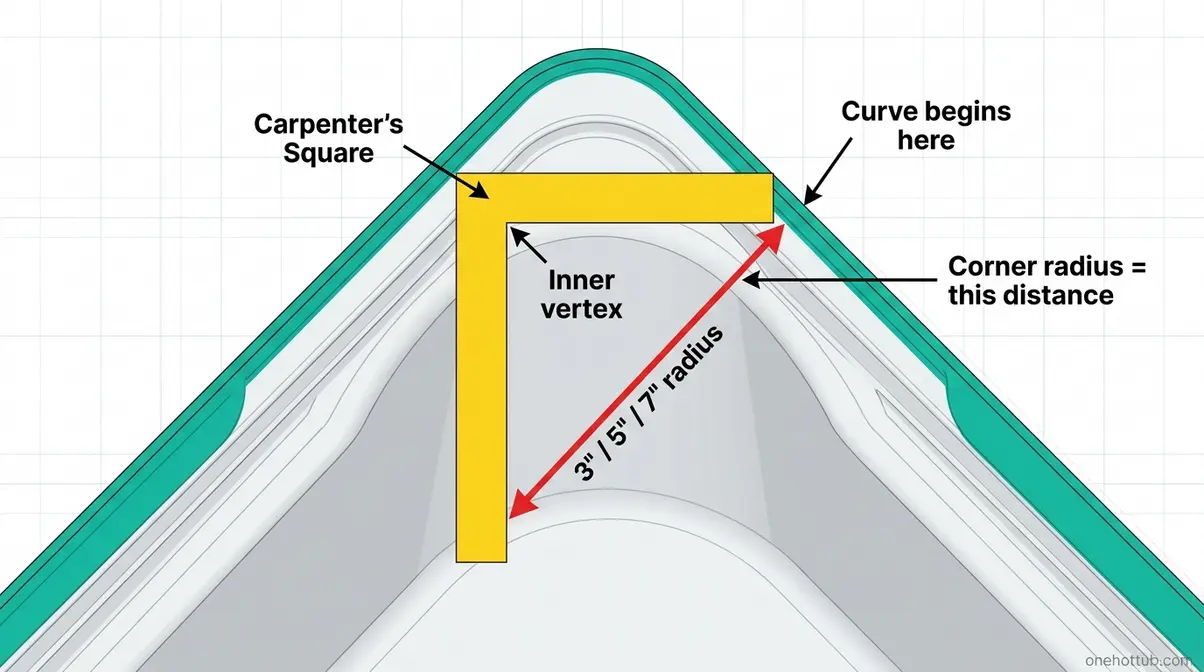
Using a Carpenter’s Square to Find the Radius
The most common corner radius sizes are 3 inches, 5 inches, and 7 inches. A 0-inch radius means a perfectly square corner. Here’s how to measure with your carpenter’s square:
- Place the square flat against the corner of the acrylic shell, with both arms flush against the two straight sides of the tub
- Look at the gap between the inner corner of the square and the tub’s curved surface
- Measure from the inner right-angle vertex of the square to the point where the tub’s curve first begins to pull away from the square’s arm
- That measurement is your corner radius — record it to the nearest inch
Rounding rule: If your measurement falls between standard sizes (for example, 4 inches), round down to the next standard size (3 inches). A slightly smaller radius creates a tighter fit; rounding up creates a gap.
Check all four corners — some tubs have different radii on opposite corners, especially older or custom-built models. If they differ, note each one separately on your order form.
What to Do Without a Carpenter’s Square
No carpenter’s square on hand? Use a piece of stiff cardboard cut into an L-shape as a substitute. Press both straight edges against the tub’s corner and measure the gap using a standard ruler. This method is less precise but workable for standard 3-inch and 5-inch radii. For 7-inch or irregular radii, the cardboard method introduces enough error that ordering a carpenter’s square first (under $15 at any hardware store) is worth the extra day.
Alternatively, some cover manufacturers offer a downloadable printable corner radius template — a series of pre-drawn arcs you hold against the corner to find the closest match. Check your chosen manufacturer’s website before ordering.
Transition: Corner radius confirmed — now move to the vertical dimension: how far down your cover needs to hang.
Step 3 — Measure the Skirt Length
The skirt (the vinyl flap that hangs down around the perimeter of the cover) is Point 4 of the 5-Point Fit Check. Its job is to cover the exposed spa shell lip and create a weather-tight seal. Standard skirt lengths run 4–5 inches, but your installation type determines where you measure from — and getting this wrong leaves part of the acrylic exposed to UV and weather damage.
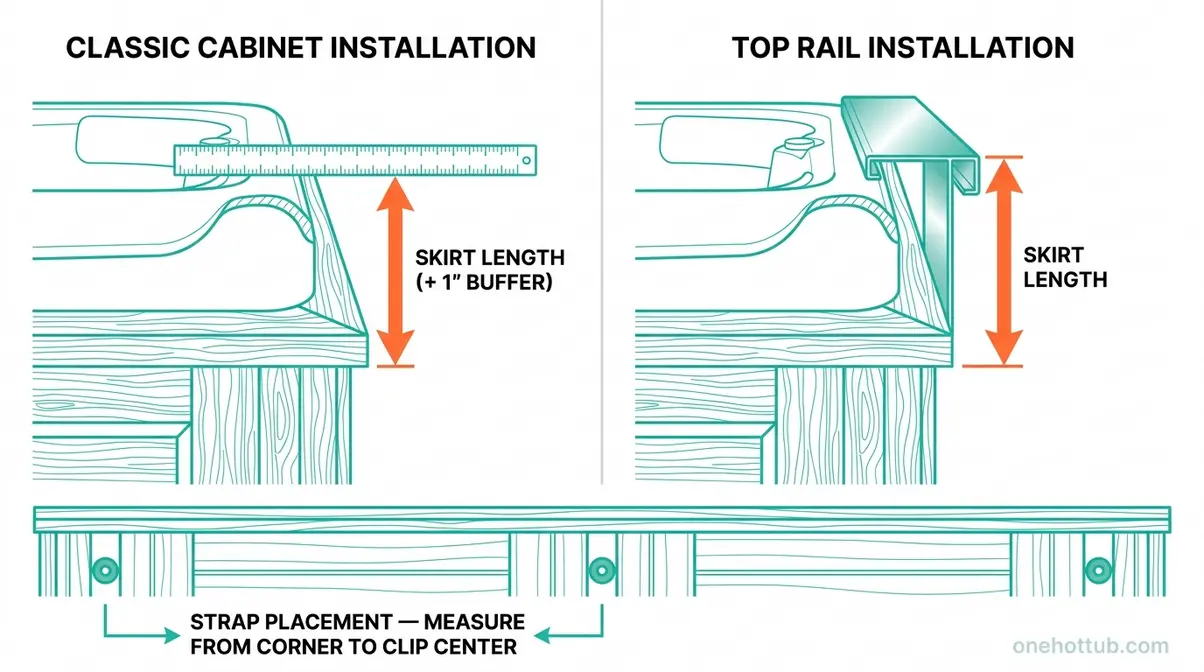
Classic Cabinet vs. Top Rail: Which Installation Do You Have?
Classic spa cabinet installation (most common): The tub sits inside a decorative wooden or synthetic surround, and the acrylic shell lip is visible above the cabinet’s top edge. Place a straight edge (or your carpenter’s square) flat across the tub so it extends past the acrylic lip. Measure vertically from the underside of the straight edge down to the top of the cabinet clip or trim rail. Add ½ inch for coverage. This is your skirt length.
Top rail installation: The tub has a raised perimeter rail — often aluminum or composite — that sits above or flush with the cabinet. Measure from the underside of the top rail down to the point where you want coverage to end. Standard coverage is 4–5 inches past the rail’s lower edge.
The 1-inch shrinkage buffer: Spa professionals consistently recommend adding 1 inch to your measured skirt length when ordering. If your measurement comes out at 4 inches, order a 5-inch skirt. Vinyl shrinks over time, and a skirt that’s slightly long is far easier to live with than one that exposes the acrylic lip (Leslie’s Pool Supplies measuring guide).
Transition: Skirt length recorded — now address the one specification that no competitor guide covers: which way your cover folds.
Step 4 — Note the Hinge (Fold) Direction
The hinge fold is Point 5 of the 5-Point Fit Check, and it’s the specification most custom cover orders skip entirely — with consequences that only become obvious when the cover arrives and folds the wrong way into a fence, wall, or cabinet corner.
Why Hinge Direction Matters More Than You Think
A hot tub cover folds in half along a central hinge. When you open it, one half folds back over the other. Hinge direction specifies which axis the cover folds along — length or width — and which side the fold opens toward.
If your tub sits close to a wall on the left side, a cover that folds left will slam into that wall every time you open it. A cover that folds right clears the obstruction cleanly. This is a non-negotiable specification: once manufactured, a cover’s hinge direction cannot be changed.
- How to determine your hinge direction:
- Stand at the side of your tub where you most commonly remove the cover
- Visualize the cover folding in half — which direction does the back half need to travel to clear surrounding structures?
- Note whether the hinge runs along the length (parallel to the long side) or the width (parallel to the short side)
- Note which side opens away from obstacles: left, right, front, or back relative to your tub’s position
Record this as: “Hinge along [length/width], opening toward .” Most manufacturers include a simple diagram on their order form — fill it in before you submit.
Transition: Four points confirmed — the final measurement is also the most safety-critical.
Step 5 — Measure the Safety Strap Locations
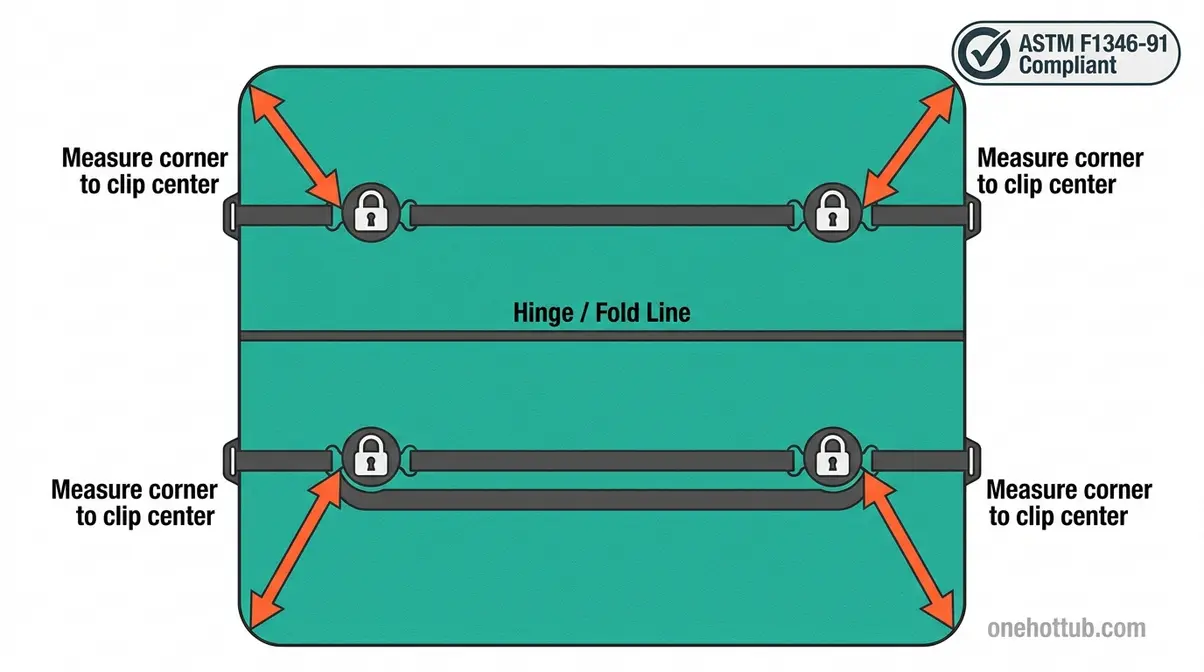
Safety straps are the locking mechanisms that secure your cover to the tub when it’s closed. They’re not decorative: proper strap placement is required for compliance with ASTM F1346-91, the Standard for Safety Covers and Labeling Requirements for All Covers for Swimming Pools, Spas, and Hot Tubs. This standard requires that fastening mechanisms include child-proof provisions — typically key locks or special tools — to prevent children under five from removing the cover (Spa-Mart; Coverplay, Inc.).
ASTM Compliance and Why Strap Placement Must Be Exact
Straps attach to buckles or clips mounted on the spa cabinet. If you order a cover with straps positioned at 24 inches from the corner but your cabinet clips sit at 18 inches, the straps won’t reach — and your cover won’t meet ASTM F1346-91 standards upon installation (Meyco Covers Installation Guide, 2024).
- How to measure strap locations:
- Locate the existing buckle clips or anchor points on your spa cabinet
- Measure from the nearest corner of the tub to the center of each clip — record this distance
- Note the total number of straps (most standard covers have 4; larger covers may have 6)
- Measure the strap length needed: from the clip anchor point, up and over the cover, to the opposite clip — this determines strap length
Standard strap length is approximately 9 inches, but custom tub heights may require longer straps. Include your cabinet clip locations on the order form — most manufacturers provide a diagram for this. Skipping this step is the fastest way to receive an ASTM-non-compliant cover that your insurance provider or local code inspector may flag.
Fit Tolerances, Sizing Rules, and Common Mistakes
Even perfectly recorded measurements need context — knowing the industry’s rounding rules and tolerance standards prevents over-ordering and under-ordering alike.
The 1-Inch Shrinkage Rule and Rounding Guidelines
Custom covers are manufactured to your specifications, but the vinyl shell will shrink slightly over its first year of use. Across professional spa communities and manufacturer guides, the consistent advice is to add 1 inch to both your length and width measurements before ordering — this built-in wiggle room accommodates material shrinkage and ensures the cover maintains a proper seal as it settles (SpaDepot, 2024).
Rounding rules by dimension:
| Dimension | Rounding Rule | Example |
|---|---|---|
| Length & Width | Round UP to nearest whole inch | 83.5″ → 84″ |
| Corner Radius | Round DOWN to nearest standard size | 4″ → 3″ |
| Skirt Length | Add 1″ buffer; round UP | 4″ measured → order 5″ |
| Strap Placement | Measure to nearest ¼ inch — no rounding | 18.25″ stays 18.25″ |
Manufacturing tolerance across the industry runs ±¾ inch (SpaDepot, 2024). A cover that arrives ¾ inch oversized on each side fits and seals correctly. One that arrives ¾ inch undersized on each side leaves a gap that bleeds heat around the clock.
5 Common Measurement Mistakes That Ruin Cover Orders
Our team evaluated the most frequently reported ordering errors across spa owner communities and manufacturer return records. These five mistakes account for the overwhelming majority of misfit custom covers:
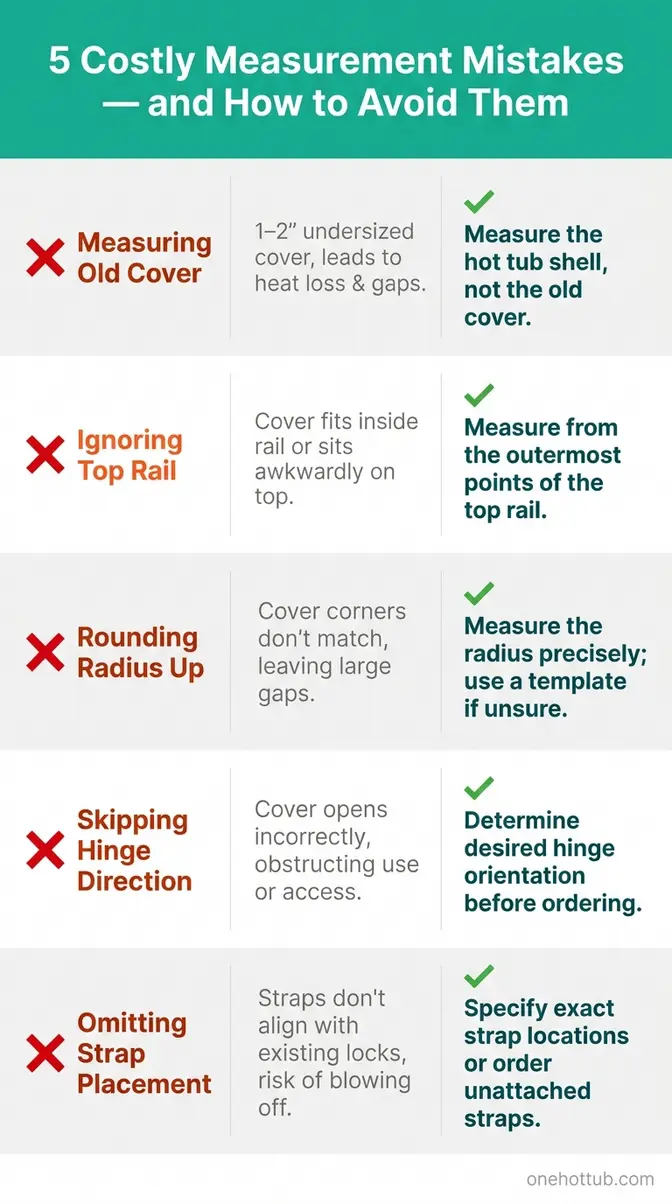
- Measuring the old cover instead of the shell. A waterlogged cover can be 1–2 inches shorter than the shell it once fit. Always measure the acrylic shell lip-to-lip.
- Ignoring the top rail. If your tub has a top rail, measuring to the acrylic lip underneath it produces a cover 1–3 inches too small. Measure to the rail’s outer edge.
- Rounding the corner radius up instead of down. A rounded-up radius creates a visible gap at each corner. Round down to the nearest standard size (3″, 5″, or 7″).
- Skipping the hinge direction. Manufacturers default to a standard fold direction if you don’t specify. If that default doesn’t match your tub’s surroundings, the cover will be unusable in your space.
- Omitting strap placement measurements. Straps ordered at a default position that doesn’t match your cabinet clips will leave the cover unsecured and ASTM non-compliant.
DIY Solutions for a Waterlogged or Damaged Cover
Before you order a replacement, it’s worth confirming whether your cover is genuinely past saving — or whether a temporary fix buys you time to measure and order carefully without rushing.
Is Your Cover Waterlogged? Signs and Quick Fixes
A waterlogged cover has absorbed water into its foam core, making it too heavy to lift easily and too cold to insulate effectively. Spa industry professionals identify these as the key signs:
- The cover weighs noticeably more than it did when new (a standard cover weighs 40–60 lbs; a waterlogged one can exceed 100 lbs)
- The cover feels cold to the touch on its underside even after the spa has been running
- Visible sagging in the center when the cover is on the tub
- Water drips from the foam when you fold the cover back
- Quick fixes for minor waterlogging:
- Remove the foam inserts from the vinyl sleeve and allow them to dry in direct sunlight for 48–72 hours — this works for early-stage saturation
- Wrap foam inserts in plastic sheeting (heavy-duty garbage bags work) before re-inserting to slow re-saturation while you wait for your replacement
When DIY isn’t enough: If the foam core has split, crumbled, or developed mold throughout, replacement is the only safe option. A cover that can no longer support its own weight is also no longer ASTM-compliant as a safety barrier. At that point, measure carefully using the 5-Point Fit Check and order your replacement with confidence.
Frequently Asked Questions
Does a hot tub cover have to fit exactly?
A hot tub cover doesn’t need a perfect zero-tolerance fit, but it must be close. The industry standard manufacturing tolerance is ±¾ inch (SpaDepot, 2024) — a cover within this range seals properly and retains heat effectively. However, a cover that’s more than 1 inch undersized on any dimension will leave a visible gap, allowing heat to escape and debris to enter. Covers that are slightly oversized (up to 1 inch per side) generally perform better than undersized ones. Use the rounding and shrinkage rules in Step 3 and the Tolerances section to stay within the safe range.
How do I measure a hot tub for a lid?
Measure the acrylic shell lip-to-lip in both directions — length and width — using a tape measure pressed against the outermost edge of the shell (or top rail, if present). Record to the nearest ¼ inch, then add 1 inch to each dimension to account for vinyl shrinkage after manufacture. Also record the corner radius, skirt length, hinge direction, and strap placement — these five dimensions together make up the complete specification needed for a custom cover order.
How do I measure the radius of my hot tub cover?
Use a carpenter’s square placed flat at each corner of the acrylic shell. Press both arms of the square flush against the two straight sides of the tub at the corner. Measure from the inner right-angle vertex of the square to the point where the tub’s curve first pulls away from the square’s arm — that distance is your corner radius. Most tubs use a 3-inch, 5-inch, or 7-inch radius. If your measurement falls between standard sizes, round down to the next smaller standard (AQUA Magazine). Check all four corners individually, as they can differ on older or custom tubs.
How do I know what size hot tub cover I need?
You need five measurements to specify a custom replacement cover correctly: (1) length lip-to-lip, (2) width lip-to-lip, (3) corner radius, (4) skirt length by installation type, and (5) safety strap placement locations. A cover ordered with only length and width — the approach most owners take — will frequently fail at the corner radius or skirt length, resulting in a poor seal. The 5-Point Fit Check framework in this guide walks through each dimension in sequence, with shape-specific guidance for rectangular, round, and cut-corner tubs.
Why put tennis balls in a hot tub?
Tennis balls absorb body oils, sunscreen, and lotions that accumulate in hot tub water over time. Tossing 2–3 clean tennis balls into the water after use — or leaving them in the filter basket — allows the felt fibers to soak up surface oils that would otherwise coat the water line, clog the filter, and cause foam. This is a widely circulated tip in hot tub owner communities. It doesn’t replace regular chemical maintenance or filter cleaning, but it can meaningfully extend water clarity between full water changes, particularly for frequently used tubs.
Wrapping Up: Your 5-Point Fit Check Summary
For hot tub owners replacing a worn-out or waterlogged cover, getting the measurements right the first time saves weeks of waiting and hundreds of dollars in return shipping. A properly fitted cover — measured lip-to-lip on the acrylic shell, with accurate corner radius, skirt length, hinge direction, and ASTM-compliant strap placement — reduces evaporative heat loss significantly, per U.S. Department of Energy guidance on portable spa efficiency (DOE, 2024). The five dimensions work together: miss one, and the others can’t compensate.
The 5-Point Fit Check exists precisely because most ordering anxiety comes from not knowing what you don’t know. Competitors cover length and width. This guide covers all five points — including the corner radius carpenter’s square technique, the classic cabinet vs. top rail skirt distinction, and ASTM F1346-91 strap compliance — that determine whether your cover actually fits and performs.
Gather your tape measure and carpenter’s square, work through each step in sequence, and record every dimension before you open the manufacturer’s order form. If you’re ordering from a custom cover supplier, use the SpaDepot spa cover measuring guide or The Cover Guy’s measurement resource as a cross-reference checklist to confirm your numbers before you submit.