

Table of Contents - How to Clean a Hot Tub Filter: 3-Step Filter Care Cycle
- Before You Start: Tools and Safety Checklist
- How to Clean a Hot Tub Filter: The 3-Step Filter Care Cycle
- Household Cleaners: What Works and What Ruins Your Filter
- How Often Should You Clean Your Hot Tub Filter?
- Pro Tips to Extend Your Filter’s Life
- Common Mistakes and How to Avoid Them
- Frequently Asked Questions
- Cleaning Your Hot Tub Filter Doesn’t Have to Be Complicated
This blog post may contain affiliate links. As an Amazon Associate I earn from qualifying purchases.
“I shut down the power and then when I pull the filters out, all the gunk that they filtered out goes right back into the spa and the water looks gross.”
Sound familiar? You are not alone. This is one of the most common frustrations hot tub owners report — and it has a simple explanation. Your filter has been trapping oils, sediment, and biofilm (the slippery layer of bacteria that builds up on filter fabric) for weeks. When you lift it out without the right preparation, all of that debris falls straight back into the water.
Learning how to clean a hot tub filter correctly is the single most impactful thing you can do for water clarity and equipment longevity. A clean filter keeps your pump from overworking, your chemicals balanced, and your water genuinely inviting. This guide walks you through the complete process — from a quick weekly rinse to a deep quarterly soak — and answers every household-cleaner question you’ve ever Googled at 10 p.m.
Knowing how to clean a hot tub filter properly means following The Filter Care Cycle — a simple three-tier routine that takes the guesswork out of maintenance.
- Rinse weekly: A 60-second hose-down removes loose debris before it embeds in the pleats.
- Spray monthly: A dedicated filter degreaser dissolves body oils that rinsing alone can’t reach.
- Soak quarterly: An overnight chemical soak is the only way to clear biofilm from deep inside the filter fabric.
- Avoid household shortcuts: Dawn, bleach, and washing machines can permanently damage your filter or create dangerous foam in your tub.
- Replace every 12–18 months: Even a perfectly maintained filter eventually loses its ability to trap fine particles.
Before You Start: Tools and Safety Checklist
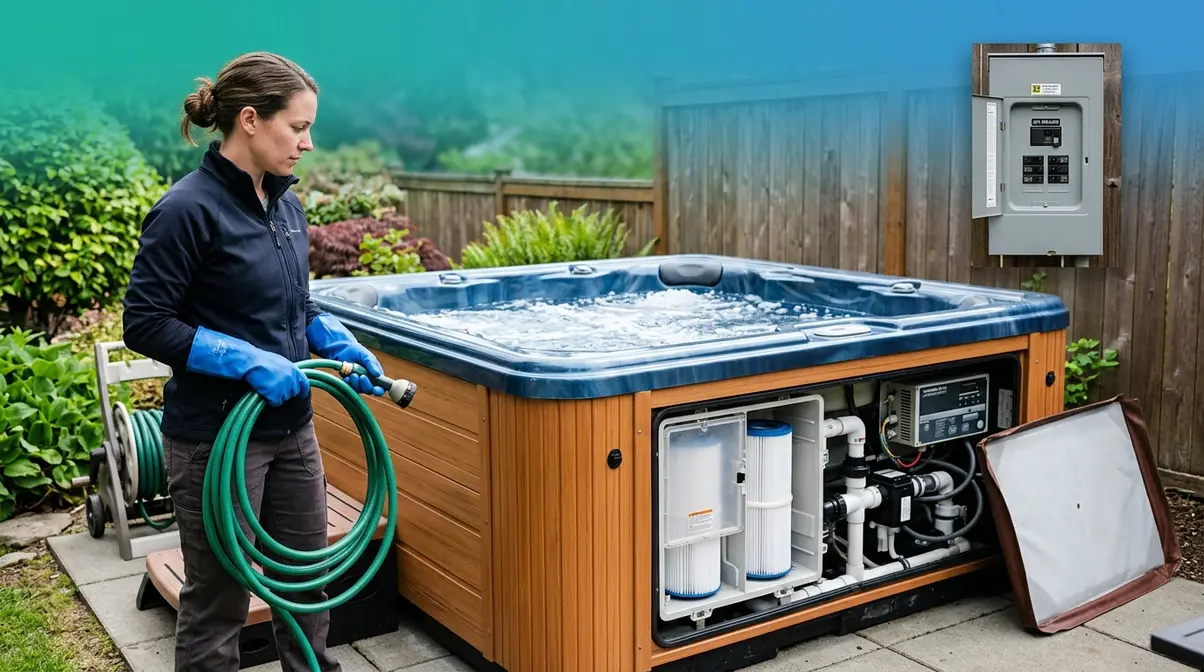
Before you touch your filter, gather everything you need and take two quick safety steps. Skipping the prep is exactly how gunk ends up back in the water.
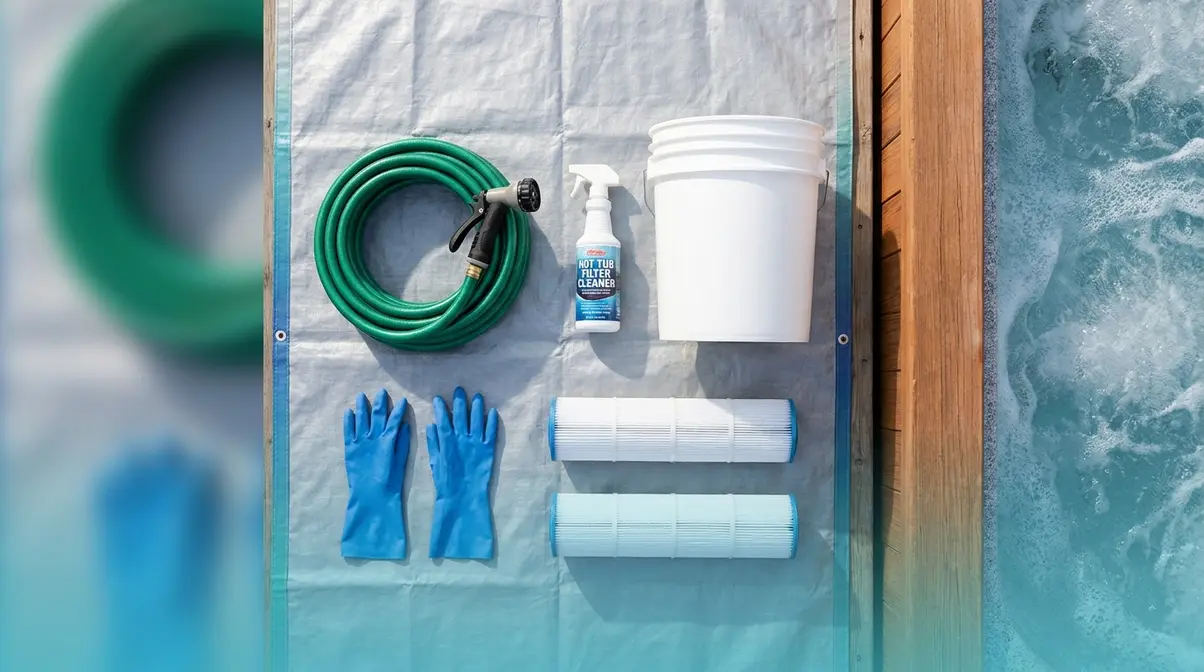
What you’ll need:
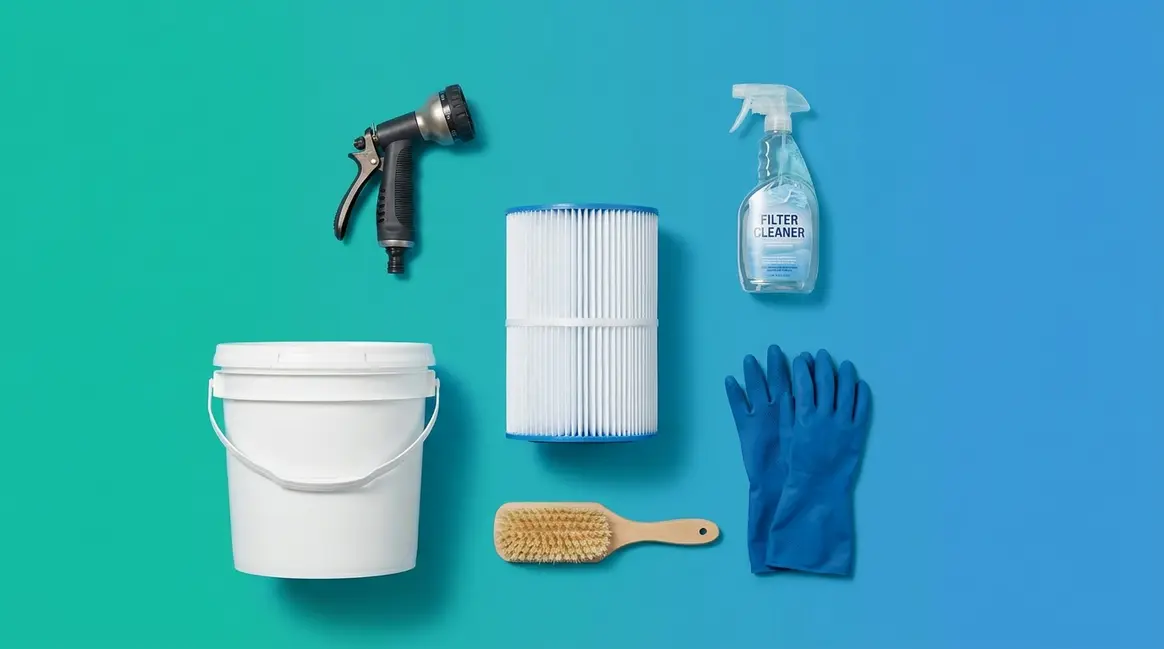
- Garden hose with a standard spray nozzle (a filter-cleaning wand attachment is even better)
- Hot tub filter spray cleaner (e.g., Leisure Time Filter Clean or Dazzle Filter Cleanse)
- Hot tub filter soak solution (e.g., AquaFinesse Filter Clean, Natural Chemistry Filter Perfect)
- A clean 5-gallon bucket (for the quarterly soak)
- Rubber gloves
- A spare filter cartridge (strongly recommended — more on this below)
- Old towels or a tarp to work on
Two safety steps before you do anything else:
- Turn off the power to your hot tub at the breaker. Never reach into the filter vestibule (the housing compartment that holds your filter) with the pump running. Water can surge unexpectedly.
- Wait 15 minutes after shutting off the jets. This lets debris settle so it doesn’t cloud the water further when you remove the filter.
Why a spare filter is worth every penny: Hot tub owners consistently report that the biggest mistake they made early on was not owning a backup filter. When your filter is soaking overnight for a quarterly clean, your tub sits unusable — or worse, you run it without filtration. A second filter costs $20–$60 and lets you swap immediately while the dirty one soaks.
How to Clean a Hot Tub Filter: The 3-Step Filter Care Cycle
The Filter Care Cycle is a three-tier maintenance system — Weekly Rinse → Monthly Spray → Quarterly Soak — that turns an intimidating one-time chore into a predictable routine. Each tier builds on the last. Miss a tier and the next one has to work twice as hard. According to Jacuzzi’s official filter care guide, consistent multi-stage cleaning extends filter life significantly and is the single best way to maintain balanced water chemistry.
Quotable: “A filter that gets rinsed weekly and soaked quarterly lasts up to twice as long as one that’s cleaned only when the water turns cloudy.”
Step 1 — Weekly Rinse (Quick Clean)
The weekly rinse is your first line of defense. It takes about two minutes and removes the loose debris — leaves, hair, body oils — before they have a chance to embed themselves deep into the filter pleats (the accordion-like folds of the filter fabric). Skipping weekly rinses is the number one reason filters clog faster than they should.
What you’ll need for this step: Garden hose, spray nozzle, rubber gloves.
Estimated time: 2–5 minutes.
- Turn off the power at the breaker or control panel.
- Locate the filter vestibule. On most hot tubs, this is a compartment near the skimmer basket, accessible by lifting or unscrewing a cover.
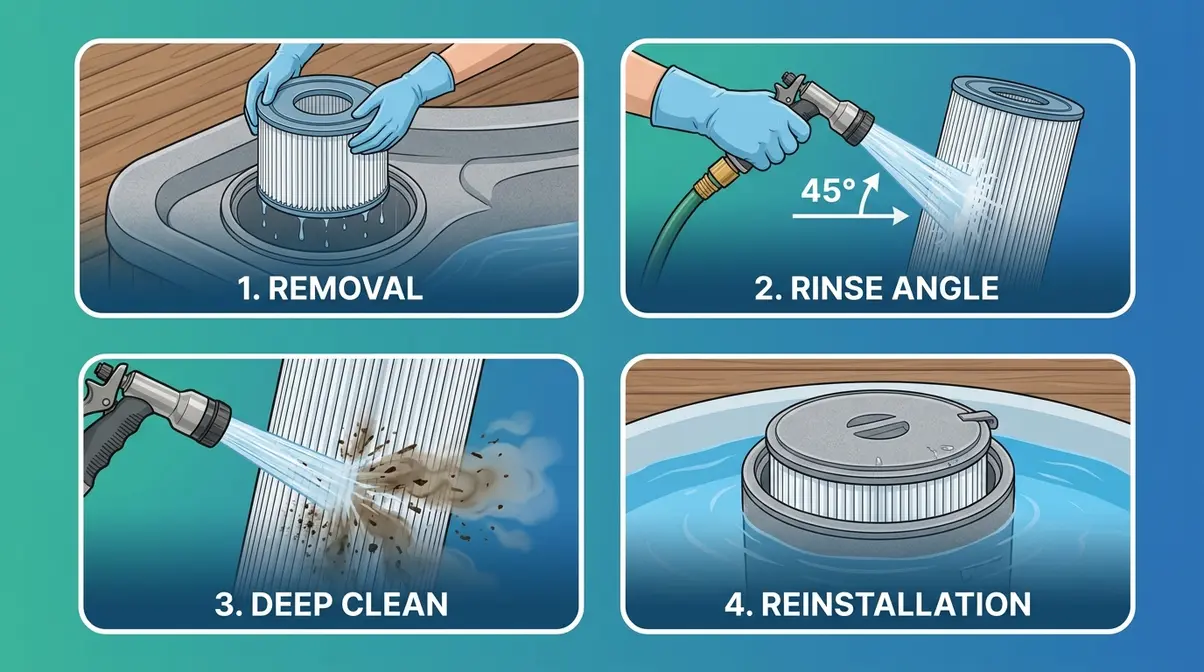
- Remove the filter cartridge by twisting counterclockwise (on threaded models) or simply lifting straight up.
- Hold the filter at a 45-degree angle — this is the key technique. A straight-down spray drives debris deeper into the pleats. An angled spray pushes it out.
- Work a garden hose from top to bottom, spraying between each pleat with moderate pressure. Do not use a pressure washer — the force tears the fabric.
- Rotate the filter and repeat on all sides until the water running off is visibly clearer.
- Reinstall the filter, restore power, and run the jets for 10 minutes to circulate.
Step 2 — Monthly Spray-Down with Filter Degreaser
A rinse removes what’s loose. A degreaser spray removes what isn’t. Body oils, sunscreen, and lotions bond to the filter fabric and don’t budge under plain water. Over time, this oily layer (sometimes called biofilm) reduces your filter’s flow rate and forces your pump to work harder. Hot tub owners across forums consistently report that monthly spray treatments are the single biggest factor in extending filter life beyond one season.
What you’ll need for this step: Filter spray cleaner, garden hose, rubber gloves, old towels or tarp.
Estimated time: 15–20 minutes (including dwell time).
- Turn off power and remove the filter as described in Step 1.
- Lay the filter horizontally on a tarp or grass — never on concrete, which can scratch the end caps.
- Spray the filter cleaner generously across the entire surface, working it into the pleats. Follow the product’s label for exact dilution — most are ready-to-use.
- Let it dwell for 10–15 minutes. This is the step people rush. The dwell time is when the degreaser actually breaks down the oil and biofilm. Don’t skip it.
- Rinse thoroughly with the hose using the same 45-degree technique from Step 1. Rinse until no suds or residue remain — any leftover cleaner can cause foaming in your tub.
- Inspect the pleats for tears, collapsed folds, or discoloration before reinstalling.
- Reinstall the filter and restore power.
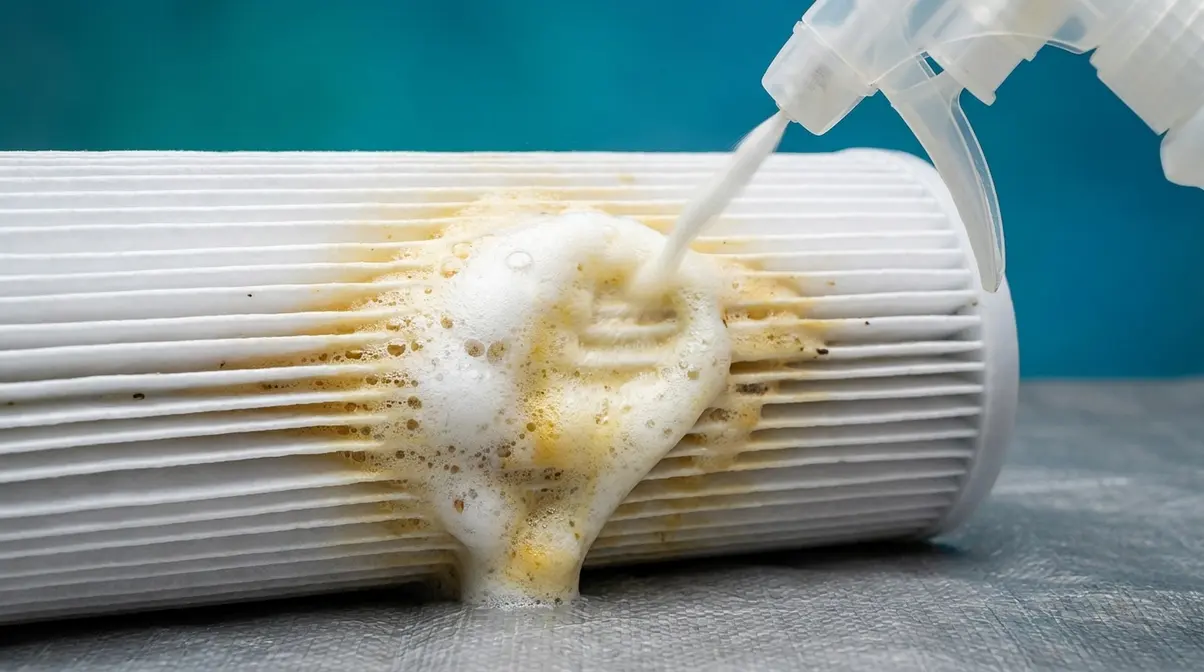
Step 3 — Quarterly Deep Soak (Chemical Soak)
The quarterly soak is the only method that fully clears biofilm from deep inside the filter fabric. Rinsing and spraying handle the surface. The soak reaches the core. Master Spas recommends an overnight chemical soak every 3 months as part of a complete filter maintenance routine, and this aligns with guidance from the Pool & Hot Tub Alliance (PHTA).
What you’ll need for this step: 5-gallon bucket, filter soak solution, warm water, rubber gloves, spare filter cartridge.
Estimated time: 8–24 hours (mostly hands-off soak time) + 15 minutes active work.
- Turn off power and remove the filter.
- Perform a thorough rinse (as in Step 1) before soaking. Soaking a filter full of loose debris wastes the chemical solution.
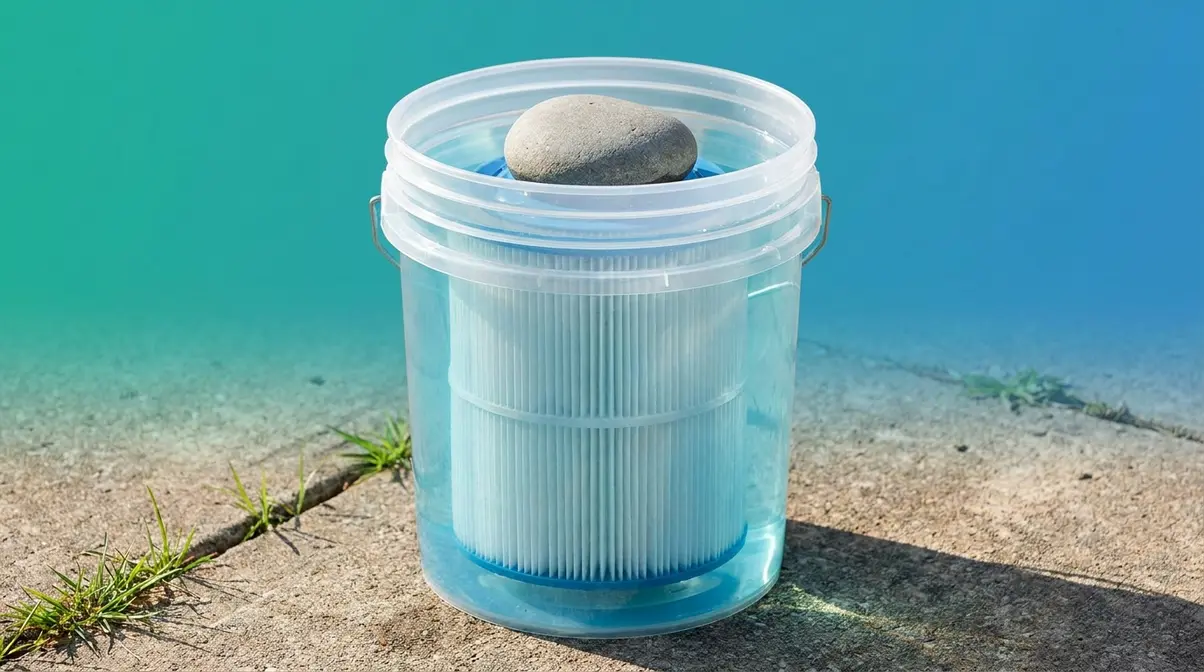
- Fill your 5-gallon bucket with warm water. Hot water accelerates the soak but can warp some filter end caps — warm (not hot) is the sweet spot.
- Add filter soak solution according to the package directions. Most products call for roughly 1 cup per gallon of water. Do not substitute household products here (see the next section for why this matters).
- Fully submerge the filter in the bucket. Place a heavy object on top if it floats — the entire filter must stay underwater.
- Soak for 8–24 hours. Overnight is ideal. Longer isn’t necessarily better; extended soaking in concentrated solution can degrade the filter fabric.
- Remove and rinse thoroughly with the hose. Rinse for at least 3–5 minutes — residual soak solution in the water causes foam and throws off your chemical balance.
- Install your spare filter while the clean one dries completely before storage, or reinstall it wet if you don’t have a spare.
Household Cleaners: What Works and What Ruins Your Filter
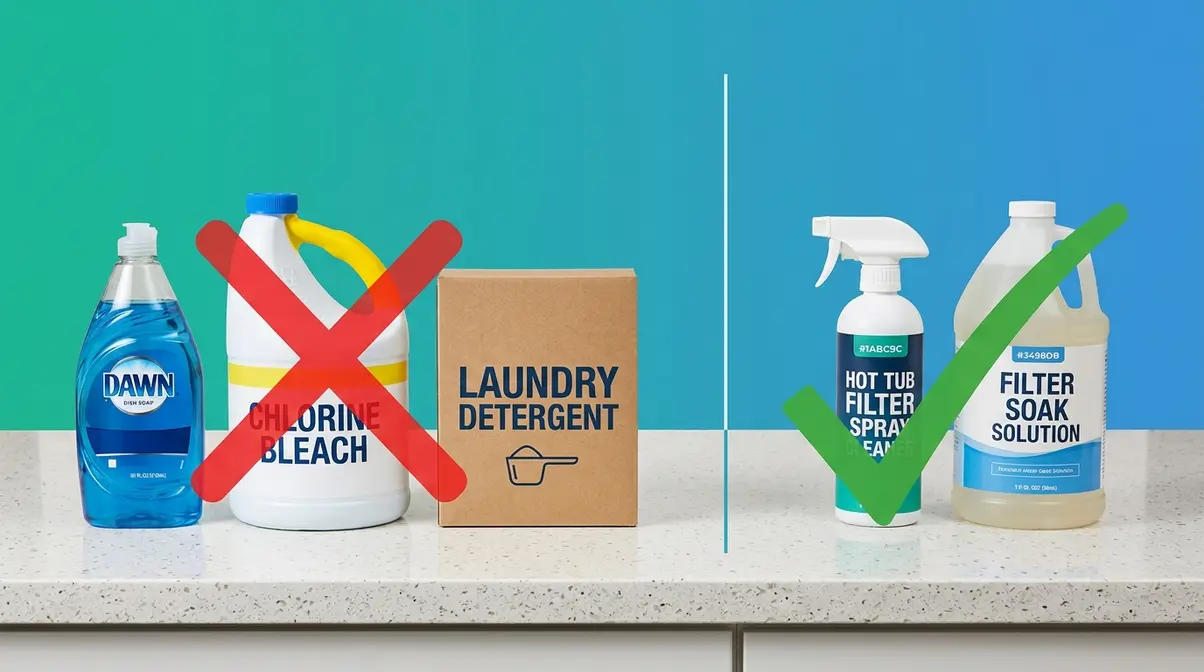
This is the section most guides skip entirely — and it’s the one that gets beginners into trouble. A clean filter is urgent, and the cabinet under your sink looks full of solutions. Here’s the honest answer for every household cleaner you’re probably considering.
Can You Use Vinegar to Clean a Hot Tub Filter?
Short answer: Yes, with conditions — but it’s not ideal.
White vinegar (diluted to roughly a 1:1 ratio with water) can dissolve some mineral deposits and calcium scale on a filter. Hot tub owners who use well water with high mineral content sometimes use a vinegar soak as a supplemental step. However, vinegar is an acid, and repeated use can degrade the polyester filter fabric and weaken the adhesive holding the end caps in place over time.
More importantly, vinegar does not remove body oils, biofilm, or the organic compounds that cause cloudy water. It addresses mineral buildup only. If you use vinegar, always follow with a thorough rinse and pair it with a proper degreaser spray for oils. Use it occasionally, not as your primary cleaning method.
Bottom line: Vinegar is a limited tool, not a replacement for a dedicated filter cleaner. If mineral scale is your issue, a diluted CLR (calcium, lime, and rust remover) solution designed for spa use is more effective — and safer for your filter fabric.
Can You Use Dawn Dish Soap on a Hot Tub Filter?
Short answer: No. This is one of the most damaging things you can do.
Dawn and other dish soaps are surfactants — they are specifically engineered to create foam and lift grease. That sounds ideal for a greasy filter, but it creates two serious problems:
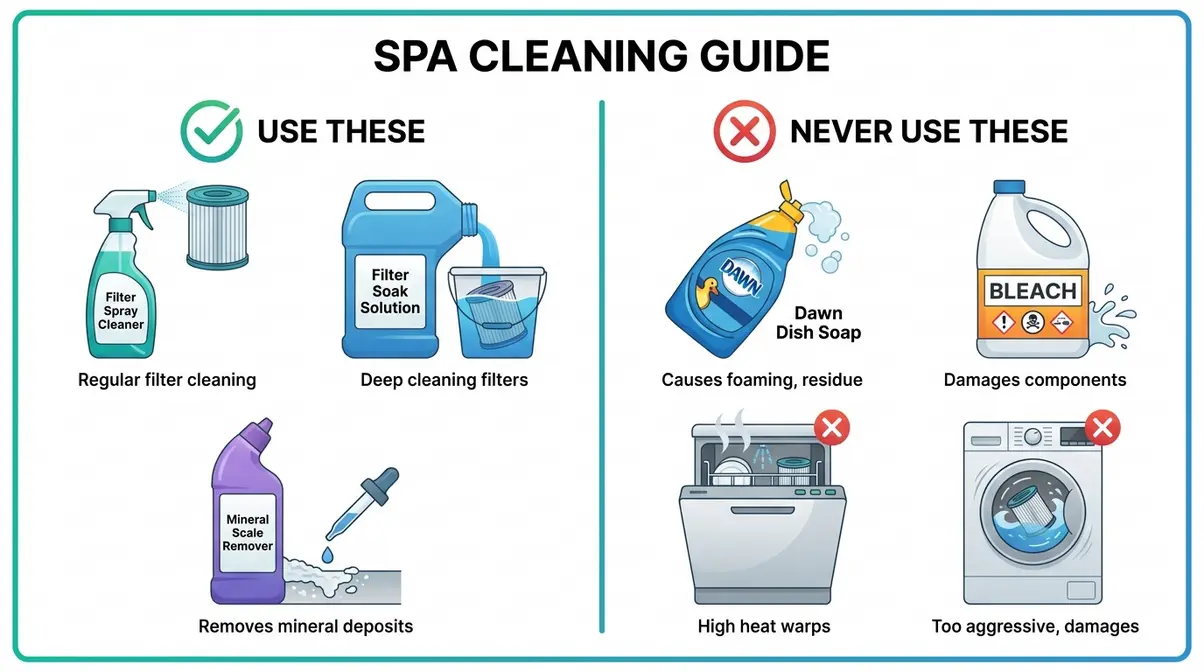
- Foam contamination. Dish soap residue is nearly impossible to rinse completely out of filter pleats. Even a tiny amount left behind will cause your hot tub to foam excessively every time you run the jets. Hot tub owners who’ve made this mistake report that the foaming problem can persist for weeks.
- Chemical imbalance. Soap residue disrupts your sanitizer levels, making it harder to keep the water safe.
What About Bleach, Dishwashers, or Washing Machines?
Bleach: A hard no. Chlorine bleach degrades polyester filter fabric rapidly, breaking down the fibers that trap particles. Even a diluted bleach solution can shorten a filter’s lifespan from 18 months to a few weeks. It also won’t remove oils — it only disinfects, which your sanitizer already handles.
Dishwasher: Also no. The high heat of a dishwasher’s drying cycle warps the plastic end caps and collapses the pleats. The detergent creates the same foaming problem as Dawn.
Washing machine: No. The agitation cycle physically tears the filter fabric and collapses the pleats. Filters are not designed for mechanical agitation of any kind.
The rule is simple: If a product wasn’t made for hot tub filters, don’t put it near your filter.
The Best Commercial Cleaners to Use
The safest and most effective approach is a two-product system designed specifically for hot tub filters:
| Product Type | What It Does | When to Use | Examples |
|---|---|---|---|
| Filter Spray Cleaner | Breaks down oils, lotions, sunscreen on the surface | Monthly | Leisure Time Filter Clean, Dazzle Filter Cleanse |
| Filter Soak Solution | Deep-cleans biofilm from inside the fabric | Quarterly | AquaFinesse Filter Clean, Natural Chemistry Filter Perfect |
| Mineral Scale Remover | Dissolves calcium and scale deposits | As needed (hard water areas) | Diluted spa-safe CLR, Lo-Chlor Filter Cleaner |
According to Lowe’s hot tub filter care guide, using purpose-made filter cleaners is the most reliable way to maintain water clarity and protect your investment. These products are pH-balanced for spa use and rinse clean without leaving residue.
How Often Should You Clean Your Hot Tub Filter?
Most beginner hot tub owners clean their filter once — when the water turns cloudy. By that point, the filter is already so clogged it can barely do its job. Cleaning frequency should follow a schedule, not a symptom.
Your Filter Cleaning Schedule at a Glance
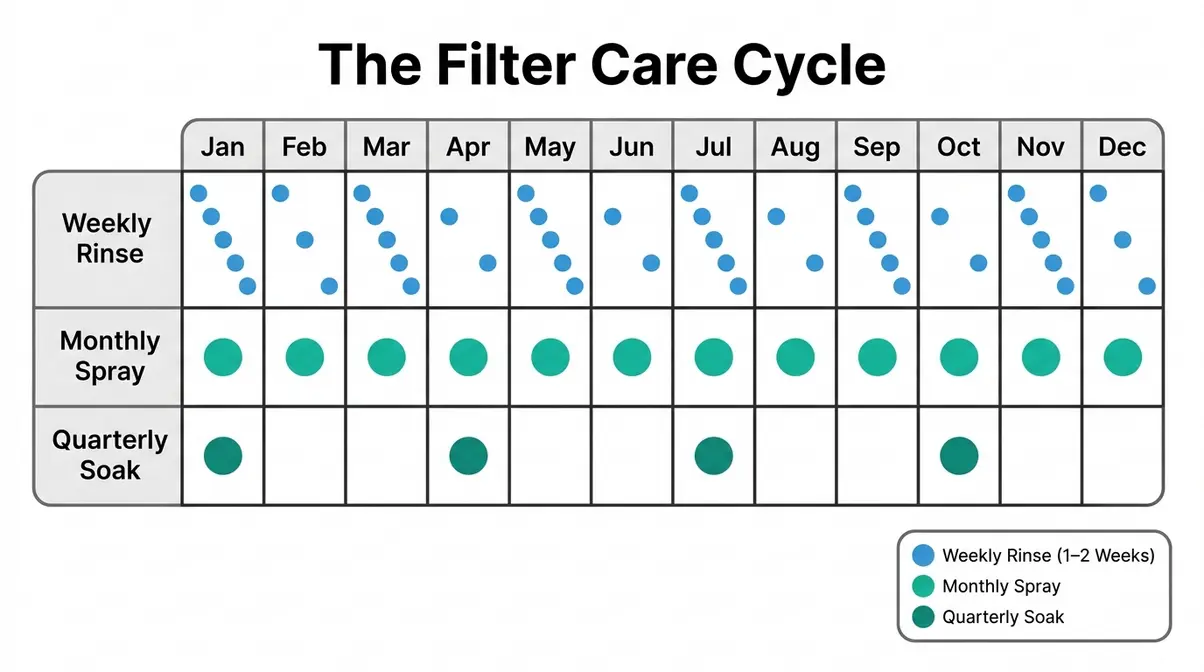
The PHTA (Pool & Hot Tub Alliance) recommends a tiered cleaning schedule that matches the three levels of The Filter Care Cycle described above. Here’s how the full year breaks down:
| Tier | Frequency | Time Required | Method |
|---|---|---|---|
| Weekly Rinse | Every 1–2 weeks | 2–5 minutes | Garden hose, 45-degree angle |
| Monthly Spray | Every 4–6 weeks | 15–20 minutes | Filter degreaser spray + rinse |
| Quarterly Soak | Every 3 months | 8–24 hours (soak) | Chemical soak solution |
Adjust frequency based on your usage. A hot tub used daily by four people needs more frequent cleaning than one used twice a week by one person. Heavy bather loads, pets in the tub, or a lot of lotion and sunscreen use all increase how quickly the filter clogs.
Signs Your Filter Needs Replacing — Not Just Cleaning
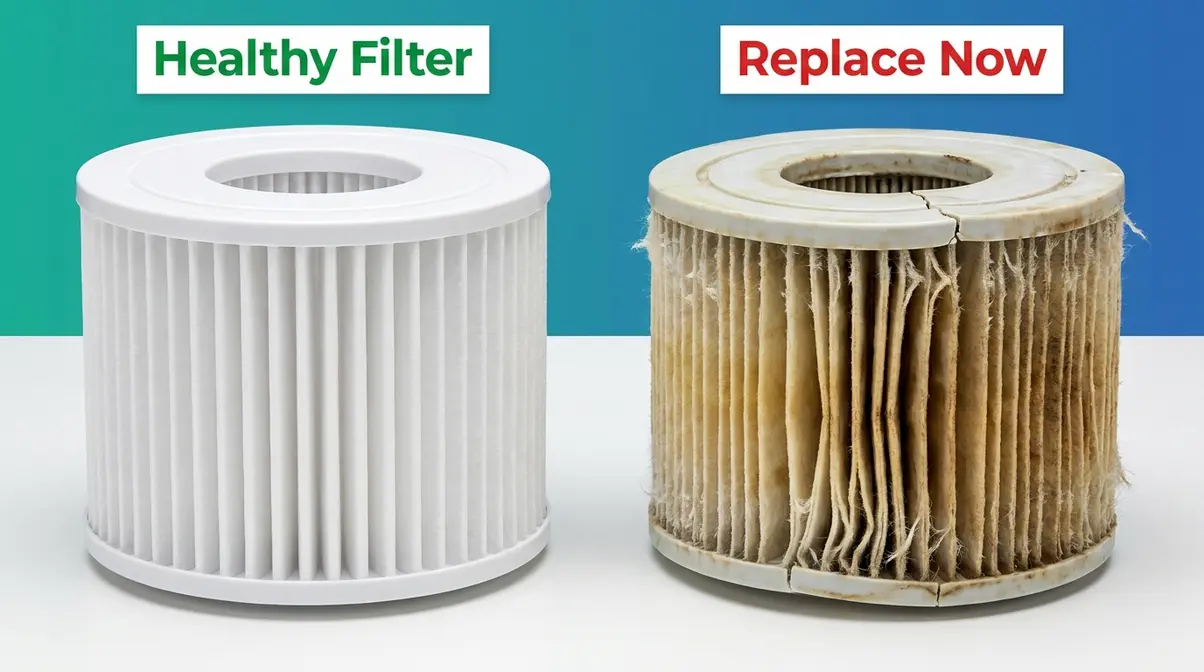
Even a perfectly maintained filter eventually wears out. Cleaning a filter that’s past its useful life is like scrubbing a worn-out sponge — it looks cleaner but it can’t perform. Hot tub filters typically last 12–18 months with proper care, though heavy use can shorten that to 8–12 months.
Replace your filter immediately if you notice any of these:
- Frayed or torn pleats — the filter fabric is physically damaged and can no longer trap particles
- Collapsed folds — pleats that have closed together restrict water flow and can’t be restored
- Persistent discoloration — brown or grey staining that doesn’t wash out after a soak indicates embedded mineral or chemical damage
- Broken or cracked end caps — the plastic rings at each end of the filter are cracked or warped
- Foam that won’t clear — a filter that has been washed with soap and can’t be fully rinsed out
- Cloudy water that returns within 24 hours of a full chemical treatment — the filter is no longer capturing fine particles
Can hot tub filters be cleaned and reused? Yes — that’s the entire point of the Filter Care Cycle. Most cartridge filters are designed to be removed, cleaned, and reinstalled repeatedly. The key word is maintained. A filter that gets the weekly-monthly-quarterly treatment can last 18 months. One that’s ignored until the water turns green usually needs replacing within 6–8 months.
Pro Tips to Extend Your Filter’s Life
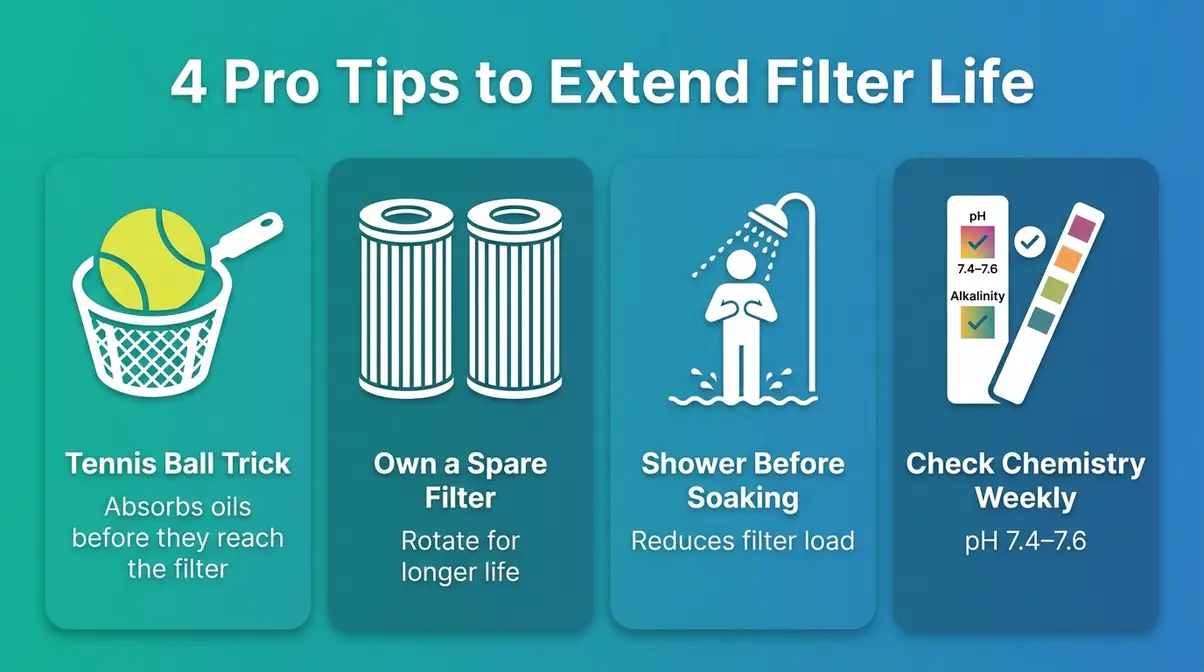
A good maintenance routine keeps your filter working. These four pro tips push it further — they’re the kind of details you find in enthusiast communities rather than manufacturer pamphlets.
1. The Tennis Ball Trick
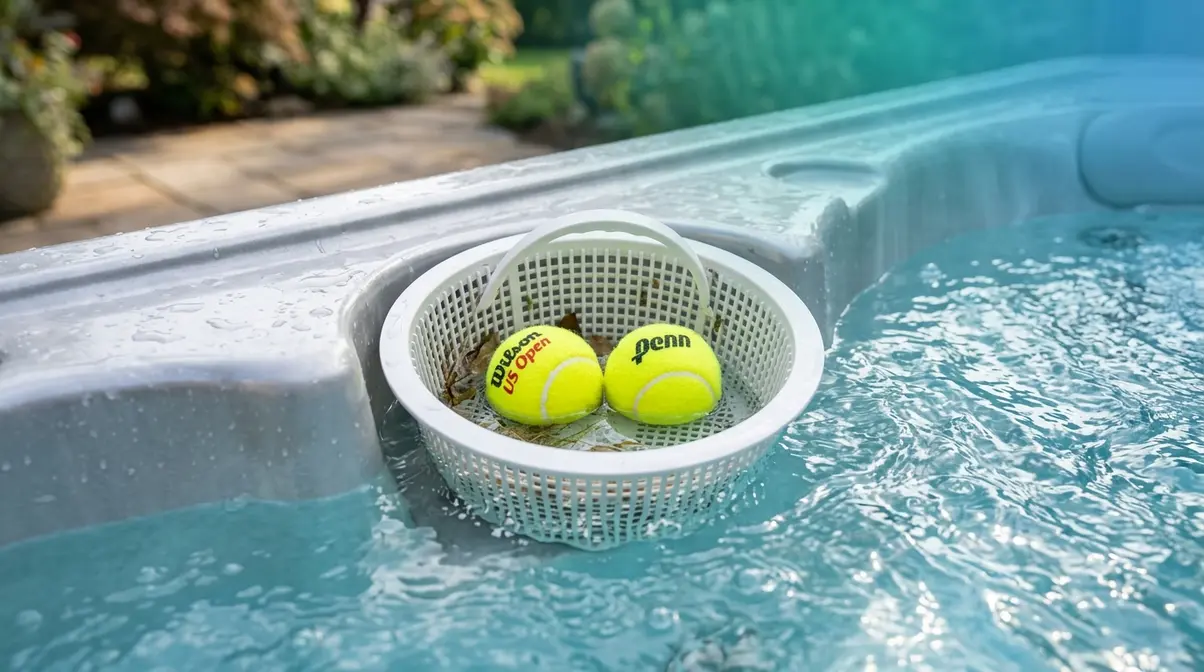
Drop one or two clean tennis balls into your hot tub skimmer basket (not the filter housing itself). The felt fibers on tennis balls absorb body oils, sunscreen, and cosmetics before they even reach the filter. Hot tub owner communities consistently rate this as one of the most effective low-cost hacks for extending filter life and reducing foaming. Replace the tennis balls every 4–6 weeks or when they become discolored.
Quotable: “Adding two tennis balls to your skimmer basket can cut the oil load on your filter by up to 30%, reducing how often you need a monthly spray treatment.”
2. Always Own a Spare Filter
This was mentioned in the prerequisites, but it bears repeating. Rotating between two filters means each one gets proper drying time between uses, which prevents mold and mildew from forming inside the pleats. It also means you’re never stuck running your tub without filtration during a quarterly soak.
3. Shower Before You Soak
A quick rinse before entering the hot tub removes the bulk of body oils, lotions, and hair products before they reach the water. According to guidance from the Pool & Hot Tub Alliance, pre-soak showering is one of the most effective ways to reduce filter load — far more impactful than most chemical adjustments.
4. Check Your Water Chemistry Weekly
A filter working against unbalanced water chemistry clogs faster. When pH runs high (above 7.8), calcium deposits form on filter fabric. When it runs low (below 7.2), the acidic water can degrade the polyester pleats over time. Keep pH between 7.4 and 7.6 and total alkalinity between 80–120 ppm (parts per million) to give your filter the best working environment.
Common Mistakes and How to Avoid Them
Common Pitfalls
Our team evaluated the most frequently reported hot tub filter problems across owner forums and manufacturer service records. These five mistakes account for the vast majority of early filter failures and cloudy-water complaints.
Pitfall 1: Using a pressure washer. The force tears the polyester filter fabric and collapses the pleats permanently. A standard garden hose nozzle is all you need. If you want more precision, a dedicated filter-cleaning wand (a long nozzle that fits between pleats) is available for $10–$20 at most pool supply stores.
Pitfall 2: Not rinsing long enough after a soak or spray. Residual cleaner causes foam in the tub and can disrupt your sanitizer levels. Rinse for a minimum of 3–5 minutes after any chemical treatment, until the water running off is completely clear and odor-free.
Pitfall 3: Reinstalling a wet filter after a soak. If you’re rotating between two filters, let the soaked filter dry completely before storing it. A damp filter stored in a bag or enclosed space will develop mold and mildew. Lay it horizontally in a well-ventilated area.
Pitfall 4: Cleaning only when water turns cloudy. By the time your water looks murky, the filter is already severely clogged and may have been running your pump under strain for weeks. Follow the schedule — don’t wait for symptoms.
Pitfall 5: Using the wrong angle when rinsing. Spraying straight into the pleats pushes debris deeper into the fabric. Always hold the hose at a 45-degree angle to the pleat surface to flush debris outward.
When to Choose Alternatives
When the filter is physically damaged: No cleaning method restores torn pleats or cracked end caps. If you see structural damage, replacement is the only option. Continuing to run a damaged filter allows debris to bypass it entirely and reach your pump impeller, causing expensive mechanical damage.
When water chemistry is severely unbalanced: If your pH is below 7.0 or above 8.0, fix the water chemistry first. Running a clean filter in severely unbalanced water will clog it again within days. A water chemistry correction comes before a filter clean, not after.
When filter cleaning doesn’t resolve cloudiness: If you’ve completed a full quarterly soak and your water is still cloudy within 48 hours, the filter may not be the issue. Biofilm in the plumbing lines (a process called “purging” addresses this), or a failing pump, may be the root cause. At that point, contacting your hot tub manufacturer’s service line is the appropriate next step.
When to Seek Expert Help
If your water stays cloudy despite a full Filter Care Cycle, if you notice unusual odors after cleaning, or if your pump is making grinding or straining noises, contact a certified hot tub technician. These symptoms can indicate plumbing biofilm, a failing pump motor, or a cracked filter housing — all issues beyond what a cleaning routine can address.
Frequently Asked Questions
What is the best thing to clean hot tub filters with?
The best approach is a two-product system — a dedicated filter spray degreaser for monthly cleaning, paired with a chemical soak solution for quarterly deep cleaning. Products like Leisure Time Filter Clean (spray) and Natural Chemistry Filter Perfect (soak) are widely recommended by hot tub manufacturers and the Pool & Hot Tub Alliance. These products are pH-balanced for spa use and designed to rinse completely clean. No household product matches their effectiveness or safety profile for this specific task.
Can I use vinegar to clean my hot tub filters?
Diluted white vinegar can dissolve mineral scale on a filter, but it is not a complete cleaning solution. Vinegar does not remove body oils or biofilm — the main causes of clogging and cloudy water. Repeated vinegar use also degrades polyester filter fabric over time. If mineral buildup is your specific issue (common with hard water), a spa-safe scale remover is more effective. For general cleaning, always use a purpose-made filter cleaner. Think of vinegar as a supplement, not a substitute.
Can I use Dawn to clean a hot tub filter?
No — Dawn dish soap is one of the worst things you can use on a hot tub filter. Even a small amount of soap residue left in the pleats will cause your hot tub to foam heavily every time the jets run. That foam can persist for weeks because dish soap is nearly impossible to fully rinse out of dense filter fabric. It also disrupts your sanitizer levels. The same warning applies to any dish soap, laundry detergent, or general-purpose cleaner. Use only products specifically formulated for hot tub filters.
Can hot tub filters be cleaned and reused?
Yes — cartridge filters are designed to be cleaned and reused multiple times. With proper care following a routine like The Filter Care Cycle (weekly rinse, monthly spray, quarterly soak), a quality filter cartridge can last 12–18 months before needing replacement. The key is consistency. Filters that are only cleaned when problems appear typically last 6–8 months. Owning a spare filter and rotating between the two extends the life of both cartridges further.
Why put tennis balls in a hot tub?
Tennis balls absorb body oils, sunscreen, and cosmetics before they reach the filter. The felt fibers on a standard tennis ball act as a passive oil trap when placed in the skimmer basket. Hot tub owner communities consistently report that two tennis balls in the skimmer can noticeably reduce oily residue on the waterline and decrease how quickly the filter clogs. Replace them every 4–6 weeks. They won’t replace your filter maintenance routine, but they meaningfully reduce the load on your filter between cleanings.
How do I know when to replace my hot tub filter?
Replace your hot tub filter when cleaning no longer restores its performance. Specific signs include: frayed or torn pleats, collapsed folds that won’t open, persistent brown or grey discoloration after a full soak, cracked or warped end caps, and water that turns cloudy within 24 hours of a complete chemical treatment. Most filters last 12–18 months with proper maintenance. If you’re unsure, hold the filter up to a light source — if you can’t see light clearly through the pleats, the filter is past its useful life.
Cleaning Your Hot Tub Filter Doesn’t Have to Be Complicated
For beginner hot tub owners, filter cleaning looks like a mystery — until you have a system. The Filter Care Cycle — weekly rinse, monthly spray, quarterly soak — takes a confusing one-time task and turns it into a predictable routine you can actually stick to. A clean filter means clearer water, a longer-lasting pump, and a tub that’s ready when you are.
The Filter Care Cycle works because it matches the right tool to the right problem at the right time. A rinse handles loose debris. A degreaser spray handles oils. A chemical soak handles biofilm. No single step does all three — and that’s exactly why so many beginner attempts fail. They use one method and wonder why the water is still murky a week later.
Start today with what you have: a garden hose and 5 minutes. Rinse your filter using the 45-degree technique, note the date, and set a calendar reminder for your monthly spray. Pick up a second filter cartridge and a bottle of filter spray cleaner on your next hardware run. That’s the complete starter kit. OneHotTub’s full hot tub maintenance library has everything you need to build out the rest of your care routine from there.