

Table of Contents - Hot Tub Water Maintenance Guide: 4-Cadence System (2026)
- Understanding Hot Tub Water Balance
- Your 4-Cadence Hot Tub Maintenance Schedule
- Essential Hot Tub Chemicals, Filters, and Accessories
- Fixing Common Hot Tub Water Problems
- Salt Water vs. Chlorine: Which System Is Right for You?
- Chemical Safety Rules Every Owner Must Know
- Frequently Asked Questions
- The 4-Cadence System Works Because It Removes the Guesswork
This blog post may contain affiliate links. As an Amazon Associate I earn from qualifying purchases.
Hot tub water maintenance doesn’t have to mean staring at a row of chemicals and hoping you grab the right one. The right system turns the whole process into a predictable, 10-minute routine — no guesswork, no anxiety, no cloudy water surprises.
Without a clear schedule, most new owners fall into one of two traps: they over-treat the water (pouring in chemicals after every soak “just to be safe”) or they under-treat it (skipping weeks until the water turns murky and uninviting). Both mistakes are easy to make and surprisingly expensive to fix. This hot tub water maintenance guide gives you the exact chemical targets, a structured time-based schedule for every task, and straightforward fixes for the most common water problems — so you can stop second-guessing yourself and start enjoying your investment.
We’ll cover water chemistry fundamentals, the complete 4-Cadence System maintenance schedule, essential products, troubleshooting, and chemical safety — everything in one place.
Effective hot tub water maintenance comes down to four time-based cadences — daily, weekly, monthly, and quarterly — each taking under 10 minutes to complete.
- Test water 2–4 times per week: Keep pH at 7.2–7.8 and free chlorine at 3–10 ppm (CDC guidelines, 2024)
- The 4-Cadence System: Organize every maintenance task by frequency to eliminate guesswork
- Add chemicals in order: Alkalinity first, then pH, then sanitizer — always, without exception
- Drain and refill every 3–4 months: Industry standard per PHTA ANSI standards
- Clean filters monthly: The single most overlooked step that leads to cloudy water
Understanding Hot Tub Water Balance
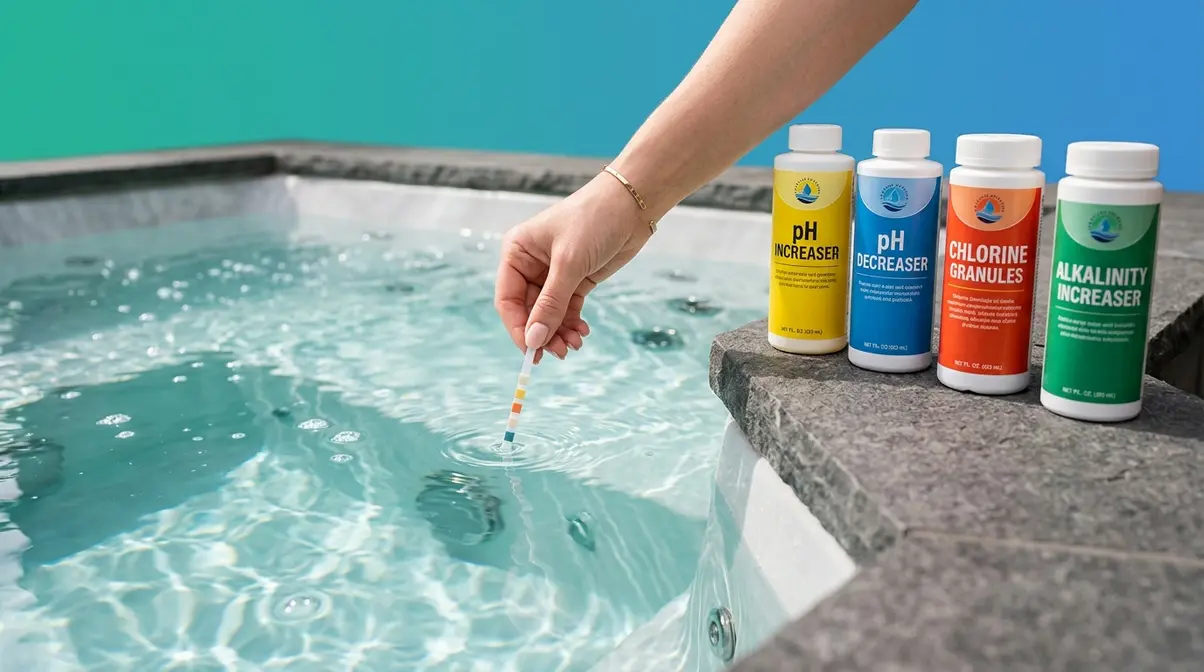
Hot tub water balance comes down to four parameters: pH, Total Alkalinity, Calcium Hardness, and your sanitizer level. According to the Centers for Disease Control and Prevention (CDC), maintaining free chlorine at 3–10 ppm and pH strictly between 7.2–7.8 is essential to prevent recreational water illnesses in residential spas (CDC, 2024). When even one of these drifts outside its target range, it can render your sanitizer ineffective, damage equipment, or cause skin and eye irritation — problems that are far more costly to fix than prevent.
“Balanced water is the foundation of every other maintenance step. Get the chemistry right, and everything else in the 4-Cadence System falls into place.”
This section is your chemistry foundation. Understanding why each parameter matters — not just what the numbers are — is what separates owners who enjoy their hot tub year-round from those who dread opening the cover.
The 4 Chemical Pillars You Must Balance
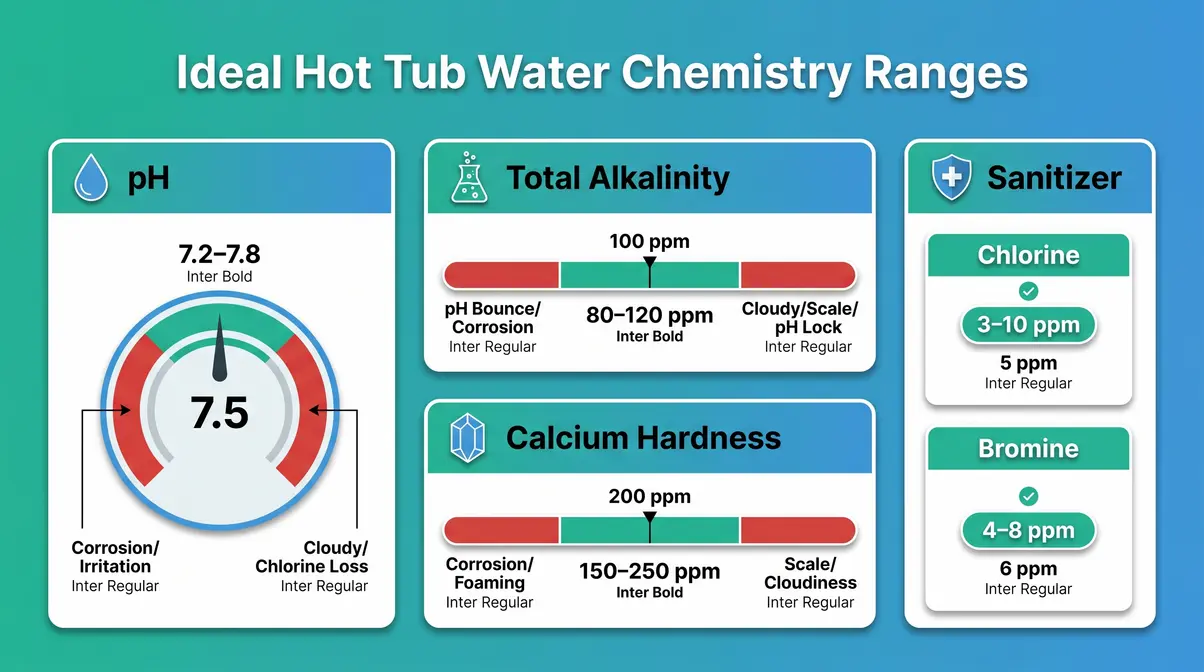
Every hot tub water problem traces back to one or more of these four parameters being out of range. Here’s what each one does, what its ideal range is, and what goes wrong when it drifts.
pH (Target: 7.2–7.8)
pH measures how acidic or alkaline your water is on a scale of 0–14. Below 7.2, water turns acidic — it corrodes jets, heater elements, and the shell, and it irritates eyes and skin noticeably. Above 7.8, water becomes alkaline, and this is where sanitizer efficiency collapses: at a pH of 8.0, chlorine loses up to 80% of its effectiveness, meaning you could be testing “fine” levels of chlorine while bacteria are barely being touched (Leslie’s Pool Supply, 2024). Test and adjust pH every time you test your water.
Total Alkalinity (TA, Target: 80–120 ppm)
Total Alkalinity (TA) is your water’s resistance to pH changes — think of it as the buffer that keeps pH from swinging wildly every time someone soaks. The most critical rule new owners miss: always adjust TA before pH. If TA is outside its 80–120 ppm range, any pH correction you make won’t hold. You’ll add pH increaser, test an hour later, and find the level has shifted again — a frustrating cycle that wastes product and time.
Calcium Hardness (CH, Target: 150–250 ppm)
Calcium Hardness (CH) measures how much dissolved calcium is in your water. Water that’s too soft (low CH) is “hungry” — it will pull calcium from your shell, jets, and heater to compensate, causing pitting and corrosion over time. Water that’s too hard (high CH, above 400 ppm) deposits scale on every surface it touches. The 150–250 ppm target keeps water balanced and equipment protected.
Sanitizer (Chlorine: 3–10 ppm free; Bromine: 4–8 ppm)
Sanitizer is your primary defense against bacteria, viruses, and the biofilm that builds up inside pipes. The CDC recommends free chlorine at 3–10 ppm for hot tubs specifically — a higher range than pools because hot water accelerates chlorine consumption (CDC, 2024). Bromine (4–8 ppm) is a popular alternative that’s more stable at high temperatures and gentler on sensitive skin. Both work; the choice depends on your preference and your tub’s system.
| Parameter | Ideal Range | Too Low = | Too High = |
|---|---|---|---|
| pH | 7.2–7.8 | Corrosion, skin irritation | Cloudy water, 80% chlorine loss |
| Total Alkalinity | 80–120 ppm | pH swings wildly | Scale buildup, cloudy water |
| Calcium Hardness | 150–250 ppm | Shell/equipment corrosion | Scale, cloudy water |
| Free Chlorine | 3–10 ppm | Bacteria, illness risk | Eye/skin irritation |
| Bromine | 4–8 ppm | Bacteria, illness risk | Irritation, strong odor |
How to Test Your Hot Tub Water Step by Step
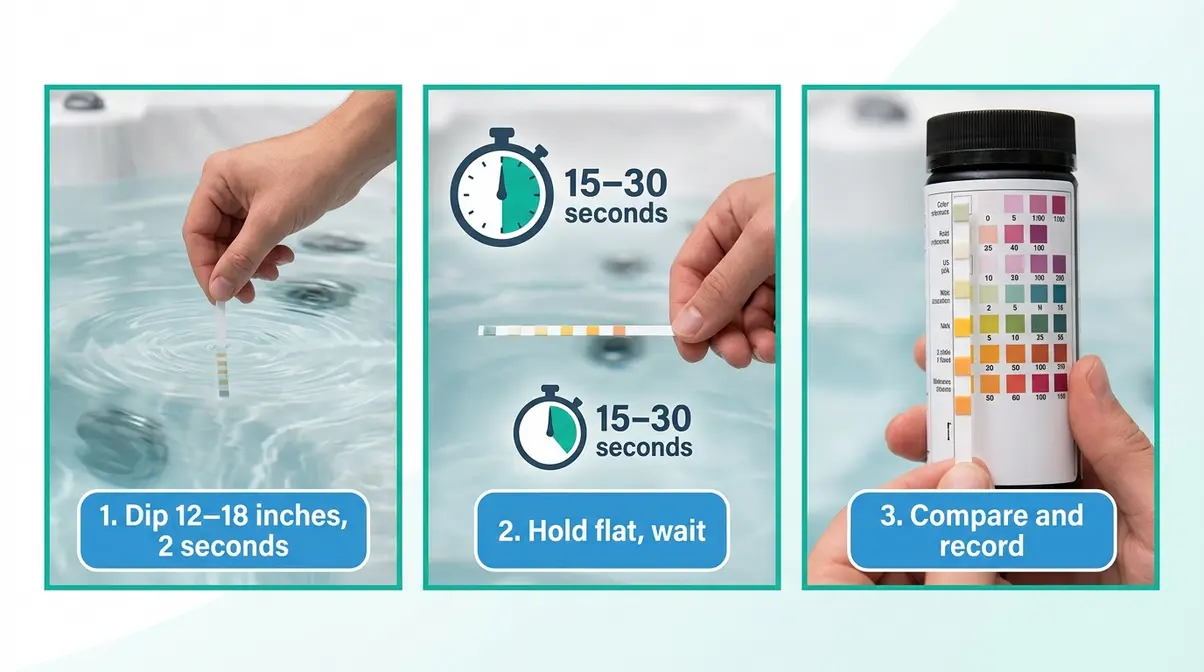
Testing hot tub water is the one task that drives everything else — without accurate readings, you’re adjusting chemicals blindly. The best way to test hot tub water is with a reliable test kit used consistently. Industry practice recommends testing 2–4 times per week, and always before adding any chemicals.
What you’ll need: Test strips or a liquid drop kit (or both), a clean sample cup, and about 3 minutes.
Step-by-step testing with test strips:
- Turn off the jets and wait 15–30 minutes. Moving water gives inaccurate readings.
- Dip the strip 12–18 inches below the surface for 2 seconds. Do not shake off excess water.
- Hold the strip flat and horizontal for the time specified on the package (typically 15–30 seconds).
- Compare the color blocks to the reference chart in good lighting.
- Record your readings. Note pH, TA, CH, and sanitizer levels before making any adjustments.
Liquid drop test kits are more precise than strips and worth the extra 2 minutes for weekly checks. They use reagent drops that produce a color change in a water sample, with less risk of color-reading error in bright sunlight. For monthly checks and after a drain-and-refill, use a liquid kit.
Pro tip from onehottub.com’s evaluation process: Take your water sample from elbow depth — not from the surface — for the most representative reading. Surface water is more affected by evaporation and recent additions.
For a complete breakdown of testing methods and tools, see our guide to how to test hot tub water.
What to Do When Levels Are Off
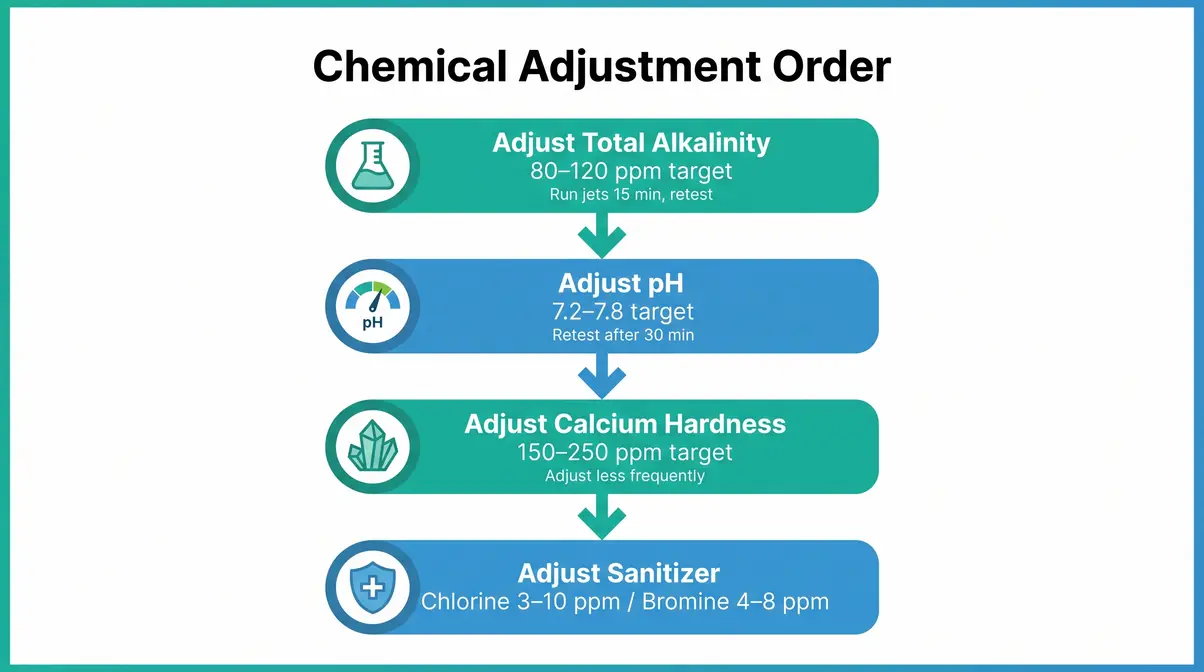
Finding an out-of-range reading is not a crisis — it’s just a signal to act in the right order. The sequence matters enormously. Adjusting pH before TA, for example, means your pH correction will be undone by the unstable alkalinity underneath it.
The correct chemical adjustment order:
- Adjust Total Alkalinity first. Use a TA increaser (sodium bicarbonate) to raise it, or add a pH decreaser (sodium bisulfate) in small doses to lower it. Add product, run jets for 15 minutes, retest.
- Adjust pH second. Once TA is stable, pH corrections will hold. Use pH increaser (sodium carbonate) to raise, pH decreaser to lower. Retest after 30 minutes.
- Adjust Calcium Hardness if needed. CH changes slowly, so adjustments are less frequent. Add calcium hardness increaser in small doses with jets running.
- Adjust sanitizer last. Add chlorine or bromine only after the other parameters are in range. Adding sanitizer to poorly balanced water wastes product and can cause irritation.
Key rule: Follow the product label for exact dosing. Dosing varies by product concentration and your tub’s volume. Overdosing is as problematic as underdosing — more is not better.
Your 4-Cadence Hot Tub Maintenance Schedule
“I have never filled, flushed or drained a hot tub before and I have no idea when to add chemicals and what order etc.”
If that quote sounds familiar, you’re not alone — it’s one of the most common things new hot tub owners say. The answer to “when do I do what?” is the core problem that The 4-Cadence System solves.
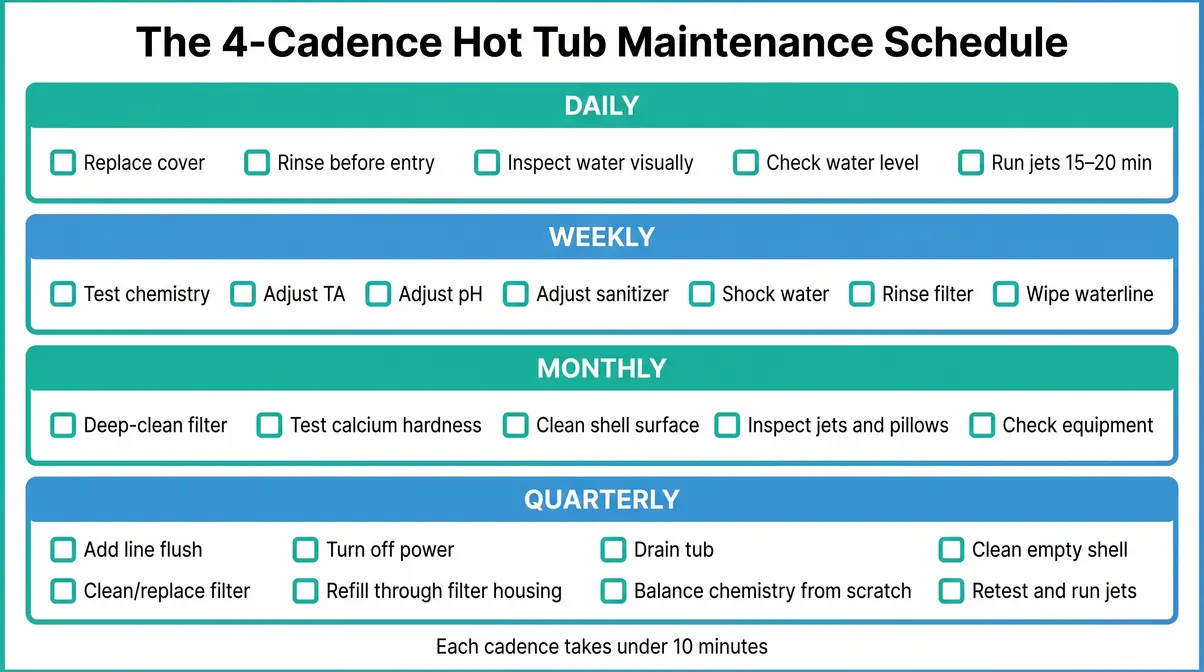
The 4-Cadence System organizes every hot tub maintenance task into one of four time-based routines: Daily, Weekly, Monthly, and Quarterly. Each cadence takes under 10 minutes. Each one has a specific, non-overlapping purpose. Together, they cover everything — and because every task has an assigned cadence, nothing falls through the cracks.
Before you start — What you’ll need:
Prerequisites / What You’ll Need
- Test strips or liquid test kit
- Sanitizer (chlorine tablets/granules or bromine)
- pH increaser and pH decreaser
- Total Alkalinity increaser
- Shock treatment (oxidizing shock or chlorine shock)
- Filter cleaner spray and/or filter soak solution
- Hot tub surface cleaner (non-foaming)
- Line flush cleaner (for quarterly drains)
- Garden hose with clean water
- Non-abrasive sponge or cloth
Daily and Post-Use Tasks (5 Minutes)
A good hot tub maintenance schedule doesn’t start with a weekly chemical session — it starts with small, consistent habits after every soak. These daily tasks take about 5 minutes and prevent the buildup that causes cloudy water and scum lines.
Daily Checklist:
- Replace the cover immediately after use. This retains heat, prevents airborne debris from entering, and slows chemical evaporation.
- Rinse off before entering (and remind guests). Body oils, lotions, and deodorant are the primary source of foam and scum lines.
- Visually inspect the water. It should be clear. Cloudiness, foam, or an unusual odor are early warning signs — catching them now is far easier than fixing them later.
- Check the water level. Water should be at the manufacturer’s recommended level. A drop of more than an inch in a day warrants investigation (see Troubleshooting section).
- Run jets for 15–20 minutes if you haven’t soaked that day. Circulation keeps water moving through the filter and prevents stagnation.
Post-heavy-use tip: After a party or multiple bathers, add a small shock dose immediately — don’t wait for your weekly session. High bather load spikes organic compounds that overwhelm sanitizer fast.
Weekly Maintenance Checklist
The weekly cadence is where the core chemistry work happens. Based on standard industry practice, this session should take 20–30 minutes the first few times, and closer to 10–15 minutes once you’re familiar with your tub’s patterns.
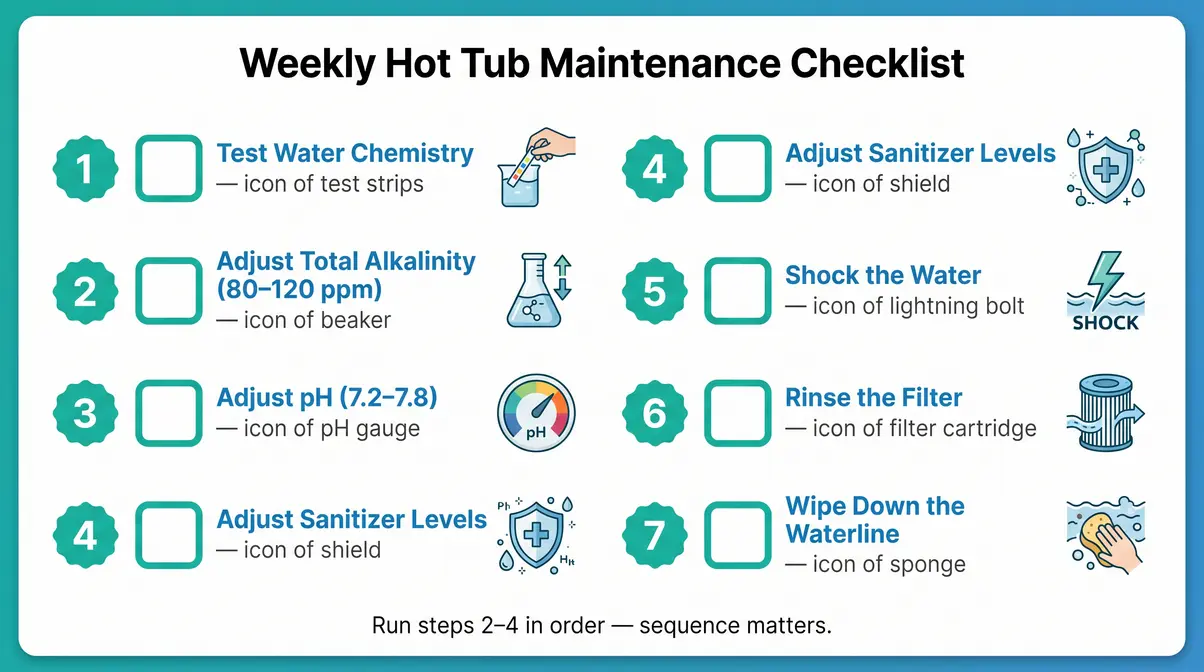
Weekly Checklist:
- Test water chemistry (pH, TA, CH, sanitizer). Use your test strips or liquid kit. Record the readings.
- Adjust Total Alkalinity if outside 80–120 ppm range. Add increaser or pH decreaser in small doses; retest after 15 minutes.
- Adjust pH if outside 7.2–7.8. Add pH increaser or decreaser as needed; retest after 30 minutes.
- Adjust sanitizer levels. Add chlorine or bromine to reach your target range (3–10 ppm free chlorine or 4–8 ppm bromine).
- Shock the water. Weekly shocking oxidizes organic waste (body oils, cosmetics) that sanitizer alone can’t eliminate. Use a non-chlorine oxidizing shock for routine use, or a chlorine shock after heavy bather loads.
- Rinse the filter with a garden hose. A quick rinse removes surface debris and keeps flow rate healthy between monthly deep cleans.
- Wipe down the waterline. Scum lines form where the water meets the shell. A non-foaming hot tub surface cleaner and a non-abrasive cloth take about 2 minutes.
Monthly Deep-Clean Tasks
Monthly tasks go deeper than weekly maintenance. This cadence addresses the gradual buildup that weekly sessions can’t fully address — filter saturation, shell deposits, and water quality drift.
Monthly Checklist:
- Deep-clean the filter cartridge. Remove the filter and soak it overnight in a dedicated filter cleaning solution. A rinsed filter looks clean but still carries oils and minerals that a chemical soak dissolves. Per manufacturer guidelines, cartridge filters should be replaced every 12–24 months depending on usage frequency.
- Test Calcium Hardness specifically. CH changes more slowly than pH or TA, so monthly testing is sufficient. Adjust if outside 150–250 ppm.
- Clean the shell surface thoroughly. Use a non-abrasive hot tub surface cleaner on the shell, seats, and headrests. Pay attention to the waterline and jet surrounds where scale and biofilm accumulate.
- Inspect jets and pillows. Remove and rinse any removable jet inserts. Check inflatable or foam pillows for mold or discoloration — these are common bacterial harborage points that owners overlook.
- Check equipment visually. Look at the heater, pump, and filter housing for any leaks, corrosion, or unusual sounds. Early detection of equipment issues prevents expensive repairs.
Why monthly deep-cleaning matters: A filter that’s chemically saturated — even if it looks clean — restricts flow and reduces the effectiveness of your sanitizer. Common reports from hot tub owners on forums indicate that neglected filters are the single most frequent cause of persistent cloudy water, even when chemical levels test in range.
Quarterly Drain, Clean, and Refill
The quarterly cadence is the most involved — but also the most rewarding. Industry standards from the Pool & Hot Tub Alliance (PHTA) recommend draining and refilling your hot tub every 3–4 months (PHTA ANSI/APSP-11, 2019). This is not optional. Over time, dissolved solids — minerals, chemicals, and organic compounds — accumulate in the water. Total Dissolved Solids (TDS) rise to a point where the water simply cannot be balanced anymore, no matter how many chemicals you add.
How often should you drain and fill a hot tub? Every 3–4 months for most households. Heavy use (daily soaks, multiple bathers regularly) may require every 8–10 weeks.
Quarterly Drain and Refill — Step by Step:
- Add a line flush cleaner 24 hours before draining. This product circulates through the plumbing and dislodges biofilm — the slippery bacterial film that builds up inside pipes and is invisible from the outside. Run jets on high for 30 minutes after adding.
- Turn off the power at the breaker before draining. Never drain with power on.
- Drain the tub using the drain valve or a submersible pump. A submersible pump is significantly faster (15–20 minutes vs. 1–2 hours via gravity).
- Clean the empty shell with a non-abrasive hot tub surface cleaner. Wipe down all surfaces, jets, pillows, and the underside of the cover lip. Rinse thoroughly — any cleaner residue will foam when you refill.
- Clean or replace the filter cartridge. After a drain-and-refill is the ideal time for a full filter assessment.
- Refill the tub with fresh water. Fill through the filter housing (not the footwell) to prevent air locks in the plumbing — a common mistake that causes the pump to run dry.
- Balance the chemistry from scratch. Follow the full adjustment sequence: TA → pH → CH → sanitizer. Fresh fill water has different chemistry than your local tap water; don’t assume it’s close to balanced.
- Run jets and retest after 30 minutes before use.
Essential Hot Tub Chemicals, Filters, and Accessories
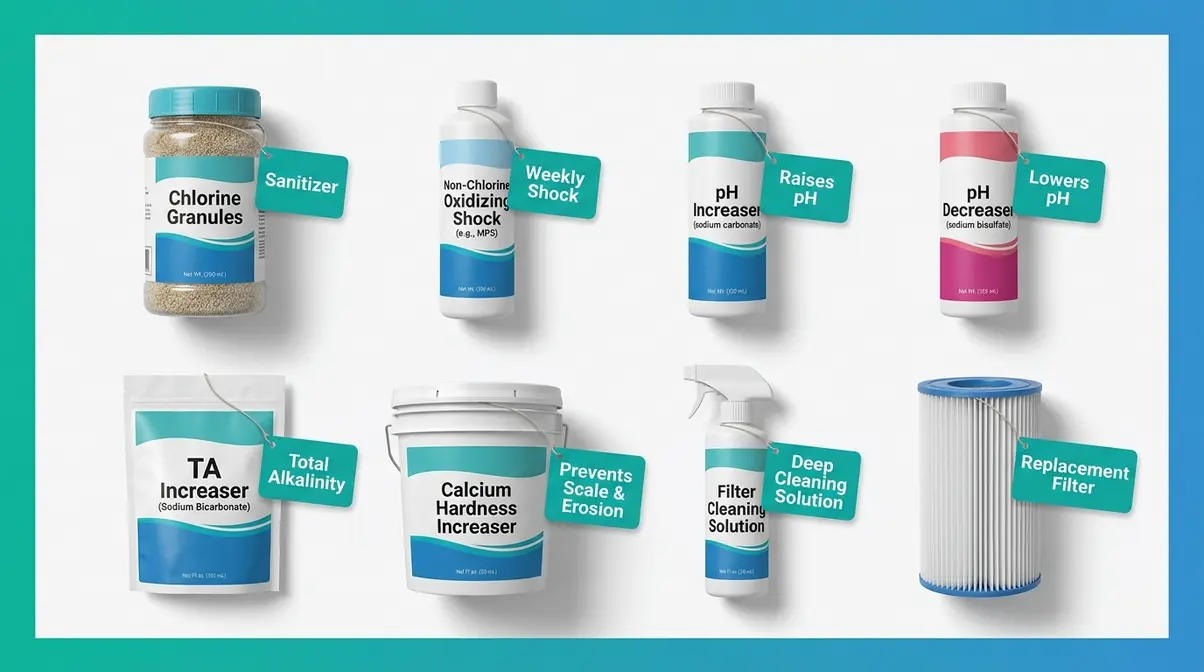
Knowing what chemicals you actually need — versus what a salesperson says you need — is one of the most practical things this hot tub water maintenance guide can give you. The market is full of redundant products. Most owners need far fewer than they think.
According to Leslie’s Pool Supply, the core chemical kit for a new hot tub owner covers five categories — sanitizer, shock, pH/TA adjusters, calcium hardness increaser, and a clarifier for occasional use.
The Core Chemical Starter Kit
What chemicals do you need for a hot tub? These are the essentials — everything else is situational.
| Chemical | Purpose | Notes |
|---|---|---|
| Chlorine granules or bromine | Primary sanitizer | Choose one system and stick with it |
| Non-chlorine oxidizing shock | Weekly oxidation of organics | Gentler for regular use; allows re-entry in 15 min |
| Chlorine shock | Heavy-use or problem situations | Wait 4–8 hours before re-entry |
| pH increaser (sodium carbonate) | Raises pH | Add in small doses; retest before adding more |
| pH decreaser (sodium bisulfate) | Lowers pH and TA | Dual purpose — use carefully |
| TA increaser (sodium bicarbonate) | Raises Total Alkalinity | Standard baking soda works; hot tub products are more concentrated |
| Calcium hardness increaser | Raises CH | Only needed if fill water is very soft |
| Filter cleaner solution | Monthly filter soak | Not optional — rinse alone is insufficient |
| Line flush cleaner | Pre-drain pipe cleaning | Used quarterly before draining |
All-in-one chemicals (products that claim to handle sanitizing, shocking, and balancing in one product) can simplify the routine for light-use owners, but they offer less precise control. If your water frequently goes out of balance, individual products give you more flexibility to target specific issues.
System-specific note: If your tub uses a FrogEase system, FROG @ease cartridges, or a mineral sanitizer system, follow the manufacturer’s protocol — these systems use lower sanitizer levels and have specific shock requirements that differ from standard chlorine maintenance.
Hot Tub Filters: Choosing and Replacing
Your filter is the mechanical workhorse of your hot tub. It captures particles the sanitizer can’t address — hair, skin cells, debris, and undissolved product. A compromised filter is the fastest route to cloudy water, even with perfect chemistry.
Choosing the right filter: Always replace with the OEM (original equipment manufacturer) cartridge specified for your model. Third-party filters that “fit” may not have the same micron rating or flow characteristics, reducing filtration quality.
Filter maintenance schedule:
- Weekly: Rinse with garden hose to remove surface debris
- Monthly: Soak overnight in filter cleaning solution, rinse, and reinstall
- Every 12–24 months: Replace entirely (sooner with heavy use or if pleats are damaged)
Per manufacturer guidelines, a filter that’s been in service for more than 2 years should be replaced regardless of appearance. The pleated material degrades and loses its ability to capture fine particles even after cleaning. Trying to stretch filter life beyond its rated lifespan is one of the most common — and costliest — false economies in hot tub ownership.
Fixing Common Hot Tub Water Problems
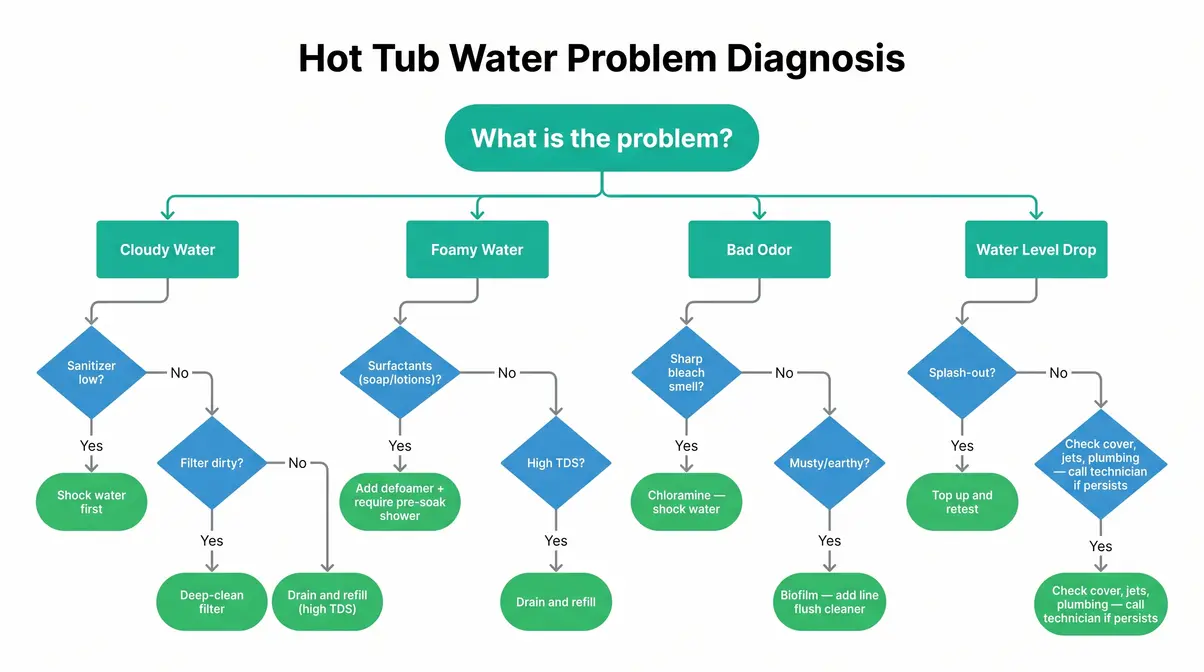
Even with a consistent routine, water problems happen. The good news: most issues have clear causes and straightforward fixes. This troubleshooting section covers the three most common problems hot tub owners encounter — cloudy or foamy water, unpleasant odors, and unexplained water level drops.
“Most hot tub water problems are symptoms of a missed step in the maintenance cadence — not evidence that something is fundamentally wrong with your tub.”
Cloudy or Foamy Water
Cloudy water is the most common complaint from new owners, and it almost always has one of three causes: low sanitizer, a dirty or saturated filter, or high TDS (dissolved solids that accumulate over time). Work through these in order before adding a clarifier.
Cloudy water — fix sequence:
- Test chemistry. If sanitizer is low, shock the water first.
- Rinse or deep-clean the filter.
- If chemistry is in range and filter is clean, the water may have reached the end of its usable life — a drain-and-refill is the permanent fix.
Foamy water has a different cause: surfactants. These are soap-like compounds from body wash, lotions, laundry detergent residue on swimwear, and even some hair products. They accumulate faster than sanitizer can break them down, especially in a hot, aerated tub.
- Foam fixes:
- Short-term: Add a hot tub defoamer product (this suppresses foam but doesn’t eliminate the cause).
- Long-term: Require a pre-soak shower for all bathers, wash swimwear without detergent or with a minimal amount, and shock weekly.
- The tennis ball hack: Drop a clean tennis ball in the water. The felt absorbs surface oils and cosmetics, visibly reducing foam and scum lines. Replace it monthly.
If foam persists despite these measures, the water likely has high TDS and needs a drain-and-refill — no amount of defoamer will fix chemically exhausted water.
Unpleasant Odors
A “bleach” or chlorine smell from your hot tub is almost always a sign of too little chlorine, not too much. That sharp odor comes from chloramines — compounds formed when chlorine binds to nitrogen waste (sweat, urine, body oils) instead of destroying bacteria. The fix is to shock the water, which breaks down chloramines and frees the sanitizer to do its job.
Odor diagnosis:
| Odor | Likely Cause | Fix |
|---|---|---|
| Sharp “bleach” smell | Chloramine buildup (low effective chlorine) | Shock treatment; increase sanitizer |
| Musty or earthy smell | Biofilm in plumbing | Add line flush cleaner; run jets; drain if persistent |
| Sulfur or “rotten egg” | Bacteria in heater or pipes | Shock; consult manufacturer if persistent |
| No odor but water looks off | Early algae or bacterial growth | Shock; check pH and sanitizer |
If musty odors return after shocking and persist between drains, biofilm in the plumbing is the likely culprit. A line flush cleaner — run through the jets before your next drain — is the most effective tool for clearing it. Based on standard industry practice, this is why the quarterly line flush is a non-negotiable part of the drain process, not an optional add-on.
Unexplained Water Level Drop
A water level drop of an inch or less per week is normal — it’s primarily evaporation, accelerated by heat and jet aeration. More than that warrants investigation.
Common causes and checks:
- Splash-out: High-use sessions with multiple bathers lose significant water. Top up with fresh water and retest chemistry afterward.
- Cover damage: A waterlogged or damaged cover absorbs water and increases evaporation. Check the underside of your cover for saturation or tears.
- Plumbing leak: Check around the pump, heater, and filter housing for drips or moisture. Also look for wet spots on the ground around the tub’s equipment panel.
- Jet seal wear: Jets that leak slightly can cause ongoing water loss. A visual inspection with the jets running often reveals slow drips.
If you’ve ruled out splash-out and cover issues and the level continues dropping, contact a hot tub technician. A leak in the plumbing or shell requires professional assessment — attempting to diagnose internal leaks without experience can cause additional damage.
Salt Water vs. Chlorine: Which System Is Right for You?
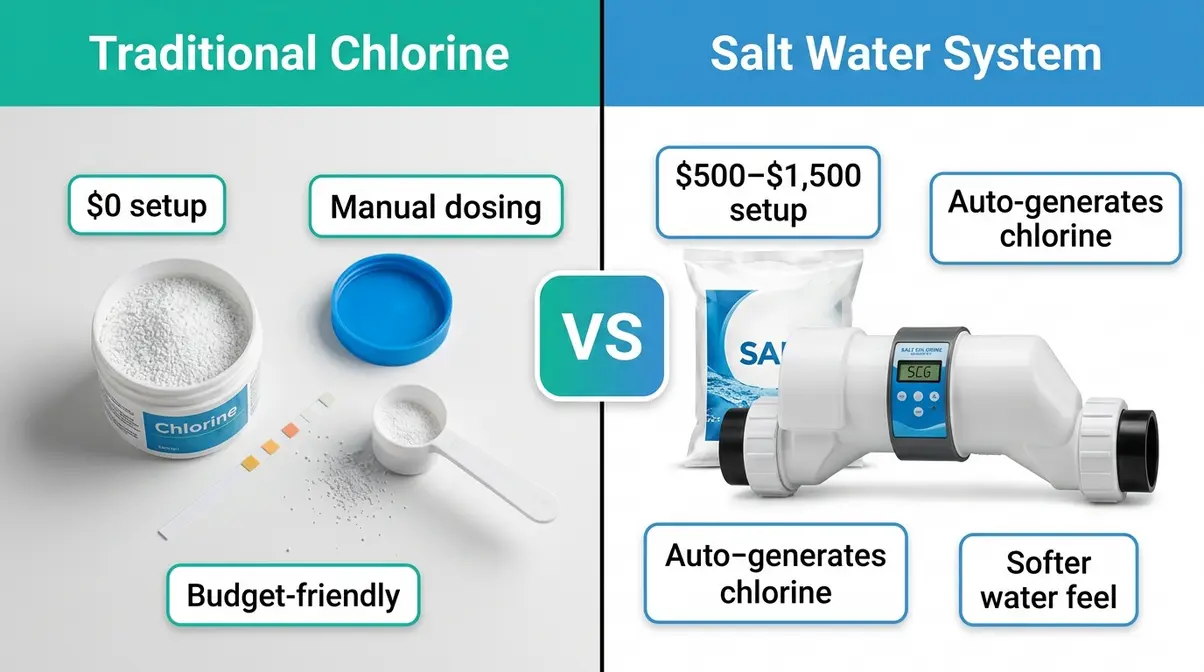
Many hot tub owners ask whether switching to a salt water system eliminates the maintenance work. The honest answer: it reduces some of it, but not as much as the marketing suggests. Understanding the real trade-offs helps you make the right decision for your lifestyle and budget.
Hot Spring’s learning center notes that both salt water and traditional chlorine systems require regular water testing and chemistry management — the difference is primarily in how sanitizer is generated and how it feels on skin.
Quick Comparison: Cost, Maintenance, and Feel
How a salt water system works: A salt water hot tub uses a salt chlorine generator (SCG) to convert dissolved salt into chlorine through electrolysis. The water still contains chlorine — it’s just generated on-demand rather than added manually. You still need to test and balance pH, TA, and CH; you still need to shock periodically; and you still drain every 3–4 months.
| Factor | Traditional Chlorine | Salt Water System |
|---|---|---|
| Upfront cost | $0 (built-in sanitizer method) | $500–$1,500+ for SCG unit |
| Annual chemical cost | ~$200–$400/year | ~$100–$200/year (lower ongoing) |
| Maintenance complexity | Moderate (manual dosing) | Moderate (SCG cell cleaning required) |
| Water feel | Can feel “chemical” at high levels | Softer, gentler on skin |
| pH stability | Requires regular adjustment | SCG tends to raise pH; requires more pH management |
| Cell replacement | N/A | Every 2–5 years (~$200–$500) |
| Ideal for | Budget-conscious owners, any tub | Sensitive skin, owners wanting less hands-on dosing |
The bottom line: Salt water systems cost more upfront and require SCG cell cleaning every 2–3 months, but they reduce the frequency of manual sanitizer additions and produce noticeably softer-feeling water. They’re not maintenance-free — they’re maintenance-different. If skin sensitivity is a driver, or if you want to reduce the frequency of chemical purchases, a salt system is worth the investment. If you’re budget-conscious or just starting out, a standard chlorine or bromine system is simpler to learn and less expensive to set up.
Chemical Safety Rules Every Owner Must Know
Handling hot tub chemicals safely is not optional — it’s part of responsible ownership. Chlorine, bromine, shock, and pH adjusters are reactive compounds that can cause serious harm if handled incorrectly. This section applies regardless of your experience level.
⚠️ Safety Disclaimer
Hot tub chemicals are oxidizing agents and can cause burns, respiratory irritation, or fire if mishandled. Always follow the product label for dosing and handling instructions. These guidelines are general best practices — your product label is the authoritative source. Consult your hot tub manufacturer’s guide for model-specific chemical recommendations.
Safe Handling Rules Before You Add Anything
Before you handle any hot tub chemical:
- Read the product label every time — even for products you’ve used before. Labels contain dosing, safety, and first aid information specific to that product.
- Wear protective gloves and safety glasses when measuring and pouring chemicals. Granular chlorine and shock products can cause skin burns and eye damage on contact.
- Never mix chemicals together — not in your hand, not in a bucket, not in the tub simultaneously. Mixing chlorine and pH adjusters, or chlorine and bromine, can cause violent reactions including fire and toxic gas release.
- Add chemicals to water, not water to chemicals. Always pre-dissolve granular products in a bucket of water before adding to the tub — this prevents concentrated product from damaging the shell or bleaching surfaces.
- Add one chemical at a time with jets running, wait 15–30 minutes, then retest before adding the next product.
- Never add chemicals while bathers are in the water. Wait the re-entry time specified on the product label (typically 15 minutes for non-chlorine shock, 4–8 hours for chlorine shock).
- Store chemicals in a cool, dry place away from sunlight and out of reach of children. Never store different chemicals in the same cabinet — fumes from incompatible products can react even through sealed containers.
- Dispose of old chemicals properly. Contact your local waste disposal authority for guidance — never pour concentrated chemicals down a drain or into a lawn.
If chemical contact occurs: Follow the first aid instructions on the product label immediately. For eye contact, flush with water for 15 minutes and seek medical attention.
Based on standard industry practice and PHTA safety guidelines, these eight rules cover the most common chemical handling accidents in residential hot tub ownership. Following them consistently eliminates virtually all chemical-related risk.
Frequently Asked Questions
How often should I add chemicals to my hot tub?
Test your hot tub water 2–4 times per week and add chemicals only when readings fall outside target ranges. Most owners find they’re adjusting pH or sanitizer 1–2 times per week. Weekly shocking is a standard practice regardless of readings. Avoid adding chemicals on a fixed schedule without testing first — water chemistry varies by bather load, temperature, and weather, so dosing without data leads to imbalances.
What is the correct order to add hot tub chemicals?
Always adjust Total Alkalinity first, then pH, then Calcium Hardness, then sanitizer. This sequence matters because TA acts as the foundation that stabilizes pH — if TA is off, pH corrections won’t hold. Adding sanitizer last ensures it works in properly balanced water. Add each chemical separately, run jets for 15 minutes, and retest before adding the next product. Following the product label for exact dosing at each step is mandatory.
Why is my hot tub water cloudy even though the chemicals test fine?
Cloudy water with balanced chemistry almost always points to a dirty or saturated filter. A filter that looks clean after rinsing may still be chemically clogged with oils and minerals — only an overnight chemical soak reveals this. If deep-cleaning the filter doesn’t resolve cloudiness within 24 hours, the water likely has high Total Dissolved Solids (TDS) and needs a full drain-and-refill. A clarifier product can help temporarily, but it doesn’t fix the underlying cause.
How do I know when it’s time to drain and refill my hot tub?
Drain and refill every 3–4 months as a baseline, per PHTA ANSI standards (PHTA ANSI/APSP-11, 2019). Signs that you need to drain sooner: water that won’t balance despite correct chemical additions, persistent foam that returns after defoaming, a strong chemical odor that doesn’t clear after shocking, or visible scale and scum lines that cleaning can’t remove. Heavy use (daily soaks, frequent guests) may require draining every 8–10 weeks.
Is a saltwater hot tub easier to maintain than a chlorine hot tub?
A saltwater hot tub is not maintenance-free — it’s maintenance-different. Salt chlorine generators produce chlorine automatically, reducing how often you manually add sanitizer. However, you still test and adjust pH, TA, and CH regularly, shock periodically, and drain every 3–4 months. Additionally, the SCG cell requires cleaning every 2–3 months and replacement every 2–5 years. The main benefits are softer-feeling water and fewer manual chemical additions, not an elimination of maintenance tasks.
The 4-Cadence System Works Because It Removes the Guesswork
For new and intermediate hot tub owners, the core challenge isn’t a lack of information — it’s an overwhelming amount of it, with no clear structure for when to act. The 4-Cadence System resolves this by giving every task a home: Daily habits that take 5 minutes, a weekly chemistry session under 15 minutes, a monthly deep-clean that protects your equipment, and a quarterly drain-and-refill that resets everything. According to CDC guidelines, maintaining free chlorine at 3–10 ppm and pH at 7.2–7.8 is the foundation of safe water — and the 4-Cadence System ensures those targets stay in range without requiring you to think about it from scratch every week.
The chemistry section in this hot tub water maintenance guide gives you the “why” behind each parameter. The maintenance schedule gives you the “when.” The troubleshooting section gives you the “what now” when something goes off-plan. Together, they cover everything a new owner needs to go from anxious guessing to confident, consistent care.
Start with this week’s session: test your water, adjust in the correct order (TA → pH → CH → sanitizer), and schedule your next drain-and-refill on the calendar. Your hot tub will reward the consistency — and so will the people who use it with you.