

Table of Contents - How to Choose a Hot Tub Cover: 5 Steps That Last
- Why Your Hot Tub Cover Matters
- Step 1: Measure Your Hot Tub Shell
- Step 2: Choose Foam Thickness
- Step 3: Select Foam Density
- Step 4: Compare Cover Materials
- Step 5: Safety and Usability
- Maintain Cover & Prevent Sagging
- When to Replace Your Hot Tub Cover
- Common Cover Buying Mistakes
- Frequently Asked Questions
- The Confident Path Forward
This blog post may contain affiliate links. As an Amazon Associate I earn from qualifying purchases.
The difference between a cover that lasts 8 years and one that’s waterlogged and sagging by year two comes down to three specs most buyers never check. Autumn is the worst time to discover you chose the wrong one — and the best time to get it right before cold weather hits your heating bill.
Most retailers hand you a cover based on your tub’s dimensions alone. But size is just the starting point — foam density, taper, and material choice determine whether your thermal cover (a foam-insulated cover designed to minimize heat loss) actually insulates your spa or quietly destroys itself from the inside out. Knowing how to choose a hot tub cover means understanding all five decision variables, not just the measurements.
This guide walks you through five sequential steps — from measuring your shell correctly to decoding foam specs, comparing WeatherShield vs. marine-grade vinyl, and meeting ASTM safety standards — so you can buy with confidence. For a broader reference on cover types and accessories, see our ultimate hot tub cover guide.
Knowing how to choose a hot tub cover requires matching foam density and taper to your climate — the wrong combination leads to waterlogging and sagging within two years, costing you in heating bills and early replacement.
- Measure your tub shell (not the old cover) for accurate length, width, corner radius, and skirt depth
- Foam density matters most: 1.5 lb is standard; 2 lb for snowy climates — higher density prevents The Cover Failure Cascade
- Marine-grade vinyl (28–30 oz) is the durable standard; WeatherShield fabric lasts longer but costs more
- ASTM F1346-91 compliance is the non-negotiable safety standard for covers with children nearby
- A good cover cuts heating costs significantly — insulated covers can reduce heat loss by up to 50% compared to an uncovered spa (U.S. Department of Energy, 2026)
Why Your Hot Tub Cover Matters
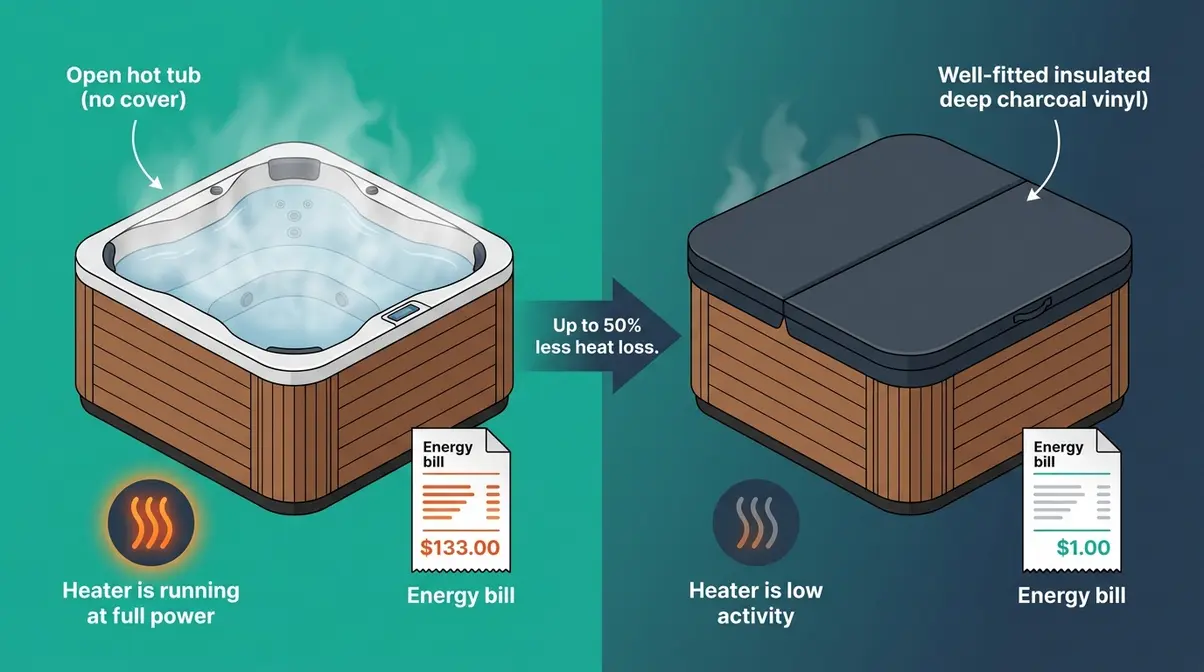
A quality hot tub cover does three things: retains heat, keeps the water safe, and prevents your foam core from absorbing water. According to the U.S. Department of Energy (DOE), insulated covers can significantly reduce heat loss, cut heating costs, and minimize chemical consumption. Getting any one of the five key specifications wrong starts a chain reaction that shortens your cover’s life by years — and costs you hundreds of dollars in premature replacement.
The Energy Bill Connection
The foam core inside a thermal cover acts as a thermal barrier between your hot water surface and the cold air above it. Without that barrier — or with a failed one — your heater runs longer and harder to maintain temperature. According to Department of Energy data on cover heat retention, insulated covers significantly reduce heat loss, decrease heating costs, and minimize chemical use for both pools and hot tubs (U.S. Department of Energy, 2026). In practical terms, a well-fitted cover can cut heating costs by up to 50% compared to leaving your spa uncovered.
Climate matters here too. In a temperate coastal town, a 4-inch taper cover retains adequate heat through mild winters. In a region with heavy snowfall, a 6-inch taper is the minimum effective standard — and the difference shows up directly on your energy bill. October and November are when this gap becomes painfully obvious: search data consistently shows hot tub cover interest spikes in autumn as owners prepare for their first freeze. A properly fitted cover is the single most effective step you can take to heat a hot tub faster and keep it there.
“An insulated hot tub cover significantly reduces heat loss and can cut heating costs by up to 50% compared to an uncovered spa.” — U.S. Department of Energy, 2026
The Cover Failure Cascade Explained
Heat retention is only half the story. The other half is what happens inside the cover when you choose the wrong foam — and it starts a chain reaction most buyers never see coming.
The Cover Failure Cascade is the sequence that turns a cheap or misspecified cover into an expensive mistake:
- Wrong foam density selected — low-density foam (1 lb/cu ft) has a more open cell structure
- Vapor barrier fails or is thin — moisture from the water surface penetrates the foam core
- Foam absorbs water — the cover gains significant weight as foam becomes waterlogged
- Sagging begins — the heavy, saturated cover droops at the center fold
- Air gaps form — the warped cover no longer seals flush against the tub shell
- Heat escapes — your heater compensates by running longer, raising energy costs
- Premature failure — a cover that should last 7–10 years fails in 2–3, costing you $300–$600 in replacement (as of mid-2026, standard replacement covers range from $250 to $700+ depending on size and material)
Every step in this guide addresses one link in that chain. Understanding The Cover Failure Cascade is the reason foam density, taper, and vapor barrier quality are not optional upgrades — they are the foundation of a cover that actually works.
Step 1: Measure Your Hot Tub Shell
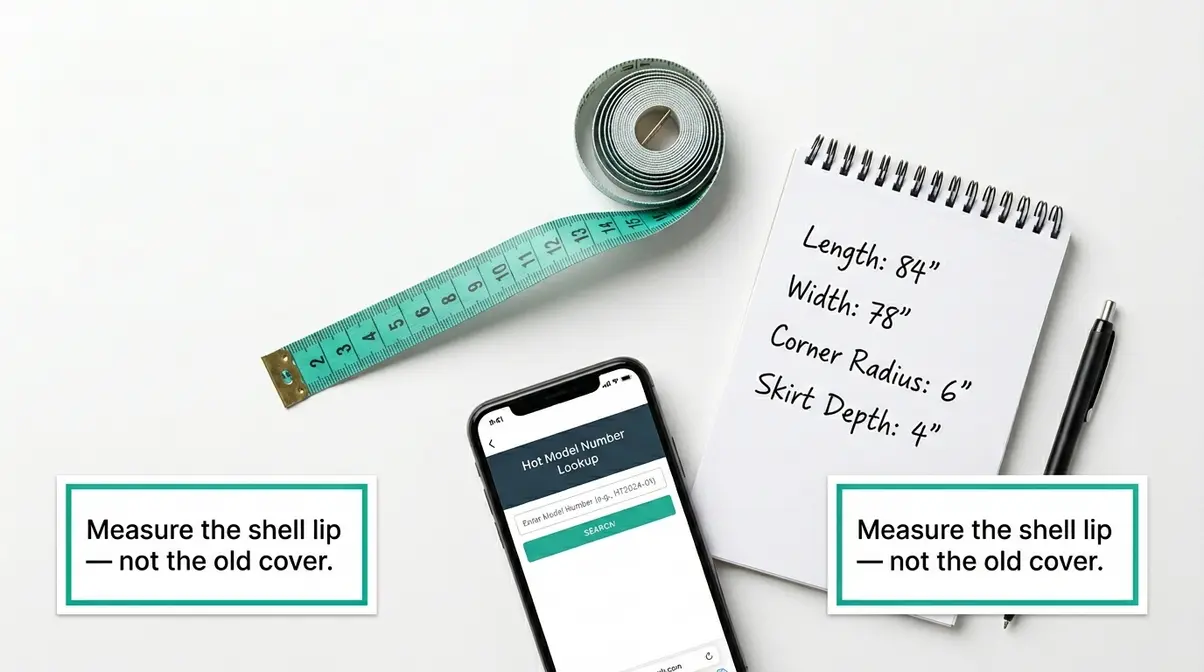
Accurate measurements are the foundation of a cover that fits, seals, and insulates correctly. When figuring out how to choose a hot tub cover, one of the most common — and costly — mistakes hot tub owners make is measuring their old cover rather than the tub shell itself. Old covers stretch, warp, and shrink; using them as a template bakes those errors into your new purchase.
“I feel the cover they gave us does not fit my tub. But this new guy is adamant that this is how it’s supposed to fit.” — Hot tub owner, Reddit r/hottub
This frustration is avoidable. It almost always traces back to incorrect shell measurements or a misunderstood corner radius. Here’s how to measure correctly.
- Before You Start — Prerequisites:
- A flexible measuring tape (not a rigid metal ruler)
- A pen and notepad (or phone notes)
- 10–15 minutes with the cover removed
- Your tub model number (useful for verifying measurements against manufacturer specs)
How to Measure Length, Width, and Depth
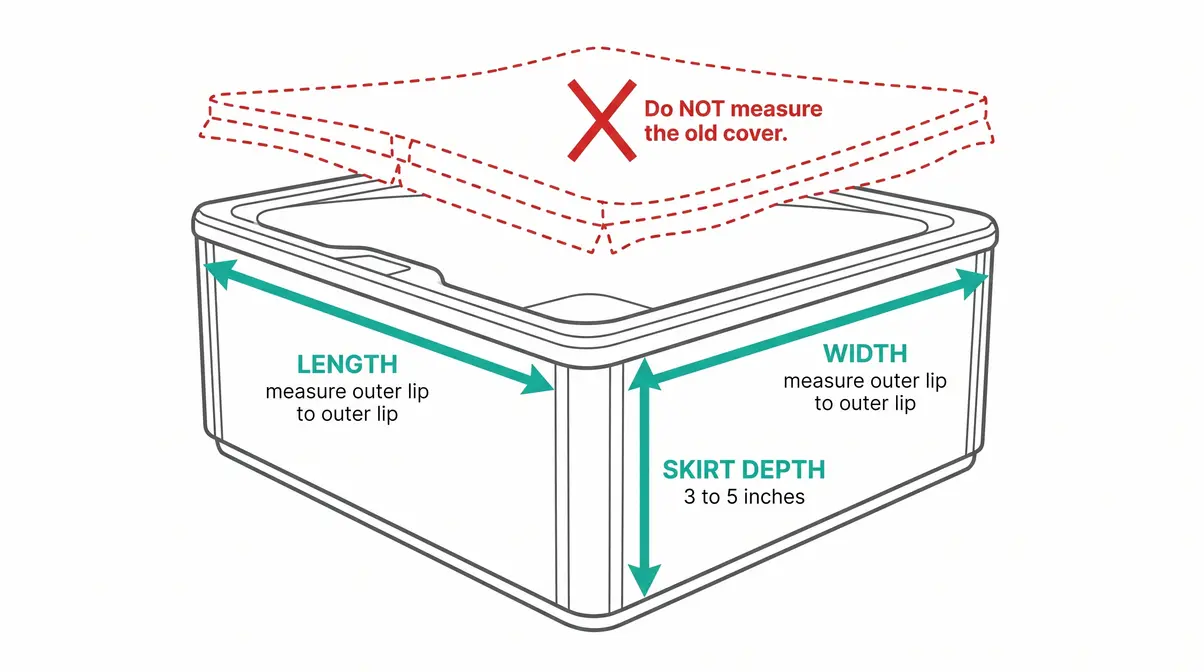
Measure the top lip of the tub shell — not the cabinet, not the water line, and not the old cover.
- Length: Measure the longest straight dimension across the top lip, from outer edge to outer edge. Record in inches.
- Width: Measure the perpendicular dimension across the top lip. For rectangular tubs, this is straightforward. For octagonal or irregular shapes, measure the widest point.
- Depth (skirt measurement): Measure from the top of the lip down the side of the cabinet to where you want the cover’s skirt to terminate — typically 2–4 inches. This determines your skirt length (covered in the next subsection).
- Center fold: Confirm which axis the cover will fold over — usually the longer dimension. Some covers fold along the short axis; verify with your manufacturer.
For a detailed walkthrough with additional measurement scenarios, The Cover Guy’s measuring guide covers rectangular, round, and irregular shell shapes.
Measuring the Corner Radius
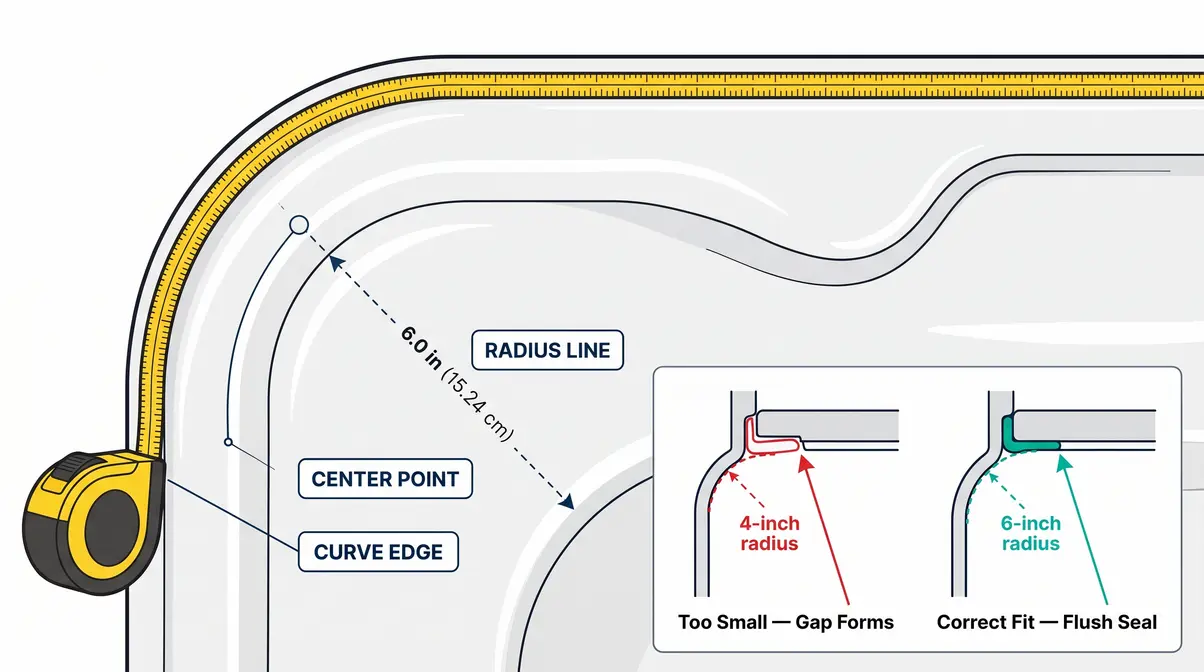
Corner radius is the single most-skipped measurement in the cover buying process — and the most likely cause of a cover that doesn’t sit flush.
What is corner radius? It’s the curve at each corner of your tub shell, measured as the radius of the circle that would match that curve. Most tubs have a corner radius between 2 inches and 8 inches. A cover cut with a 4-inch radius on a tub with a 6-inch radius will leave visible gaps at every corner — exactly the air leaks that accelerate The Cover Failure Cascade.
- How to measure corner radius:
- Place a flexible measuring tape flat along one corner of the tub lip, following the curve.
- Identify the center point of the curve.
- Measure from that center point to the edge of the curve — this is your radius.
- Repeat for all four corners (they are not always identical, especially on older or custom tubs).
- Record the largest radius measurement — covers are typically cut to the largest radius for a flush fit.
Skirt Length and Center Fold
The skirt is the flap of material that hangs down from the cover’s edge, wrapping around the top of the tub cabinet. It creates a secondary seal that blocks wind from pulling heat out from under the cover.
Standard skirt length is 3–4 inches for most residential tubs. A longer skirt (5–6 inches) provides better wind protection but can interfere with cover lifter mechanisms if not accounted for in the hardware mounting.
- How to measure skirt length:
- With the cover removed, measure from the top of the tub lip straight down the cabinet side.
- Decide where you want the skirt to terminate — 3 inches is the minimum effective seal; 5 inches is recommended for exposed, windy installations.
- Note whether your tub cabinet has any protrusions (jets, panels, drainage fittings) that would prevent a longer skirt from hanging freely.
Center fold measurement: The center fold — where the cover hinges open — must align with the tub’s center axis. Measure from one end of the tub to the exact midpoint and record it. Most covers are built symmetrically, but custom tubs sometimes require an off-center fold.
How to Find the Right Size?
Finding the right hot tub cover size requires measuring your tub shell directly — not the old cover, which may have stretched or warped. Measure the outer lip of the shell for length and width, then measure each corner radius with a flexible tape. Record your skirt depth preference (3–5 inches is standard) and confirm the center fold axis. Most manufacturers require four measurements: length, width, corner radius, and skirt length. If your tub is an irregular shape (octagonal, round, or custom), photograph the shell from directly above and include the photo with your order — most reputable cover manufacturers can work from photos and dimensions together.
Step 2: Choose Foam Thickness
Foam thickness and taper determine how well your cover sheds water and how effectively it insulates across your entire tub surface. These two variables are closely related — and both are climate-dependent.
What the Taper Means and Why It Matters
Taper refers to the difference in foam thickness between the center of the cover and its edges. A “4/2 taper” means the foam is 4 inches thick at the center fold and 2 inches thick at the outer edges.
Why does this matter? Water and snow need to run off the cover rather than pool in the center. A flat cover (no taper) allows water to accumulate, adding weight that accelerates sagging — link #4 in The Cover Failure Cascade. A tapered cover sheds precipitation naturally, protecting both the foam core and the vapor barrier beneath the outer shell.
Standard taper options:
| Taper | Center Thickness | Edge Thickness | Best Climate Use |
|---|---|---|---|
| 4/2 | 4 inches | 2 inches | Mild / temperate coastal |
| 5/3 | 5 inches | 3 inches | Moderate / four-season |
| 6/4 | 6 inches | 4 inches | Cold / heavy snow regions |
The 4/2 taper is the industry baseline — it suits the majority of residential installations in mild climates. If you live somewhere that regularly receives more than 12 inches of snowfall, a 5/3 or 6/4 taper is worth the additional cost.
Matching Taper to Your Climate
Choosing the wrong taper for your climate is one of the four most expensive cover buying mistakes (covered in the Common Mistakes section). Here’s a practical decision framework:
Mild climate (rarely below 20°F / -7°C): A 4/2 taper paired with 1.5 lb foam density provides adequate insulation. Owners in a temperate coastal town report covers lasting 7–9 years with this combination when maintained correctly.
Four-season climate (regular freezing temperatures): A 5/3 taper with 1.5 lb or 2 lb foam density. The extra center thickness adds R-value at the most thermally vulnerable point — the center fold, where two foam panels meet.
Cold/northern climate (heavy snow, sustained sub-freezing temperatures): A 6/4 taper with 2 lb foam density is the minimum recommended specification. The additional foam mass provides both insulation and structural resistance to snow load. Some manufacturers rate 2 lb foam covers to support 60–80 lbs of distributed snow load — verify this specification with your supplier before purchasing.
For guidance on managing your tub through winter, our hot tub winterization guide covers taper and insulation selection in seasonal context.
Step 3: Select Foam Density
Foam density is the single specification most buyers overlook — and the one most directly responsible for The Cover Failure Cascade. If you want to know how to choose a hot tub cover that lasts, remember that density is measured in pounds per cubic foot (lb/cu ft) and determines how resistant the foam core is to water absorption over time.
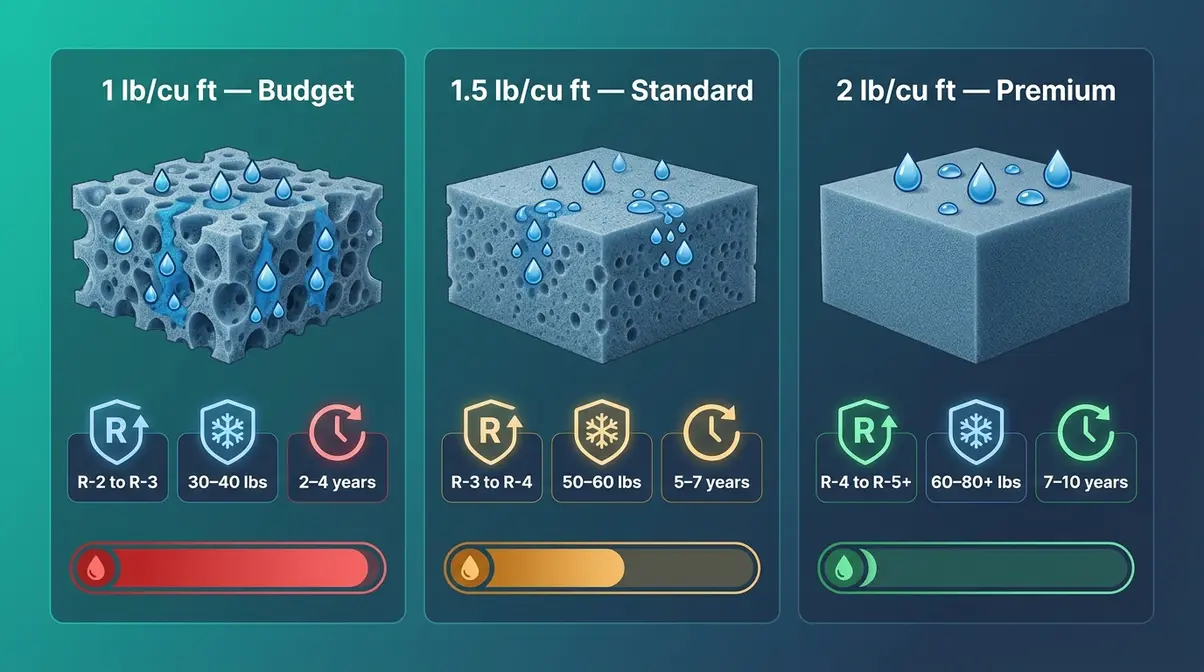
3 Foam Density Options Compared
Our team evaluated foam density specifications across covers from leading manufacturers, comparing R-values, weight ratings, and real-world longevity data reported by hot tub owner communities. Here’s what the data shows:
| Foam Density | R-Value (per inch) | Snow Load Capacity | Typical Lifespan | Best For |
|---|---|---|---|---|
| 1 lb/cu ft | ~R-2 to R-3 | Low (30–40 lbs) | 2–4 years | Budget / mild climates only |
| 1.5 lb/cu ft | ~R-3 to R-4 | Moderate (50–60 lbs) | 5–7 years | Standard residential use |
| 2 lb/cu ft | ~R-4 to R-5+ | High (60–80+ lbs) | 7–10 years | Cold climates, heavy use |
R-value (thermal resistance) measures how effectively the foam resists heat transfer. A higher R-value means less heat escapes through the cover. The difference between 1 lb and 2 lb foam isn’t just durability — it’s measurable energy savings every month your tub runs.
For a broader comparison of cover types by insulation performance, see our hot tub insulation comparison guide.
How Density Stops Waterlogging
The cell structure of foam determines its vulnerability to moisture. Low-density foam (1 lb/cu ft) has a more open, porous cell structure — when the vapor barrier beneath the vinyl outer shell develops even a small pinhole, moisture from the water surface migrates into the foam core. Higher-density foam (1.5–2 lb/cu ft) has a tighter, closed-cell structure that resists this moisture infiltration.
Across hot tub owner communities, the consistent complaint is waterlogged covers that begin sagging within 18–24 months of purchase — almost always traced back to 1 lb foam paired with a thin or damaged vapor barrier. A waterlogged cover can add 40–80 lbs of unintended weight, creating the structural stress that causes the center fold to droop and air gaps to form at the tub lip.
This is the mechanical heart of The Cover Failure Cascade: once water enters the foam, the process is essentially irreversible without a full cover replacement. Higher density foam doesn’t just last longer — it keeps the cascade from starting in the first place.
Practical density selection rule: 1.5 lb is the minimum specification worth purchasing for any residential installation. The price difference between 1 lb and 1.5 lb foam is typically $30–$60 — a fraction of the $300–$600 replacement cost you’ll face if the cascade runs its full course.
For help selecting covers by insulation grade, our best hot tub covers buying guide ranks options by foam density and climate suitability.
Step 4: Compare Cover Materials
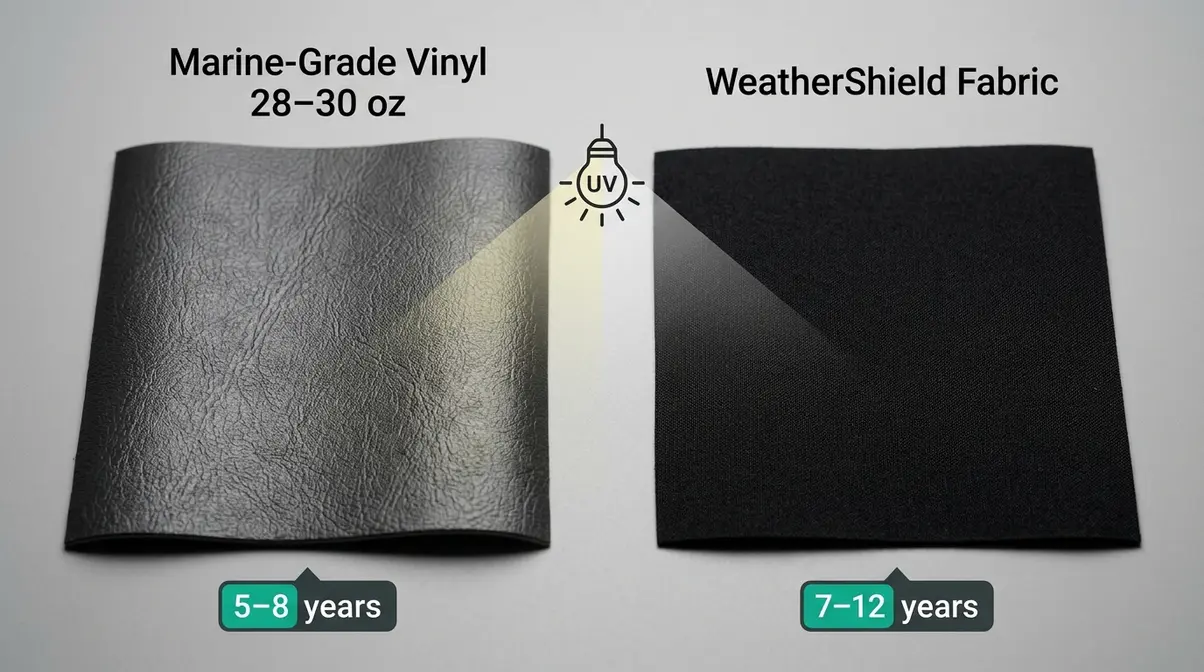
The outer shell material determines UV resistance, water repellency, mildew resistance, and how long the cover looks and performs before degrading. Two materials dominate the market for residential hot tub covers: marine-grade vinyl and WeatherShield fabric.
Vinyl vs. WeatherShield Costs
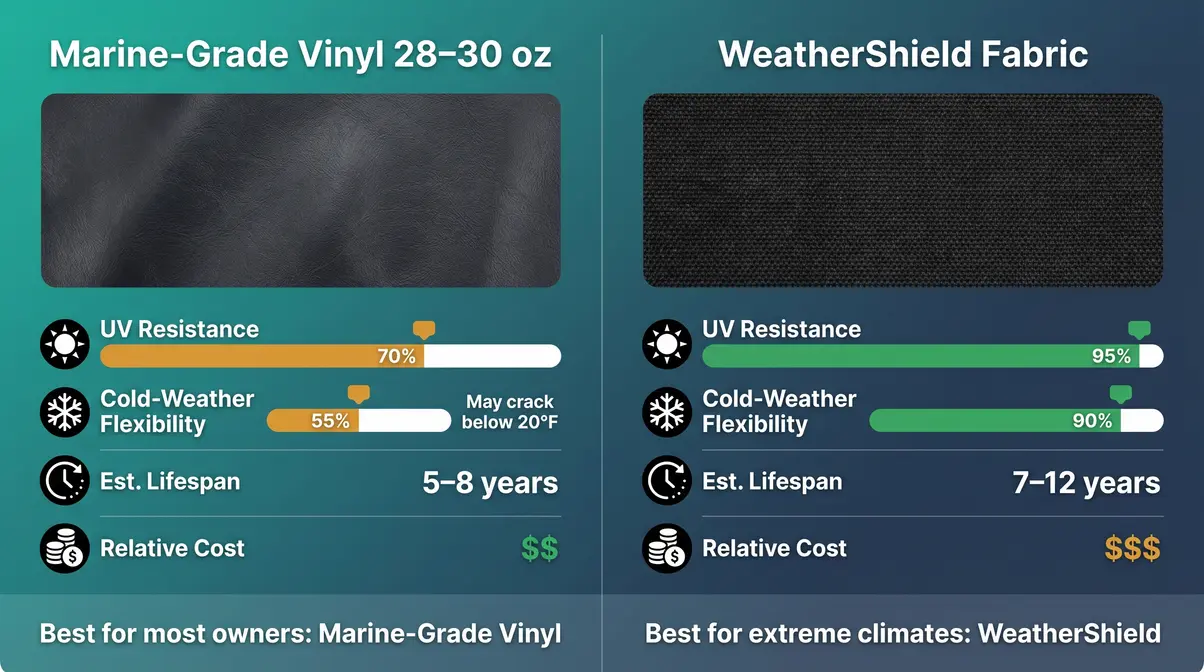
Marine-grade vinyl (28–30 oz weight) is the industry standard for hot tub covers. It’s the same material used on boat upholstery — designed to resist UV radiation, chlorine off-gassing, and repeated wet/dry cycles. A quality marine-grade vinyl cover in a 28 oz specification typically lasts 5–8 years with proper conditioning.
WeatherShield is a proprietary fabric used by some manufacturers that layers a UV-resistant outer coating over a denser base material. It typically outperforms standard vinyl in UV resistance and maintains flexibility longer in cold temperatures — important in northern climates where vinyl can crack when lifted at sub-freezing temperatures.
| Material | Weight/Grade | UV Resistance | Flexibility in Cold | Est. Lifespan | Relative Cost |
|---|---|---|---|---|---|
| Standard Vinyl | 18–22 oz | Moderate | Low (cracks below 20°F) | 3–5 years | $ |
| Marine-Grade Vinyl | 28–30 oz | High | Moderate | 5–8 years | $$ |
| WeatherShield Fabric | N/A (proprietary) | Very High | High | 7–12 years | $$$ |
For most owners, marine-grade vinyl at 28–30 oz is the practical choice — it balances cost and durability effectively. WeatherShield is worth the premium if you live in a climate with intense UV exposure (high altitude, desert Southwest) or sustained sub-freezing temperatures where vinyl flexibility is a concern.
The Vapor Barrier Explained
Beneath the vinyl outer shell, every cover contains a vapor barrier — a thin polyethylene or similar film that wraps the foam core and prevents water vapor from the spa surface from migrating into the foam. The vapor barrier is invisible from the outside, but it’s the component that determines whether your foam core stays dry for 8 years or starts waterlogging in 18 months.
- What to look for in a vapor barrier:
- Thickness: 6-mil polyethylene is the minimum; 8-mil is recommended for climates with high humidity or heavy use
- Sealed seams: The barrier should be heat-sealed or taped at all edges — any open seam is a moisture entry point
- Full coverage: The barrier should extend over the full foam panel, not just the top face
When evaluating covers, ask the manufacturer or retailer specifically: “What is the vapor barrier thickness, and how are the seams sealed?” A supplier who can’t answer that question is likely selling a budget product that will fail within the cascade timeline.
For guidance on cover accessories that extend material life, see our hot tub cover accessories guide.
UV, Mildew, and Lifespan Ratings
UV degradation is the primary killer of vinyl hot tub covers in sunny climates. UV radiation breaks down the plasticizers in vinyl that keep it flexible and water-resistant — once that process begins, the material cracks, fades, and loses its seal. Applying a UV protectant conditioner every 90 days (more on this in the Maintenance section) can extend the life of marine-grade vinyl by 2–3 years.
Mildew resistance is the second factor. Covers that trap moisture between the vinyl and the foam — either through condensation or a failed vapor barrier — develop mildew on the underside, which accelerates material degradation and creates odor problems. Marine-grade vinyl with a mildew inhibitor treatment resists this better than standard vinyl.
Lifespan summary by material and maintenance level:
| Material | Maintained | Unmaintained |
|---|---|---|
| Standard Vinyl (18–22 oz) | 3–5 years | 1–3 years |
| Marine-Grade Vinyl (28–30 oz) | 5–8 years | 3–5 years |
| WeatherShield Fabric | 7–12 years | 5–8 years |
For comparisons that include specific cover brands by material type, our hot tub cover brands guide includes manufacturer ratings.
Who Makes the Best Covers?
No single manufacturer makes the best cover for every situation — the right brand depends on your tub dimensions, climate, and budget. Reputable manufacturers known for consistent foam density and vapor barrier quality include The Cover Guy, Prestige Hot Tub Covers, and Spa Covers Canada, among others. When evaluating any manufacturer, ask specifically about foam density (minimum 1.5 lb), vapor barrier thickness (minimum 6-mil), and ASTM F1346-91 certification. Owner communities on Reddit’s r/hottub consistently report that covers specifying 2 lb foam with 8-mil vapor barriers outperform budget alternatives by 3–5 years in real-world use. For a vetted shortlist, our hot tub cover brands guide includes manufacturer ratings by specification.
Step 5: Safety and Usability
Safety compliance is the non-negotiable dimension of selecting a hot tub cover — and the dimension most competitors ignore entirely. If there are children in or near your home, ASTM F1346-91 compliance is not an optional upgrade.
ASTM F1346-91 Safety Locks
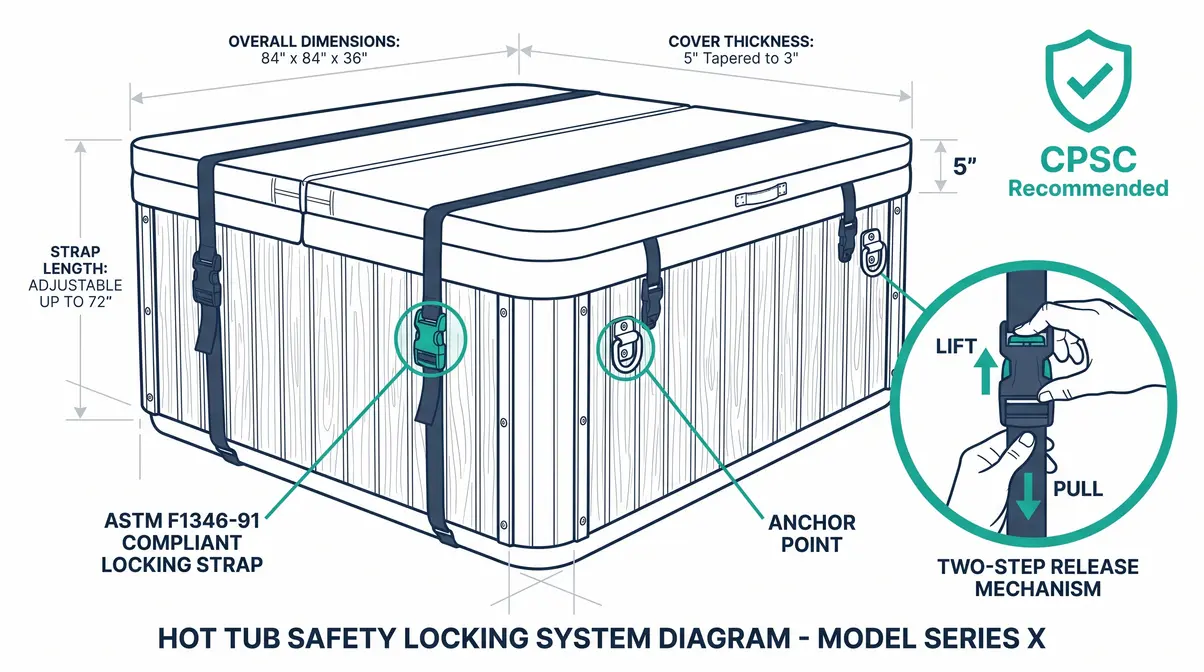
ASTM F1346-91 is the American Society for Testing and Materials standard that specifies performance requirements for safety covers for swimming pools, spas, and hot tubs. A cover that meets this standard must support a minimum distributed load to prevent a child from becoming entrapped beneath it. The U.S. Consumer Product Safety Commission (CPSC) recommends ASTM F1346-compliant covers as a critical layer of drowning prevention for residential spas.
- Key ASTM F1346-91 requirements for hot tub covers:
- The cover must support a minimum weight load distributed across its surface without collapsing
- The cover must include a locking mechanism that prevents unsupervised access
- The locking mechanism must require a deliberate two-step action to open (preventing accidental release by young children)
- Child safety locks — typically nylon buckle straps that anchor the cover to the tub cabinet — are the standard compliance mechanism. When evaluating covers, verify:
- The cover is explicitly labeled “ASTM F1346-91 compliant” (not just “safety cover”)
- The locking straps are included and rated for the load requirement
- The straps connect to reinforced anchor points on the tub cabinet, not just the cover skirt
For current CPSC guidance on pool and spa barrier requirements, see the CPSC pool and spa safety resources. For the ASTM standard specification, consult ASTM F1346-91 directly. The Pool & Hot Tub Alliance (PHTA) also maintains updated safety guidelines at PHTA safety resources.
For a complete overview of safety-rated covers, our hot tub safety covers guide includes ASTM-certified options by price range.
Cover Lifters for Easy Handling
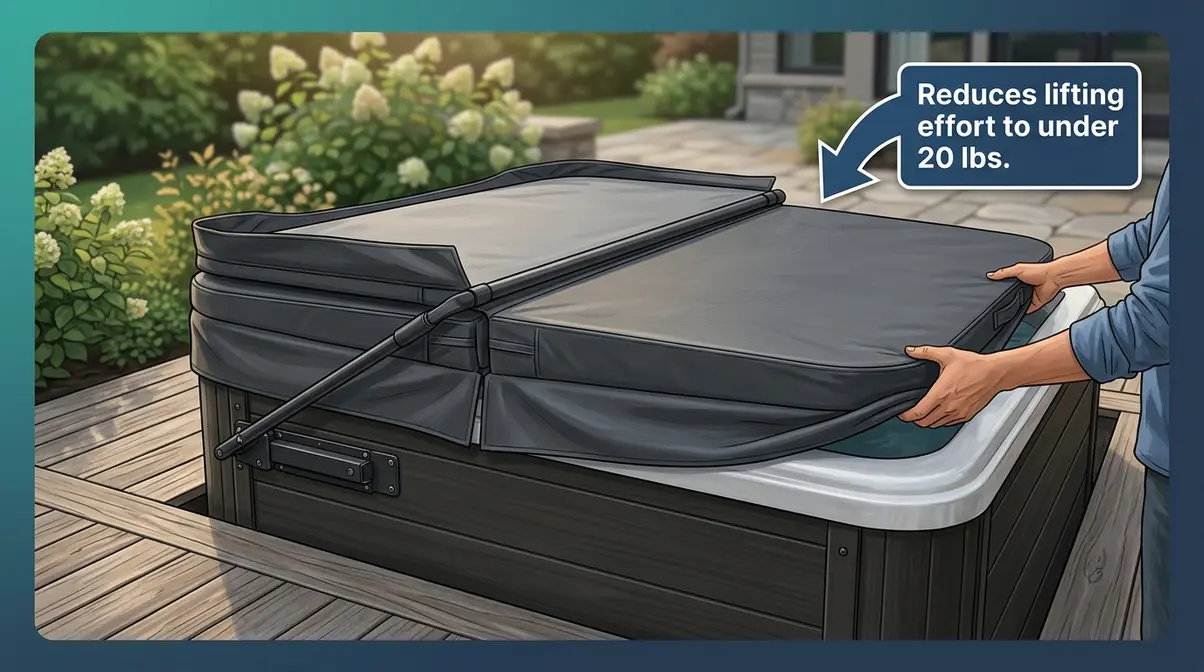
A 2 lb foam cover in a 28–30 oz marine-grade vinyl shell can weigh 50–80 lbs before any moisture absorption. Removing and replacing that cover manually — especially in cold weather — is a real usability problem, and it’s a leading reason owners leave covers off longer than they should, directly accelerating heat loss.
A cover lifter (also called a lift system) mounts to the tub cabinet and uses a pivot arm or hydraulic assist to raise and fold the cover with minimal effort. Most residential lifters reduce the effective lifting effort to under 20 lbs. There are three main types:
| Lifter Type | Mounting | Effort | Best For |
|---|---|---|---|
| Under-mount (side-fold) | Cabinet side | Low | Standard rectangular tubs |
| A-frame (free-standing) | Ground posts | Very Low | Any shape; no cabinet drilling |
| Hydraulic assist | Cabinet rear | Minimal | Heavy covers (2 lb foam) |
When selecting a lifter, verify it’s rated for your cover’s weight and compatible with your skirt length — a 5-inch skirt can interfere with under-mount hardware if the mounting bracket isn’t positioned correctly. For full compatibility details, our hot tub cover lifter guide covers bracket placement and weight ratings.
Maintain Cover & Prevent Sagging
Selecting the right cover is step one. Maintaining it correctly is what keeps The Cover Failure Cascade from starting years down the line. A well-maintained marine-grade vinyl cover can last 8+ years; a neglected one of the same spec may fail in 3.
Cleaning and Conditioning Routine
- Monthly cleaning:
- Remove the cover and lay it flat on a clean surface.
- Rinse with fresh water to remove chemical residue and debris.
- Apply a pH-neutral vinyl cleaner (avoid petroleum-based cleaners — they degrade vinyl plasticizers). Scrub gently with a soft brush.
- Rinse thoroughly and allow to air dry before replacing.
- Inspect the underside for mildew spots — treat with a diluted bleach solution (1 part bleach to 10 parts water) if found.
Quarterly conditioning:
Apply a UV protectant and vinyl conditioner to the top surface every 90 days. This replenishes the plasticizers that UV radiation depletes and keeps the material flexible. In high-UV climates (desert Southwest, high altitude), condition every 60 days. This single maintenance step is the most effective way to prolong the cover’s useful life.
Chemical management: Maintain proper water chemistry — particularly pH between 7.2 and 7.8. High pH produces more off-gassing that degrades the vapor barrier from below. Test water chemistry weekly and balance before closing the cover.
For a complete maintenance schedule, our hot tub maintenance checklist includes cover care as a recurring task.
Preventing and Fixing Sagging
Sagging is the visible symptom of The Cover Failure Cascade — it means moisture has likely already entered the foam core. However, early-stage sagging (within the first 12 months, before significant waterlogging) can sometimes be reversed.
- Prevention:
- Always use a cover lifter — removing a heavy cover by dragging it across the tub edge stresses the center fold hinge
- Keep the cover centered on the tub — uneven weight distribution accelerates one-sided sagging
- Clear snow promptly — more than 6 inches of accumulated snow exceeds most cover load ratings and compresses the foam permanently
- Inspect the vapor barrier annually by lifting the vinyl shell at a corner seam; replace the cover if you find wet foam
- Early-stage sag correction:
- If the center fold has developed a slight downward bow but the foam is still dry, you can sometimes restore shape by:
- Removing the cover and standing it on its folded edge in a warm, dry location for 24–48 hours
- Allowing the foam to decompress and dry out
- Replacing the center hinge foam wrap if it has compressed
If the foam is wet or the sag is severe, replacement is the correct action — no surface fix will stop the cascade once moisture is in the core. For step-by-step repair guidance, our how to fix hot tub cover sagging guide covers both DIY repair and when to replace.
When to Replace Your Hot Tub Cover
5 Signs Your Cover Has Failed
Knowing when to replace rather than maintain your cover saves you money on heating bills and prevents you from throwing good maintenance effort at a failed product. After evaluating feedback from hot tub owner communities and manufacturer replacement guidelines, these are the five definitive replacement signals:
- The cover weighs noticeably more than when new. A waterlogged foam core is the clearest sign the cascade has completed. Lift one side — if the cover feels dramatically heavier than it did when new, the foam has absorbed moisture and will not recover.
- Visible sagging at the center fold that doesn’t resolve. A bow of more than 1–2 inches in the center fold indicates structural foam compression or waterlogging. Heat loss through this gap is measurable.
- Cracked, faded, or peeling vinyl on the top surface. UV degradation has broken down the material’s water resistance. Water is now penetrating toward the vapor barrier.
- Persistent mildew smell that cleaning doesn’t eliminate. Mildew has colonized the foam core or the interior of the vinyl shell — a sign the vapor barrier has failed.
- Heating costs have increased noticeably without a change in usage. If your heater runs longer than it used to and water temperature recovery time has increased, your cover’s R-value has degraded. The foam is no longer providing effective insulation.
If you’re seeing two or more of these signs simultaneously, replacement is more cost-effective than any maintenance intervention. A new 1.5 lb foam cover in marine-grade vinyl at $350–$500 will pay for itself in reduced heating costs within one to two seasons compared to running a failed cover. For our recommended replacement options by budget, see our replacement hot tub covers guide.
Common Cover Buying Mistakes
4 Expensive Buying Mistakes
Our team reviewed hundreds of community forum posts, manufacturer return data, and owner feedback to identify the mistakes that cost hot tub owners the most money. These four appear consistently.
Mistake 1: Measuring the old cover instead of the tub shell.
Old covers stretch, warp, and shrink over time. Using them as your measurement template transfers those distortions to your new cover. Always measure the tub shell lip directly, as described in Step 1.
Mistake 2: Choosing 1 lb foam density to save $30–$60.
This is the single decision most likely to trigger The Cover Failure Cascade. The price difference between 1 lb and 1.5 lb foam is minimal at purchase — but the difference in lifespan is 3–5 years and $300–$600 in replacement costs. Never specify less than 1.5 lb for any residential installation.
Mistake 3: Ignoring corner radius.
A cover with the wrong corner radius leaves gaps at every corner of the tub — exactly where cold air infiltrates and heat escapes most readily. These gaps are invisible from above but measurable in heating costs. Measure corner radius as described in Step 1, and confirm the specification with your manufacturer before ordering.
Mistake 4: Skipping the vapor barrier specification.
Most buyers ask about vinyl weight and foam density but never ask about the vapor barrier. A thin or poorly sealed vapor barrier fails within 2–3 years regardless of how good the foam density is — because moisture bypasses the foam’s cell structure entirely through the unsealed entry point. Ask specifically: “What is the vapor barrier thickness and how are the seams sealed?”
Avoiding these four mistakes at the point of purchase eliminates the most common failure modes before they start. For a comparison of covers that meet these specifications across different price ranges, our hot tub cover buying guide lists vetted options.
Frequently Asked Questions
How do I choose a hot tub cover?
Choosing a hot tub cover requires five decisions in sequence: measure your tub shell (not the old cover) for length, width, corner radius, and skirt depth; select a foam taper matched to your climate (4/2 for mild, 6/4 for cold regions); choose a foam density of 1.5 lb minimum (2 lb for snowy climates); select marine-grade vinyl (28–30 oz) or WeatherShield for the outer shell; and verify ASTM F1346-91 safety compliance if children are present. Getting foam density wrong is the most common trigger for the Cover Failure Cascade — waterlogging, sagging, and premature replacement. Most intermediate owners can complete all five decisions in under an hour with accurate measurements in hand.
What is the best material for a hot tub cover?
Marine-grade vinyl at 28–30 oz is the best material for most hot tub covers due to its balance of UV resistance, durability, and cost. It resists chlorine off-gassing, handles repeated wet/dry cycles, and typically lasts 5–8 years with quarterly conditioning. WeatherShield fabric outperforms vinyl in UV resistance and cold-weather flexibility, lasting 7–12 years — but costs significantly more upfront. Standard vinyl (18–22 oz) is not recommended for most climates; it cracks below 20°F and degrades within 3–5 years even with maintenance. For high-UV or cold climates, WeatherShield’s premium is worth the investment.
Is vinyl or fabric better for a hot tub cover?
Vinyl (marine-grade, 28–30 oz) is better for most owners; fabric (WeatherShield) is better for extreme climates. Marine-grade vinyl is the industry standard — it’s proven, widely available, and cost-effective. WeatherShield fabric maintains flexibility at sub-freezing temperatures where vinyl can crack and provides superior UV resistance in desert or high-altitude installations. The practical decision comes down to climate: if you rarely see temperatures below 20°F and have moderate UV exposure, marine-grade vinyl is the right choice. For sustained cold or intense sun, WeatherShield’s longer lifespan justifies the higher cost.
Why do people put tennis balls in a hot tub?
Tennis balls are placed in hot tubs to absorb body oils, lotions, and cosmetics that accumulate in the water and on the cover’s underside. The felt material on tennis balls acts as a filter medium, picking up oils that standard filtration misses. This is a widely reported DIY tip in hot tub owner communities — it can reduce the oily film that degrades the underside of your cover’s vinyl and contributes to vapor barrier deterioration over time. While not a substitute for proper water chemistry management, it’s a low-cost maintenance habit that can modestly extend cover life by keeping the water surface cleaner.
The Confident Path Forward
Learning how to choose a hot tub cover is a five-variable decision — measurement, taper, foam density, material, and safety compliance — and each variable connects directly to your heating costs, cover lifespan, and the safety of everyone who uses your spa. The Cover Failure Cascade is a real and preventable sequence: wrong density leads to waterlogging, waterlogging leads to sagging, sagging leads to heat loss, and heat loss leads to a $300–$600 replacement bill years before it should be necessary.
The framework in this guide breaks that chain at every link. Measure your shell (not the old cover), specify 1.5 lb foam minimum, choose marine-grade vinyl or WeatherShield matched to your climate, and confirm ASTM F1346-91 compliance before purchase. These are not optional upgrades — they are the baseline specifications that separate a cover that lasts a decade from one that fails in two years.
Your next step: grab a flexible measuring tape, remove your current cover, and spend 15 minutes getting accurate shell measurements. With those numbers in hand, every other decision in this guide becomes straightforward. For a curated list of covers that meet these specifications across multiple price points, our best hot tub covers buying guide is the logical next stop.