

Table of Contents - Baking Soda in Hot Tub Alkalinity: Dosage & Safe Use
- Hot Tub Alkalinity and pH Basics
- How Much Baking Soda to Add
- Step-by-Step: Adding Baking Soda
- Hot Tub Baking Soda Safety Facts
- Pool vs. Hot Tub: Why Dosing Differs
- Common Mistakes and When Baking Soda Isn’t Enough
- Frequently Asked Questions
- Can you put baking soda in a hot tub to raise alkalinity?
- Is it safe to put baking soda in a hot tub?
- Can I use baking soda in my hot tub to increase alkalinity?
- Does hot tub folliculitis ever go away?
- What kills folliculitis naturally?
- Will baking soda make hot tub water cloudy?
- Can I use baking powder instead of baking soda?
- How often should I test hot tub alkalinity?
- Your Hot Tub Water, Under Control
This blog post may contain affiliate links. As an Amazon Associate I earn from qualifying purchases.
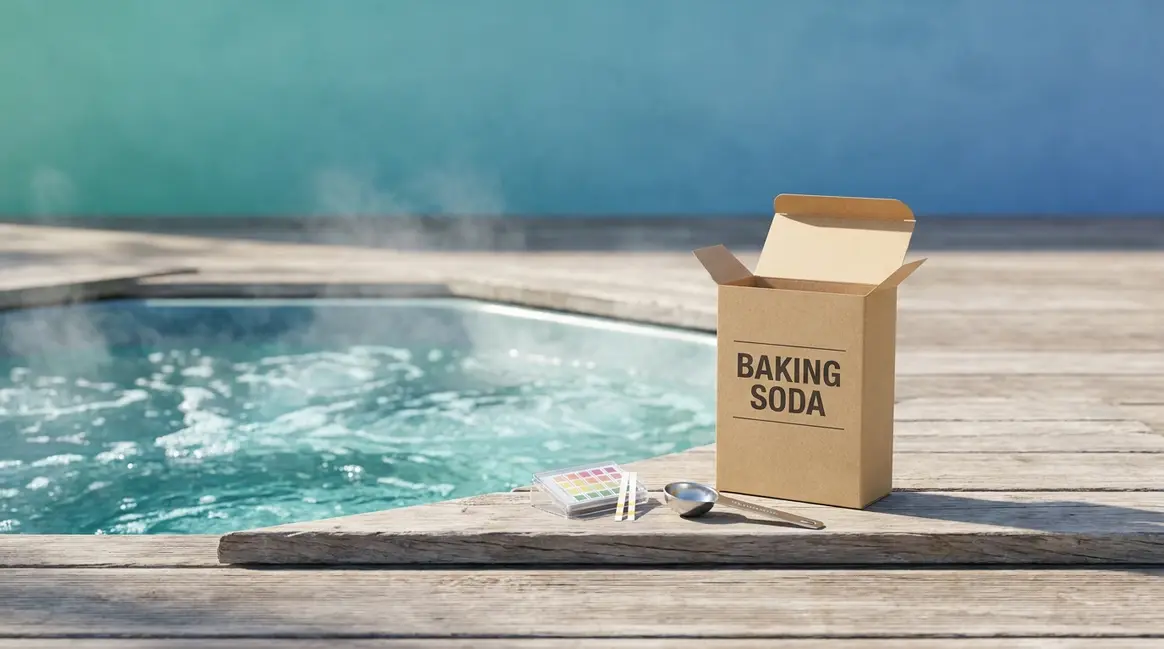
Baking soda — the same box sitting in your kitchen — is the precise chemical you need to raise your hot tub’s total alkalinity. It’s the active ingredient in most commercial “Alkalinity Increaser” products, and it costs a fraction of the price.
When Total Alkalinity (T/A) drops below 80 ppm (parts per million), your pH becomes unstable — swinging wildly and making every other chemical adjustment frustrating and ineffective. Left uncorrected, low alkalinity creates the warm, bacteria-friendly conditions that cause hot tub folliculitis, a skin infection you genuinely want to avoid. Using baking soda in hot tub alkalinity management is the standard, safe, and cost-effective fix recommended by water chemistry professionals.
In this guide, you’ll learn exactly how much baking soda to add for your specific tub size, the 6-step process for adding it safely, and the critical safety rules that protect both your water and your skin. We’ll cover the chemistry fundamentals first, then the dosing matrix, the step-by-step process, safety concerns (including folliculitis), and how hot tub dosing differs from pool dosing.
Many newer owners run into exactly this scenario:
“Fairly new user here. Fresh fill with filtered city water. Trying to get alkalinity and pH in range. Alk first and used some alk up. Just got to 60 ppm shooting for 100. But pH at 7.8. If I add more sodium bicarbonate the alk will go up but the pH will be too high.”
— Hot tub owner, r/hottub community
That concern about pH climbing alongside alkalinity is completely valid — and it’s addressed directly in the dosing section below.
Using baking soda in hot tub alkalinity management safely raises your levels — use 1 tablespoon per 100 gallons to raise T/A by approximately 10 ppm, run jets for 30–60 minutes, then retest after 6–24 hours.
- The Alkalinity-First Protocol: Always fix T/A (target: 80–120 ppm) before adjusting pH — alkalinity is the chemical anchor that stabilizes everything else and makes all subsequent adjustments predictable
- Dosing is size-specific: A 300-gallon tub needs ~3 tablespoons; a 500-gallon tub needs ~5 tablespoons to raise T/A by 10 ppm
- Pre-dissolve first: Always dissolve baking soda in a bucket of spa water before adding — never pour dry powder directly onto surfaces or the filter
- Safety rule: Never add baking soda and shock at the same time — add chemicals one at a time, 15–30 minutes apart
- Cost advantage: Baking soda costs roughly $0.50–$1.00 per pound at grocery stores versus $10–$20 per pound for branded alkalinity increaser — the same sodium bicarbonate molecule at a fraction of the price
Hot Tub Alkalinity and pH Basics
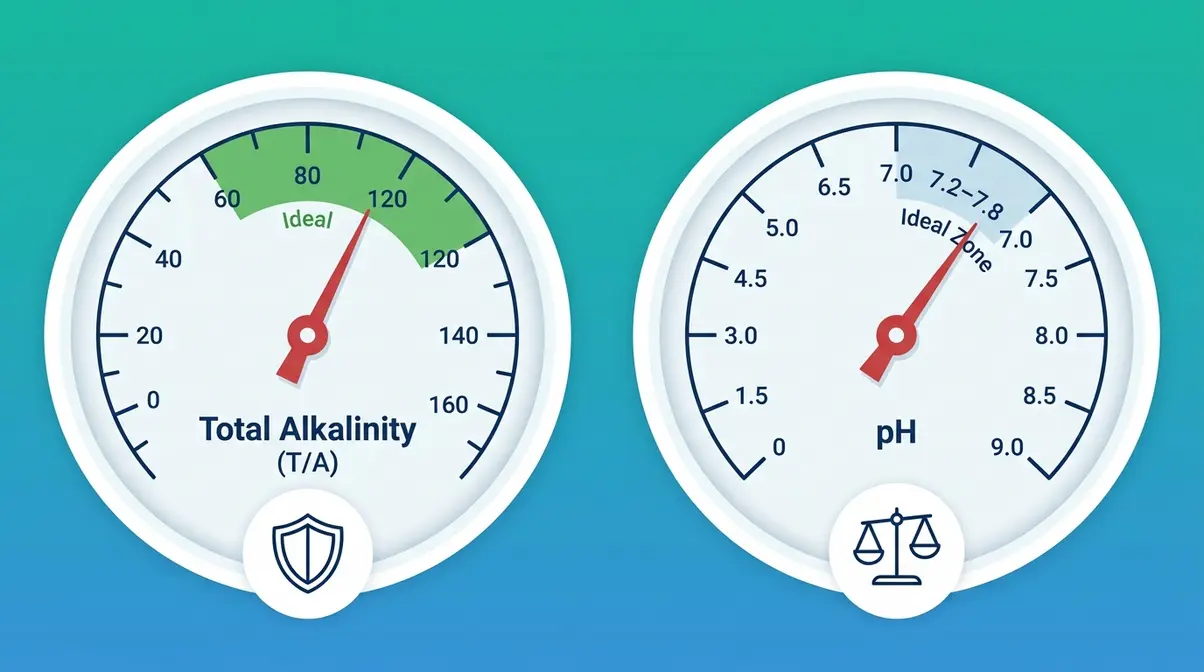
Total Alkalinity (TA) and pH are related but different measurements, and understanding the difference is the first step to fixing your water chemistry. The World Health Organization recommends maintaining hot tub T/A between 80 and 120 ppm to ensure optimal buffering capacity, with sodium bicarbonate recommended for adjusting low levels (WHO Guidelines for Safe Recreational Water Environments, Vol. 2). Getting T/A right first makes every other chemical adjustment faster, cheaper, and more predictable — this is the foundation of The Alkalinity-First Protocol.
As explained by Penn State Extension on alkalinity and pH buffering, sodium bicarbonate is the standard chemical used to raise total alkalinity because it acts as a buffer to neutralize acids without causing a drastic spike in pH levels.
What Is Total Alkalinity?
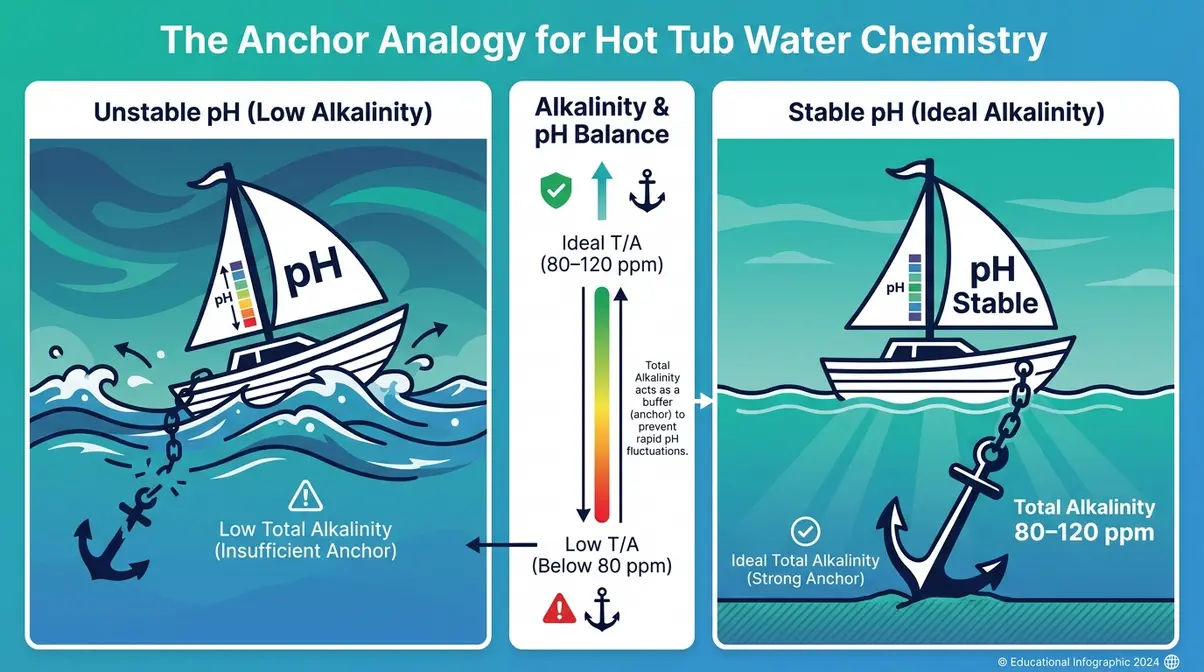
Total Alkalinity (TA) is the measure of your water’s ability to resist changes in pH — what chemists call “buffering capacity.” When T/A is in range, your water chemistry stays predictable and manageable. When it falls below 80 ppm, you lose that stability entirely.
Think of it this way: alkalinity is the anchor, and pH is the boat. Without a heavy anchor (sufficient T/A), the boat (your pH) drifts with every wave — whether that wave is a chemical addition, a bather load, or a temperature shift. Hot tubs run at 100–104°F, which accelerates these shifts dramatically compared to a swimming pool.
Here’s a common symptom user communities report: you add pH increaser, the reading climbs briefly, then falls back down within a day or two. That’s low T/A at work. “If your T/A is low, every fix to your pH is temporary” — it’s the most consistent feedback across professional hot tub forums. The ppm measure (parts per million) describes the concentration of bicarbonate ions dissolved in your water. The ideal range is 80–120 ppm (WHO, 2006).
Alkalinity vs. pH Differences
Many owners treat alkalinity and pH as interchangeable — they’re not, and that misunderstanding is the source of most recurring water chemistry problems. Here’s the key distinction:
- pH measures how acidic or alkaline your water is, on a scale of 0–14. The CDC recommended hot tub pH levels between 7.2 and 7.8 and free chlorine levels between 3.0 and 10.0 ppm to prevent the growth of harmful bacteria.
- Total Alkalinity (T/A) measures how resistant your water is to pH changes. It’s the chemical stability layer beneath pH.
The critical insight most guides miss: alkalinity is the prerequisite for pH stability. If you adjust pH first when T/A is low, you’re pouring money and chemicals into a system that can’t hold the adjustment. Fix T/A first — every time. This is the core principle of The Alkalinity-First Protocol.
A practical example: a 300-gallon tub with T/A at 50 ppm might require three separate pH adjustments in a single week. The same tub with T/A at 100 ppm typically holds a stable pH for 7–10 days between adjustments. That’s the real-world cost of ignoring the difference between pH and alkalinity in a hot tub. For more on understanding pH and total alkalinity in hot tubs, the relationship between these two measurements is covered in depth on the linked guide.
The Ideal Hot Tub Alkalinity
The target range for Total Alkalinity in a residential hot tub is 80–120 ppm, per WHO recreational water guidelines. Some manufacturers specify a slightly narrower window of 80–100 ppm; the consensus across professional spa technicians is that 80–120 ppm is the practical working target.
Here’s what happens outside that range:
| T/A Level | Condition | Effect on Water |
|---|---|---|
| Below 80 ppm | Low alkalinity | pH swings wildly; sanitizer loses effectiveness; surfaces corrode |
| 80–120 ppm | Ideal range | pH stable; sanitizer works efficiently; water comfortable |
| Above 120 ppm | High alkalinity | pH “locks” high; water becomes cloudy; scale deposits form |
If your T/A reads below 80 ppm on your test strip or digital tester, baking soda is your direct fix. If it’s above 120 ppm, you’ll need a pH decreaser (muriatic acid or sodium bisulfate) — a separate process not covered in this guide. Now that you understand why alkalinity comes first, here’s exactly how much baking soda to add for your specific tub size.
How Much Baking Soda to Add
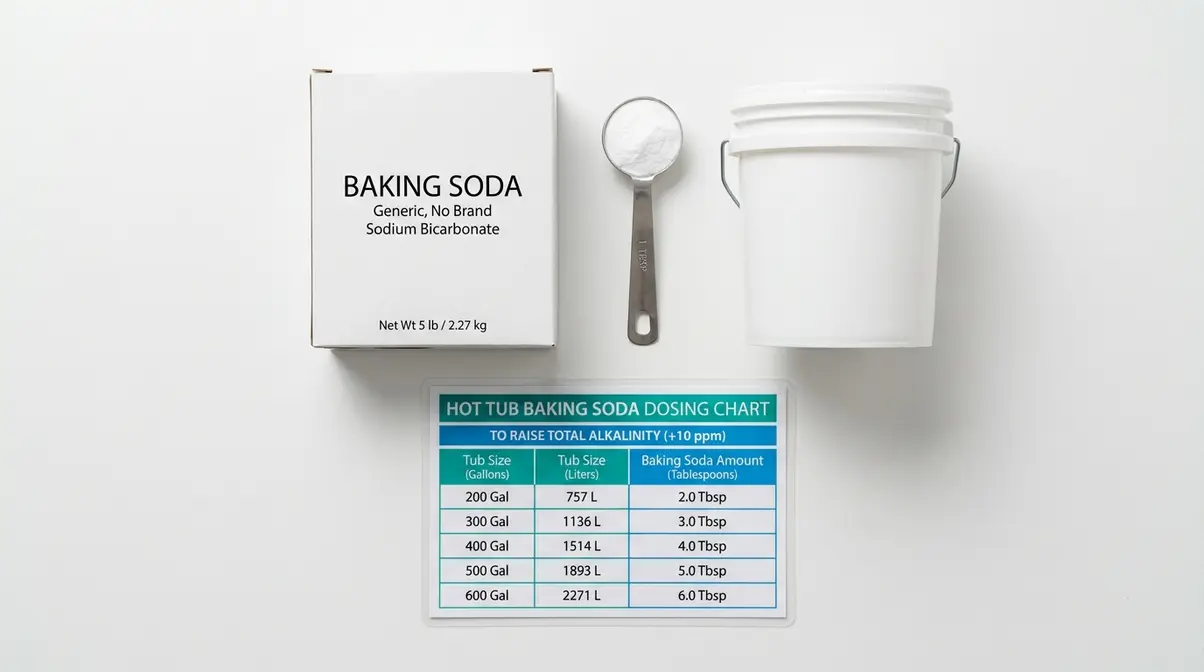
The correct baking soda dosage for raising hot tub alkalinity is well-established: 1 tablespoon of baking soda per 100 gallons of water raises T/A by approximately 10 ppm (Aquatica USA; AmAnoCare Spa Chemistry). This is the foundational rule that every calculation below is built from. Knowing your tub’s water capacity — usually printed in the owner’s manual or on the manufacturer’s spec sheet — is the only prerequisite before you start. When calculating your dosage, remember that using baking soda in hot tub alkalinity adjustments requires precision.
The Standard Dosage Rule
The 1-tablespoon-per-100-gallons rule has been validated across multiple spa chemistry references and is consistent with sodium bicarbonate’s known buffering properties. One tablespoon of baking soda weighs approximately 14 grams, and sodium bicarbonate (NaHCO₃) raises alkalinity by contributing bicarbonate ions that neutralize acids in the water (PubChem, Compound CID 516892).
Before calculating your dose, determine your deficit:
- Test your current T/A level with a test strip or digital meter
- Subtract your current reading from your target (e.g., 100 ppm target − 60 ppm current = 40 ppm deficit)
- Divide deficit by 10 to get your multiplier (40 ÷ 10 = 4)
- Multiply by tablespoons-per-100-gallons for your tub size
Important: Never add the full calculated dose in one treatment if your deficit is large (above 30 ppm). Add half the dose, wait 6 hours, retest, then add the remainder if needed. This prevents overshooting into the high-alkalinity zone.
Baking Soda Dosing Matrix
The table below shows the exact baking soda dose needed to raise T/A by 10 ppm, 20 ppm, and 40 ppm for the five most common residential hot tub sizes. Use this as your reference every time you need to raise alkalinity.
| Tub Size (Gallons) | +10 ppm (tbsp) | +20 ppm (tbsp) | +40 ppm (tbsp) | +40 ppm (oz) |
|---|---|---|---|---|
| 250 gallons | 2.5 tbsp | 5 tbsp | 10 tbsp | ~5 oz |
| 300 gallons | 3 tbsp | 6 tbsp | 12 tbsp | ~6 oz |
| 400 gallons | 4 tbsp | 8 tbsp | 16 tbsp | ~8 oz |
| 500 gallons | 5 tbsp | 10 tbsp | 20 tbsp | ~10 oz |
| 600 gallons | 6 tbsp | 12 tbsp | 24 tbsp | ~12 oz |
How to use this table: Find your tub’s gallon capacity in the left column. Read across to the column matching your T/A deficit. That’s your starting dose. For deficits above 40 ppm, split into two treatments 6–12 hours apart. User consensus from hot tub owner communities consistently confirms that splitting large doses prevents pH overshoot — the exact concern raised in the r/hottub quote above.
How Baking Soda Affects pH
This is the question that trips up nearly every newer owner: “If I add more sodium bicarbonate, the alkalinity will go up — but will the pH get too high?”
The honest answer: yes, baking soda does raise pH slightly, but the effect is modest and manageable when you dose correctly. Baking soda has a natural pH of approximately 8.3. When dissolved in hot tub water, it contributes a mild alkaline shift — typically raising pH by 0.1 to 0.3 points per treatment at standard doses (AmAnoCare Spa Chemistry).
Here’s what this means in practice:
- If your pH is currently at 7.2–7.4 (low-normal range), baking soda will likely bring both T/A and pH into range simultaneously
- If your pH is already at 7.6–7.8, adding baking soda may push it slightly above 8.0 — monitor closely and be prepared to add a small amount of pH decreaser afterward
- If pH climbs above 8.0 after your T/A treatment, wait 24 hours, retest, and use sodium bisulfate (dry acid) to bring pH back to 7.4–7.6
The key principle: fix T/A first, then fine-tune pH second. A pH that’s slightly high after a T/A correction is a much easier problem to solve than a pH that keeps swinging because T/A was never corrected. This is The Alkalinity-First Protocol in action.
Baking Soda for a 300-Gallon Tub?
A 300-gallon hot tub needs 3 tablespoons of baking soda to raise T/A by 10 ppm. To raise T/A by 20 ppm, use 6 tablespoons; for a 40 ppm increase, use 12 tablespoons (approximately 6 oz). Always pre-dissolve in a bucket of spa water first, add with jets running, and wait 6–24 hours before retesting. For deficits above 30 ppm, split into two treatments rather than adding the full dose at once.
Step-by-Step: Adding Baking Soda
Following a consistent process protects your tub’s surfaces, prevents chemical waste, and ensures accurate results. The 6-step procedure below reflects the standard methodology recommended by spa chemistry professionals and validated through user consensus across multiple hot tub owner communities. Before you begin, gather your materials:
You’ll need: baking soda (standard grocery-store box, food-grade or pool-grade), a 5-gallon bucket, a test strip kit or digital water tester, a measuring tablespoon, and 30–60 minutes of time. Total process time: 30–60 minutes active, plus 6–24 hours for full stabilization.
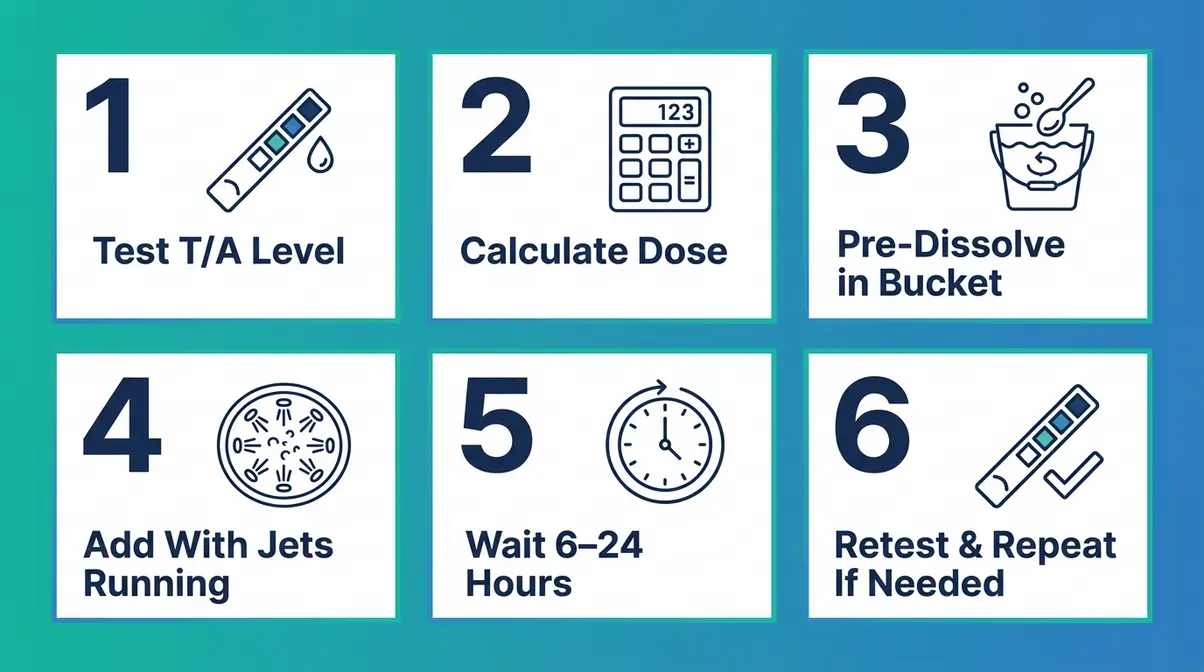
Step 1 — Test Your Current T/A Level
Test your hot tub water with a test strip or digital meter before adding anything. Dip the strip per manufacturer instructions (typically 2 seconds, then hold still for 15 seconds before reading). Record your current T/A reading in ppm.
This step enforces The Alkalinity-First Protocol: you cannot calculate the correct dose without knowing your starting point. If your T/A reads below 80 ppm, proceed. If it reads 80–120 ppm, your alkalinity is already in range — do not add baking soda.
Expected outcome: A confirmed T/A reading and a calculated deficit (target ppm minus current ppm).
Step 2 — Calculate Your Dose
Using the Dosing Matrix above, identify the correct number of tablespoons for your tub’s gallon capacity and T/A deficit. For deficits above 30 ppm, plan to split the dose across two treatments.
Example: 400-gallon tub, current T/A = 65 ppm, target = 100 ppm. Deficit = 35 ppm. First treatment: 12 tablespoons (to raise ~30 ppm). Second treatment after 6 hours: 4 tablespoons (to raise ~10 ppm). Measure precisely — guessing introduces the pH overshoot problem the r/hottub community frequently reports.
Expected outcome: A specific tablespoon count ready to measure out.
Step 3 — Pre-Dissolve in a Bucket
Fill a clean 5-gallon bucket with warm water drawn directly from your hot tub. Add your measured baking soda to the bucket and stir until fully dissolved — this typically takes 60–90 seconds of stirring.
Why pre-dissolve? Pouring dry baking soda powder directly into the tub can cause it to settle on the shell surface or filter, creating localized high-concentration zones that may temporarily bleach acrylic surfaces or clog the filter. Pre-dissolving distributes the chemical evenly from the moment it enters the water. This step is consistently recommended by spa technicians and confirmed by user reports across hot tub communities. Estimated time: ~2 minutes.
Expected outcome: A clear bucket solution with no visible undissolved powder.
Step 4 — Add With Jets Running
Turn your hot tub jets on to the highest setting. Pour the pre-dissolved baking soda solution slowly around the perimeter of the tub — not directly over the filter intake. Keep jets running throughout and for at least 30 minutes after adding.
Running jets ensures thorough circulation, which distributes the bicarbonate ions evenly throughout the entire water volume. Uneven distribution is the most common reason for inaccurate retest readings. If your tub has multiple jet zones, cycle through all of them during this circulation period. Estimated time: ~2 minutes to add, then 30–60 minutes of circulation.
Expected outcome: Solution fully mixed into tub water with jets circulating.
Step 5 — Wait Before Retesting
This is the step most owners rush — and rushing it leads to incorrect second doses. After adding baking soda and circulating for 30–60 minutes, wait a minimum of 6 hours before retesting. For the most accurate reading, wait 24 hours.
Why the wait? Bicarbonate chemistry requires time to fully equilibrate in the water. Early readings (taken within 1–2 hours) often show artificially elevated T/A levels that fall back as the chemistry stabilizes — leading owners to believe they’ve overshot when they haven’t. Across hot tub owner forums, the consistent recommendation is to test the following morning after an evening treatment.
Expected outcome: A stable T/A reading that accurately reflects your water’s current alkalinity.
Time to Raise Alkalinity?
Baking soda begins raising alkalinity immediately, but full stabilization takes 6–24 hours. After adding the dissolved solution with jets running, you’ll see a preliminary rise within 30–60 minutes of circulation. However, the chemistry continues to equilibrate over the following hours. Testing within the first 2 hours often produces artificially elevated readings. For the most accurate result, test the following morning after an evening treatment — this 24-hour window is the professional standard (Aquatica USA; Master Spa Parts).
Step 6 — Retest and Repeat If Needed
After your 6–24 hour wait, test T/A again. If the reading is now between 80–120 ppm, your alkalinity correction is complete — proceed to check and adjust pH if needed. If T/A is still below 80 ppm, calculate a second dose using the Dosing Matrix and repeat Steps 2–5.
After T/A is in range: Test your pH. If it has climbed above 7.8 as a result of the baking soda treatment, add a small amount of sodium bisulfate (pH decreaser) per the manufacturer’s instructions. Never add pH decreaser and baking soda at the same time — allow 15–30 minutes between chemical additions. For guidance on balancing pH after raising alkalinity, the linked resource covers the next steps.
Expected outcome: T/A confirmed at 80–120 ppm; pH checked and adjusted if necessary.
Hot Tub Baking Soda Safety Facts
Baking soda is one of the safest chemicals you can add to hot tub water — but “safe” doesn’t mean “add without care.” When applying baking soda in hot tub alkalinity treatments, safety remains paramount. Understanding both the safety profile of sodium bicarbonate and the health risks of not maintaining correct alkalinity will help you treat your hot tub chemistry with the precision it deserves. This section covers three areas: a common misconception about what baking soda does, the real health risk of low alkalinity (folliculitis), and the chemical safety rules you must follow.
Does Baking Soda Lower Alkalinity?
No — baking soda raises alkalinity, not lower it. This misconception appears frequently in online searches (the query “baking soda to lower alkalinity in hot tub” generates significant search traffic), likely because people confuse baking soda with muriatic acid or sodium bisulfate, which are the chemicals used to lower alkalinity.
Here’s the chemistry, stated plainly: sodium bicarbonate (NaHCO₃) is an alkaline compound with a pH of approximately 8.3. When dissolved in water, it releases bicarbonate ions (HCO₃⁻) that neutralize acids and raise the water’s buffering capacity — which is precisely what Total Alkalinity measures (PubChem, Compound CID 516892).
If you need to lower your T/A (readings above 120 ppm), the correct chemical is muriatic acid (hydrochloric acid) or sodium bisulfate (dry acid), added in small, carefully measured amounts with jets running. Baking soda will not help in that situation and will make high alkalinity worse.
Hot Tub Folliculitis Risks
Hot tub folliculitis is a skin infection caused by Pseudomonas aeruginosa — a bacterium that thrives in warm, poorly balanced water. It presents as itchy, red bumps or pustules, typically appearing 12–48 hours after exposure to contaminated water, most commonly on the torso, buttocks, and legs.
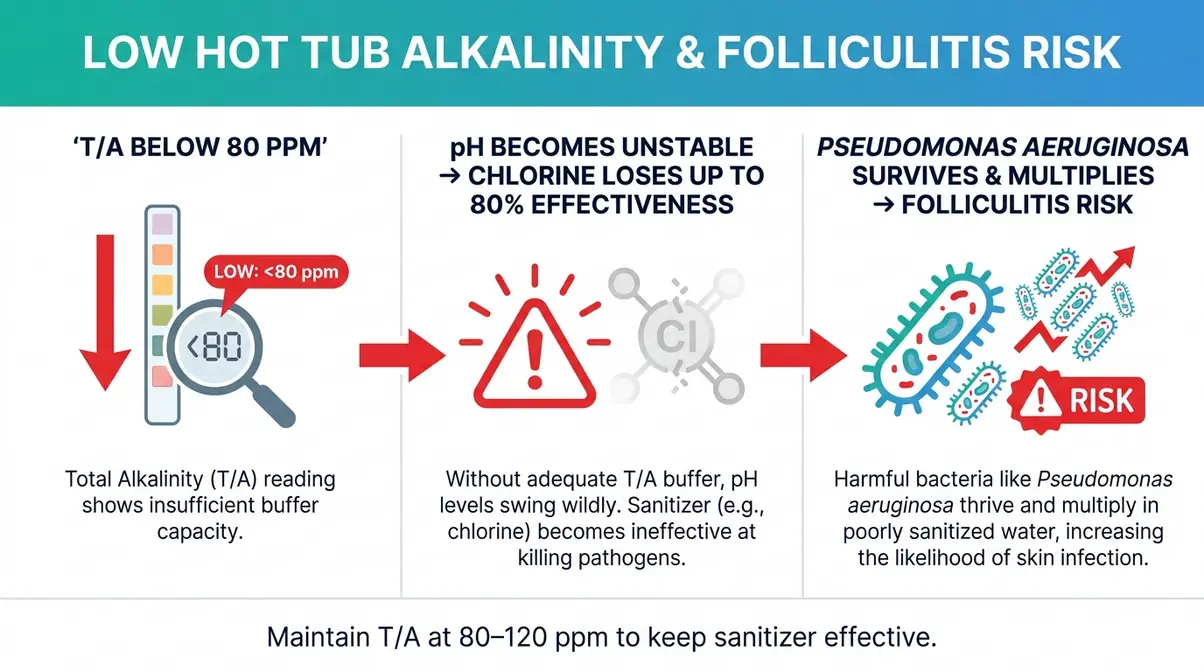
According to the CDC, hot tub folliculitis is one of the most commonly reported illnesses associated with hot tubs and spas, with Pseudomonas aeruginosa identified as the primary causative agent. The connection to alkalinity is direct: when T/A drops below 80 ppm, pH becomes unstable, and unstable pH dramatically reduces the effectiveness of chlorine and bromine sanitizers. A pH reading above 8.0 can reduce free chlorine effectiveness by up to 80% — meaning bacteria that would normally be killed survive and multiply.
Does hot tub folliculitis go away on its own?
In most healthy adults, mild cases of hot tub folliculitis resolve within 7–10 days without medical treatment, according to the Mayo Clinic. The standard approach is to keep the affected area clean and dry, avoid re-exposure to the contaminated water, and apply over-the-counter antiseptic if needed. However, cases involving severe or spreading infection, fever, or immunocompromised individuals require medical evaluation and may need oral antibiotics (typically ciprofloxacin). The Mayo Clinic notes that folliculitis that spreads or doesn’t improve within 2 weeks warrants a doctor’s visit.
Tub Care After Folliculitis?
After a folliculitis outbreak, drain and refill the tub completely before re-entering. Clean the shell, headrests, and filter thoroughly with a spa surface cleaner. Once refilled, follow The Alkalinity-First Protocol: balance T/A to 80–120 ppm with baking soda, verify pH is 7.2–7.8, then shock the water with an appropriate oxidizer. Confirm sanitizer levels meet CDC guidelines (free chlorine 3.0–10.0 ppm) before anyone re-enters. Do not simply add more sanitizer to an unbalanced tub — the bacteria that caused the infection thrive when pH and alkalinity are off.
Chemical Mixing Safety Rules
Baking soda itself is non-toxic and non-reactive under normal hot tub conditions. However, the context in which you add it matters — and there are specific rules that protect both you and your equipment.
The core safety rules:
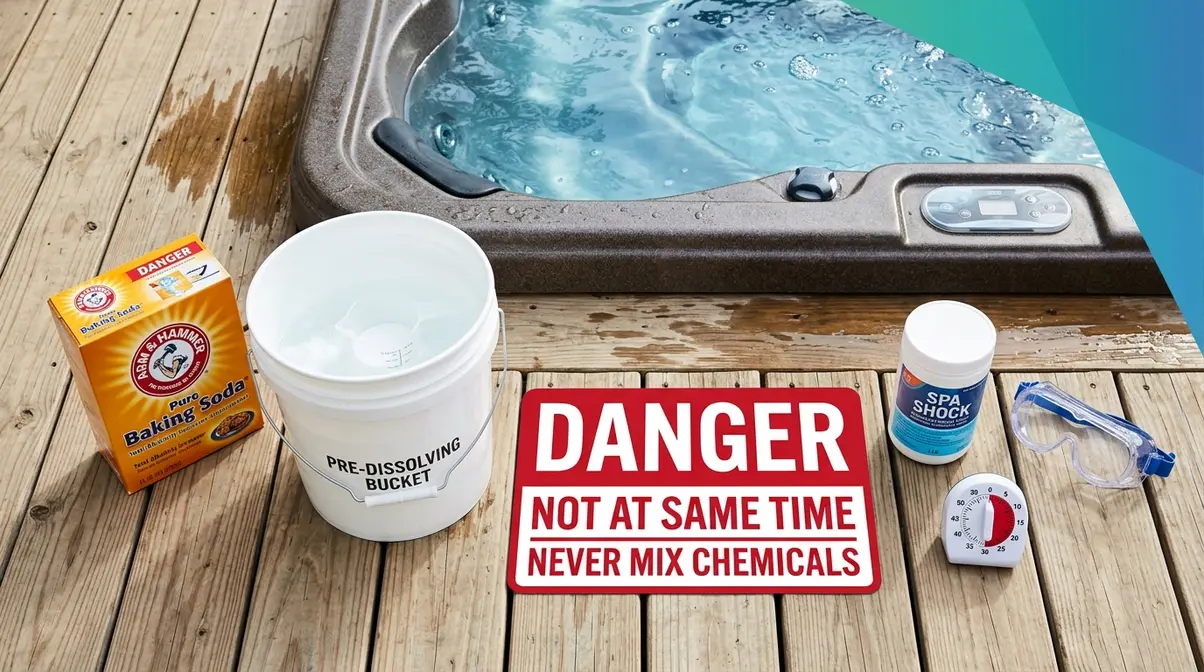
- Never add baking soda and shock simultaneously. Pool/spa shock (typically calcium hypochlorite or non-chlorine oxidizer) should be added separately, with a minimum 15–30 minute gap between chemical additions. Adding multiple chemicals at once can cause rapid, unpredictable reactions in the water and potentially irritate skin and eyes.
- Never mix chemicals in the same bucket. Each chemical gets its own pre-dissolving container. Even residual traces of incompatible chemicals in a shared bucket can react.
- Always add chemicals to water, not water to chemicals. Pour baking soda solution into the tub — never pour water into a concentrated chemical container.
- Wear eye protection when handling concentrated chemicals. While baking soda is mild, this habit protects you when handling the pH decreasers and sanitizers that follow.
- Keep the cover off for at least 30 minutes after adding any chemical to allow off-gassing.
User consensus from hot tub owner communities consistently confirms that the most common chemical safety mistake is impatience — adding the next chemical before the previous one has fully circulated. The 15–30 minute rule between additions is not conservative; it’s the standard professional recommendation.
Pool vs. Hot Tub: Why Dosing Differs
If you’ve maintained a swimming pool before, you might assume your pool chemistry knowledge transfers directly to a hot tub. It does — partially. The same chemicals work, and the same principles apply. But the dosing frequency, concentration, and sensitivity are meaningfully different, and applying pool-scale thinking to a hot tub is one of the most common mistakes newer owners make.
Why Hot Tubs Need More Adjustments
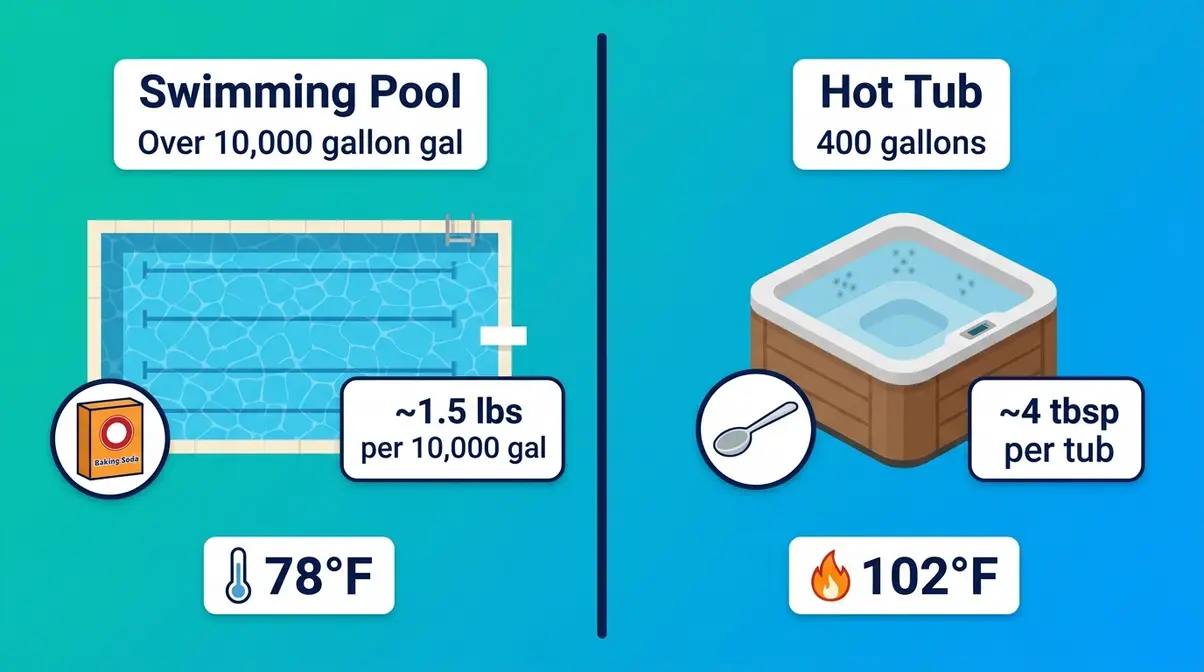
The fundamental difference is water volume relative to bather load and temperature. A standard swimming pool holds 10,000–20,000 gallons. A residential hot tub holds 250–600 gallons — roughly 1/30th the volume. That means every bather, every splash, and every chemical addition has a proportionally larger impact on water chemistry.
Consider these compounding factors:
- Temperature: Hot tubs operate at 100–104°F, compared to pool water at 75–85°F. Higher temperature accelerates chemical reactions, depletes sanitizers faster, and increases the rate at which alkalinity and pH drift.
- Bather load: Two adults in a 400-gallon hot tub represent a far higher bather-to-water ratio than two adults in a 15,000-gallon pool. Body oils, lotions, and organic matter are concentrated into a much smaller water volume.
- Aeration: Jets introduce air into the water, which naturally causes CO₂ off-gassing — a process that gradually raises pH over time. Pools rarely have this effect at the same intensity.
As a result, hot tub owners typically need to test and adjust chemistry 2–3 times per week with regular use, compared to once a week for a typical pool. Alkalinity in a heavily used hot tub can drop 10–20 ppm within a few days of a fresh fill.
Pool vs. Hot Tub Dosing
The chemical is identical — both pools and hot tubs use sodium bicarbonate to raise total alkalinity. The difference is in concentration and frequency.
| Factor | Swimming Pool | Hot Tub |
|---|---|---|
| Typical water volume | 10,000–20,000 gallons | 250–600 gallons |
| Standard baking soda dose (raise T/A 10 ppm) | ~1.5 lbs per 10,000 gal | ~1–6 tbsp per tub |
| Recommended testing frequency | Weekly | 2–3× per week |
| Temperature effect on chemistry | Moderate | High (100–104°F) |
| pH drift from aeration | Low | High (jets) |
| Alkalinity drop rate (heavy use) | Slow | Fast (days) |
For a standard pool, pool-care guides often recommend adding a pound or more of baking soda at a time to correct low alkalinity in low alkalinity in pool baking soda scenarios. Translating that directly to a hot tub would severely overshoot — you’d be adding 30–40 tablespoons when the correct dose might be 3–5. Always recalculate from your tub’s specific gallon capacity using the Dosing Matrix above, regardless of what you’ve done for a pool.
Common Mistakes and When Baking Soda Isn’t Enough
Baking soda is highly effective for raising alkalinity, but it has limits — and certain mistakes can make your water chemistry worse before it gets better.
Common Pitfalls
Pitfall 1: Skipping the pre-dissolve step. Pouring dry baking soda powder directly into the tub is the most frequently reported mistake in hot tub owner forums. The powder can settle on acrylic surfaces, temporarily cloud the water, and produce uneven chemistry readings. Always pre-dissolve in a bucket first — it takes 2 minutes and prevents multiple problems.
Pitfall 2: Retesting too soon. Testing within 1–2 hours of adding baking soda produces unreliable readings because the chemistry hasn’t fully equilibrated. The 6-hour minimum wait (ideally 24 hours) is not arbitrary — it reflects how long bicarbonate ions take to stabilize in warm water. Impatient retesting leads to double-dosing and overshooting into high-alkalinity territory.
Pitfall 3: Adding the full dose when the deficit is large. For deficits above 30 ppm, split your dose into two treatments. A single large dose can temporarily spike pH well above 8.0, which reduces sanitizer effectiveness and may require a corrective acid treatment afterward.
When to Choose Alternatives
Baking soda is the correct choice for raising low alkalinity. It is not the right tool in these scenarios:
- T/A above 120 ppm: You need muriatic acid or sodium bisulfate to lower alkalinity — baking soda will worsen the problem
- Persistent alkalinity drops (weekly): Frequent drops may indicate a pH problem, a high-bather-load issue, or excessive aeration. Address the root cause rather than repeatedly adding baking soda
- Combined low T/A and very low pH (below 7.0): Consult a spa professional — aggressive acid conditions require a more controlled correction sequence than a standard baking soda addition
When to Seek Expert Help
If you’ve completed two or three full correction cycles using the steps above and T/A still won’t hold in the 80–120 ppm range, the issue may be beyond chemistry adjustment. A spa technician can test for calcium hardness (CH) imbalances, equipment issues, or water source problems (very soft municipal water sometimes requires a different treatment approach). Similarly, if anyone using the hot tub develops a skin infection that doesn’t resolve within 10 days, seek medical advice rather than attempting to self-treat with natural remedies alone.
Frequently Asked Questions
Can you put baking soda in a hot tub to raise alkalinity?
Yes, baking soda is the standard chemical for raising hot tub alkalinity. Sodium bicarbonate (NaHCO₃) is the active ingredient in commercial “Alkalinity Increaser” products and is safe for hot tub water at correct doses. The standard dose is 1 tablespoon per 100 gallons to raise T/A by approximately 10 ppm. It’s non-toxic, widely available, and costs significantly less than branded spa chemicals containing the same compound.
Is it safe to put baking soda in a hot tub?
Baking soda is one of the safest chemicals used in hot tub maintenance. Sodium bicarbonate is non-toxic, non-irritating at correct doses, and does not react dangerously with the chlorine or bromine already in your water. The key safety rules are: never add it simultaneously with shock, always pre-dissolve before adding, and never exceed the calculated dose in a single treatment. There are no documented cases of harm from correctly dosed baking soda additions in residential hot tubs.
Can I use baking soda in my hot tub to increase alkalinity?
Yes — baking soda is the correct chemical to increase hot tub alkalinity, and it’s chemically identical to the branded “alkalinity increaser” products sold at spa retailers. The active ingredient in both is sodium bicarbonate. Using grocery-store baking soda costs roughly $0.50–$1.00 per pound versus $10–$20 per pound for branded spa products. Use the Dosing Matrix in this guide to calculate the exact amount for your tub’s gallon capacity and T/A deficit.
Does hot tub folliculitis ever go away?
In most healthy adults, hot tub folliculitis resolves on its own within 7–10 days without medical treatment (Mayo Clinic). Keep the affected skin clean and dry, avoid re-exposure to the contaminated water, and apply over-the-counter antiseptic if needed. Cases that spread, worsen after 2 weeks, or occur in immunocompromised individuals require medical evaluation and may need antibiotic treatment. Preventing recurrence is straightforward: maintain T/A at 80–120 ppm and sanitizer levels per CDC recommendations consistently.
What kills folliculitis naturally?
The most effective natural approach is correcting your hot tub water chemistry to prevent the Pseudomonas aeruginosa bacteria from surviving. For the skin infection itself, warm compresses applied 3–4 times daily can help drain affected follicles and speed healing. Keeping the area clean and dry is well-supported. Tea tree oil has limited antimicrobial evidence in general, but its effectiveness against P. aeruginosa specifically is not well-established. For anything beyond mild, localized folliculitis, consult a healthcare provider rather than relying on home remedies alone.
Will baking soda make hot tub water cloudy?
Yes, adding baking soda can temporarily make hot tub water cloudy if not pre-dissolved. When you pour dry powder directly into the water, it takes time to fully integrate. Always pre-dissolve the sodium bicarbonate in a bucket of warm spa water first. This ensures clear water and prevents the powder from settling on your acrylic shell or clogging the filter system.
Can I use baking powder instead of baking soda?
No, you should never use baking powder in a hot tub. Baking powder contains additional ingredients like cornstarch and acidic compounds (such as cream of tartar) designed for baking, not water chemistry. Using it will introduce organic matter and acids into your spa, causing cloudy water and potentially lowering your pH. Always use pure sodium bicarbonate (baking soda).
How often should I test hot tub alkalinity?
You should test your hot tub alkalinity 2 to 3 times per week. Because hot tubs have a small water volume and operate at high temperatures (100–104°F), chemical levels shift much faster than in swimming pools. Regular testing allows you to catch a drop in Total Alkalinity before it falls below 80 ppm, preventing wild pH swings and potential equipment corrosion.
Your Hot Tub Water, Under Control
For hot tub owners managing low T/A, baking soda in hot tub alkalinity correction is the precise, proven, and cost-effective solution. Sodium bicarbonate raises total alkalinity by contributing bicarbonate ions that neutralize acids and restore your water’s buffering capacity — targeting the 80–120 ppm range recommended by the WHO. At $0.50–$1.00 per pound versus $10–$20 for branded products, it delivers the same chemistry at a fraction of the cost.
The Alkalinity-First Protocol exists because alkalinity is not just another parameter — it’s the chemical foundation that makes every other adjustment stable and predictable. Fix T/A first, verify pH second, then confirm sanitizer levels. Skipping the sequence wastes chemicals and time, and leaves your water in the unstable cycle that most new owners experience during their first few months. The Dosing Matrix in this guide gives you the exact numbers; the 6-step process gives you the method.
Your next step: test your T/A right now. If it reads below 80 ppm, calculate your dose from the Dosing Matrix, pre-dissolve your baking soda, and follow the 6-step process. Check your results in 24 hours. Most owners see their water stabilize fully within a single correction cycle — and once T/A is in range, maintaining it becomes a routine 5-minute task rather than a recurring frustration.