

Table of Contents - EC Error on Hot Tub: What It Means & How to Fix It
This blog post may contain affiliate links. As an Amazon Associate I earn from qualifying purchases.
“Older American spas hot tub came with the house we just bought. It’s in great shape but after a few uses it started flashing ‘Ec.’ We don’t know what to do.”
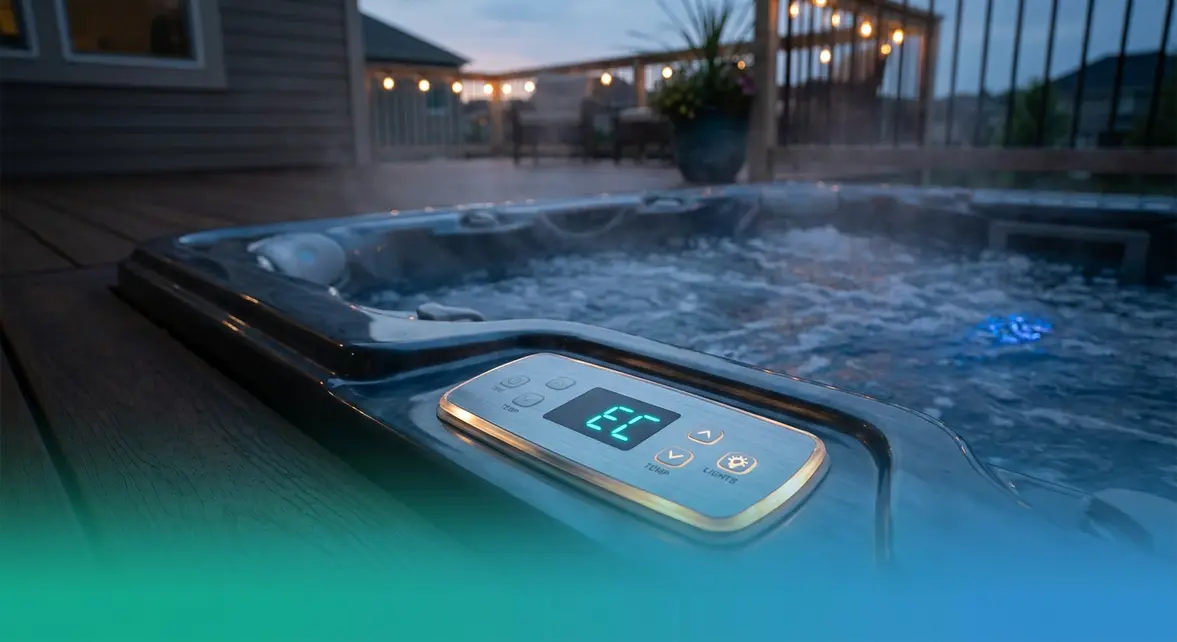
That feeling is more common than you’d think — and the relief you’re about to feel is immediate. Here’s the good news: EC is not a broken heater. It stands for Economy Mode (EC), a built-in energy-saving setting that simply limits when your heater runs. Your spa is working exactly as designed.
Without understanding what the ec error on hot tub meaning actually is, most owners either call a technician unnecessarily or sit with cold water for days. Both outcomes are avoidable. By the end of this guide, you’ll know exactly what the EC error on your hot tub means, how to clear it in under two minutes, and when Economy Mode is actually worth using.
This guide covers three things in order: what EC means and why your water feels cold, how to switch back to Standard Mode step by step, and what to do if EC keeps coming back.
The EC error on a hot tub means Economy Mode is active — not a broken heater. Switching back to Standard Mode takes under two minutes on most control panels.
- EC = Economy Mode: The heater only runs during scheduled filter cycles, not continuously — so cold water between cycles is expected
- Quick fix: Press the Temp + Lights buttons simultaneously (Balboa panels) to switch to Standard (ST) mode
- The EC Anxiety Gap: Most owners fear a costly repair when they only need a one-button setting change
- When EC is useful: Vacations and multi-day absences — it can meaningfully cut standby energy costs
What Does EC Mean on a Hot Tub?
The EC code on a hot tub display means your spa is running in Economy Mode (EC), an energy-saving setting that limits heating to scheduled filter cycles rather than maintaining a constant temperature. According to Balboa Water Group documentation — the manufacturer behind control systems used in Sundance, Jacuzzi, and dozens of other brands — EC is an operational status indicator, not a fault alarm. Your heater is not broken. The cold water you’re feeling is the system working exactly as programmed.
This distinction matters because it defines the entire fix: you don’t need a technician, a replacement part, or a service call. You need a button combination.
“The EC code on a hot tub is not an error — it is Economy Mode, a scheduled heating feature that reduces energy use by limiting the heater to filter cycle windows.” — Balboa Water Group documentation
This is the heart of The EC Anxiety Gap: the painful disconnect between what EC actually means (a harmless, reversible setting) and what most owners fear it means (a circuit board malfunction, a failed sensor, or an expensive repair). Competitors either bury this explanation or, worse, treat EC alongside genuine fault codes — which only deepens the confusion.
For more context on this operational code, learn more about what EC mode means before diving into the fix.
Economy Mode vs. Standard Mode: The Key Difference
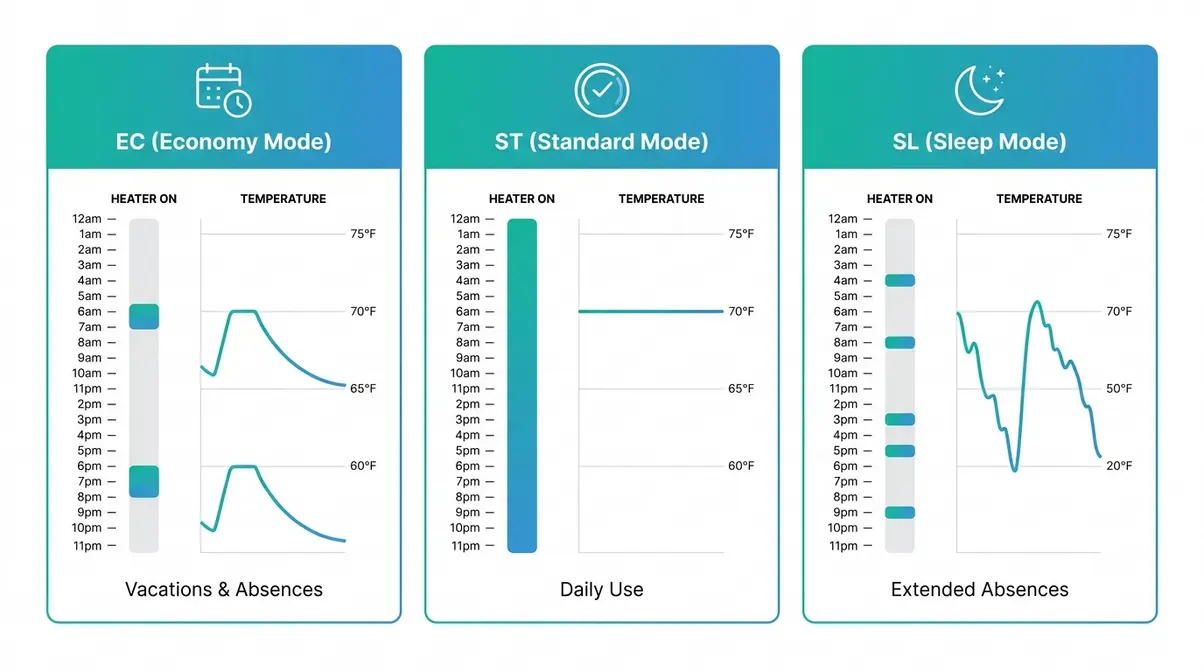
The three operational modes on most hot tub control panels work very differently. Here’s what each one actually does:
| Mode | What It Does | Water Temperature | Best For |
|---|---|---|---|
| EC (Economy) | Heats only during scheduled filter cycles (typically 2–4x per day) | May drop 5–15°F between cycles | Vacations, multi-day absences |
| ST (Standard) | Maintains your set temperature continuously | Always at target temp | Daily use |
| SL (Sleep) | Heats only when temp drops more than 20°F below set point | May vary significantly | Extended absences |
Think of EC mode like a programmable thermostat that only kicks on at 6am and 6pm — versus Standard mode, which runs on demand any time the temperature dips. Both save the same water; only Standard mode keeps it consistently hot.
Balboa Water Group’s official documentation defines Economy Mode as a heating-only-during-filter-cycles behavior, clearly distinguishing it from Standard Mode’s continuous temperature maintenance.
Why Your Water Feels Cold in EC Mode
In EC mode, your heater is programmed to run only during filter cycles — often two windows per day, such as 6am–8am and 6pm–8pm. Between those windows, the heater stays off entirely. That’s by design.
Depending on outdoor temperature, your spa’s insulation quality, and how long since the last filter cycle ran, the water can drop noticeably. If your hot tub last completed its heat cycle six hours ago and it’s 40°F outside, the water may be 10°F below your set temperature — and that’s completely normal in EC mode. Owners in cold climates or with older insulation notice this drop most dramatically. It is not a sign of heater failure.
EC Is a Setting, Not a Malfunction
Hot tub control panels display two types of messages: operational codes and fault codes. Operational codes — like EC, ST, and SL — describe the current heating mode. Fault codes — like FLO (flow error), OH (overheat), or SN (sensor error) — signal actual problems that need attention.
EC belongs firmly in the first category. It has no relationship to a circuit board malfunction, a broken sensor, or a failed heater element. Across owner communities on Reddit’s r/hottub forum, the consistent experience is that switching from EC to ST mode immediately resolves cold water — no repair required.
How to Turn Off EC Mode on Your Hot Tub (Step-by-Step)
Switching from EC mode back to Standard Mode takes under two minutes on virtually every modern hot tub. Based on our review of Balboa Water Group manufacturer documentation and community-verified experiences across hot tub owner forums, the process is consistent across most panels — with minor variations by brand covered below.
Before You Start: What You’ll Need
You’ll need: Access to your hot tub control panel, your owner’s manual (optional but helpful), and about 90 seconds.
- ✅ Power must be ON — the control panel display should be lit and showing “Ec”
- ✅ No tools required — this is a button-press change, not a wiring task
- ✅ Your manual is helpful but not required for Balboa-equipped panels
Total estimated time: Under 2 minutes.
The Universal Method: Temp + Lights Button Combination
This method works on the majority of Balboa-equipped hot tubs, which cover a large share of the U.S. market — including many American Spas, Sundance, and Cal Spas models.
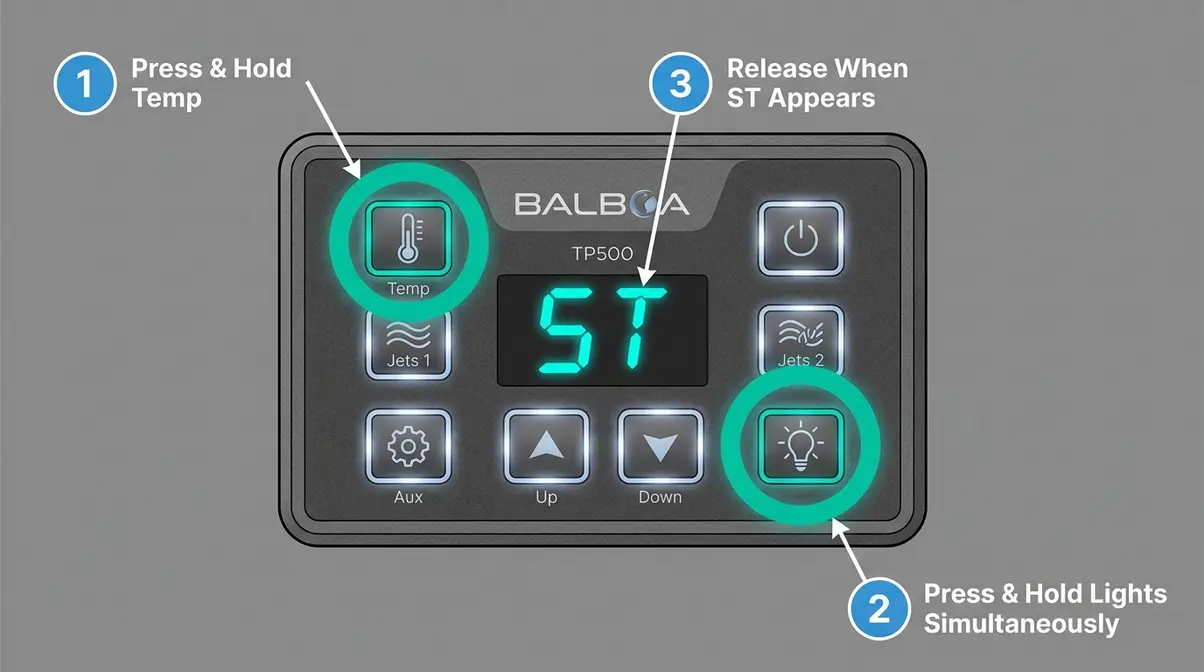
- Locate the Temp and Lights buttons on your control panel. They are typically labeled clearly — “Temp” (or a thermometer icon) and “Lights” (or a lightbulb icon).
- Press and hold both buttons simultaneously for 3–5 seconds. Keep holding until the display changes.
- Watch the display. It will cycle through: EC → SL (Sleep) → ST (Standard). Release the buttons when “ST” or “Std” appears.
- Wait 15–30 seconds. The panel may briefly flash before settling on the new mode.
- Confirm the change — the display should now show “ST” or “Std” rather than “Ec.”
Note: This step may vary by brand or panel model — always check your owner’s manual if the display does not respond as described.
How to Confirm Standard Mode Is Active
Once you’ve pressed the button combination, confirming the change is straightforward:
- Display check: The panel should show “ST,” “Std,” or “Standard” — not “Ec” or “SL”
- Heater indicator: Many panels show a small heating icon or “HTR” when the heater is actively running
- Temperature rise: Allow 30–60 minutes. In Standard Mode, the heater will begin working toward your set temperature immediately
If the display reverts to EC after a few minutes, the mode switch didn’t register fully — repeat the button hold for a full 5 seconds.
Brand-Specific Instructions (Balboa, Cal Spas, Jacuzzi, Dream Maker)
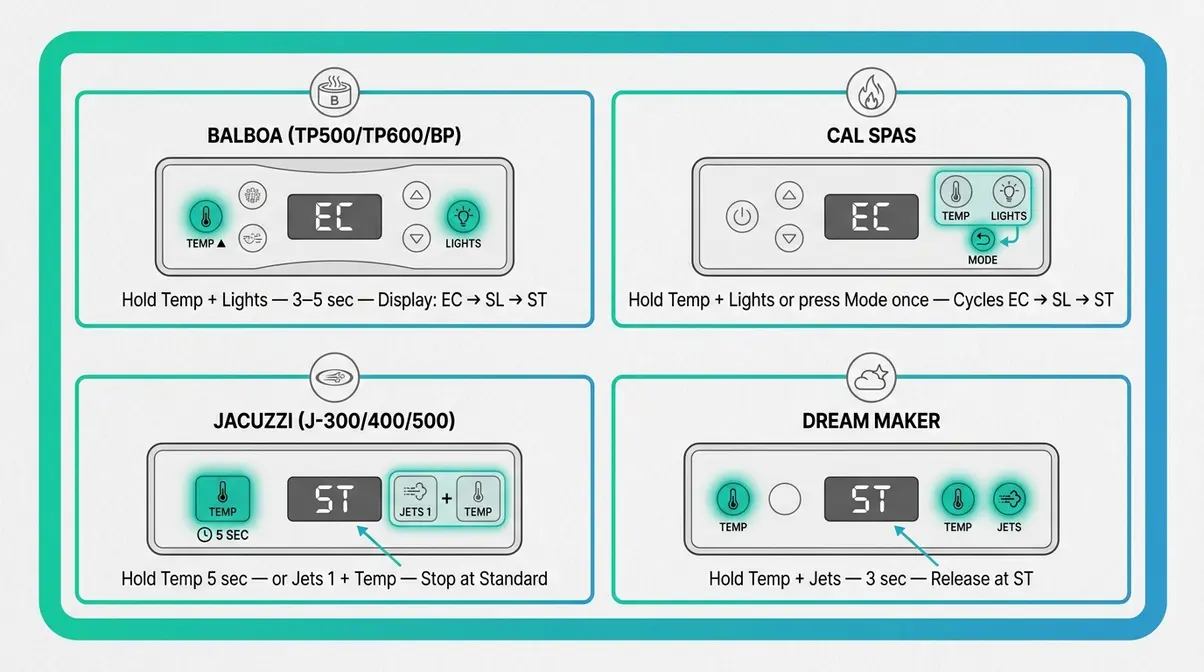
While the Temp + Lights method covers most panels, some brands use slightly different button labels or sequences. Based on Balboa Water Group’s official documentation and brand-specific owner manuals:
Balboa Water Group panels (TP500, TP600, BP series):
Press Temp ▲ + Lights simultaneously for 3–5 seconds. Display cycles EC → SL → ST.
Cal Spas:
Most Cal Spas use Balboa control systems. Use the Temp + Lights method above. If your panel has a “Mode” button, press it once to cycle through EC → SL → ST directly.
Jacuzzi (J-300, J-400, J-500 series):
Press the Temp button and hold for 5 seconds. On some models, press Jets 1 + Temp simultaneously. The display will cycle through available modes — stop at “Standard.”
Dream Maker (Balboa-based panels):
Press Temp + Jets simultaneously for 3 seconds. The display cycles through modes. Release when ST appears.
If none of these work: Check your owner’s manual for the exact panel model number (usually on a sticker inside the equipment compartment door). Search ” Economy Mode switch” for model-specific instructions.
When EC Won’t Go Away: Advanced Troubleshooting
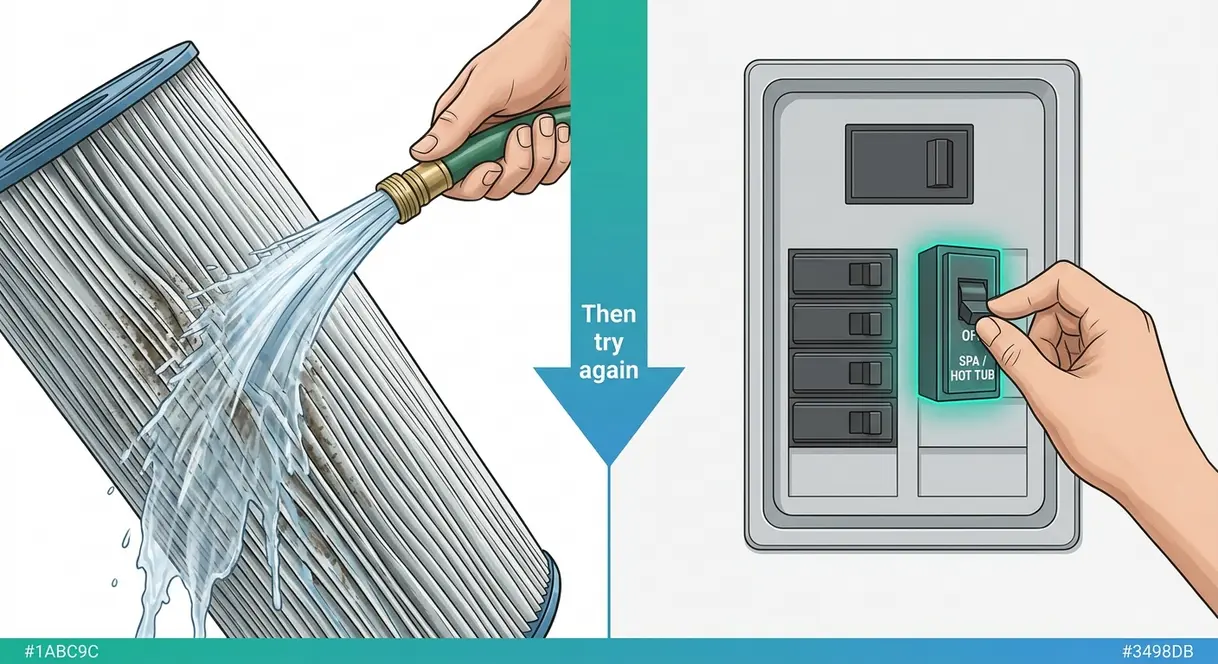
Most of the time, the Temp + Lights method resolves EC mode immediately. But if your display keeps returning to EC — or if EC appeared suddenly after normal use — a few underlying causes are worth checking. Based on owner reports across hot tub forums and verified against Balboa documentation, these are the most common culprits.
Step 1: Check Your Filters and Water Level
A dirty or clogged filter is one of the most common reasons EC mode persists or returns unexpectedly. When flow is restricted, some control systems default back to a conservative heating mode to protect the heater element.
- Remove and inspect your filter cartridge. If it’s visibly dirty or hasn’t been cleaned in 30+ days, rinse it thoroughly with a garden hose.
- Check your water level. The water should sit at mid-skimmer level — roughly 1 inch below the top of the skimmer opening. Low water level reduces flow and can trigger protective mode behavior.
- After cleaning or topping off water, attempt the mode switch again.
For detailed filter maintenance steps, learn more about what EC mode means and its relationship to flow restriction.
Step 2: Power Cycle Your Hot Tub at the Breaker
If the button combination isn’t working and your filter is clean, a full power reset often clears stuck mode settings. According to spa troubleshooting guides from SpaStores, a breaker reset is a reliable first step for persistent display codes.
- Locate your hot tub’s dedicated circuit breaker in your home’s electrical panel. It is typically labeled “Spa,” “Hot Tub,” or “GFCI.”
- Flip the breaker to OFF. Wait a full 60 seconds — this clears the control board’s memory.
- Flip the breaker back to ON. Wait for the control panel to fully restart (30–60 seconds).
- Check the display. If EC appears again, attempt the Temp + Lights mode switch.
⚠️ Safety note: Never open the equipment compartment or touch wiring while power is on. The breaker reset involves only the panel switch — no tools, no internal access.
Understanding Flow Codes (FLO, FLC) and Sensor Errors
If your display shows something other than “Ec” — particularly codes like FLO, FLC, FL1, OH, or SN — you’re dealing with a different category of message entirely. These are genuine fault codes, not operational mode indicators.
- FLO / FLC / FL1: Flow error codes. These indicate insufficient water flow through the heater, often caused by a dirty filter, closed valve, or pump issue. A clogged filter is the first thing to check.
- OH: Overheat. The water temperature has exceeded safe limits. Power cycle and check for blocked circulation.
- SN / HL: Sensor errors. These point to a temperature sensor or high-limit sensor fault — not resolvable with a button press.
Flow codes and sensor errors require different solutions than EC mode. If you’re seeing FLO alongside EC, address the flow restriction first (clean the filter, check water level) before attempting a mode switch.
When to Call a Hot Tub Technician
Most EC mode issues are resolved with the steps above. Call a qualified technician if:
- EC mode returns within minutes of every reset, even after a clean filter and power cycle
- You see sensor error codes (SN, HL) combined with EC
- The heater indicator never activates even after switching to Standard Mode and waiting 60 minutes
- You smell burning or notice any visible damage near the equipment compartment
A certified spa technician can diagnose circuit board malfunctions, failed sensors, and heater element failures that go beyond software-level fixes.
Should You Use Economy Mode? When EC Actually Makes Sense
EC mode isn’t a mistake — it’s a genuinely useful feature in the right circumstances. The issue is simply that most owners don’t choose it intentionally. Here’s when it works in your favor, and when it doesn’t.
Best Times to Use EC Mode
According to the U.S. Department of Energy, heating water accounts for a significant portion of hot tub operating costs — and reducing heater run time during periods of non-use can meaningfully lower your energy bill. EC mode is a practical tool when:
- You’re leaving for vacation (3+ days away): EC prevents the heater from maintaining full temperature around the clock while nobody’s using the spa
- You use your hot tub on a predictable schedule (e.g., only on weekends): Program filter cycles to align with your usage windows
- Your energy rates peak during certain hours: EC mode lets the heater avoid those windows
Why Standard Mode Is Better for Daily Use
For everyday use — evenings after work, weekend soaks, spontaneous use — Standard Mode (ST) is the right setting. It keeps water at your set temperature continuously, so the spa is ready when you are. There’s no 30-minute wait for the heater to catch up from a cold EC cycle.
Standard Mode uses more energy than EC mode, but the trade-off is immediate readiness. For most households using a hot tub 3–5 times per week, that convenience is worth the difference in operating cost.
Winter Warning: Why EC Mode Can Backfire in Cold Weather
This is the most important seasonal consideration. In winter — particularly when ambient temperatures drop below freezing — EC mode carries a real risk. Research from the Pacific Northwest National Laboratory (PNNL) on residential water heating systems confirms that extended off-cycle periods in cold climates allow water temperature to drop significantly, requiring much longer and more energy-intensive recovery periods to reach set temperature.
More critically: if temperatures drop well below freezing during an extended EC off-cycle, pipes and equipment can be at risk of damage. Most modern spas have freeze protection circuits that override EC mode, but older equipment or spas with compromised insulation may not respond reliably.
In winter, the recommendation is: Keep your hot tub in Standard Mode. The energy savings from EC mode are outweighed by the risk of a freeze-related repair — which can cost hundreds to thousands of dollars.
Frequently Asked Questions
What does EC mean on a hot tub?
EC stands for Economy Mode, an energy-saving setting built into most hot tub control systems. In EC mode, the heater only activates during scheduled filter cycles rather than continuously maintaining your set temperature. This is not a fault code or error — it is an operational status indicator. According to Balboa Water Group documentation, EC is intentionally designed this way to reduce standby energy consumption. If you didn’t choose EC mode yourself, it may have been the factory default or set by a previous owner.
How do I get EC off my hot tub?
Press and hold the Temp and Lights buttons simultaneously for 3–5 seconds on most Balboa-equipped control panels. The display will cycle through EC → SL → ST — release the buttons when “ST” (Standard Mode) appears. If your panel doesn’t respond, try a full power cycle at the breaker first, then repeat the button combination. Brand-specific variations exist for Jacuzzi and Dream Maker panels — see the brand-specific section above for exact steps.
Should my eco mode be on or off?
For daily use, eco mode (EC) should be off — Standard Mode (ST) is better when you use your hot tub regularly. EC mode is worth enabling during vacations or multi-day absences when you want to reduce energy costs without fully powering down the spa. In cold climates during winter, keep EC off entirely: the energy savings are not worth the freeze risk during extended off-cycle periods when the heater is not running.
What are hot tub flow codes, and how are they different from EC?
Flow codes — like FLO, FLC, or FL1 — are genuine fault codes, not operational mode indicators like EC. They appear when water circulation through the heater is insufficient, typically due to a dirty filter, low water level, or a pump issue. Unlike EC (which you can clear with a button press), flow codes require you to address the underlying restriction — usually by cleaning the filter or topping off the water level — before the code will clear. If you see FLO and EC at the same time, fix the flow issue first.
Closing Thoughts
For anxious new hot tub owners, the EC error on a hot tub is almost always the least serious thing it could be — a reversible setting, not a broken heater. Across owner communities and verified against Balboa Water Group’s official documentation, switching from Economy Mode to Standard Mode resolves cold water complaints in the vast majority of cases, with no technician, no parts, and no cost.
The EC Anxiety Gap is real: the flashing code looks alarming, the cold water feels like proof of damage, and the instinct to call for help is completely understandable. But the fix is a button combination that takes 90 seconds. That gap between fear and reality is exactly what this guide is designed to close.
Start with the Temp + Lights method. If EC returns, clean your filter and power-cycle at the breaker. If it still won’t clear after those steps, that’s the right time to call a certified spa technician — but for most owners reading this, you’ll never need to get that far.