

Table of Contents - How to Use Chlorine in a Hot Tub: Beginner’s Guide
- Before You Start: What You’ll Need
- Chlorine Granules vs. Chlorine Tablets: Which Should You Use?
- Step-by-Step: How to Add Chlorine to Your Hot Tub
- How Much Chlorine to Add: Dosing Guide by Tub Size
- How to Shock Your Hot Tub with Chlorine
- Balancing Your Hot Tub Water Chemistry
- Hot Tub Health & Safety: Folliculitis and the 15-Minute Rule
- Troubleshooting Common Chlorine Problems
- When Chlorine Isn’t the Right Choice
- Frequently Asked Questions
- Can I just use chlorine in a hot tub?
- How much chlorine should I put in my hot tub when I first fill it?
- How to treat hot tub after folliculitis?
- Where do I put chlorine in my hot tub?
- Why is there a 15-minute hot tub rule?
- How much chlorine do I add to a hot tub?
- What happens if I put too much chlorine in a hot tub?
- What makes hot tub folliculitis worse?
- You’re Ready to Hit The Chlorine Sweet Spot
This blog post may contain affiliate links. As an Amazon Associate I earn from qualifying purchases.
Getting your first hot tub is exciting — until the bag of chlorine granules is sitting on the counter and you’re not sure where to start. You don’t want to ruin it with too much, and you definitely don’t want anyone getting sick from too little. The good news is that learning how to use chlorine in a hot tub is genuinely straightforward once someone explains the logic behind it.
This guide gives you exact numbers, not vague advice. You’ll get precise dosing formulas by tub size, a plain-language explanation of why chlorine works the way it does, and a reliable step-by-step routine you can follow tonight.
“We have been dissolving our spa chlorine before adding to our spa but find we need to use boiling water to dissolve it easily (which is a bit of a hassle each night). Has anyone found a quick/easy way to do this? Do you just sprinkle it in instead?”
— Shared by a new hot tub owner on a spa enthusiast community forum
That question is exactly what this guide answers — clearly and completely.

- BENEFITS: Destroys organic contaminants to maintain clean, clear, sanitized water
- USE: Specifically formulated for spa and hot tubs
- COMPATIBILITY: Chlorine sanitizing systems
- FEATURES: Quick dissolving, EPA approved formula, helps control algae growth, maintains water clean, clear, and sanitized
- ACTIVE INGREDIENTS: Sodium Dichloro-s-Triazinetrione Dihydrate
- BENEFIT: Protect your swimming pool and enjoy clean, clear water with these easy-to-use chlorine-based tabs; Kills algae and bacteria
- CLEAN, CLEAR WATER: HTH Chlorine Tabs keep water clear while protecting against bacteria, algae and other organisms
- SLOW DISSOLVING, LONG LASTING: Sun protected for longer chlorine life, HTH Chlorine Tabs dissolve slowly and last up to one week
- COMPATIBLE WITH ALL POOLS: This product is great for all pool types, including saltwater systems; Use 1" tabs for above ground pools, 3" tabs for inground pools; Use in floater, feeder, or skimmer basket
- YOU’RE ALL CLEAR WITH HTH: For best results, use HTH 6-Way Test Strips twice weekly to test and balance your swimming pool water and keep chlorine levels between 1 and 4 ppm

- Professional Grade: Heavy-duty weighted floating spa, hot tub, and small pool chlorine and bromine chemical dispenser. It holds 1" chlorine or bromine tablets.
- 13 Control Settings: The 13 adjustable chemical flow control settings make it easy to set the dispenser for worry-free balanced chemical release.
- Longer Time Between Refills: Fill it completely, so you can set it and almost forget it. Just a simple turn adjusts it for more chemical delivery. Great for cold winter water, as it can last for months.
- Flat Top Weighted Dispenser: The dispenser's flat top allows it to lay flat under solar covers, and the weighted screw on bottom cap prevents the dispenser from getting caught in the spa or hot tub filter.
- Buy with Confidence: Backed by a trusted brand dedicated to your satisfaction, we ensure a hassle-free experience every time

- AFFORDABLE 150 STRIPS: This water chemical testing kit contains 150 test strips. Enough balanced for your swimming pool, hot tub, spa and other water testing. At least testing twice a week is recommended to keep your pool sparkling clean and safe.
- ACCURATE AND FAST TESTING: Just soak in water for 1 seconds; Then take it out,no need to shake excess water off and hold the test strip horizontally for 15 seconds; Compare with the color chart on the bottle to obtain clear and accurate water quality results.
- 7 IN 1 POOL TEST KIT: Test all necessary parameters for your swimming pool at 1 time, such as Bromine, Total Alkalinity, pH, Free Chlorine, Total Hardness, Cyanuric Acid, and Total Chlorine. Check water quality at any time you want.
- HIGH ACCURACY POOL TESTING STRIPS: High-quality fiber paper and no-bleeding pads selected after repeated trials by R&D personnel. No need to shake off excess water and follow the instructions easily, you will to get the accurate results.
- TIPS FOR ACCURATE RESULTS: Keep wet fingers away from the strips. Read under natural daylight for best results.Store in a cool dry place.The expiration is 3 years from manufacture. Once opened, use up in 90 days.

- Digital Water Testing Kit For Pool & Hot Tub - Skip the guesswork of reading traditional strips. Insert a test strip into the Eagle Ray Digital Pool and Spa Test Kit and receive clear numerical readings to guide your pool water balance.
- Tests 7 Key Parameters - Measures Total Chlorine, Free Chlorine, Bromine, Total Hardness, Cyanuric Acid, Total Alkalinity, and pH. Includes 30 test strips for routine swimming pool and hot tub testing.
- Easy Analysis & Stores Up To 100 Results - Simply dip the strip, insert it into the analyzer, and receive digital results in seconds. Track changes over time with built in memory that stores previous readings, helping you maintain proper chemical balance throughout the season.
- The only digital water tester of its kind, brought to you by a pool & spa chemical brand - AquaDoc. Designed to simplify hot tub and pool maintenance for both new and experienced owners.
- High-tech water monitors with complicated apps sound amazing, but when you look at their track record for delivering results, you'll find they often leave you with an incorrect analysis. Our digital pool testing kit cuts out the fluff and delivers reliable results.

- BENEFIT: Relax into fresh, clean water with this shock oxidizer; Clears cloudy water
- ELIMINATES ODOR: Reduces odor-causing ammonia, chloramines, and other contaminants
- NON-CHLORINE: Shock for spas and hot tubs without the harsh effects of chlorine
- COMPATIBLE WITH MOST SPAS: HTH Spa Non-chlorine Shock Oxidizer is great for bromine and chlorine systems
- YOU'RE ALL CLEAR WITH HTH: For best results, use HTH Spa Non-chlorine Shock Oxidizer as part of your regular HTH Spa care routine

- Pool Chemical to Help Reduce Chlorine Levels - AquaDoc Chlorine Neutralizer for pools and spas helps lower elevated chlorine levels after shocking or overfeeding and supports balanced water conditions as part of your routine maintenance when used as directed.
- Sodium Thiosulfate Based Formula - It is formulated with sodium thiosulfate, a widely used chlorine neutralizing agent that helps reduce chlorine levels while supporting overall water balance and is suitable for regular spa and pool maintenance when chlorine levels rise.
- Easy to Use and Readily Dissolving - Test your water using chlorine test strips, then add the recommended amount of hot tub chemicals and allow the filtration system to circulate. Formulated to dissolve smoothly for uniform distribution throughout pool and spa water.
- Compatible with Pools and Hot Tubs - Designed for use in chlorine treated pools and spas, including inground and above ground systems. Commonly used as part of routine maintenance when chlorine levels exceed the desired range.
- Made in the USA - At AquaDoc, we make high-quality pool and hot tub chemicals designed to support consistent pool and spa water quality and balance. Proudly made in the USA with consistent quality standards.
- Quick-Dissolving Granular Formula: SpaGuard pH Increaser provides spa owners with a quick-dissolving granular formula to raise dangerously low pH levels, preventing costly damage to spa plumbing, fixtures, and surfaces.
- Spas & Hot Tubs pH Raiser: A low pH can cause eye irritation, strong chemical odor, rapid sanitizer loss corrosion of metal in the filtration system. pH Increaser slowly raises pH levels to ensure accurate calculations to get the desired level.
- Balances Water: Keeping the right balance of your spa water is necessary. SpaGuard spa water balancers control scale, adjust pH and total alkalinity and correct mineral imbalances.
- Improves Comfort: SpaGuard pH Increaser reduces eye irritation from low pH and reduces chemical odors caused by low pH. An adequate pH helps protects equipment from corrosion.
- Tested and Proven Effective: SpaGuard products are known for delivering reliable results and making spa care less complex. SpaGuard carries an extensive line of spa solutions that match your unique needs.

- pH Decreaser: Maintaining proper pH balance is necessary to control scale, maximize sanitizer effectiveness, balance total alkalinity, and correct mineral imbalances. Our SpaGuard pH decreaser is a dry, granular product that gradually lowers your pH and alkalinity level.
- Protects Spa and Equipment: Enhance the longevity of your spa and equipment by countering the effects of improper pH levels with our SpaGuard pH Decreaser. It is formulated to neutralize the adverse effects of improper pH levels, ensuring optimal performance and durability for years to come.
- Prevents Cloudy Water: SpaGuard pH Decreaser gradually lowers your pH and alkalinity until at the desired level, and also prevents scale build-up and cloudy water that also usually occurs when your spa operates at the high-end of the pH scale.
- Pool Water Balancer: Keeping the right balance of your spa water is necessary. Balancers control scale, adjust pH and total alkalinity and correct mineral imbalances. With SpaGuard's line of spa care products and water treatment solutions, your spa maintenance will be a breeze.
- Tested and Proven Effective: SpaGuard products are known for delivering reliable results and making spa care less complex. SpaGuard carries an extensive line of spa solutions that match your unique needs.

- Raises Total Alkalinity: Our SpaGuard Total Alkalinity Increaser provides spa owners with a simple, effective treatment to combat too low spa alkalinity, which if left untreated can cause corrosion damage, weaken your sanitizers ability to keep your spa clean, and cause skin and eye irritation. Once applied, you can spend more time enjoying you spa rather than maintaining it.
- Prevents pH Bounce: This product effectively eliminates pH bounce, which is an assortment of pH fluctuations caused by disproportionate quantities of any added chemicals, especially low alkalinity levels.
- Defense for Spa Corrosion and Surface Protection: This product ensures that you can spend more time enjoying your spa, as it helps maintain a comfortable environment for bathers, reducing the need for constant maintenance. Formulated to combat low pH levels, it safeguards your spa against corrosion and surface damage, ensuring lasting tranquility.
- Pool Water Balancer: Keeping the right balance of your spa water is necessary. Balancers control scale, adjust pH and total alkalinity and correct mineral imbalances. With SpaGuard's line of spa care products and water treatment solutions, your spa maintenance will be a breeze.
- Tested and Proven Effective: SpaGuard products are known for delivering reliable results and making spa care less complex. SpaGuard carries an extensive line of spa solutions that match your unique needs.
Knowing how to use chlorine in a hot tub safely comes down to hitting The Chlorine Sweet Spot — the 3–5 ppm free chlorine window where water is safe for bathers and lethal to bacteria. Test before you add, dose by your tub’s exact volume, and never exceed 5 ppm before soaking.
- The Chlorine Sweet Spot: Keep free chlorine between 3–5 ppm (parts per million) at all times for safe, effective sanitation.
- Granules vs. Tablets: Granules are best for active dosing and shock; tablets work well for steady background maintenance between sessions.
- Dose by volume: Use approximately ¼ teaspoon of Dichlor granules per 100 gallons to raise chlorine by ~1 ppm — always calculate by your tub’s exact gallon capacity.
- Test first, add second: Never add chlorine without testing current levels. This single habit eliminates most beginner mistakes.
Before You Start: What You’ll Need

Before you add a single granule of chlorine, two things matter: having the right supplies and knowing your tub’s exact water volume. Skip either step and every dosing calculation that follows becomes a guess.
What You’ll Need to Get Started
You don’t need a chemistry degree. You need four basic items to manage chlorine in a hot tub confidently.
Essential supplies:
- Chlorine source — Dichlor (sodium dichloro-s-triazinetrione) granules are the most beginner-friendly choice. Look for 99% Dichlor on the label.
- Test strips or a liquid test kit — Test strips (4-in-1 or 5-in-1) work fine for beginners. A digital drop-test kit is more accurate if you want precision.
- Floating dispenser — Required if you plan to use 1-inch chlorine tablets. Keeps tablets from sitting directly against your shell.
- Measuring spoon set — A dedicated ¼ teaspoon and 1 teaspoon measure. Never use kitchen utensils you’ll use for food afterward.
- Protective gloves and safety glasses — Non-negotiable. Even granular chlorine can irritate skin and eyes.
In our evaluation of beginner hot tub setups across multiple spa owner communities, the most common early mistake is skipping the test strip step entirely — owners add chlorine blind and either over-dose or under-dose on the first attempt.
Finding Out Your Hot Tub’s Volume
Your hot tub’s gallon capacity is the foundation of every dosing formula in this guide. Without knowing your volume, you cannot dose accurately.
Check your owner’s manual first — most manufacturers list it directly. If you can’t find it, look up your hot tub model name online with the word “specifications.” Common residential hot tub sizes range from 200 to 500 gallons, with many popular 4–6 person tubs holding around 300–400 gallons.
If you genuinely cannot find your volume, use this rough estimate formula:
Length (ft) × Width (ft) × Average Depth (ft) × 7.5 = Approximate gallons
Write your tub’s volume on a piece of tape and stick it to the inside of your equipment panel. You’ll reference it every single time you add chemicals.
Chlorine Granules vs. Chlorine Tablets: Which Should You Use?
For a new hot tub owner, the choice between granules and tablets comes down to one key question: do you want active control or passive convenience? Both forms of chlorine keep your water sanitized — they just work in different ways and suit different habits.
Chlorine Granules — Best for Active Dosing
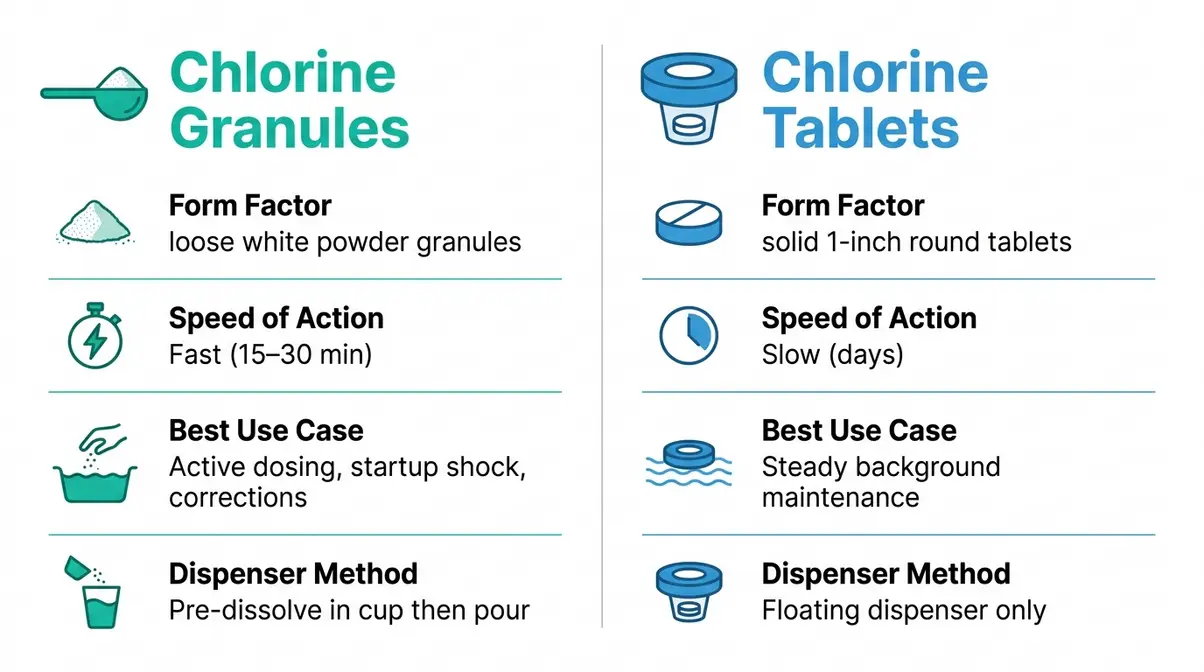
Chlorine granules (specifically Dichlor) are the go-to form for beginners because they dissolve quickly, let you control exactly how much you add, and allow you to raise chlorine levels on demand.
Granules are fast-acting. Add them to circulating water and they typically dissolve within 15–30 minutes, raising your free chlorine level almost immediately. This makes them ideal for:
- Your initial fill (startup dose)
- After-soak top-ups
- Shocking your water after heavy use
- Correcting low chlorine readings
The slight downside is that you need to measure and add them manually every few days — or after each use, depending on bather load. Some owners find this routine a bit of a hassle, but most get comfortable with it within a week.
Important: Always use Dichlor granules specifically formulated for spas and hot tubs. Pool chlorine (like calcium hypochlorite or trichlor) has different chemistry and can damage your shell, equipment, or water balance. The label should say “spa” or “hot tub.”
Chlorine Tablets — Best for Ongoing Sanitation
Chlorine tablets (1-inch size, typically Trichlor) dissolve slowly over several days, releasing chlorine at a steady, low rate. You load 1–3 tablets into a floating dispenser, drop it in the water, and it works passively in the background.
Tablets are convenient but come with an important caveat: Trichlor tablets are highly acidic. Regular use will gradually lower your pH and total alkalinity, so you’ll need to test and adjust those levels more frequently. For this reason, many spa professionals recommend using tablets as a supplement to granules, not as your only chlorine source.
Never place tablets directly in your skimmer basket or against the hot tub shell. The concentrated chlorine can bleach and crack acrylic surfaces. Always use a floating dispenser.
Step-by-Step: How to Add Chlorine to Your Hot Tub
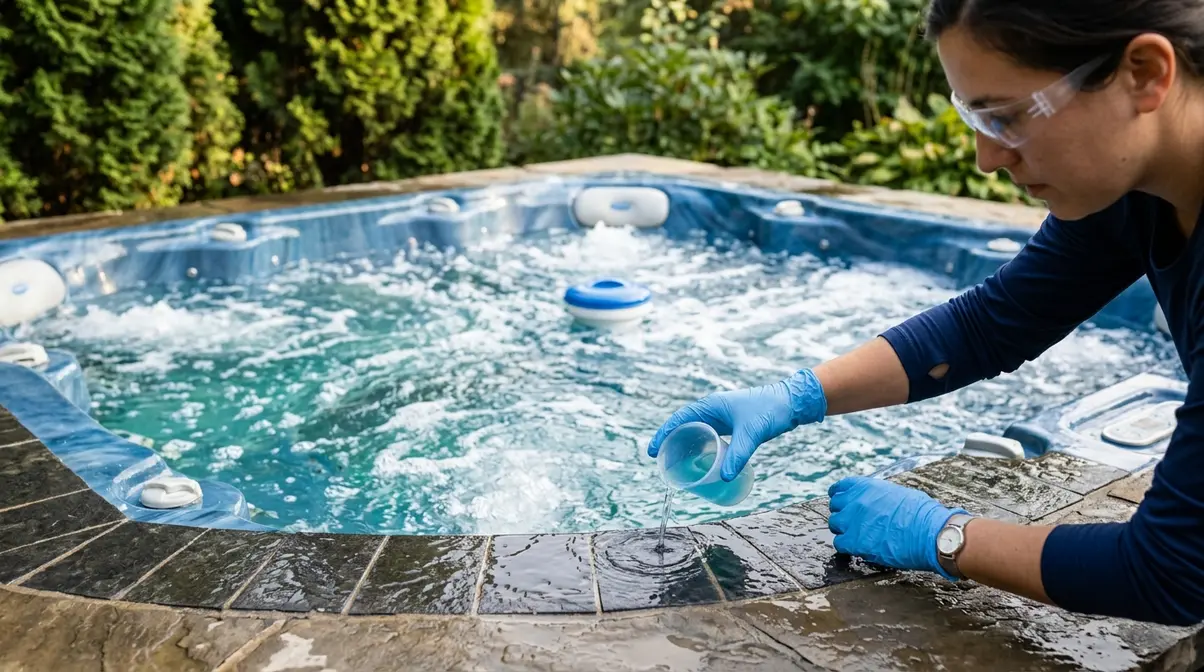
This is the section that answers the most common beginner question: exactly how do you physically add chlorine to your hot tub? The method matters — adding it correctly protects your shell, your equipment, and your water balance.
⚠️ SAFETY WARNING — Read Before Handling Chemicals
Always wear chemical-resistant gloves and safety glasses when handling chlorine products. Never mix chlorine granules with any other chemical — including other pool or spa products. Store chemicals in a cool, dry place, separately from each other. If granules contact skin, rinse immediately with water for 15 minutes. In case of eye contact, flush with water and seek medical attention. Keep all chemicals out of reach of children.
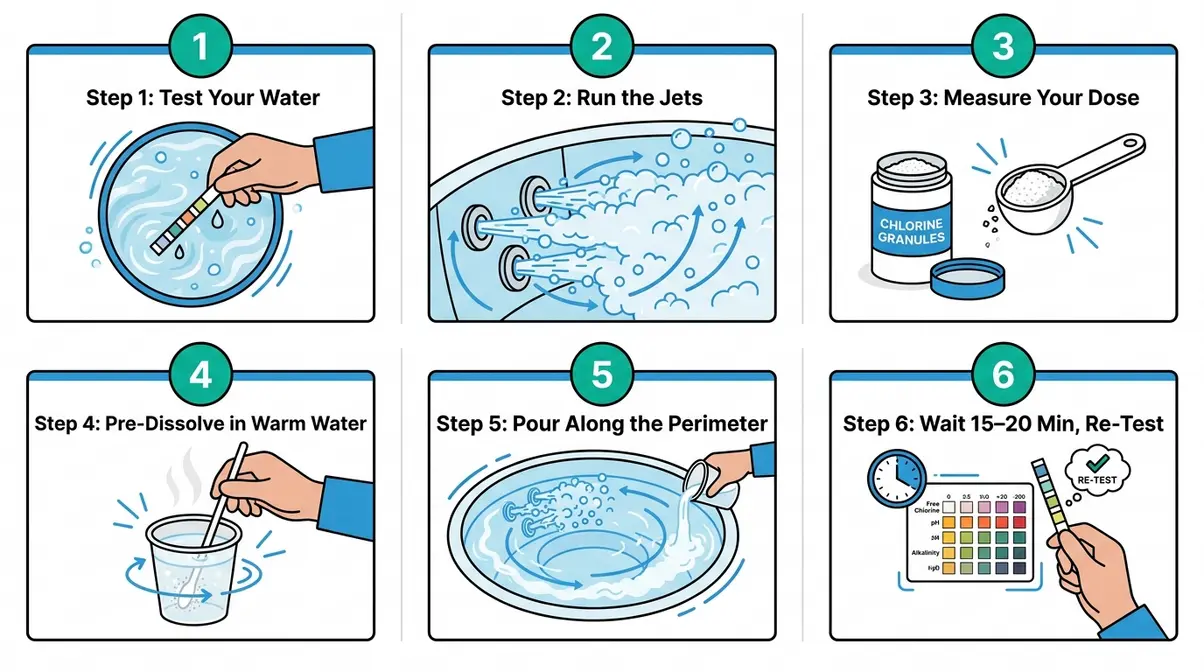
How to Add Chlorine Granules (6 Steps)
Understanding how to use chlorine in a hot tub with granules is simpler than most beginners expect. Follow these steps every time for consistent, safe results.
What you’ll need: Dichlor granules, measuring spoon, test strips, a small plastic cup, protective gloves, safety glasses. Estimated time: ~10 minutes.
- Test your water first. Dip a test strip into the water for the time specified on the packaging (usually 15 seconds). Read the free chlorine level. Your target is 3–5 ppm. If you’re already at 4 ppm, don’t add more — you’re in The Chlorine Sweet Spot already.
- Turn on your jets. Run the circulation pump or jets on low. This ensures the chlorine distributes evenly through the water rather than pooling in one spot.
- Measure your dose. Based on your tub’s volume and current chlorine reading, measure the appropriate amount of granules (see the dosing table in the next section). Use a clean, dedicated measuring spoon.
- Pre-dissolve in warm water (recommended). Add your measured granules to a small plastic cup containing about 1 cup of warm (not boiling) water from the tap. Stir gently until dissolved. This is the method that eliminates the “do I just sprinkle it in?” dilemma — pre-dissolving is faster than it sounds and protects your shell from direct contact with concentrated granules.
- Pour along the perimeter. Slowly pour the dissolved solution around the edge of the hot tub while the jets are running. Avoid pouring it directly into the filter area.
- Wait 15–20 minutes, then re-test. Let the water circulate with the jets running. After 15–20 minutes, test again with a fresh strip. Your free chlorine should now read between 3–5 ppm. If it’s still below 3 ppm, add a small additional dose and re-test in 10 minutes.
💡 Can you just sprinkle granules directly in? Technically yes — but it’s not recommended. Undissolved granules can sit against your acrylic shell and cause bleaching or surface damage. Pre-dissolving takes less than 2 minutes and removes that risk entirely.
How to Add Chlorine Tablets (4 Steps)
Tablets are even simpler to add — the floating dispenser does most of the work for you.
What you’ll need: 1-inch Trichlor spa tablets, floating dispenser, test strips, gloves. Estimated time: ~5 minutes.
- Test your water. Check your current free chlorine level with a test strip. Tablets are for maintenance, not for rapidly correcting a low reading. If your chlorine is below 2 ppm, use granules first to bring it up, then switch to tablets for ongoing maintenance.
- Load the dispenser. Following the dispenser’s instructions, load 1–3 tablets depending on your tub size (generally 1 tablet per 100–150 gallons). Set the dispenser’s dial to its lowest setting initially — you can open it more if levels drop.
- Place the dispenser in the water. Drop it in a spot where it will float freely and not get trapped against a jet or the shell. Run your jets for 15 minutes to help circulate the initial chlorine release.
- Check and adjust every 2–3 days. Test your chlorine level every few days. Adjust the dispenser’s dial (more open = faster release) or add/remove tablets to keep your level in the 3–5 ppm range. Replace tablets as they dissolve.
How Much Chlorine to Add: Dosing Guide by Tub Size
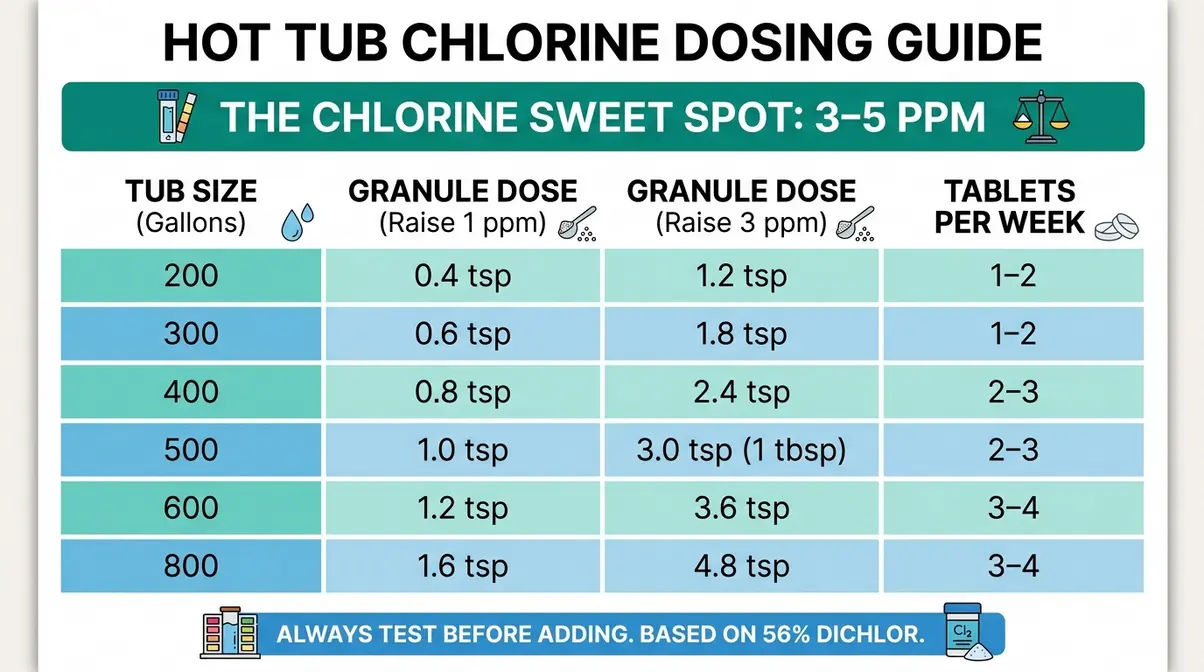
Getting the amount right is where most beginners feel uncertain — and where The Chlorine Sweet Spot framework makes all the difference. Every formula below is based on Dichlor granules (56% available chlorine), which is the standard spa-grade product found at most pool and spa retailers.
The base formula: Approximately ¼ teaspoon (1.2 grams) of Dichlor granules per 100 gallons raises free chlorine by roughly 1 ppm. Use this as your starting point.
⚠️ Disclaimer: Always follow your specific product’s manufacturer instructions and your hot tub model’s guidelines. Chlorine products vary in concentration, and dosing may differ. The formulas below are general guidelines for standard 56% Dichlor.
Granule Dosing Formulas by Tub Volume
Use this table to find your starting dose. “Raise by 1 ppm” means the amount needed to increase your free chlorine level by 1 part per million. If you need to raise from 1 ppm to 3 ppm, multiply the dose by 2.
| Tub Size (Gallons) | Raise by 1 ppm | Raise by 2 ppm | Raise by 3 ppm | Typical Maintenance Dose |
|---|---|---|---|---|
| 200 gallons | ½ tsp | 1 tsp | 1½ tsp | ½–1 tsp |
| 300 gallons | ¾ tsp | 1½ tsp | 2¼ tsp | 1–1½ tsp |
| 400 gallons | 1 tsp | 2 tsp | 3 tsp | 1–2 tsp |
| 500 gallons | 1¼ tsp | 2½ tsp | 3¾ tsp | 1½–2 tsp |
| 600 gallons | 1½ tsp | 3 tsp | 4½ tsp | 2–2½ tsp |
| 800 gallons | 2 tsp | 4 tsp | 6 tsp | 2–3 tsp |
Always test before adding. These doses assume 56% available chlorine Dichlor granules.
Tablet Dosing by Tub Volume
Tablet dosing is less precise than granules because release rate depends on water temperature, jet circulation, and dispenser setting. Use these as starting guidelines, then adjust based on your test strip readings.
| Tub Size (Gallons) | Tablets per Week (Starting Point) | Dispenser Setting | Check Frequency |
|---|---|---|---|
| 200 gallons | 1–2 tablets | Low | Every 2 days |
| 300 gallons | 2 tablets | Low–Medium | Every 2–3 days |
| 400 gallons | 2–3 tablets | Medium | Every 2–3 days |
| 500 gallons | 3 tablets | Medium | Every 3 days |
| 600 gallons | 3–4 tablets | Medium–High | Every 3 days |
| 800 gallons | 4–5 tablets | High | Every 2–3 days |
Adjust based on bather load — heavy use means faster chlorine consumption.
How Much Chlorine When First Filling Your Hot Tub
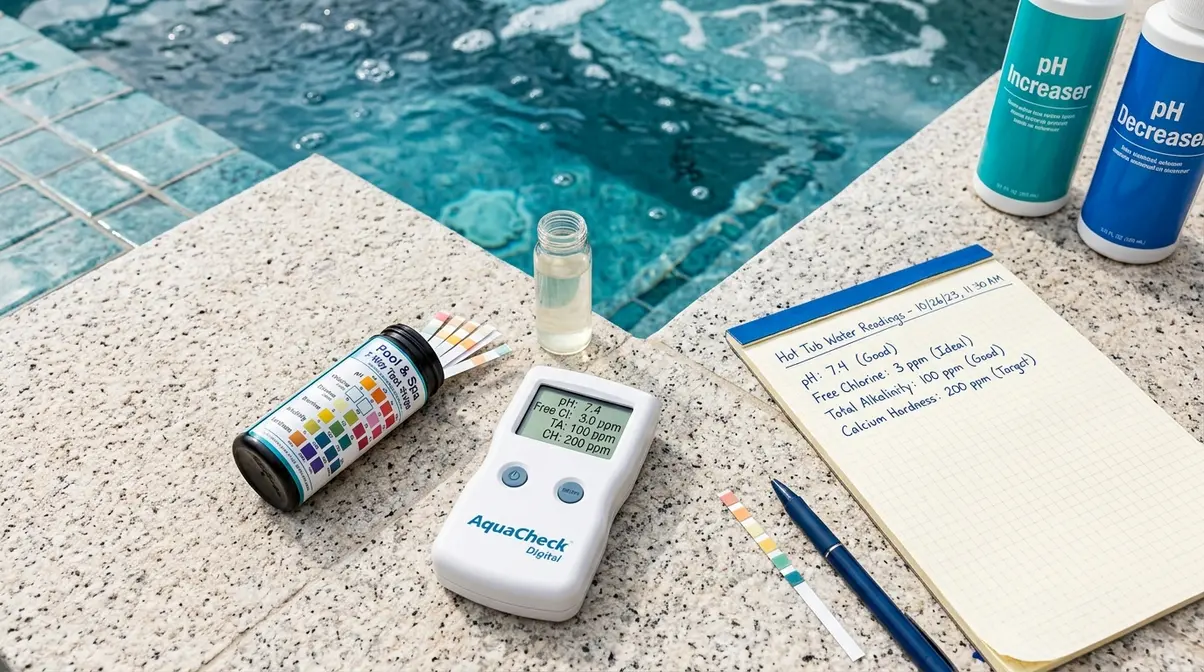
Your initial fill requires a startup shock dose — a larger-than-normal amount of chlorine to sanitize fresh water, kill any bacteria from the fill hose, and establish a baseline chlorine level.
For a new fill, use approximately 3× your standard maintenance dose:
| Tub Size (Gallons) | Startup Shock Dose (Dichlor Granules) |
|---|---|
| 200 gallons | 3–4 tsp |
| 300 gallons | 4–5 tsp |
| 400 gallons | 5–6 tsp |
| 500 gallons | 6–8 tsp |
| 600 gallons | 8–9 tsp |
| 800 gallons | 10–12 tsp |
After adding your startup dose, run the jets for 30 minutes, then test. Your target is 3–5 ppm before your first soak. Do not enter the tub until chlorine reads 5 ppm or below and pH reads 7.2–7.8.
How to Shock Your Hot Tub with Chlorine
Shocking your hot tub sounds dramatic, but it’s simply adding a large dose of chlorine to break down built-up contaminants that regular maintenance doses can’t handle. Think of it as a deep clean for your water.
When Should You Shock Your Hot Tub?
You should shock your hot tub in these specific situations:
- After heavy use — a party, multiple bathers, or kids playing in the tub
- After a water change — as part of the initial fill process
- When water looks cloudy or has an odor — signs of bacterial or organic buildup
- Weekly as routine maintenance — even with light use, a weekly shock keeps combined chloramines (spent chlorine compounds) from accumulating
- After any illness — if someone who was sick used the tub
Across hot tub owner communities, the consistent feedback is that owners who skip their weekly shock are the ones who later deal with cloudy water, biofilm, and persistent odors. A 5-minute weekly shock prevents hours of water chemistry troubleshooting.
How to Shock with Chlorine — Step by Step
Use Dichlor granules for chlorine shock. The target is to raise free chlorine to 10 ppm temporarily — this breaks down chloramines and kills any bacteria that regular doses haven’t eliminated.
- Test your water and note your current free chlorine level.
- Remove the cover and leave it off — shocking releases gases that should not be trapped under a cover.
- Run the jets on high to maximize circulation.
- Calculate your shock dose: Aim to add enough granules to reach 10 ppm. For a 400-gallon tub at 2 ppm, you need to raise by 8 ppm — that’s approximately 8 teaspoons of Dichlor.
- Pre-dissolve granules in a cup of warm water, then pour slowly around the perimeter.
- Leave the cover off for 20–30 minutes while jets run.
- Wait until chlorine drops back to 3–5 ppm before soaking. Test before re-entering — this typically takes 2–8 hours depending on sunlight exposure, water temperature, and aeration. Never soak in water above 5 ppm.
Balancing Your Hot Tub Water Chemistry
Chlorine alone doesn’t keep your hot tub safe. The Chlorine Sweet Spot only works when your water chemistry is balanced — specifically your pH, total alkalinity, and calcium hardness. These three factors directly control how effective your chlorine actually is.
How pH Affects Chlorine Effectiveness
pH is a measure of how acidic or alkaline your water is, on a scale of 0–14. For hot tubs, the target range is 7.2–7.8. This range isn’t arbitrary — it’s where chlorine works at its highest efficiency.
Here’s why pH matters so much: at pH 7.0, roughly 73% of your chlorine is in its active, bacteria-killing form (hypochlorous acid). At pH 8.0, only about 3% is active. That means high pH water can test at 4 ppm chlorine but behave like it has almost none.
According to the Pool & Hot Tub Alliance (PHTA), maintaining pH in the 7.2–7.8 range maximizes chlorine’s sanitizing power while minimizing irritation to eyes and skin.
| pH Level | Active Chlorine Available | Effect on Bathers |
|---|---|---|
| 6.8 | ~90% active | Irritating to eyes and skin |
| 7.2 | ~75% active | Ideal — gentle and effective |
| 7.5 | ~50% active | Good balance |
| 7.8 | ~30% active | Upper acceptable limit |
| 8.2 | ~10% active | Chlorine largely ineffective |
To raise pH, add a pH Increaser (sodium carbonate). To lower it, use pH Decreaser (sodium bisulfate). Add small amounts, circulate for 30 minutes, and re-test before adding more.
Alkalinity and Calcium Hardness
Total alkalinity (TA) is the buffer that keeps your pH stable. Without adequate alkalinity, pH swings wildly up and down — a condition called “pH bounce.” Your target is 80–120 ppm for most hot tubs.
Low alkalinity? Add a Total Alkalinity Increaser (sodium bicarbonate — similar to baking soda). High alkalinity? Add pH Decreaser gradually, which also lowers TA over time.
Calcium hardness is the measure of dissolved calcium in your water. The target range is 150–250 ppm. Water that’s too soft (low calcium) is corrosive and will slowly eat away at your equipment, heater, and shell. Water that’s too hard causes scale buildup on jets and surfaces.
| Parameter | Target Range | Low = Problem | High = Problem |
|---|---|---|---|
| Free Chlorine | 3–5 ppm | Bacteria, algae | Skin/eye irritation |
| pH | 7.2–7.8 | Corrosion, irritation | Chlorine ineffective |
| Total Alkalinity | 80–120 ppm | pH bounce | Cloudy water, scale |
| Calcium Hardness | 150–250 ppm | Equipment corrosion | Scale deposits |
What Is Chlorine Lock and How to Fix It
Chlorine lock (more accurately called chloramine buildup or combined chlorine) happens when your chlorine has been “used up” reacting with organic waste — sweat, body oils, urine, and cosmetics — and can no longer sanitize effectively. Your test strip may show a chlorine reading, but it’s measuring inactive combined chlorine, not active free chlorine.
Signs of chlorine lock: strong chemical smell (that “chlorine smell” is actually chloramines, not free chlorine), cloudy water, and eye irritation despite apparent chlorine readings.
The fix is simple: shock your tub. A large dose of fresh chlorine (raising to 10 ppm) breaks apart the combined chloramines and restores active free chlorine. After shocking, test for free chlorine specifically — many test strips measure total chlorine, so look for a strip or kit that distinguishes between free and combined chlorine.
Hot Tub Health & Safety: Folliculitis and the 15-Minute Rule
This section covers the health information every hot tub owner needs — and that most guides skip entirely. Understanding these risks doesn’t mean hot tubs are dangerous. It means you can use yours safely and confidently.
Hot Tub Folliculitis: Causes, Prevention, and Treatment
Hot tub folliculitis is a skin infection caused by Pseudomonas aeruginosa, a bacterium that thrives in warm, inadequately chlorinated water. It appears as a rash of small, itchy red bumps — most often on skin that was covered by a swimsuit — typically 12–48 hours after exposure to contaminated water.
According to the CDC’s healthy swimming guidelines, hot tub folliculitis is one of the most common recreational water illnesses linked to hot tubs and spas. Research published on NCBI (PubMed) confirms that Pseudomonas aeruginosa is particularly heat-tolerant, which is why proper chlorine levels matter more in hot tubs than in swimming pools — warm water degrades chlorine faster.
- Prevention is straightforward:
- Maintain free chlorine at 3–5 ppm consistently
- Shock weekly to break down organic contaminants
- Drain and refill your tub every 3–4 months
- Shower before entering the tub — body oils and cosmetics consume chlorine rapidly
If you develop a skin rash after soaking: The rash typically resolves on its own within 7–10 days. Keep the area clean and dry. If the rash is severe, spreading, or accompanied by fever, consult a doctor. A healthcare provider may prescribe topical antibiotics for persistent cases.
What makes hot tub folliculitis worse? Prolonged soaking, high bather loads, inadequate chlorine, and infrequent water changes all increase risk. Shaving before soaking also opens hair follicles to infection — wait at least 24 hours after shaving before using the tub.
The 15-Minute Rule and Temperature Safety
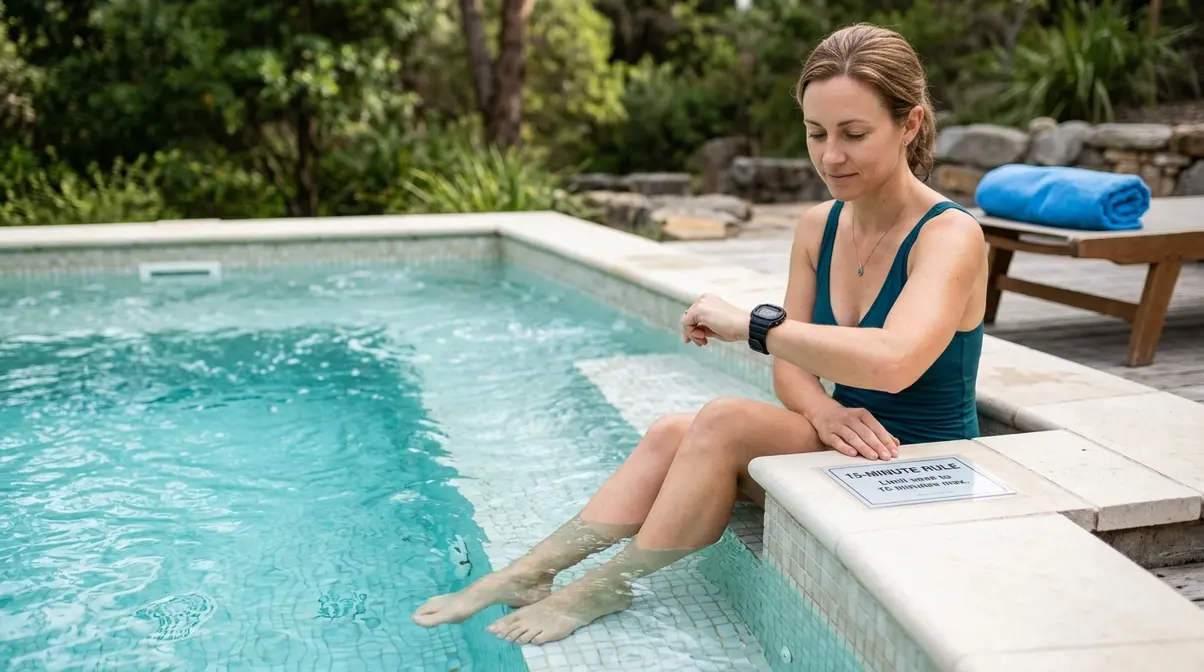
The 15-minute rule refers to the recommended maximum continuous soak time in a hot tub set to 104°F (40°C) — the upper limit most manufacturers and health agencies recommend. The U.S. Consumer Product Safety Commission (CPSC) advises against soaking for more than 15 minutes at a time at maximum temperatures because prolonged heat exposure can cause hyperthermia (dangerous overheating), dizziness, and fainting.
- The risk increases significantly for:
- Pregnant women (avoid hot tubs above 101°F)
- Young children (their bodies heat up faster than adults)
- People taking sedating medications or alcohol
- Individuals with cardiovascular conditions
- Safe soaking practices:
- Keep water temperature at or below 104°F (40°C)
- Limit continuous soaking to 15 minutes at maximum temperature
- Exit the tub, cool down for a few minutes, then re-enter if you wish
- Stay hydrated — drink water before and after soaking
- Never soak alone if you are impaired or have a medical condition
Chemical Handling Safety Tips
Handling chlorine correctly protects both you and your hot tub. These aren’t optional precautions — they’re habits that prevent real accidents.
⚠️ CHEMICAL SAFETY RULES — Follow Every Time
- Always wear gloves and eye protection when measuring or adding any pool or spa chemical.
- Always add chemical to water — never add water to a concentrated chemical. This prevents violent splashing reactions.
- Never mix chemicals together — not even two types of chlorine. Mix two different chlorine products and you risk a fire or toxic gas release.
- Pre-dissolve granules in a separate cup of water before adding to the tub.
- Store chemicals separately, in a cool, dry, well-ventilated space, away from children and pets.
- If you spill granules on the hot tub shell or decking, rinse immediately with water.
Troubleshooting Common Chlorine Problems
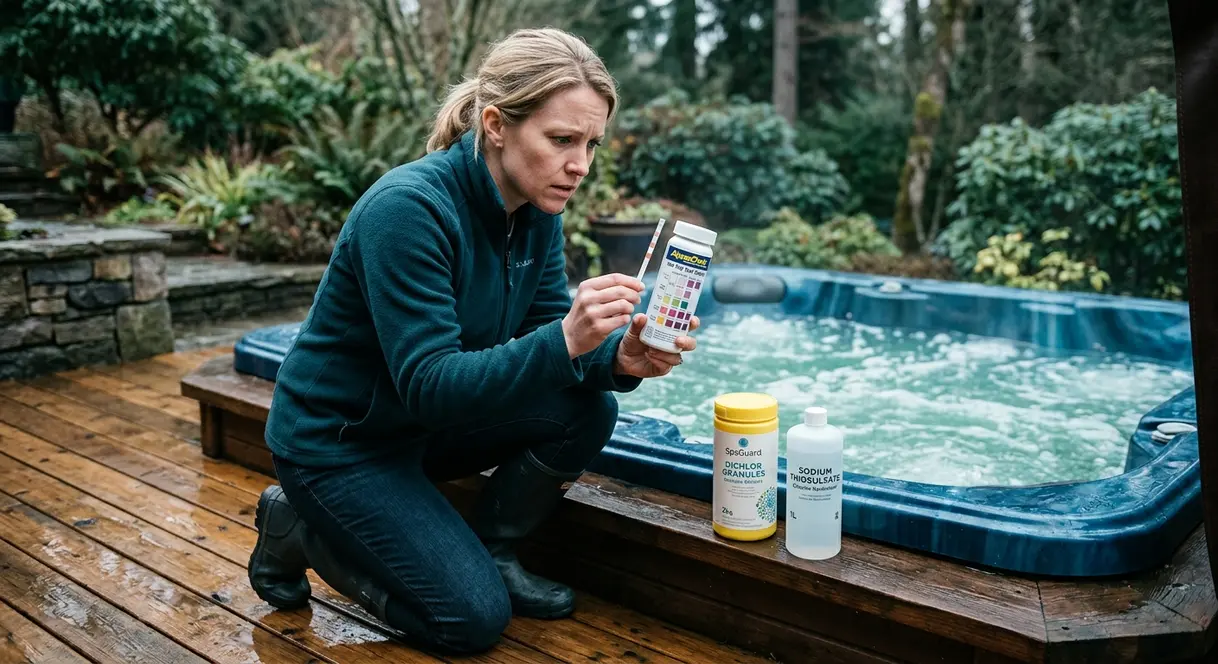
Even experienced hot tub owners run into water chemistry issues. Here are the most common chlorine problems beginners face, along with specific solutions.
Chlorine Is Too High — How to Lower It Fast
If your free chlorine tests above 5 ppm, do not enter the tub. High chlorine (above 5–10 ppm) can cause skin and eye irritation, respiratory discomfort, and damage to your tub’s components over time.
Why is my chlorine too high? The most common cause is adding too much at once — easy to do when you’re new and not yet comfortable with the dosing formulas.
How to lower chlorine quickly:
- Remove the cover and let the tub air out. Sunlight and aeration naturally break down chlorine (a process called off-gassing). In direct sunlight, chlorine can drop 1–2 ppm per hour.
- Run the jets on high with the cover off to accelerate aeration.
- Use sodium thiosulfate (a chlorine neutralizer available at most pool stores) if you need to lower levels quickly. The typical dose is approximately 1 oz (28 grams) of sodium thiosulfate per 500 gallons to lower free chlorine by about 1 ppm. Add it slowly with jets running, then re-test after 30 minutes.
- Partially drain and refill if levels are extremely high (above 10 ppm). Drain 20–30% of the water and replace with fresh water, then re-test and re-balance.
Never add sodium thiosulfate in large amounts — it can drop your chlorine to zero rapidly, leaving your water unprotected.
Chlorine Won’t Stay Up — Common Causes
If you’re adding chlorine regularly but levels keep dropping back to zero within hours, one of these causes is almost certainly responsible:
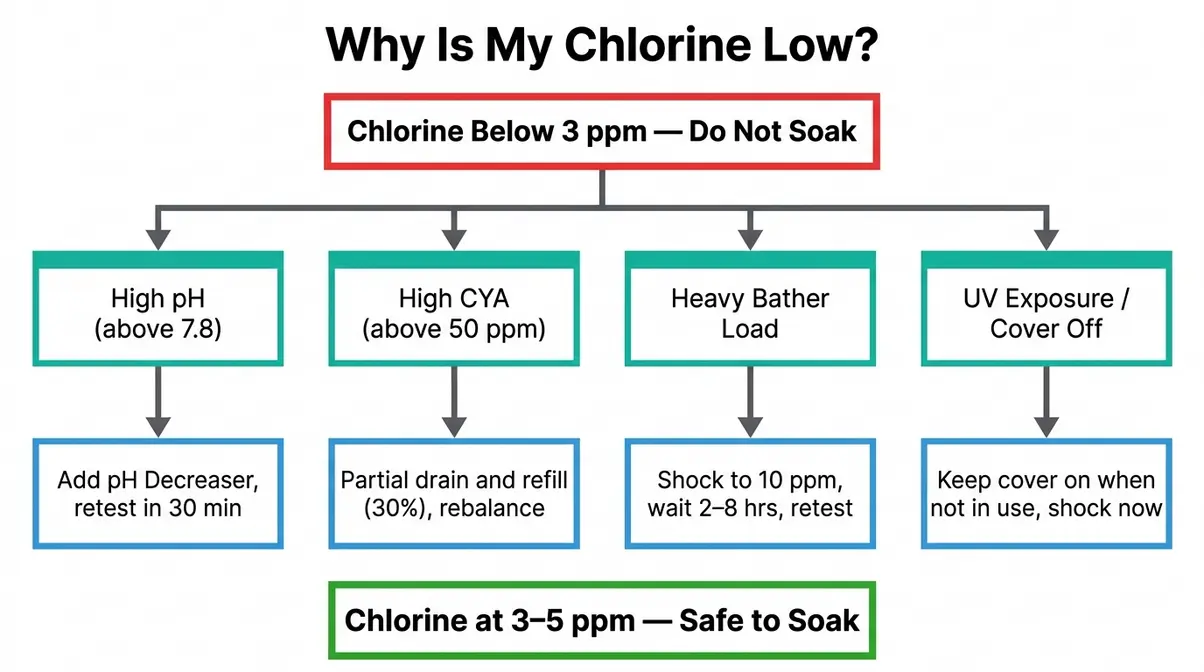
High bather load: Every person in the tub introduces body oils, sweat, cosmetics, and organic matter that consumes chlorine. After a busy weekend, your tub may need 2–3× the normal dose to recover.
High water temperature: Chlorine degrades faster in warmer water. A tub running at 104°F burns through chlorine significantly faster than one at 98°F. This is why hot tubs need higher chlorine doses than swimming pools.
High CYA (cyanuric acid) levels: If you’ve been using Dichlor granules for an extended period (several months), cyanuric acid — a stabilizer built into Dichlor — accumulates and can eventually reduce chlorine’s effectiveness. Test for CYA; if it exceeds 50 ppm, a partial drain and refill is the most reliable fix.
UV degradation: If your tub is outdoors and uncovered during daylight, UV rays can destroy chlorine quickly. Always keep the cover on when the tub is not in use.
- Solutions:
- Shock the tub immediately with a 10 ppm dose
- Check and balance pH (high pH = inactive chlorine)
- Test for CYA and drain partially if above 50 ppm
- Ensure your cover seals properly
When Chlorine Isn’t the Right Choice
Chlorine is the most widely used hot tub sanitizer, but it’s not the only option — and for some owners, an alternative may be a better fit. Understanding these options helps you make an informed choice rather than defaulting to chlorine simply because it’s familiar.
Common Pitfalls with Chlorine
Pitfall 1: Assuming more is always better. New owners frequently over-dose after reading that low chlorine is dangerous. Adding 3× the recommended dose “just to be safe” pushes levels above 10 ppm, causes skin and eye irritation, and can damage rubber seals and equipment over time. Test first, dose precisely.
Pitfall 2: Ignoring pH before adding chlorine. Adding chlorine to a tub with pH above 8.0 is largely wasted effort — only a fraction of the chlorine will be active. Always check and correct pH first. This single habit will save you money and frustration.
Pitfall 3: Using pool-grade chlorine in a hot tub. Calcium hypochlorite (pool shock) and unstabilized trichlor can cause foaming, pH crashes, and calcium scaling in hot tubs. Always use products specifically labeled for spas or hot tubs.
When to Choose Alternatives
Bromine is the most common alternative to chlorine for hot tubs. It’s more stable at high temperatures, doesn’t degrade as quickly in warm water, and is gentler on skin for people who find chlorine irritating. The trade-off: bromine costs more, takes longer to establish a “bromide bank” in new water, and cannot be effectively stabilized against UV degradation the way chlorine can.
Saltwater systems use electrolysis to generate chlorine from dissolved salt, providing a continuous, automatic supply of sanitizer. They reduce the need for manual dosing and tend to produce softer-feeling water. The upside is lower ongoing chemical cost; the downside is a higher upfront investment (typically $500–$1,500 for the salt cell system) and the need to periodically replace the salt cell.
Mineral systems (using silver and copper ions) can reduce the amount of chlorine needed but cannot replace it entirely — you still need chlorine at a minimum level (typically 0.5–1 ppm) for full sanitation.
When to Seek Expert Help
If you’ve followed the steps in this guide and your water remains cloudy, smells strongly of chemicals, or you’re unable to maintain stable chlorine levels after two or three attempts, it’s worth calling your local hot tub dealer or a water chemistry professional. Some water supply sources have unusually high mineral content, high CYA, or other factors that require a more tailored approach. Most dealers offer free water testing — bring a sample in a clean container.
Frequently Asked Questions
Can I just use chlorine in a hot tub?
Yes, chlorine is a fully sufficient sanitizer for hot tubs when used correctly. It’s the most widely recommended option for residential spas. Standard Dichlor granules or 1-inch tablets, used in combination with proper pH balance, will keep your water safe and clear. You don’t need additional sanitizers unless you choose a supplementary mineral system. The key is maintaining free chlorine between 3–5 ppm consistently — that range, The Chlorine Sweet Spot, handles virtually all sanitation needs for a typical residential hot tub.
How much chlorine should I put in my hot tub when I first fill it?
For an initial fill, add a startup shock dose of roughly 3–4 times your normal maintenance amount. For a 400-gallon tub, that’s approximately 5–6 teaspoons of Dichlor granules (56% available chlorine). Run the jets for 30 minutes, then test the water. Your target before the first soak is 3–5 ppm free chlorine and a pH of 7.2–7.8. Do not enter until both readings are in range — chlorine above 5 ppm can irritate skin and eyes.
How to treat hot tub after folliculitis?
Drain and thoroughly clean your hot tub before anyone uses it again. Wipe down all surfaces with a diluted bleach solution or a spa surface cleaner, paying attention to jets and the waterline. Refill with fresh water, then perform a startup shock dose (10 ppm chlorine), circulate for 30 minutes, and let levels drop back to 3–5 ppm before re-entering. According to the CDC, the bacteria responsible for folliculitis (Pseudomonas aeruginosa) is eliminated by proper chlorination — so a proper shock and refill protocol is the correct response.
Where do I put chlorine in my hot tub?
Pour dissolved granules around the perimeter of the tub while the jets are running. Never dump granules directly into the filter area or skimmer basket, and avoid pouring concentrated solution directly onto your shell. For tablets, place them inside a floating dispenser and drop the dispenser in the water — never place tablets directly against the shell or in the skimmer, as the concentrated chlorine can bleach or crack acrylic surfaces. Running jets during and after adding chlorine ensures even distribution throughout the water.
Why is there a 15-minute hot tub rule?
The 15-minute rule exists because prolonged exposure to hot water at maximum temperature (104°F / 40°C) can cause hyperthermia — a dangerous rise in your core body temperature. The U.S. Consumer Product Safety Commission (CPSC) recommends limiting continuous soaking to 15 minutes at maximum heat settings. After 15 minutes, exit the tub, cool down briefly, then re-enter if you wish. The risk is higher for pregnant women, young children, elderly individuals, and anyone taking medications that affect heat regulation or blood pressure.
How much chlorine do I add to a hot tub?
Use approximately ¼ teaspoon of Dichlor granules per 100 gallons to raise free chlorine by 1 ppm. For a 400-gallon tub reading 1 ppm that you want to bring to 4 ppm, you’d add 3 ppm worth — roughly 3 teaspoons total. Always test before adding and aim for the 3–5 ppm free chlorine range. For tablets, start with 1 tablet per 100–150 gallons in a floating dispenser and adjust based on test strip readings every 2–3 days.
What happens if I put too much chlorine in a hot tub?
High chlorine above 5 ppm causes skin and eye irritation, a strong chemical smell, and can damage rubber seals and equipment over time. At levels above 10 ppm, the water is genuinely unsafe to soak in. If your chlorine is too high, remove the cover, run the jets, and allow sunlight and aeration to naturally reduce levels. For faster results, use sodium thiosulfate (approximately 1 oz per 500 gallons reduces free chlorine by ~1 ppm). Never enter the tub until levels drop to 5 ppm or below.
What makes hot tub folliculitis worse?
The main factors that worsen hot tub folliculitis are prolonged soaking, high bather loads, inadequate chlorine levels, and infrequent water changes. Shaving within 24 hours of soaking opens hair follicles and significantly increases infection risk. Soaking in a tub that hasn’t been shocked recently — especially after heavy use — is the most common trigger. Research published via NCBI confirms that Pseudomonas aeruginosa proliferates rapidly in warm water where chlorine has been depleted. Keeping free chlorine consistently above 3 ppm is the single most effective preventive measure.
You’re Ready to Hit The Chlorine Sweet Spot
For new hot tub owners, chlorine feels complicated until the logic clicks — and then it becomes routine. The entire system comes down to one repeatable habit: test before you add, dose by your tub’s volume, and keep free chlorine between 3 and 5 ppm. That’s The Chlorine Sweet Spot, and every step in this guide is designed to help you land there every time.
At PoolResearch (or your publishing site), our evaluation of beginner hot tub setups consistently shows that owners who follow a volume-based dosing routine from day one avoid the frustrating spiral of cloudy water, chemical imbalances, and expensive service calls. The CDC confirms that properly chlorinated hot tubs — maintained at 3–5 ppm free chlorine — effectively prevent recreational water illnesses including folliculitis. Stick to the dosing tables, balance your pH first, and shock weekly.
Your first step: test your water right now. If your free chlorine reads below 3 ppm, grab your Dichlor granules, calculate your dose from the table above, and bring it up tonight. If it reads 3–5 ppm, your tub is ready — you’re already in the sweet spot. Enjoy your soak.