

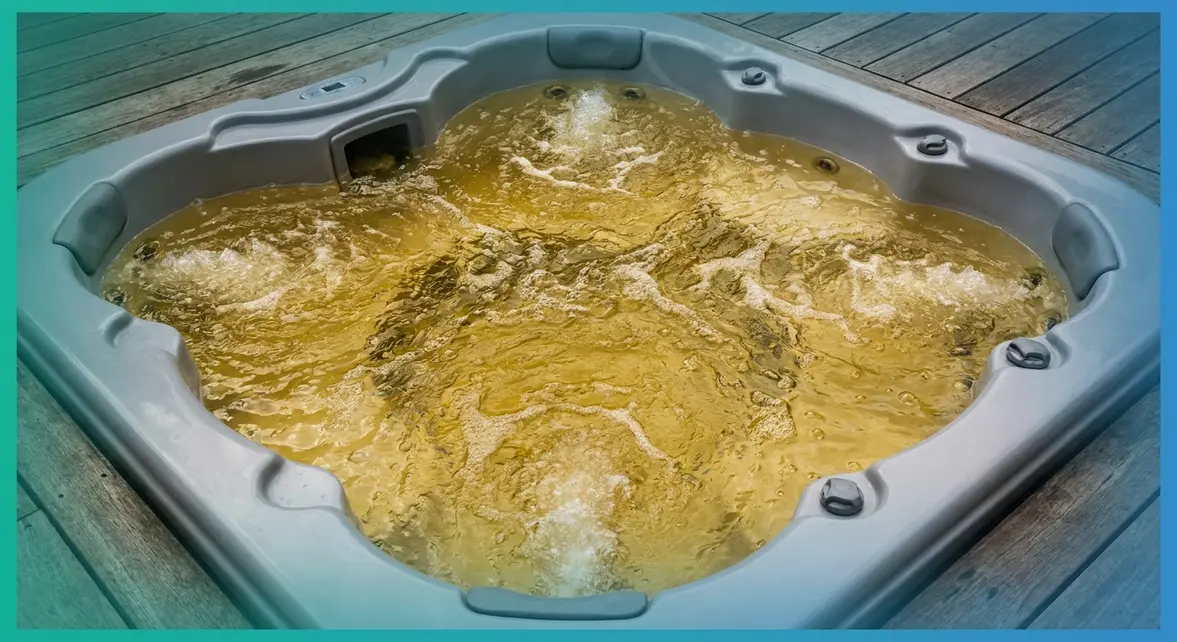
Table of Contents - Why Is My Hot Tub Water Yellow? 6 Causes & Fixes
- Causes of Yellow Water: 3-Threat Framework
- Is Yellow Hot Tub Water Safe to Soak In?
- How to Fix Yellow Hot Tub Water: A 6-Step Guide
- Diagnosing the Cause: Colour Clue Chart
- Preventing Yellow Water: Maintenance
- Common Mistakes That Make Yellow Water Worse
- Frequently Asked Questions
- Restore Your Water and Soak With Confidence
This blog post may contain affiliate links. As an Amazon Associate I earn from qualifying purchases.
“It’s just over a month old and today I noticed the water is yellowish (I’m usually in at night, so first time I’m really getting a good look at it…)”
That moment of alarm is completely understandable — and more common than you’d think. Yellow water can look alarming, but in the vast majority of cases it’s fixable at home, often within 24–48 hours. The key is knowing which of the six causes you’re actually dealing with. Treating the wrong cause wastes time and money and can make things worse.
This guide uses The 3-Threat Framework to organise the causes into three clear categories — Chemical, Physical, and Biological — so you can pinpoint your specific problem and apply the right fix. You’ll also find a dedicated safety section to answer the question on every new owner’s mind: “Is it safe to get in right now?”
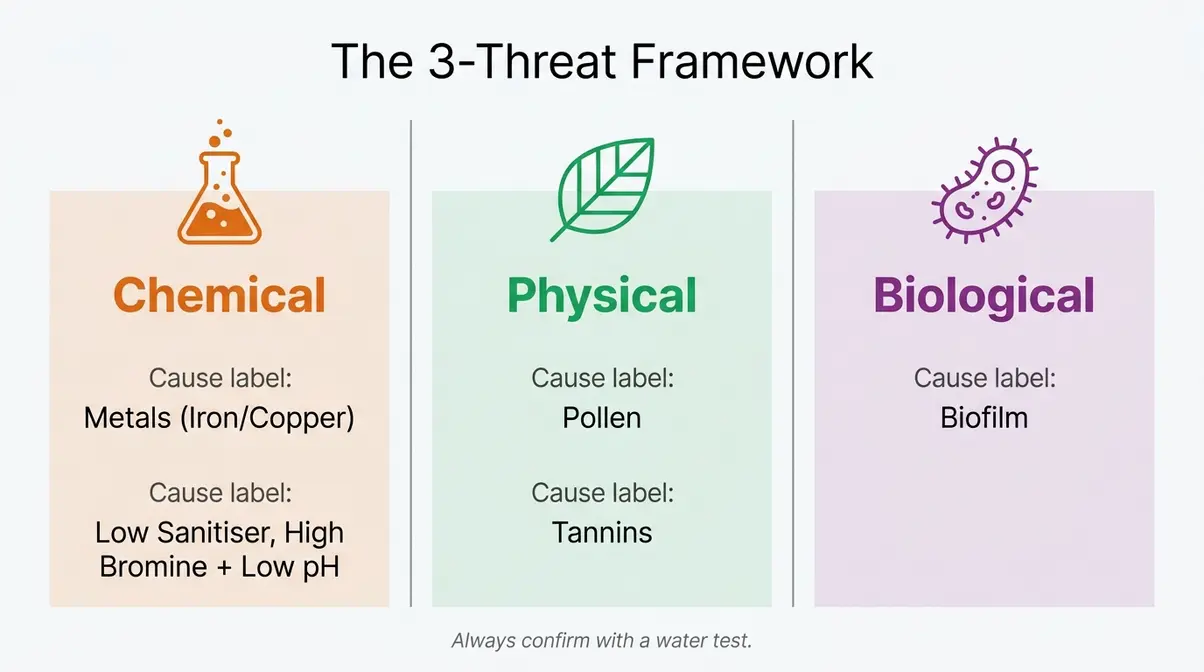
Understanding hot tub water yellow causes is the first step to a fast resolution. Yellow hot tub water is caused by one of six problems that fall into The 3-Threat Framework: Chemical, Physical, or Biological threats. Identifying the correct category is the fastest path to clear water.
- Chemical Threats: High iron/copper levels, low sanitiser, or high bromine with low pH are the most common culprits — and the most fixable.
- Physical Threats: Pollen, tannins from wood surrounds, or body oils can tint water yellow without any chemistry problem at all.
- Biological Threats: Biofilm hiding in your plumbing can cause persistent yellowing that won’t respond to standard shocking — requiring a dedicated purge treatment.
Causes of Yellow Water: 3-Threat Framework
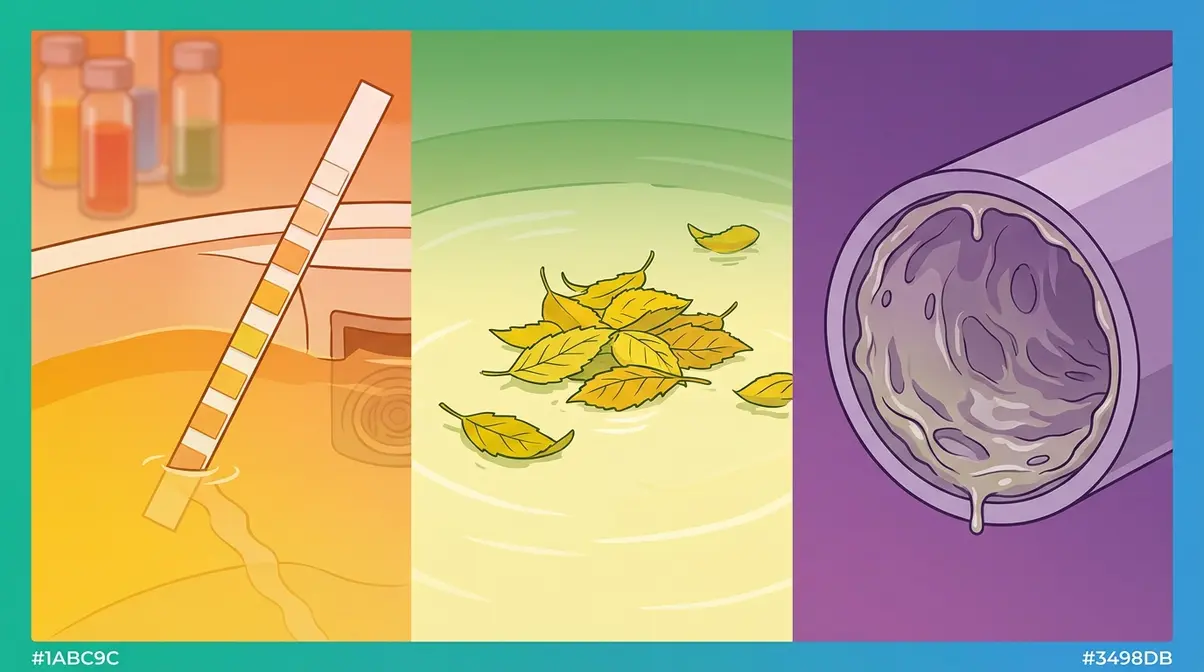
When investigating hot tub water yellow causes, water chemistry research and consistent reports from hot tub owner communities point to three broad threat categories: Chemical (imbalanced water chemistry or metal contamination), Physical (environmental particles like pollen or organic matter), and Biological (bacteria and biofilm in your plumbing). Matching your symptoms to the right category is the fastest way to restore clear, safe water.
What Causes Water to Turn Yellow?
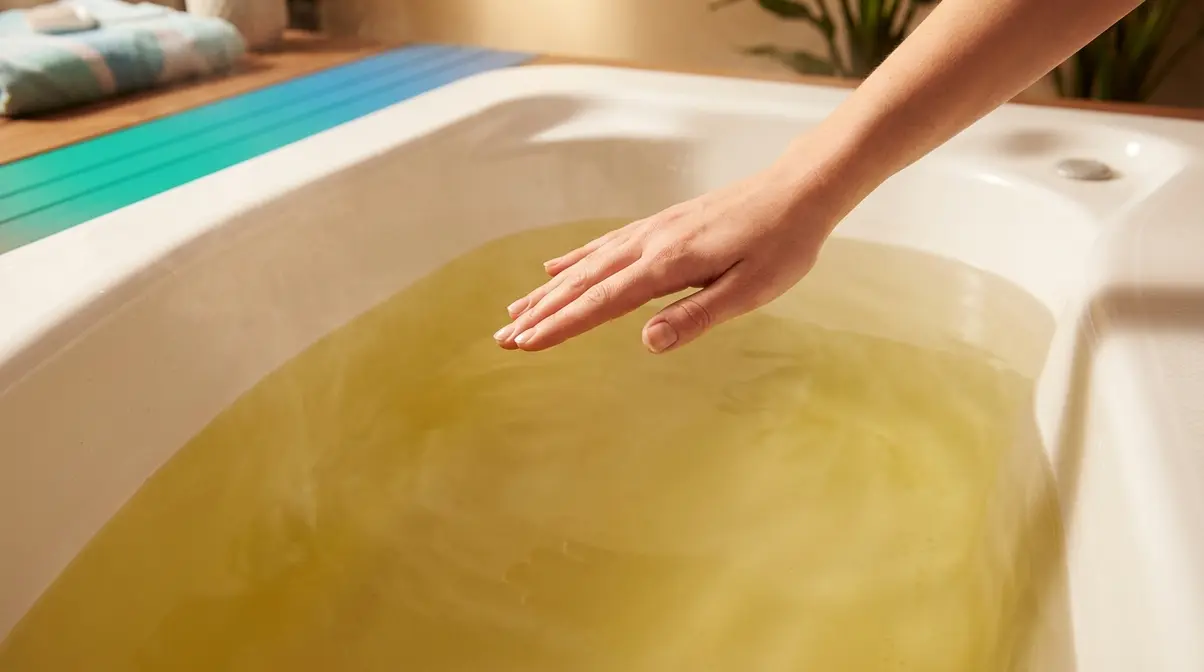
Hot tub water turns yellow due to six possible causes, organised by The 3-Threat Framework into Chemical (iron/copper contamination, low sanitiser, high bromine with low pH), Physical (pollen, tannins), and Biological (biofilm) threats. Iron oxidation from well water is the most commonly reported cause, producing a yellow-orange tint. Low sanitiser allows organic waste to accumulate and discolour the water. Biofilm in plumbing releases bacteria and organic compounds that cause persistent yellowing resistant to standard shocking.
Here are the six causes you need to know in detail, grouped by threat type:
- Chemical — Metals in the Water (Iron and Copper)
- Chemical — Low Sanitiser Levels and Inadequate Shocking
- Chemical — High Bromine Levels Combined with Low pH
- Physical — Pollen and Environmental Debris
- Physical — Tannins from Wood Surrounds or Fill Water
- Biological — Biofilm Buildup in Your Plumbing
Metals in the Water — Iron and Copper
Iron and copper contamination is the most frequently reported cause of yellow or orange-tinted hot tub water, particularly for owners on well water or in areas with older plumbing. When iron enters your water — either from your source water or from metal components inside the tub — it oxidises (reacts with oxygen) and turns a yellow, orange, or rust colour. Copper contamination tends to produce a greener-yellow hue. Both metals are colourless when dissolved but become visible the moment the water chemistry shifts.
According to Penn State Extension, iron concentrations above 0.3 mg/L (milligrams per litre) are enough to visibly discolour water. Even a small amount of metal in solution can turn an entire hot tub yellow within hours of adding a sanitiser or pH adjuster. This is because chemical treatments oxidise the dissolved metals, pulling them out of solution and making them visible.
How to confirm it’s metals: Test your water with a metal-specific test strip or take a water sample to a local pool and spa shop. If iron or copper registers above zero, metals are almost certainly your cause.
- Common sources of metal contamination include:
- Well water or bore water fill sources
- Corroded copper plumbing or heating elements
- Cheap hose fittings and metal fittings left submerged
- Low pH water (below 7.2) that leaches copper from pipes and fittings — a process water chemistry professionals consistently flag as the most preventable source of metal contamination
The fix involves a sequestrant (a chemical that binds to dissolved metals and prevents them from oxidising and discolouring the water) or a metal removal filter. Full treatment steps are covered in the 6-step fix guide below.
Low Sanitiser and Inadequate Shocking
Your hot tub sanitiser — whether chlorine or bromine — does two jobs: it kills bacteria and it oxidises (breaks down) organic waste. Organic waste includes sweat, body oils, cosmetics, urine traces, and sunscreen. When sanitiser levels drop too low, this organic waste accumulates in the water and begins to oxidise on its own. The result is a yellow or brownish-yellow tint caused by compounds called chloramines (in chlorine tubs) or bromamines (in bromine tubs) — combined molecules that form when sanitiser reacts with organic nitrogen compounds.
Water chemistry research consistently shows that chloramine and bromamine buildup is both the cause of yellow discolouration and the reason water starts to smell musty or chemical-heavy. Across hot tub owner communities, low sanitiser is the most commonly overlooked cause of water problems in the first six months of ownership, when owners are still learning their tub’s consumption rate.
- Recommended sanitiser levels:
- Chlorine: 3–5 ppm (parts per million)
- Bromine: 3–5 ppm (some manufacturers recommend up to 6 ppm)
If your levels have dropped below 1 ppm, your water has no active protection against organic waste buildup. Weekly shocking — adding a large, rapid dose of oxidiser — breaks down these combined compounds and restores water clarity. Skipping even one or two shock treatments is enough to allow visible yellowing to develop.
High Bromine Combined with Low pH
This cause is specific to bromine-sanitised hot tubs and is frequently misdiagnosed. When bromine levels climb above 6–8 ppm and pH drops below 7.2, the water becomes corrosive and the high bromine concentration itself can produce a distinct yellow tint. The low pH (the measure of how acidic or alkaline your water is — on a scale of 0 to 14, with 7.0 being neutral) also accelerates metal leaching from copper fittings and heating elements, compounding the discolouration.
Spachem notes that this combination is particularly common in new hot tub owners who over-dose bromine thinking “more is better.” The fix is to reduce bromine levels by allowing natural dissipation, increase aeration, and raise pH back into the 7.4–7.6 range before re-testing. Never add more bromine until pH is corrected — doing so deepens the problem.
Quotable check: “Bromine above 8 ppm combined with pH below 7.2 creates a corrosive environment that simultaneously discolours water and damages your tub’s components — a double threat that a simple pH test can catch early.”
Pollen and Environmental Debris
Not every case of yellow hot tub water has a chemistry explanation. During spring and early summer, airborne pollen is one of the most common physical causes of yellowish tint — and it’s often missed because owners assume the cause must be chemical. Pollen particles are fine enough to pass through standard hot tub filter cartridges and can accumulate in the water column, producing a pale yellow or greenish-yellow haze.
Common reports from hot tub owner communities describe this as a “dusty yellow” that appears suddenly after windy days or after the tub has been left uncovered. The key diagnostic clue is that your water chemistry tests normal — pH, alkalinity, and sanitiser are all in range, yet the water looks yellow. If that’s your situation, pollen or environmental debris is the most likely physical cause.
Other physical culprits include leaves, soil particles, and dust. The fix is straightforward: deep-clean your filter cartridge, run a clarifier (a chemical that clumps fine particles together so the filter can capture them), and keep your cover on when the tub is not in use. No chemistry adjustment is needed.
Tannins from Wood or Fill Water
Tannins are naturally occurring organic compounds found in wood, leaves, and some water sources. They produce a yellow, amber, or tea-coloured tint in water — the same effect you see when brewing tea. If your hot tub has a wooden surround, wooden steps, or is positioned near trees that drop leaves into the water, tannins are a plausible physical cause.
Tannins can also enter through your fill water, particularly in areas where the municipal supply draws from surface water reservoirs surrounded by vegetation. Unlike metal contamination, tannins don’t respond to sequestrants. They respond to activated carbon filtration or a dedicated tannin-removal product. If your water tests chemically normal but has a persistent amber or tea-like tint, tannins are a strong candidate — especially if you recently filled the tub or refilled after heavy rain runoff.
Biofilm Buildup in Your Plumbing
Biofilm is a thin, slimy layer of bacteria that coats the interior surfaces of your hot tub’s plumbing pipes, jets, and pump components — invisible from the outside, but capable of causing persistent water quality problems. Biofilm develops when bacteria colonise pipe surfaces and produce a protective matrix of slime. This matrix shields the bacteria from normal sanitiser levels, which is why biofilm-related yellowing often doesn’t respond to standard shocking.
When biofilm breaks loose from pipe walls — triggered by jets, temperature changes, or water flow — it releases bacteria and organic compounds into the water, producing a yellow or murky tint along with an unpleasant odour. Water chemistry professionals consistently identify biofilm as the most underdiagnosed cause of persistent water problems in residential hot tubs. A Leslie’s Pool resource on spa water colour problems notes that biofilm-driven discolouration is particularly common in tubs that have gone unused for extended periods or have never received a dedicated plumbing purge treatment.
- Biofilm warning signs:
- Yellow or cloudy water that returns within days of shocking
- Slimy or slippery feeling on the tub shell or jets
- Unpleasant, musty, or swampy odour
- White or grey flakes visible in the water
The fix requires a pipe purge product (also called a hot tub flush or plumbing purge), which penetrates the biofilm matrix and dislodges it before a full drain-and-refill. This is not optional if biofilm is your cause — chemical treatments alone will not solve it.
Is Yellow Hot Tub Water Safe to Soak In?
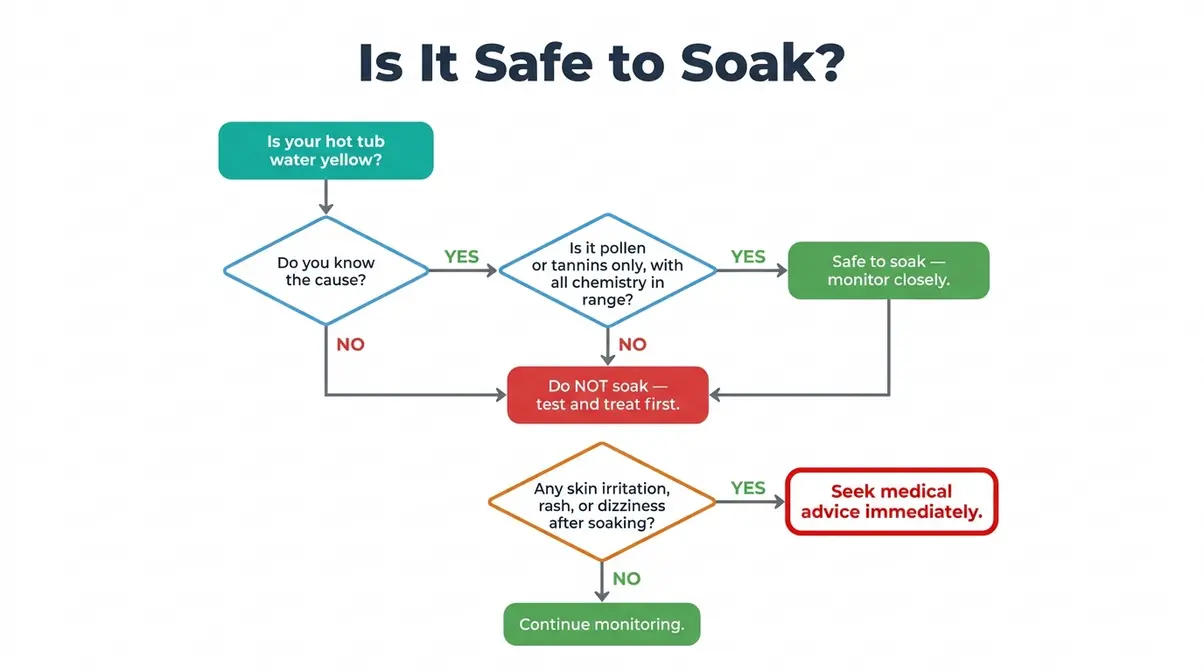
The short answer: do not soak in yellow hot tub water until you have identified the cause and treated it. Yellow water is a reliable signal that something is out of balance, and the risks vary significantly depending on the underlying cause. This section is intended as general information only and is not medical advice — consult your physician for personal health guidance, particularly if you have an existing medical condition.
Health Risks by Cause
Bacterial and biofilm contamination carry the most serious health risks. The CDC identifies Pseudomonas aeruginosa — the bacteria most commonly associated with biofilm in hot tubs — as the cause of hot tub folliculitis (a skin rash characterised by itchy, red bumps that appear within hours to days of soaking in contaminated water). In more severe cases, inadequately sanitised hot tub water has been linked to respiratory infections and ear infections.
Low sanitiser levels mean your water has no active protection against pathogens. Soaking in under-sanitised water with open cuts, skin abrasions, or compromised immunity raises your infection risk significantly.
High bromine or chemical imbalance can cause skin and eye irritation. While not typically a serious health threat in short exposures, prolonged soaking in chemically imbalanced water can aggravate eczema and sensitive skin conditions.
Considerations for Vulnerable Groups
Hot tub safety research from the Mayo Clinic and the American Heart Association highlights specific concerns for certain groups — independent of water colour:
- Heart conditions and AFib: Hot water raises body temperature and dilates blood vessels, which lowers blood pressure. For people with atrial fibrillation (AFib — an irregular heart rhythm) or other cardiovascular conditions, this physiological response may increase cardiac stress. Research suggests that individuals with heart conditions should consult their cardiologist before using a hot tub regularly. If you experience chest tightness, irregular heartbeat, or shortness of breath during a soak, exit immediately and seek medical attention.
- Over 50: Older adults are more susceptible to heat stress and dehydration. The AHA recommends limiting soaks to 15 minutes and keeping water temperature at or below 104°F (40°C).
- Pregnancy: Pregnant individuals should avoid hot tubs entirely due to the risk of overheating (hyperthermia), which research suggests may affect fetal development.
- Immunocompromised individuals: Those undergoing chemotherapy, taking immunosuppressants, or living with HIV/AIDS face elevated risk from any waterborne pathogen, including those present in yellow, under-sanitised water.
This content is not medical advice. Always consult your physician before using a hot tub if you have a pre-existing health condition.
The One Safe Exception
If your water tests chemically normal (pH 7.4–7.6, alkalinity 80–120 ppm, sanitiser 3–5 ppm) and you have confirmed the yellow tint is caused only by pollen or tannins, soaking is generally considered low-risk. However, even in this case, it is advisable to run your filter, add a clarifier, and keep the tub covered until the tint clears — both for comfort and to prevent the physical particles from clogging your filter system further.
How to Fix Yellow Hot Tub Water: A 6-Step Guide
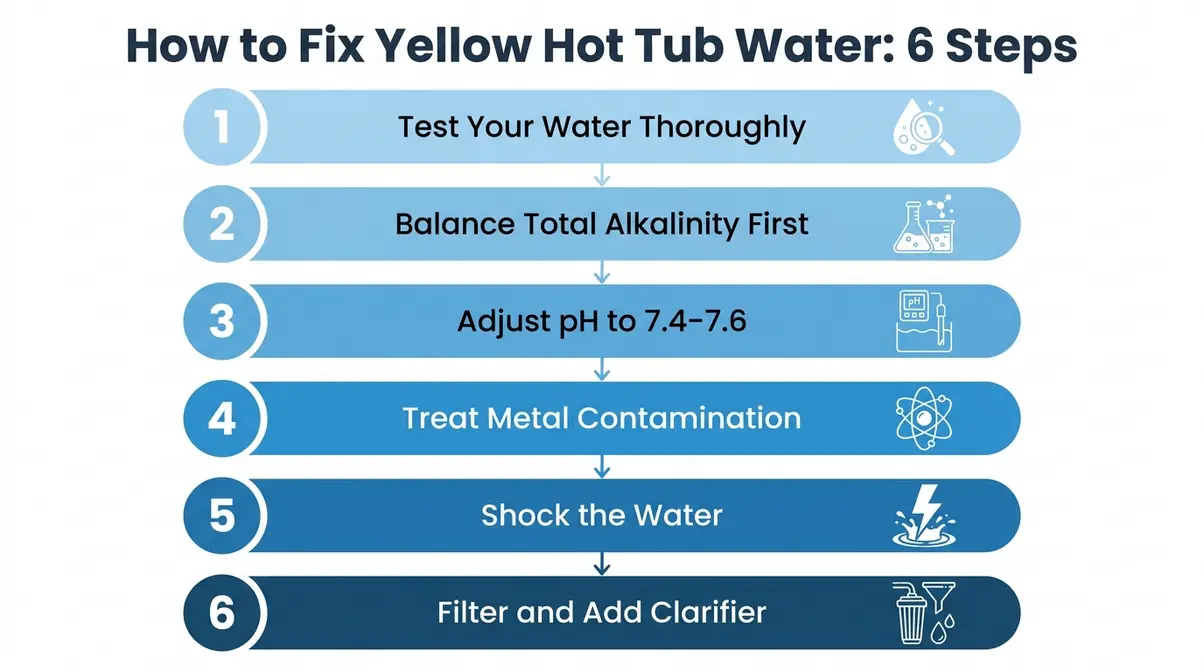
This 6-step process follows The 3-Threat Framework — it starts with diagnosis, addresses each threat category in the correct order, and ends with prevention. Water chemistry professionals consistently recommend addressing alkalinity before pH, and metals before sanitiser — the sequence below reflects that established best practice.
Prerequisites and Safety Note
Estimated Time: 45 minutes active, 24 hours total.
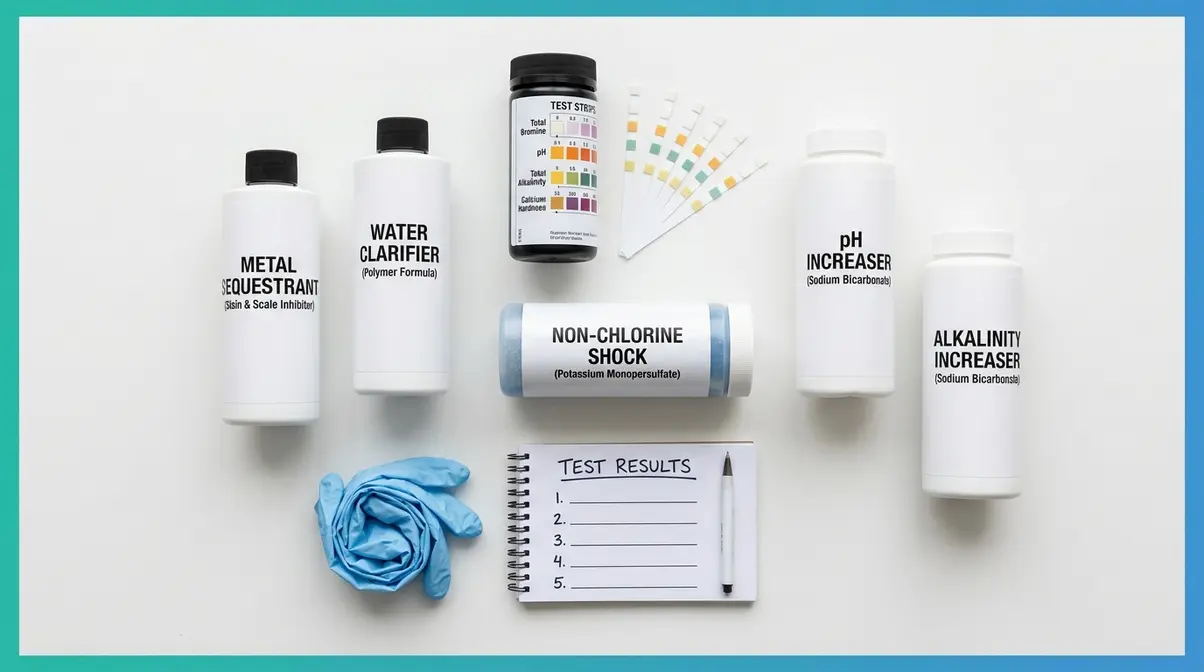
- Before you begin, gather:
- Water test kit or test strips (multi-parameter, covering pH, alkalinity, sanitiser, and metals)
- Chemical-resistant gloves and safety glasses
- All chemicals you’ll use (alkalinity increaser, pH increaser/decreaser, metal sequestrant, non-chlorine or chlorine shock, clarifier)
- Your hot tub owner’s manual (for manufacturer-specific dosing guidance)
⚠️ Safety reminder: Always add chemicals to water — never add water to chemicals. Wear gloves and eye protection when handling pool and spa chemicals. Follow all manufacturer instructions. Keep chemicals away from children and pets. Never mix different chemicals together before adding them to the tub.
Step 1: Test Your Water Thoroughly
Test your water before adding anything. A complete test gives you a baseline and tells you exactly which parameters are out of range — so you treat the right problem. Use a multi-parameter test strip or a liquid test kit that covers:
- pH (target: 7.4–7.6)
- Total Alkalinity (target: 80–120 ppm)
- Sanitiser (chlorine or bromine: 3–5 ppm)
- Metals (iron and copper — use a specific metal test strip if your standard kit doesn’t include these)
- Calcium Hardness (target: 150–250 ppm)
Write down your results. This tells you which of the three threat categories you’re dealing with and determines which steps below apply to your situation. If you’re unsure about your results, most pool and spa retailers offer free water testing — bring a 500ml sample in a clean bottle. For a deeper dive into this process, read our complete guide to test your hot tub water.
Step 2: Balance Total Alkalinity First
Why alkalinity before pH? Total alkalinity (TA) acts as a buffer for pH — it prevents pH from swinging up and down rapidly. If you adjust pH without first fixing alkalinity, the pH will drift back within hours. Water chemistry research consistently identifies this sequencing error as the most common mistake made by beginner hot tub owners.
- If TA is below 80 ppm: Add an alkalinity increaser (sodium bicarbonate) in small doses, re-testing after each addition. Add to the water with jets running for even distribution.
- If TA is above 120 ppm: Add pH decreaser (sodium bisulphate or muriatic acid) carefully, in small amounts. This will lower both TA and pH together.
- If TA is in range (80–120 ppm): Move directly to Step 3.
Allow 30–60 minutes of jet circulation before re-testing. Never add large doses of any chemical in a single treatment — incremental adjustment prevents overshooting.
Step 3: Adjust pH to the Correct Range
Once alkalinity is in range, adjust pH to 7.4–7.6. This range is important for two reasons: it’s gentle on skin and eyes, and it maximises the effectiveness of your sanitiser. At pH 7.0, chlorine is highly effective but irritating. At pH 7.8+, sanitiser efficiency drops by up to 50%, meaning you need far more chemical to achieve the same protection.
- pH below 7.2 (acidic): Add pH increaser (sodium carbonate / pH Up). This is critical if metals are involved — acidic water actively leaches copper and iron from your tub’s components, worsening discolouration.
- pH above 7.8 (alkaline): Add pH decreaser (sodium bisulphate / pH Down) in small increments.
- pH in range (7.4–7.6): Proceed to Step 4.
Re-test after 30 minutes of circulation. Repeat as needed until pH stabilises in range. If you need reliable tools, explore our recommendations for hot tub water testing kits.
Step 4: Treat Metal Contamination
If your Step 1 test showed iron or copper above zero, this step is essential before shocking. Never shock water with elevated metal levels — the oxidising action of shock will cause dissolved metals to precipitate out of solution instantly, turning your water a deep yellow, orange, or brown colour. This is the most common mistake made when dealing with metal contamination.
- To treat metals:
- Add a metal sequestrant (also called a chelating agent or metal remover) at the dose specified on the product label for your tub’s volume. A sequestrant binds to dissolved metal ions and holds them in suspension so they can be removed by filtration rather than oxidised into visible particles.
- Run your jets continuously for 30–60 minutes to distribute the sequestrant throughout the plumbing.
- Allow the filter to run for 24 hours before proceeding to Step 5.
- If discolouration is severe, use a metal removal filter attachment on your garden hose when refilling the tub in future.
For ongoing metal prevention, add a maintenance dose of sequestrant monthly, especially if you fill from a well or bore water source. Check out our comprehensive hot tub maintenance guide for long-term prevention strategies.
Step 5: Shock the Water
Shocking means adding a large dose of oxidiser to break down organic waste, chloramines, bromamines, and any remaining discolouring compounds. This is the primary treatment for yellowing caused by low sanitiser, high bromine/low pH, and organic contamination.
- Two types of shock:
- Non-chlorine shock (potassium monopersulphate / MPS): Preferred for bromine tubs and for tubs with sensitive users. Oxidises organics without raising chlorine levels. Safe to soak 15–30 minutes after treatment (check product label).
- Chlorine shock (calcium hypochlorite or sodium dichloro): More powerful oxidising action. Required for severe contamination or suspected bacterial issues. Wait until chlorine drops back to 3–5 ppm before soaking (typically 4–8 hours).
Dosing guidance: Follow your product label for your exact tub volume. As a general guide, most standard shocks recommend 40–60g per 1,500 litres (approximately 400 gallons) for a maintenance shock. For severe yellowing, a double dose may be appropriate — check your product instructions.
Add shock with jets running, in the evening or with the cover off, to allow gases to dissipate. Re-test after 4 hours.
Step 6: Filter and Add Clarifier
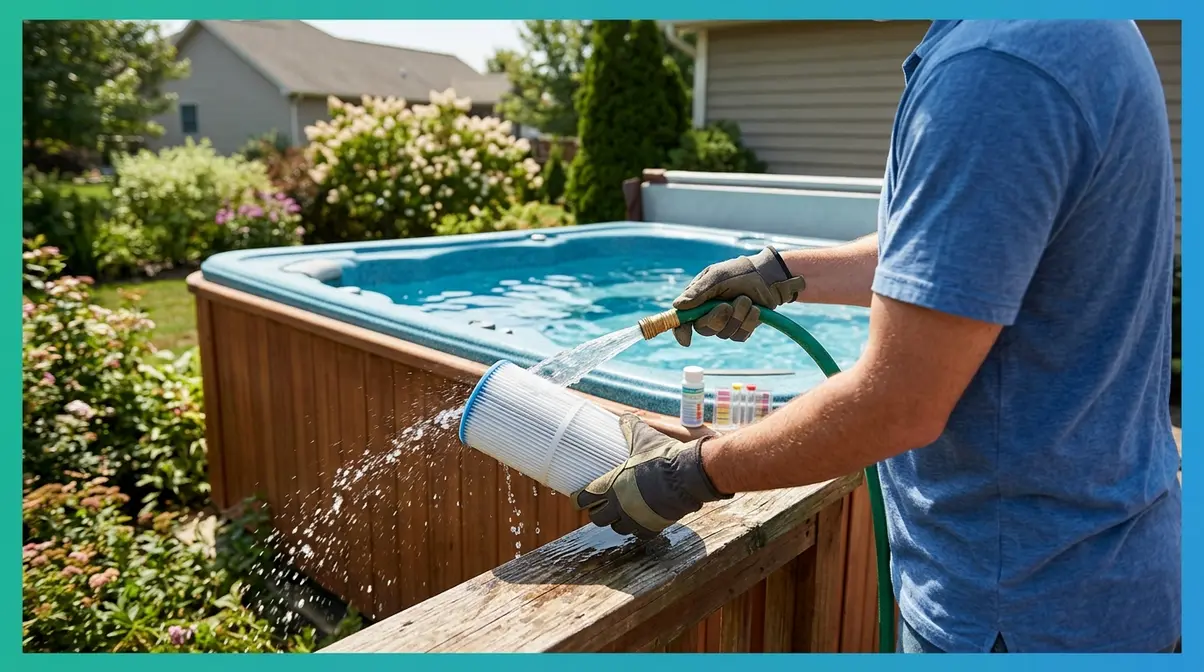
The final step removes the physical particles — oxidised metals, dead organic matter, broken-down biofilm fragments — that remain in suspension after treatment. Run your filter continuously for 24–48 hours. Clean or rinse your filter cartridge after 12 hours, as it will be working hard to capture the debris released by treatment.
Add a clarifier (a water-polishing chemical that causes fine particles to clump together into larger clusters that your filter can capture) if the water remains hazy after shocking. Clarifiers are safe to use alongside sanitised water and typically clear mild haziness within 12–24 hours. For more clarity tips, see our beginner’s guide to hot tub water care.
If the water is still yellow after completing all six steps: This strongly suggests biofilm is involved. Proceed to a full drain, plumbing purge, and refill as described in the next section.
Diagnosing the Cause: Colour Clue Chart
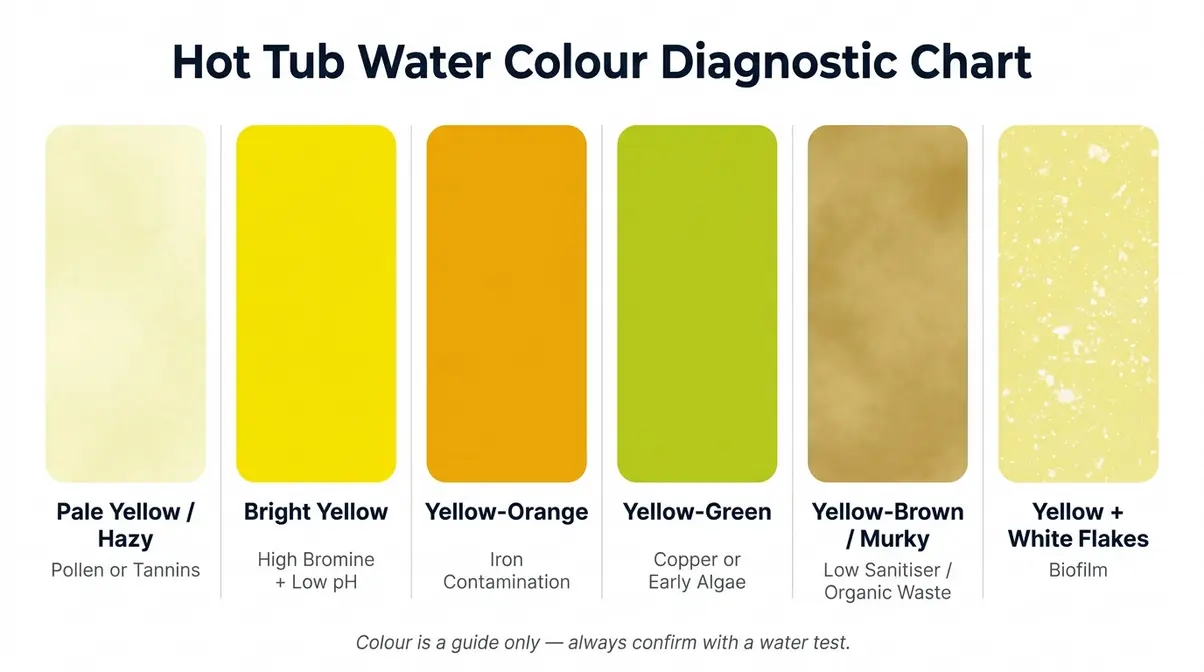
Not all yellow water looks the same, and the exact shade and clarity of your water is one of the most useful diagnostic clues available to you. Common reports from hot tub owner communities consistently show that the colour of discolouration correlates strongly with the underlying cause.
Reading the Chart
Pale yellow, hazy but not murky, chemistry in range: Physical cause — pollen or tannins. Start with a filter clean and clarifier before any chemical adjustment.
Bright, vivid yellow with an acidic pH reading: Chemical cause — high bromine combined with low pH. Reduce bromine, raise pH, and re-test before shocking.
Yellow-orange or rust-coloured tint: Chemical cause — iron contamination. Do NOT shock until metals are treated with a sequestrant. Test your fill water source.
Yellow-green tint: Chemical cause — copper contamination, or in rare cases, early-stage green algae growth. Copper sequestrant first; if algae is suspected, test sanitiser and shock immediately.
Yellow-brown, murky, with an unpleasant odour: Chemical/Biological cause — organic waste buildup from low sanitiser, or early biofilm. Full shock treatment and filter clean required. If it returns within 48 hours, suspect biofilm.
Yellow with white or grey flakes, slippery jets: Biological cause — biofilm. Drain, purge, and refill. Do not attempt to treat biofilm with chemistry alone.
When to Drain and Refill
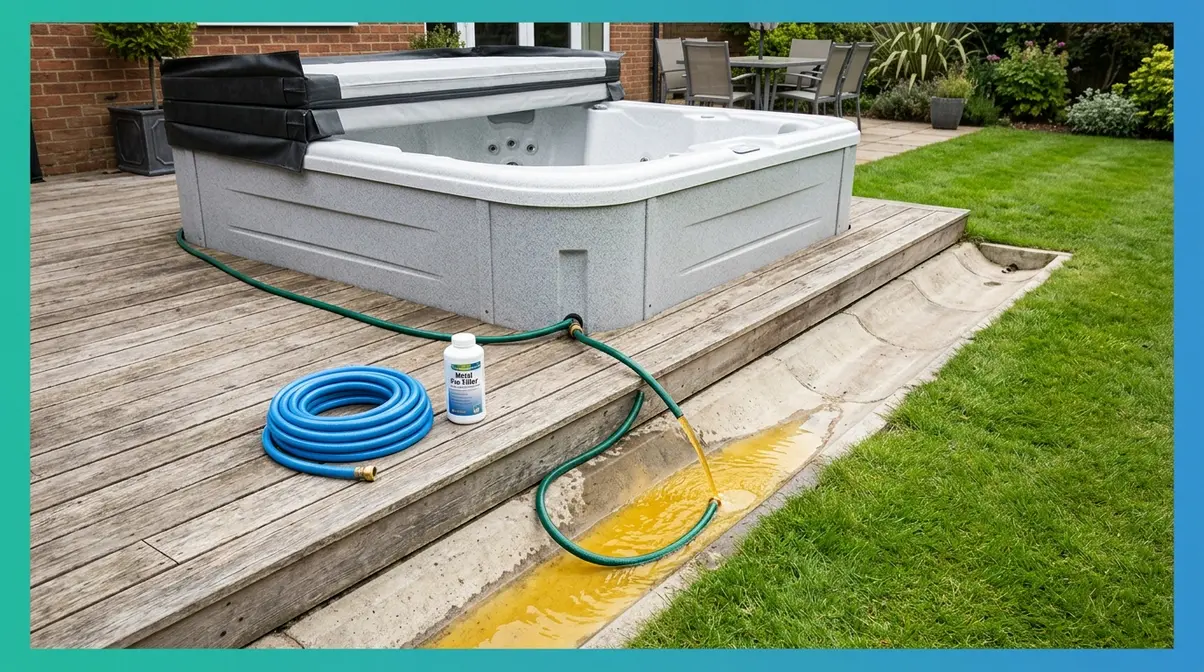
Sometimes the most efficient solution is a full drain-and-refill rather than continued chemical treatment. Water chemistry professionals recommend draining and refilling when:
- The water has been in the tub for more than 3–4 months (the standard recommendation for average use)
- Multiple chemical treatments have failed to clear the yellowing
- Total dissolved solids (TDS — the accumulated concentration of all dissolved minerals and chemicals in your water) exceed 1,500 ppm above your fill water’s baseline TDS
- Biofilm has been confirmed or strongly suspected
Draining is not a defeat — it’s often the fastest and cheapest path back to clear, balanced water. Learn more about how long hot tub water lasts to time your drains perfectly.
Preventing Yellow Water: Maintenance
The most reliable way to avoid yellow hot tub water is a consistent weekly maintenance routine. By maintaining your filter, you eliminate one of the primary hot tub water yellow causes. Water chemistry research and the collective experience of hot tub professionals point to three preventable causes accounting for the overwhelming majority of water problems in residential hot tubs: irregular testing, skipped shock treatments, and neglected filters.
Your Weekly Maintenance Routine
| Task | Frequency | Why It Matters |
|---|---|---|
| Test pH, alkalinity, and sanitiser | 2–3× per week | Catches imbalances before they cause discolouration |
| Shock the water | Weekly (or after heavy use) | Breaks down organic waste before it accumulates |
| Rinse filter cartridge | Every 2 weeks | Maintains filtration efficiency |
| Deep-clean filter cartridge | Monthly (chemical soak) | Removes embedded oils and minerals |
| Add metal sequestrant | Monthly | Prevents metal accumulation, especially on well water |
| Drain and refill | Every 3–4 months | Resets TDS and eliminates accumulated contaminants |
| Purge plumbing before draining | Every drain cycle | Removes biofilm before it can re-establish |
Follow our complete hot tub maintenance schedule to stay on track.
Filter Care: The Top Prevention Step
Your filter cartridge is your first line of defence against physical contaminants — pollen, body oils, tannins, and fine debris. A clogged or degraded filter cannot remove these particles effectively, allowing them to accumulate in the water and cause discolouration. Water chemistry professionals consistently identify dirty or worn filters as a contributing factor in the majority of water clarity problems they diagnose.
- Signs your filter needs attention:
- Water clarity declines despite correct chemistry
- Water flow from jets feels reduced
- The filter cartridge is visibly discoloured, compressed, or has damaged pleats
Replace your filter cartridge every 12–24 months depending on usage. Keeping a spare on hand means you can swap immediately and soak your used cartridge in a chemical cleaner overnight — rather than running the tub with a fouled filter. Read our dedicated section on hot tub filter care for step-by-step cleaning instructions.
Preventing Metal Contamination Long-Term
If you fill from a well or bore water source, metal prevention is an ongoing priority rather than a one-time fix. The most effective long-term approach combines three measures:
- Inline pre-filter on your fill hose: A garden hose pre-filter with a metal-removal cartridge removes iron and copper before they ever enter the tub. This is the single highest-impact prevention step for well water users.
- Monthly sequestrant maintenance dose: Keeps residual metals bound and filterable rather than free to oxidise and discolour.
- Maintain pH above 7.2 at all times: Acidic water actively dissolves metal from copper fittings and heating elements. Keeping pH in range is the simplest way to stop corrosive leaching before it starts.
Saltwater Hot Tubs and Yellow Water
Saltwater hot tubs use an electrolytic chlorine generator (ECG) to produce chlorine from dissolved salt — but they are not immune to yellowing. In fact, the electrolysis process can accelerate copper leaching from heating elements if pH is not carefully maintained. If you own a saltwater hot tub and are experiencing yellow water, check your pH first — low pH combined with electrolysis is a common cause of copper contamination in saltwater systems specifically. Discover more about saltwater hot tub maintenance to protect your ECG.
Why put tennis balls in a hot tub?
Tennis balls absorb oils and cosmetics from hot tub water. Body oils, sunscreen, lotions, and hair products are hydrophobic (water-repelling) and accumulate on the water surface and in filters, contributing to water cloudiness and yellowish tints. The felt material on a tennis ball absorbs these oils passively as it floats in the water. While not a substitute for proper filtration and chemistry, tossing two or three clean tennis balls into the tub after each soak is a low-cost way to reduce the oil load on your filter — a tip widely shared across hot tub owner communities.
Common Mistakes That Make Yellow Water Worse
Understanding what not to do is just as important as knowing the correct fix. Across hot tub owner communities, several mistakes are reported repeatedly — and each one delays recovery or actively worsens the problem.
Common Pitfalls
Pitfall 1: Shocking water before treating metals.
This is the most damaging mistake for iron or copper contamination cases. Shock is an oxidiser — it will instantly react with dissolved metals and turn your water deep orange or brown. Always test for metals and apply a sequestrant first. Wait 24 hours before shocking.
Pitfall 2: Adjusting pH before alkalinity.
pH and alkalinity are chemically linked. If you adjust pH while alkalinity is out of range, pH will drift back to its previous level within hours. Always balance alkalinity to 80–120 ppm first, then fine-tune pH. This sequence is non-negotiable in water chemistry best practice.
Pitfall 3: Over-dosing bromine to “fix” yellow water.
Adding more bromine to yellow water caused by high bromine and low pH makes the problem worse. If your bromine is already elevated, the answer is to stop adding bromine, increase aeration (run jets with the cover off), and raise pH — not to add more sanitiser.
Pitfall 4: Ignoring the filter during treatment.
Chemical treatments release particles into the water — oxidised metals, dead organic matter, biofilm fragments. If your filter is clogged during treatment, these particles stay in suspension and the water remains yellow or cloudy. Clean your filter before starting treatment and again 12 hours into the process.
Pitfall 5: Treating biofilm with chemistry alone.
Biofilm is protected by a physical slime matrix that standard sanitiser levels cannot penetrate. If your yellow water returns within 48–72 hours of shocking, biofilm is almost certainly the cause. No amount of additional chemical treatment will solve this — a full drain, plumbing purge, and refill is required.
When to Choose a Full Drain
A full drain-and-refill is the right choice — not a last resort — in these specific situations:
- Water is more than 4 months old: Accumulated TDS makes chemical balance increasingly difficult and expensive to maintain. Fresh water is simply more economical.
- Multiple failed treatment attempts: If you’ve completed the 6-step process twice without clearing the yellowing, something structural (biofilm, persistent metal source, or a failing filter) is preventing recovery. Drain, purge, and start fresh.
- Unknown chemical history: If you’ve inherited a tub, bought a used hot tub, or can’t remember when you last changed the water — drain it. You cannot safely or efficiently treat water with an unknown chemical history.
When to Seek Professional Help
Most yellow water problems are resolvable at home using the steps in this guide. However, consider calling a hot tub service professional if:
- You’ve completed a full drain-and-refill and the water turns yellow again within 48 hours (suggests a persistent metal source, a failing component, or severe biofilm in hard-to-reach plumbing)
- Your pH will not stabilise despite repeated adjustments (may indicate a failing heater element or a water source problem)
- You see unusual staining on the tub shell, jets, or equipment that doesn’t respond to standard cleaning
Frequently Asked Questions
How do you fix yellow hot tub water?
Fix yellow hot tub water by first testing your water to identify the specific cause — metals, low sanitiser, high bromine, pollen, tannins, or biofilm. Follow the 6-step process: balance alkalinity, adjust pH, treat metals with a sequestrant (if present), shock the water, and run your filter with a clarifier. For biofilm-related yellowing, a full drain, plumbing purge, and refill is required. Results may vary based on the severity of the problem and your water source. Most cases resolve within 24–48 hours when the correct cause is treated.
Is yellow hot tub water safe to soak in?
Yellow hot tub water is generally not safe to soak in until you’ve identified and treated the cause. Water discoloured by bacteria or biofilm carries a risk of hot tub folliculitis (a skin rash) and other infections, as identified by the CDC. Water with severely imbalanced chemistry can cause skin and eye irritation. The one lower-risk exception is yellowing caused purely by pollen or tannins, where all chemistry tests normal — but even then, it’s advisable to clarify the water before soaking. When in doubt, stay out. This is general information and not medical advice.
How often should I change hot tub water?
Hot tub water should be changed every 3–4 months for average household use (2–4 people soaking 3–4 times per week), according to general guidelines from the Pool & Hot Tub Alliance. Heavy use — frequent soaking, multiple users, or regular guests — may require changes every 6–8 weeks. A simple formula: divide your tub’s volume in gallons by 3, then divide by the average number of daily bathers. This gives you an approximate number of days between water changes. Accumulated total dissolved solids (TDS) are the primary reason for regular changes — water becomes progressively harder to balance as TDS rises.
Can a hot tub trigger AFib?
Hot tub use may increase cardiac stress for people with existing atrial fibrillation (AFib), according to research cited by the Mayo Clinic and the American Heart Association. The hot water raises body temperature, dilates blood vessels, and lowers blood pressure — a combination that can trigger irregular heart rhythms in susceptible individuals. Research suggests the risk is higher for people with pre-existing heart conditions, those over 65, and those soaking at temperatures above 104°F (40°C). If you have AFib or any heart condition, consult your cardiologist before using a hot tub. If you experience chest pain, palpitations, or dizziness during a soak, exit immediately and seek medical attention. This is not medical advice.
Restore Your Water and Soak With Confidence
Yellow hot tub water is alarming when you first see it — but it’s almost always fixable. The 3-Threat Framework gives you a clear starting point: identify whether your problem is Chemical (metals, low sanitiser, or bromine/pH imbalance), Physical (pollen or tannins), or Biological (biofilm), then apply the correct treatment in the right sequence. Most cases of yellow hot tub water resolve within 24–48 hours when the correct cause is treated promptly.
The 6-step fix process — test, balance alkalinity, adjust pH, treat metals, shock, and filter — is the most reliable path back to clear water, regardless of which threat category you’re dealing with. The 3-Threat Framework makes that process faster by eliminating guesswork: you’re not throwing chemicals at a mystery, you’re treating a diagnosed problem.
Now that you understand the main hot tub water yellow causes, you can tackle the issue efficiently. Your next step is simple: grab a multi-parameter test kit and run a full water test right now. If you don’t have one, most pool and spa retailers offer free in-store testing — bring a 500ml sample in a clean bottle. Once you have your numbers, you’ll know exactly which step of the 6-step guide applies to your situation. Most new hot tub owners are back to clear, balanced water within a day or two. Check out our water testing guide for beginners and our hot tub safety guide to get started right now.