

Table of Contents - Can You Put Bleach in a Hot Tub? Risks & Safe Guide
- What Is the Difference Between Bleach and Hot Tub Chlorine?
- Why You Should Not Use Household Bleach in a Hot Tub
- If You Choose to Use Bleach: The Only Safe Method
- Better Alternatives to Bleach for Hot Tub Sanitation
- Can a Hot Tub Make You Sick? Health Risks of Poor Sanitation
- Epsom Salts and Pool Salt in a Hot Tub (What You Need to Know)
- Can a Doctor Prescribe a Hot Tub?
- Frequently Asked Questions
- How much bleach should I add to a 300-gallon hot tub?
- What can I use in my hot tub instead of chlorine?
- Why is using bleach in a hot tub risky?
- How do you treat a hot tub after folliculitis?
- Why is there a 15-minute hot tub rule?
- Do hot tubs reduce cortisol?
- Why do people put tennis balls in a hot tub?
- Why do so many people get rid of their hot tubs?
- The Right Chemical for the Right Job
This blog post may contain affiliate links. As an Amazon Associate I earn from qualifying purchases.
⚠️ Safety Warning: The chemical information in this article is for educational purposes only. Always consult your hot tub manufacturer’s manual before adding any substance to your water. Improper chemical use can cause serious injury, equipment damage, and void your warranty. When handling any pool or spa chemicals, wear gloves and eye protection and ensure adequate ventilation.
“Are hot tub stores lying when they say to NOT use bleach because they want us to spend more money and exclusively use their dichlor chlorine products?”
— r/hottub community member
It’s a fair question — and the answer is more nuanced than most spa retailers will tell you.
Household bleach is sodium hypochlorite (the same active ingredient as pool and hot tub chlorine), so the skepticism makes complete chemical sense. But hot tubs operate very differently from pools — and those differences are exactly where the danger lies when you ask whether you can put bleach in a hot tub.
In this guide, you’ll learn exactly why household bleach damages hot tubs, the precise conditions under which it’s acceptable, and the safer alternatives that protect your equipment, your health, and your warranty. You’ll also get The Sanitizer Hierarchy — a tiered decision framework that cuts through the confusion once and for all.


- BENEFIT: Quickly and easily check and adjust the 5 key elements in your spa to keep water clear, clean, healthy, and balanced
- INCLUDES: 25 strips for testing total bromine, free chlorine, alkalinity, pH, and total hardness
- FAST TESTING: Provides accurate results in seconds
- COMPATIBLE WITH MOST SPAS: HTH Spa Test Strips are great for bromine and chlorine systems
- YOU'RE ALL CLEAR WITH HTH: For best results, use HTH Spa Test Strips twice a week to test and balance your spa water

- BENEFITS: Destroys organic contaminants to maintain clean, clear, sanitized water
- USE: Specifically formulated for spa and hot tubs
- COMPATIBILITY: Chlorine sanitizing systems
- FEATURES: Quick dissolving, EPA approved formula, helps control algae growth, maintains water clean, clear, and sanitized
- ACTIVE INGREDIENTS: Sodium Dichloro-s-Triazinetrione Dihydrate

- Organic Brominating Compound (BCDMH): SpaGuard Brominating Tablets provide spa owners with an organic brominating compound in time-release tablet form to provide continuous spa sanitation, while simplifying maintenance.
- Dissolve Slowly, Protect Continuously: Experience continuous protection with SpaGuard Brominating Tablets. It has a slow-dissolving formula that provides reliable sanitation, keeping your spa water free of microorganisms and other contaminants for a clean and healthy hot tub experience.
- Trustworthy Spa Maintenanance: Trust SpaGuard's proven formula for effective and reliable hot tub maintenance, so you can relax and enjoy your spa with peace of mind. It is effective in killing and controlling algae and other microorganisms in the water to maintain a clean spa environment.
- Compatibility: Regular and routine application of SpaGuard Bromine Tablets is essential to maintain consistent and effective sanitation in the spa. Compatible with most spa water balancing products and chemicals.
- Tested and Proven Effective: SpaGuard products are known for delivering reliable results and making spa care less complex. SpaGuard carries an extensive line of spa solutions that match your unique needs.
- BENEFITS: Destroys organic contaminants to maintain clean, clear, sanitized water
- USE: Specifically formulated for spa and hot tubs
- COMPATIBILITY: Chlorine sanitizing systems
- FEATURES: Quick dissolving, EPA approved formula, helps control algae growth, maintains water clean, clear, and sanitized
- ACTIVE INGREDIENTS: Sodium Dichloro-s-Triazinetrione Dihydrate

- Reliable Results In Seconds – Everything you need to test your pool or spa is conveniently packaged in the handy storage case, including a comparator to mix samples, and 13 easy-to-use reagents for 9 common water test parameters for DPD high range testing: Free & Total Chlorine, Bromine, pH, Acid & Base Demand, Total Alkalinity, Calcium Hardness, and Cyanuric Acid (CYA).
- Quick & Easy to Use – Simply collect your water sample using the comparator and add the appropriate testing reagents to determine the results. Product instructions are written in non-technical language with easy-to-understand pictograms.
- Pool & Spa Test Kits Built to Last – With testing kits built to last, you’ll find yourself needing to replace your Taylor reagents before the entire kit. Replacement reagents are available separately so you can easily replace your pool and spa testing chemicals every season.
- For Homeowners and Professionals – Taylor products are built to professional standards but with processes easy enough for any pool or spa owner to use. With unparalleled customer service and support, Taylor is the go-to for every distributor, retailer, commercial operation, and homeowner… wherever water is tested.
- The K-2005C Service Complete kit contains larger, 2oz bottles for high-frequency water testers. The larger bottles provide more than 2.5x the total number of water tests completed compared to the standard Complete K-2005 kit. If you are a low-frequency tester, the K-2005 standard Complete kit contains .75oz bottles to fit your testing need.

- Versatile: Granular chlorine with the ability to be used in all types of swimming pools, spas, fountains, and water features.
- Powerful Sanitizer: Sodium Dichlor shock removes bacteria, breaks down organic contaminants, and eliminates algae.
- Calcium-Free Formula: Perfect for hard water areas—keeps pool water sparkling clean and crystal clear.
- Stabilized Chlorine: Contains 56% available chlorine for effective, long-lasting sanitation.
- Usage Directions: Add 3 oz. per 10,000 gallons for routine chlorination; use 21 oz. per 10,000 gallons for super chlorination
Yes, you can put plain, unscented household bleach in a hot tub — but only in specific emergency situations, not for routine sanitation. The CDC recommends maintaining 3.0–10.0 ppm free chlorine in hot tubs; household bleach’s high pH (~12–13) makes precise dosing very difficult.
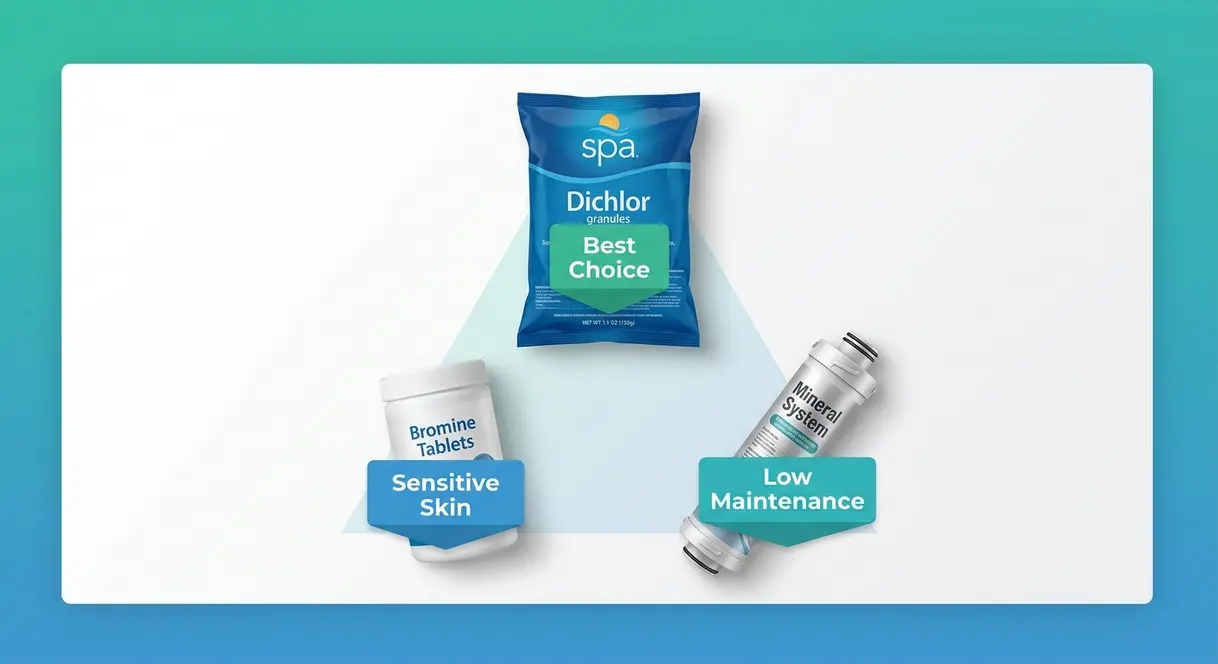
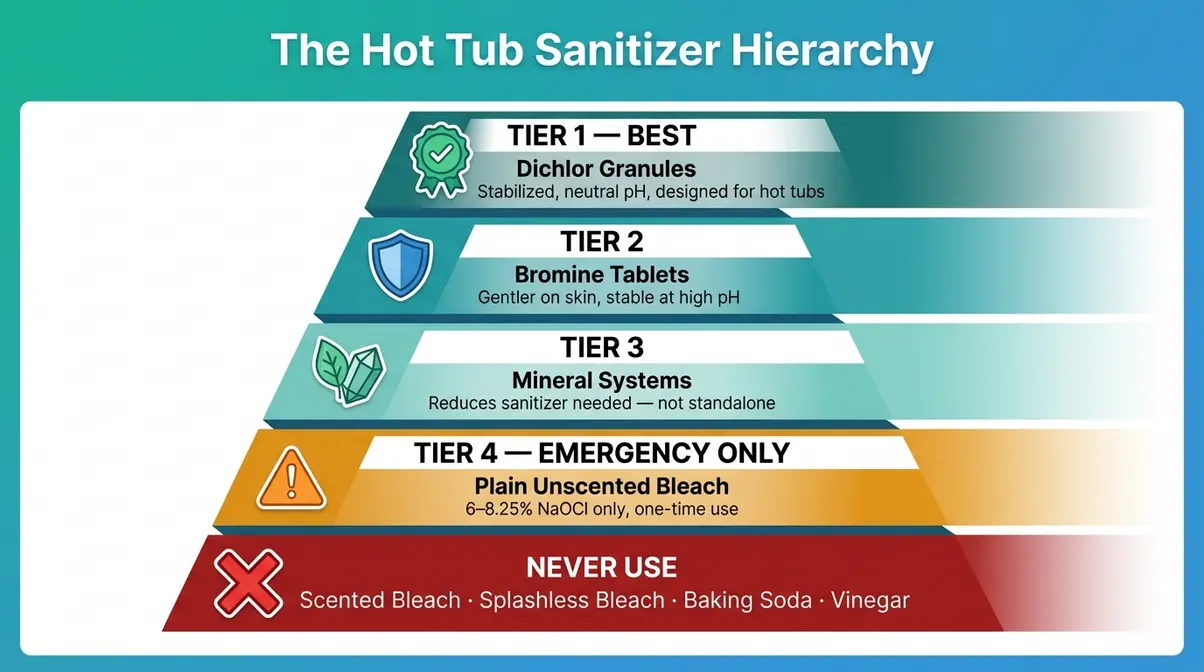
- The Sanitizer Hierarchy: Dichlor → Bromine → Mineral systems → Emergency bleach (plain only) → Never: scented or thickened bleach
- Biggest risk: Household bleach can void your manufacturer’s warranty and corrode heaters, jets, and acrylic surfaces
- Safe use: Only plain, unscented bleach (6–8.25% NaOCl) — never “splashless,” scented, or thickened formulas
- Better option: Dichlor granules are stabilized for hot tub temperatures and cost less per use than most people assume
What Is the Difference Between Bleach and Hot Tub Chlorine?
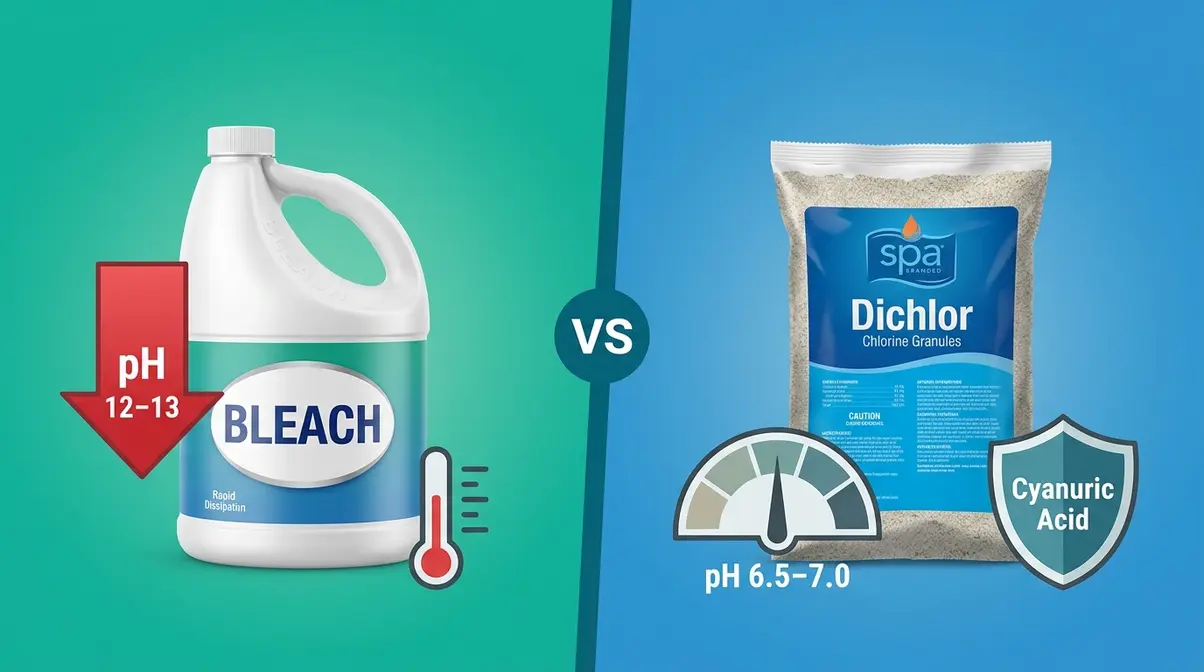
Bleach and hot tub chlorine both rely on sodium hypochlorite as their active ingredient — but they are formulated for completely different conditions, and using them interchangeably can cause real damage. Understanding what separates them is the foundation for every decision you’ll make about your hot tub’s water chemistry.
Household Bleach vs. Dichlor: A Chemical Comparison
Sodium hypochlorite is the active sanitizing agent in both household bleach and hot tub chlorine products. That’s the chemical fact that fuels the skepticism — and it’s legitimate. However, the formulation differences between a jug of Clorox and a bag of Dichlor (a stabilized chlorine granule specifically formulated for hot tubs) are significant enough to matter a great deal in practice.
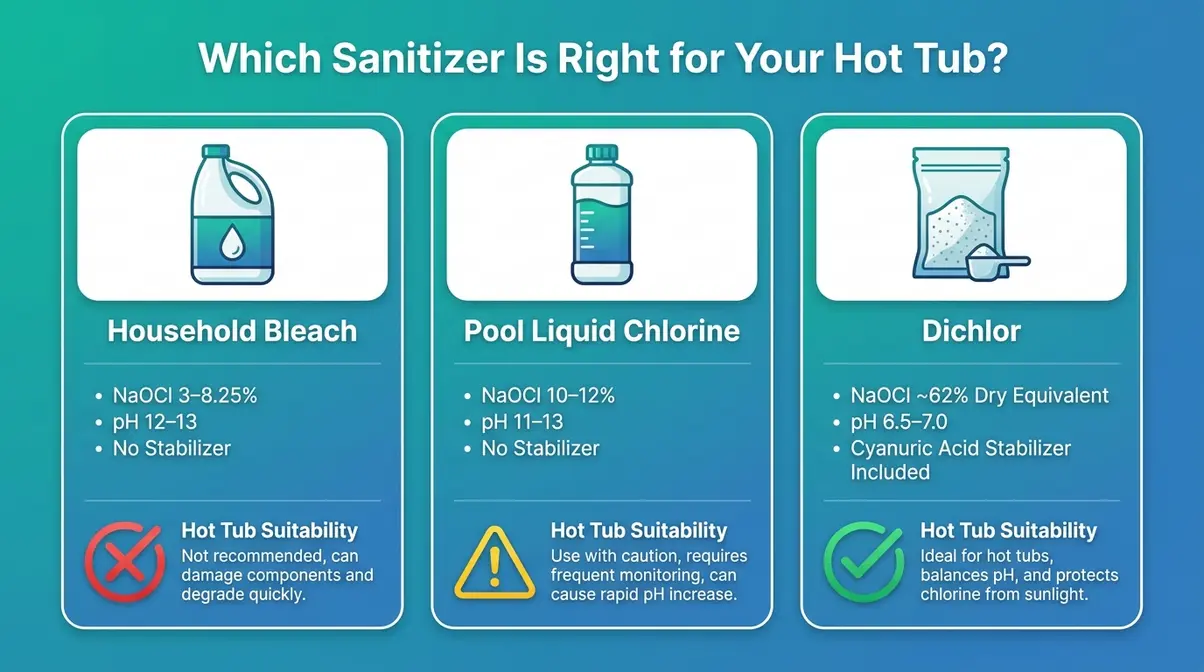
Household bleach typically contains 3–8.25% sodium hypochlorite. Pool-grade liquid chlorine runs higher, at around 10–12%. Neither contains a stabilizer. Dichlor, by contrast, is formulated at a near-neutral pH of 6.5–7.0, includes cyanuric acid — a stabilizer that prevents chlorine from burning off in heat and UV light — and is designed to dissolve cleanly without leaving residue.
Think of cyanuric acid as sunscreen for chlorine. Without it, the sanitizer degrades rapidly before it can do its job — especially in a hot tub operating at 100–104°F.
| Property | Household Bleach | Pool Liquid Chlorine | Dichlor (Hot Tub) |
|---|---|---|---|
| Active ingredient | Sodium hypochlorite | Sodium hypochlorite | Sodium dichloro-s-triazinetrione |
| NaOCl concentration | 3–8.25% | 10–12% | ~62% (dry equivalent) |
| pH level | ~12–13 | ~11–13 | ~6.5–7.0 |
| Stabilizer (cyanuric acid) | None | None | Yes |
| Additives | Fragrances, thickeners (varies) | Generally none | None |
| Designed for hot tubs | No | No | Yes |
| Typical cost per dose | Low | Low | Low–moderate |
The CDC recommended chlorine levels for hot tubs are 3.0–10.0 ppm free chlorine (CDC, 2024). Household bleach can technically deliver chlorine within that range — but its high pH and lack of stabilizer make hitting and holding that target reliably very difficult.
Why Hot Tub Temperatures Make Bleach Even Riskier
A backyard pool sits at roughly 78–82°F. Your hot tub runs at 100–104°F. That 20–26°F difference is not a minor detail — it’s a chemical accelerant.
Unstabilized chlorine (like household bleach) off-gasses significantly faster at higher temperatures. Research in aquatic chemistry shows that without cyanuric acid stabilization, chlorine in a heated spa can dissipate 4–5 times faster than in a cooler pool. That means the bleach you added may be essentially gone within an hour — leaving your water unsanitized while you’re soaking in it.
Hot tub water also has a higher bather-to-water ratio than a pool. A standard 300-gallon hot tub holds roughly the same number of bathers as a 20,000-gallon pool, proportionally speaking. More body oils, cosmetics, and organic contaminants per gallon mean your sanitizer works harder and burns off faster. This is precisely why The Sanitizer Hierarchy places plain bleach in the “emergency-only” tier — not because retailers are inventing risks, but because the chemistry genuinely doesn’t work well at spa temperatures.
Across hot tub owner communities, the consistent finding is that bleach-treated hot tubs require retesting and re-dosing far more frequently than Dichlor-treated tubs — often within the same session.
Why You Should Not Use Household Bleach in a Hot Tub
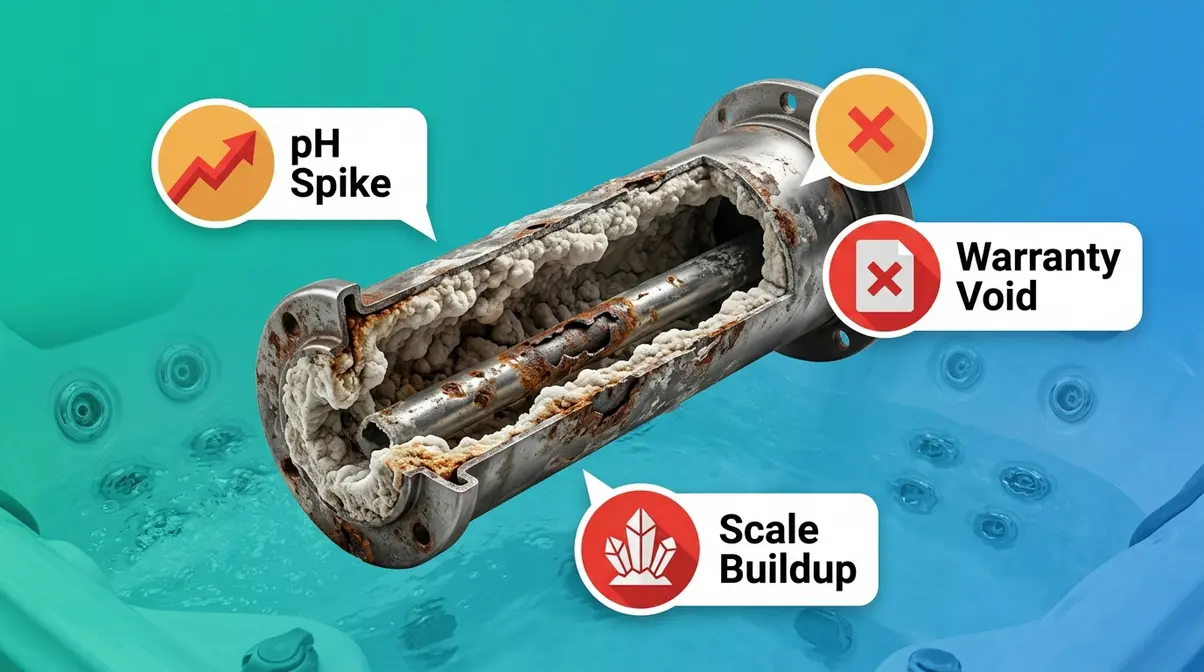
The risks of using household bleach in a hot tub go well beyond chlorine levels. Three separate problems — pH disruption, chemical additives, and warranty language — combine to make routine bleach use a genuinely costly mistake.
The pH Problem: Scale Buildup and Equipment Damage
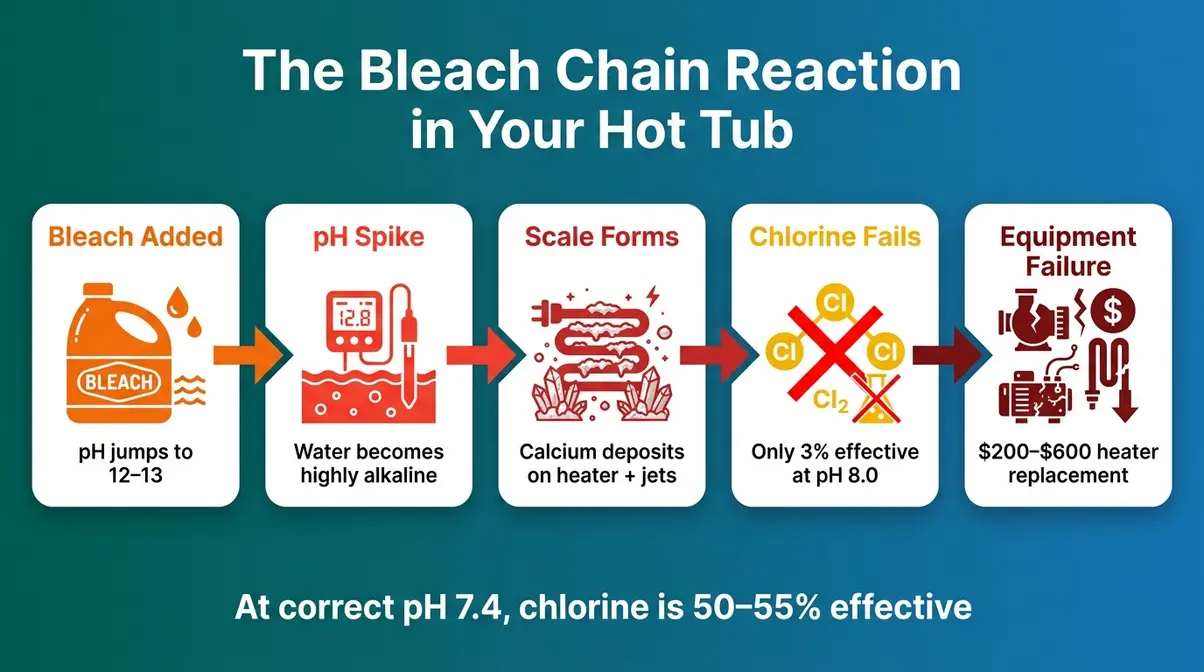
Household bleach has a pH of approximately 12–13. Your hot tub’s ideal water pH range is 7.2–7.8. Every time you add bleach, you’re introducing a highly alkaline substance that pushes your water chemistry far out of balance.
When pH rises above 8.0, calcium carbonate (scale) begins to precipitate out of the water and deposits on your heater element, jet nozzles, and plumbing. Scale acts as an insulator — a heater coated in scale has to work harder, runs hotter, and fails sooner. Pool and spa technicians report heater element failure as one of the most common consequences of chronic high-pH water, and replacement costs typically run $200–$600 depending on the unit.
High-pH water also reduces the effectiveness of the chlorine you just added. At pH 8.0, only about 3% of available chlorine exists as hypochlorous acid (the form that actually kills bacteria). At the correct pH of 7.4, that figure rises to around 50–55%. So adding bleach not only spikes your pH — it simultaneously makes the chlorine you added far less effective. User reports from r/hottub and PoolSpaForum consistently show that owners who use bleach regularly end up battling persistent cloudiness and algae because the chemistry simply isn’t working as expected.
Additives, Foaming, and Damage to Physical Components
Plain, unscented bleach is already problematic in a hot tub. Scented, thickened, or “splashless” bleach formulas add a second layer of risk that makes them completely off-limits.
Most commercial bleach products contain surfactants (soap-like agents that reduce splashing), fragrances, and thickening polymers. When these additives hit hot, turbulent spa water and jet action, they foam aggressively. That foam isn’t just cosmetically unpleasant — it signals that surfactants are coating your jets, filter cartridge, and pump impeller. According to the EPA’s guidelines on pool and spa chemical safety, surfactant contamination in recirculating spa systems is a recognized cause of filter media degradation and pump seal failure.
Beyond the mechanical components, bleach additives attack the physical materials of your hot tub. Acrylic shells become brittle and discolored with repeated chemical exposure outside the manufacturer’s specified range. Vinyl headrests and pillows degrade within weeks of surfactant contact. Foam cover interiors absorb bleach vapor and break down from the inside — a replacement spa cover typically costs $150–$400.
The EPA’s pool and spa chemical guidance emphasizes using products specifically labeled for pool and spa use to avoid these additive-related failures (EPA, 2013).
Warranty Voiding: The Hidden Financial Risk
This is the risk most hot tub owners don’t find out about until it’s too late. The majority of hot tub manufacturers — including major brands like Jacuzzi, Bullfrog, and Hot Spring — explicitly state in their warranty documentation that damage caused by non-approved chemicals is not covered.
The language typically appears under “Conditions That Void Warranty” and references use of chemicals not specifically formulated for spa use. Household bleach is not formulated for spa use. If your heater element corrodes, your acrylic shell cracks, or your jet housing degrades after using bleach, your warranty claim will be denied.
A mid-range hot tub costs $5,000–$12,000. A heater replacement runs $200–$600. A shell refinishing job starts at $1,000. The cost savings from using a $4 jug of bleach instead of a $15 bag of Dichlor disappear quickly when you factor in the warranty exposure. As masterspaparts.com notes, manufacturer warranty compliance is one of the most overlooked aspects of hot tub ownership — and one of the most financially consequential.
If You Choose to Use Bleach: The Only Safe Method
If you’re in an emergency situation and bleach is your only option, there is a right way to do it. This section covers the exact conditions under which plain bleach is acceptable and the precise steps to use it safely.
Only Plain, Unscented Bleach — No Exceptions
Before anything else: the only bleach that is even conditionally acceptable in a hot tub is plain, unscented sodium hypochlorite at 6–8.25% concentration. Read the label carefully before you open the bottle.
Acceptable: “Regular” or “Original” bleach with no added ingredients. Clorox Regular Bleach and similar store-brand equivalents at 6–8.25% NaOCl are in this category.
- Never acceptable — full stop:
- Scented bleach (lavender, lemon, fresh scent — any fragrance)
- “Splashless” or “no-splash” formulas (contain thickening surfactants)
- “Concentrated” bleach above 8.25% NaOCl (too difficult to dose safely)
- Gel bleach or bleach with added cleaners
The Sanitizer Hierarchy places plain bleach in the “emergency-only” tier specifically because even the acceptable version introduces the pH and stability problems described above. It’s a last resort, not a routine option.
Emergency Decontamination vs. Regular Sanitization
This is the distinction no competitor article makes — and it matters enormously for how you use bleach safely.
Emergency decontamination means you need to quickly raise chlorine levels to shock the water after a contamination event: someone got sick in the tub, the water has been sitting untreated for several days, or you’ve just refilled after a drain-and-clean. In this scenario, a single, carefully measured dose of plain bleach can be acceptable as a stopgap until you can get proper Dichlor.
Regular sanitization means maintaining ongoing chlorine levels between 3.0–10.0 ppm (as the CDC recommends) across multiple sessions per week. Bleach is a poor tool for this job because its rapid dissipation at hot tub temperatures means you’d be dosing constantly, each dose spiking your pH, each spike reducing effectiveness and stressing equipment.
| Scenario | Bleach Acceptable? | Better Alternative |
|---|---|---|
| Emergency shock after contamination | Yes — plain only, one-time | Dichlor shock granules |
| Water sitting untreated 3+ days | Yes — plain only, one-time | Dichlor shock granules |
| Routine weekly sanitation | No | Dichlor or bromine |
| Daily maintenance dose | No | Dichlor or bromine |
| Salt system top-up | No | Follow manufacturer protocol |
Step-by-Step: How to Add Bleach to a 300-Gallon Hot Tub Safely
Before You Start — Prerequisites:
- Plain, unscented bleach at 6–8.25% NaOCl (check the label)
- Test strips or a liquid test kit (to measure free chlorine and pH)
- Protective gloves (nitrile or rubber)
- Safety glasses or goggles
- Adequate ventilation — do this outdoors or with the cover fully open
- Estimated time: 20–30 minutes (including 15-minute wait period)
Step 1: Test your current water chemistry.
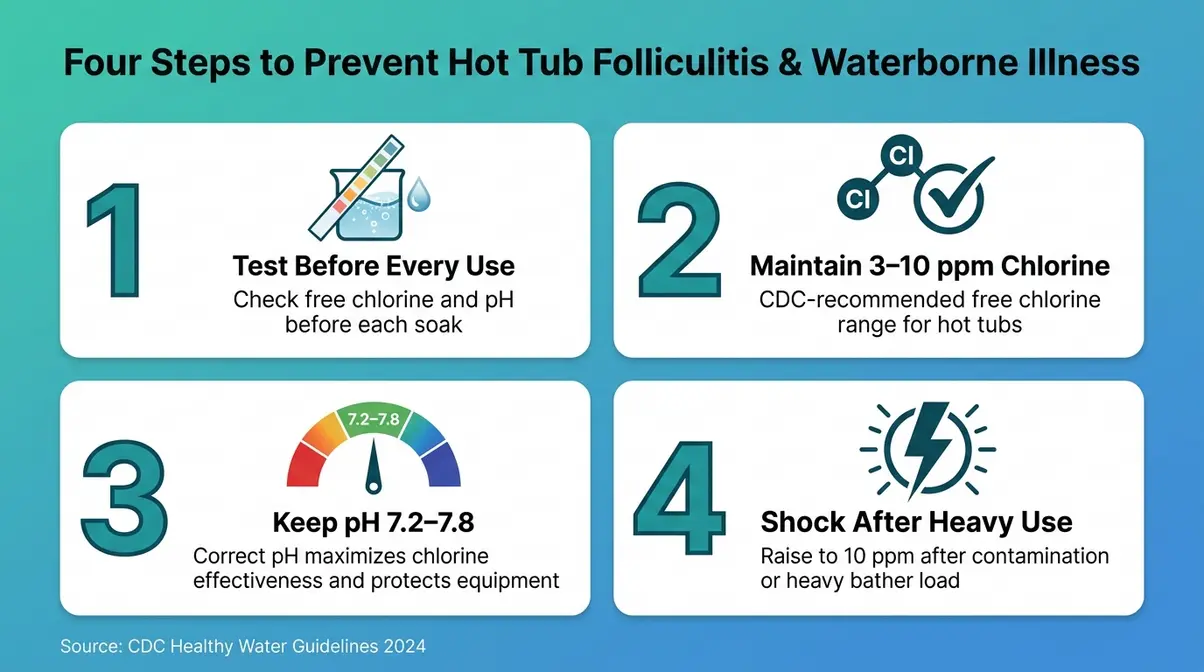
Use test strips to measure your current free chlorine level and pH. Record both numbers. You’re aiming to raise free chlorine to 3.0–5.0 ppm for maintenance, or 10.0 ppm for emergency shock. Why: You need a baseline so you don’t over-dose.
Step 2: Calculate your dose.
For a standard 300-gallon hot tub using 6% plain bleach: add approximately 1.5–2 fluid ounces (3–4 tablespoons) to raise free chlorine by approximately 3–5 ppm. For emergency shock to 10 ppm, use approximately 3–4 fluid ounces. These figures are starting estimates — always verify with a test strip after adding.
| Target Chlorine Level | 300-Gallon Tub | 500-Gallon Tub |
|---|---|---|
| Raise by 3 ppm (maintenance) | ~1.5 fl oz (6% bleach) | ~2.5 fl oz |
| Raise by 5 ppm (light shock) | ~2 fl oz (6% bleach) | ~3.5 fl oz |
| Raise by 10 ppm (emergency shock) | ~3.5 fl oz (6% bleach) | ~6 fl oz |
Step 3: Turn off the jets.
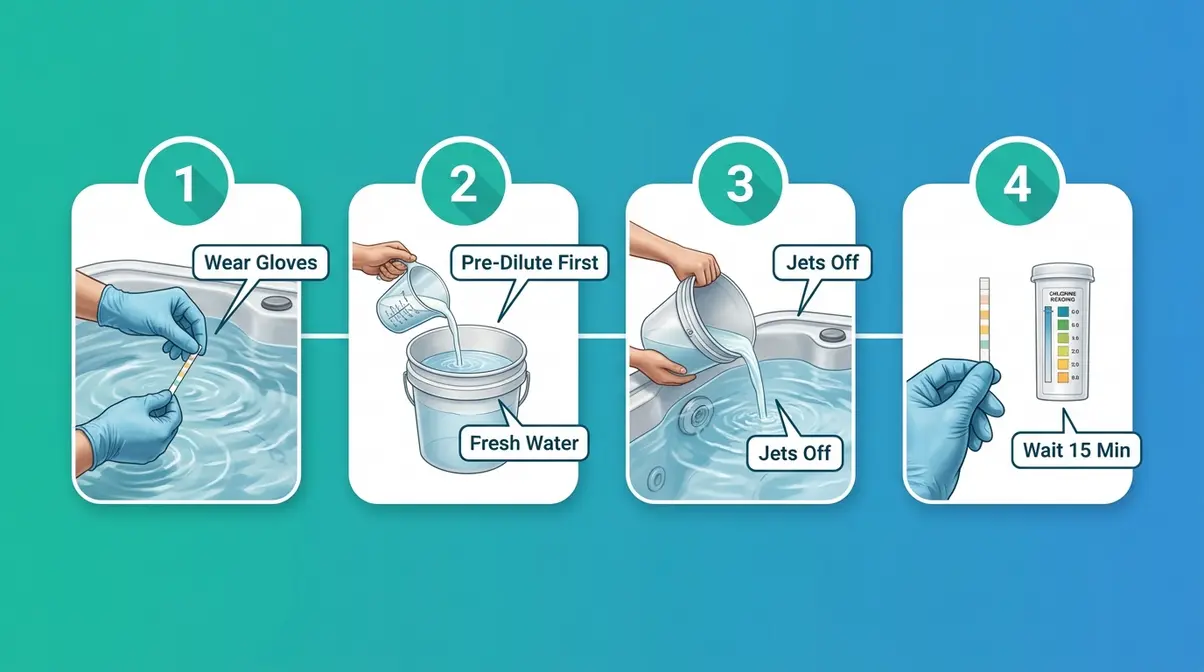
Switch off your hot tub’s jet pumps before adding any chemical. Why: Active jets disperse chemicals unevenly and can splash the concentrated bleach onto your skin or eyes.
Step 4: Pre-dilute the bleach.
Pour your measured bleach dose into a clean plastic bucket with 1 quart of hot tub water. Stir gently. Why: Adding concentrated bleach directly to the tub can create localized high-concentration zones that bleach the acrylic shell.
Step 5: Add the diluted solution slowly.
Pour the bucket contents into the tub near a return jet, moving slowly around the perimeter. Wear your gloves and eye protection throughout this step.
Step 6: Wait 15 minutes, then retest.
Allow the water to circulate (jets off, circulation pump on) for 15 minutes, then test free chlorine and pH again. If chlorine is below target, you may add a second small dose. If pH has risen above 7.8, add a pH decreaser (sodium bisulfate) per the manufacturer’s instructions.
Step 7: Do not enter the tub until levels are safe.
Wait until free chlorine drops below 5 ppm and pH reads 7.2–7.8 before anyone uses the tub. Elevated chlorine combined with high pH is a skin and eye irritant.
Common Mistakes to Avoid:
- Adding bleach directly to the skimmer: This concentrates bleach at the filter and can bleach or degrade the cartridge media.
- Using scented or splashless bleach: Even a small amount of surfactant causes persistent foaming that’s very difficult to clear.
- Skipping the post-dose pH test: Bleach’s high pH can push your water out of range even if chlorine looks correct.
- Treating bleach as a regular routine: One emergency use is a stopgap. Two or three uses in a row begins causing the equipment damage described in the previous section.
Better Alternatives to Bleach for Hot Tub Sanitation
The Sanitizer Hierarchy isn’t about upselling — it’s about matching the right chemistry to the specific conditions of a hot tub. Here’s what actually works, and why.
Dichlor Chlorine: Why It’s the Gold Standard for Hot Tubs
Dichlor (short for sodium dichloro-s-triazinetrione) is the most widely recommended sanitizer for residential hot tubs, and the reason is straightforward chemistry: it’s built for exactly the conditions your spa creates.
Dichlor dissolves completely without leaving residue, has a near-neutral pH of 6.5–7.0 that won’t spike your water chemistry, and contains cyanuric acid that stabilizes the chlorine against heat degradation. A single tablespoon of Dichlor granules in a 300-gallon tub raises free chlorine by approximately 5–6 ppm — a predictable, measurable dose that’s easy to manage with basic test strips.
Cost-wise, Dichlor is not the luxury product some owners assume. A 2-pound container typically costs $12–$18 and provides 30–50 doses for a standard 300-gallon tub. That’s $0.25–$0.60 per treatment — comparable to or less than the effective cost of bleach when you factor in the additional pH adjustment products you’d need after each bleach dose.
As noted on troublefreepool.com, Dichlor is the community-recommended first choice for hot tubs because it requires the fewest corrective chemical additions after each dose — making total cost of ownership lower than it first appears.
Bromine: The Gentler Option for Sensitive Skin
Bromine is the second-tier option in the Sanitizer Hierarchy and the preferred choice for hot tub owners with sensitive skin or those who find the chlorine smell irritating.
Bromine works differently from chlorine: it forms bromamines (rather than chloramines) when it reacts with organic material. Bromamines remain active sanitizers, unlike chloramines, which are the “combined chlorine” compounds responsible for that sharp, eye-stinging smell associated with over-chlorinated pools. The result is a gentler-smelling, skin-friendlier sanitized environment.
Bromine also performs better at high pH levels (7.0–8.0) than chlorine, which makes it more forgiving in a hot tub where pH management can be challenging. The trade-off: bromine costs more per dose than Dichlor and cannot be easily boosted with a shock treatment the way chlorine systems can. For most hot tub owners, bromine tablets placed in a floating dispenser or inline feeder represent a reliable, low-maintenance option.
According to ionrx.com, bromine’s stability at hot tub temperatures makes it a particularly strong choice for owners who use their spa several times per week and want consistent water quality with minimal daily testing.
Baking Soda, Vinegar, and Other Household Myths
Some online forums suggest alternatives like baking soda, white vinegar, or hydrogen peroxide as hot tub sanitizers. These claims need to be addressed directly.
Baking soda (sodium bicarbonate) is a pH buffer and alkalinity increaser — it has legitimate uses in hot tub chemistry, but it is not a sanitizer. It does not kill bacteria, viruses, or algae. Using it as a chlorine substitute will leave your water biologically unsafe.
White vinegar is a mild acid (acetic acid) useful for descaling and lowering pH in small applications. It has no meaningful sanitizing effect at the concentrations practical in a hot tub, and adding enough to matter would damage seals and acrylic.
Hydrogen peroxide (H₂O₂) is used in some specialty “non-chlorine” spa systems — but these are purpose-formulated products at specific concentrations, not the 3% drugstore variety. Drugstore hydrogen peroxide at 3% concentration would need to be added in quantities that make it completely impractical for a 300-gallon tub.
The honest answer: there is no household pantry substitute for a proper spa sanitizer. The Sanitizer Hierarchy exists because each tier was evaluated for effectiveness, safety, and compatibility with hot tub chemistry — not because retailers invented the hierarchy to sell products.
Can a Hot Tub Make You Sick? Health Risks of Poor Sanitation
A properly maintained hot tub is safe and relaxing. An improperly sanitized one — whether from using the wrong chemicals or simply not testing often enough — can cause real health problems. Here’s what the evidence shows.
Can You Get a UTI From a Hot Tub?
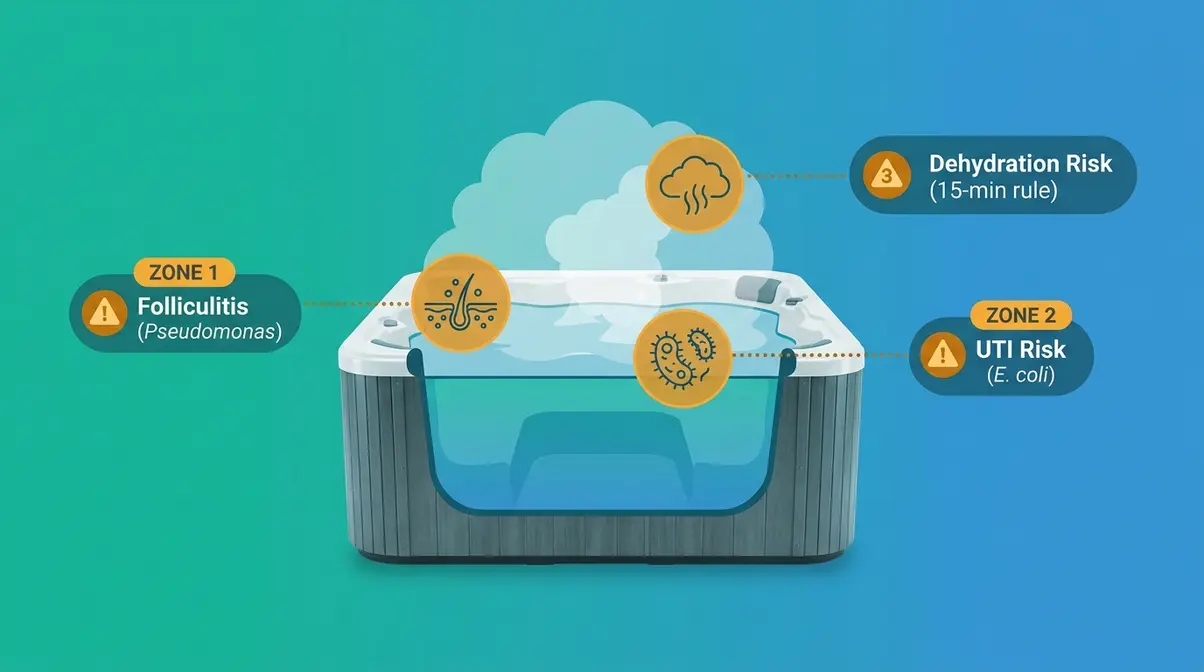
Hot tub water itself does not directly cause urinary tract infections (UTIs), but poorly sanitized spa water creates conditions that increase your risk. UTIs are caused by bacteria entering the urinary tract — most commonly E. coli — and a hot tub with inadequate chlorine levels can harbor enough bacterial load to contribute to that exposure, particularly for women.
The risk is higher if free chlorine has dropped below 1.0 ppm, if the water is visibly cloudy, or if the tub has been used by multiple people without a chlorine check between sessions. If you currently have a UTI, avoid the hot tub entirely — soaking in warm, turbulent water can introduce additional bacteria and prolong recovery.
The Mayo Clinic’s guidance on UTI prevention recommends avoiding prolonged exposure to warm, potentially contaminated water as a general preventive measure (Mayo Clinic, 2023). Maintain free chlorine above 3.0 ppm and test before every session.
Hot Tub Folliculitis: Causes, Symptoms, and Prevention
Hot tub folliculitis is a skin infection caused by Pseudomonas aeruginosa, a bacterium that thrives in warm, under-chlorinated water. It appears as a red, itchy rash — typically on areas covered by a bathing suit — within 12–48 hours of exposure to contaminated water.
The CDC identifies hot tubs and spas as the primary environment for Pseudomonas aeruginosa outbreaks in recreational water settings, noting that the bacteria can survive even brief lapses in proper disinfection. The CDC’s healthy water guidelines recommend testing hot tub water before each use and maintaining the 3.0–10.0 ppm free chlorine range specifically to prevent folliculitis and other waterborne illness (CDC, 2024).
If you or a bather develops folliculitis after using a hot tub, the treatment protocol for the tub itself is: drain completely, scrub all surfaces with a diluted bleach solution (this is an appropriate use of bleach — surface decontamination, not water treatment), rinse thoroughly, refill, and shock with Dichlor to 10 ppm before any further use.
Hot tub folliculitis is entirely preventable with consistent sanitation. Maintaining chlorine levels within the CDC-recommended range eliminates Pseudomonas aeruginosa from the water supply before it can cause infection.
Can You Get an STD or Gonorrhea From a Hot Tub?
The short answer: no, you cannot get gonorrhea or other sexually transmitted infections from hot tub water. Neisseria gonorrhoeae (the bacterium that causes gonorrhea) and most other STI pathogens cannot survive in properly chlorinated water, and they die rapidly even in unchlorinated water due to osmotic stress and temperature.
The Cleveland Clinic confirms that gonorrhea and most STIs require direct mucous membrane contact for transmission — casual water contact does not provide a viable transmission route (Cleveland Clinic, 2023). This is a persistent myth worth addressing directly: you cannot “catch” an STI by sharing a hot tub.
What you can contract from a poorly maintained hot tub is Pseudomonas folliculitis (described above), Legionella (from aerosolized water in inadequately maintained tubs), and gastrointestinal illness from Cryptosporidium — all preventable with proper sanitation.
Can a Hot Tub Dehydrate You?
Yes — soaking in a hot tub raises your core body temperature, which triggers sweating even though you’re submerged in water. You lose fluids through perspiration without feeling the typical thirst signals that would prompt you to drink. This is the physiological basis for the commonly cited “15-minute rule.”
Most hot tub manufacturers and aquatic health guidelines recommend limiting continuous soaking sessions to 15–20 minutes, especially at temperatures above 100°F. After that, exit, cool down, and drink water before re-entering. Children, elderly individuals, and anyone taking blood pressure medication face elevated dehydration and heat stress risk and should limit sessions further.
Practical prevention: keep a water bottle at the tub’s edge, limit sessions to 15 minutes at a time, and avoid alcohol before or during hot tub use — alcohol accelerates dehydration and impairs your body’s ability to regulate temperature.
Epsom Salts and Pool Salt in a Hot Tub (What You Need to Know)
Can You Put Epsom Salt in a Hot Tub or Jacuzzi?
Epsom salt (magnesium sulfate) is popular for bath soaks, but adding it to a jetted hot tub or Jacuzzi is not recommended. While a single bath tub application is low-risk, the recirculating nature of a hot tub creates specific problems.
Epsom salt raises total dissolved solids (TDS) in your water. High TDS interferes with sanitizer effectiveness and makes the water difficult to balance chemically. More critically, magnesium sulfate can corrode metal components over time — particularly jet internals, heater elements, and pump hardware made from brass or copper alloys. Many manufacturers explicitly prohibit Epsom salt use in their warranty documentation for these reasons.
For the full breakdown of Epsom salt compatibility with specific hot tub models, see our detailed guide at onehottub.com/can-you-put-epsom-salts-in-a-hot-tub.
Can You Use Pool Salt in a Hot Tub?
Pool salt (sodium chloride) is designed for salt chlorinator systems — it generates chlorine via electrolysis when passed through a salt cell. Using pool salt in a hot tub without a dedicated salt chlorination system does nothing for sanitation and simply raises your water’s salinity unnecessarily.
If your hot tub has a built-in salt system (some premium models do), use only the salt grade specified by the manufacturer — typically pharmaceutical-grade or food-grade sodium chloride at the stated concentration. Standard pool salt works in these systems, but always verify the purity grade and dosage in your manual. Adding pool salt to a non-salt-system hot tub will not sanitize the water and may corrode metal components in the same way as Epsom salt.
Can a Doctor Prescribe a Hot Tub?
Which Medical Conditions May Qualify for Hydrotherapy
Yes — a physician can write a letter of medical necessity for a hot tub as part of a prescribed hydrotherapy treatment plan. Conditions that commonly qualify include osteoarthritis, rheumatoid arthritis, fibromyalgia, chronic lower back pain, multiple sclerosis, and post-surgical rehabilitation programs.
The key distinction is that the hot tub must be prescribed as treatment for a specific diagnosed condition — not purchased for general wellness or relaxation. The prescription typically takes the form of a Letter of Medical Necessity (LMN) from a licensed physician or physical therapist outlining the diagnosis, the prescribed treatment modality (hydrotherapy), and the medical necessity of home equipment.
For a comprehensive overview of conditions that qualify and the documentation process, visit onehottub.com/what-is-hot-tub-therapy.
What a Letter of Medical Necessity Actually Means
A Letter of Medical Necessity is not a traditional prescription — it’s a formal document from a licensed healthcare provider stating that a specific item or treatment is medically necessary for a patient’s diagnosed condition. For hot tubs, this letter can support two financial applications: insurance reimbursement (rare, but possible with some health plans and HSA/FSA accounts) and a tax deduction under IRS Publication 502.
IRS Publication 502 governs medical expense deductions for tax purposes. It allows deductions for equipment prescribed for medical treatment, provided the primary purpose is medical (not recreational). The deductible amount is typically limited to the cost that exceeds the home’s value increase from the installation — meaning the hot tub’s “added home value” portion is not deductible.
According to IRS Publication 502, capital expenses for medical equipment are deductible to the extent they exceed any increase in property value (IRS, 2024). Consult a tax professional before claiming this deduction, as the calculation requires a formal appraisal.
Frequently Asked Questions
How much bleach should I add to a 300-gallon hot tub?
For a 300-gallon hot tub, use approximately 1.5–2 fluid ounces (3–4 tablespoons) of plain 6% bleach to raise free chlorine by roughly 3–5 ppm. For emergency shock to 10 ppm, increase that to 3.5–4 fluid ounces. Always pre-dilute in a bucket of spa water before adding, and retest with test strips 15 minutes after dosing. These figures apply only to plain, unscented bleach at 6–8.25% NaOCl — never scented or splashless formulas.
What can I use in my hot tub instead of chlorine?
Bromine is the most popular chlorine alternative for hot tubs, particularly for owners with sensitive skin. Bromine tablets in a floating dispenser provide steady, low-maintenance sanitation. Mineral systems (silver/copper ion cartridges) can reduce the amount of chlorine or bromine needed but do not replace it entirely. Saltwater systems generate their own chlorine via electrolysis and are available on premium models. Baking soda, vinegar, and hydrogen peroxide are not effective sanitizers and should not be used as substitutes.
Why is using bleach in a hot tub risky?
Household bleach is risky in a hot tub primarily because of its high pH (~12–13) and lack of stabilizer. Each dose spikes your water’s pH, which reduces chlorine effectiveness and promotes scale buildup on heaters and jets. At hot tub temperatures of 100–104°F, unstabilized bleach dissipates 4–5 times faster than Dichlor, making consistent sanitation nearly impossible. Scented or thickened bleach formulas add surfactant damage to the equation. Most manufacturers also consider bleach use a warranty-voiding event.
How do you treat a hot tub after folliculitis?
After a hot tub folliculitis outbreak, drain the tub completely and decontaminate all surfaces. Scrub the shell, jets, and filter housing with a diluted bleach solution (1 tablespoon per gallon of water), rinse thoroughly, and clean or replace the filter cartridge. Refill with fresh water, then shock with Dichlor to 10 ppm free chlorine. Allow chlorine to drop below 5 ppm before re-entry. The CDC recommends this shock protocol to eliminate Pseudomonas aeruginosa from spa surfaces and plumbing (CDC, 2024).
Why is there a 15-minute hot tub rule?
The 15-minute rule exists because prolonged soaking at 100–104°F raises your core body temperature and triggers significant fluid loss through sweating, even though you’re immersed in water. After approximately 15–20 minutes, the risk of heat stress, dizziness, and dehydration increases — particularly for children, elderly users, and anyone on blood pressure or heart medications. Most hot tub manufacturers and aquatic health guidelines recommend 15-minute sessions followed by a cool-down period and water intake before re-entry.
Do hot tubs reduce cortisol?
Research suggests that regular hot tub use may reduce cortisol (the primary stress hormone) through a combination of heat therapy and parasympathetic nervous system activation. A study published in the International Journal of Stress Management found that passive hydrotherapy significantly reduced self-reported stress markers in participants. The warm water raises body temperature, which promotes muscle relaxation and may improve sleep quality — both of which are associated with lower baseline cortisol. However, individual responses vary, and hot tub use is a complement to, not a replacement for, evidence-based stress management.
Why do people put tennis balls in a hot tub?
Tennis balls are placed in a hot tub to absorb body oils, cosmetics, and sunscreen that accumulate in the water over time. The felt surface of a tennis ball acts as a passive absorbent — oils cling to the fibers rather than forming a scum line on the waterline or clogging the filter. This is a genuine community hack (widely discussed on r/hottub and PoolSpaForum) that can extend filter life and reduce the frequency of scum line cleaning. Use clean, unused tennis balls, and replace them every 2–4 weeks.
Why do so many people get rid of their hot tubs?
The most commonly cited reasons hot tub owners sell or remove their tubs are ongoing maintenance costs, chemical management complexity, and energy bills. A hot tub costs an average of $50–$100 per month in electricity to maintain at temperature, plus $20–$50 monthly in chemicals. Owners who underestimated these ongoing costs — or who purchased without understanding the weekly testing and chemical balancing routine — frequently find the tub underused. Poor water chemistry leading to equipment failure is the second most common reason, reinforcing why using the right sanitizers from the start protects your long-term investment.
The Right Chemical for the Right Job
For budget-conscious hot tub owners, the bleach question deserves a straight answer: stores are not lying to you, but they’re often not explaining the full picture either. Household bleach can be used in a hot tub — in a genuine emergency, using only plain unscented formula, with careful dosing and immediate pH correction. That’s the honest truth.
The Sanitizer Hierarchy exists because the chemistry of a 100–104°F jetted tub is genuinely different from a pool or a laundry load. Unstabilized bleach dissipates 4–5 times faster at spa temperatures, each dose spikes pH into the scale-forming range, and most manufacturer warranties explicitly exclude damage from non-spa-formulated chemicals. The CDC’s recommended range of 3.0–10.0 ppm free chlorine is achievable with bleach — but sustaining it reliably requires a stabilized product like Dichlor.
The Sanitizer Hierarchy is not about brand loyalty. It’s a framework built on what the chemistry actually does at 100°F. Dichlor costs $0.25–$0.60 per dose — less than most people assume — and eliminates the pH correction step, the warranty risk, and the equipment wear that comes with routine bleach use.
Start with a 2-pound bag of Dichlor and a set of test strips. Test before every soak, maintain 3.0–5.0 ppm free chlorine and pH between 7.2–7.8, and your hot tub will reward you with reliable, safe water — without the guesswork.