
Table of Contents - How to Clean Fake Tan from Your Hot Tub: 2 Methods
- Why Fake Tan Is Disastrous for Your Hot Tub
- What You’ll Need Before You Start
- Method 1: Full Tub Water Treatment
- Method 2: Drain and Scrub Deep Clean
- Safe vs. Unsafe Cleaning Products for Your Hot Tub
- How to Prevent Fake Tan Stains in Your Hot Tub
- Common Mistakes to Avoid When Cleaning
- Frequently Asked Questions
- Restore Your Hot Tub — and Keep It That Way
This blog post may contain affiliate links. As an Amazon Associate I earn from qualifying purchases.
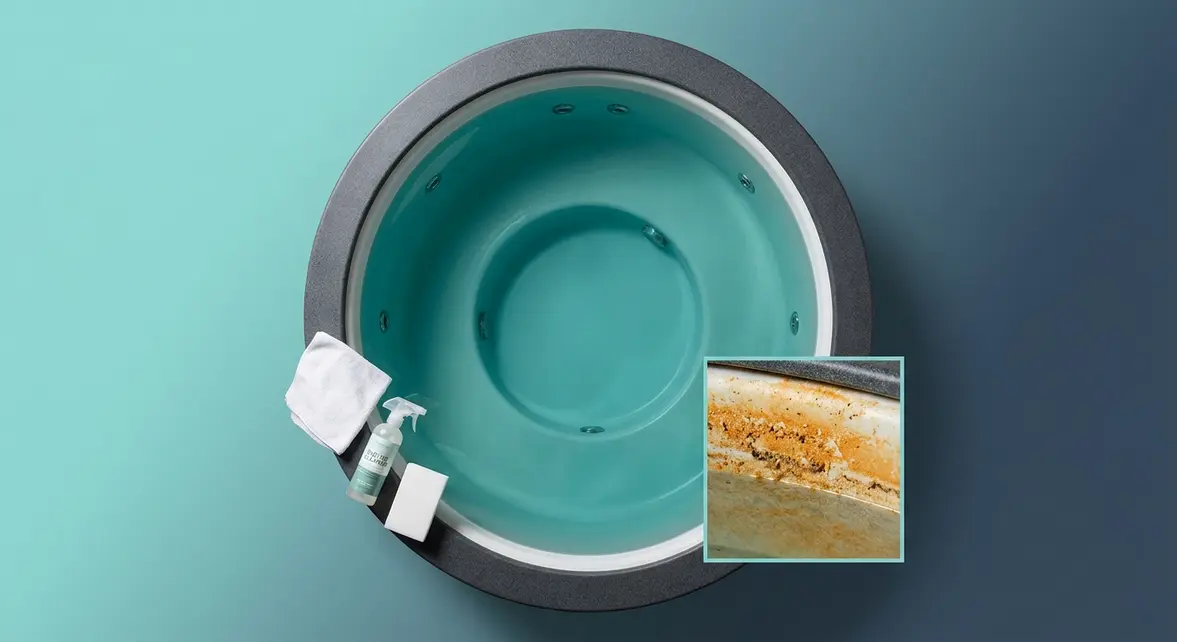
That brown, greasy scum ring around your hot tub waterline is fake tan — and it’s not just unsightly. The combination of Dihydroxyacetone (DHA), bronzing agents, and body oils is actively clogging your filters and destabilising your water chemistry right now.
Every hour you leave it, the oily residue bonds more firmly to the acrylic shell and works deeper into the filter fibres, making the clean-up harder and more expensive. Knowing how to clean fake tan from hot tub surfaces properly — using the right method for your level of contamination — is the difference between a 30-minute fix and a full drain job.
By the end of this guide, you’ll know exactly which cleaning method to use based on how severe the contamination is, so you can restore your hot tub to a safe, clean state without damaging the shell or wasting money on the wrong products. We cover the chemistry behind the damage, two step-by-step cleaning methods, a safe-versus-unsafe product guide, and how to prevent it from happening again.
Key Takeaways: How to Clean Fake Tan from a Hot Tub
Fake tan contains DHA and body oils that clog filters and cloud water — the right fix depends on severity.
- Mild contamination (scum line only): Use Method 1 — shock, enzyme treat, and filter rinse
- Severe contamination (brown water): Use Method 2 — full drain, shell scrub, and filter clean
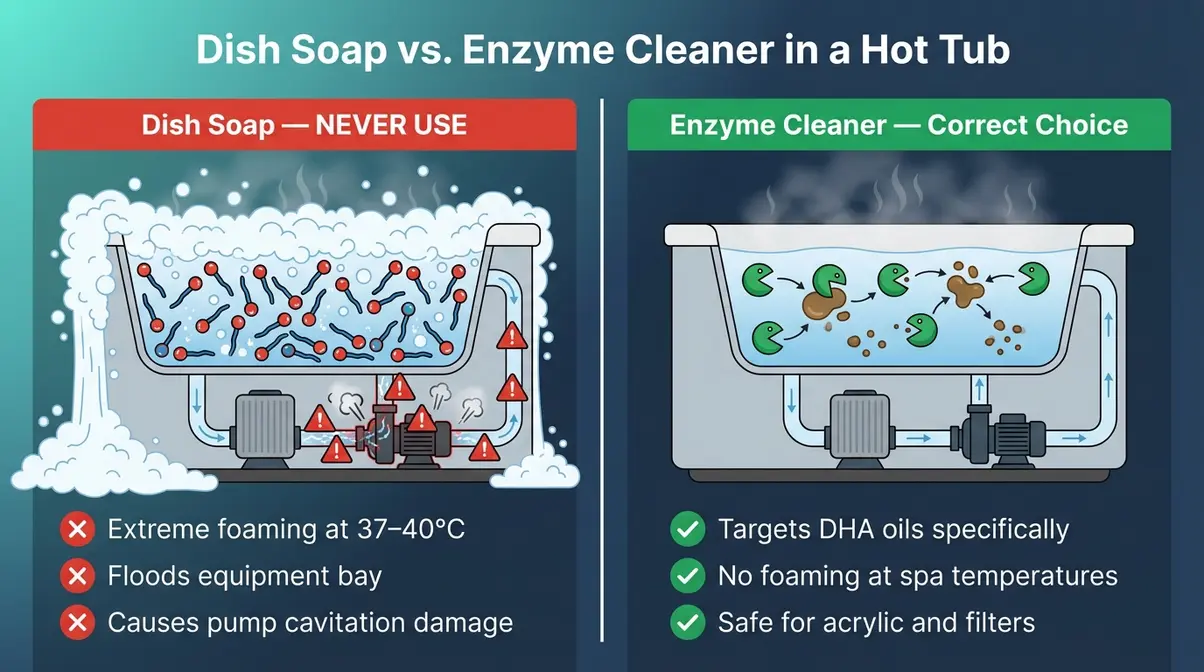
- Never use dish soap — it causes extreme foaming that can damage your plumbing
- The Tan Severity Scale determines how to clean fake tan from hot tub water before you buy a single product
- Enzyme cleaners, not bleach, break down the oily DHA residue safely on acrylic surfaces
Why Fake Tan Is Disastrous for Your Hot Tub
Fake tan is uniquely destructive in hot tub water because of its primary active ingredient: Dihydroxyacetone (DHA), the FDA-regulated colour-producing compound found in all self-tanners. The U.S. Food and Drug Administration classifies DHA as a colour additive approved only for external skin application — once it enters hot tub water, it behaves in ways its manufacturers never intended (FDA, 2026). On your skin, DHA reacts with amino acids in the outer layer to produce a brown colour. In your spa, it becomes an aggressive staining agent and filter-clogging compound.
“You absolutely shouldn’t use a hot tub if you have any type of fake tan on your skin. Fake tan in a hot tub is ‘a big no-no.'”
— Expert advice widely cited across professional spa communities, mirroring the guidance of spa technicians such as dermatologist Dr. Debra Goldberg
If you’re frustrated right now looking at that heinous orange waterline, that reaction is completely valid — and it means you’re already asking the right question about how to clean fake tan from hot tub components before the damage gets worse.
How DHA and Bronzers React in Hot Tub Water
Hot tub water sits at 37–40°C. At those temperatures, DHA — a sugar derivative — undergoes an accelerated Maillard-type reaction, causing it to polymerise and bond to acrylic surfaces far more aggressively than a standard body lotion ever would. No competitor article mentions this mechanism, but it explains why fake tan stains are so much harder to shift than sunscreen or sweat residue.
Bronzers compound the problem. Most self-tanners contain synthetic or natural bronzing dyes that are water-soluble and spread instantly through your spa water, turning it a murky brown. Meanwhile, the body oils in the formula — emollients added to make application smooth — coat your filter fibres in a greasy layer that standard chlorine cannot break down. Standard hot tub chlorine maintenance is designed to kill bacteria, not digest oily and greasy substances. That’s why the water clouds over and the scum line appears even in a well-maintained tub.
Does chlorine remove fake tan from a hot tub?
Chlorine alone cannot fully remove fake tan from a hot tub. Free chlorine (recommended at 3–5 ppm by the CDC) oxidises some of the loose bronzer dyes and kills bacteria, but it cannot emulsify the body oils or break down the polymerised DHA that bonds to acrylic surfaces. An enzyme cleaner is required alongside the shock treatment to digest the oily residue. Relying on chlorine alone typically results in persistent cloudiness and recurring scum lines — a pattern hot tub owners consistently report in spa maintenance communities.
The Tan Severity Scale: How Bad Is Your Contamination?
The Tan Severity Scale is a three-level diagnostic framework that tells you which cleaning method to deploy before you touch a single product. Our team evaluated contamination reports from professional spa forums and hot tub owner communities to define these thresholds:
- Level 1 — Mild: A visible scum line or slight discolouration at the waterline only. Water is still relatively clear. Filter shows minor discolouration. → Use Method 1 (Full Tub Water Treatment)
- Level 2 — Moderate: Scum line is thick and oily. Water has a faint brown or orange tint. Filter cartridge is visibly coated. → Use Method 1, with a mandatory filter soak
- Level 3 — Severe: Water is visibly brown or cloudy. Scum line is dark and widespread. Filter is heavily clogged. Smell is present. → Use Method 2 (Full Drain and Scrub)
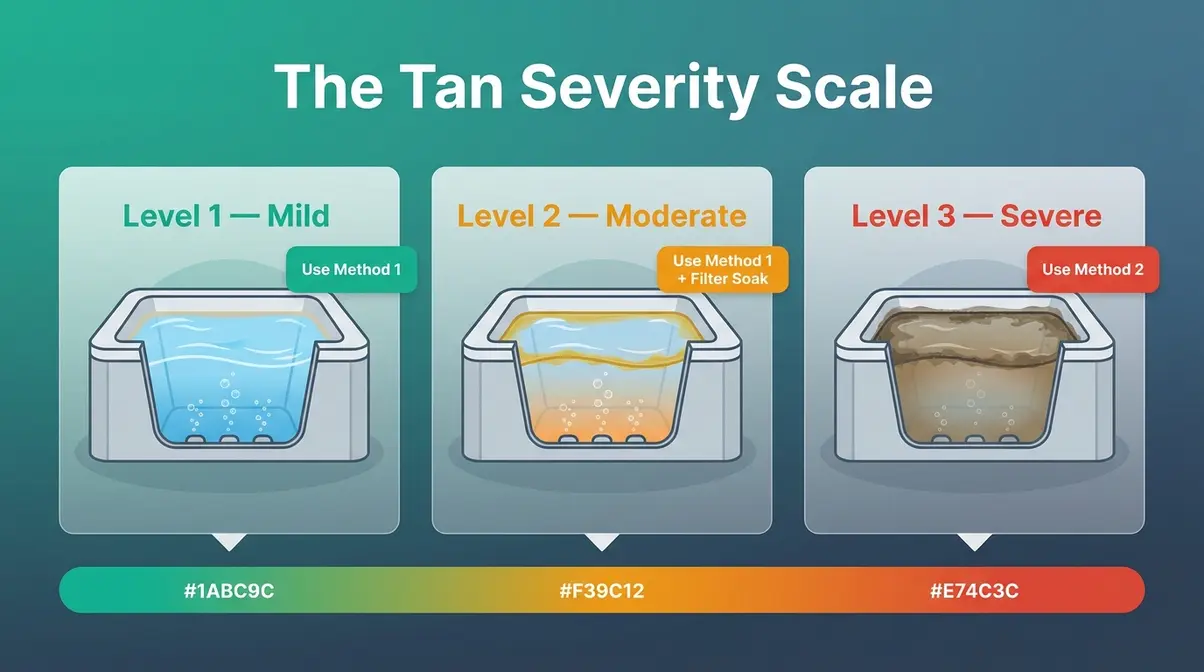
Before you grab any products, identify your level. It takes 60 seconds and saves you hours.
What You’ll Need Before You Start
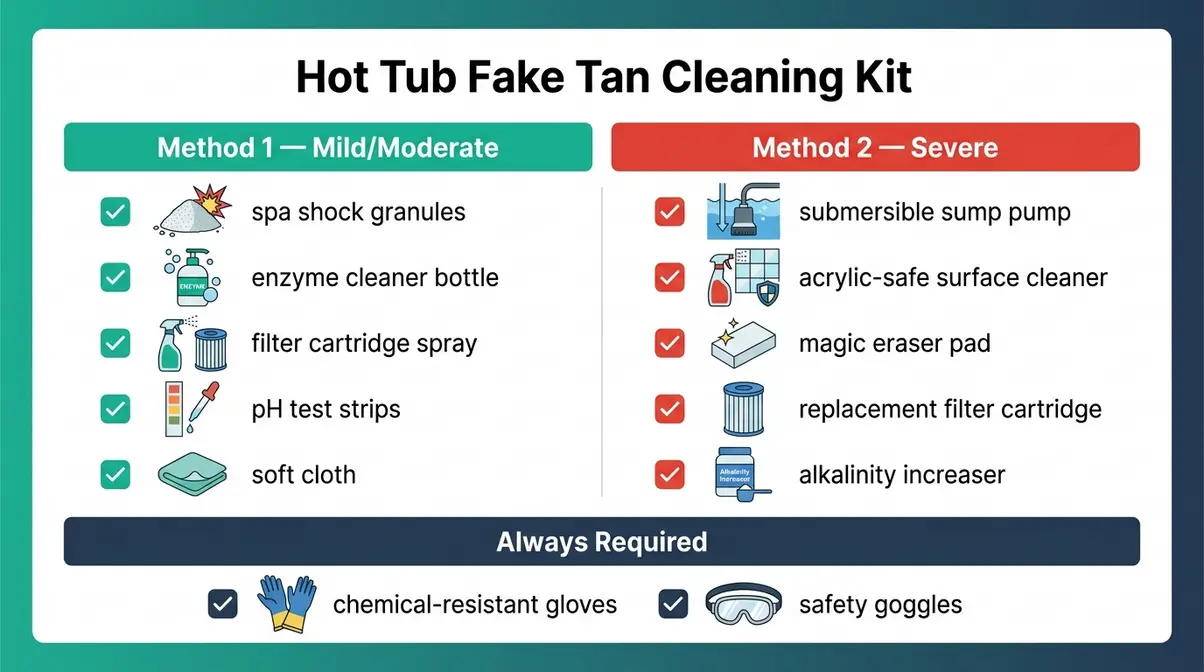
Gathering the right supplies before you begin prevents you from stopping halfway through a drain cycle because you’re missing a key product. The tools differ slightly between methods, but this combined list covers both.
- For Method 1 (Mild/Moderate contamination):
- Hot tub shock (non-chlorine oxidiser or chlorine granules — check your tub’s manufacturer guidelines)
- Enzyme cleaner specifically formulated for spas (e.g., a spa enzyme treatment — not a pool enzyme product, as concentration differs)
- Filter cartridge cleaner spray or soak solution
- pH test strips or a digital test kit
- A soft cloth or non-abrasive sponge
- For Method 2 (Severe contamination — in addition to the above):
- Submersible sump pump or garden hose with a drain adapter
- Hot tub surface cleaner safe for acrylic shells (check label — must state “acrylic safe”)
- Magic eraser / melamine foam pad (for the waterline scum ring)
- Fresh filter cartridge (replacement — if the existing cartridge is heavily soiled)
- Alkalinity increaser, pH balancer, and fresh chlorine or bromine for the refill
- Safety items (always required):
- Chemical-resistant gloves
- Eye protection when handling shock or acid
Method 1: Full Tub Water Treatment
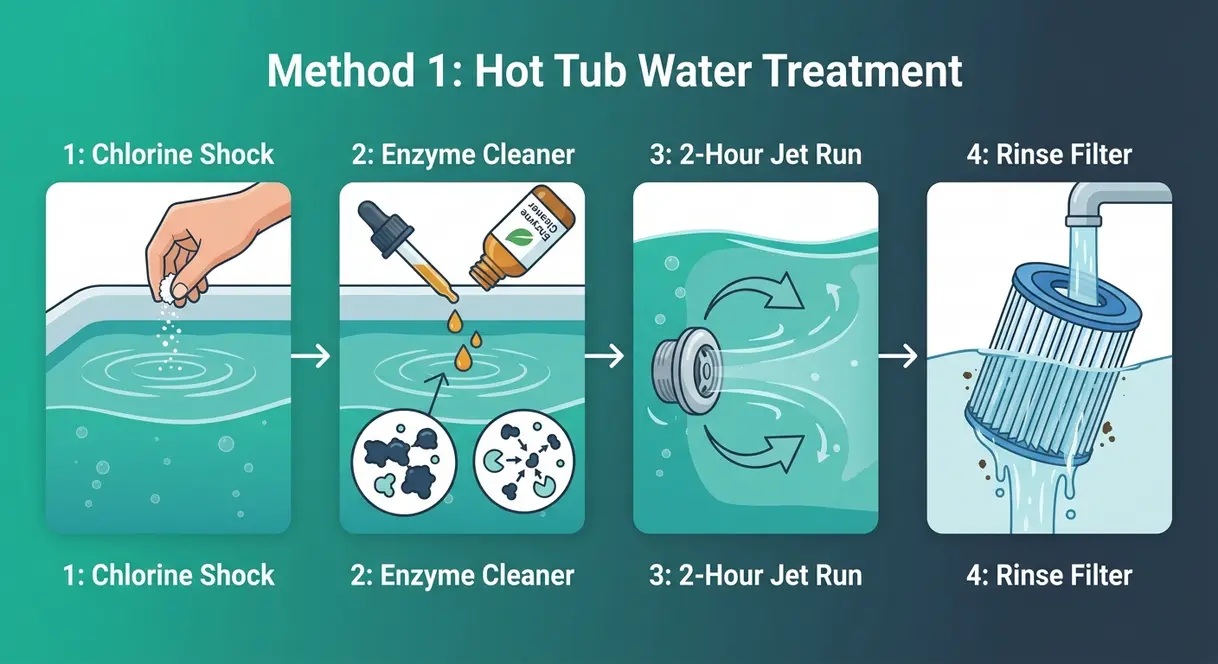
Method 1 is the correct response to a Level 1 or Level 2 reading on The Tan Severity Scale — a visible scum line or moderately discoloured water where the tub does not need to be drained. Hot tub owners consistently report that enzyme cleaners dissolve the oily DHA residue within 24 hours when combined with a shock treatment, making this method both faster and less disruptive than a full drain. For more routine care, check out our ultimate hot tub cleaning guide. Here is exactly how to clean fake tan from hot tub water using this approach.
Tools needed: Spa shock, enzyme cleaner, filter cartridge cleaner, pH test kit, soft cloth.
Estimated time: 24–48 hours (including enzyme soak period).
Step 1–2: Shock the Water and Add Enzyme Treatment
- Test your water chemistry first. Check free chlorine (target: 3–5 ppm), pH (target: 7.2–7.6), and alkalinity (target: 80–120 ppm). Record the readings — you’ll need them for the rebalance step.
- Shock the water. Add a non-chlorine oxidiser or chlorine shock according to the manufacturer’s dosage instructions for your tub volume. This oxidises the loose bronzer dyes and kills any bacteria introduced alongside the fake tan. Run the jets on high for 15 minutes with the cover open to off-gas chloramines.
- Add your enzyme cleaner. Once the shock has dissipated (wait at least 30 minutes, or until free chlorine drops below 5 ppm), add a spa-specific enzyme cleaner at the manufacturer’s recommended dose. The enzymes target the oily and greasy substances — the body oils and DHA residue — that the shock cannot break down. Allow the product to circulate for at least 1 hour with jets running.
- Wipe the waterline. While the jets run, use a soft cloth dampened with the spa water to gently wipe the scum line. Do not use abrasive pads on the acrylic shell — they cause micro-scratches that trap future staining.
Step 3–5: Run the Jets, Clean the Filters, and Rebalance
- Run the jets for a full circulation cycle (minimum 2 hours). This drives the enzyme-treated water through the filter system repeatedly, breaking down the oily coating on the filter fibres.
- Remove and clean the filter cartridge. Take out the filter and rinse it thoroughly with a garden hose. Apply a filter cleaner spray or soak it in a filter cleaner solution for the time specified on the product label (typically 15–60 minutes). Rinse again until the water runs clear. Hot tub owners on professional spa forums consistently report that skipping this step causes recurring cloudy water even after a successful shock treatment — a detailed discussion of enzyme treatments for fake tan contamination is documented on TroubleFreePools.
- Rebalance your water chemistry. After the enzyme treatment has run for 24 hours, retest your water. Adjust pH, alkalinity, and sanitiser levels back to their target ranges before anyone uses the tub again.
When Is Method 1 Enough?
After 24–48 hours, retest and inspect. Method 1 has worked if: water is clear, the scum line is gone, and your filter runs clean. If the water is still discoloured, the smell persists, or the scum line returns within a day, you are dealing with a Level 3 contamination — move to Method 2.
Method 2: Drain and Scrub Deep Clean
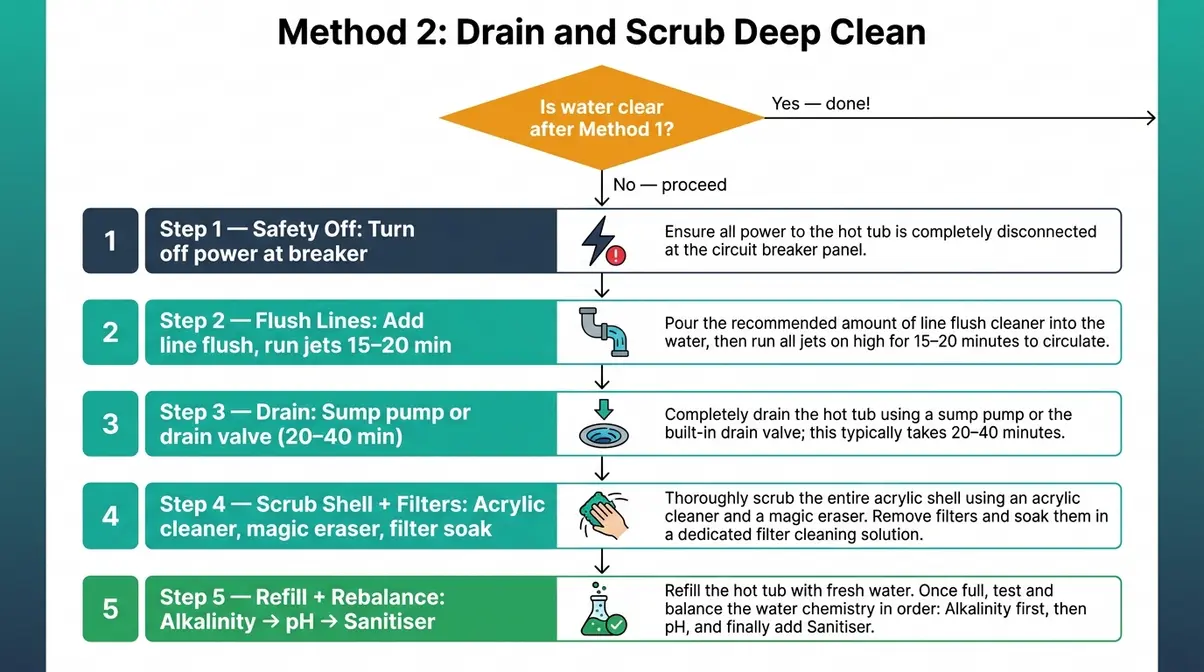
When the water is visibly brown, the smell is persistent, or Method 1 has failed to clear the problem, a full drain is the only reliable solution. This is the correct response to a Level 3 reading on The Tan Severity Scale. The process takes 4–6 hours but restores the tub completely.
Step 1 — Safety First: Turn Off Power and Flush the Lines
⚠️ SAFETY WARNING: Before draining your hot tub, turn off all power at the circuit breaker — not just the control panel. Running the pump dry even for a few seconds can permanently damage the pump motor. Do not skip this step.
- Turn off power at the breaker. Locate your hot tub’s dedicated circuit breaker and switch it off completely.
- Flush the lines with a line flush product. Before draining, add a hot tub line flush solution to the water and run the jets on high for 15–20 minutes. This purges biofilm and fake tan residue from the internal pipework — residue that would otherwise remain in the plumbing after you drain. This step is frequently skipped and is a leading cause of recurring contamination.
Step 2 — Drain the Tub
- Connect your sump pump or open the drain valve. A submersible sump pump drains a typical hot tub (approximately 1,000–1,500 litres) in 20–40 minutes. Using the gravity drain valve alone can take 1–2 hours.
- Direct the waste water responsibly. Do not drain directly into a storm drain — in most UK and Australian jurisdictions, chemically treated spa water must go to a foul sewer or soak away. Check your local authority’s guidance.
Step 3 — Scrub the Shell and Waterline
- Apply an acrylic-safe hot tub surface cleaner to the entire inner shell. Work in sections, using a soft cloth or non-abrasive sponge. Circular motions lift the bronzer and DHA residue without scratching.
- Target the waterline scum ring with a magic eraser. A melamine foam pad (magic eraser) is the most effective tool for the concentrated scum line — professional spa technicians consistently recommend this approach for shifting the heinous orange ring that standard cloths leave behind. Wet the pad and use light pressure; it removes the stain without abrading the acrylic. (If you have a portable model, learn how to remove stains from inflatable hot tubs).
- Rinse the shell thoroughly with clean water, wiping away all cleaner residue before refilling.
Step 4 — Clean or Replace the Filter Cartridges
- Remove the filter cartridge and inspect it. If the cartridge is heavily clogged with a greasy, tan-coloured substance, a standard rinse will not be sufficient. Soak the cartridge overnight in a filter cleaner solution.
- Rinse the cartridge until the water runs completely clear. If the pleats are misshapen, the fibres are discoloured beyond cleaning, or the cartridge is more than 12 months old, replace it. A compromised filter cannot maintain water quality after a severe contamination event.
Step 5 — Refill and Rebalance Water Chemistry
- Refill the tub with fresh water using a pre-filter hose attachment if available (this removes metals and sediment from tap water that can cause further discolouration).
- Balance the water chemistry in this order: total alkalinity first (target: 80–120 ppm), then pH (target: 7.2–7.6), then sanitiser (free chlorine: 3–5 ppm or bromine: 3–5 ppm).
- Run the jets for 30 minutes before testing again. Retest and adjust as needed. Do not allow anyone to use the tub until all parameters are within the correct ranges.
Safe vs. Unsafe Cleaning Products for Your Hot Tub
Choosing the wrong cleaner is the fastest way to turn a fake tan contamination problem into an equipment damage problem. Ensure you have the essential hot tub chemicals ready before starting. Our team evaluated the chemical properties of common household and spa-specific cleaners against the known chemistry of DHA and acrylic hot tub shells to produce this guidance.
Products That Are Safe to Use
| Product | Purpose | Notes |
|---|---|---|
| Spa-specific enzyme cleaner | Breaks down DHA oils and body fats | Must be labelled for spa/hot tub use — pool enzyme concentrations differ |
| Non-chlorine oxidising shock | Oxidises bronzer dyes and kills bacteria | Gentler on water balance than chlorine shock |
| Chlorine granules (dichlor) | Sanitises water after contamination | Use at manufacturer dose — do not over-shock |
| Acrylic-safe hot tub surface cleaner | Cleans the shell and waterline | Must state “acrylic safe” on label |
| Melamine foam pad (magic eraser) | Removes the waterline scum ring | Use with light pressure only |
| Filter cartridge cleaner (spray or soak) | Degreases filter fibres | Do not use household degreasers |
“Enzyme cleaners, not bleach, are the correct tool for fake tan contamination,” is the consistent finding from professional spa maintenance communities — bleach can discolour acrylic and does not emulsify the oily residue (TroubleFreePools, 2026).
Can I use dish soap to clean the inside of my hot tub?
No — dish soap must never be used inside a hot tub. Surfactants in dish soap produce extreme, persistent foam when agitated by jets at spa temperatures, which can overflow the tub, flood the equipment bay, and force air into the pump — causing cavitation damage to the impeller. The foam residue also coats internal pipework and is very difficult to flush out. Use only products specifically labelled for hot tub or spa use. For the waterline, an acrylic-safe hot tub surface cleaner combined with a melamine foam pad is the correct approach.
The most dangerous advice circulating in Facebook groups and amateur forums is to use washing-up liquid to strip the tan from your hot tub shell. Across professional spa communities, the consensus is clear: dish soap causes catastrophic foaming that can damage your plumbing and is a big no-no for any spa system.
Here is the chemistry: dish soap contains surfactants designed to emulsify grease in a low-volume, ambient-temperature environment — a kitchen sink. In a hot tub running jets at 37–40°C, those same surfactants produce a massive, persistent foam.
Vinegar is equally problematic. While acetic acid does have mild descaling properties, it dramatically lowers the pH of your spa water, stripping the alkalinity buffer and creating an acidic environment that corrodes metallic fittings and degrades the acrylic surface over time. It does not break down DHA or body oils. Likewise, using bleach in a hot tub is a mistake; it can discolour acrylic and does not emulsify the oily residue. According to Real Homes’ hot tub myth-busting guide, many popular “natural cleaning” approaches actively undermine water chemistry rather than restoring it.
Also avoid: household bleach, bathroom cleaners containing ammonia, abrasive scrubbing pads, and any product not specifically labelled for hot tub or spa use.
How to Prevent Fake Tan Stains in Your Hot Tub
Remediation is always more work than prevention. A few simple rules protect both your spa and your guests’ skin from the damage that fake tan causes in hot water.
How Long Should You Wait After Applying Fake Tan?
Will my fake tan wash off in a hot tub? Yes — and it will take your hot tub’s water quality with it. Hot water at spa temperatures (37–40°C) actively accelerates the breakdown of self-tanner on the skin, stripping the tan faster than ambient-temperature water would and releasing concentrated DHA, bronzers, and oils directly into the spa.
The minimum recommended wait time before entering a hot tub after applying self-tanner is 48–72 hours — long enough for the DHA reaction to complete fully and for the product residue to wash off during a normal shower. Some professional tanning technicians recommend up to 7 days for deeper colour formulations. Even after this window, shower thoroughly with soap and water before entering the spa. A thread on Reddit’s r/hottub community confirms this is a widespread issue that catches tub owners off guard when guests apply fresh self-tanner hours before a soak.
Does chlorine remove fake tan from the skin? Chlorine will fade the colour on the skin’s surface, but it does not remove the DHA that has already bonded to the skin cells. The net result is patchy, uneven fading — and all the DHA and bronzer that washes off ends up in your water.
How to Remove Fake Tan from Your Skin at Home
If a guest has already entered the tub with fresh fake tan, the priority is to remove as much residue from their skin as possible before they re-enter. For skin removal:
- Exfoliate with a damp exfoliating mitt in the shower — this removes the surface layer of DHA-stained dead skin cells.
- Apply a baking soda paste (baking soda mixed with shower gel) to areas with heavy tan — the mild abrasion helps lift the colour without irritating skin.
- Use a dedicated fake tan remover product — these contain erythrulose or citric acid formulations that break the DHA-skin bond more effectively than exfoliation alone.
- Rinse thoroughly before re-entering the spa, and allow the skin to dry.
Note that removing the tan from skin does not mean it’s completely safe to enter the hot tub immediately — residual oils and bronzing agents remain on the skin surface and will transfer to the water.
Common Mistakes to Avoid When Cleaning
Even with the right products, these errors consistently derail the clean-up process. Learning to avoid common hot tub maintenance mistakes saves time and money. Hot tub owners on forums like JustAnswer’s pool and spa section repeatedly report the same failure patterns — including in lazy spa inflatable models, which are just as vulnerable to fake tan damage as hard-shell tubs.
- Skipping the line flush before draining. Fake tan residue in the pipework recontaminates the fresh water immediately after refilling. Always flush before you drain.
- Using Method 1 on a Level 3 contamination. If the water is visibly brown, no amount of enzyme treatment will restore clarity without a drain. The Tan Severity Scale exists precisely to prevent this mistake.
- Over-shocking the water. Adding more shock than the manufacturer recommends does not clean faster — it destabilises pH, bleaches the shell, and creates a harsh chemical environment that damages gaskets and seals.
- Reinstalling a wet filter. After cleaning the cartridge, allow it to dry partially before reinstalling if possible. A soaking-wet filter reintroduces the dissolved contaminants it just shed back into the water.
- Ignoring the scum line and treating only the water. The waterline ring contains concentrated DHA polymerised onto the acrylic. If you shock and enzyme-treat the water without physically removing the ring, it continues to leach back into the spa.
- Using a lazy spa (inflatable hot tub) without checking the manufacturer’s chemical guidelines. Inflatable spas use different liner materials that can be damaged by some surface cleaners — always confirm product compatibility before applying anything to the interior of an inflatable tub.
Frequently Asked Questions
Will my fake tan wash off in a hot tub?
Yes — fake tan washes off rapidly in hot tub water, and the process is far more damaging than a regular shower. Hot water at spa temperatures (37–40°C, per CDC guidelines) accelerates DHA breakdown on the skin, releasing concentrated bronzers and oils directly into the water. The tan fades unevenly on the skin while the hot tub water turns brown and the filters clog with oily residue. Wait at least 48–72 hours after applying self-tanner before entering any hot tub, as recommended by the American Academy of Dermatology.
How do you remove fake tan from a hot tub?
Removing fake tan from a hot tub depends on the severity of contamination. For mild cases (scum line, clear water), use Method 1: shock the water, add a spa-specific enzyme cleaner, run the jets for 2+ hours, and deep-clean the filter cartridge. For severe cases (brown water, heavy clogging), use Method 2: turn off the power at the breaker, flush the lines, drain the tub, scrub the shell with an acrylic-safe cleaner and magic eraser, replace or deep-clean the filters, then refill and rebalance. Never use dish soap — it causes extreme foaming that can damage the plumbing.
Will fake tan ruin a hot tub?
Fake tan can cause serious damage to a hot tub if left untreated. Dihydroxyacetone (DHA) polymerises at hot tub temperatures and bonds to acrylic surfaces, creating stains that become harder to remove over time. The body oils in self-tanner coat and clog filter fibres, reducing filtration efficiency and shortening filter life. Bronzer dyes discolour the water and can stain the shell. Prompt action using the correct method for your contamination level — as identified by the Tan Severity Scale — prevents permanent damage (JustAnswer Spa Experts, 2026).
Can I use self tanner with keratosis pilaris before using a hot tub?
Applying self-tanner over keratosis pilaris requires extra care, especially if you plan to use a hot tub later. The dry, bumpy skin characteristic of KP absorbs Dihydroxyacetone (DHA) more heavily, creating dark patches. When exposed to hot tub water (37–40°C), these concentrated areas of tan break down rapidly and shed into the water. To prevent this, thoroughly exfoliate and moisturise KP-prone areas before applying tanner. Always wait the full 48–72 hours before soaking to protect both your skin and the spa water.
Where should you not apply self-tanner if you plan to use a spa?
You should avoid applying heavy self-tanner to areas with thick, dry skin like elbows, knees, and heels if you frequently use a hot tub. These areas absorb excess DHA and are the first to shed when exposed to the hot, chlorinated water. Additionally, avoid applying tanner immediately before putting on tight swimwear, as the friction combined with spa jets will cause rapid streaking. If you must tan these areas, use a light, gradual tanning lotion rather than a dark mousse to minimise water contamination.
Restore Your Hot Tub — and Keep It That Way
For hot tub owners figuring out how to clean fake tan from hot tub shells and filters, the right approach is always severity-first: use The Tan Severity Scale to assess your contamination level, then apply Method 1 for mild-to-moderate cases or Method 2 for severe ones. Enzyme cleaners break down the oily DHA residue that chlorine cannot touch, and the right acrylic-safe surface cleaner removes the waterline ring without scratching the shell. Acting within the first few hours consistently produces better results than waiting — every hour the DHA polymerises further onto the acrylic.
The Tan Severity Scale matters because it prevents the most common and costly mistake: applying a water treatment to a contamination level that requires a full drain. That single framework — assess first, then act — is what separates a successful 30-minute fix from a week of cloudy water.
Start by assessing your tub right now. If you’re at Level 1 or 2, gather your enzyme cleaner and shock, and work through Method 1 today. If you’re at Level 3, turn off the power at the breaker and begin the drain process — your tub will be back to full working order within a day. For ongoing protection, enforce a 48–72 hour wait rule for anyone who has applied self-tanner before they step in.